Women-Owned Businesses Defy Stereotypes in the Trades | Podcast Ep. 201 | Toolbox for the Trades
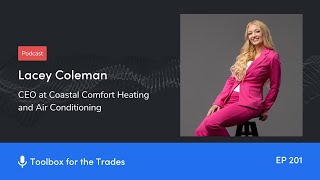
This is a Toolbox for the Trades podcast episode (Ep. 201) in which host Jackie Aubel interviews Lacy (Lacey) Coleman, president of Coastal Comfort in Salisbury, Maryland. Coleman describes joining her father’s HVAC business (founded in 2005) after personal and family upheaval, taking ownership, and scaling annual revenue from under $2 million to about $10 million; the company recently recorded its first million-dollar month. The conversation covers confronting gender bias in a male-dominated trades market (she notes women ownership is under 2%), operational changes that enabled growth (hiring management, training apprentices, staging installations), and the challenges of scaling while raising two daughters as a single mother. Themes: resilience, leadership, strategy, and community-oriented growth on the Eastern Shore (Delmarva).
Hello, contractors, and welcome to Toolbox for the Trades. My name is Jackie Aubel and today I am chatting with Lacey Coleman, the president of Coastal Comfort in Salisbury, Maryland. Lacy and I spoke about how since taking ownership of the business from her father, she scaled the business from 2 to 10 million, all while maintaining the attitude that failure is not an option. I hope you enjoy this conversation as much as I did. Lacey Coleman, you are the president of Coastal Comfort in Salisbury, Maryland. Today you and I are going to be talking about how you grew your family business from 2 to 10 million while being a female trailblazer in the industry. Welcome to Toolbox for the Trades.
Thank you so much, Jackie. I am so happy to be here talking with you today.
I am so excited to talk with you to give everyone a little peek behind the curtain. Sometimes whenever I get ready to do these podcasts, I always, you know, chat with our guests a little bit beforehand. And Lacy and I just have so much in common that, that we could probably sit here talking for hours on hours on hours about stuff, not trade related, but we're going to try and keep it focused to the industry. But before we even get into that, I'm going to kick this off with an icebreaker. And Lacy, you should know this is a question I used to ask on the show all the time. However, I slowly, like, I slowly weaned it out and I think I'm going to bring it back because people always cite how much they loved it. So for our icebreaker today, I would love to know what song, if any, would be the soundtrack to your life.
All right, this is actually a really hard question. I think Otis Redding change is going to come because if there's one thing that's inevitable is change and just kind of looking back at, you know, backwards and forwards of my life, always in the pursuit of excellence means you're always evolving and changing. So I think that kind of sums it up a little bit.
Yeah, that is such a wonderful and touching song. I always joke that my response to this is the Benny Hill theme song. You know, like the horns, like, like. Because I think that is kind of like, I feel like life's been really chaotic recently. But that was such a thoughtful and beautiful answer that really speaks to all the things you've done in your career so far. So I think it honestly sets the stage perfectly. So let's get right into it. Lacy, how did you get into the trades?
Once upon a time, I was, I was in college for business. My father originally started the company in 2005. He started with a business partner. Initially, I knew nothing about heating and air conditioning, home services. I knew that's what my dad did. But short of him going to work and coming home, that was really the extent of it. I really had plans on. I really wanted to be in business, but I was really thinking more of like a retail store, corporate track. So I was in college for business administration and I was working at the time as a firm pharmacy. Certified pharmacy technician. I got pregnant when I was 19. So I was working full time, going to school full time, and eventually I had a baby. When all of this is, is going on, unfortunately, the partnership that my dad had created, I think he was two years, about two years into the business. But the partnership ultimately dissolved. My father retained the shares, 100% shares of the company. The company was in a really terrible spot, truthfully. Could have gone out of business, maybe should have. A lot of money was owed to distributors. So the company was in a really bad spot. On the flip side, I am working at a pharmacy. We ended up being robbed at gunpoint when I was about five weeks pregnant. And that was a really terrible, scary experience. So that really made me nervous. The DEA was cracking down on Schedule 2 narcotics, which was really affecting, unfortunately leave everybody, mostly those that were taking advantage of getting those prescriptions fraudulently. So at the time, there was a rash of pharmacy robberies every couple of weeks that the pharmacies in my area were being robbed at gunpoint. And honestly, having someone point a gun, you know, directly at you, especially when you're pregnant, you're just a couple feet away from that. It's a life changing experience. So I wanted to no longer work in that environment. I wanted to be somewhere safe. At the same time, my dad was going through such big changes. And he's an H Vac guy. He'd been in the field his whole life. He wasn't really great at office or, you know, the business side of things. And I was really young, not that I knew necessarily what I was doing either. So at the time it made sense, I think, for, for me to come in, really just help him. At the time I. I ended up having my daughter and then I was able to bring her along with me to the office for a while. So that's kind of the very beginnings of, you know, how the different pieces kind of played a part of landing me where I am. It definitely wasn't the plan or the dream, but that's where we are.
I know so many different factors that contributed. Your dad's business partner, partner Leaving the business, you having that horrendous experience, you getting pregnant, all of these things changing really kind of put you in this position to join your dad. And you were one of four, correct. So that you were the only child of his that was like, all right, I guess I'll help you with the business, right?
Yeah, definitely. I have a sister that's, you know, registered nurse. I have another sister that's a teacher. So they were. They're all older than I am, my siblings. I'm the youngest, and just really, the pieces just kind of fell into place. It wasn't the plan to have any of us involved in the business. It just made sense at that time. While all of this is going on at the same time. I had my daughter really young as, you know, as a teen mom. So I also was experiencing postpartum depression pretty terribly for the first couple years. So I think it was a benefit to be able to work, you know, with the family business while I was trying to navigate those feelings and trying to figure life out honestly, you know, so young. And my life at the time felt like it had been derailed from, you know, what I pictured. So I was really struggling with all those things. Teen mom, teen pregnancy, you know, not finishing school like I wanted to, not being where I wanted to be in life. But it ended up working out clearly pretty well.
It certainly did. And I actually want to talk a little bit more because you were a very young woman in the industry, and one of the things you and I first spoke about when we met is that you encountered a lot of biases, actually, early on in your career. So could you tell me a little bit about that and how. How that affected you?
There's not a lot of women in. In the trades, in HVAC or across the board. I think women ownership is less than 2% or something like that in the. In the construction envelope across the board. So initially, especially if, you know, the area that I'm from, it is more rural and we are 10 years or so behind bigger cities with things that, you know, I joked up until, you know, five years or so ago, phone books were still relevant, which seems crazy because I think they've been gone in other markets for you 15, 20 years. But it's just a different market where things are a little slower to come here when that, you know, socially, you know, things changing is no exception. So initially it was really, really difficult. I had customers say, one like, women in chargeants, what's wrong with the world? Or you're not just a pre face you actually know what you're talking about, or if I would try to explain, you know, certain things to customers, they just were sometimes hostile and wouldn't believe what I was saying. I could have one of my male counterparts or colleagues call and say, basically verbatim what I would say, and they would listen to if, you know, the same message came from a man or someone said, hey, I'm gonna talk to the owner or, you know, a manager. And I would come on the line, like, yeah, I was waiting for, you know, the man to. To come to the zone. So there was a lot of just things being said, just being treated as if I didn't know. You know, I was young, too, but I never have pretended to know everything there is to know about this industry. We're always evolving and changing. You know, it's kind of a theme here today, so, always evolving and changing. But I was very dedicated to learning and listening to, you know, my guys in the field. And that's how I've learned as much as I have is, you know, I have technicians, salespeople, installers that are out every day. I've been in the industry, and I was able to learn a lot. Just even reading invoices to determine, you know, if we went out on a specific work order and the information said these were the symptoms. And then I look at the diagnostic just, you know, like a doctor would, and I could really start making the correlation of, you know, different things and how the systems worked. And I was able to learn a lot of information that way. So I would say for the first, gosh, eight to ten years or so, it was really an uphill battle I've had. Since then, I think I've had to work three times as hard to prove myself. But since then, I've had. It's been a more pleasant experience. Not that it doesn't exist, because it still does, but it's definitely. I've had to work to earn the respect of my colleagues, other business owners. A year or so ago, I had another business owner message me on social media and just said, I was one of those people when you used to come into the home shows that we were working. They would have a booth, and we would have a booth, and they would just be like, oh, look at her walking in here. You know, just. They would be talking poorly about me. And then, you know, he said, I'm eating my words, essentially. And I now have owners, you know, male owners of other businesses that call me for support and help. And I love it. It's, you Know, I, I think collaboration happens at the top, competition happens at the bottom. So, you know, the more that we work together, we can, you know, help, help one another. Now I actually have customers reaching out because it is, you know, owned by a woman and ran by a woman. They say, and this is how, you know, you carry yourself or, you know, I love that it's a woman owned business. And so now I'm getting the opposite. I had people that wouldn't use the company before because they didn't want to, you know, listen to a woman or a woman in charge is what's wrong with the world. Now I have, you know, way more support from the community and other distributors. I mean, I mean, banks, distributors, you name it. I had nobody, nobody on my, on my team, on my side. So I have worked endlessly and tirelessly. It was a little exhausting, but, yeah, I think that it's paid off. And, you know, there's always more work to do. I don't, you know, think that I know everything there is to know. There's always more to learn.
Yeah, what a, what a wonderful. Not wonderful, but like, what a way to kind of talk about the biases that you were up against early on. Again, dealing with postpartum depression, raising a newborn, having to learn this business and getting so much negativity thrown your way, but still persisting regardless. What do you think it was that kept you persisting in spite of all of that? Because a lot of people, like I was hearing like, you know, women running businesses, what's wrong with the world? Like, if I heard that, I might have, you know, been like, okay, whatever, you don't want me, fine, I'm leaving. So, like, what was it that kept you going?
Well, that particular customer, I fired him as a customer.
So, yeah, that'll do it. That was, yeah, okay, that's nice.
I said, I don't need your business. And he ended up calling back, I think the next day and apologizing. And I said, no, thank you. I just, I don't, I don't need that kind of energy directed. I mean, it's hard enough in this industry without all the additional biases and everything. You know, there's a lot of other out, you know, things that we're dealing with every single day. I don't need that. Additionally, I've always just taken all of the negative things and, you know, there's other things that, you know, we won't touch on. But there's things that have happened in my lifetime, you know, as an adult that I Just constantly channel them back into myself and into my work. I joke that the company is my husband because it's just. I have really just kept diving into personal development and then professional development. And I also, I really enjoy the people part, especially with my employees and building something that's bigger than myself for, for them and for, you know, just for my daughters to look up to. It's bigger than me. Right? I, you know, I channel it into myself and I, you know, I put everything negative that happened to me, and it's almost like I have something to prove and might be a little ego in there, and that's okay, but, you know, if I felt like someone didn't believe in me, I just work twice as hard to make sure that I, I know that I can do it and I believe in myself and I just keep channeling that energy back into my work. I put it in, you know, my employees. I know that I have the distinct position as a business owner, as a manager, as a CEO, as a, you know, I'm a coach to them as well. And I get joy and seeing people that have worked for me for five years, 10 years, that have started out as a helper and now, you know, they're in, in sales or they started out part time helping me file in the office, and now, you know, they're an office manager for me. And they've, you know, been able to do those things because of the investment in them. So I really, I just pour into people, myself included, and just keep revisiting and you get the results from that. And then every each year, you know, we grow and we grow and you, and you get to see the results of that firsthand. Things don't change overnight, but you can look at the long term. I can say we're a completely different company than we were three or four years ago and. But definitely different than we were eight years ago and who we were 15 years ago. You wouldn't even recognize us.
Amazing. That's a beautiful answer. So you already kind of hinted at this in your answer. You are a woman. Don't. Business. So dad is no longer in the picture. When we first spoke, you talked about you taking ownership as kind of a gentle takeover. I'd love to know what inspired you to take on full ownership of the business and how did that play out?
I think gentle, because that's a nice way to put it. I didn't. It was, I mean, hostilely take over, but I definitely pushed, pushed a little bit.
Very awkward to do a hostile takeover with your own Father. So, yeah, that would be. That would be. This would be a whole other podcast if you did that. But, yeah. I'm sorry to interrupt. Keep going.
No, you're good. So, honestly, being a little bit naive, maybe being young was probably a really good thing because I just, you know, even though there was those challenges and, you know, that we discussed, I just really went. I'm very headstrong, super independent, a little stubborn. So I wanted to be more. I wanted to be bigger. I have really big goals for myself and, you know, in life and, you know, things I want to be able to do with my children, for my parents, you know, going back a little bit, kind of a sidestep, you know, my parents raising four kids on what they had in terms of. In life. You know, neither one of them have a college education. My dad dropped out of school relatively early in life, and he was able to learn a trade and start, you know, start the business, which is phenomenal. But he never wanted it to be big. He never wanted to be more than what he could handle. And I did. I really wanted to scale the company. I wanted to do more. I really focused on branding. I wanted to create something that continued to grow, to continue to get bigger, so that way it could support my parents and a good life and same thing for myself and also creating opportunities, as I mentioned before, for my employees. Along the way, we had a lot of tough conversations. He really wanted to be small. He was very nervous that the bigger that it got, that it was easier to. The bigger you are, the more work you need, the more employees you have, the more mouths you have to feed, the more responsibility that you have. I'd say failure is not an option. I just didn't accept that I would ever fail. So we had some tough conversations, you know, starting more than a decade ago, and I just said, you're. You're in my way, and, you know, I'm proving myself over and over and over again, and you're in my way, and I want to be able to push and do more. And you either need to be all in or step aside and let me do the things that I want to do, knowing that I've taken on the responsibility of making sure that my parents were taken care of. So I have that little bit of pressure as well, which is. It's, you know, it's fine. It's. It's turned out great. So when I took over, we were doing under 2 million a year, you know, as we talked about. So we. It's, you know, it's Been a great journey up until this point. I know I have a lot of work to. To do, but I'm so grateful that my dad instilled great work ethic in me. But then also the core values of the business that he started with, with a good name, you know, I still make sure that I keep that as part of our foundation as we continue to grow. But also, I want him to be proud and know that I can take this, even as a woman, as someone that's never been in the field, that I can take it to, you know, bigger, greater and new heights.
Amazing. Wow. So you basically told your dad, get out of my way. And he was like, okay.
Yeah, it was a couple conversations. It was a few. Because he was nervous, you know, he didn't want to let go. And he was once you work for someone else in the industry for, you know, a long time. And then when he left and started this business, he just never wanted to have to go back and work for someone else if it didn't work. So he was very worried about the failure part. And I just look at it as, failure's not an option, and that will never happen, and I will make sure that it doesn't happen. So we just have. We just think differently and that's okay. Honestly, we just. We do. We just had different thought processes and how things should go. He felt if things stayed small and more, you know, tightly in control, possibility of failure was significantly less than, you know, what I'm doing. So it's kind of fun. Sometimes I'll call him and be like, hey, like, guess what we did, you know, in sales this month? Or, you know, guess what our gross revenue, you know, is compared to, like, last year and different things and kind of a guessing game because he truly doesn't have any part to do with the business. And it's. It's fun to see because, you know, what we used to do in a year when I first joined the business, or we got to that point after a couple years of me being with the business, you know, we can do in a month now. So it's. It's really cool to see the growth. And now, you know, my parents are super proud, and they, of course, trust me now. I think that they are a lot more comfortable with the idea now.
Of course they're proud of you. I'm proud of you, and I don't even know you that well. I mean, this is a really phenomenal story, Lacy. And I mean, speaking to your success, right, you guys are up to 10 million now. And you actually just recently did your first million dollar month. Congratulations.
Thank you.
So, kind of stepping into the more strategic side of things. Like tell me a little bit about what programs or strategies or processes you implemented to kind of make this happen or is there any one of those things in particular that you attribute a ton of that success to?
We have performance programs for my technicians that helps. We built a culture that people want to work for us and long term. So I don't have an excessively high turnover. We have a great training program with apprentices. As you know, most people, there's always a shortage. So in order to meet the demand, you need, need more people. So we started working with the local votech schools, high schools, years ago and hiring directly from the program. So we have great relationships with them and we kind of bring those in just to kind of even meet the demand. But honestly, a big part of it, and I know there's probably some small to medium sized companies that are probably facing this now, is hiring management. So it was just kind of like me and everyone else and I was getting in my own way and I, I just can't be part of everything. I was really restricting my own growth because it's a big step. You have a big salary, you have, you know, more overhead, all these different things that contribute to it. So once I put those particular people in place and it really allowed us one, we had much better quality, we had more accountability, but we also were able to be more efficient. We changed the processes. I have a separate building now for my installation team where the equipment comes in and gets delivered in advance and we're staging our job so our installers are picking up there as opposed to going to the distributors, which you know, would waste an hour, hour and a half or more every single day. So we've done a lot of different things to change the efficiency and how efficient we were and how much time our guys spent on the job. But really management helped tremendously. I know there's a lot of people that are on the fence like should I do this or should I not? Absolutely go for it. And I'm currently right now restructuring again because I've reached that point. In order for me to be able to get over, you know, the, the 10 million and move forward, I need more of a GM and hiring. So I have a gentleman that started with me as a service technician from another company 10 years ago this year. Then he went to a service manager role. Then he was over my service and installation department. He's moving into a GM and now I'm hiring additional managers. So that way, getting really. The structuring for growth is extremely, extremely, extremely important. It took me a little bit to figure that out or to be able to figure out a way to. To pay for it. So once we did that, I mean, the growth, we went from, you know, 3.3 million at the end of 2020 to know where we are now. So that definitely helped as well.
Yeah, yeah. Did you model after any type of, like, program? Did you, like, what did you research? Like, did you, you know, like, did you access any best practices groups? Did you just interview a bunch of people? I love what you said, by the way, but you've had a bunch of really great sound bits. But you said something ago that was like, collaborations at the top, competitions at the bottom. Did you ask some of your competitors how they do it? Like, how did you figure out how to structure the business this way?
Honestly, Jackie, and this is something that I found out about myself when I went to the Pantheon, I have just been doing it 100% on my own. I have not. I've. And I've probably made it harder for myself because I haven't, like, I'm not following, you know, like, the Tommy Mellows and all these people. And, um, I met another gentleman there, that intro, you know, Gilbert, he introduced us and he is, you know, oh, I read this person's book and you introduce to this person and all of these people, and he really takes in all of that information and he goes back and immediately puts it into his business. I haven't been following anybody in the industry. I'm just here in my own bubble. I'm just.
Well, that's impressive. You realize how impressive that is? If you've just been, like, doing your own thing and you haven't been following, like, any best practices or anything like that, like, this is really impressive still, Lacy.
Just trying to figure out, Lisa, what's up here. So. I know, but I know that I definitely. I think that's the advantage of going to Pantheon. And I go to work carrier dealers, so I go to their annual dealer meeting every year. We saw Mitsubishi Douglas as well, and I go to their Summit as well. But the Pantheon was honestly just a very different type of experience, different energy than those. Not that you do. Do you do networking at those events, but it's different than at Pantheon. I will. And that's, I think, a great experience. It was my first time going, but here I am a big company. I am one of the largest companies. I'm the Largest, I think, carrier dealer on, you know, our. In our area, the Eastern Shore. And I have people coming to me asking questions and how I'm doing things and modeling, you know, the way that I'm doing things. And it's interesting because I was telling someone earlier, it's easy to get complacent here in my position where I am, because I'm already doing so well. Not. But I know that there's always work to do and there's always things to change. And when I said earlier, the pursuit of excellence means you're constantly evolving. So going there and seeing these massive, you know, big, huge companies that are doing incredible things, that are super, super advanced, are using a lot more different types of softwares and tools that I'm not using yet, it's really good. And to get that experience and talk to those people and see how they are. So now I know in order to get over to hump right now, the 10 million mark, where I am now, to be able to push forward to be a 20, 40, 60 million dollars a year, I will need to be doing that. So send me your book recommendations.
Oh, my goodness.
I have a lot to. And I have read leadership, different leadership books like Atomic Habits and things like that, but it's just very different from, you know, H Vac and the processes every day. So I am thankful that I've been able to figure out what I can on my own, but it's probably taking me a little bit longer than it should have. So I definitely would say there's a lot of resources out there and people to turn and talk to, and I'm really grateful for some of the connections that I was able to make and the people that I was able to meet at Pantheon.
Yeah, a little bit longer, you were figuring out life while you were also figuring out the business. So we're going to give you some grace there, because you're not even 40 yet. Lacy, you and I are like in the same generation, which is just incredible in that I can't imagine running a $10 million business. And you're doing it, which is fantastic. So you've managed to do all of this while being a single mom of two, and I would love it because I know this is really important to you. So tell me a bit about that experience and how it shapes the person that you are today.
Having my children, it gives you a different purpose in life. And where we, we live, as I mentioned, it's a more rural area, smaller area. They go to the same high school that I went to. And some of the teachers are the same people. And some of the teachers are also people that I went to high school with, which is cool. There's a very community feeling there. The Eastern Shore from, you know, where I am, that's what we call it. So it's Delaware, Maryland, part of Maryland, and a smidge of Virginia. So we call it the Delmarva or the Eastern Shore. So having my children, it's been hard. Finding a balance is. What is that when you're trying to scale a company to the fights that I want to be able to scale to, but also be there fully present for my children. I'm at every equestrian horseback riding show, I'm at every gymnastics meet, trying to get them from point A to point B, driving back and forth and I, you know, literally killing myself trying to make all of those things happen. I would say I've definitely been in survival mode. It's gotten a little bit easier. My oldest daughter, she was able to get her driver's license this year, so thank goodness for that. So it gave me a little bit of a reprieve to just be able to have her drive herself to work and to different things. And I got to the point where I just was every day, I mean, taking it in small, small bits and just, you know, if I think about the big picture of all the things that have to be done, it can get very overwhelming. But just focusing on the immediate things right in front of you. So it gives me a different drive to be able to show them one, they are way stronger, way more independent, way more confident in who they are. I think because of my experiences in life and how I've channeled that into, you know, back into myself. You have decisions, right? So whether you think you can or you can't is completely up to you. Our circumstances is how we respond to them. And that's, you know, what I tell my daughter, it doesn't matter what someone did to you or what they said to you, how you respond is more important. So responding to all the different adversity and different things that have come up, I think has in turn shown them how to be a strong, independent woman. I'm just, I have drive. My parents have exampled a strong worth at work ethic since the beginning of time, especially taking care of the, you know, four kids. My mom worked two jobs, my dad worked in the industry, but also did a lot of side jobs as well. So I saw them work a lot and I just wanted to create different experience for my kids, but also give them an experience off the Eastern Shore. Last summer we went to Europe and we were able to go to a couple different countries and this year we went to Hawaii. Just different cultural experiences, just different experiences off the Eastern Shore so they can be more open minded to understand that there are lots of different types of people. There's a lot of opportunity here and outside of here and if you want to leave and come back, that's great. But I always say I want them to. Whatever happens to them is to channel it back into yourself and turn it into something positive. There's a learning experience in everything that we do and it's up to you how you move forward. And being a mom, it was hard. It's been hard. It still is hard. It's not perfect. I have used the opportunity to just try to set an example for my kids, to be strong. Even now, it took me a long time, I think to kind of figure things out. I felt like to get my feet under me because of all these different things that were happening in my life. But I'm forever grateful for those experiences and being able to show them has really helped. Pushing forward.
That's awesome. You've got such a great mindset. Can I just compliment you on that? Like, failure is not an option. Collaborations at the top, competitions at the bottom, being able to. It's not how you, how people. What people do to you, it's how you respond to them. Like you've got some really great knowledge and wisdom in there that I don't.
Drama, Jackie.
It's all the trauma.
It's just I've been, I have been in a relationship that fully broke me down as, as a person just so I felt like I was nothing and to have to completely rebuild myself from the bottom up multiple times and you know, postpartum depression is certainly a of time that you would have to build your. And going through a divorce at the same exact time as postpartum depression, all these things and then years later getting into a relationship that where I felt like I was in a healthy place and then by the end of it, three years later, I was nothing. You know, just someone constantly tearing you down. Just you know, like a. Yeah, a nail file, just slowly, you know, working.
Bit by bit, breaking you down.
So I've had to rebuild myself multiple times throughout my adult life and it's not been fun. It hasn't been easy. But I know that because of those experience I have the mindset that I do. I again, going back to choices, I could have chose to handle things a lot of different ways, but I've always just poured back into myself and just to use that as a determination to rise and move forward, rise onward and upward. I literally told someone that this morning. It's always onward and upward.
You know, sometimes when people have that type of attitude, it can come off a little disingenuous because it can almost be like toxic positivity. But I want you to know that when you talk, I can genuinely hear the authenticity in your voice and the fact that, like, you earned this mindset. And I just want to thank you for being so vulnerable on this episode and sharing some of the things you've had to overcome to build this up. Because the fact that you've raised. You're raising two children, you've got a multimillion dollar business, you're doing this all in the trades. It's a fantastic story, and I'm so priv. I'm so honored that you chose to share it with me and my audience. So thank you. One of the things I love to say to folks when they're like, why would I come on the podcast? What would I want to even say? I like to say, this is your chance to take a megaphone to the industry. We have, you know, many people listening to this show in the service titan community. And outside of it. What would you like to say to the trades at large?
Well, I think I kind of already touched on a little bit. And it's definitely whether you think you can or you can't is what's going to happen to you. You really have to channel that energy into, you know, figuring out a way to move forward. If you think that you can or you think it's something is impossible than it probably is. And it's funny that you mentioned toxic positivity, because I joke sometimes because I do just try to find a way to, like, make it happen like I do. There's a way to make it happen. And I try to run a very good company. We have a great reputation, a great brand. A lot of, you know, our work comes from referrals because we treat people with, you know, respect and kindness. And we, we don't try to get over on people, but to be able to just figure out a way to move forward. But it all is in. In your mindset. And I, you know, have met other companies at different things, and one of the questions is, you know, like, how much you do in a year. It's just something that comes up and if someone says, oh, I'm only at 3 million or whatever, the Case is, and I'm like, it doesn't matter. You can. You can be 100 million. It just. You have to choose to want to be there and be and be dedicated. But ultimately, whether you think you can or you can, it's. It's entirely up to you. And if you want to get there, you absolutely can. There's. If I can do it. With all of the things that have been going on in. In my life, I know, you know, everybody is dealing with something, some kind of external, whether it's kids or, you know, sick parents or there's, you know, so many different out outside things that go on. And we can choose to let that push us forward or hold us back. And for me, that is something that has been a game changer, life changing, not only my personal life, but in my professional life, too. So if you want to, you can. You just have to believe in it. And I told my daughter the same thing because she has really terrible anxiety and she want. She's does competitive gymnastics, and she actually fractured her L5 a couple years ago. And so she was out for a while. Coming back, she was really, really nervous that she couldn't do the same skills. And she was doing them a few months ago, and then she stopped doing that. And she's just like, I don't know what's going on. I said, do you believe in yourself? And she was crying and she said, no. I said, that's it. That's the problem. You just don't believe in yourself. I believe in you. Your coach believes in you. I said, but I can't fix it. And neither can, you know, your coach. You have to believe in yourself. And when you go back to practice or whatever the case is, you know, you're flipping your vault. You have to visualize yourself doing it, and then you have to have a belief that you can. You can do it. You already know that you have the skills. Now you just have to put it together. It's always up here, and it's in here. It's your head and your heart. So if you have the head and the heart and you already have the skills, then what else do you need? And so guess what? She started doing it again.
Well, I genuinely can't think of a better way to end this interview. Lacy, thank you so much for donating some of your time to share your story. I am motivated by this interview. I am, and I'm, like, charged up. And I'm sure the folks listening are feeling the same way. So thank you so much for coming on toolbox of the trades. I can't wait to see where Coastal Comfort's going to be in the next few years.
Thank you. Well, I hope to see you next year at Pantheon, because now I'm a believer and I would love to go again. So when we're there, we're going to have to catch up and Share story.
More from Bill



ServiceTitan Virtual Agents: Simplify Before You Scale | Podcast Ep. 110 | Mastering ServiceTitan



Life After Live Events: How to Turn Post-Conference Energy into Real Profits | Podcast Ep. 297




