
Demystifying Bitcoin (Special Collaboration with the Money Loves Women Show)
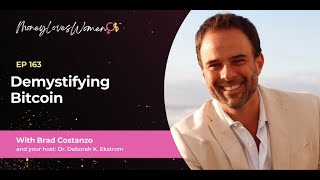
This content was created by Brad Costanzo. This content was uploaded by Brad Costanzo. This is a YouTube interview episode titled "Demystifying Bitcoin (Special Collaboration with the Money Loves Women Show)" (recorded June 24, 2023) featuring host Dr. Deborah Ekstrom and guest Brad Costanzo. The conversation covers Brad's personal finance and investing background (including early losses and later gains), his transition into studying alternative assets, and an extended, accessible explanation of bitcoin, cryptocurrency, blockchain, and comparisons with gold and fiat money—framed for an audience of women seeking financial education.
Chapters
This is Dr. Deborah Ekstrom for the Money Loves Women podcast today. I'd like to introduce Brad Constanzo, and he is very simply a investor and a consultant. And I just found out that he is a recovering financial advisor.
Yes, ma'. Am.
Anyway, welcome, Brad.
Thanks.
We're going to talk about some really interesting things today. But before we get into things like crypto and bitcoin and gold and investing and all the kinds of things that you do and the fun you have, tell us a little bit about your growing up years, where you came from in our, I assume, in our country, and what influenced you and what led you down this path.
It's a great question. And you know, Dr. Deb, I'm honored to be on a show about Money Loves Women. I have a lot in common. Like, I love women, too. I got a wonderful wife and mother and people that I celebrate. And I actually think it's a fantastic thing. What you're doing is helping to bring, you know, some really great financial and investment education to women because I think it's an area that is. They've been sorely neglected by mainstream society for a long time. So I applaud you for bringing a lot of these topics, you know, to the wonderful women out there who are, you know, really, women drive the economy. They can. They. They control most of the spending, which keeps the wheels running. And it's a shame when they don't really understand how to, you know, make their money work for them. So thank you for doing what you do. My background. So I grew up. I grew up in just outside of St. Louis, Missouri. My dad had been a recovery and financial advisor. He worked with. What was the name of the company he worked with? I can't remember right now. But growing up, I had a really good relationship with my dad. But it was funny because one of the ways I bonded with him, it wasn't over sports. It wasn't over other stuff. It was over stock market. And he loved to invest in things. He would sit down and show me from an early age, what are stocks? What is this? What is that? And that was kind of. It was interesting. Like, I was. I thought it was interesting, but I was also. It was a way to bond with dad. And I remember because I would read and I would do some stuff that in my eighth grade, in eighth grade, everybody had to do a research paper on something. And like, some people did rockets or lasers or something else. And. And my topic was Compound Interest. And I remember the opening phrase. I was like, you know, I remember standing there in my eighth grade class saying, you know, the. Who was it Albert Einstein once had? The greatest power in the universe is not that of the atom or et cetera. It's the power of compound interest. And then I went on, and it was funny for all of the Gen X boomer and anybody else beyond who used to watch the show Family Ties. Growing up with Alex P. Keaton, who was like the kind of the nerdy financial kid. I don't know if I was nerdy, but I loved finance and investments from an early age. And whether that was just because I thought it was cool or it was a way to bond with dad, it at least allowed me to create, like, to start to learn about it early. And then I went to school for finance and economics and I had dreams of working on Wall street and just the glamour of investment banking and all that other stuff, which that was when I was a kid. And as I got older and I got through college, I realized, yeah, I don't know, I'm kind of burned out on a lot of this stuff. I'm going to go. I'm going to go do something else. I'm going to prevent a midlife crisis because I've been too adult for too long. I went and got a job at Disney and I started screwing around for a little while, took a couple of years break. And then I got into. I became a financial advisor. I went back to those roots and I became a financial advisor at Prudential Securities. I was age 25, so this is in the mid-90s, and I was picking up the phone and smiling and dialing and cold calling people and trying to get them to invest their money with my very inexperienced self. And this was during the late 90s. The stock market was on this tear. Like, you didn't actually need a financial advisor to make money. You threw a dart at the board, you hit a tech stock or a dot com, and you made a bunch of money. Well, then the 2000 came along and I had, you know, I had amassed about $100,000 in savings and it was all in the stock market. And I had discovered at the age of 26 margin, they're like, oh, this is great, and everything's going up. You can just borrow money and, you know, double it every other day. And then when Mary Meeker came out in 2000 and said that, yeah, it looks like we're about to start, you know, a major fall, and everything fell to crap within about two and a half, three months, I was broke. I went from having it all to having nothing. And that was from gambling in the stock market. Right. So I learned a couple of hard lessons there. And then throughout the next five or so years, I still was at Prudential Securities. I was working in another role, working with financial advisors, helping to just help work with them on their portfolios. And not their portfolios, but their client portfolios. And I would, you know, just really try to help them increase their business. But I wasn't dealing with clients as much. And in that time, to be really frank, I from. With my own investments, I was deer in the headlights and I was scared because I just got burned by the stock market. And something I loved burned me really bad. Made a bunch of money in real estate investing. And then I was like, oh, this is great. Now that gambler Gene kind of came back and I had a. A close friend that worked for an oil and gas company and talked about these natural gas wells that they were drilling in Texas. And I put $25,000 in one of those. The numbers all made sense. Like, I actually, I come to things not as a gambler, but I look at things pretty astutely, do a lot of due diligence on them and put the money in there. What I didn't realize was that natural gas and oil wells, etcetera, These are general partnerships and they have cash calls, so if something goes wrong, they can ask for more money from the investors. And if you don't give them money, you can lose your entire. You can use your entire investment. So my $25,000 investment became $100,000 investment before it went bankrupt. And so I lost pretty much everything I had twice in my life. That was fun. Now, it was a while. This was, by the way. Yeah, that was maybe the early 2000s. The stock market great financial crisis came along and I made one really brilliant bet, which was in June, in 2007. I just didn't like the way everything smelled. And I went completely to cash. I had six figures at this time. I went completely to cash and I sat out and I missed this massive drop in the great. In 2007. 8, et cetera, and 9. Problem was I didn't get back in right. And I missed one of the greatest bull markets. I got back in a little bit and I missed one of the greatest bull markets. So stimulated by quantitative easing that we've ever seen, and I sat on my hands. I did invest in some other stuff. I invested in my own business, which paid many, many dividends. But that's really kind of how I. That's kind of, you know, my financial investment backstory up until the past few years where I started to really want to understand money, the roots of money, how it all works. The system that we're in, discovered know, crypto, bitcoin, the two are not the same and a lot of different alternative investments. So even though I've been burned quite a few times, I've never let it, you know, stop me. You can slow me down, but you can't stop me. And some things have worked out pretty well, some things have not. But I continue to be a student of the game and continue to try to make my money work for me. So hopefully that a little more than a nutshell.
Yeah, that's great. What was your mom doing? Your dad was doing financial investing? My dad stock market.
My dad did. Yeah, my dad did financial. He was a financial advisor and then I. But when I was born, he was already. Now he was like the head of labor relations at a steel mill. So he was no longer in the final because he got out of being a stockbroker like in the energy crisis in the early 70s, like 72 or 3 or something of that nature. And my mom was an account executive at a television. They sold television advertising. So she was kind of brokering TV ads, but she was an executive back in that time. So my mom always made really good money. You know, probably, you know, throughout the 80s and maybe the 90s, whenever she was working, you know, she was making about a hundred thousand dollars a year, which is, which was amazing for a woman at that time who had not graduated from college. She was, you know, she was kicking butt. But she also didn't know anything. She still doesn't know much about investing. Right. That was always dad's, that was always Dad's world. Dad and Brad would do the investment. Mom knew how to make the money and spend the money, but she never really tried to pay attention to investing the money per se because she had people to take care of her on that and still does. But that's, that was kind of what her role was.
That's lucky that she still does because that doesn't always happen. I, I heard a very interesting statistic recently that 98% of women at some point in their life become primarily responsible for their own financial well being. And I thought that was, that was a, a frightening and fascinating statistic because.
It makes perfect sense.
Yeah, it makes perfect when you think.
About it like the divorce rate. Yeah. Well, if you look at like, you know, whatever it is, 50 divorce rate, and then the fact that, that women typically live longer than their husbands. Yeah, it makes sense that they're either gonna, they're either gonna leave them or outlive them. And at some point it falls on them to really understand their finances.
Yes. So it's, it's a gamble to not understand your finances.
Yes.
Well, you know, it's, it's, it's interesting. You learn some really great lessons by making some mistakes. You were young, so you could recover pretty easily. But it doesn't matter when it happens. You have to get back in the game. Right. And then you discovered cryptocurrency, you discovered bitcoin. Tell us about your forays. It will, first of all, take, tell us what bitcoin is, tell us what cryptocurrency is, tell us what blockchain is, and then how they all relate to each other. Because we hear about this all the time. Some people are very scared of what's going on because of the newspapers and cryptocurrency. So kind of give us the rundown.
Absolutely. So a lot of people are familiar at some degree. They've heard of bitcoin, They've heard of crypto especially because it's been all over the news. Like, you know, it's the bubbles and the busts and, you know, fortunes are made and fortunes are lost. And it looks like a gigantic casino. And to a large degree, they are right. However, I stumble first. Well, first of all, let me explain a little bit about what it is. I'll preface it. But then I'll tell you how I discovered that and we'll circle back and go a little deeper. And I want to talk about the things that I think are the most important things that I've learned over the past several years. So bitcoin, what is a, is a, is a digital. You can think of it as a digital currency. A lot of people call it that. That's actually not quite what it is. Bitcoin. There's never been an asset like bitcoin in history. It is a duck billed platypus, meaning it's like a combination of all these different. Like a duck billed platypus looks like a duck, it looks like a otter, it looks like a, you know, something else. It's like all of these different pieces of something else put together and it's its own unique animal. But bitcoin is very similar. You know, it's a piece of cryptocurrency. It's a distributed ledger. Meaning it's like I always run the risk of trying to go really Basic on this because I try to start at different areas, and I don't. I don't want to confuse people. So I'm going to. Let me. Let me circle back and say, this is how I discovered it. You can make a lot of money with this, Brad. You should put your money in. I'm like, what is it? They're like, it's bitcoin. It's Ethereum. It's this, that and the other. Just put some money in and. And then pay and then start to pay attention to it. I was like, yeah, but what is it? They're like. It's like digital coins. It's like, okay, well, I'm not gonna pay attention to it if I don't have a little bit of money into it. So I'm gonna dabble. I went. They said, go to coinbase.com and buy some bitcoin. I still didn't even know what I was buying at the time. I'm like, all right, I'm buying digital. Some digital asset, whatever that means. And I put five. This is back in 2017, early 2017, I bought, like, $5,000. I took $2,500. I put it in bitcoin, which I'd been hearing about for, you know, five, six, seven years through other friends talking about it. And then I put another $2,500 in Ethereum. And then I was like, all right, now that I got a little money into it, maybe I'll start figuring out, well, what is this? What did I just buy at the time? For me, 5,000 was enough. Like, it was small enough I could kind of gamble and just see what was up. So. And I remember back in, like, 2012, 11 and 12, some friends of mine saying, man, bitcoin is the future. You got to get in on this. It's the. It's the future of money. So you don't know what. This thing is so volatile, it's crazy. Money has to have a store of value. It's got to be stable. It's got to have, you know, have things priced in it, et cetera. Like, you guys don't know what you're talking about. That's just silly. And I dismissed it wholeheartedly because I obviously was an expert in investing in money. I understood more than they did. This was child's play. Well, I put that $5,000 in. And it just so happened that that year, 2017, was. Was a year of a massive run where when I bought bitcoin, I think it was like $3,000, and it went up to $20,000 that year. I was like, wow. I just 7X'd my money in a year, and I still barely knew what I bought. Keep this in mind. I still, I got in, I wrote it up. I didn't know when to sell it, and I wrote it all the way back down. And then I ignored it, like, so I had like $5,000 in Bitcoin, and ethereum became something like, I don't know, 25 or $30,000 within the year. And I wrote it back down, and I still couldn't explain it to somebody. What do I own now? Let's fast forward to July of 2020. So a friend of mine who was telling me about Bitcoin Back in 2013, we reconnected, and he says, the bull market's coming back. You got to get in on that. If you. If I can help you. He goes, I made about $30 million in this. If I can. If I can help you in any way, I would love to. And I was like, all right, I. I'm willing to take a look at this again. You say, the bull market's coming back. I'm willing to dabble. He goes, well, now's not the time to dabble. Now's the time to study. Put a little more in study and figure out what the heck this is, because your life will change. So now I began studying. Now they say that bitcoin, specifically, one of my favorite sayings is it's a global monetary revolution disguised as a get rich quick scheme. Let me repeat that. It's a global monetary revolution disguised as a get rich quick scheme. So a lot of times it's the exact opposite, right? It's. It's something else. But, you know, in reality, it's a get rich quick scheme. So this is, first of all, this is how I discovered it, right? This is how I started to get into it. I did not study a bunch and figure out what I was doing. I just kind of got in and then figured it out. Now, when I got in, I put a bunch of money in bitcoin, and then I put a bunch of money in Ethereum, and I put a bunch of money in God knows how many other coins, 20, 30 different coins. And at this one point, I had like $400,000 invested in crypto all, you know, all over the place. And I got in early. I was up over a million dollars in profit. And I started to. And then I, you know, within about a year and a half, made a million dollars in profit, like 3 or 4x to my money. And then I started to see it just go down, down, down, down, down. And I will be the first one to say that over the past year, it has been a bloodbath. I've lost all those gains, right?
They have.
They. They have gone. The gains have gone away for the most part. But I'm still a big believer in one coin, which is bitcoin. Now, I kind of want to get back to what it is, but I. I think it's important that your audience understands what my journey was and, like, where my mind was that when I got into it, I was just here to make money. I was like, oh, this is a way to get rich quick. So bitcoin was developed in. I want to say developed in 2000, really released in 2008, but I think released to the public in January of 2009. And there was a. There was a. Anonymous, either developer or group of developers who goes by the name of Satoshi Nakamoto. To this day, nobody, very few, if anybody, knows who Satoshi Nakamoto is. Completely anonymous. And he saw the problems with the global financial system in. In that we were having during the great financial crisis. And I. I pulled up a quote the other day, and I'm trying to find it right here. This is one of the things that Satoshi said when he was developing this. This cryptographic code that he saw could serve as digital cash or. Or money. And he said the root problem with conventional currency is all the trust that's required to make it work. The central bank must be trusted not to debase the currency, but the history of fiat currencies, which is what we're in, is a full of breach. Full of breaches of that trust. Banks must be trusted to hold our money and transfer it electronically, but they lend it out in waves of credit bubbles with barely a fraction in reserve. We have to trust them with our privacy, trust them not to let identity thieves drain our accounts. So it was born out of this being fed up with the global monetary system, which is a. It's an absolute. It's the biggest crime of the century, which is the way that our fiat money system is structured, in my opinion, right? The Federal Reserve cartel, which, by all. By all definitions of a cartel, it is a cartel based upon collusion, getting rid of competition and control and inflating the monetary. Inflating the. The monetary supply on a whim, backed by absolutely nothing. And it has caused unbelievable amounts of damage, both in terms of wars, income inequality, and the fact that you can no longer save money. Saving money does not exist, as you might know. Like inflation completely eats it away. You cannot save money these days. If you want money to not be completely destroyed by inflation, you have to put it into risk assets, you have to put it into real estate, or you have to put it into businesses or stocks or bonds, or you have to put it into something else. And God forbid, you just want to hold on to the hard earned money you've worked for and not go broke after a while. Bitcoin, where how does that fit in? Well, Bitcoin. And once more I separate Bitcoin and crypto completely. Crypto, to me those are, for the most part, it's technological innovations that may or may not find a use. They're trying to compete with bitcoin. They cannot. It's not even a thing. Those are little tech stocks. Bitcoin is money. So what are the properties of money? Right? So. Well, money should be a store of value. It should be a unit of measurement. It should be there. Should. Ideally, money should be hard to come by because if it's not, then it just becomes counterfeitable. So, and Dr. Deb, please stop me if I'm, if I'm on a, if I'm on some kind of a tangent, then you want to either stop me.
Because otherwise you're teaching like crazy. I loving, I'm loving every minute. Keep going.
Good.
So money, money should be a store of value. It should be a unit of measurement. That's great. That's exactly what money should be. Right?
Exactly. And it's a. It should be fungible, it should be interchangeable. Actually these are the traits of money. Right? It's interchangeable or also called fungible. If I give you a dollar and you get, and you give me back a dollar, we can interchange it. Right. One dollar is $1. It should be non consumable. Right? It, you know, as opposed to, let's say you're bartering and you're giving out bread for something else. It should be portable, should be able to take it with you. It should be durable. You know, it should be, it should be something that withstands time. So if I do store it somewhere, it's not going to degrade. It should be secure. Meaning ideally it should not be able to be counterfeited. It should be easily transactable. So if I give you something, you give me something. It's easy and it should be scarce. That's the other thing, because this kind of comes back to cannot be counterfeited. It should be scarce. If you and I Are trading gold, for instance, and we'll talk about gold. Gold is scarce. It's hard to find gold. If we were trading pebbles, well, those are everywhere. Or grains of sand, right? All of a sudden that's, there's no value in that. Then there's three other aspects of money that have come into play. Play especially with technology, is, is it sovereign? Meaning, is it government issued or is it, is it issued by the people? Is it centralized and controlled? Or is it decentralized and without control? And now there's, you know, with technology, is, is the money smart? Is it programmable or, or not? Now it's been said, and I love this, that, you know, a lot of people think, well, the government makes the money. Well, government doesn't make money. Government makes currency. They determine what currency is. People determine what money is. We determine what has value. So if you want to trade, like right now over in, I think right now over in Zimbabwe, currently there's insane inflation. Over in Argentina, there's insane inflation. The, the dollars, these are, these are Mexican pesos, right? But imagine that these are Zimbabwe dollars. There's, you know, trillion dollar bills. There's. It's insane. Like these have no value. And the people are realizing that the government is saying this has value, but it's not valuable to me. I'd much rather go back to barter. I'd trade you eggs for your, for your milk, right? That's what value is. Because money is simply the ability for individuals to exchange value over time and space, right? So, you know, fundamentally, like, what is money? Well, it's, it's. I'm trading the work that, that I've put into something, and I'm emphasizing work because that's important when we talk about bitcoin. I'm trading the work that I put into something for the work that you put into something, right? If I made, if I'm a potter and I make this, this coffee cup right here, you know, with my own time and energy and resources, and I sell this to you for five or for $5. Well, now you've done something to earn that $5, right? So you're going to give me a part of your life force and, and I'm going to exchange it another part of my life for. So money is a way we exchange the energy we have expended, which represents like our life force at a very fundamental level. Where does this, what does this have to do with, with, you know, with bitcoin and money, etc. Well, let's go back to gold. So Gold has always been this place where you put your money as a hedge against inflation and currency debasement, which is really the same thing, where the value of the. Of the dollar gets lower and lower because the government keeps printing money. And gold for 6,000 years has been recognized as money. It's interchangeable. People want it. The government doesn't really control it. They can buy as much as they. As they want. But ultimately, you can go find gold somewhere, and now you've got gold, and you can exchange it with people without permission. And gold, because it's scarce, because it's so scarce, it has a tremendous amount of value. And they call it hard money. And one of the reasons they call it hard money is because it's hard to make that money. It's hard to make gold. You have to expend a tremendous amount of time and energy and resources and money in order to extract the gold from the ground. And that means that if the price of gold goes way up, and the miners, the gold miners are like, wow, if we go find more money, we're going to be able to sell this, you know, and get rich? Well, it's hard to do that, right? It's not easy money. Easy money is what we have right now. This is when Jay Powell over at the federal cartel pushes a button and he's, he's. I'm simplifying the matter, but he says, you know, turn on the money printer. Let's go. Let's just create money backed by absolutely nothing but the full faith and credit of the United States government, which has betrayed its people many, many times, betrayed the trust, completely debased our purchasing power. And that's what it's based on. It's easy money. Hard money means it's hard to create. Okay, so some of the traits of gold is, yeah, it is fungible. If you have. If I have a little piece of gold, you have a piece of gold, we can trade it back and forth. It's not consumable. It's fairly portable. But this is actually one of the big problems with gold is that it's hard to transfer a large amount over, you know, over time and space. Right. If you're trying to transfer a billion dollars worth of gold, for instance, you better have a heck of a big truck. It's divisible, but it's not highly divisible. I mean, you can shave off little, you know, gold flecks. It's somewhat secure. It's hard. It's really hard to counterfeit, but it's not impossible A lot of companies of countries like China, I think, recently bought a bunch of counterfeit gold. It's not that easy to transact in. Right. You either have to carry it with you or, you know, as I said, you have to shave off a piece. And it is pretty scarce. But there's a lot of gold out there still that has to be mined. Now, in the face of banking crisis, in the face of inflation, et cetera, gold's a great place to be because it will ideally protect your purchasing power because as the value of the dollar goes down, the value of gold typically goes up. And that's it. It's a great place in times of crisis like we are in now to store your money and I, and I own gold. But let's compare that now to bitcoin. Let me go back to what is bitcoin? So bitcoin is a ledger. It's a database, right? Well, why is that valuable? So back in the old times, or like prehistoric times, Dev, if it's you and I, let's say we're close friends, we're in the same family and, you know, you do something for me and I do something for you, we could write that down in a ledger because we trust each other, right? We could, we could have a little book and we could say, Brad mowed Deborah's lawn. Deborah made Brad dinner. Okay. We exchanged value, right? So there's a value exchange there. Or, you know, if we're doing something else like, right, we're writing it down, but that requires trust. So then what happened is, is objects such as gold, silver, etc. Became money because in the absence of trust, you need something else. And that is a hard money that is hard to be counterfeited but that both people find valuable. So in this case, let's say it's a gold coin. So I may give you a gold coin. And you know that, okay, this is hard, this is real, it's hard to find. It has value to you, it has value to me. And you don't need to trust anybody as long as you can test that that gold is real. I've just. You just transferred value with kind of without trust. But then the government's got a hold of this and they started to buy up all the gold and they started to realize this. And then they started to create currencies backed by gold. So they were like, we got gold over here, but instead of dealing out gold, we're just going to give you pieces of paper. In this case, here's a Mexican peso as I said, I just had it on my desk. But this is a piece of paper. Now, this represents gold. So you can exchange it for gold, but, you know, gold's hard to carry around. Why don't you just keep this piece of paper with you or this checkbook? And then what? You know, the government started to ease all these restrictions because they realized, well, wait a minute. What if we just print more paper than we have gold? People, not everybody's going to come ask for all their gold back. So we're going to be all right. So maybe we just have 10%, you know, for every, you know, dollar worth of gold, we'll print $10 worth of paper and more and more. And that's, you know, that's the world we live in right now. We have to trust the government that they're not over inflating this. Now, this comes back to bitcoin. So bitcoin is a. Is a piece of code. Anybody can read it. It's open source. Nobody controls it. And it's. This code is a digital ledger, just like I talked about in the very beginning. And it's this ledger of, like, left and right, you know, debits and credits that exists on tens of thousands of computers around the world. And anybody can run their own. No bitcoin node and any. Anybody can hold a copy of the ledger. And what this allows you to do is have. I don't want to get too technical, but this ledger really cannot be breached. It cannot be censored, it cannot be hacked because of the way it's set up. Once more, I won't go into all the technical details. It is the most secure computer network on the face of the earth so far, even uncrackable by any government. And it's designed that way. It's a very robust antifragile. The more you attack it, the stronger it gets. You know, we could talk for days about this, but because you don't need permission to use it and you cannot censor it and you cannot change becomes a. It becomes a ledger that you can trust. There's value in that alone to say, if I give you this dollar, you give me that dollar, this transaction is recorded. Or if I want to put information on the ledger, I can do that. It's recorded in posterity, and. And nobody can change that. That's very valuable. Bitcoin is. So there's the ledger, the network of computers. That's the bitcoin network, and then there's the coin. So the coin is what secures the ledger in Order to do a bitcoin transaction, it costs some bitcoin. So you have to own some. And these computers around the world, there is thousands and thousands of computers are called miners, similar to gold miners. And what they're simply doing is solving problems. And whenever they solve this certain mathematical problem that gets harder or easier, dependent upon the network, if it solves it correctly, it wins some bitcoin. Okay, so what's the big deal? How does that matter? Well, these miners are working really hard to produce as much bitcoin as they can, because obviously it becomes valuable. They can sell it now in the code uncensorable. You cannot change this. There will only ever be 21 million bitcoin ever mined throughout history, which the last bitcoin is scheduled to probably be released into the, into the world I think 2140. So we'll probably, probably be long dead. But that means that's all there is. It has a perfectly scarce and finite supply. It is the only object that we know of in the universe that is an absolute finite supply of it. And it's a known supply. Can't find any more. Scarcity has value. And that also means that there is no government entity, no individual entity, no corporate, no rich person, etc. Who can make this change. They cannot decide to print more, they cannot decide to add more. And every four years, the amount that gets distributed to these miners gets less and less. So you've got supply, a limited supply that gets smaller, and you start to have demand grow and grow and grow. And these two fundamental forces alone have driven Bitcoin from zero to today. It's trading at about 26, $27,000 of Bitcoin. Are you following me so far? Am I? Because I'm just kind of doing this off the top of my head. Good.
Yes, you're doing a great job. Continue.
Good. So, and I want people to really understand like that if you either only barely know what bitcoin is, or you have a somewhat of knowledge or not at all, it's supposed to be hard to understand. It's actually once it clicks, it's amazing. Like, oh my God, I get it. But you almost have to earn that. It's hard money, meaning it's hard to produce, but it's also kind of hard to wrap your mind around because you have to unlearn so many things and you have to learn so many things about what money is and the way it works. You have to unlearn about all the other crap that we've been taught, and then you have to see it for what it is and look at it from probably 10 different angles. And then it goes. I get it. It's been said that a bitcoiner is forged. They're not born. You know, you don't just learn bitcoin. You are forged in this by, by wins and losses and learning and going, oh, shit, you have to read, read, read, read, and then wrap your mind around some stuff. But once more, it's, it's a really worthwhile thing when it clicks. So why do I, why do I invest in bitcoin? Well, as I said, it's a, it's a global monetary revolution disguised as a get rich quick scheme. It's got the largest asymmetric risk return ratio in history. In history. So it's only been around since like 2009. In that time, it has had an average annual growth of 200% per year. You know, the stock market over time has an average compound annual growth about 8%, give or take 200%. It's brand new. It's still in its infancy, right? In 2009, it did 3000%. In 2013 it did 5100 and almost 5200%. In 2017 it was up almost 1200%. And then the next year it was down 72% and then up 87 and then up 302 and then up 57. And it's, it's absolutely wild and it's crazy. And for that reason, I don't, I don't suggest somebody just goes out and throws all their money into, into it, but the fact that it's grown through all of the, it's had at least four or five bubbles, meaning insane, insane heights followed by dramatic lows of dipping. 85%. Right? You, hey, it's one thing if, if you get in and it goes up a thousand percent, that's great. But then if it drops 85% from where it was, that's not so fun, right? However, with all of those bubbles and busts, I think we're on the 4th or. I think we're on the 5th one right now. I can't remember if it's 4 or 5. Every time it goes up, it goes up higher. And when it crashes down low, it crashes higher. So it's like a stair step. Yes, it goes way up and yes, it pulls way back down. But when it comes down, it doesn't go down as much as it did last time. And then it goes up, it goes up a lot higher than it did last time. And then it keeps and it comes down higher than last time. And although it's a wild ride, it's a very easy to trace the path. Now, what does that mean? Well, it's important. Earlier I mentioned this. It's antifragile. Like what? Doesn't kill bitcoin, makes it stronger. It's got a lot of naysayers and it proves them right every time there's a crash. But then it doesn't crash enough, and it doesn't.
More from Brad

Seriously. If you pay mortgage or your rent this is like an IQ test Bilt https:/bradslinks.com/bilt

AI Native email marketing: Send emails from Claude/ChatGPT with NitroSendAI (Review, Not Sponsored)

How to Migrate ChatGPT Memories and Chats to Claude (Including Claude Cowork Triage)




My Investing Message To My Younger Self (And The Lessons I Learned the Hard Way)



