
How To Build A Second Brain with Tiago Forte + Bonus Interview
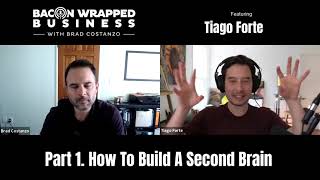
Brad Costanzo interviews Tiago Forte about his Building a Second Brain system for managing knowledge. Forte walks through PARA (Projects, Areas, Resources, Archives) and CODE (Capture, Organize, Distill, Express), tools like Evernote and Roam, and how the method helped him launch cohort-based courses and a container-home business.
Chapters
Welcome to Bacon Wrapped Business. This is Brad Costanzo and I am happy to have you guys with me today on an episode I've been wanting to have for a while about a topic that I love to geek out on. I've actually talked about this topic quite a bit with some of my friends and in some previous episodes. And this really kind of has to do with, for lack of a better term, personal knowledge management and understanding the way we learn, retain information and take notes so that we can not only just comprehend them at the time we need them, but to go back in time when we need them in different contexts. I kind of do this naturally. I've got a little bit of a. I've got a good memory, but I support that through just organically the way I take notes and throw information out so that I think I can remember it later. I've however, always been very unstructured in the way I do it. I kind of wing it and I throw caution to the wind and hope it works out kind of the way I run my life, it feels like sometimes. However, today's guest, Thiago Forte, is an absolute expert in this concept and he's got a website, a business, a course called Building a Second Brain. And for those of you who geek out on this stuff, like me, you've probably heard his name because he's one of the, the thought leaders in, I guess, capturing and retaining thoughts. So I invited him on the show today. We're going to talk a lot about what he does and specifically how he does. And I'm going to be asking really personally selfish questions. And then at the same time, Tiago just mentioned to me that he'd like to talk to me about some of the things that I've done that might be interesting to him as a course creator. So I welcome you to eavesdrop on this conversation that I've been wanting to have for quite a while. Tiago, welcome to Bacon Wrapped Business.
Yeah, good to be here, Brad. Really. I've been really looking forward to speaking with you and sounds like we have a number of common interests to talk about.
Yeah, I think so as well. So let's talk about this. Let's talk about your expertise here of personal knowledge management. Do you call it? Besides the Building a Second Brain, which is your brand, do you have another name for this concept of what we do and how we codify information?
Yeah, I think depending on the situation, there's three terms that I use. The more kind of technical academic is pkm, like you said, personal Knowledge Management which actually I didn't make up which people often, it's often the first time they've heard that it's an existing kind of academic field of study. There's journals, there's papers written. Started in the 90s out of libraries actually. But then sometimes I use Building a Second Brain. That's the more like the brand, the marketing. That's my upcoming book, my course, my product methodology. Exactly. That's more specific to me. But then the kind of everyday, most relatable term is just digital note taking.
In a minute we're going to talk about that. You've really created a system that not only works for you but has worked for a lot of other people. How did you get into this? Because a lot of times we create the course or we create the system that we need most for ourselves. They say we write the book we need to read. So what was the genesis of this for you? Like your background as it applies to this?
Yeah, you know, it was quite a journey. It was a long journey. Let's see if I can summarize it. It was really a combination of needing it, like you said, in different areas of my life in different ways. So one way was I was in the Peace Corps, which is a US government run program to send Americans abroad as volunteers for two years. For two year terms. That's been around since the late 60th. I did this right out of college and I was in Ukraine. So they basically shipped me off. I had a few months of training, but really I hardly knew what I was getting myself into. And I find myself in this little town in the far east of Ukraine in Eastern Europe, kind of like almost to Russia by myself. They purposefully didn't place you with any other Americans. You were just on your own. And I was a teacher. I had to teach five, six classes a day. This was my not. I had to.
This was teaching English as a second language.
Yes, English, English. And suddenly I just have a lot of demands on my information management skills. Right. Like I have to manage student records, I have to plan exercises, give quizzes, do the different games we would play. So really it started with my knees as a teacher, but then there were other areas of my life, like my health. I had this, I've written before about this initially very mysterious health condition that affected my throat. It was like an unexplainable pain and tension in my thro. I spent years and years going to every kind of doctor. I mean spending insane amounts of money, doing everything that western medicine could offer. And what I eventually Realized is that it was like so many health conditions. It wasn't just one thing that you can take a pill, right? Oh, it's fixed or do a procedure. It was a holistic thing that was basically just too much stress and imbalance in my life. And so I had to. And actually the way I discovered this was piecing together all the. Some test results over here. You go to a doctor and they, they don't know about all the other things you're doing. They kind of act like you're the only doctor that you're seeing. They're the only doctor that you're seeing. I would have to put together the different doctor's notes and cross reference them and compare things, do my own research, try different experiments. I really use what I eventually came to call my second brain to just figure out my health and get to a place that I could live without pain. There was a few other areas that I used this like my first job and starting my business. But eventually I just realized, wait, if this need to more intelligently manage my knowledge is so fundamental to all these aspects of my life, maybe there's other people that could use these skills and these tools. Once I started talking about it, it was like a dam breaking. Because people have incredible frustration and pain and challenges in this area of their life. And they don't even know that this is a thing you can do. They don't even know it's a skill and a practice you can train. They just put up with it. Oh, of course. Everyone is complet overwhelmed with information in their life. Is there any other way?
Yeah, absolutely. You know, it's funny that when I, when I looked back at how like I did this, I guess I was. What's the word? Unconsciously competent of this. Like I would just, I retain information well and I could recall it really well. And for a while I thought, well, maybe I'm just. Maybe I'm just a genius. But then when I went back and through and I was like, no, there actually is a method to my madness. And I realized it actually started for me. I tried, I tracked it back to high school. I was a. I was. I don't even know how to phrase this. I tried to cheat in high school. And it all stemmed from trying to cheat but not being able to cheat. Because what I would do is I would, I would create these amazing little crib sheets right where you like, okay, I'm going into this class and I'm going to take like a little 3 inch by 3 inch piece of paper. I'm going to put it up my sleeve, and I'm going to cheat my ass off on this, because I don't like studying. So I would. That night, I'm cramming, and I'm writing it all in the right context, almost codifying it so that I could understand with very few words what it was about. And I was really proud of this. And I was, like, looking forward to going in and being like, I'm going to ace this shit without even trying. But what I realized is, by the time I got to the course, the act of writing it down and putting it in the context just ingrained it in my brain. I never needed to cheat, so I was like, a failed cheater.
That's funny. That's really funny.
I laughed when I looked at that. I was like. But that's how I learned to retrain it, because you have to really distill down and synthesize the things you learn and put it somewhere. And just the act of actually writing it out and putting it somewhere, there's something magic, right? Like, it engages your kinesthetic senses and your visual, and you're seeing it. And I remember I would often, by the time I would need to recall the information, I could see not only where I pulled it from the book, but I could see where I wrote down, and that's what started to solidify it. And then as I started to go back through, like, how do you retain information from the books you read? I just realized that when I read a book like a Kindle, I love Kindle, because you can highlight things. And I'll read for context, like, is this highlightable? Is this highlightable? And I read really quickly because I'm only thinking, okay, this is an anecdotal story. I already get what he's trying to say. I'm going to skip to the next one. And as long as I review those notes one time, it's like, it sticks in here. But it took me a very long time before I would then synthesize all those out, pull them into, like, Evernote. Or I use Roam. Now I used Workflowy. In the past, I've used a million things, like, I'm sure you have, but. So that's kind of how I went down this path. And now when I do it intentionally, it's like magic, even though I don't do it methodically. So I'm intentional, but not methodical, which is why I love having you here. Talk to me some more about what you discovered about with your methodology, because you've got some cool acronyms and you've got some cool ways that you've put this out so that people can not be overwhelmed by what seems like it could be a Herculean task of consuming and recalling this information.
Yeah, yeah. I liked your example of the Kindle highlights because that's many people's gateway to this. What I really try to do is not come in and say, okay, we're going to change everything. We're going to overhaul your entire life, give you two dozen new things to do and do them all the time, every day. What I really try to do instead, and this is the reason that the course I teach, it's not a bunch of prerecorded videos, it's not self paced. It's what I call a live cohort based course. It's delivered via zoom. Because I need to interact, right? I need to listen. Like you just said that you read Kindle books. Great, that's an entry point. And so what I would say, like a great starting point for you or for your listeners. If you do that, you highlight ebooks, for example, either on a Kindle device or the Kindle app, which is free on iOS and Android devices, export those highlights, right? You've already done 90% of the work, which is reading the book. You've done an extra 5%, which is highlighting. Just do the last 5% or less and you can either hit the share button within the Kindle app and just email just those highlights, just those excerpts that you've highlighted to yourself. Or if you want to get fancy, you can use a service such as one called Readwise, which kind of automates the syncing process, taking those highlights.
I was using Clippings IO on a little Chrome plugin.
Yeah, that's another one.
Yeah, I like read wise.
Yeah.
And then once you get those, don't just read through them. Like don't you. You talk about now synthesize those a little bit more for the look for those big ideas. Is that correct?
Yeah. So people move through stages, okay. So like in the beginning, usually people will think, I don't really know what I want to do with these highlights. In fact, I don't know if I want to do anything with them. They're just kind of in a gathering. It's like a harvesting phase. They just need to get in the habit of collecting in one central place. So they do things, you know, they'll like try a web clipp and save some websites. They'll get the app on their phone and try jotting down Things. They might try a voice memo app, they might save some emails, they just gather stuff. But then there's this very natural evolution where once you gather the stuff and it's all in one place, you look at it and you're like, crap, this is valuable. This isn't just random bits and pieces. This is real ideas and insights, theories, evidence, research. I could really do something with this. I should do something with this. And then that kind of leads into the phase of like structuring, organizing, linking, tagging. There's all sorts of methods which we can get into that. I teach on how to do that, like add structure, add order to it.
Yeah, that's what I. That's the. Just really this year I've been going down that. Like, I think my first real introduction to this was maybe the whole Zettelkasten method. And then that got really confusing as I was reading through it going, okay, wait, what I don't have. I'm also add. So it's got to be simple enough to where I'm actually going to do it. And I'm not researching things for a PhD thesis. I want to just recall the stuff. So I'm always looking for that. 80, 20, what is that? 20%? I can do that. It's going to get me 80% of the recall. And speaking of books, most books, let's say nonfiction books, if you retain one or two big ideas from even books that you really enjoyed the whole time, you're like, ah, this is amazing. It's blowing my mind six months from now, if you can retain one or two big ideas, that's actually a big feat. And then when you synthesize it a little bit more, maybe you retain four or five big ideas. But realistically, the best books in the world are like, they have one or two big ideas around it and everything else is just kind of filling in the blank. But I just realized that by going through that, going through my notes and then distilling them down to say, look, if I had to teach this to somebody else, if I had to give a five minute summary to somebody of why they should read this book or one big takeaway, what would it be? That's kind of the way that I look at it. Like I look at my notes going, how can I summarize this for somebody else? Because that's where you really, as you know too, is once you teach it to somebody else, that's where the real learning gets integrated.
Exactly.
In fact, I'll annoy some of my friends or business partners sometimes I'LL say, hey, listen, I just read this great book. Let me explain to you what it's about. But that's actually not for you. I'm telling you what it's about so that I remember it.
That's great.
Just sit back and shut up. I don't need your opinion. Not trying to teach you. I'm trying to teach me.
That's so great. No, Brad, I think that's you've hit on a incredibly important strategy which, you know, like a lot of people have observed, the best way to learn something is to teach it. To me, that's not just like a little, you know, fun side fact observation that is fundamental to the nature of knowledge. Right. Like if you think of a scientist, a scientist is not allowed to scribble something privately in their notebook and say, this is knowledge. It's not, it's only publish it. Yeah, they have to. Exactly. They have to get peer review. They have to have it replicated. They need other people to critique it. And I, you know, not that we always need to have the same standard of a scientist, but like, say you know something, you think you know something about marketing or about product design or about racing fast cars. Well, the only real way to know if that has any connection to reality is to try it, apply it, teach it, share it, and then you get feedback from the real world or from other people. And that way it's sort of like trial by fire.
Absolutely. Now, are you familiar with the concept of the trivium in classical education?
No.
Okay. Oh, you'd love this. You'd love this. So the trivia, this goes back to like, I think ancient Greece. And this is the way that they taught back then, like, school system. You know, our current school system is based on the Prussian education system, which is really just factory schooling. And let's just get people to try to, you know, cram for tests and be obedient. But classical education was based on three concepts. They called it grammar, logic and rhetoric. And in those orders. So grammar, learn the fundamentals. Like let's say you're learning a language, right? Learn the fundamentals of the language. This is the grammar. This is the building blocks of it. And then the next step is to learn the logic. How does it all connect together? This works. That doesn't work. You're starting to piece it. This is where you're trying it. The last one is rhetoric. Rhetoric is now can you go basically give a, a speech about, can you teach it? Can you pass this knowledge on to others? Because only when you've kind of gone through all levels of the trivium, understand the fundamentals, got in there and tried it and then taught it to somebody else. Do we actually think you know it? And then the quadrivium is more like, you know, math and science, et cetera. Those are like the subjects. But the method of trivium is really, it's really brilliant. And it's funny. One of my, one of my clients and now business partners is a, is a like five time UFC champion named Frank Shamrock and known as the legend in the sport. He was one of the very first big champions. And in his speeches, books, in his whole thing, he talks about how he came up with the secret to learn and to master anything. He calls it plus equals minus. Find your plus. Like find the person who's above you, find your mentor, find your equal, like your person on the mat that you're going back and forth with on the same playing field. And then find your minus, somebody that you can be the mentor for, because then teach it. And he goes, plus equals and minus. That's the secret to mastering anything. So it all kind of goes back to this. Learn it, try it, teach it and that. Yeah. So when I do that, that's, that's how I integrate it. And people like, wow, how do you know all this stuff? It's because I'm teaching you. That's why I'm.
Yeah, if you really want to master a subject, teach it.
Yeah. So now you've got, I know you've got some like, you've got some acronyms. PARA is yours, right?
Yeah.
And explain what PARA means.
Yeah, PARA is the kind of that second stage that we talked about that you said that you're out of the organizing, adding structure. It's my technique for organizing digital information, like all digital information. And that's an important part of it. It's universal. What people tend to do is we all use many different tools to manage information. There's no way around it. There's never going to be a tool. I think about you're managing information in your email, in your web browser, in a Word doc, in Google Docs, in a project management tool, there's dozens. And so what PARA says is instead of organizing all of those in a completely different way, which, like, if you really think about it, is insane. Right. Like throughout your day, going to all these different places that have a completely different organizational method, just it fragments your attention. And the switching costs of having to go from here to here and use those two things together is too high. And so what para does is has you organize all those places the same way. And that same way is to organize all of it in four groups, which are the letters of para, Projects, areas, resources and archives, which are categories that. And you have to see this to believe it can encompass anything, any kind of information from any source on any topic, for any use case.
So give me a couple examples of how you use this.
Yeah, good. So we can go through them. The first and most important is projects. So this I think is the fundamental kind of insight of para, which is that our work is becoming more project centric. Right. Like no matter whether you're an employee or you're a contractor or an entrepreneur or a consultant, or you're doing side gigs, whatever it is, the unit of work that is becoming most central is the project. Right. Like you can say this is the project. It has a beginning, has an ending, has a goal, has metrics, like it's a finite thing. And so that's something that is across all your tools. Whether you're interacting with an email over here or a website or a document or some notes, it's likely that all those things relate to a given project that you're currently working on.
Now, would project also be like, let's say you've got a business, right? You've got. Let's say you've got an E commerce business, for instance. Right. Would that be considered a project? Or would that be considered. Or would it be the things inside that, that you're working on would be more considered projects? Like, where would that kind of fall into this?
Yeah. Good. So this is one of the distinctions that really is impactful for people and it's actually kind of a segue to the A areas. The difference between projects and areas is so key. Okay. And the difference is projects have an end date. They have a specific outcome within a certain time frame that you are trying to achieve. And then when that moment arrives and that outcome happens, you will check it off your list and the project will be finished. Great.
So in context of a business, and this is something we'll talk about in the second half of this interview, is you may be gearing up to sell a business. Right?
Okay.
I have an exit in mind and I need to know everything I can about what this takes, because there is a definitive end date.
Exactly.
But let me guess. Something like health is an area, maybe.
So there's always, there's. They always come in pairs. Okay, so let's, let's look at a few examples, actually. First, let me kind of define areas in contrast areas is anything that there's a standard or performance that you're trying to maintain, but it's indefinite over time. It could end someday, right? Like a good example is a relationship. Relationships are not projects. There's no, like, oh, we're trying to achieve X and then I will cross this person off a list and never talk to them again. Right. But relationships can end, right? So it's not that areas go on forever, it's just that it's indefinite. Right. So let's look at some examples of the different pairings. Health is an area. You're never done with health. You never cross health off a list. But losing £10 is a project. Or, you know, being able to have a certain vertical jump is a project. Or being able to make 10 hoops on the basketball court is a project. It's. It's a finite thing.
Gotcha. Sustaining general wellness and just making sure you've got a dietary program that works for you for the rest of your life, et cetera. That's more of an area. But yeah, I'm trying to get in shape. Like, I want a six pack for summer. That's gotcha. Okay, cool.
And this, this is everywhere. So like finances. Finances is an area. But make a certain amount of money is a project. You know, marketing in your business is an area. But hire marketing director or launch marketing campaign is clearly a project and you really need both. And in fact, what you'll notice, Brad, is people tend to favor one or the other. Right? Like, let's take both cases. So some people are very good at projects. They're good at like, you know, like all hands on deck, just like grit their teeth, really push and drive and get to the outcome, but then they don't sustain it. It's like they're always starting and stopping things. There's always a new project. You know, your friends like this, okay, the new thing that. The new kick that he's on. Right. But then, you know, in a month from now, it's going to be over. And so there's no sustainability, you know.
Interesting to that point. I think I first heard about this from Dan Sullivan. Do you know who Dan Sullivan is?
No.
Coach strategiccoach.com he's great. One of the top business consultants, really in the world. But he's got this concept. I even think he may have written a little booklet about it. But he says big mistakes people make when hiring. They'll like hire a project manager. And he goes, they don't understand that there's a distinction. There's two types of people. There's a project manager and a process manager. And the two are almost never the same mentality. The project manager loves what you said, start and stop. And they're really good. They'll run fast and they're sprinters. Right. And if you give them a new project, what they'll do is they'll say, oh, my God, shiny object. I love new projects. And they'll put it ahead of the other one, and the other one won't get done. Right. But they'll marshal all the resources, they'll push through, and you want them because they're gonna finish it. A process manager is different. Right. You're gonna get them to maintain the project. So he goes hire a project manager to get it off the ground, move them off that, and get them into somebody who can just maintain and make sure, because they're the one they love, stability. And if you give them a new project on top of the processes that are already doing, they'll say, great. This is secondary. I got to make sure my processes are in place. Don't screw up those. So I've tried, Perfect example. I've tried to take that into account when hiring people to go, I need you for short bursts, or I need you to just make the ship sail.
Yeah, that's exactly what it is. Projects versus processes require different approaches, different mindsets, different tools, different way of thinking, and often, as you said, different people.
Yeah. It's also a reason why a lot of startup entrepreneurs, myself included, are not good managers and operators. Like, that's why we jump from thing to thing, because we love the thrill of get in, get it moving, and then we get the minute there's no end date or there's no goal, we get bored and we're like, I need a project.
Yes. Yeah. It's something quite fundamental, I think, in our temperament.
And the world needs both. Right. Like, if they do process people don't like unknowns. They just, like, this is known. I just know what to do to keep it up. And if we didn't have both, it's almost like a masculine, feminine energy, if you would.
Yes.
And together it works really, really well.
Yeah.
So we've kind of talked about projects, areas, resources, and archives.
Yeah. So projects and areas that you kind of understand are like, ongoing things in your life, whether they're one time or ongoing. But then there's a third category, which is resources. And resources is a very broad term to encompass any piece of information or knowledge that is not currently actionable. Like, there's no project you're working on that it has to do with. There's no area that it's relevant to, but you still see that it has some kind of durable value. Right. This could be like a statistic about your industry. It could be like a marketing swipe file, like an ad that you want to use sometime in the future. Like no current use for it, but you just like to keep it. Exactly. And then archives is just anything from the previous three categories that is no longer relevant.
Yeah, exactly.
So with digital information, there's no need to throw anything away. It's not like Marie Kondo like, oh, if it doesn't spark joy, trash it, give it to goodwill. We effectively have now infinite information storage capacity. So you don't want to delete everything, but you also don't want to keep it front and center staring at you in the face all the time.
Bingo. Yeah.
You want to hide it. Yeah.
Once you sell the business. Alright, cool. Like I'm gonna go do other stuff. Like I might not need to ever sell another business, but I don't want to lose that information, so.
Exactly.
I may need to tap into that. I may need to teach it to somebody else.
Right, exactly, exactly. It's the archive. I think of it as the cold storage.
Right.
Things can stay in cold storage for years if necessary.
Yeah.
But if I need it, I just pull open the freezer and it's there for me.
Now the other acronym, and I heard you talk about this, I see it on your site on Building a Second Brain is code capture. And we've kind of talked about this a little bit. But capture, organize, distill it and express it. I love that acronym and I don't think we need to go into too much detail on. I mean I think those are really self evident. Capture the information, organize it, distill it down and then express it. But I want to hear more about your specific process. Like let's, let's get a little bit more nitty gritty into the tools. Tools and techniques you use to. Whenever you're exploring a subject or even just on the day to day. What are some of your, what are some of your go to strategies there?
Yeah, I mean in terms of tools, I use Evernote, which is kind of the. It's like the industry standard, tried and true. It's been around for a decade plus plus note taking app. It kind of defined the category of note taking apps. But I also am experimenting with roam research which you mentioned. It's kind of the. It's like the hip Trendy, up and coming, innovative new startup. So it's. It has some really interesting, advanced features, but it's also quite rough. It's not this, like, very easy, seamless user experience.
I remember the day that I downloaded a friend of mine was like, you got to try this out. And I'm like, this is the worst onboarding experience I've ever had. Like, how the hell do you use this? And then Billy Ross, who we know together, he was one of the people who also got me into it, and he's like, there's a moment where it just clicks. And once it clicks, you're cool. But until then, you're gonna be a little frustrated because there is no. It's like, so open. Like what? Like you're in an empty room. Like, what do I do?
Yeah, exactly. Exactly. And you know, when you've been around this sort of industry for a while, like I have, you just see, though, it's like waves.
Yeah.
Every few years there's a new generation. And it's like, it's a good perspective to have because people get really caught up in the new tool. They think, okay, now it's different. Now this is going to save me. It's going to save and fix me and all my problems. And I warn people away from that, because no thing, no object or tool is going to solve all your problems. Like, eventually it's going to disappoint you in some way. And so I ask people, really, and this is what I teach, is to step away from the tool and to think about the process. And once they see the process that they want, which is really their creative process, then to look at the different tools that they could swap in and out over time to support that process.
I love it. Can you give the folks and myself kind of maybe an example process flow that you go through whenever you're researching something, then you can use whatever example or context you'd like.
Yeah, I have a great example. Starting a business so early. I think spring 2020, I started a business with my brother Lucas. It's called Fort Shelter. Fort or Forte is our last name. And then Shelter. And it was something he'd been. He'd been in construction.
Yeah, yeah, yeah. I saw you talking about that on Twitter. I was meaning to ask you about that. So this is a perfect example. Example.
We're going to hit both with one stone. So we started this business, which was basically getting shipping containers, the standard ones you see on ships, on trucks, and making homes out of them. So not a small endeavor to start A business, a physical business, construction. Building people's homes that they're going to live in, their children are going to live in. It's not a cheap product. My brother had spent a decade in the construction industry, but I was completely new and I'm in charge of, like, marketing and also, like, helping him with strategy and some of the finances. Like, I need to play a part and think about how common this need is in our lives. How often in your life, almost on a constant basis, do you have to sort of just like boot up your knowledge about a subject in a very short amount of time?
Oh, yeah, right.
Like there's a new project at work, there's a new hire. You know, your kid gets into some hobby like life is constantly throwing right now, too.
I'm also launching an E commerce marketplace with a couple other partners. And although I've consulted on the growth of E comm businesses, this was my first real foray into this, into this category. So it's like I'm drawing on all the past knowledge and going like, drinking from the fire hose.
There you go, There you go. So I think that comes naturally to people, the drinking of the fire hose. Right. There's endless, endless sources of information out there. But what I would add and how I use my second brain is I'm constantly. Whatever I'm exposing myself to, you know, I'm listening to home building podcasts, I'm watching there's a tiny homes, you know, show on YouTube or Netflix, like reading these reports about growth and container shipping. Like really random stuff every single time. I'm not just like downloading the PDF or watching the show. I'm looking, I'm just trying to look for what is the 1 to 10%. Right? It's usually like a tiny minority that is really useful, interesting, insightful, or surprising. And then once I find that I'm extracting it, I'm either like taking a screenshot or copying and pasting or saving a bookmark to my second brain. So that after a few months, and it took just two, three months, I looked in my Evernote notebook for this project, which was starting a business, and I had, you know, not an overwhelming amount, maybe about 35 notes, right? But each of those notes is a very succinct, like, takeaway from that source that I had consumed.
Nice. So then. And then this business. So screw note taking and all of this other stuff. I'm really interested. Like the container home. So are these typically made out of multiple containers or one? Or is it just depend. Hey, what do you want. I mean it's kind of, it's like tiny homes but it's like the shell is pre built and now let's, you know, forging into what you want.
Yeah, that's the thing. The containers are kind of like Legos you can do. There are buildings with hundreds, hundreds of containers.
I've seen some. There was, I was down in Medellin, Colombia not too long ago and I believe there's an entire hotel that looks like it's made out of them. And it was like really, really cool.
Yeah, yeah. We started off, we built a, a small house that was, you know, like a standard container is 40ft. That's like the standard size. We did a 20 foot container and made a home with a bathroom, kitchen, desk, queen size bed, all of it in a 20 foot container, which was crazy. But then we kind of, we went out into the market and this is where you have to do your research, get feedback. And it was a bit too small for people. So the current house we're building is four 40 foot containers. So it's eight times the size. It's like a typical two to three bedroom house. This one is actually four bedrooms. Bedrooms. And we're going to finish that in the next month and deliver it to a customer outside of Austin, Texas. But then as again we've gotten feedback that's a bit too big for a lot of people. The demand seems to be for like a, either a home office in the backyard, you know, it's during COVID So people sometimes need a place to work or like a guest room or a.
Cottage or the wife needs a place to send her husband.
Exactly.
Get out of my house.
Exactly.
Hide from the kids.
An exile house. A man cave. Yeah. Once you start getting into this, you see that there's many uses that people have for just an extra room. It's kind of crazy because like if you need an extra room and you don't have something like this, what do you have to do? You have to move. Yeah. Spend who knows how much time and money just to, just to get an extra room. So what we settled on is a 40 foot container, a single 40 foot foot standard container we can build a complete house in. And that's the next product that we're developing.
That's awesome. I can't wait to follow your progress on that. That seems super cool. I know that earlier on you wanted to flip the interview around and start to ask me some questions for some of your knowledge, especially as it revolves around exiting a knowledge based business before we do that. I want to give you a plug for some folks if they're like, I really like this, this topic, et cetera, is the best place to go. Building a secondbrain dot com.
Yep, that's the website.
And you, some of the resources you give are you have a cohort based class. So it's a live class. It's not a self paced online study program, which I saw on Twitter. You're like, I don't want to do those anymore. Like, it's only cohort based. So it's live. Right? Obviously, yes. Well, it sounds like you care about getting results for your students.
Imagine that.
Right. Obviously harder work for you because you have to kind of be there live. But let's. Yeah. So guys, go check it out buildingasecondbrain.com and see what Thiago's doing. He's one of the best in the world at teaching this stuff, as you've probably gleaned from this podcast. But yeah, I want to flip it around and now see how I can be of service to you. So what kind of questions do you have for me around what you're doing? I'm happy to tell you my experience first about what I did and how I did it, and then we can relate it towards yours.
So I have this thesis, this belief that courses, which is just a term for educational programs, are complete businesses. Like in the past, a course was one product and then you'd have to have other products, other courses, other services, all this stuff. But. But building a second brain is now a seven figure business. And instead we're not doing what most other instructors do, which is sort of expanding horizontally. Like new course and then other new course, other new course. We're expanding vertically, we're going into books and then coaching and then eventually we'll have a self paced course and then corporate training and then licensing. It's like we're staying on the same topic in the same brand and just different modalities. Exactly. So part of my thesis that I need to prove it is it's not a business if there's no exit, if there's no possibility of moving on from it. And when I say exit, like anything, acquisition, selling, putting it on autopilot, giving it to someone else, getting a business partner. There's so many ways of exiting and you are someone who has gone through that rare experience of, I believe it was acquiring, buying a course. Right.
So I've done both. Yeah. So I've sold a course and then I. Oh, nice.
Oh, perfect.
So my very first One, the very first thing I ever did was I started a course and I sold it. And then a few years later, Billy like I bought his course and media based site and and then I ended up selling it again. So I bought it and sold it. So I've kind of been through amazing various things.
So. So okay, let me interview here. So let's start with why. Why did you want to sell a course and then buy a course? What were you seeking?
Great question. So let me start off with why I got into it in the first place. So back in 2008 I just gotten laid off a financial services job and I had no idea what to do. But I'd read the four Hour Workweek and I was like, hey, Tim Ferriss said you can sell information online no matter how specific, like small niche it is, there's a global audience for it. I was like, I'm not an expert in anything. I was like 32 or so at the time and although I had experience in financial advice, I didn't know what else to do. The other book that I read at the same time just happened to be a New York Times best selling book by Neil Strauss called the Game, all about the pickup artist movement. I never considered myself a pickup artist. I was never part of the community. I was with my girlfriend at the time who's now my wife wife. But when I was single I like to run around and impress the ladies. And it just so happened to one of the little things that I knew how to do more to win drinking bets was to do magic tricks at bars without looking like a goofy magician. Like I would make a dollar bill, tear it up and replace it. And I had about two dozen tricks and my business part who guy a friend who became a business partner said well, why don't we teach people who are reading about picking up girls? And Neil talked about magic tricks in the book why don't we teach them how to do magic tricks to pick up girls? And I was like, ah, that would actually be fun. And more importantly I was like, I don't care about building a career on this, but I want to learn about digital marketing and selling information online. So I always looked at it as a marketing laboratory and I created this course and it was like a $67 course and then a monthly thing where totally self paced, you get access to all these videos and and you learn how to pick up girls with magic tricks without looking like a cheesy magician. So I did that for about five years. I want to say, wait, 2008 sold it in 2012, so maybe about four years. And it did pretty well. Like my best year was maybe half a million dollars just off of affiliate traffic, et cetera. But in the meantime I had started doing other business based courses and other things that I was actually more interested in. Cause selling magic training tricks to nerds who can't get laid on the Internet was not as much fun. But I loved my people so my interest was waning. So this is, why would I decide to sell it? So I wasn't putting any new content out. I was like my brain was off to some other stuff and I thought the entire time, well, I'm just going to have to let this thing die on the vine. At the time it was probably doing about, I don't remember exactly when I sold it, maybe seven to $10,000 a month in sales. And most of that was profit. I was like an 80, 90% profit margin. But it had been going down, trickling down. It was just, I was like, if I don't sell this, I'm just going to let it fold. But I was like, that'd be a shame to just let it fold and just die. I was talking to another friend who sold his business and he's like, I got a business broker. I mean, I don't know know if you could sell a personality based business, but you can talk to him. And I talked to him and he's like, well, let me try it up. So we, so we packaged up a deal together. Luckily for me, like I actually had a pen name, it was Brad Jackson. So I was a little bit more packaged. People weren't buying Brad Costanzo for the thing and I didn't have to put any more things into it. But I was like, this is a fully baked out product. I've never put, I haven't put new content out in two years. I'm just selling what's there, see if you can sell it. He happened to go and do some research and he found a group of investors out of New Zealand who are good at digital marketing and they liked the fact that it was a stable product, that they didn't have to add a bunch of new stuff. But if they did, if they found a new guru or whatever, that would be value add. And we ended up doing a deal. I sold that. I didn't sell it for like, like FU money, but I think I sold it for about a year and a half times my monthly or a year and a half times my profit. So it was just enough to kind of go, hey, here's. It was a six figure deal, all cash and I was just like, wow, that was, that was actually a lot easier than I thought. They ended up running it into the ground like they.
Oh really?
They weren't that good at digital marketers.
Why, what happened?
They just didn't know what to do. I think that they were more amateurish than they thought and I thought somebody probably sold them a bill of goods, that it's way easier just to buy a business and run with it. And they didn't realize that if you didn't build it, you don't really know it. There's a lot of nuances and they were just like, I think, oh crap, what did I get myself into? And they just didn't give it any love. A lot of my traffic came from my affiliates and those were my relationships. And although I told them that up front, I don't think they continued to massage those relationships the way I did. So yeah, after a couple years the site was defunct and I felt bad for them, but I felt like, fine for me. I was like, all right, got my face with that off the Internet.
Yeah, that's the beauty of exits, is you exit.
Exactly.
This kind of brings up a question I had, which is what exactly do you sell when you sell an online course? What is included in that bill of sale?
Yeah, so in that case, it was obviously the URL and the brain. It was the customer list, the website, all the content included in it, all of the courses, none of it was cohort or live based. So somebody could just take it, run with it and continue. But yeah, it's basically the content on the website, the URL and the customer list is primarily it. In fact, are you familiar with the Traffic and Conversion Summit convention? They sold that, or at least the majority. I don't remember if they sold the entire thing, but they sold that to a big private equity company called Clarion Events. I know what they sold for, but let's just say it's multiple, eight figures. They sold a URL, a trademark and a customer list and that's it.
What?
Yeah, they had a really interesting way that they did this. Roland Fraser, who is one of the principals there, he calls it thin slicing. So. And he's one of my mentors in the whole area of acquisitions and whatnot and business in general. But they had, they created an event company that put on the event they created. You know, they have their marketing arm like digitalmarketer.com who markets the events, buys all the ads. They have another company that holds the ip. And I believe they only sold. And they probably have multiple things around it, but they only sold the I ip. They sold the customer list and the customer list and the URL and trademark. But then when they sold it, they maintained the contracts with their own event planning company and marketing company. So when they sold it, they sold it with those contracts. Now those are optional. They said, by the way, do you want to keep these contracts? We'll just have to redo them, re pencil them in. But we obviously know how to do it. And they thought that was pretty smart because they sold it, but they got to maintain the servicing agreements. So that's where if you can thin slice your business into the operational, the ip, the marketing, then you give yourself a lot more capabilities in order to.
Interesting. And they own those service companies. So they were basically their acquirer then became their customer.
Yes, exactly. So they still have. I forget what it's called off the top of my head. Boost. I think it's called Boost Events. And they still put on other events for other people, but their primary client was themselves. Traffic Conversion Summit. But now Boost Events helps put on tnc.
Fascinating.
Yeah, they sold it, but not all of it. They just sold off the components that the other company wanted. So whenever you go to sell a business or buy a business, it's really important to understand that you're either typically selling an entity or assets. And when I sold mine, I sold the assets. I didn't even sell my llc. I still maintained the same LLC that I had. I just sold the assets out from under it. And there's different reasons why you may want to do that. Like oftentimes it's cleaner or you can just. Somebody could just buy your customer list or they could buy your IP and you could keep the customer list.
So that's what I want to talk about because I see how all the rest of it could work. The customer list, which I imagine is the biggest asset by far.
It really, I mean, assuming that it's a well taken care of customer list. Absolutely.
Because that's like an annuity, that's an ongoing stream of revenue. Right. But how do you like. I guess I see how my personal email list is by far my biggest business asset, but I just cannot. Maybe because it's so personal. It's a personal newsletter. I cannot fathom. Like if I sold that and someone else sent the emails, it would be the weirdest thing to have the newsletter with my last name in it.
The way that you're 100% right. And that's where it's really challenging to sell a personal brand business. Roland, who I just mentioned, he calls it a dancing bear business. Like if you have a dancing bear business where you're the dancing bear, people are paying to see you. Did I mention Tony Robbins or did you?
I didn't hear that.
So Tony Robbins is a good example. If he retires or dies or tries to sell.
More from Brad

Seriously. If you pay mortgage or your rent this is like an IQ test Bilt https:/bradslinks.com/bilt

AI Native email marketing: Send emails from Claude/ChatGPT with NitroSendAI (Review, Not Sponsored)

How to Migrate ChatGPT Memories and Chats to Claude (Including Claude Cowork Triage)




My Investing Message To My Younger Self (And The Lessons I Learned the Hard Way)



