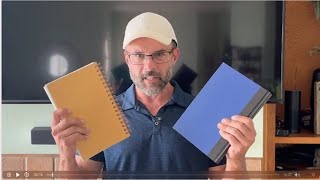
Brad Costanzo reflects on the difference between information and wisdom, then shares why he hand-copied the Dhammapada as a meditative practice. He describes how the precise, slow work of copying Buddhist teachings by hand changed how he internalized them, unlike anything AI or quick reading could do.
Chapters
I believe it's important in this day and age where information is abundant. It's everywhere. It's basically free. Tactics and strategies on Google and ChatGPT, etc, they're everywhere. I believe that seeking not only knowledge, but more importantly, wisdom is the key to accelerating our humanity because it's one of the things that the robots and the AI cannot replace. And that might be ironic as somebody who is an evangelist for leveraging artificial intelligence, but I do that so that we can improve and accelerate our human intelligence. And intelligence is worthless without wisdom. How do you build wisdom? First of all, I'm a prolific reader. I read books that were just written, just came out today, written this century, etc. But years ago I learned from Perry Marshall, who was a big inspiration for this, that when you're seeking wisdom, you want to go to the source. Now what is the source? For thousands of years, knowledge has been shared by amazing thinkers, gurus, spiritual thought leaders, philosophers, and in. I don't even remember what year it was. I think it was the 1400s. I should look this up. The Gutenberg press came out and this was the printing press when it was invented. And it made distribution of books a lot easier to be widespread. And now anybody who's got an idea can pump trash out on Amazon or Kindle if they want. But back then, in order for a book or wisdom to survive, it had to be hand copied, written by hand by sometimes monks or scribes. In order for it to survive, it had to be really good. And this goes back to December 13th of 2000. I used to study Shaolin and tai chi years and years ago. I know kung fu and the sifu. The masters and I were talking about philosophy and spirituality. And he gave me an assignment one day. He said, I want you to get a copy of the Dhammapada. Dhammapada. I want you to hand copy it. Hand copy the whole book. Wow, really? But he wasn't somebody I often said no to. And the book, it's not that big. So I said yes and I went home and I eagerly copied it. Took me about a week to do. And every day I would just get the book. I would read a sentence and I'd write it. And I went proudly back into my sifu. And I said, I'm done. And I showed him my notebook. He looked at me. By the way, it wasn't this notebook. It was the first notebook. So he looks through it and he flips and he goes, what's this crap? I go, what? He goes, you're going to have to do this again. And I said, why, Master? He said, because you've got words scratched out and you've got mistakes in it. Yeah, I had to write the whole book. And he goes, he was teaching me a lesson. He did this on purpose. And he said back in the days when the monks would copy this, when they, whether they were copying the Bible or something else, it had to be perfect. And so I need you to do it perfectly, which means no scratch outs, no mistakes. And he said, here's how you're going to do it. He said, you're going to take the book, you're going to sit upright, good posture, practice your breathing. Two feet flat on the floor. And what you're going to do is you're going to open the book, the actual book on one side here. You're going to look at the first word, which is in this case, the first sentence says, our life is shaped by our mind. We become what we think. Okay? So he goes, you're gonna see the first word and you're gonna go hour o u R. And then you're gonna come over here and you're gonna write the word our. And then you're gonna look back at the first word in the book hour to double check. And then you're gonna look at what you just wrote hour. This means every single word. Took me about five seconds to write. I'd have to read hour o u R Hour our O u r correct. And I did this. I don't know if you can see, if you look at my handwriting, it's like nearly perfect. And there is not, there is a couple hundred pages here. There's not a single cross out or mistake. This took me about three weeks to do. Every day I get home from work, I actually looked forward to doing this. It was very meditative and I got to know this book so well. When you slow down and you get to a point where you are intentionally doing something like this, there is something that happens to your entire nervous system and then you integrate. You understand these words better and it gets in. You're not just scanning, man. As I pick this up, it brings back so many memories. I haven't actually picked this book up in several years. Hope you've enjoyed this. Thanks a lot.