
Superhuman Resources: Building a Culture of Innovation With AI
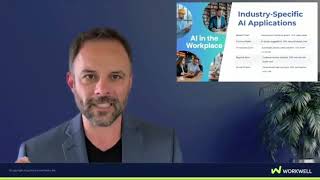
Webinar presentation by Brad Costanzo (hosted by Adam Markell) introducing the concept of “Superhuman Resources”—using AI to amplify HR and organizational capabilities. The talk covers the current state of AI in organizations, case studies with quantified ROI, key adoption concerns (ROI, data/privacy, skills gap, overwhelm), and a Five Buckets framework (think, create, communicate, analyze, automate) plus practical demos (chatbots/voice agents and a presentation-generator demo).
Chapters
Everyone, welcome. I am so excited to be here to be your host. My name is Adam Markell. I'm the CEO and co founder of workwell Labs, an organization that's committed to creating healthier and happier places to work. I'm very excited today to present another amazing topic and an incredible presenter in our webinar series. I'm going to share a little bit more about him. Brad Costanzo is the gentleman that you're going to get to spend some meaningful time with today. I'll quickly introduce him about 40 minutes of content and then some Q and A. So if you've got questions that come up for you along the way, you can type them into the Q and A, you can type them into the chat if you like. You can hold on to them until the end. The choice is yours. But without further ado, let's just jump right in. Brad Costanzo is an AI and innovation strategist. As the founder of Accelerated Intelligence AI, he advises organizations of all sizes, helping them to navigate the future of work while helping leaders to think faster, adapt smarter and leverage AI to build scalable future proof businesses without losing their human edge. I know Brad personally. I think the world of him. I'm so excited that he's going to join us today. So, Brad, why don't you come out from behind the screen and take it away.
Hey, Adam. Thanks for having me, everybody. I'm Brad Costanzo. I appreciate the introduction and the opportunity to talk to everybody today about one of the most exciting, disrupting, overwhelming, confusing trends and technologies we've got today, which is, you know, artificial intelligence. And you know, I titled this presentation Superhuman Resources. And not everybody watching this is in hr, but everybody deals with human resources. And I came up with this name after, you know, I was, I was speaking with another company and I was working with their human resources department and we were just working with some, you know, a handful of initiatives to help them be more productive. And I was able to help one of the HR people accomplish something. I won't go into all the details. And she looked up at me and she goes, you don't understand. You just saved me maybe a week's worth of time in every single month in doing this. And she goes, this human resources department is going to be a superhuman resources department. And I laughed at that. And I was like, you know, there's something to that name, but it's also very appropriate because of the capabilities that that AI and innovation give us all. But today we're going to talk about how to create a culture of innovation at every level, While de risking the transformation because it is not without risk. Now, AI isn't coming. You probably know that it's on its way. I mean, it's not on its way. It's actually here. And if you're here, well, that's good. That means that you and your organization will be here tomorrow because you took time out of your day. You're spending the energy to pay attention to this, and that means that you. You are paying attention to the trends that matter. Now, AI is interesting in the fact that it gives us superhuman capabilities right now. There's a tale of two superhumans here. We're all familiar with spider man and batman. And I'm going back into my nerdy comic book days when I was growing up, But I thought this was an appropriate metaphor because there's two types of superheroes. One of them is spider man. He's superhuman. He has capabilities that other humans don't have. He was bitten by accident. He didn't ask for these powers. They were thrust upon him, and they're very unique. Nobody else has spider man's powers. But if you look at batman, and if you're familiar with the batman comic, he's not superhuman. He is fully human. And he uses tools and skills and training to wield these tools unlike anybody else. And that gives him these superhuman capabilities. The only problem with having this is that everybody is Batman now. Like, imagine everybody had batman's tool belt and capabilities, Just like everybody has access to artificial intelligence. It's an amazing technology, but if we're the only one, like if I was the only one who had it, I could take over the world. But everybody has access to this. And that means that it is our responsibility to learn how to use these tools for good and to how to shepherd them in so that our organizations that are human resources and that ourselves can really capitalize on them. Now, Batman also had Alfred. Alfred was his butler, and it was his trusted guide that allowed him to save the world. Right? If everybody's batman now loaded up with the same tools and technology, then to a large degree, HR is the Alfred. It's the steady, trusted force that's helping superheroes do their best work, you know? Well, right now, Alfred's stepping out of the shadows. And in today's world of in the AI Era, HR isn't just support. It's leadership. It's the heart of strategy and innovation and people centered growth. And we're at a point where we can now have innovation at every single level of the company. Because Every single person has access to the tools and strategies that allow them to work better, faster and smarter. And it allows us to not only innovate at the C suite level, but to go down to people at managers of departments and the people who work for them to say, if you were given these tools, how could you do faster work? How could you do better work? How can we create new opportunities for you to use your brilliance and let the robots do what the robots do? And I called my company Accelerated Intelligence for a reason. Two reasons. It looks like artificial intelligence sounded kind of cool. But more importantly, I view artificial intelligence just as a tool. Accelerated intelligence is the outcome we all want because intelligence is the seed of creativity, of productivity, of innovation. And there's a lot of types of intelligence. There's obviously human, there's business intelligence, marketing intelligence, social intelligence, financial intelligence. And it just so happens that AI can help us leverage those to a great degree in all of those ways. Now today I'm going to go over a handful of things for you. I'm going to touch on the current state of AI for organizations large and small. I'm going to show you a few success case studies of companies successfully using AI. I'm also going to address the some of the key concerns of organizations large and small in adopting and embracing this. I'm going to share with you my Five Buckets framework to simplify AI. And whenever I show this to people, it removes overwhelm from them to go, what should we do? What could we do? As long as they're making the final piece, which is the five critical shifts that I believe all organizations need to make. So without further ado, I would like to move on to the state right now. I think we all understand that AI is powering a shift in human resources. And by hr, I don't mean the department necessarily, I mean the human resources. And that's at every level. You know, human resources at the C suite, human resources out on the front line, it automates the mundane. It can supercharge your core functions and produce really, really powerful results. I'd love to know, like, you can put this in the chat. Is there anybody right now using AI, whether you're dabbling with it, is it a part of your every single day workflows? Are you restricted from using it? Randy, that's great. You said yes. You know, I think I remember very distinctly when like Chat GPT came out on the market a couple about, oh, two and a half, three years ago. God, time's flying. I remember my jaw was a Little bruised because I played with it for about three minutes and it slammed on the desk with, I can't believe we can do this. Now, I've been using artificial intelligence in my career as an entrepreneur, as a growth consultant, and as an innovation strategist. When it came out, I noticed the shift as something, this is a shiny object that we cannot afford to ignore. And so I did everything I could to learn how to use it, but use the practical applicable aspects of AI to, to innovate. And I'm not a computer engineer or a programmer. I have ones who work for me, but I'm the one focused on the outcomes. Now, there was a recent study, I believe this was done by McKinsey or Deloitte, I can't remember, I don't have the thing on the bottom. But there was a study that said, what percent of executives are citing, you know, the desire for AI benefits. Like what are the reasons? Well, 62% of them said we want to enhance the value of our products and services. 46% just said we want to optimize operations. 44% said we want to automate our tasks. 39% said we want to be able to make better decisions. And 33% said we want to pursue new markets. Well, what do you know about the very last one in the lower right hand corner? 20% said job cuts. Truth is, job cuts are the least common driver, but they're the biggest concern of employees everywhere. Well, not just employees. I mean, business owners themselves. Everybody is worried about obsoletion, but it turns out it's the least common reason that organizations and executives want to embrace it. There's going to be an impact on jobs. People will lose jobs. That is true. They will be replaced sometimes by other people who know how to use AI. It'll also be replaced by technology. But a lot of new jobs will get created and it will increase the hiring specifically of people who come in with AI and automation skills. This is the new super skill set to learn. I was talking to a colleague of mine recently and he's got a organization, I think he's got about 150 employees, small but very successful business. And he said, game has changed. We're on a hiring spree right now. But if you do not, if you do not have any AI experience, you're out. We don't even consider you at this point. Kind of reminds me like, you know, years ago you had to have like Microsoft Office experience. Well, now you have to have at least a degree of AI proficiency. Good news is it's not that complicated to learn. This is a memo I'm going to blow this up on March 20th from the CEO of Shopify. Many people know what Shopify is. It's one of the largest e commerce platforms in the world. The CEO said, I'm going to read a little bit of this to you over on the left hand side saying, having AI alongside the journey is increasingly doing not just the consultation, but doing the work for our merchants. Our merchants is a mind blowing step, function, change. Here right in the middle you can see it's also exactly the kind of environment that our top performers tell us they want. Learning together, surrounded by people who are also on their journey of personal growth and working on worthwhile, meaningful and hard problems is precisely the environment that Shopify was created to provide. This is both an opportunity and a requirement deeply connected to the core values of be a constant learner and thrive on change. Now they went on to say a couple other things. Using AI effectively is now a fundamental expectation of everyone at Shopify. Everyone. Because I don't think it's feasible to opt out of learning the skill and applying AI in your craft. You're welcome to try, but I want to be honest, I can't see this working out today and definitely not tomorrow. The last section of his memo said, learning is self directed, but share what you learn, have access to as much, you have access to all the cutting edge AI tools as possible. We've got all this stuff for you. But before asking for more headcount, before asking for more human resources, teams must demonstrate why they cannot get what they want done using AI. What would it look like if an autonomous AI agent were already a part of the team? This question can lead to really fun discussions and projects. Now I bring this up to just, I guess, what is the word escaping me. Amplify the imperative that companies all over the world are starting to adopt. And the fact that you're here means that you might be one of those as well. So congratulations. Now AI is also empowering HR professionals, specifically, right beyond just equipping the human resources you have, it can help coach talent, advise management, develop expertise, and bring out the truly human aspects of what we want to do with our teams. AI should not replace the human interaction, it should amplify it by using automation and the technology to do all the robotic stuff so that we can focus on real people, so we can focus on their emotional needs, their financial needs, their skill set needs. And instead of cutting people, we can augment them so that we can get a lot More done in a lot less time and do a lot better work. Now some of the more tactical aspects that AI can help you in just in a new hire is it can prove the onboarding experience. For instance, many of the companies you know work with have employee manuals, SOPs how to do this. And if you're like me, non instruction reader, I've never opened one of those in my life. However, what some a lot of the companies who are using this and they're creating chatbot based employee manuals, employees will start to use those to a great degree by just typing in what's the employee policy on vacation or dress code or changing our passwords, etc. And they can get it in multiple modalities and in an instant the way they need it. And if they can say I forgot how to do XYZ instead of going to their manager or going to a senior colleague, they can just ask the the internal chat knowledge base and it'll tell them exactly what to do. If you played around with ChatGPT or your favorite language models, you'll understand that that's exactly how it works. You can just get the answers. But when this is tied into your company's corporate knowledge base, those answers are much more specific. You can also create accelerated adaptation. And by that what I mean is when you are going through change, AI is amazing for managing that change, for managing both what people learn and how they learn. The ability to acquire skills now is unprecedented because you can use these tools to create customized learning paths that are interactive and say tell me what I need to know about topic A. And then I break that down. Here's what I don't understand. And if you've ever used ChatGPT or Google Gemini or something like that in this manner of, you'll understand what I mean by that. Next, I want to talk about a handful of companies out there, I'm not going to mention the names who are achieving some dramatic results. This was a company that does technology sales and they had very slow responses to RFPs. Those I'm sure you understand, that means request for proposal. So what they created was an RFP generator and sales chatbot and it resulted in a 33% faster deal closures in just 45 days. So what this meant was when an RFP came in, the first thing they had to do was analyze the rfp, determine if this is something they could could fulfill and then create the their proposal that met the RFP guidelines. So instead an automated function was done to analyze what is on the RFP Cross reference with the company's capabilities and then create a proposal 10 times quicker and even better and more thorough that answered absolutely every single thing that the person wanted. And once more, this resulted in them getting better proposals done and faster. And I think a 33% jump in sales in 45 days is something any company would welcome. That's not all. There's other companies in different industries, such as an apparel chain recently used AI to personalize marketing emails based upon the actions being taken at the organization, like with their customer list. And by personalizing them using AI based upon the things they clicked on, the topics they read, it increased a sales boost of 10% almost immediately. A furniture maker used AI as design suggestions, reducing the design time by 20%. That's enormous for a large furniture making company. A chiropractic chain, automated patient communication. So this is both using voice agents and chatbots and text message that can go back and forth. It resulted in 15% fewer no shows. And that's a, you know, that was a big move for them and they just implemented that. So it's brand spanking new. A regional bank added customer service chat bots and that reduced call center load by 30%. And lastly, a private school recently created personalized learning plans for their students which, well, for their teachers were creating these to teach their students. And that resulted in a 25% less teacher prep time, which not only gave the teacher more time to focus on what was important, but it also reduced and removed some of the stress. Now I could go on for days about industry specific applications, but I think you guys get a lot of the point. It's insanely useful. But some of the biggest concerns about adopting AI include the following. These are probably the big four that I come across. How do I justify the return on investment? And they have difficulty proving the value. They know it'll help. But how? Well, what we like to do is focus on the quantifiable cost savings and efficiency gains. We start with small projects. We say let's start with this, see how it works, move on to the next one. You don't have to, you know, what do they say about eating an elephant one bite at a time? A lot of folks are concerned about data, data privacy concerns and that is legitimate. The bigger the company, the more they have to be worried about this. But a solution is simply to implement strong AI governance, ethics framework and transparency. Or you can also integrate private large language models. A large language model is like a chatgpt or a cloud or something that you probably have all used. But These can be implemented on premises, private. They, you know, OpenAI does not get the data. So there are a lot of ways to lock this down to where it does not let data leak out of your company. The last two are the expertise gap, people just don't know what they don't know. And making sure that employees have enough skills to use this with specialized training while also hiring employees who are AI enabled. And the truth is this is still so new, it's moving quickly, but there is not enough people who have AI skills as the demand is out there. If you have, if you have children out there and they're wondering what do I do when I grow up? Well, this is the number one thing to be proficient in now. Lastly and certainly not least, the biggest concern about it of anybody who's paying attention is overwhelm. They don't know there's so much they can do. AI can do a little bit of everything. Where do I start? And the more you pay attention to the AI news, the more AI newsletters you're on, the more overwhelming it can get because you just see there's nothing that this doesn't touch. Well, today I'm going to show you a few ways to reduce some of that overwhelm. So it took me about a full year of working with a variety of organizations to realize something important. AI only does five jobs. I call this the five Buckets framework. And I'll explain the bucket method metaphor in a minute. But it helps you think, create, communicate, analyze, and finally helps you to automate. I'm going to go through some examples on each one of these. But it's important to know that everything AI does falls into one of these categories. So if we go on to the thinking bucket. Well, what does that mean? I think of the thinking bucket as all of the for your eyes only material. It helps you brainstorm or research or do strategic planning. Whether you're planning out a go to market strategy in the marketing department or you are planning, thinking about how do I, you know, I've got a problem employee who is not doing really well. How do I talk to them about improving their performance without, you know, ruffling the feathers or making them, you know, triggered and go home and cry. It can use it for just giving you ideas on how to frame things. Here's a couple of other examples. These are prompts. You can use thinking bucket prompts depending on your, your position. These are very basic. But if you, if you've been using AI and haven't been doing things like that, this you're missing out. So if you're in hr, you could say, create a comprehensive employee onboarding schedules checklist for this specific role, including tasks, responsible parties and timelines. If you're in the content or marketing group, you could say, create a. Generate a list of 50 potential blog post ideas with working titles. Right. Marketing strategy. Develop a detailed marketing funnel for this product, including strategies for each stage. This is just getting ideas. Competitive analysis. Create a comprehensive competitor analysis. It's going to go out there and do deep research on these companies and the ability for it. The deep research right now is unprecedented. What you can get, literally, it's kind of scary. I ran a deep research report on myself and I was like, wow, I didn't know that that much information was out there about me. Crisis management. Create a detailed crisis communication plan, including key messages, stakeholder analysis, communication channels. These are very simple. If you haven't been doing them though, you'll be amazed if you just play with it. And as a side note, playing with AI is the single best way to get good at it. I've got a. I've got a little acronym I use called fafio, F A F I O, which is F around and figure it out. You'd be surprised at how expert I've become at a lot of things just by saying, well, let's see what it can do. Now. We're going to move on from the thinking bucket into the creating bucket. Now, the thinking and creating bucket is where I'd say 90% of people and organizations are playing. These two little buckets and pretty much nothing else. You think, well, what can it create? Well, AI can create text, images, audios and videos or combinations of those. It can create an email copy, but it can also create an entire video script, actual AI generated video, audio narration with an AI voice, AI generated images and, and then shorts and combinations of them. Now, a lot of people use this to create pitch decks and investor reports and content marketing and blog posts and for search engine optimization, sales copy ads, creative stakeholder, you know, shareholder reports. There's really no limit to what you can create. In fact, you can also create presentations. Anybody in the audience here ever created a slideshow like, let's say on PowerPoint. Does anybody love that? Like, they just like, I can't wait to get to a blank screen and stare at PowerPoint and then start to create my presentation. Because this is so much fun. I know, it's my favorite thing to do. I'm going to give you an example. This is a program that I use it's called Gamma G A M M A. And in the next 60 seconds you're going to see real time. I recorded this earlier. Start to finish, a sample presentation being started. I think if I click it, it'll press play and I'll walk you through what I'm doing. So let's just see if this plays. And let's go play. Here we go. So I'm going to describe what I want to make in here. I think it's plain, actually. I don't think it's playing. I'm going to back up one and I'm going to go back into it. Let's just see what this does. Okay. I typed in how to create a five star customer service using AI. And what it's doing right in front of your face is it's creating an outline just like this. Now this is editable. I can move them around. I can add cards here. I'm just picking a color, I'm picking a color at random and then I'm trying to decide what I want. AI images. This looks good. Let's go ahead and click Generate. That's all I did. And once more you can see the timer in the lower left hand corner and it is creating a fully editable, researched AI generated with images presentation that I can then give as is edit or export into something like PowerPoint Keynote PDF. You can see it's doing this and everything you saw from the beginning, all I typed in was one line. And you can see what it created. Once more fully editable. I can add new slides. I can add a slide with AI and you can see the elapsed time is 1 minute 11 seconds. Does anybody think that this would be a useful tool for them to have if they need to communicate something in their organization? I do. Is it cheating? No, because it's using AI to do the heavy lifting. I've got a framework I call the 108010 principle. And that means I still have to do the first 10% and I have to do the last 10%. AI does the middle 80. But it's my job to define what I want, the parameters and constraints, and then refine what it gives me. The people who complain that AI doesn't produce good results are just having AI do all the work for them. But if you remember that you still need the human bookends, you got to be on the front end and the back end. Now I want to move on to the communication bucket. This is one of my favorites because to me it's the closest to the cash Register because you're communicating with leads and customers and stakeholders. So in the communication bucket, this is typically chatbots and voice agents, right? How do you communicate with people in text and voice? So we often see companies using chatbots on their website to answer questions, but also via sms, dealing with customers, reactivating past customers, saying, you know, send a text. Hey, is this the same Adam who inquired about roofing getting a new roof a few months ago? And he replies, well, yes, it is. Great. I was just curious, is this something you're still interested in? It goes back and forth, it answers questions and then it. It has a goal to book them on an appoint, thus bypassing the need for a salesperson. It just books them right into their calendar. This can also be done with 24, 7 virtual voice agents that answer the phone, ask questions and book appointments too. They're multilingual. They can make both inbound and outbound calls. One of the ones that I'm going to show you right now, this is a demo for a client using a voice agent. And hopefully you'll be able to hear.
This, which means we use materials and techniques that are biocompatible and minimize toxic. Who do I have the pleasure of speaking with today? This is Julie. Okay, Julie, are you a new patient or an existing patient? I'm a new patient. Are you calling for a new patient evaluation or is this an emergency? No, it's not an emergency. That's great. Julie, do you have any questions about seeing a holistic dentist before we get you scheduled? Is it safe?
Okay, I'm going to stop right there because it goes on for quite a few minutes and it is one of those things that I think you can understand if you're listening to it. It's very real sounding, it's emotional, there's background noise. You don't have to try to fool the person, but you have the ability to offload a lot of the heavy lifting, especially after hours. And these can be built for a number of reasons. There's another one right here that I just put on the screen. This is my own chatbot. So this is been trained with about three and a half million of my words. And if you go to chat.bradcostanzo.com, you can text it, you can do voice with it, you can call it, and you can even do a video chat if you see that little video button. You can do this on mobile or desktop and it may ask you your email, but it will allow you to ask me questions about me, my business about AI in general. Things that I know, and it's really an amazing thing. I build a lot of these for executives and founders who want to be able to give their. Give their employees the ability to communicate with a virtual version of them and to get advice and.
More from Brad

Seriously. If you pay mortgage or your rent this is like an IQ test Bilt https:/bradslinks.com/bilt

AI Native email marketing: Send emails from Claude/ChatGPT with NitroSendAI (Review, Not Sponsored)

How to Migrate ChatGPT Memories and Chats to Claude (Including Claude Cowork Triage)




My Investing Message To My Younger Self (And The Lessons I Learned the Hard Way)



