
Survey Funnel Formula with Ryan Levesque & Brad Costanzo
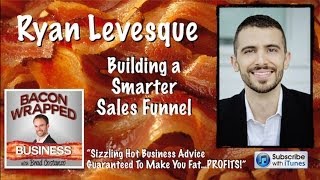
Podcast episode (Bacon Wrapped Business) in which Brad Costanzo interviews Ryan Levesque (creator of the Survey Funnel Formula) about using surveys and assessments to convert website visitors into highly qualified prospects and customers. They discuss deep-dive (open‑ended) surveys to extract buyers' language, micro‑commitment/multiple‑choice bucket surveys for segmentation, mapping survey data into autoresponders, phone follow‑up, traffic rollout strategy (Bing → Google search → Google display → Facebook), sample use cases, and implementation tips (softball questions, echoing answers, and testing with paid traffic).
Chapters
How do you make business problems disappear? Wrap em in bacon for business owners, marketing execs, and anyone trying to grow your business, pump your profits and make more while doing less. Welcome to Bacon Wrapped Business with Brad Costanzo. Sizzling hot business advice guaranteed to make you fat profits. Every week, our chefs will serve you proven recipes for ramping up your revenue. Now here's your host, Brad Costanzo.
Hey, this is Brad and welcome to the show.
It's going to be a hot one today.
Not outside, but on the show. In the studio. I've got Ryan Levesque. Ryan's the founder of Survey Funnel Formula. And we're going to talk about ways to convert online visitors into customers in a way that's much more effective than what you might traditionally seen. So if you're the least bit involved in online digital Internet marketing, pay close attention. We're going to go deep on this and it's going to be a little bit more advanced of a topic. This is not about how to get involved with online marketing and get started. But if you're already selling something or thinking about launching a product, this is really a tremendously powerful way to do it. And we'll get started with him in just a second. Right now, I just want to mention a quote that I heard by Robin Williams. Rest in peace.
It was actually the day that he.
You know, news that he passed away. And I watched one of his movies called the Angriest man in Brooklyn. And you know, small spoiler alert. You know, Robin's character is facing death in the movie and he says something very poignant. I believe it was, I'm paraphrasing here. You know, my Tombstone will read 1951 Dash 2014. And I didn't realize until now that it's not the dates that matter, it's the dash. Now, what's surreal about that is that his tombstone really will read 1951, 2014. And was it prophetic? Is this art imitating life or life imitating art? I don't really know. But instead of focusing on Robin's passing, focusing on that quote was really poignant for me. It's not the dates that matter. It's the dash. It's the life you live in between and what you do with that. Robin lived bigger than most people out there, and that's always been one of my goals. But also a challenge is to live bigger and to live better and to put myself out of my comfort zone and to grow even when I'm comfortable and happy because I know that I'm never Happy, really. When I'm comfortable, I'm satisfied. And that's about it. Another person who's really inspired me to grow is Sean Stephenson. I don't know if you're familiar with Shawn. A lot of you are. Shawn is known as the three foot Giant. He's a author, expert, motivational speaker. Really actually one of the most, if not the most amazing public speaker I've ever seen. You can check him out@seanstevenson.com that's with a ph. Shawn had an accident recently and he's, he's recovering from a. He's recovering from his accident. He's doing pretty well. But if you know him, send him your prayers and your thoughts and I know he'll appreciate it. He's been a mentor and a friend to me. And you know, John, if you're listening to this buddy, I'm can't wait to see you again and wishing you speedy recovery. Okay, now let's get into the show. So once more, today's about digital marketing, but more importantly, it's about converting website visitors into really highly qualified prospects and customers by using something called a survey funnel. And what this simply means is asking your website visitors certain questions that qualify them and guide them to the path that is most suitable for them. And I've done this for years in one way or another. But today I brought on an expert who's done this even more so than myself. He is probably the leading expert in designing these assessments and funnels and surveys that that result in just amazing conversions. His name is Ryan Levesque and he's responsible for creating millions of dollars online for his own products, for his clients, millions of leads and across industries, he's proven that this formula works. Now, he's not some just ordinary guy who kind of lucked into success with online marketing. He is genius level Ivy League educated.
He'S taught at Ivy League schools, he's.
Done a little bit of everything and he's got kind of a background in neuroscience and all this. But at the same time, he's not hard to understand geeky nerd about this stuff. He breaks it down into really easy to understand step by step instructions that anybody can follow. And in fact, I've been putting together a very similar survey funnel assessment for multiple clients of mine. And we're going to dive into this in just a minute.
We're going to talk about how to.
Build this, why to build it, what's important, what people are doing wrong. And I just really encourage you to listen to the whole thing because Even if you're not highly involved in online marketing and conversion, etc. You'll learn a lot from this, I guarantee it. So without any further ado, let me bring him on the line.
Okay.
Ryan, are you with me, buddy?
I am here and I'm really excited to be here, man. Cool.
I appreciate you taking the time to be on the show. You know, this is going to be an exciting episode for me because I'm currently, as I told you, I'm currently working on a version of what one.
Of the things you're known for, one.
Of your specialties, the survey funnel, which I don't know is that, that's kind of your kind of coined that term, haven't you? That's your.
Yeah. I mean, I tell people if there's a centimeter wide piece of the online marketing world that we live in, my unique contribution to that world is this survey funnel concept. But I do all day, every day. I love it.
That is great. And we're going to dive really deep into that. We're going to turn up the heat in the skillet, get some and bacon grease flying all over the place.
Awesome.
So for online marketers and for people who are doing anything e commerce, selling information, products, selling things online right now, this is a really, really valuable tool in order to be able to use, I think up until surveys have been used for years online. And you have, I hesitate to say perfected it because there is no perfection. You can always improve. But you've optimized this process better than really I think anybody I've personally seen and what's cool about it is for the longest time, I think you probably agree with me. Most people who sell online treat it as a one size fits all with their sales pitch. You know, it's like, hey, somebody come by my. I think of it, most online marketers, as you know, they're at a trade show barking at the, you know, at the booth, hey, come buy my product. Here's what it does. It slices, it dices, it does all this other stuff. And in real sales, one on one sales, you ask questions, you engage, you talk and you, you get feedback and you give your answers based upon that. And that seems from everything that I've seen that you're doing, that's really the heart of what your entire formula, the survey funnel formula is about.
Am I right?
You're absolutely right. If you want to draw a parallel to what this is like in the offline world, if you think about how we buy stuff, right there are kind of like Two different models. One model is you go to a store like Best Buy and there's a ton of stuff on the shelves and your head is spinning with all the different options that you've got there. So you spend hours and hours researching which TV or DVD player, whatever it is that you're going to buy and you spend a tremendous amount of time, time trying to figure that out. That equivalent online is the E Commerce model. Right. Then on the other side of the spectrum you have the direct response model which is like getting a piece of direct mail, you know, Geico sending you something, hey, apply for our insurance. Here's a unique offer code. Do it by calling this phone number and do it now. That's the one size fits all direct response model. Both of those models have tremendous flaws. The E Commerce model is again creates that head spinning, too many options, the paradox of choice. And then on the other end of the equation you have that direct response model which is. But why are you sending this to me? I just applied for auto insurance, I don't need this. Right, so what's the solution? The solution is the midpoint. The solution is going into a store like Best Buy, but instead of just wandering and meandering and trying to figure out which option's right for you, having an educated, trained, skilled salesperson help guide you in the right direction. Right. So what are you looking for today, ma'? Am? Oh, I'm looking for a tv. And what kind of TV are you looking for? Is this something for the main TV in your house, an auxiliary room? Tell me a little bit more about what your needs are. Oh, I'm looking for something. Blah, blah, blah. That conversation is a sweet spot that is very straightforward in an offline environment. But up until recently isn't something that in scale people are doing a good job of online replicating that experience like you described, that sales experience where someone is asking questions to figure out what is it that you're really looking for and then putting that prospect in touch with the best match solution based on their particular situation. The survey funnel formula, the survey funnel process that I use basically all day, every day in all the different markets that I'm in, tries to replicate that offline experience but translate it online and we can talk about all the nitty gritty, sort of devil in the detail stuff behind that. But big picture, that's what we're talking about today.
Yeah, that's great. And I think it's so important, so underutilized. In the past we saw with the invention of the squeeze page, which I would imagine a lot of my listeners are familiar with this, but if not, it's just where you come to a page and there's nothing on there except the promise of a, you know, the promise of what they call an ethical bribe. Hey, get my free report on 7 Ways to Do XYZ. Enter your email and it's a one size fits all that's getting to me. That's less effective. And they're just going for quantity. And on a survey funnel or assessment quiz, anything else prior to that where you're actually asking them to engage with you and make these commitments. In my experience, and I'm sure you'll agree, you sometimes get less, but sometimes you get more of an opt in percentage and a conversion percentage on the front end. But you always get better. Because if somebody's willing to go through all of the little hoops and answer your questions, these are potential buyers versus, you know, folks who just kind of want, who are willing to trade their email and maybe even a fake email address to get your little bribe. I know when I come across webpages that, you know, they've got seven ways to do XYZ and I kind of want that I'll first oftentimes put in a fake email address just to see if I can download it right away without having to clog up my inbox with spam. But if I come across somebody who actually cares and is assessing me in some way and diagnosing my problems, which is what your funnels always do, I'm much more likely to give my email because it's like, wow, man, this guy's engaging in conversation with me and offering me value besides just a little bribe.
Yeah, I mean, you're absolutely right. So Brad, there are two different dynamics that are going on with the survey funnel versus a traditional squeeze page. So the first dynamic affects the perception of what people are about to get. So typical squeeze page is the equivalent of hey, look at me, check out my free report. It's the best frickin report online. Give me your email address and I'll give it to you. And it's the equivalent of standing on your tippy toes in a crowd shouting and saying, hey, hey, hey, come look at me. It's like the guy at the carnival who's selling you on his knife set. What's that?
Yeah, the carnival barker.
Yeah, exactly. That's what the squeeze page is. And if it's a dead match, like I really need a new set of knives and I'll listen, then it works. Okay. However the problem is when you're doing that, it's difficult to stand out from the crowd because what is everybody else doing? They're standing on their tippy toes and it's whoever yells loudest. And so you're in this shouting match equivalent in your market. But then there's, imagine this in that carnival, the row of carnival barkers or if you've ever been overseas, I don't know if Brad, if you traveled overseas, but in countries that. I lived in China for five years. So this is close to home. You travel to these markets and basically as a white skinned person in a foreign place, I mean you're screaming money. So people are reaching at you, they're pulling you. Buy my stuff, buy my stuff. And it's who wins that sale and it's whoever's most aggressive, whoever grabs you, pulls you into their shop and says, here's my thing, here's the deal. Buy it, buy it, buy it. That's basically scenario these days.
Yeah, exactly. Yeah, I've got a problem. And then you see the most hype filled headlines and you know, hypey headlines, they still work, they get people's attention but you know, they get drowned out with, you know, people don't want to be screamed at anymore. They want to be talked with and talk to. And that's what yours seem to do. I kind of want to go deeper than this. We're giving people a great primer in what this is. And at the end of the show, or actually even right now, I want to give them some more information to go get some of the basics. Surveyfunnelformula.com Bacon little bonus that Ryan's making available for you guys, the funnelspecialist.com I want to get those out right now just in case we forget at the end of the show. But to make sure that if you want to know how Ryan builds these funnels and these sales processes to blow up your conversion, go check it out. But right now I want to kind of dive into the nitty gritty and let you guys listen in because I've done these before and I've been very effective at it. And then I saw what Ryan was doing and I was like, well damn, this guy. This guy's like a rocket scientist with this stuff. So I love it. So your stuff is advanced and it's not advanced like it is rocket science, but it takes some real thought into it. So I kind of want to recap a little bit about what I've seen you doing and kind of What I've done and been doing and I want to compare, I want to hear your contrast. Hey man, I've tried that, what you're.
Doing, and here's kind of a better.
Way to do it, et cetera. So what you're doing from I'm four weeks into your training and what I love about it is in the beginning it seems as though you're saying, look, if you, to really dial in what the customer's language is, which is so important, if you can talk to the customer in their own language, it's huge. Your conversion goes up immediately. You're asking them a series of questions. You even use it a very basic survey. You're not even necessarily, and correct me at any time that may, maybe I've misunderstood your training, but you're asking them very basic questions. What's your biggest challenge? What's your business model? What's this, that and the other, what are you most focused on solving in your business, Et cetera, et cetera. And depending upon what niche you're in, you're going to ask different questions. Then you're going to use that in order to really assess what the market once, what language they're using. What you use the term buckets a lot. Like, okay, what buckets do I put these people in? And that's going to tell you prior to, especially if you're just starting off, prior to ever offering a product to these people, find out what they, you know, what they want and how they want it and what language they're using to describe their problem. So is that kind of the step one, depending on where you're starting at?
Yeah, I mean, I think when people hear surveys and using surveys to funnel people into one of several offers or different directions, most people jump right to the stage of, well, there are three types of people in my market, A, B or C. And I'm going to funnel people into one of those three buckets. And they're usually assuming, and it's an assumption. I don't care how much time you've spent in your market. Every time I've gone through this process and I've done this now in actually 23 different markets, both my own businesses and with high level clients. And every time that we've gone through this process, there's always been aha moments and surprises. So the biggest mistake that you can make is rush to the multiple choice stage of the equation where you're funneling people into one of several directions. Before you do that, you need to do what I call a deep Dive survey and the deep dive survey consists of open ended questions where you're not presupposing what the answers are. You want to make them as open ended as possible. So you can actually figure out, number one, what are the buckets? So when people just, when I say what are you struggling with right now? People just tell me in their own language so I can figure out what the buckets are. Number two, we can figure out what language they use to describe those buckets. Right. If people consistently say as a guy versus as a man, that might seem like an inconsequential detail, but it has huge implications. There are some markets where men will refer to themselves as men and if you, you want to echo that back to them and then in other markets they'll refer to themselves as guys. And that seemingly, it doesn't seem like a big deal, but it actually is. And the same thing with women. You know, some markets women will say, you know, they'll describe themselves as a woman versus, you know, as a chick or as a lady or as a girl. That has huge implications. And so that's just one tiny detail. But, or one example. But there are a million reasons why you want to extract that natural consumer language out of the consumer himself or herself so that you can echo back that same language to them when you're funneling through a series of multiple choice questions that are designed to funnel people into one of several possible products that you might sell or funnel people into one of several different sales letter variations that you might have, et cetera.
Yep, you're so right.
And kind of on a, on a slightly different utilization of one of these surveys I put on one of my clients who sells a software for real estate investors to, you know, it's like a lead, a lead database and helps them find, for instance, one of them is helping them find motivated sellers to do, you know, to send direct mail to. And at the, at the end, immediately after purchasing on the thank you page and before logging in, simply say.
Thank.
You for investing in the software. Are we excited? Just two quick questions before you get started. Number one, where did you hear about us? And I kind of put that in as a softening question. And they might say an email from so and so or a Google search and there's some good data in there, you never know. But the second question is the most important, which was why did you, I believe it was why did you decide to invest in this software today? And it's a totally open ended question and I can go in there at all times. And remember, these are people who just purchased, so they're in that buying mode and it's fresh in their mind of why they decided to purchase it. And I've been able to pull out gold from there. One of them was because I'm tired of killing myself trying to find motivated sellers. I was like, that's a great.
That's copy right there. There's a copywriter. That's your headline.
Yeah. As a copywriter, you know, the word killing or kill, whatever is a really powerful word. And I put that immediately in an email to the prospects on the list which said, tired of killing yourself trying to find motivated sellers. And the open rate went through the roof because I was using their words, I was using the buyer's words to the buyers. And I wouldn't have come up with that necessarily on my own. So you're doing this in the front of the process, but you can do it in both places. You can use the back end survey to help on the front end. But that's great. I love that. So now you're mining your entire database for gold and you don't need a lot of. You don't need a lot of responses, am I right? I mean, if you get several dozen responses, you can get some good information out of that. You don't need hundreds and hundreds or thousands of responses.
I mean, there are two schools of thought on that. So for a project that I might do, I like to get 1000 total responses when I'm doing a deep dive survey. Typically the way I'm able to do that is one of two ways. One, working with a large client that has a large list, sending out an email asking for feedback. You can get those types of responses pretty easily, usually within 24 hours. If you don't have a large list, you can run traffic, paid traffic. So Google, AdWords, Facebook, Bing, Facebook, paid traffic to a survey that's designed to get data. And you have to do this in a skillful way. You can't just send people straight to a page with an open ed survey question and nothing else on it. It has to be in the context of something else. But you can send traffic and then gather the data. The reason why I like to have 1,000 responses is because what I'm really focused is the 80, 20, the top 20%, the top 20%, most passionate responders of that group. And 200 is a good number to work with.
Now that's a good point.
If you're hearing me say this, you're saying, well, there's no Way in hell I'm going to be able to get a thousand responses. Is it worth doing if I can only get a couple hundred? Well, the answer is this. 200 responses in total is infinitely more valuable than 0 responses. The only thing you need to be careful of when you're working with small numbers is jumping to conclusions where they might not exist. For example, if you only have 15 responses and you've got six people who all respond in a very similar way, and you say to yourself, man, it looks like 40% of my market is focused on this one thing. Well, you could get another 15 responses and get zero people who respond that way. And you still have a total of 6 out of 30. Now all of a sudden it's 20% of your market has responded that way. So you just need to be careful to overweight the data when you're working with small numbers. But beyond that, the natural consumer language that you're extracting, the ability to. One of the things we haven't talked about yet but is ask for people's phone numbers and then get on the phone with them and then talk to them about their survey response and find out the, you know, the reason behind the reason and get more background. That in and of itself is infinitely valuable. And that's one of these activities that it's not sexy and so you're not going to hear about it on some, you know, warrior forum special offer, but it's one of the most powerful things that you can freaking do.
Oh yeah, I agree totally. And you know, people may not give you their phone number, they may give you a fake one, but the ones who do, they want to hear from you. If somebody's willing to give you their.
Real phone number and you're willing to.
Call them, I mean, you could secure a customer for life.
Yep.
You know, when you do that, so that's. That's huge. That's really important. I like that. When it comes to, you know, that initial. Let's just say you're starting from scratch. I actually do have a client who's starting from scratch with no list. And then she's got going into. And this is one of the things we've been working on and planning out exactly how to do this. So we will now running Facebook ads and I don't want to get into the whole ad buying thing, but running Facebook ads to like a survey assessment, anything like that is infinitely easier than doing it on Google. Would you typically, I mean, have you, if you were starting off, do you do both Google and Facebook or do you stick to one or the other?
I actually start with Bing and I'll give you the reason why. So the difference between AdWords, Bing and Facebook are as follows. So the reason why I like to start with Bing and when I say Bing, Yahoo Bing, we'll just call it Bing for shorthand is I like people who are actually in search mode, so typically they're looking to solve a very specific problem. In my tennis market, it might be they're looking to hit their serve harder. In the golf market, it might be they're looking to hit their drives further. So they're searching on a very hyper focused keyword like how to hit the ball further or how to hit the tennis ball fast or something like that. Not a lot of volume, but I'm not looking for volume and I'm not looking for scale at this point. What I'm looking for is my bullseye prospect, my most dead center prospect. And it's someone who is actively searching for a solution to a specific problem. You're not going to get that on Facebook. Facebook, it's a right angle thing. Facebook, it's an interrupt angle. Whereas bing is. And AdWords, which we'll get to in a second, is again a problem solving mode. So this person is looking for a solution and you're basically saying, hey. The way you position the survey is hey. It just so happens that I have a special free report, video, whatever that solves the exact problem that you're looking for. The only thing is I've got a few different versions of this and if you take a moment to tell me a little bit about your situation with that information, I'll be able to send you the best match version of that free report video, whatever it may be. All you need to do is give me your name, email for where you'd like me to send the report and just answer this question. What's the single biggest challenge that you're struggling with? Xyz. Improving your memory, Hitting the tennis ball harder, hitting the golf ball further, whatever it may be. And it's an open ended question. And then you have the option to, you know, like you were describing earlier, ask a few other contextual questions. Maybe ask for their age, their gender, why were they searching for this information today specifically to your survey question. And you can do a few other things like that, but in its most basic vanilla form, you ask that open ended question. Now, why bing and not AdWords or Facebook? Well, a couple things. Bing, in my experience is typically more difficult to get to make the economics work than AdWords, that's the first thing. And I like to start in an environment that's a little bit more difficult so I don't get any false positives.
Okay, so explain that when you say it's difficult to make the economics work in Bing. Why Bing?
The targeting isn't as clean as Google is. So with Google they have so many more levers and buttons that you can pull around. Hyper focusing, your targeting, demographic targeting, day parting. The keyword targeting is more precise, the geo targeting is more precise. There's a whole host of levers and buttons that you can work with that individually aren't a big deal. But collectively, when you're fine tuning things, allow for you to make your economics work so much better. So the first reason is I like to work with Bing because if I can make it work in Bing, I can guaran fucking tee you. Excuse me. I can guarantee you that. Let me just take that out.
We're explicit on this show, baby.
Oh, are we? Okay, I know itunes is very strict about these things, but listen, I can guarantee you I can make it work in Google, but I can't guarantee the other way around. So that's one of the reasons why. The second reason is actually something that you won't hear most people talk about and that's this. There's always a risk whenever you introduce a new site to any media platform that it can get blacklisted.
Oh, and Google's famous for that.
Exactly. Everybody's heard about it. Facebook will blacklist you. Google will blacklist you. Bing will blacklist you. Of the three, the one I'm least worried about, the one that doesn't keep me up at night about blacklisting me, is Bing. So it's a way to test the waters in a lower threshold, lower risk environment first before you expose your site to Google. If Bing shuts you down, your business isn't dead. But if Google shuts you down, you have fun. It's not going to be. Yeah, exactly. You're going to have to build a new site from scratch and it's not going to be fun. So it's kind of a way to test the waters as well as avoid those false positives. So my rollout schedule is always Bing search, Google search Google display, Facebook.
Right, that's, that's really helpful. I love that. That's not something I've seen you cover yet in the course. Although you probably, maybe you would, I.
Might touch on it. I mean, the course, the survey funnel course you're going through really isn't a Traffic course. It's more about building one of these funnels. I might, I, to be perfectly honest, I just don't remember if, if it comes up. But that's typically what my rollout schedule is.
That's great though. So Bing, Google Search. Bing Search, Google Search, Google Display and then Facebook. And then Facebook.
And I don't really do Bing Display. There's really not a whole lot of opportunity there in general in most markets. So you can slot that in when you start moving to Google Display, but it's really not going to be a huge needle mover, at least in my experience. Cool.
So moving on a little bit. So now that's really about getting the initial, initial. Especially if you have your own email list, if you've got your own prospects, etc. You can send them through there, you can get some pretty targeted responses in addition to this. You can shortcut the process. But then now when it really comes to building the funnel and I've gone through a couple of your different websites and just in addition to the training and kind of seeing what you're doing and getting a few aha moments and what I see is that you are still asking a lot of open ended questions and not just multiple choice and you are doing a lot of micro commitments and if anybody has ever if, and I guarantee I know why, or one of the reasons you're doing this because of, you know, the commitment principle of persuasion. It has to be if I'm wrong, you know, if you have read Cialdini's book Influence, you know that if you can get people to take these small commitments, just saying yes, yes, yes or jumping through even little bitty hoops and getting them jump through the bigger hoop of getting their credit card out is a lot easier. So I've noticed you going to the extra steps of doing little smaller videos and then having them click a continue button or type in I agree or answering a little question is that one of the reasons is you're trying to kind of pull these people along and engage them.
Yeah, it's exactly it. You know, it's, you know, going back to the beginning of the conversation to answer your question, you know that the whole concept of the squeeze page, I describe it in relationship terms is like meeting someone for the first time, outstretching your arms and giving them a great big hug. Some people are going to be cool with that, but most people would prefer maybe a hello, waving the hand from afar, maybe a handshake before you go in for that big hug. Well, what we're doing here is we're replicating that online. Asking for someone's name and email as the first step is a big threatening step. And it's one that causes people again to either put in a false email address, it basically elicits that fight or flight response in your brain. And you think to yourself, wait, maybe this isn't something I want to do. Maybe I should bail, maybe I should throw in a fake email address. I, I don't know. But if alternatively you throw out a really tiny baby step or micro commitment, as I like to describe it, that asks them before we get started, tell me, are you a man or a woman? And the reason why I ask that question is because men and women suffer from different, you know, problems with the golf swing, problems with the tenant, whatever it may be, memory problems. That's a very non threatening step. Most people will at least click on that just to see what comes next. Because again, it's not threatening, it's not asking for personal information, it's anonymous. It's a baby step. But what you're doing there is you're setting up action, taking momentum. And to your point, yeah, there's a consistency and commitment thing that goes on in cialdini terms. But really what you're doing, again, it's just imagine if I met you for the first time and I said hey Brad, can I borrow $5,000 because I need it for this thing. You're going to say no fucking way. Right? But if we get to talking and then we kind of go deeper and deeper and we build our relationship over time, I might be able to to that point where you would say yes. Well, online I think people go for that. Can I borrow $5,000 for you? Way too quickly. And so it's the equivalent of trying to ask someone to jump across a river without any stepping stones in between. You want to put those stepping stones there for them so the river is no longer scary. And asking very basic multiple choice questions, usually the first one of which is what I call a softball question. Something that is, are you a man or a woman? Something easy.
Think about it.
Exactly. There's no thought, there's no you know. Which of the following describes you? Are you more of an introvert, more of an extrovert or a combination thereof. I gotta think about that. Like no, ask me something that unless I'm being a smart ass, I literally cannot get it wrong. Are you a man or a woman? It does not get any more basic than that. That just gets the ball rolling. It's important Data that you can use in your marketing to your own persuasive advantage. Because once you capture that data, you certainly want to be marketing to your men and women differently. You want to be exposing them to different offers. Especially if you're in a health market, for example, men you want to expose to low T offers, things of that nature. Women you might want to expose to a menopause offer or after having a baby offer, things like that. So there are things that you can do from a persuasive perspective, but beyond that, just in the most basic sense, you do want to throw out that softball question first to kind of get the ball rolling.
Yeah. There's a website, you may have seen it. I came across it in a mastermind, so somebody mentioned it called wiringthemind.com, if you familiar with that one.
Very familiar with it, yep. Yeah.
I love the very first question that is asked is, you know, take a look at these following four shapes. Which is the most appealing to you and whether or not. I have no idea if that has anything to do with the results on it, but it's. It's kind of a. Which of these shapes is the most appealing? I don't know why, but. Okay, I'll answer that. And many goes into the more deep dive questions, but that's, I mean, it's a great example of what you're saying. It's a softball. Not asking you anything invasive. Just have, you know, which of these colors is your favorite do anything on there. So the next step, as you're. As you're walking them through, and this can be as, you know, you can make this simple, you can make it highly complex. You know, the best funnel is the one you actually put into place. Like the best exercise program is the one you actually put do.
Right.
Asking any questions is probably better than asking none. But what's really important as it gets through the entire process, as they've gone through the gauntlet of the questions and they've answered them, you're segmenting them out now, and in your email system, you can talk to them in their language. Right. So if one's a man, if one's a woman, if one has this problem, if one has that problem, you now have the ability to address them in your autoresponder sequence or your broadcast or.
Whatever based upon their answers.
Right, exactly. So there are different ways that you can do this. I have a software program that my partner and I developed out of necessity because we do this all day, every day in all the markets that we're in. And basically what you're doing is you're capturing that data along the way. And you don't need to use our software tool, you can code something up yourself or you can come up with other solutions, but you capture that data along the way and you tie it back into whatever email autoresponder system that you're using. So if you're using OnTraport, if you're using GetResponse, if you're using AWeber, if you're using Infusionsoft, whatever solution that you're using, you can map the data that you're acquiring through the survey back to a person's contact record. You're just basically saving the data temporarily in hidden fields and pumping it into your email follow up system. Then you can use that data later on in a whole bunch of different ways. So the first way that we described is you've captured the person's gender. Let's just send an affiliate promotion to the women on our list for a cellulite removal product geared towards women. Well if you sent that to the men, you're gonna get emails from guys being like hey man, I'm a dude, this is a waste of my frickin time. Why are you sending me this shit? Right? And you're going to alienate your list. And that's the most basic application. So that's one thing. The second thing is, which is really cool, is we've all seen and Brad, I know you know this but I mean we've all seen the dear first name trick, right?
Oh yeah.
I mean that's been around for 15 years, right? And most people, it's like the jig is up. Like, you know, it doesn't even, I get an email, it's like dear Ryan. I mean I don't even, I don't even bat an eyelash. I'm not like whoa, you know, my name is. Those days are over. They've been over for 5, 10 years. However, however, when you capture this data in the way that we're describing, you can also use that data as merge fields. And so I'll give you an example. So just take the gender thing for a moment. Imagine how much more powerful it is to say, you know, one of the most interesting things that I find with the women that I work with is that for whatever reason they struggle with X and I slotted the word women. Well, imagine writing that same email using merge fields that that same email says, you know, one of the most interesting things about the men that I work with is this. If you're a woman or a man. Getting that gender specific context in an email is infinitely more powerful than just a generic, you know. You know, what's interesting about the people that I work with is this when you say men, all of a sudden your brain as a prospect is oriented to, wait, maybe there's something about being a guy that makes things different. You know, the male business owners that I work with versus the female business owners that I work with tend to struggle with this one specific challenge. All of a sudden now there's this gender context. Even if you're prescribing them the same outcome, you're saying, you know, it is a generic struggle that they or problem that they struggle with the fact that you framed it as being gender specific. And this is the most basic application. You can do this, you know, to the nth degree. What happens is people pay attention to it so much more. They say, this is something for me, right? You combine gender and age and imagine the possibilities. You know what's interesting about, I'm in my 30s, right? So you know, what's interesting about men in their 30s when it comes to, you know, male CEOs in their 30s, is that they tend to reach this.
Interesting point hits home so much.
You've got my attention right there. Like I am reading that. Versus if you say, you know, what's interesting about CEOs is that they run into this struggle. Not interested. It's not specific enough for me. So the survey allows you to do all this. And hopefully if you're listening to this, your mind is racing with possibilities right now about all the different ways that you can apply this type of methodology in your business. Because it really is universal. Any business can use this, right?
And so one of the ways that we've been in, a very long time ago, I had some courses in the dating advice market and one of the things I did was there weren't a whole lot of open ended questions on this. But it was, you know, what makes you the most nervous about approaching a woman you've never met or what are you most comfortable with? And I can't remember how many questions I asked. It was a very, very micro survey, but it was just trying to get them to go through two or three little steps of just click one, click one, click one. And I was segmenting them out. So if it said that, oh, you know, your biggest sticking point is really you get nervous approaching and then I can talk to them like that. And then, by the way, here's my product that covers that. And all These other problems that you may have, but this is your number one. One of the things that I'm working on right now and you know, I am following some, some proven I've had success with this in the past. I know some other colleagues who have as well is this is where it differs from yours. Although I think that merging this could be really effective. But I want you to tell me if, oh, I've tried that, here's why it wouldn't work or how to make it work better is more of an assessment style where it's like, you know, look, if you take this, you know, take this 30 second assessment and find out your, you know, the number one reason holding you back from success with X or find out how you compare to other people in this market. Like so with the real estate investing, it's going to take this 32nd survey or assessment, we don't even call it a survey to find out how you compare to other high volume real estate investors. And so we don't ask at this point, it's not even active yet. But we're not even asking open ended questions, although we will be. We've got about 10 different questions which kind of, you know, we're scoring them so when it drops them off it says hey, we, you know, come, congratulations. We calculated your score, you are a. And we give it kind of a code like you're an rga. You know, would you like to find out what that means? And we'll give you a free, free book if you decide to opt in. We actually don't even force them to opt in at this point. We want them to either, you know, have the choices, they go onto the next page where the, you know, the business owner in this case explains, you know, one of the three groups that okay, well here's what an RGA means. You know, you should be focusing on revenue generating activities and blah, blah, blah, blah, blah. In fact we're having a, you know, I'm doing a webinar right after this and I'm inviting you to it. You qualify to attend the webinar. We're going to cover how to cover that and get over all this other stuff. And after, you know, after they register for the webinar, we offer them a low dollar offer just to kind of liquidate the cost of the traffic. There's about with upsells in there, there's only one little upsell, but we're able to get about a $30 customer value when people do that.
But that's kind of the funnel that.
I've got experience setting up and have seen. Although one of the things we really.
Don'T do and I like, or we haven't done yet, and I like what.
You'Re doing is integrating more of the open ended questions and doing. I forget what it's called where the answer to one question becomes part of the next question.
Right. So typically my path, and there's always exceptions to this, but typically I go through what I call my deep dive survey, which we talked about, which is the open ended one. I then take the answers of that and use it to determine what my close ended. So multiple choice survey is going to be, which is what I call my micro commitment bucket survey. And the reason why I call it that is because it's broken down into multiple steps, the micro commitment side of things. And the bucket piece of it is it's designed to funnel people into one of several buckets. That survey is the one that runs consistently over time, the one that we're sending traffic to. The deep dive survey is the open ended one is a one time thing to extract data to identify and help design the micro commitment bucket survey. So that's sort of my typical path.
Okay, so the micro commitment you still keep, you don't put as many, as many open ended questions in that one then, do you?
I generally don't put any open ended questions in that one. Generally there are some exceptions to that. So it's not that different from what you're doing. However, one of the things that I do do is and this is something again that my software enables and again there are other ways to do this, but you reference the previous question in each subsequent. So for example, if your question is are you a man or a woman? Okay, then maybe the next question is and they say they're a man. Maybe the next question is which of the following best Describes your age? 20s, 30s, 40s, 50s, 60s, 70s. Then the next question might be as a man in your 30s, the men you know as a man in your 30s, there are typically three challenges that you know or you know. There are typically three challenges that men in their 30s tend to struggle with when it comes to losing weight. Which of the following best describes you? Right. So you're basically echoing back what they've said and you're becoming. It feels like you're a playing doctor and you're getting closer and closer to the answer to their question. It's like you're acknowledging that the information that they've given you is valuable in the context of helping them reach their goal. And it encourages them and motivates them to keep giving you more information, because it overcomes that objection of why are you asking me these questions? Like, when is this going to stop? But if you reference what they just said, they kind of get it. They say, oh, I get it. If I give more information, you're going to get closer and closer and pinpoint exactly what my solution is. That's unique to me. So it is tremendously important in improving your survey uptake rates, getting people to go through the whole survey and reach the end. So to answer that question, I think what you're doing makes a lot of sense. I think if you can add that layer to it, you'll probably see even better results.
I love that.
And I would say, to the extent that you can really get people excited about what's at the other end of the rainbow, what that pot of gold is before they take the survey, that's really the key. Make this big promise that if they go through the survey, they're going to achieve this X result. And typically it has to do with learning about something about themselves, because what's everybody's favorite topic? Themselves.
Oh, yeah.
So if you can give them insight into who they are, what their strengths are, what is it that makes them unique? Why have they been struggling? Anything around that idea that gets people motivated to answer a series of questions? That's right. Yeah.
That's what I've been kind of playing on, you know, most. What's your probability of success with this area? Or how do you compare to others who are already succeeding? Or how do you diagnose your sticking points? How do you find that one thing, that one little kink in your hose that's holding you back? Well, if you answer these questions, I can almost guarantee that we can find it. You got to make it really, really simple. And people love. I mean, you've seen that probably on Facebook, when people are always sharing. It's like a little assessment. What city are you? What Game of Thrones character are you?
People love that stuff.
They love it. They absolutely do. So kind of trying to integrate that. And when I saw that one piece that you just explained how you're. Which is one of the parts I loved about what you're doing is it's so powerful how you just echo back what they said in the other ones in the question, you know, in the next subsequent questions, I think that's really, really powerful. So we are. We're coming to the end here of the interview, and I can't tell you how much fun this has been.
I know.
We could talk probably for hours about this.
We could talk all day about this, man. I mean, I love geeking out about this stuff, and it's so much fun to talk to, you know, you about this because I know you're. You like to geek out over it just as much as I do, so.
Oh, yeah, And I get it. I get it. Like, I've been. I've kind of been sitting here, you know, over the past few years, trying to find an even more elegant solution and easier to deploy than what I found. And I really like that you've gone through the painstaking steps of laying it out inside the survey funnel formula and say, look, this is how I do it. You can make it as complicated or as advanced as you want to get it, but the most important thing is get it up there. I do believe it's the way of the future, talking at people, talking with people instead of talking at them.
The more.
Pretty soon it will be artificial intelligence. We'll be going back and forth, and it'll be just like we're really there. But until then, this is really one of the most effective ways that I've seen.
More from Brad

Seriously. If you pay mortgage or your rent this is like an IQ test Bilt https:/bradslinks.com/bilt

AI Native email marketing: Send emails from Claude/ChatGPT with NitroSendAI (Review, Not Sponsored)

How to Migrate ChatGPT Memories and Chats to Claude (Including Claude Cowork Triage)




My Investing Message To My Younger Self (And The Lessons I Learned the Hard Way)



