Ep 97 - Make It Better with Matt Hullander
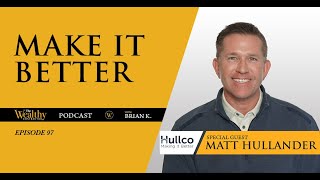
Matt Hullander runs Hullco, a Tennessee home-improvement company that grew from $4M to $13.5M in revenue by raising prices, refining its sales process, and protecting margins through weekly job-cost reviews. He built the business on three core values: wow customer experience, profitability, and giving back through a charitable foundation.
Chapters
All right, everybody, welcome to another episode of the Wealthy Contractor Podcast. This is Brian Kaskavalciyan with G4 Marketing Group, and today I have got a great guest. His name is Matt Hollander from Hullco, and we will get started with Matt in just a minute. He's got a great story, great business. We're going to learn a lot. I just want to remind everybody that if you haven't done so already, go and grab a copy of my book, The Seven Secrets to Becoming a Wealthy Contractor. And you'll notice when you get to the website, just go to thewealthycontractor.com and you'll notice there that you can get a copy of the book basically for free. I just ask you to pay shipping and handling. I buy the book. You pay shipping and handling and we'll get you a copy of the book, The 7 Secrets to Becoming a Wealthy Contractor. All right. So with that, Matt, welcome. I appreciate you being here.
Thank you, Brian. I'm a big fan of your podcast and happy to be a guest today.
Thank you. So, um, I've known about Holco for a really long time. Um, I know the business has been around for quite some time. Why don't you tell us a little bit about, give us, like the 2-minute version of, of the Holco story?
Sure, real quick. I'm second generation. My father started the business in 1976. We were incorporated in '77, and we manufactured storm windows for many years back in the '80s. That evolved into a replacement window facility, and we manufactured windows up until 2000. Then we partnered with Sunrise up in Temperance, Michigan. I sit on their advisory board and actually have a small piece of the company. We buy from them now, but in those early years it just evolved from windows into doors, siding, all the other exteriors that we do. Then over the last few years, the bathroom product. In 2007, I purchased the business from my father, or let me clarify in case you ever have listeners that are more curious about how that transaction happened. Our corporation purchased the stock from my father and he gifted me one share. So that made me owner, but the corporation made the payments to him and/or my mother for a certain number of years. So he was out capital gains, but it didn't, create a tax situation for myself.
Nice.
So I bought that in '07 and then we started to grow from there. I think that year we did around $3.5, $4 million. Uh, we're on pace to do $13.5 this year. We're in 2 markets now. We opened a showroom and, um, office up in Knoxville, Tennessee last year. So our goal is 10 in Chattanooga, 3.5 in Knoxville, and our Vision statement is to sell and produce $25 million a year annually and be— remain the largest home improvement company in East Tennessee.
Nice. So, you do a lot through the business in terms of giving, charity work. I definitely want to talk about that. But all of that is made possible because of one of your core values. You want to share? You could share all of them if you'd like, but the one, you know, the one that I'm talking about. Sure.
And I'll run through them real fast and save that one to the end. Um, deliver a wow customer experience, no negativity, change and adapt, when in doubt, act, whole life success. And then the one you're asking about is make a profit and generate cash. It, It allows us the opportunity not only as a company to grow, but to give back. I've always felt like what goes around comes around. In the book of Luke, it says, to whom much is given, much is required. And I've been given a lot over the years, so we started our own foundation and give back in many ways throughout the year, which is fitting with our mission statement, which is to make it better for our customers, our coworkers, and our community.
So, um, talk a little bit about the foundation.
Yeah, my wife and I started it 8 years ago, and we were just passionate about certain local nonprofits that we wanted to help that we knew were not top-heavy, where we knew where the money was going and how it was helping folks. So we have various events throughout the year that our employees— and we have a board, we have volunteers that help us We do a really big golf tournament in the fall that normally raises around $100,000 that we give back. Next month we're doing a wine dinner. We do a concert in the summer at a local car museum that's pretty cool. So we do things throughout the year through the foundation that we just turn around and give back to typically between 5 and 7 different nonprofits per year.
So I saw something on Facebook where, if I remember correctly, you and your wife are in the car. You got— you turn on the camera and you are headed somewhere and you have a bunch of envelopes. Yeah, that was— what was that all about?
That was our excess money in our foundation fund that we wanted to give away that day. It's a I think it was Giving Tuesday. So we picked several area nonprofits and we just drove around all afternoon giving money away. It was fun.
You know, and so we talk a lot about profitability here. It's something that I— it's, it's One of my things to help change in this industry is that everybody's so damn focused on top line, top line, top line, and not enough people are focused on the bottom line. And one of the reasons why, um, you want to make sure that your business is profitable is so that you can live out your best life. And everybody's got a different version of their, of their best life. And it's incredible to me the things that you've been able to do, because those— as I was watching that video, these were not $100 checks. These were pretty significant checks. I don't know if you want to share how much they were, but let's just say they were pretty significant checks. And And what I mean, it just does so much good in the community. It's one thing. Yes. You know, profit, we have to be profitable for our families. We have to be profitable for our coworkers, but you're taking that a whole nother step further. And you're saying, well, I also want to, you know, influence and, and, and make an impact in my community.
Well, and I meet the people that it helps. So like one of the foundations is called the Hunter Worley Foundation and they help of families that lose a child, whether it be through funeral expenses or bereavement counseling. And I've met those parents, and so that's why we're passionate. Another one is the Jason Foundation. They raise awareness for teenage suicide, and I have a teenage daughter. And we don't just write them a check, we're involved in helping the community. I'm going up to our Capitol with our governor and the leader of the Jason Foundation and UT's football coach next week to bring awareness to the Jason Foundation on a statewide level. So there's all kinds of activities we can do to help aside from just writing a check.
Yeah, no, that's fantastic. And look, you know, to everybody listening too, you don't have to do $10 million a year or $13 million a year to, to live out whatever your version of your best life is. So let me ask you this then. So how do you— and so wait, let me go back. Actually, let's go back to the beginning when you took over the business. Was profitability something that you were always aware of, or was it something that you had to kind of grow into and learn how to make it happen?
Well, first I'm going to shout out for you. I appreciate what you're doing for the industry and letting them know how important it is. And I think it's definitely gave many small business owners the opportunity to, to be healthier and make more money. When I took over, I was aware of it. We had a mediocre P&L we could look at. And then as I began to grow the business, I got involved in several peer groups or vendors would introduce me to other business owners. I would start reading the trade magazines and we wouldn't have got where we're at without my father, but he wasn't exposed to all that extra help. So, um, I joined the NAHB 20 Club peer group, uh, and they shared financials. And that was the first time I was really exposed to how much can we really make. And then for some of the members, it was, how can we help you make more? So I actually was the 10% guy for a long time until Over the last couple of years, I've heard you preach 15, and that's our goal now.
Nice. Yeah. And so how do you, how do you make sure that you are, that you continue to stay profitable? So at the beginning, when you started to become aware of it, you saw what other people's financials were, and maybe your financials weren't quite there. What were some of the things that you had to do in order for you to start making that shift to getting to that 10%? And now, you know, let's just talk about that first.
Well, it's definitely pricing and learning the sales system to sell value versus price. We always stuck to our core value: deliver well customer service. We had a good reputation. Our integrity was and still is great in our communities where we work, but we just weren't asking for enough money. I can remember my father made me, uh, my first job was rolling screens in our window shop for a dollar apiece. And then I eventually started installing and then I sold and then I managed before I bought the business. But, um, I remember selling replacement windows installed for $225. Uh, and somehow we made it through back then, but now we're over $1,000 and We just have to have the right margins. And then we always do what we call a preliminary job cost summary after the job's sold. We send our project managers out, we break down all our costs, we know what our materials and our labor is going to be, and we have certain minimum gross margin numbers that we need to hit for different products. And then we have great staff and managers, and we meet every week and look at our numbers, and the numbers don't lie.
So to the listener, what's interesting is you've heard this stuff before. And I— and Matt, you know, I always point this stuff out. Matt said they got their pricing right. You know, so whatever that means for you, that means you've got to make sure you're, you know, you cover your material and labor and then you cover your sales expense, your marketing expense, and of course your overhead expense. And then the other thing you said was the selling system. And, and focusing on value, not on price. Um, talk a little bit about, um, the importance of having a selling system. Did you, did you, when you took over the business, was there a selling system in place or is that something you had to bring on?
There was an old-fashioned 10-step list on the wall, but it wasn't trained properly. And honestly, when our first window rep, who's a regional now, Jeff O'Leary, when he came in, he really helped my team develop that system. And then it's evolved, you know, some people still do 10, some do 6, we're at 7. And so it depends on your company, the individuals there and the culture. We have very little turnover. Most of our sales consultants have been with us decade or longer. But it was just slowly raising that price and learning how to sell better value and price condition and trial closing and just practicing it over and over, which we have to continually do. So that, that took us from, you know, and it took a few years to change the culture. And then, you know, back then we had 4 salespeople, now we have 11. So We just try to get better and better at it. And we constantly change the way— right now our marketing manager Terry's building us a new onboarding presentation to go through with new employees and new salespeople. And, you know, going back to one of our other core values, which is change and adapt, I wake up every day trying to find something to change to make it better because nothing stays the same. And that I think is somewhat true with the Selling System too, because of people's attention span and instant gratification and smartphones, it's not going to always be the same.
When you were, when you were, when you had the 4 salespeople and you had an, you know, you had a system, but it wasn't really being followed. What were some of the things that you had to do to get people onto a system when they weren't on a system before?
Well, like other folks you've interviewed, I read The E-Myth over and over and over. I've read it many times and then pass it around for our managers to read even today. And so I had a sticker made that was on everyone's desk that said, the system is the solution. Um, The system we followed then isn't different than the system we follow now. So we evolved and make our systems better, but it was just preaching to everyone that that was part of our culture to follow a system and that they would be better because of it. And so would the company and the salespeople could make more money and so on.
Yeah. And the importance of having a system is that, okay, we have— and look, there are, like you said, there's a 10-step system, there's a 6-step system, you have a 7-step system. But the key is you have a system and your system produces this result. So you, you're not out there running leads every day. You have 11 people out there. And so if you're putting leads into these people's hands, and it doesn't matter if you have 11 or if you have 1 or if you have 2, the mechanics are the same, or you have 50. So you're putting a lead into this person's hand. You want to have a pretty good sense of, okay, if I give this person 10 leads, they're going to bring back X number of sales with X number of revenue. And from that, now you can start to build a business model, right?
Yeah, that's the way we do it. We, that's the way we budget for used marketing. For example, um, we look at all our numbers from the previous year or year to date to figure out, you know, what our lead cost, how many leads we need to generate, what our closing percentage is, our NSLI. And we, We build our whole model from there. That's how we decide how much we're going to spend on marketing. And, um, you know, I think that I couldn't stress enough, especially to, you know, contractors that are just learning the business, how important the numbers are.
Yeah. It's a numbers— look, every business is about the economics. Um, home improvement has its own very, you know, very, uh, structured set of numbers. These are the numbers. They start here and boom, boom, boom. Just like you said, it's, You know, how many raw leads do we create? How many appointments? You know, how many of those demo? How many have sold? What's the NSLI? I mean, there's a formula here and it's driven by those numbers. If the numbers aren't right up front, they're not going to be right at the end where the profit comes in.
Yeah, I agree. And, um, you know, back to profit, I think it's important to if you have the opportunity to share financials with— I don't know that it has to be the exact same business, but, you know, we have our model based on information I gathered from one of my peer groups that shares all that. So, you know, from our G&A or overhead costs to what our sales cost is, what our marketing cost is, what our production cost is. And that's how we start the year out with the right model so that when we fill out those preliminary job cost summaries, they come in like they're supposed to. And then it's also important. I think you can pick up a few points if you are selling value and you are priced correctly and you're still not achieving the optimal net profit. There's leakage somewhere, typically in production. So we go back now and audit all our jobs. Once we know they're all in and complete and the bills are paid, we'll audit to try and find— I'll give you an example. We just went back and did an entire month. And we found where we missed a point or two on some doors that the sales guys were selling as a standard size and the project manager was ordering a custom size. So it gives us an opportunity to find where those mistakes are happening and pick those 3 or 4 points back up.
Yeah. Nice. And I, and this is, it's understanding the numbers and it's, it's doing the work. So pricing, let's talk about that for a minute because It's interesting you said, you know, you obviously get your pricing right. Before you were selling windows at $225, that was a long time ago, and now you're over $1,000. And what happens is I think a lot of people are afraid to raise price. First off, before I ask you the next question, talk to me a little bit about that, about how did you kind of How did you conquer that fear? Because all of us have that fear, I think, in business.
Well, knowing what I know now, I would have raised the prices more on the front end. We did it $225, $250, $275 until we got where we're at. But having known now, I would have raised them a lot more earlier on and made more money in those years. And it's a fear of anyone, even when you ask, you know, a salesperson during the needs assessment to ask the homeowner what their budget is. It's, I don't know why, an awkward question to talk about money like that. And it's the same thing to raise prices, but it's completely necessary if you want to stay in business.
Yeah. How did you, but how did you deal with the, how did you personally kind of deal with the fear? Cause you have to deal with it first. It starts with you, the owner.
No, it took a long time, to be honest with you. And then we had a close-knit group of salespeople that— and we spend more time together than sometimes our families. So it's changing the culture from within to where everyone believed they could get it. And it took some time, but they're all on board now. And then when the new guys came along, they realized what was possible too. And then just knowing that it's a smart and healthy way to run a company, uh, you have to be profitable and When we started growing, we would go through periods of what I call no man's land. When you go from whether it be $4 to $6 million or $8 to $10 million, and we just came out of one where we're opening in a new market. It's especially important then when you're hiring additional staff to grow.
Yeah, what's interesting is that you mentioned that one of your core values is the wow customer experience. And it's interesting that, you know, when we have these conversations about price, you ask a contractor, hey, how is your customer experience? And, you know, you'll ask them, if you say you're going to be there at whatever, 8 o'clock, do you show up at 8 o'clock? Well, of course we do. If a customer calls your office, does a live human being pick up the phone? Well, yeah, of course they do. Well, doesn't that add value to, to what you're doing? So why are you competing against somebody that doesn't answer the phone live, who has a crappy, you know, customer experience, who doesn't show up on time? You can't— it's not— it doesn't make any sense.
Well, without sounding boastful, we wouldn't, you know, be able to sell that value or show them all the achievements or awards that we've won if we didn't deliver that. And, you know, so we actually have a written process for the way our installers greet the customer till the time they leave. They're going to say, you know, Brian, I'm here to work at your house today and we believe in giving wow customer experience and I need a 5-star review out of you today. So if there's any time I'm not delivering you that experience, please let me know. So they're expecting it and we're going to ask them for the review when we finish. And typically it's 5 stars.
What a great script too, by the way, for anybody that's listening, go back a minute. Write that down when your installers show up. That was just a great little script that Matt just gave you. Let's talk about— I know that your business, the Hulco business, has— well, especially the existing office, the one that's been there, you have a very high repeat end referral rate. I would imagine some of that has to do with the customer experience. Um, but what, what else do you attribute that to?
I think doing the right thing, good customer experience, being in the same town, the same spot for 43 years. Um, I think it's sometimes helpful for the— and I know a lot of owners are not comfortable with this. My dad was a county commissioner for several years, very active in the community. I do the same thing. So sometimes branding yourself as the owner, especially those that do their own, say, TV commercials or whatnot. I think that's been helpful because I am well known in the community and my father was too. So I think that the history and the experience we give homeowners is what contributes to it the most.
Yeah. Yeah. Repeat referrals kind of helps with the bottom line too, doesn't it?
It definitely does. There are higher closing percentages, sometimes a higher average job cost. And I will say though, that over the years, you know, when I bought the business from my dad, he spent maybe 1% of our revenue on marketing in the local newspaper, maybe Yellow Pages back then. So most of the business came from word of mouth. So over the years, as I now spend quite a bit more than that on marketing, you will see a reduction in repeat and referral because you're generating the leads in a different way. And, and the challenge is to figure out how to do both. You're going to have to generate more leads and they're going to cost more and they're not going to be as good as the repeat and referral, but you still got to keep that, that big base of repeat and referral important too.
Well, but also don't you take care of every customer that comes in so that they become a source of either another job or another lead through a referral?
Yeah, absolutely. And then we use them a lot. We've never paid them a dime. And you can go on our website and see hundreds of video testimonials. Uh, we use them in a lot of our advertising as well. And, uh, we want them to be another book that we ask all our employees to read as a raving fan. So, um, that's just our goal on the front end is out of all the things, you know, things I might learn learn at peer meetings or things that we need to work on to improve, the one that's most common that I think will help all home improvement companies is the focus on the homeowner.
Yeah. At the Bath Wraps event that we were both at a few weeks ago, at my table at dinner was Brian Kaskavalciyan. From TundraLand. And what he— what was interesting in the conversation, what he said was that when we go to— when we all gather together, all the contractors gather together, there's all this talk about close rates and marketing costs and marketing efficiencies and average job costs and top-line revenue. And the one thing that is not talked about is is the customer and the focus on the customer. And I was, you know, and I'm sitting there, I'm listening to Brian say all of this, and I looked over at him and I kind of sheepishly raised my hand and I said, you know, I've been trying to talk about this stuff for the last 10 years, you know, maybe somebody's, you know, finally starting to listen. But yeah, I mean, any business, the most important person in any business is the customer, aren't they?
Exactly. And I think to look at those guys, you know, there was a the panel out there, and it was Brian Kaskavalciyan at Tundra Land and Vince from Reborn and BJ from Westshore. And that, that was the common theme, uh, was to focus on the customer. And of course, they've all been wildly successful. So that's just something that a lot of folks maybe out there listening can take to heart and put more focus on.
Yeah, absolutely. Um, you, you— I wrote this down— you said you have hundreds of video testimonials. Did I hear you say that right?
Yeah, we also have a fantastic videographer who's also our marketing manager, Terry, and we've been collecting those for, well, since he, since he came to work for us. And we use them a lot in our iPad presentation in the home. We use them on our website, and then we use them in some TV advertising too.
How killer a strategy is that?
I mean, social proof is just, I mean, it's hard, especially I will purposely try to find for small communities, the local celebrities. So all the radio hosts, the guy that's our TV commentator, our city and county mayor, whoever I can work for that's willing to do it. It's just going to give even more validity to choosing us once they hear it from somebody they know.
Yeah. And it's, And it's really simple. You don't have to have anything fancy. You don't— you have a videographer. But if you didn't have a videographer, you'd still have the testimonials, right? We take— you take the phone, right? What are the things— how do you ask for the video testimony? What are you— you put the camera on the customer. What are you asking them?
Well, we do them in different ways. So we use Guild Quality. And one of our questions is, are you OK with helping us with our marketing? And the The ones that say yes, they've already said yes, so we line it up and go out and video the products and have them sit down and talk to them. But we also do it on our cell phone as well. We just had an event that all of our employees participated in to help replace windows for a lady that's going through cancer, and we just used our phones and FaceTime. It doesn't have to be professional, although we do both, and when the ones that are on TV, they're produced better.
You know, I think you know my friend and client, Jer Ronan, from Yankee Home.
Yeah, great guy. Yeah.
So, Jer's been on the podcast before, and he was— so I used to talk about video testimonials a lot, way, way back, way before even getting into the marketing business in this space. And when I had my own home improvement company, and I was shocked at I met this guy, Jer, and here's a guy that had been using video testimonials for years and years, and nowadays it's, I mean, he used to lug around a TV with a VHS player in it so that he could show people testimonials, and nowadays it's like, it's so simple. It's like every customer you have, put the camera on 'em, ask 'em a couple questions, ask 'em about their experience, ask 'em what would you say to somebody, And you would be amazed at what they say. And you don't— and by the way, I think you'll agree with this, Matt— you don't need hundreds of video testimonials. You need like 5 or 6 really good ones. And it doesn't— it's not that hard to get people to do it. He has this one video that I, that I've shown quite a bit, and I don't know if you've seen it. I call the lady Mrs. English. Of just because of her accent. I don't know what her real name is. This video has made Jere literally millions of dollars because this lady says— I'm a pretty good copywriter. I could not have scripted this thing. You could not. We could not. You and I could have sat in a room for a day and said, what would be the ultimate testimonial? And we couldn't have come up with how good this is. And He— all he did was put the camera on her and ask her a couple of questions, and he uses that video, like you said, in the iPad presentation. I don't know if it's on his website or— well, but this lady has made him millions, and it's incredible to me that more people aren't using the social proof that they could be using to sell more jobs and to build more value. How do you justify the price? And this lady at the end of this video said 3 times, it was worth the extra money. Pay the extra money. I mean, you can't—
I mean, I completely agree. Um, I think, um, it's a lot easier than folks think it is together. Uh, all you have to do is ask. And like you just said, I was surprised at how many people even start our video by saying we knew Holco was going to be more. Um, so that's price conditioning right there. I think you were maybe showing Jere's age though when you're talking about the VCR tapes.
Yeah, well, hey, I'm there too because, uh, I remember, uh, I remember those times. I remember those, the cameras up on your— you had to put up on your shoulder. You're still a young man, you don't remember those days.
I do. I'm older than you think.
Um, if you don't mind, I want to, I want to, um, I want to, I want to ask you a couple of more personal questions, if you don't mind. Um, you've done very, very well in your, from your business, and, um, you have been able to take money and profits from your business and make investments that are outside of the business to build wealth for you, for your family. Was that always part of the plan? Was that a vision that you had to, you know, grow the business so that I can build wealth? Where did that kind of all come about?
It just kind of fell into place several years ago. I had replaced windows for one of the neighbors of our office, and it's right next to I-75 on the second busiest road in our county. And this area was going commercial, and I was passionate about real estate. I had built and flipped homes for a while on the side, and this gentleman Got cancer and was going to— he knew he was dying. And so he asked me to buy his house from his wife and I did. And I developed that property and I just enjoyed it and had a passion for it. So I continued to look for opportunities to start new businesses or ventures. I've built office buildings downtown that I've sold. I have a retail space that I rent. I'm involved in a couple of different development companies that do mixed-use development, and I'm really passionate about proper development. There's a lot of really bad development in every town, but I studied and learned about new urban development and the whole live here, work here, play here thing, and I've always had a passion for it. And so I look for opportunities to do that, and Holco gave me or afforded me the ability to do that. So over the last few years, I've tried to build my team to where I can go do that and the company still be successful. So our structure may be a little different than most. I have maybe one extra person at the top. We have a vice president and we have a general manager, and then we have our other managers as well. But being in two markets, I don't think we're top-heavy, and I'm still participating mostly in the marketing side of it now and the you know, culture and employee engagement. Um, but yeah, WholeCo gave me the ability to do that and I really enjoy it.
So one of the things that has to happen in order for somebody, anybody to make more money, to grow their wealth, is that they have to accept it in their, in their mind first. They have to believe that it's possible for them. How did you— did it come natural to you that, hey, I'm going to build this building and all of a sudden now, you know, I don't know if you— I don't think you became, you know, incredibly wealthy from one, from one, any one thing. I think it grew over time. But How did you kind of prepare yourself for that?
I think focus is a lot of it. I could equate it to Holco or any of those other ventures, but it's focusing on the end result. Um, there's a business school we've been to and we send managers to, it's called Aileron. It's up in Ohio. Clay Mathews sold Iams Dog Food to Procter Gamble for $2.5 billion, and he wanted to give back to small business. So he built this campus and, um, It's a nonprofit. You can, you can take employees there. They have a course for presidents, a course for managers, and they teach you professional management skills. And when you build a plan, they, they always talk about focus. And so having the end result in mind, and I've always felt like if you believe you can, you can, if you believe you can't, you can't. And I thought I could, and I still feel that way about But damn near anything I do, I'm gonna give it my all and focus on the end and try to go get it.
Yeah, what a great answer. Thank you. All right, so, um, as we, as we wrap up here, um, I want to ask you, kind of knowing, knowing what you know now and kind of looking back, you know, over the last, I guess, 13 or 14 years that you've been the owner of the, of the business, what's something you might have done different, um, or, or changed, or, you know, what got you where you want to go faster?
Maybe I think my, um, industry peer groups and meeting folks like yourself that want to help one another has been most helpful to me, and I would be more eager back then to seek that advice. I learned so much from my peers, and likewise, I love helping other people. I'll help local competitors. I just got a text message during our podcast here from one of my competitors that's a roofer that wants to have lunch. I don't mind helping him. Cause I've had a lot of people help me along the way. So I would just strive to get as much of that information as you could and then execute it. I see so many times, um, I read a book one time called Execute. You know, people learn from others or may go to an industry event or they gather information, but they don't execute on it. So when you learn it, just go do it and get her done.
Get it done. Yeah. Yeah. And you know, that's, it's, it's one of the things that I recommend to people all the time. It's like, go find, go seek out people like Matt. Um, go seek out other people in the, in the business. They want to help. Most people want to help. Most entrepreneurs want to help other entrepreneurs. There's really no reason for you to have to go through it alone. I was one of those guys early on that I had a chip on my shoulder. I had friends whose parents were setting them up with businesses and my parents weren't. I mean, I had to work my way through school and all of that stuff. And I had a chip on my shoulder like, oh, I'm going to do it all myself. Damn, I wish that back then I knew what I knew now and did what you just recommended was go talk to more people and say, hey, how do I do this right? How do I accelerate this? How do I— and it took me a while to figure that out. And And I won't do that anymore. I won't make that mistake again. And I think that's such great advice.
Yeah. And to be able to share that information with others quickly, you know, hey, we're making new contracts. Send me a copy of yours. I want to see what it looks like. Or, you know, especially some of the marketing costs and conversion rates on different products or whatnot is, you know, when I see an employee working too hard to figure out how to do it, I'm like, well, did you ask our peer in Birmingham? Did you call this guy in that town? And we'll figure it out a lot quicker that way by helping each other.
Yeah. Yeah. That's absolutely true. All right. Well, Matt, this has been, this has been great. Thank you so much for taking the time to, to be here with us.
Well, Brian, I enjoyed it. Thanks for having me on. If any of your viewers or listeners out there need my help, just tell them to let me know, matt@callwholeco.com.
See, look, the, the guys in this business that do well, they want to help others. And, and I thank you for, for, for doing that and making your email address available. I think that might be the first time somebody's done that on, on here, but he's serious about it. So if you're out there and you're listening, you can reach out to Matt and he will help. All right, everybody, so again, a reminder, make sure you go get a copy of the 7 Secrets to To Becoming a Wealthy Contractor. You can get that at thewealthycontractor.com. This is Brian Kaskavalciyan with G4 Marketing Group. This is the Wealthy Contractor Podcast, and until next time.










