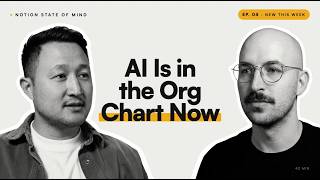
Josh and Bryan Takayama explore how AI moved from buzzword to daily coworker. They show concrete wins: a proposal that used to take 40 minutes now takes 3 minutes, and they break down when to use Claude Chat versus Cowork versus Code. Strategy and creative thinking are becoming the most valuable skills as AI handles repeatable tasks.
Chapters
Every time that I find myself doing the same task twice, I try to figure out a solution to make it repeatable using Notion AI or Claude.
Welcome to the Notion State of Mind podcast where everything's made up and the points don't matter. Shout out to my childhood of Whose Line Is It Anyways. We're talking about something that does matter a little bit more, AI. And I'm your, I guess, your co-host. I'm your co-host, Josh, joined by my co-host Bryan, who's also my co-founder. And we're going to talk about AI. How's that sound?
How AI is our coworker.
Yeah, there we go. All right, let's talk about from the beginning. How do we get, how did we get here? I mean, AI, I already am like cringing inside a little bit by talking about AI because everybody, I mean, I just, you know, it's like the buzzword and I'm a hipster at heart and I don't want to do, I don't want to do things that are, you know, everybody else is doing. But here's the real question. Is everybody else doing it? Are we, are we on the leading edge? Are we still tech hipsters talking about AI? What do you think?
I don't think that we're necessarily too early anymore at the moment. I would say that it's becoming much more mainstream. Like my mom uses it, not to, not to say my mom doesn't use these sorts of things, but she uses ChatGPT on a pretty regular basis to answer questions about her flowers and stuff. So like on general use and adoption, I think it's probably pretty pervasive in most people's lives that have a smartphone today.
Um, it's not like everyone's using it to the full extent and are in Claude code or building custom agents. But I'd say that people are using AI often today. I don't know.
What do you think? That's fair. I mean, I guess if our moms are using AI, my mom is not using AI, I can tell you that for sure.
But she's Googling and her Google search results come back with Gemini answers.
Probably. I should ask. And the flowers, that's a good one. My mom definitely likes flowers and, and, uh, gardens. So maybe I should introduce her to it.
Anyways, um, sorry, I built my mom a Notion system. So all of her favorite plants, she has a card for it, and then she takes pictures of the plants on a weekly basis, and it updates them, and it gives them a health journal and has AI kind of like review the images to tell you about the health and health trends over time. So, okay, just an application there.
That's in Notion?
Yep.
I mean, I've definitely seen like AI identify this plant, uh, and I can see a world where that turns into like, talk about the, the, the funniest thing to use AI to like help you do is keep something organic alive. And really all you have to do is water it and make sure it has sunlight.
You water it too much and it dies. That's why this guy's got all these yellow leaves.
I know.
Gave it too much love last week.
Uh, robots are gonna take over even the most organic, down-to-earth thing, gardening. Um, anyways, to answer your question, do I think we're early? I mean, maybe in the ways that we're using it, I guess on the knife's edge, we are probably on the, the very sharp edge. Not the sharpest, that's for sure. Uh, I just saw a tweet from Simon, or it was a video from Simon, one of the co-founders of Notion, who said he had an agent running. His record was for 13 days straight. I don't even know how to do that. I mean, I'm, I'm still kind of unlocking how to make my agent do things without having to ask me every time and get some memories and some skills. So I think I'm working my way up the, the, the power curve on, uh, on Claude, probably, you know, more than the general population, but there's just those people that are pioneers.
Let's take just a quick step back. What are you using AI for on a daily basis today? Think of today, you're, you're a few hours into your day. How have you used it?
So, uh, that's a great question. Yesterday, actually last night, saved my life. Okay. So taxes, especially when you're an S corp, uh, business owner become a nightmare. Also, I won't reveal what day that we're recording, but yesterday was the day before the deadline. Um, I was, uh, yeah, I had to collect a bunch of documents that were, you know, I have them and I do a, I do an okay job of keeping track of documents. I actually scan every physical document now. So that's amazing because I can search for them, but Claude isn't necessarily attached to every single platform that I have right now. So I basically just gave it a list of things that I needed and if I didn't quite understand it. So, all right, let me give you an example. Um, I needed to, this is tax related. I needed to get a list of everything that was business personal property. And those purchases are scattered around like Amazon and my emails and different things like that. And so I just started like grabbing things and throwing it in Claude saying, hey, by the end of this, I need, I need this kind of list. And so I can just dump things. And it's like, hey, great, I got this little bit of information, I'm going to update this row, you still need these. Go and find these. And I'd still throw things in and it's like, okay, I still need this one. You know, you, you, you gave me this, but it didn't have what I needed. Maybe you can check here. So actually being like a partner to help you do those, those things that are kind of menial or kind of stressful because you don't fully understand what you need and where and why and things like that. I thought was awesome. So I still had to do a few hours of work, but I, it like kept a ceiling on my stress level. You know, whereas without it, I just would have ruined my week.
My first response to that is IRS, close your ears.
I mean, I'm compliant. I did every— I've done everything. We're good.
At least that Claude told you to do.
Well, at the end of the day, the CPA is going to have to review it, right?
So yeah, no, I'm just messing. But so, okay, so that's a good use case right there. So it was taking a pretty complicated task and then using it as a partner to be able to analyze large amounts of documentation, organize documentation, and help kind of create a checklist and make sure that, make sure that you are following the steps that you need to be following. So that, that's a pretty complicated use case, but it's a good one. What, what else have you used it for recently?
Drafting, drafting documents, drafting proposals that, you know, we've done that a couple of times over the last week. And that's usually not based on just a prompt, but that's based on previous conversations. And agreements and things like, you know, it could be just what I love is like, I can just even take a screenshot from Slack, you know, if I don't have something connected, I could just throw it in there and it knows how to, so it's like having that, it's like having that assistant that you don't have to feel bad about just like giving them the worst possible folder of resources to like make sense of. And it can do it really fast. So yeah, lots of like little things throughout, you know, if I'm trying to think of something or visualize something like yesterday. I was trying to make sense of how, you know, we're working on like scaling our business and part of that is the process of our business and we're attaching things like metrics and ownership and playbooks and things like that. I'm trying to make sense of this and so I'm using it as a thought partner. I think that's probably my favorite way to use it at the moment is a thought partner. And I eventually got it to kind of laser in on a visual and I was like, okay, now I I finally, you know, I get it. Like it didn't just like, it didn't answer me out of nowhere cuz it kind of needs to know how I'm thinking. But that's for me, the beauty of it being a thought partner is it's this back and forth helping me get clarity. And then I'm like, okay, if this is how you understand it, I see this gap, let me talk to it. And then we get somewhere that's really useful.
How, how long is a typical interaction with you and, and your AI partner when you're, when you're using it as a thought partner?
That depends. Sometimes it can be really quick, obviously, but sometimes, I mean, I can be working with it for a few hours or I might pick up a session over, you know, a couple of days. Like it, especially Claude Code, if I'm doing something in Claude Code, like it might be over the course of a couple or a few days. And I kind of cross the lines between like what could probably be in chat and what could be in code. And it's just, it's just nice to have. So I use Claude in the terminal and I use iTerm to manage my sessions. So there's a world where like, I just want to talk to, I just want to talk to the terminal, right? Because it has access to everything plus my computer and it can do things. And I'm building kind of a harness understanding of not just like doing my projects, like building software. Like sometimes I do build those kinds of things to help me, but a lot of times it's knowledge management, you're, I'm kind of getting towards that like Jarvis concept. So it needs to understand me, needs to understand my knowledge. It also needs to understand itself and how to like make itself smarter. It needs to understand my preferences. If I'm saying like I have a, you know, trigger set up that will check every time I close out a session, part of that close down process is looking through the previous chat history and looking for ways that it could be more efficient the next time. You know, so adding more memory so that it's doing its job better every single time. Um, to answer your question, I guess it depends. These things can, can, can vary because life, life is varied. Projects are varied, you know, and that's, that's the point of it is that it's there for you for whatever you need.
So let's walk through it. So you did, you're using it for complicated tasks to help be your, your, uh, tactical execution partner like Taxis. You're using it as a kind of an admin support to help draft things like proposals or emails.
You're using it as a thought partner to have multi-hour, multi-threaded discussions to develop a point of view on something.
And then you're also building things in Claude Code.
All right. And that's all—
you've touched all these different surface areas in the past, past day.
In the past day? No. In the past week. Yeah. I mean, some days I just, I have other things to do, so I don't get to touch my, my Claude Code projects. But yeah, this is where, this is where I'm hoping that the harness gets, and it just comes down to my daily routine as well, but getting the harness to a point where I can just, my routine is like logging on for the day and just like, hey, let's get started, you know, and it starts taking off and doing the projects that I have, but also like while it's doing those things, working on like things right in front of me that I need to do.
Yeah, I think that's what Simon's video was about.
His goal is to, whenever he leaves the session, for it to still be working whenever he comes back to it.
This is the hard part. I don't know how I'd be interested in your take, but the hard part for me is I feel like I'm learning pretty rapidly and I'm, I'm adopting it rapidly, or at least I'm adopting it and then I'm getting to the point where I understand it. Okay, maybe I don't need to code this, but, um. I also still have normal work to do, right? And you got, and we like taxes, obviously. So the balance of doing ambitious things, you know, so AI can help you augment and compress your existing work, but it can also do ambitious things. And I definitely have a mind towards the ambitious things. So it's a balance of getting what you need to do and what you're doing kind of set up and operating and helping you with those. And then kind of expanding into unknown territory, especially as Claude, like, releases 10 new features every day. So how have you found that, that balance and that, that roadmap for you as you kind of adopt AI? How has that gone for you?
Every time that I find myself doing the same task twice, I try to figure out a solution to make it repeatable using Notion AI or Claude.
An example is 2 days ago we had 2 proposals to build, so I recorded every step that I did to do the first one, and then I was able to get Claude Cowork to reproduce all of that in 3 minutes. It took me 40 minutes to do the first one. So like, every time I find myself doing any sort of repeatable task, I will try to figure out a way to build a skill or build a scheduled task or something along those lines to be able to support the reproducible execution of it.
Yeah. This highlights something that I think people could use some clarity on, and it's probably the same issue as Notion, like the blank page syndrome. What you just said was there's a lot of, there's a lot of knowledge kind of baked into how you just went about what you did, but there was a lot of options there. And the framework for which direction to go and why would be really interesting to uncover. So like the trigger, which I have some thoughts on this, like the trigger for you creating an AI workflow was, do I do the process twice or more than twice, you know, more than 2 times. So then you have some options. One, go to Notion. If you're inside Notion, do you use custom agents? Do you use Nozi? What are skills in Notion? How does Notion relate to Claude? Okay, so then if we're talking about Claude, you've got chat, you've got co-work, you got code. Do you build an app for it? What are schedules? What are triggers? What is dispatch? You know, how do you make sense of this? And this is probably a world where like people need some clarity on just even how to use AI in general and get somewhat of a mental picture of the landscape of their available tools and how to use them.
So Claude Chat is for thought partnership.
You're having a conversation with the AI to talk about something and develop an answer and maybe create an artifact and a visual representation of it. That's what chat in my mind is for.
Cowork is for autonomous or semi-autonomous multitask workflow execution. And what that means is I might have a conversation in Fireflies and then I have a document in Notion and I have emails in Gmail and I have Slack messages in Slack. And I want this scheduled task or this task in Cowork to review all of those and then also review examples of outputs that I've done before and leverage that new context to put it into an example of like a, what I believe is the right output. That's a many-step workflow. That's why it takes 40 minutes is I have to go to the conversation and then I have to develop the understanding of that, of what is the brief.
And then I have to go into the previous messages and understand.
So like Cowork has the ability to do many tasks in a really intuitive way.
I think the way that I saw Alex Lieberman talk about this was in chat, you're going there for a conversation and you have to give it a lot of guidance on what sort of answer you want to respond or what you want to receive.
In Cowork, you go there with a problem and you let it figure out the solution.
And it will determine if it's going to other applications for you, or if it's taking over your computer screen, it will be able to kind of produce that sort of output.
Those are my, my Claude surface areas.
I mean, there's Claude code, but I go there for building net new applications or net new integrations or any sort of custom script development. Like those are, that's how I separate those 3 different activities.
Now Notion surface areas, um, they are similar and different. Honestly, I use Notion when I'm using exclusively Notion. Notion has connectors and they work pretty well together, but, um, it's a lot slower than Claude in my opinion. So when I'm using a Notion agent, it is, let's use just Notion, like Nosy right now. I'm using it to create or interact or work specifically within a Notion workspace.
And this is really relevant when your organization has security issues, or it's really relevant when you're only inside of Notion at that time. Uh, and that's when I use Notion AI.
When I use a custom agent, and I'm covering a lot of different grounds right now, I use a custom agent when I want to create something that creates a really nice integration and automation with something like Slack. It's going to be leveraging a data source in Notion or creating an operational workflow in Notion.
But it gives a user the ability to have an interaction in another application like Slack.
And that is relatively hard to build custom, but it's super easy to build with Notion, uh, with custom agents. And that is an immediate trigger for me to go to custom agents. Other examples of when I would go to custom agents are maybe like a Notion database enrichment, or maybe just a Notion-specific knowledge bot. That's when I would go to any of these one surface areas. Um, and I don't necessarily have, let's say, this is a hard-pressed framework, but this is how my mind is orienting around when I go to which area.
Yeah. Yeah. Makes sense. How did you, how did you get pilled on, on AI? Cause I think I look back at even Notion State and between the two of us, uh, I can see, I, I see like kind of some distinct stages where We were like, oh, whoa, okay, here we go. And then the next one was like, oh my gosh. What was that for you? How did you get here?
I've been using it since Notion State started, basically. Like, I think ChatGPT came out, uh, with its first model, GPT-4 or whatever it was, maybe 2 months before we even started Notion State. And I was using it a lot for like Google at that point in time. And it was like replacing Google for me. Um, and it was just a better way to find information faster. It wasn't always fantastic in its results though. It just helped me like draft this email quicker. It was a very simple thing. The next phase was when it could take large amounts of transcript, like a Loom video transcript or a call recording and summarize it. And like, that was a really big moment for me where I might have 14 calls in a day and being able to actually get action items effectively out of it would take another 3, 4 hours in the day, and I could use it effectively to build those SOP documents or build those, those summary messages really quickly. And that was probably the main one for a long period of time. And then this past December is when Opus came out and Opus just changed the whole game.
That's when I got into Claude Code. That's when I transitioned over to Anthropic. That's when Notion AI started to get a lot better.
And now it's.
It's a part of every single workflow that I do. Like there, if, if I find myself doing something manual, it means that the data, the way that I'm storing data isn't effective enough for AI to be effective on it. And I need to fix that problem before I can leverage AI for the solution. And that's almost how I feel and think exclusively on every activity that I do today.
Do you think that we, let's say we're starting Notion State today. What, what would you be doing different? Cause to marry this with my point of like right now, for me at least, it's like we have things that we already need to do, right? So it's like you have to balance getting things done and also like kind of folding it into what you're doing that's already existing, that's already kind of broken. It's like that renovation versus greenfield concept. If we were greenfield building Notion State, what would you, what would you do differently?
That's a really fun question and I've never thought about it, but Um, just for context, when we first started Notion State, we didn't have many clients, right? We were a new business and we spent what, maybe 6 months building Dominion, like, like a lot of time on the, on the phone together, just arguing about what is a domain or what is a team arguing about, like, what are, like, what are these service areas? And we spent a lot of time like building out the original framework that is our current product.
This, yeah, Dominion being our strong opinion on, on a Notion framework that we install in a company. That we then kind of build on top of, uh, as we've got a scalable system in place for a company.
Yeah. If Notion is a collection of Lego blocks, Dominion is our prebuilt house, uh, that you get when you, when you sign up for, for our services.
And Dominion was just the name because like we were kind of building around the concept of like domains. Like we didn't want to, we didn't want to lock ourselves into teams necessarily because At that point, we were still kind of exploring like different business models as clients. And so some people might not have, you know, uh, or like they might not have like a department or a function or a team necessarily. They might have something totally different. Like we were working with somebody that really organized their work around the islands that they kind of had, you know, um, they were, they kind of thought in and, and, and operated within. So we're, we're a little, we're a little. I think past that, but that's where the name came from.
What's funny is one of our clients actually had islands, and each perspective that we built was an island.
That's what I mean.
Geographical island.
So you can't really call them teams, so we're like, oh, domains, okay, dominion, but yeah, I don't know if we call it dominion anymore, but that's what that is.
So we spent 6 months doing that, and it was very, honestly, taught us a lot about what we needed to build, and it's a really integral part of our day-to-day today.
But we have never tried to rebuild that solution using prompts.
And I'm relatively confident we could do that today. So as in, and I'm relatively confident we could make it more of like a Mad Lib approach to the prompt creation. And then we manually configure it with human labor to add these teams to it or to create these views. I think that if I was to start Notion State today and we had this sort of idea and we didn't have 20 clients and 15 team members in a business that we're trying to scale.
I would spend a lot of time thinking of how we could leverage prompting or code to— and more of like a, a form or survey approach to our discovery to deploy a workspace. And this is probably something we should do anyways, and we should—
we likely will in the next couple of quarters. But this is where I would, I would, I would focus on approaching this as opposed to the way that we do it today.
All right. I got to call this out. Does this Are we showing our cards too much here? Does this open up the door for somebody who's listening and is like, hey, they're already bloated, they can't move the ship as fast as they say that they maybe should, I'm going to go and build this. Are we afraid of that?
I'm not afraid of the person that wants to take this idea and go do it. I'm afraid of Anthropic just doing it. The person that wants to go out and go build this, go do it.
Um, that's, that's great.
If you know how an organization structures, you, you understand how their data needs to flow, how an operating model should fit into a Notion workspace, the right questions to ask the client to, uh, populate this and that, like, do it. Also, if you want to invest the time to do it, call us and reach out to us and like, let's, let's get on the phone and let's, let's build it out. Um, but I think that I'm not scared that the individual with this idea and the time is going to be, um, a competition for Notion State. There's more demand than there is supply of good Notion consultants.
Um, but there is a real concern of Anthropic building a replacement replacement for Notion inside of their platform that I think isn't a sci-fi world future.
Yeah. Yeah. I mean, we have to be, I think if we delude ourselves into thinking that we're safe, we're just setting ourselves up for failure. But I think there's more to it that as well, and not to, not to, you know, this isn't like Copium, but we go beyond just the deployment. Like if we were just implementation specialist, I'd be, I'd probably be nervous and I'd be like, hey, we need to, we need to rebuild this ASAP. Right. Uh, but I mean, it's far beyond that. Even as we were working on our business process over the last few weeks, even kind of discovering that the implementation is, I mean, and we've known this, right. But like the implementation is just like, it's just the foundation to work from. Like our real value is the quote unquote embedded operational partnership that we have with clients that we, we have to just have something to start with. And we need people to understand it, to be trained on it, to be bought in. And then, and then we start building on top of that. And it's not just building based off of a simple prompt. Like we work with them to actually understand their business on a much deeper level, not just in their sphere, but across the entire sphere of the business so that we can build something that's a lot more integrated and actually valuable.
It's such an important point, especially with what we're, what we're talking about, um, with AI and this general conversation is AI is only, is only as good as the data framework that it's pulling from. The solution that we are deploying is a good data framework. The sweet spot is, and what you're getting to is building the trust with the client. That all of their, what feel like unique and decentralized workflows can fit within this best practice framework and architecture. And that takes a lot of time. An example is like one of our clients, they have a few thousand people and we've been working with them for a couple of years now. And we've built many really strong systems in their workspace, but we still find people that just create 357-page Google Docs where they copy and paste every meeting transcript into that and they use Command+F to find it. And where a lot of the value is that we bring is we help one, reduce the amount of information debt that lives in that 357-page document by bringing it into Notion. But we also work with them to understand how leveraging this new system will be more beneficial. Like, it doesn't matter how good the AI is. If their system, the way that they're, they're, they're working on it today is, is that 357-page document or what have you, or the 500 Google Docs, they won't be able to integrate into the system that everyone else is using.
And it takes us. And a lot of hard work and a lot of individual conversation and a lot of greasing the wheels to get them into the system. And I think that that's a lot of what we bring to the picture.
That's interesting. Not that it's anything new, but now that you're saying it like that, do you think that we're more people managers than technology managers?
Change managers is probably the right way to say it, not necessarily people managers, but A key thing that we need to be thinking a lot about and we need to build, we even need to be better at it as an organization in our delivery, is managing the communications and managing the trust creation and managing the data in its before state into its future state and managing the nuances that occur as they start to use it. Like, a lot of what we do is that part. It's not the initial build.
And every custom system that we build, which is a very large portion of our day-to-day as well, every custom system we build, requires another change management process.
So there's the initial implementation, then there's the new ticketing system, then there's the new, uh, then there's the new custom agent, then there's the new Claude Cowork workflow. All of those require more change management communications and trainings and support.
And you would say that change management— here's a good question, uh, does change— not to get too sci-fi— does change management only apply to humans rather than agents?
Oh, haven't started developing a point of view there. The short answer is no, 'cause you have deterministic workflows, which are more like custom script integrations, and then you have MCP workflows, which are more like bulls in a china shop.
They're gonna get out eventually. They just gotta break everything first, and then they'll get you the right information.
And both of those require some degree of coaching and integration and collaboration and orchestration. That likely can be AI-enabled but is still going to be managed by humans. So we haven't started to even think about how to manage change for agents yet, but that'll absolutely become something as every new agent is going to fit into the piece somehow.
And how we communicate and coordinate is going to be very important. My biggest fear is a workspace where they have 3,000 people and everybody's able to create their own custom agents.
And you end up with 10,000 custom agents in a year and figuring out how many of those are using the same Slack emoji to trigger an action, um, is just like a crazy thing, right?
Um, so there's going to be a degree of maintenance and coordination collaboration, especially as Notion agents can work together.
Yeah, this, this actually highlights like one of the things that I chew on the most that I keep thinking about, which is What is like, you know, as, as AI kind of levers people up, I think we, everyone talks about it replacing people and sure it might if you don't, if you don't lever up using it, but the ideal is that like you, you lever up using it and you go higher and higher levels of coordination or abstraction, right? What is, what is the, the skill above all skills that somebody needs? Or, you know, exemplifies that makes them a winner in this world?
Arguably, it's the strategy. It's like AI and agents are really powerful in reproducing predictable workflows right now, right? That's what everyone's talking about. Like LLMs, they provide you the most predictable outcome. And coding oftentimes is that, or a simple email is oftentimes that, or an SOP based on a transcript will do that. But What's really hard today still is designing a product strategy.
We're building Notion Scan, the ability to scan a workspace before we get in there to audit it.
And it started with just, this is what I think the heuristic model should be for this. And we're on our like 7th iteration of this at this point. That's because I'm not, I wasn't a product manager going into it.
I went at it as a vibe coder.
And as we're thinking about hundreds of agents working together in workspaces for thousands of people. and as we're thinking of agents working together with themselves across multiple platforms, and as we're thinking about building our own net new things using these agents, I think the most important thing to be able to understand is the actual strategy of how to manage and orchestrate these in an effective way.
Um, but I don't, I don't know if that's a helpful answer right now.
It's the answer now. I think that's the answer now. In a couple of years, I don't, I don't know. I mean, I think you just. You give an agent a goal and it strings all that together. It works with you to understand what your goal is and how to do it. And it, you know, releases 20 agents to go get it done and doesn't stop until it's there. Like, that's coming, right? So it's like, sometimes I feel like even in building out like my harness, you know, to kind of try to be a Jarvis, it's like, I feel like I'm just scratching at like what Anthropic is just going to absolutely blow up here in like a month, right? But there's a sense of like, the more you kind of do it, the more you understand it. Hopefully it translates into something, you know, useful where you like, you take a step, two steps forward, one step back, two steps forward, one step back. But you said something that's really interesting. I think everybody talks about LLMs as like, when you, when you boil it down, it's pattern recognition. But the way you said it actually, the little twist is really interesting, predictability. And the difference between a human and an agent might just be that. It might just be how unpredictable can you be as a human. It really highlights the need for real creativity. I don't know. It's really fascinating because if everything in an LLM truly is a pattern, depends on what you believe creativity is. Can you really create something brand new? Even as we steal an artist and take things from different sources and come up with something new. What separates us from, from agents?
Getting super meta right now.
Yeah, I'm getting into, getting into Blade Runner territory.
That's fantastic though. Yeah, I was going to respond and say like strategy is probably the wrong one. I actually still think it's pretty important, but maybe it's, it is like novel thinking or creative thinking is maybe the next piece. It's funny because like engineers were the most valuable piece, but now in the current state of AI, it is product managers are the most valuable piece, and probably pretty soon it's going to be designers, um, because designers can do all the other pieces. So it's, it's interesting to see how AI and its capabilities are, are shifting the way that roles currently behave and the value attributed to them.
Yeah, I have to— I, I, sorry, I'm just so fascinated by this. I have to stay on it for just one more second. Do you see that just moving itself further and further up the org chart? I mean, this is why people talk about when will we have a one-person billion-dollar company? And I think maybe somebody already did it technically, but does it all just come down to vision? Like who has the vision and the right vision and the right taste, you know, to use the buzzword, that's all you need. Like if you just have the vision and the taste and you can steer it in the right direction fast enough. Like, and, and nothing else is necessary between your vision and reality. Is that what it is?
You know, Jack Dorsey wrote an article about it recently that was pretty interesting, and I'm, I'm not going to be able to effectively pull any quotes from it, but they laid off 40% of Block, and it was because of the mindset that you don't—
historically, you needed a hierarchical org chart because information needed a, a, a, a pathway to flow, to have information organized at the right altitude. And AI removes the need for that. So it was, you can have a much flatter organization work effectively. The one-person billion-dollar company just sounds like a security risk. And I believe that that person's being served by many different agencies right now for illegal activities.
But, um, the point that you're making is right. A traditional go-to-market organization, we talked about this last step, is SDR to sales development to account executive to customer support and enablement. And Those silos need to exist today because you could only historically capture so much information at each phase. But in this future state, there's no reason that one person shouldn't be able to be there the entire lifecycle.
The CSM should be able to be the development all the way through end of lifecycle. And because it's so much easier to organize and capture information and you don't need to hand it over or transition it.
So we should be able to see silos break down and altitudes break down within organizations.
And I'm not saying we should be replacing humans with AI, but a lot of organizational structure is inefficient by nature today, and AI helps make it much more efficient.
Yeah. Yeah. You just, you just gave me the, the correlation between Notion has talked about the history of software has been kind of bundling and unbundling, and Notion is a bundling of, of many different software workflows and use cases. And, and I wonder if like there's a real correlation, not just like a coincidental one, between the bundling of— I see it as a bundling of the kind of domain of influence that a worker can have, like their ability to have real, you know, exercise real autonomy and authority and execution over a much wider range of work that needs to be done in a company. And so it's this thought, you know, this idea of just bundling. It's not replacement, but there will be a bundling, and the person who will kind of win that bundle, I suppose, is the one who goes ahead to take advantage of the tools at this moment to do that.
That's spot on.
Well, I know we're coming up on time. Any last thoughts? Last mic drop moments?
What's the coolest thing that you've built or done using AI lately that you think is relevant enough to share with everyone else?
Taxes are not the coolest thing you've used AI for.
No. Not at all. Well, okay. So let me caveat this with like, I've, I've, I come full circle pretty fast and I use, I use Claude to build something and then I build it and I go through the whole process and then I'm like, this is really cool. I cannot believe that I just built this. And then through that exercise, I come to the point where I realize, okay, now I get it. I get why, you know, like maybe it's actually better to just use Miro rather than build my own Miro. Replacement, you know, it's like the $10 a month, like what's it worth to not have to maintain it and build it out. And if Claude starts connecting to these things, you know, all I have to do is talk to Claude. So that, that's amazing. A couple of things that I built is like my own terminal manager so that I can, I'm not using Claude Desktop, but I'm using like my own kind of manager where I'm using the terminal, but then I can also see like, I wanted to surface all of what I consider the primitives of AI, that's like skills. Memories, you know, the cloud.md file, those kind of things. I wanted to service them on a holistic level, but then on a project level and a session level. And I wanted to see what's actually happening under the hood as I, as I continue to work, right? So then it was kind of working in the Jarvis concept, but also my projects as well. So that was, that was fun. And then I was previously building out connecting our business process maps to metrics and what people are responsible for doing and ownership. And it was going to be an integrated system. And now I'm kind of coming full circle where it's like, no, like we're Notion, we're Notion maxis. Like, let's, let's use it in the best way. And I see a real value in doing that rather than just like building your own. So having gone there and coming back, I feel like I learned quite a bit about what, when is it worth it to go there and when is it worth it to come back, but you have to, you have to go there first and come back to really understand both.
That's a really good learning. I love that.
Yeah, same. How about you? Let's close out with what's the one thing that you've done that's been most exciting?
It's a really simple one that I built just a couple weeks ago and is using Cowork as the scheduled task to execute and it was using Notion as the place to store the brief and the knowledge output. And it's the idea that Being co-founder or being one of the leaders of the organization, I don't get much feedback anymore from people. And my previous roles, I would get feedback from my managers and my peers and other people, all of the clients all of the time. And I noticed that that was kind of— that was a gap in my knowledge base. So I leverage Claude now to produce a weekly report that looks at all of the different tools that I'm doing and all the different communications that I'm having. And it provides me a report. It's like a coach for me where it tells me where I could be speaking better, where I could, where I have improvements, where I could be preparing better, where I could have a better management style or client management approach. And what it's, what's really helpful is that used to be an incredibly manual effort that I only did sometimes. They say that there's 3 forms of learning, right? The, there's the academic classroom learning, There's learning through experience and then there's learning through reflection. And that third one is the most valuable and important one. Uh, but it's also the one that takes the most time and effort to accomplish.
I didn't do it nearly enough, but now I have this tool that on a weekly basis, it's, it's my, my big reflection tool.
So that's, I think, the coolest thing that I've built recently just to make me better at all the things.
Man, there's so many, so many things, so many more things to talk about and touch on. That's really cool. Uh, we'll have to save it for another episode or if anything—
We didn't even get to Notion as the orchestration layer or as the orchestration layer for Claude, which feels like a big miss, but we'll talk, we'll have more episodes like this.
Yeah, for sure. All right, well, until that next episode, of course, go find that subscribe button wherever you're at, give it a tap, and we'll see you on the next one.
More from Bryan



Bolt-On or Built-In // AI-native services, scaling, and the people who make it work