Your 100-Person Company Has (Mathematically) 4,950 Places Info Gets Stuck
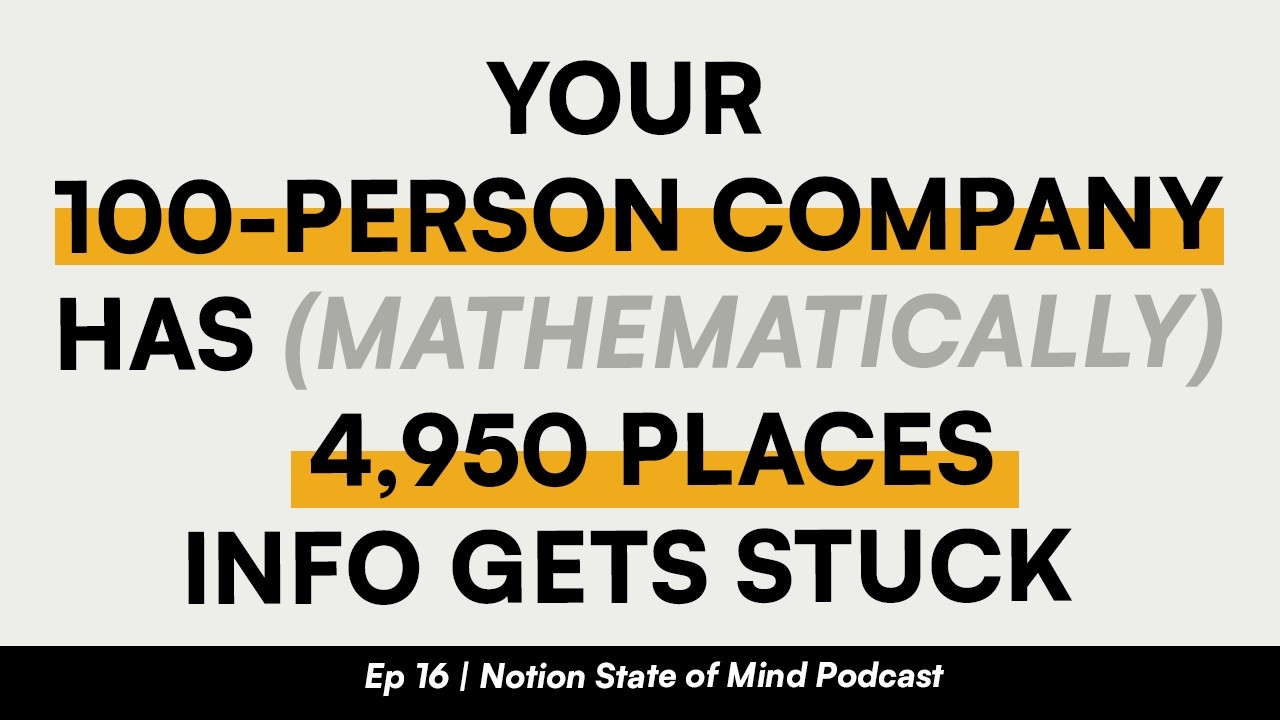
In this conversational video, the participants explore how the network effect (Metcalfe's Law) applies to modern organizations, illustrating the exponential growth of connections as teams expand (handshake analogy, 3‑person, 10‑person, 1,000‑person examples). They discuss human limits on managing relationships (Dunbar's number, span‑of‑control ~7) and how hierarchical structures attempt to mitigate the combinatorial explosion of communication pathways. The dialogue then shifts to Notion’s role as a central knowledge hub that consolidates disparate tools (documents, spreadsheets, briefs) into a single, self‑service platform, thereby reducing friction in information sharing. AI is presented as both an enabler—traversing connections across Slack, meetings, and documents to surface relevant context—and a source of additional noise, potentially creating a “black‑hole” of information. The conversation expands to concepts of shared cognition (collective processing akin to a ship’s navigation), emergent behavior in complex systems, and the need for “composable context” – structuring data into modular, reusable layers that AI can efficiently query. Throughout, the speakers balance optimism about AI‑augmented knowledge flow with caution about over‑complexity, emphasizing the importance of human‑legible, structured data (the “oil of the 21st‑century”) to keep organizational insight scalable.
Chapters
He would always say data is the oil of the 21st century. And it's not untrue even still in this moment.
All right. Today we're talking about the network effect and we'll discover with you why that matters in our world. I think we have a very deep belief in this concept. It's very relatable to organizations, knowledge, just probably about everybody that works with other people. So yeah, we're going to talk about the network effect, oftentimes referred to as Metcalfe's Law, and how that works in organizations, how Notion plays a part in that, and maybe even start asking ourselves, how does AI change or play a part in this as well. We're going to discover it along the way, I think. But yeah, this, this all stems back to, well, definitely not an original idea, but a few years back when AI didn't even kind of exist in a popular sense, just thinking about the way Notion, like what, what purpose Notion serves, kind of discovered this, this idea of the network effect. And really it can be summarized in The more people that get connected to a network, the more valuable that network becomes at an exponential rate. So as you add each new person to a network, the number of connections that that person can make to all the other people in the network and new connections those people can make to that person increases exponentially. So Bryan, uh, you kind of talked about this as like handshakes. What's the picture here? For the network effect and how, what we're talking, like, what am I talking about? What exponential, what do we even mean?
Yeah, I think there's two things that I'll respond to that. The value of the network expands exponentially when the value is attributed to the number of connections. So phone networks, the more people with phones, the more valuable the network it is. I think there's another way to look at it is the more connections you have, the more touchpoints there are required to communicate information. So when we're thinking of something like a phone network, more people is better. And we're thinking of something like an organization, like the clients we work with. The more people means more need to coordinate. And there's, there's challenge associated with that. Um, but I guess the value of that organizational network is the more people, the more knowledge being created. And that's, I guess, the corollary there. But the handshake piece that you're referring to is, I think, a simple way of explaining how it is exponential in nature, the more people that are involved. And when you think of if you had a group of 2 people, it takes 1 handshake for each person to shake hands with one another. When you have 3 people, it takes 2 handshakes for each person, which means that there are 6— yeah, 3 handshakes means there's 6 touchpoints there. Anyways, when you have 50 people, then you have 49 other people that each person has to shake hands with, which means that the total number of connections there is like I don't know, somewhere in the 1200s or so. So it's the more people in the network, the more connections that exist.
Yeah. Without forcing people to do some math, I'll just give you a couple little benchmarks. At 3 people, there's 3 connections. At 4 people, there's now 6 connections. At 10 people, there's 45 connections. At 50 people, there's 1,225 connections. That's 50 people. Uh, and when we go all the way up to, let's say, 1,000 people, which we work with companies that have 1,000 people working in their Notion workspace, the number is 499,500 connections, which is not feasible for, for a single person to really manage that. Right? So this is where, you know, a phone is, is a really good example of the network effect or handshakes because. You can only, well, I guess you could handshake with two people at once, but the idea is like you have one handshake at a time. Like you have one connection. It's literally a one-on-one, right? And organizations don't really operate that way. Or I mean, we scale beyond that, right? We move beyond one-on-one conversations or one-on-one calls. We move beyond going down the hall to talk to every single person that might have what you need to get work done. All of a sudden we're talking about we're getting beyond what a human can really handle, either just efficiently or just like mentally, right? And I think there's some concepts out there like Dunbar's number. You know, there's only a maximum amount of connections that one person can handle and they kind of put it around 150. I don't think we need to go down that, but you know, it's been kind of recognized that you can't, you can't connect with everybody. And so this really is like, I think kind of getting to maybe the core almost like the why of why Notion exists, why it's so compelling. And, you know, how to think of a tool like Notion, because Notion is meant to be a solution to that one-on-one requirement of a telephone signal or like a handshake. Do you see that? How do you see Notion? Like, I know we're kind of, we're kind of riffing, but like, if it's handshakes, like, what is Notion doing here? What are we solving and how are we leveraging? Notion to actually do something better?
Before I answer that question, I'm actually going to back up a little bit to the number of connections that inherently occur at a normal organization. Like when you think of a 1,000-person org and you said that it's, I don't know, 500,000 basically. That I think misconstrues the signal just a bit because organizations acknowledge this. It's not one person interacting with the rest of the organization. They naturally start to form into departments and then teams within that department and sub-teams and your actual connection points One, they have more of a linear view and they also have more of like a cross-functional level view where managers interact with managers and department leads interact with department leads or just their reports. So that's how organizations naturally start to decrease those, or manage those connections, but it's still inefficient. They have to organize in that way because we can't have every person trying to communicate with the other. We're forcing the signal to be through these pathways because we can't communicate otherwise. Does that make sense? And does that resonate?
Yeah, 100%. Introducing hierarchy, right? Like managers.
Yeah, you, you said Dunbar's Law because it's hyper relevant because the average person can only do with 150. That's in their entire life. That's not within an organizational.
The actual span of control recommendations, I believe, is like the aspirational number is 7.
You shouldn't be managing more than 7 people if you want to be effective. A lot of people go above that rank, but it's because 7 connection points that you're directly managing and then 1 to maybe a few that you're reporting out to, that's a lot of connections for you to have to manage in your own sphere. Um, and it's all because this concept of the network effect and even your small team of 10 is quite hard to manage, um, the amount of different touchpoints and make sure that the signal behind the message is viable. That was a little bit of my tangent there, but I just wanted to bring it, bring it home. To answer your question of why Notion is relevant is when we think about communicating in organizations, it's not just voice-to-voice communication, but it's also the sharing of knowledge through a message or the sharing of information through an email, um, or the presentation of that on a call. And before Notion. That occurred person to person or team to team across multiple different software. An Excel document for the project plan, another Excel document for every task, a Word doc for the brief, so on and so forth. That means every connection that you are sharing that information with, you're sharing 1 to 3, 1 to 4 different pieces of software that people have to be able to digest and organize their information in. And Notion gives us the ability to start to centralize the, at least information sharing aspect of this into one place. So you're not switching from app to app. You're just sharing that information within one place, or you have the ability to self-service it in one place. And I think that's where Notion plays a really important role in making it easier to communicate and bridge these different connections.
I had a thought and I lost it because Ashley is brooming our window on the outside.
We can hear it.
Okay.
We do have a lot of spiders. Hey, hey, they're really good for the backyard and the environment. We have a lot.
I'm battling with that. I'm like, yeah, they're good, but man, they're— we have like, there's spider webs everywhere. Like all of our, all of our bushes and our grass and the front.
Like, I'm like, you could probably make a connection between a spider web and Metcalfe's Law.
Probably. Yeah. So how does AI kind of fit into this?
I actually don't like that, that plug into AI.
Um, well, won't AI just solve all of our problems here? Being a little facetious.
It has the ability to enable us to traverse these connections much easier because the chat agents we work with, Notion AI and Claude and ChatGPT, via the MCPs that they use in the way that they traverse data, it's basically the same way. It's like, look at this Slack channel that I spoke with this person, find out the last 5 things I said to them, then go to Fireflies, look at my last 5 meetings with them to provide me an update on my recent comms with them. Like, AI has the ability to do that quite effectively, and it reduces the amount of live touchpoints that I need to have or synchronous touchpoints I need to have with the other person to get the information. So AI absolutely gives you the ability to traverse the network much easier. Where AI poses another interesting piece is it's also creating volumes more information. And so that status update it just captured, that's going to be deposited somewhere. And that's another piece of knowledge that somebody has to be able to source or the other person's chat needs to be able to find. So AI gives you the ability to move faster, but it also gives you the ability to muddy the network.
Yeah, I think what kind of comes to mind when you, when you bring that up is almost like a black hole. It has so much density that it just collapses itself because it's creating all of its own context and then consuming it, then recreating context. That's the danger, I suppose, is just, just turning into a nothing burger, right, of usefulness.
You were talking about that earlier today on a call, and I won't butcher what you were getting at, but it's the concept of figuring out how you can abstract signal out of the information and have that be what is leveraged by the LLMs, I think, is such It's going to be the secret sauce to getting these tools to work effectively over time. It's not the 7,000-word transcript. It's the 5 actual core insights from it or the decisions from it.
Man, this, this thought, I'm not going to say it keeps me up at night, but it wakes me up in the morning and I spent a couple hours just researching this. I love being able to do that because I want to make sense of it. I don't even know what the question is that I'm trying to ask, but it's like, what is knowledge? Or what's worth remembering? Or what is it that we're even trying to accomplish? Because I think we all feel I think the problem that we solve is one that people absolutely resonate with. It's like, yeah, of course, uh, I need this cleaned up. I do the same work over and over. I'm looking for information or I'm solving a problem that should have already been solved. And maybe the solution was in an update meeting, but it wasn't decomposed into its smallest pieces or components to actually be useful for me.
I didn't hear it that time.
Sorry, my, my wife is outside. Brooming our windows for spider webs. She doesn't even notice me. So I'll continue. There's like this felt problem that everyone in knowledge work deals with. And I think we've just kind of taken it for granted up until now. And now everybody believes that we shouldn't have to deal with this. And it's re-solving problems, or how do you break, how do you break down knowledge into its most composable forms? So that you can pull out the good stuff and leave all of the context. But the caveat here is all that other context might still be useful for somebody else to pull from in a different way, or it might be useful when you're reevaluating why we made that decision. You know, when we took this as truth, as the artifact to build on top of, we built on the conclusions that were established here. And if I'm going to do that and just pull the conclusion and not all of the reasoning behind it, I am basically trusting that this is an accurate representation of the truth and reality. And the world is always shifting. And so I'm trusting that we even made a valid conclusion based on the, the current reality as it was at that point and building off of that. But you also have to realize the world changes, right? And it's never going to always stay the same. And so as I'm reevaluating it, if I don't have at least access to all of the reasoning and decision-making that went into making that conclusion, I lost it, right? Like I've lost the, I guess, institutional memory. And I've just been building off of— it's almost no different than knowledge that lives in people's heads. If you don't have the reason behind it, you kind of lose the ability to for it to be alive. It's almost just kind of like dead or maybe just crystallized and not doing anything anymore. It's not organic anymore. Does that make any sense?
Yeah. Well, one, I think it's funny because it might come back to a term we were talking about with Ali a couple of weeks ago and judgment. But I actually think there's one, it sounds like you're having a crisis. Um, cause there's a lot, a lot of, a lot of conflicting concerns about our future. Um, but they're all valid. I think at the beginning you said you took it, everyone just takes it for granted that this isn't possible. But I think everyone just compromised that. We didn't have the power to be able to abstract the insights. We had to rely on an individual that consumed that information and their judgment, or we had to do it ourself, right? And we couldn't do that for every piece of information. So that's just something that we had to make a compromise with and, and really invest where we prioritize. The second piece you really touched on is like the actual important bits of the information differ based on the perspective of who's consuming that. So how do we create that picture for every person? Without creating a lot of noise. No idea how to solve that piece.
Well, I think the moment that you crystallize those artifacts, you remove— like, you're crystallizing the perspective that you got the artifact from, right? So I almost want to push back against the, you know, we kind of joked like it just turns into a black hole of nothingness. Maybe that was the previous world, but maybe with tools like AI where effort is kind of almost limitless, or like workforce You know, it's like as computers got better and better and better, there was almost this law that basically you should treat storage as free because it's always going to get cheaper and cheaper and better and better. Whether or not we hit that wall or not, I don't know. But maybe there's almost this concept in work. And what I mean is by like execution of knowledge work, not like the strategy and the ideas and the taste and judgment. Maybe that's the parallel here is that is now being treated as this almost like a limit. Less resource that you can take advantage of. And so if that's the case, what is the most raw, unprocessed, unperspectivized, if that's a word, material that you can, you can put into your company or give to your company? And I hate to say this, and I don't even know if I believe it yet, but it's almost like brain dumps.
Yeah.
Tribal knowledge, right?
It's almost like it's people's worldview. It's their view of the world. So within a business context, it's their view of the world according to their business, right? And they might have gaps, they might have differing opinions to other people, but usually you kind of almost like a shared worldview in your area, at least in your lane, but there is room for misinterpretation, miscommunication, right? But everybody has a worldview, whether it's correct or wrong. So it's, it's actually the company's in their best interest to align those and flag where they are misaligned. And so it's, maybe there's like this world where people just present their worldview to the black box of, you know, Mr. Company. Uh, sounds like a terrifying future.
I'm so happy that we've gone from a fatalistic viewpoint of this to an optimistic one.
Uh, cause I, if I ever had a fatalistic view, maybe you took it. You called it a black hole.
Like that's the absence of existence.
I was just meaning like it, it, yeah.
Okay. Sure.
But no, I hear you on the, on this front, but I'm aligned with that optimistic future where it's like everyone has their worldview and then the structured version of that becomes the company's worldview or the company view, what have you. Um, but I think what you were getting at, it reminded me of a manager of mine back in, I don't know, 2014 when I was at Deloitte. He would always say data is the oil of the 21st century. And, uh, it's not untrue even still in this moment.
It's context. So I guess the, the unstructured format of that is the oil of the 21st century in the AI world.
And without any doubt, the most successful and capable and competent models of the future will be able to traverse these wealths of data and create insights. But I think it's our job to find and create the systems that structure the data so it isn't a massively cost-expensive exercise to digest this information. It's an efficient way to do it. And humans can also traverse it as well.
Yeah, I was just reading an article because I'm a nerd, uh, and the proposition was that your company is essentially defined by the components and how you organize them together. Basically like the schema of your business. Like what are the entities? How do they relate to each other? And how do you organize them? That's your choice, right? And that's like a very fundamental decision that you make about your company.
I always actually found that interesting about Notion and how they created their product teams. And it correlates with what you're saying. It's like they structure the way that they build products based on collections of surface areas on the product itself.
They have a collections team and everything related to databases fits into that. And I think that that is a really interesting way that organizations determine their own future.
Yeah. I'm also chewing on this idea that I never really considered of shared cognition, which is, and this is, this is a real effect that, that happens. Maybe it's actually simpler than I think it is, but in systems, where no single person actually does all of the cognition to get the output, right? And the example that was used was actually like a ship's navigation. And maybe this was more of an old school navigation, but it was like it took one person taking readings and sending them to, you know, a certain person, and that person would, would log them and then also relay those to the captain. And, you know, so it's like there isn't one person actually bringing the ship into harbor. It's not just the captain. The whole thing is like the brain, I guess, like the shared processing of how to get the ship into harbor safely and where the ship currently is located is not done by one person. And maybe computers kind of just abstracts all of this concept away where people don't even think about this as a reality anymore. But when we talk about organizations of multiple people, we're really talking about like a shared cognition, shared systems. And when you talk about systems, a lot of behavior becomes emergent or the outcomes become emergent. Like you don't actually sometimes plan on what's going to come out of this system. And it's almost like a black box where, you know, you sometimes don't know what you're going to get out of it when you put a bunch of people into the same room and ask them to do something and all of a sudden things happen that you weren't expecting. Is that relevant to this conversation? I don't know.
I think it's directly related to Metcalfe's Law.
It's every connection point is a different, I guess, piece of shared cognition. And every person that you add changes the entire map. And that can change the whole future and output of the organization from a culture perspective, from an output perspective, from a decline perspective, from a growth perspective. So I think Yeah, I think that's pretty spot on.
I think if we brought this all back to Metcalfe's Law and we look at the diagram of connections in general, it's very scary for organizations and it's even scarier when you put AI on top of it because it can help you move faster, but it can also add that additional foggy layer of more information. And the role that we play in organizations is like understanding Metcalfe's Law and Brooks' Law. These, these exist and these are challenges and there's very real value and problems that come out of it. But our job is to figure out what are the the pathways that are traversed the most and make those the most efficient pathways. And we can do that easier now by leveraging AI to understand how does knowledge communicate, where can we build agents to take out the manual communication steps.
But it's very much creating these predefined pathways of communication to reduce the, the weight of exponential connections in the organization. I think that's really the value that we bring into it.
You have in your Math Breaking Magic article from 2023, you have a diagram where it takes the, the mesh network of Metcalfe's Law with many connections, and then you have one where it's just dots on the outside and then us in the middle. I don't know that we're actually the ones in the middle, but Notion might be, or whatever the context layer is in the middle. And our job is for making data get to that in the most efficient way. That way it can be led to its most important recipient from there, or pulled from any relevant recipient.
That's really, I think, the value of understanding Metcalfe's Law and our services and bringing it together with Notion and AI today.
Yeah, totally, totally. Um, you got it right. I was just trying to brand the concept with our old logo, the brain. Uh, but absolutely Notion is what's in the middle.
Brain's accurate though. It is the brain in the middle.
Yeah, the company brain. Definitely not us. Didn't have us in mind. I don't want to, I definitely don't want to take that on, right? But yeah, there's. I know I keep using the term black box and Notion's not meant to be a black box. It's meant to be human legible, right? You're meant to be able to see kind of the conclusions inside and kind of, I guess, reverse engineer some of those conclusions and the reasons behind them to make better informed decisions. That way you're not making decisions just based on, oh, this is what the black box told me, right? Like that's, that's, I think the, in an AI world, that's where Notion's becoming really useful is decomposing business knowledge into pieces that you can take or leave or, you know, evaluate, not have to carry the baggage of understanding every, absolutely everything that the company knows all at once. Like nobody can do that. So how do you, how do you do it in a way that people can take what they need, do what they need, you know, and not have to relearn how to do calculus to be able to do their work or learn calculus for the first time ever. Throwing shade at myself.
I think we're going to wrap soon, but I want to highlight a phrase that you used earlier that I think is probably going to be a common part of my day-to-day vocabulary is the concept of composable context is such an important one because right now when you build a Notion system, you're just creating zones for all of the context. And we do need to figure out how to find the abstracted layers of this that drive value as the data starts to scale. And figuring out how to create this system that can find the correct composable context and then build it into the systems that drive insights for business, I think is the next key layer to be on.
Yeah. Yeah. I almost wonder if like, you know, if you could define your business basically by how you organize your components and your, basically your ontology of your company. Almost getting to the point where like, if people do kind of have the ability to brain dump and you have to teach your company brain how to compose it in the way that your company makes the most sense out of that, like, is that composability universal or is that your competitive advantage as a company? You know, being able to compose it in the way that will best serve your people and your agents and all of that to be more, you know, sharp in the direction that you want to take your company in.
Maybe. Yeah. Metcalfe's Law to composable context.
Let's go.
This will either be somebody's favorite episode or they would have stopped listening 2 and a half minutes in.
Yeah, this was a wild journey. There's some really interesting things that we touched on though. I don't think we went very deep in anything, but we touched on some really interesting concepts.
More from Bryan




Bolt-On or Built-In // AI-native services, scaling, and the people who make it work