How Notion Is Building a New Category of AI Consulting Firms
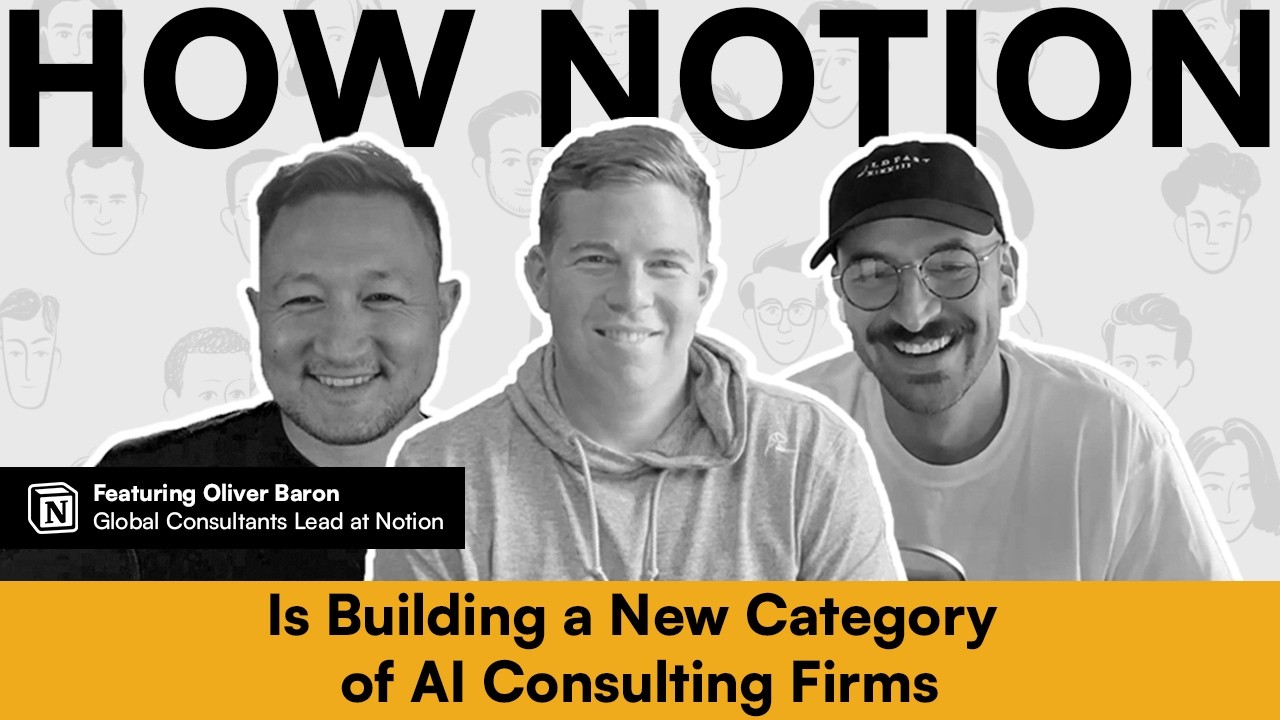
Ollie Barron, Notion's Global Consultants Lead, explains how the company is building an AI-native consulting ecosystem. Notion's Setup/Startup Sessions program has delivered over 16,000 free calls, and consultants using the Collaborative AI methodology are seeing margin improvements up to 70% by capturing judgment as reusable assets in workspaces.
Chapters
the gap between tools and the outcomes people want from those is wider than ever, and it requires a lot of judgment to get people there.
All right, welcome to the Notion State of Mind podcast. I'm your co-host and co-founder of Notion State, joined by my co-host and co-founder Bryan Takayama. And joined by a special guest, Ollie Barron, Global Consultants Lead at Notion. Ollie, super stoked to have you on the podcast.
Yeah, super excited to be here. And, um, I'm a big Knicks fan and I haven't stopped listening to New York State of Mind since they won. So when I hear Notion State of Mind, it just, you know, brings all the good feelings of victory to light. So thank you guys.
Congratulations on the victory in the championship, by the way. Very exciting times.
I've done a lot for the franchise. I've been a loyal fan for 20 years, you know, so I feel like I deserve this plane. I deserve it.
I feel that way as a Browns fan, but that doesn't get me very far.
No, no, no, never, never will, unfortunately. But cool. Yeah, super stoked to be here. I know we talk a lot about a lot of different things, you know, whether it's how do we build this ecosystem, how do we make sense of everything that's happening in the world of AI. What role does Notion play in all of this? How do you build a services business? How do you solve the minutia of like, hey, this client's given us problems? So it's exciting to be here and to just maybe talk about all the things we are talking about in our calls all the time. And it's my first podcast, so I don't know what to do with my hands if I keep them like this or not. But yeah, good to be here.
No, thanks for joining. We really appreciate you investing time to have this conversation with us. I think you cover such a breadth of different categories and topics for Notion. Across the entire Notion consultant community. I think there's a lot of value that we're gonna get. And you also just released a really awesome article on, on LinkedIn. Before we do that, Josh introduced you as Global Consultants Lead, and you started to talk about a few of those items there, but tell us what that means and tell us a little bit about your background too and why you're well positioned to be Notion's Global Consultant Lead.
It's a great question. I feel like I'm re-interviewing for the job again, but, um, yeah, I guess, um, so my title is I am the Global Consultants Lead. Here at Notion. I've been at Notion for 10 months. It feels like I've been here for an eternity. Things are just moving so fast and transparently, I've just like never had so much fun in my career. And I think in, in large part it's because just the amount of, the amount of tact and joy that this brings you all is just infectious. Like you're, you are all finding your life's work and anytime you have an ecosystem of experts that's born from an organic community, people like you that found Notion in your work and fell in love with it and decided to build a business around it. You just get so much more fulfillment out of working with partners like yourself. And I've worked across the gamut, you know, as we've talked about, I started my career at HubSpot in 2011 at kind of an interesting time just in the world. I had just graduated right after the recession, saw just this really interesting dynamic where this technology came to light that democratized a lot of things that historically were prohibitive. So in the past, you needed a lot of money to gain attention. Then all of a sudden, inbound marketing as a methodology came to light and people could get found and could drive traffic and could get leads without having to spend as much money. And Despite the fact that inbound gave people this methodology and said, hey, like, you can blog and you can drive traffic yourself, there was still a gap between what the tool could do and the outcomes people wanted to achieve. And I was on the ground floor of talking to hundreds and hundreds and hundreds of different agencies that were navigating that shift and was given an incredible methodology to be able to offer to these agencies to say, hey, you're doing individual tactics, you're running a project-based business model where you're selling a web design project and then you're delivering it, then you're hunting for the next one and revenue's lumpy, or hey, you're an SEO firm and you're building your entire business around one tactic, you drive traffic, but what happens when Google changes the algorithm? And inbound as a methodology not only gave these businesses a way to reintroduce and readapt what they do, but it also gave them a repeatable delivery mechanism that allowed for them to turn a one-time project into a recurring revenue-based business model, predictable revenue, easy to scale. So ultimately it was just fascinating to be at HubSpot, and I also was there for 12 years. So every time there was a new, you know, technology shift, every time we launched a new product, it created demand for new services and we were constantly giving our partners ways to adapt and expand what they do. And then, uh, the last 2 years I was in a different ecosystem. I went to a company called Attentive where I was building our network of partners that were responsible for driving SMS and email programs for large brands. And that was just a much different philosophy. The TAM was a lot smaller because there's only like one Nike, right? There's not hundreds and hundreds of Nikes. So the way we use partners was just really different. So I've kind of seen like every end of the spectrum across my career, both ecosystems that require a huge network of partners that can go out there and convince businesses that there's a better way of doing things. And also, um, a smaller TAM where you need partners' influence and expertise to help unlock pipeline and solution, uh, customer use cases that you can't staff up or, um, satisfy yourself. So, um, lo and behold, here at Notion talking to all of you.
That's super cool. And I think what's really neat is that you've stayed in a very similar lane your whole career, but seen it in different scopes and environments. And now with such a different, I guess, technological environment, what parallels do you see from your early days at HubSpot to Notion? And where do you see it starting to deviate?
Yeah, well, I feel like, um, in the early days at HubSpot, we had an ecosystem that was born from genuine love of the product and just a community origin. So you had people who started off becoming HubSpot partners that had backgrounds similar to the backgrounds that you all have, whether it's management consulting, whether it's they were just high-agency operators that were working at a field services company and were the person that was, you know, was the person that actually implemented HubSpot and was like, oh, I should I should do this. And I think the parallels to me are like the, the J curve of just people joining and finding this at a time where it's on the up and, and on the exponential and how it just created this new category of business model. You're able to deliver this system to clients in a repeatable and deliverable way. And I think fast forward to where we are at Notion, we have people that come from even more diverse backgrounds across I think 47 countries right now is the breadth of our ecosystem. We have consultants that were like management consultants. We have some consultants that were former architects. We even have a consultant that I believe is a former cake maker that found Notion as a way to manage her recipes and, you know, decided, hey, I'm going to start a business doing this. I think the really unique thing about this ecosystem is just the quality of system thinking. We're no longer confined by some of the boundaries of legacy software where you need to think about the implementation in the context of how are we going to map the way the business works into these objects. And oftentimes I always felt like most of my conversations with our partners was like, what's the workaround here? And it's kind of fascinating to see a world where the database that you build is no longer bound by the objects, the records, the properties on those records. Like you can kind of just architect a database however you want. And that just requires a different level of system thinking. And I actually find at times that when I talk to you guys, I'm like, hey, you take a look at this database. I just want your, like, your wisdom on this. And yeah, I'm just so impressed by just the caliber of people in our ecosystem and just how much joy the work brings them. It's fascinating.
Yeah, if there's anything I love about the ecosystem, I have to shout out to the community in general. And this was even kind of early days of, you know, the consultant kind of channel. It was just people that loved Notion. That was me too, right? Uh, just love the software and there's no better, you can't ask for any sort of better skill to bring to starting a consulting business than love for the product that you're going to consult on, which is just such a funny thing to say that we love software, but anybody who's been online in the last 5 years, it's very obvious that there's like a genuine love. And community for Notion for, you know, whatever reason that is. So, uh, happy to jump on that ship.
Can't say I had anything to do with that. Uh, credit, you know, Ivan and Simon and Akshay and just the, the Notion OGs for creating just a beautiful product and coming up with a culture that people just fall in love with when they use the product. I also think one thing that's been super interesting is just the constraint that we're trying to solve for. Is just so different than what we were trying to solve for in 2011. You know, in 2011 we were trying to convince thousands of businesses that they had to blog and do social media and, you know, have a website that's really well architected from a content perspective. And that these businesses had to publish content very regularly. And when you're talking to like a manufacturing company that makes plastic molding bits that sells these bits to another, you know, company in the supply chain and you're telling someone that's been in business for 40 years that they need to start doing blogging. I think they kind of look at you like you're crazy, but we needed partners that could go out there and convince people that, hey, you need to do things differently. The constraint that we're solving for right now is super unique because we have millions of people signing up for Notion, you know, every single month. And a lot of those people see Notion's potential, but after they sign up, they just don't know how to get from like, hey, I signed up and I kind of built some cool stuff to now Notion is a workspace that humans and agents can work together on top of beautifully architected context. And that's why the initial hypothesis that kind of, I assume kickstarted my candidacy here was this setup session program. And maybe I can just talk about that really quickly because I think it's just a signal at how much demand there is for this level of expertise. And how integrative the value proposition is between what we offer to customers and how that helps our consulting partners. And kind of what, in my opinion, gave me a little bit of inspiration for why I wanted to write an article. In addition to the fact that I just wanted to, you know, show my mom that all those years of schooling, I can still write. But we had this hypothesis that if we were able to give a new customer a free call for 30 minutes with a Notion expert, that, that customer would get value more quickly. And I think we've year to date, we've fulfilled over 16,000 calls across 10 local markets, 10 local languages, and across over 200 experts. And the fascinating thing about those calls is, yes, some of them are like, how do I build this? But a lot of them are focused on more upstream work, right? The judgment piece, the craft, the wisdom, the system thinking. And on these calls, most of these people are just beginners. They think they need AI. They're talking about agents, but the consultant's actually able to spend more time on how they work and what the workflow is that they're trying to solve for and why it's important to them. And then connecting the dots in a really short amount of time between what that client is trying to accomplish and how Notion can help. And if you think about any other piece of software in the world, like to be able to show that much value in 30 minutes is incredibly hard to do. Like you can't actually demonstrate in any legacy SaaS product in 30 minutes how a tool can satisfy a use case. And that's just giving us so much insight on what customers are looking for and how much the constraint is around activation. And this program is, is doing two things. It's getting clients to activate faster within a 28-day period. And secondly, it's giving consultants an on-ramp to start actually building their business, building their context moat. In their own workspace of all the different decision traces that they've solved so that they can sharpen their judgment for every future engagement. And we're starting to see just across the ecosystem this incredible change in how folks like yourself are running your business. And it's breaking the mold on the traditional 40 to 50 hour work week, service-based business that's based on utilization. And instead it's making the work more upstream and it's producing margins that I've personally just never seen before. And, uh, it's turning the delivery into a product and it's just unlike anything I've ever seen in my career. So I'm just fascinated by it.
It's really exciting times. The Startup Sessions program is so neat to see where it started and now to hear 16,000 calls to date. It's really incredible. And I think one of the key things that you highlight with it is when you first open Notion and you don't have anybody to talk to, it's like blank page shock is what we've always termed it. And it's really hard to get from there to any sort of value, but But a 30-minute call can immediately get you on step 1 of a very long journey. And it's really cool that you and Notion are invested in helping people along the journey. It makes a huge difference. We just hired someone who one of their resume items was, I conducted 150-some Notion startup sessions, which I thought was a pretty interesting resume line item. It is.
And you know, every ecosystem that people want to emulate, if you look at like HubSpot, Salesforce, Shopify. They've created their own industry of people that make their careers around making the software successful. And I view the setup sessions as this on-ramp into the AI economy. And that's how you get the flywheel going for your business. And there's so many people around the world that find Notion in their work and just are high-agency operators. And Notion is a tool that just allows them to operationalize the way they, they, the way they think. It just makes sense for them and So many people right now, I think, um, are maybe a little disenchanted by corporate America and just have never seen a better time to build their own businesses, but don't necessarily know how to. And I think that's one of the things that we're solving for right now is we're in an abundance opportunity where millions of businesses are trying to work better. And I think at one point we said that knowledge work is a, you I don't even know what the TAM is, but knowledge workers are omnipresent, right? Everyone is working in front of their computer. So the opportunity to bring Notion and the transformation is just unlimited, exponential. And we want to bring more people into the ecosystem that want to monetize their craft and their judgment and want to build a business doing AI consulting. And I think it's coming at a time where the market is just so noisy with like, how do you actually do this. And that was like one thing that I kind of wrote about in my LinkedIn piece, you know, not to promote my book tour or anything like that, but—
You should absolutely be promoting your book tour. All right, cool.
All right. I just didn't want to be too shameless here, but I just remember there was a point in time in the early, you know, 2010s and 2015 where the SEO Ninja was like a persona. And I'm not even being facetious. That was actually the name of the persona, the SEO Ninja. And all of the promotional content was like, here are the 5 tips and tricks to get your client to the first page of Google. And here's how you build an SEO consulting firm. You know, do on-page SEO, add keywords to the HTML elements. And I just can't help but look at the current dialogue and say it feels exactly the same. If you go on LinkedIn or Twitter right now, you'll see comment prompt to get this, you know, this prompt that replaced my client's entire RevOps team or Here's how to build an AI consulting firm in 30 days by selling second brains as a service. And I think what we've learned from the SEO era is that when Penguin went live, it fundamentally changed just the overall business model for a lot of SEO firms. It put way less emphasis on on-page SEO and put more emphasis on context. So it's not just about SEO, it's about your blogs, it's about your landing pages, it's about your social media posts. It's about making sure that there's consistency between what people search for and what's actually on the pages on your website. So I think we're in that place right now where so many of the tactics are model reliant. And what happens if you build an agent for a client and you deliver that agent to the client and all of a sudden the model depreciates or another LLM says, we can do this significantly cheaper. All of a sudden, the service that you thought you were charging $40,000 for needs to be completely rebuilt. And how do you do this repeatedly with a methodology? And what I find is that the antidote to tactics, which are, you know, they come and go and they're very liable to disruption from model changes, as we saw from Google, and as we're seeing pretty much every week now from the LLMs. Methodologies tend to compound and tend to be the antidote that allows for people to build real durable practices. And I think everyone right now is trying to figure out who is an agency or a system integrator or a SaaS consultancy. All right, the work we're doing is getting compressed. Our clients are coming to us with something that typically would've taken us 90 days, and that was like the purchase validation phase where someone signed up for our service. And we showed our value within those first 90 days of that first deliverable, because that was the point in time where we validated to the client, hey, you're buying our service because we have expertise and capacity that you don't have. And now when a client's like, hey, just open this chatbot and put together a, a website design mockup that looks pretty good, it kind of diminishes a little bit of what the agencies and the consultancies and the system integrators have been doing for their entire career. And even though most of the work that the client produces is not going to be compatible with how an org actually works and will probably fail immediately. It just still changes the conversation. And I love methodologies. Obviously had a great one behind me when I was calling on all these partners inbound, obviously. And the collaborative AI methodology is something that I find to be just remarkably similar to inbound in that it is about the system and it always, the work never ends, right? Because it's one workflow at a time. It's about identifying the value of that workflow, quantifying it, then actually focusing on the context layer of like tuning the dials. How do we make all of this data flow correctly into this workspace? How do we understand how people work? Then how do we build the actual primitives that are beautifully architected, um, that get everyone rowing in the same direction? And then how do we layer agents on top. And once you do that for one workflow, all right, how do we improve that workflow or how do we move to the next workflow? Um, and then the engagement compounds, your margins compound. So I'm just fascinated by the work that you are all doing to bring this methodology to light.
I was reading through your article. There's, there's a few kind of one-liners that stuck out to me. And on what you just said, you said the engagement renews not because you signed a retainer, but because there's always a new problem worth solving. Right. And I think that's actually in my mind, if I could simplify it, because I'm a simple man, it's like, let's be problem solvers. You know, there's, there's a lot of different tactics. There's a lot of different strategies and approaches and methodologies. And you're giving us good stuff at the end of the day. Like, let's solve business problems. And if you can get to the highest layer of problem, you know, go upstream in your words, that's where the real value is found.
Yeah, 100%. I think the pitfall right now is like, let's take an example. Let's take a school or a nonprofit that provides computer science services to underserved school districts in a city, right? And let's say right now they have 100 schools that they've been able to match, like a computer science expert, cuz they wanna offer this service to these underserved schools and communities. And, uh, right now they can only serve 100 schools. And the reason why is it's just really hard for them to match the right expert. Or the right computer science expert or teacher to the right school district based upon availability. I think everyone's first instinct is to say, let's build an agent. Like, let's vibe code something in Claude or, you know, uh, in OpenAI, et cetera. And the reality is that just fails. It's the same dynamic that we saw with SEO firms, which is like a business saying they want to grow. And it's like, let's just get you to the first page of Google. And I think instead of just being really quick to sell the tactic, it's important to do the system thinking up front to understand why is that workflow broken today. And let's just say you were able to serve 200 schools. What does that mean for your business? What does that mean for your mission? And getting kind of that mutual contract and buy-in on why that's important is how you create the flywheel of the always be renewing type of engagement, um, as opposed to being like, we're going to ship you an agent, then all of a sudden it's like, well, how do we hand it off? Like, what happens if it doesn't work in 3 months? Is the client going to really pay you to fix it? And then also just the difference of like, well, can I just do this myself if I'm a client? Like, I, I have the same chatbot that you have.
Yeah, on that note, I often think about like— and I actually don't know if I have like the clearest answer here. I'd be curious, you know, just off the top of your head. But I, I am a firm believer in writing is thinking. So a lot of people think of like, oh, you, you think and then you write, but really when you're writing, you're actively thinking intentionally and focused. And with AI chatbots and everybody has access, everybody's kind of, they're kind of offloading their accountability and responsibility of judgment, of thinking to the chatbot. And so it's like, if writing is thinking, what is thinking? Like in the new world, I feel like thinking will just be this almost analog, you know, superpower to bring to the table of judgment. You know, everybody uses the term judgment, like. Maybe you could kind of unpack the word judgment and maybe that'd be the answer.
I guess to me, judgment, it's very like philosophical question, but I think judgment's the ability to really know what matters before the client can articulate it. And I think in a traditional services firm, judgment just like if a client invested in support for their CRM or their website, the judgment was very siloed in the actual people. And what that meant is that one person could only manage 5 to 6 clients, and that judgment was just capped based upon the 50-hour work week. And when I think about judgment in the context of our world right now, it's this idea that, you know, you're making your judgment reusable because every time you work with a client, that's that context and that judgment's getting, you know, architected inside of your workspace. So the work that historically capped you from scaling your judgment and making that value accessible to more people, your brain just being available, was just capped by the hands work that required you to actually do the service. And now so much of the work that you guys are doing is, is so far upstream. Where the building is compressed. I mean, your first deliverable can be delivered the day after a call, right? If someone's like, we want to see a database, great. We're going to use our workspace and all the schemas and all the decision traces to quickly deploy a workspace. And we're going to spend more time with you teaching you how to use this tool, um, change management and just articulating to them how to work differently. So I guess if I were to unjumble that a little bit, to me is like, it's about taking high craft people and just making their judgment more accessible and almost exponential where someone wants access to Bryan or Josh's time. Well, now you can give more of your time and more of your craft to more people. And that's ultimately what everyone wants nowadays when the initial build is just, is kind of being commoditized. Anyone can build anything, but the difference between building a toy and building a really functional AI system engine is huge. And that the gap between tools and the outcomes people want from those is wider than ever, and it requires a lot of judgment to get people there.
Would it be fair to compare or draw a line between judgment and kind of experience?
Yeah, I mean, I think so. I mean, it's so interesting because like you're seeing experience matters, right? Because obviously, like I've spent my entire career studying the ways in which services businesses grow in between you know, this in between the, the, the gap of, of tools and outcomes. And I'm fascinated by it, not only for the companies that I've worked for, but how it plays out at other organizations. I think the cool thing right now is that you actually don't need as much experience if you're a high craft person, if you're a great system thinker. All of this technology just gives you such a far head start. And that's what we're seeing with our Setup Session program where we're bringing people in that have just graduated college and they're just as far ahead on their AI journey as people that have been in the workforce for years. Um, so I think experience has, um, always been an important pedigree, but to me, I don't know, it, it, it matters less if you're high craft and experience just can become an accelerator if your experience is like part of your context mode and is in your own workspace and all that stuff, right? So I don't know if that answers your question, but that's just how I think about it. I mean, I have my daughter making some apps at times. And when I was her age, I could have never imagined doing anything like that. I was too busy, like, burning ants with a magnifying glass or something like that, doing things outside. Exactly, exactly.
Yeah, well said. Uh, maybe an unfair question, but, uh, well navigated.
Um, so yeah, yeah, I want to ask, based on your visibility to the Notion Consultant Partner Marketplace, and you have individuals, you have people that are just doing startup sessions, you have bigger integration partners, organizations like Notion State, and without naming names, like what are things that you're seeing in the market that are working and what are things that you're seeing in the market that are not?
Yeah, I think the, you know, I have 3 daughters and the one thing that I always tell them is like, you can't have dessert until you eat your broccoli or your chicken. And I think it's actually much I think, harder conversation to have with my 3 daughters than what I see our consultants doing with their clients. But I think the analogy here is like our best consultants actually don't like talking about agents until their client has, you know, eaten their broccoli and their protein. And we have different numbers of Notion, like Notion 1.0, 2.0, 3.0, and the number's just continuing to grow. And I think our consultants do an incredible job of slowing their clients down and saying, look, We're not going to talk about agents right now. We're going to build, we're going to identify the workflow. We're going to then talk about the context layer. We're going to then build you the collaboration layer, and then we'll talk about agents. And I think in the short term, clients are itching for the ability to build agents, but in the long term, I think they're really grateful that their consultant, you know, pushed back on them a little bit. And I think it does a couple things. One is like, it's just a responsible approach to AI. As opposed to just letting token consumption proliferate across an organization. And I think you actually said it, Bryan, and I'm, I'm going to steal your line here, but the outcome is that you're not starting off with one person building 500 agents. It's a layered approach. It's, hey, let's focus on the one agent first that can support 1,000 people, and then let's nuance another agent for a specific team or a specific workflow. And then, hey, let's create a really tightly governed approach so that everyone at the organization can innovate and, and use agents, but that the consumption of tokens at that level match the value of the output. So I think that like that's working incredibly well as we think about the collaborative AI methodology, consultants starting first with that workflow, then going into the different stages of the methodology and then culminating on agents and then saying, all right, like now let's continue to iterate not only with this workflow, improve these agents, but also let's talk about where else this fits into your business. In terms of what's not working, honestly, like I haven't found anything across our ecosystem that's not working. I mean, when you're hearing stories of consultants growing their ARR, you know, doubling their ARR year over year and not compressing their margins and hitting 70% margins on engagements. I, I just don't even know how to correct or critique that at all because it's something I've never seen before. I think in my world, the gold standard was always like 20%, and if you got to a 30% margin, you were doing something remarkably well and efficient. And I think that's the difference between AI-assisted consulting where you're just trying to catch up with the pressure that your client is asking you for. Like, hey, when is it going to be done? Why is it Why is it so expensive? AI-native consulting flips the script a little bit. So AI-native consulting is like, hey, we're going to deliver you a product with really high judgment. And yeah, our delivery is not just, we're going to give you a few things and we're going to have status updates. It's going to be a ship and enable and a change management and then an evaluation. So I really have no critiques for our ecosystem yet. I think we're on the upswing of this incredible J-curve right now. Yeah, I mean, and I think maybe one area of opportunity is just selling this is abstract. I think we're all new and trying to figure this out. And I think Notion just started investing in a sales team a few years ago after just being purely PLG-oriented. So I think we can all do better at selling Notion and and championing this methodology and just making it more clear on what customers are buying and what they're investing in.
I really appreciate you shedding light on that and adding that context. I was going to push back on you and say like, what about pricing and figuring out how to actually sell value as opposed to— but I feel like you were getting there.
You know, I remember there was a partner of ours and we'll shout him out here. It's Paul Raetzer. He started an agency called PR 2020 back in the day. So started as like a PR shop and then expanded from just creating press releases and content to inbound marketing, which at the time was probably like the most logical shift because you're already an expert at creating remarkable content. Now you can plug it into the system where you can measure the value of that content. And Paul was always big on iterating on pricing. He wrote an agency called The Hybrid Agency, or a book called The Hybrid Agency Blueprint. He championed this idea of point-based pricing., and he said something that always resonated with me, which is when you price as a function of the billable hour, you're pricing based upon your inefficiency. And if I'm telling you, Bryan, like, hey, it's gonna, it's gonna cost you, you know, like $10,000 and we charge X per hour, you're gonna say as a client, well, is that good? Can I find someone that can do that faster and cheaper? Um, so I do think we need to get better just in general of like value-based pricing, selling against the outcomes. And just from my time in CRM, it was really easy to quantify that because it's like, are you willing to make a $50,000 investment to get, you know, $300,000 more of pipeline? And I think there's just a lot of parallels that we can draw from that, which is how much is this workflow worth to you? And it's not just about the time savings. Time savings is a great thing to quantify, but it's how is this investment is, you know, in Notion and in these services and in AI transformation worth to you? And going back to the workflow example that we talked about earlier with that school, if I'm able to serve 200 more schools with this service, how much more value does that mean for my nonprofit? And how many more people am I bringing the mission forward to? So I think that's, we could probably get better.
And I know it's easier said than done, but It's really abstract right now, and it's quite hard to quantify indirect spend and transition that to value, but I'm 100% alignment. Like the, the more services become commoditized based on, you know, AI augmentation, the more important it's going to be to translate the value of the ratio to the value of the services. So it's something we need to figure out, but it's a very challenging equation to bring to fruition.
It is for sure. And I think you are all probably better suited to solve it than I am, but because I've never run an agency myself, I've just been sitting on the outside.
We'll solve it on our weekly 30-minute meetings.
Hey, plenty of time, right? If our consultants can help get a workspace set up in 30 minutes and do that 16,000 times over, then I can help you all figure out value-based pricing.
Deal.
I know we've been cruising through this for quite some time. Is there anything that we're not hitting on from the article that you really want to share with those that are listening?
Yeah, I mean, I just think— I mean, one thing I'll just say as just proof in the pudding of just what a well-architected workspace looks like in practice and what the methodology looks like at an individual level I would say that my entire career has been in linear partner manager headcount, where the way that I was able to scale a partner program was by hiring more partner managers, carving them a book, telling them to get their partners to go out there and sell more licenses. And then year over year to achieve more growth, it was just wash, rinse, and repeat. Carve their book, ask them to do more with less, hire more partner managers into new books. And I think one of the things that's just most fascinating about our partner team is that it's me. I don't have a team of 40 partner managers, nor do I want to have a team of 40 partner managers. And in large part, it's because, you know, I've done the hard work with the support of folks like yourself and with obviously cross-functional team members. That have just helped me think about the system that I use to support a global partner ecosystem. And not only just how to support it, but how to help it grow. And I have agents that now do a lot of the things that have required a partner manager, which to me has always been a job that's very much so an air traffic controller. So take just a very simple but high impact task of an account executive saying they need help. And they need a partner to be brought into their deal. Well, in a historical partner motion, I would be getting a lot of Slacks and my reps would be slacking a lot of AEs trying to get their partners opportunities. Today we actually have our account executives going into a Slack channel called the Notion Consultant Matcher channel and talking about an opportunity they need help with. And the agent actually uncovers what the client is looking for, what the AE needs help with, logs that request. That database then has an agent in it that creates a match, not based upon a directory, but based upon the actual work that our partners are doing across their workspaces. And we have a database that is an expertise graph and looks at the meritocracy of your partnership. Like, how good are you at database schemas? What industries have you worked with? What tools have you integrated Notion with? What's your building intensity? And it creates a match based upon the work that you're doing. And that's prevented me from needing to hire more people to support that. And it's not just about not needing to hire more people, it's about the fact that it's no longer this tribal partner program where your partnership and your success is dependent on who you know at the company because Turnover now, I think at a company is like on average, like 1.5 years. So if you're staking your entire success of your business on one person, um, you're probably in trouble when that person leaves. And I think what we've been able to build here is this architecture that allows for our partners' expertise to shine through where they don't have to play the political games of who they know and how many AEs they know, but rather we reward partners for doing incredible work. And I think that's just really unique here. So I think what we're trying to do is build a partner program that's future-proof, that's not dependent on necessarily who you know, but really is dependent upon democratizing access between go-to-market teams at Notion and the expert network of our consultants that have the judgment and the craft to turn any messy workflow into a beautifully architected workspace to help clients get through their journey of becoming an AI-native company. From just using AI as a chatbot to, you know, using AI as a system.
So I imagine out of the countless number of people that will listen to this podcast, that there'll be some, uh, people who are interested in becoming a consultant. You know, we're talking about the ecosystem, the partnership, the opportunity. There's a lot of thought that you've put into it and building a, honestly, in our experience, like an incredible upgrade to the, the partnership channel. How would you recommend, what would you tell those people that are interested in this kind of ecosystem? Like where do they start? What kind of people does it take? Would you encourage them to jump in and where?
Yeah, I mean, I'll tell you who shouldn't join the program first, and I'm being a little facetious on this, but I would say if your thought process is, hey, this is get rich quick, I'm going to just vibe code a website with some AI slop words like transformation and I can keep going on and on. I would say that it's probably not a good fit for you. Uh, but if you're a high, um, agency operator in a company and you kind of are like the human workaround where everyone's always like, uh, hey Bryan, where do we find this answer? Or can you help us figure out how to improve this process? I would say that you probably know what it's like to solve these problems. Uh, but you're capped in terms of how far you can go because corporations and businesses are slow to move from the outside, and sometimes they're even slower to move from the inside. So I would say if you're that person that has been just dying to monetize your judgment and your craft, and you feel like you've been the human workaround for a long time, you're a great fit. As opposed to the person that's just like, I want to start an AI consulting firm because I read how easy it is to sell AI assessments and charge $1,000 for them after recording one. That's probably not a good fit for what we're doing. I think if you're an agency, like I look at a lot of these RevOps firms and web design shops, and I think about the parallels between designing a website and making that website well architected so that you can guide someone through different cycles or different stages in the buyer's journey. It's very similar to what it takes to architect a workspace instead of doing it for an external audience. You're doing it for internal team members and agents. So to me, that's just a really logical transition. And I just think anyone right now that's feeling the compression that has built a really nice business and feeling like their clients are taking more work in-house and are just feeling like their clients are trying to make sense of the AI wave right now and want the leverage, Feel like we've got a great methodology that helps you get from where you are today to actually building a real services practice, something that you can scope and deliver and staff and maintain a margin and actually like hand something off to your client that's human legible that you can actually deliver versus pie in the sky, you know, an abstract code base that the client can't really understand how it works. So Yeah, that's my point of view. And I think that, you know, the on-ramp's wide open. We want to bring more experts into the program. We want more judgment. We need, we need more judgment. There's so many clients signing up for Notion that need help. And if you have industry craft or you're just a great system thinker, I feel like we're the place to build a real practice.
It's really exciting and really exciting times. And not to potentially end this on a not as positive note, I just have to ask because we started with the concept of an SEO ninja. Is the SEO ninja of the airline right now an Ocean consultant?
Absolutely not. That's offensive. No, I don't know what they're, I don't know what they're called now, but it's just a, it's just the dialogue I see that to me massively discredits the amount of work that you all do to make AI functional at, you know, thousands and thousands of companies because if everyone just starts selling agents right now, then My concern is that not only will these consultancies and system integrators, solopreneurs, not be able to build a really repeatable business methodology, but that, you know, clients are not going to really feel the true leverage that we all know and believe AI is capable of creating to give people time back to do more valuable work with their clients at their business. And, and again, for me, like the work that I get to do every day is just so fulfilling and valuable because I get to talk to all of you.
So.
You are all not the SEO ninjas of your time. Um, validating.
Thank you.
Yes. Don't you worry.
Fishing.
Just, yeah.
Well, you know, maybe we can end on a shameless plug. If you're a person that matches any of those descriptors of Ollie's, we're always looking for some team members to join Notion State. So if not us, of course, go through the partnerships, but, uh, our door is also open.
For sure. Yeah.
And also another, not a shameless plug for us, but a plug for you, Ollie. The article is titled The Methodology Powering a Global Ecosystem of of AI-native consulting firms. So awesome article. Encourage everyone to give it a read. We'll link it in the bio of everywhere that this is posted, and then we'll also repost it on our LinkedIn as well. So definitely awesome.
Thank you guys. Wouldn't be able to even have this conversation if it wasn't for you all being the trailblazers here, showing us what good looks like, helping us define the category. And, uh, thanks for the tough questions too. Uh, you know, quantifying and explaining what judgment is, I think broke my brain a little bit, but, um, Overall, I'd say—
Sorry we only gave you 35 minutes before the episode to think about an answer for it.
No, it's all right. It's all right. But yeah, super excited by the opportunity and just appreciative of the overall community that we have because it's just, it's a remarkable group of people across so many different backgrounds. So yeah, check out our consultants, go on our website, check out our marketplace. Thank you guys for inviting me on today.
Yeah, thank you for all the amazing work that you do for the community. And I know that you're a face for the community inside of the organization and constantly fighting for us and helping get us benefits and all of this. We definitely appreciate you and all the work you're doing. And it's been really great having you for the past 10 months. It's completely changed the visibility we have into the program and the amount of value that we take out of it. So thank you.
Awesome. Love to hear it. Well, we only, I think we're what, 1% done? We're just getting started. So a lot more to do.
More from Bryan



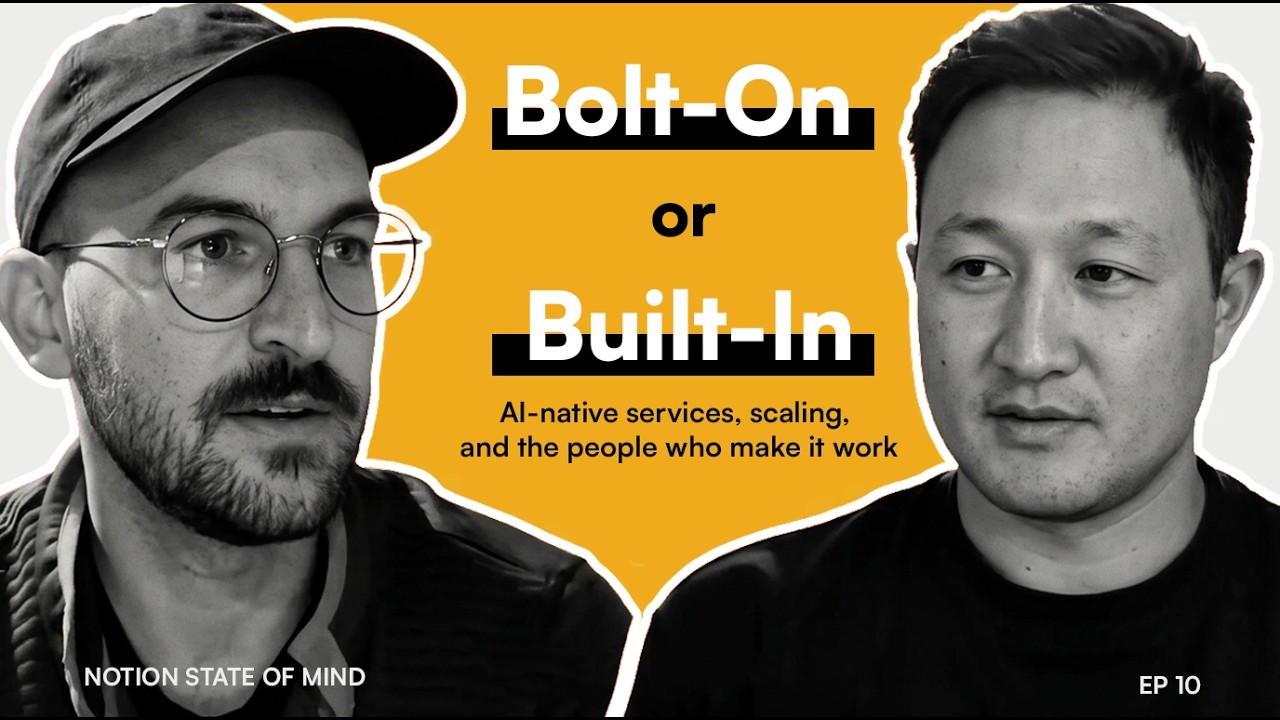
Bolt-On or Built-In // AI-native services, scaling, and the people who make it work