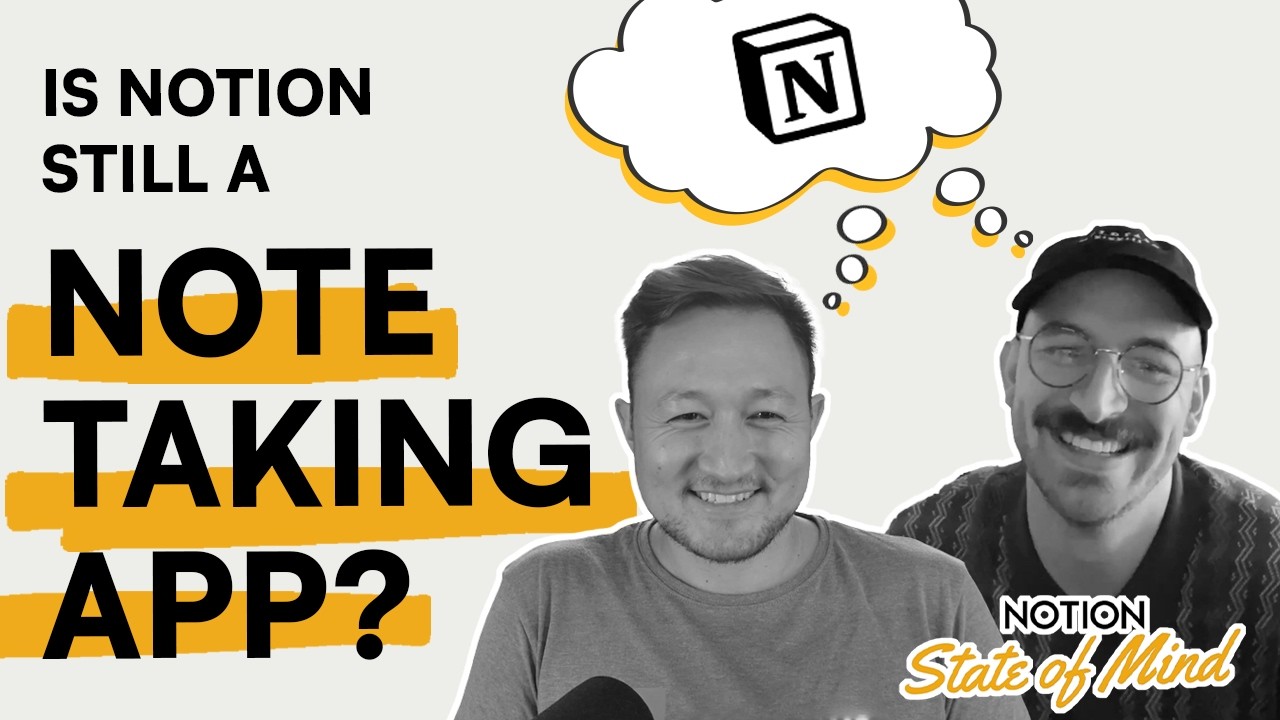
Bryan Takayama discusses whether Notion is still a note-taking app or has become something bigger. The platform started as a consumer tool for students but evolved into a knowledge-work platform with AI agents and databases. Notion's core strength is being malleable software that lets individuals bring it into their workplaces.
Chapters
Is Notion still a note-taking app? Answers absolutely yes. Is Notion just a note-taking app?
The answer is absolutely no.
Welcome to the Insom podcast, the Notion State of Mind podcast. We are back, your two favorite Notion consultants. Nope. Sorry. We're not Notion consultants. We're Notion State consultants. As Bryan would like to make very clear. And, uh, today we're talking about, is Notion still a note-taking app? Very open-ended question, but I feel like it elicits some emotion from me. Does it get you emotional, Bryan?
I think it gets me excited. So I guess positive emotion, but tell us, is it still a note-taking app to you? What do you think?
Well, if I gave you the answer, then we could just call the podcast over and move on with our day.
But in normal fashion, we're going to disagree and then ultimately make Meet in the middle.
We'll come back around like a horseshoe for sure. But we got to be good content creators and really stretch it out. No, but I mean, the background is, let's just be honest, like very clear early days of Notion. Well, honestly, just a few years ago, Notion was the de facto note-taking app. Like that's what everybody loved it for. That's what it was marketed as. You know, as Notion was beginning with the consumer market, lots of like a huge community presence and grassroots growth of Notion came from the individuals. Especially like students. A lot of people use it as their quote unquote note-taking app. And so as Notion has grown, matured, obviously getting into more mature workflows and solutions and settings and features for enterprise and business, still relevant for individuals. But the, I guess the heart of the question is, do they still have their soul as a note-taking app? That's what resonates with me.
What do you mean by do they still have their soul?
Well, I think a lot of people. This comment's gonna prove that we're not on the Notion payroll. I think a lot of people would, you know, maybe claim that Notion has kind of sold out a little bit, I suppose, to business or to enterprise. There's a lot of maybe individuals that are kind of, you know, they're just kind of disenfranchised. And the internet is a really bad place to look for comments and reviews, right? You're always gonna get some negative bias. And a lot of people, this is not exclusive to Notion, just any app, any software was like, man, don't, I don't want the AI features. I don't want this. I don't want the first thing that happens when I press space to be pulling up AI features. I kind of get that. I don't want the first option in my calendar to be AI transcription on the meeting. I do love having those features. Anyways, all that to say that there, you know, there, there might be some like fair, lots of unfair critiques on Notion as they've matured. It's like blaming somebody for getting big, you know, it's classic. You like somebody as an underdog and then once they make it. I mean, come on. I'm from Kansas City. You know we got the Chiefs. Like everybody loved the Chiefs until they started winning, and then they became the villain, right? So as Notion has grown up, do people still have a love for its core identity as a note-taking app?
It's so fascinating to hear you have this point of view on Notion as a whole with how it's related to this question. And this is going in a very different direction than I anticipated this conversation was gonna go because I actually think a fun counter question is like. Is Notion still a note-taking app? Answer's absolutely yes. Is Notion just a note-taking app?
The answer is absolutely no.
And I actually thought that would be the direction we'd be taking this as opposed to being potentially disenfranchised or thinking of the communities that are disenfranchised because they evolved and became better.
Yeah, I mean, I think we're going in the same direction because that was kind of my next train of thought is exactly what you said. Yes, it's a note-taking app. You can take notes, right? But it's become a lot more. And I think we're just, we're, I don't know, give people a break. They're figuring it out, going through some growing pains. Right. And I think what I really appreciate about Notion is that they consistently have been making updates that are not just about the new next feature, the new AI thing, bolt on this, bolt on that. It's like, make it exist and then they polish it. And consistently the things keep getting better. For example, the sidebar. The sidebar was getting overwhelmed with all these features. You know, it's like AI agents and chats and now library and marketplace. And now we've got these new tabs and all this stuff. And it's like, yeah, that was getting to be quite a bit. And I think I saw some feedback online like, this just doesn't feel like it did in the past. It didn't feel— and that I think is fair. And it's funny how shallow of an experience somebody can have that will shape their entire view of the app. And when they're just using it as a note-taking app, that feels like a lot, right? But what I think Notion does really well is gets down to the atomic unit of what makes something good. And if you can go one layer lower conceptually, you can then give every single person the experience that they want without overwhelming them with all the other features that are useful for a whole subset of users, right? So the sidebar update, I think, was incredible and a good validation of my, I guess, My point that they yes, maybe we go through waves of like yeah, this feels overwhelming. But I mean, that's kudos to the culture of craft at Notion where it's like we are going to make this an experience. That might be what saves them. You know, as AI obviously hit the scene, but AI has allowed for really fast creation and shipping of new features that people love. Like I love that they can ship new features faster. But we got to make sure that it integrates into the entire seamless experience. And that's where Craft will be the only thing that makes sure that that happens.
I think you're getting to it with Craft and how it's a part of their ethos. And this is something you've always held onto in many of our previous conversations. Save for a couple features that have happened over the past, I mean, my entire time of using the tool, almost everything has always made sense and been with a lot of intention. Most of the time, everything that they launch is still within The core kernel that is what Notion started out to be.
And I think that is one of the most endearing things about Notion to me.
Yeah. And I think to pull on that thread, Notion as a note-taking app is, is actually like the emergence of that kernel. Like, what is that kernel that Notion is? Note-taking is a really easy, approachable, and intuitive emergent activity that you can do in Notion. I don't think they built it just as a note-taking app. But it was a note-taking app because there was this deeper sense of what Notion is. I have an answer, but be curious if you can put words to that.
Wait, sorry, what was the question? I didn't, I didn't agree with what you said, but I didn't fully grasp what you were asking me to respond to.
What is that kernel? You know, if it goes deeper than note-taking.
I think that this is a really fun question that I haven't put nearly enough thought into of what that would be. Because my easiest response is, oh, it's the block, but I don't think the block accurately answers kind kind of the way that I truly feel. And note-taking also doesn't truly answer how I truly feel about it, but it's something—
we had a conversation a long time ago where Notion was a home for ideas, and that's why we created Sparks. RIP. Uh, but it was the whole idea of like everything that is in Notion is just an idea in a different level of maturity of what that idea is.
And that I think is what it would explain what it is for me, because Notion's evolution from a note-taking app to the app that is today is like It's just evolved with what people needed it to be as they started to use it more.
We created a lot of notes and then we needed a database to organize those notes. And then we had different types of notes or different ways of categorizing them or different altitudes of them. So we created relations to connect those together.
And then we had so much information and technology was progressing effectively and efficiently that we could layer AI into it and then we could interrogate it and proliferate it and then reorganize it.
All those things, right?
Like, it's still a note-taking app.
It's just way more now. Uh, I guess maybe it's not a note that I'm landing on, but it is an idea and the different stages of that idea as it grows.
Yeah. Yeah. I think everything you're saying is like a different lens of saying the same thing or like the same truth of what Notion is. And I was reminded, so not my words, but I was reminded on a post recently about Notion as malleable software. I think it was a good explanation of it. And the block is the expression of that idea of malleable software and like Like you said, home for ideas. Honestly, I feel like that was, that was like the, I don't know. I wanted Notion to pick that up because it felt so appropriate. But I kind of had this opinion that Notion is really just comes down to storing one thing, which is knowledge. We like to talk about it as like in workflows and now Notion does work for you and you've got operations and knowledge. Those are big buckets for us. But you know, when you think about the thing that you actually put in Notion, it's information, like it's text, right? We could talk about the difference between information and knowledge and all that, sure. But it's like ideas. Everything is just, it's just words. Now Notion can do some things for you. So that's where a big evolution has come, like Notion 3.0, Notion as work. Notion will actually process inputs and give you outputs. But the thing that it works with, the, the material is like ideas and information and knowledge. You know, whatever that is.
And Notion 3.0 to being able to do the work with you or for you is just, again, the evolution. Of the idea maturity or the idea journey and who's responsible for facilitating the maturing of it.
Because historically before Notion was doing work for you, it was just someone was responsible for that manual effort or that manual status change or that manual tag or identifier. And now we just have the ability to take your ideas and scale them or dissect them or proliferate them in a very different way. And that's what the agents are able to do for you.
Yeah, man, I know that it's just such a, so untapped. I'm making an active effort. Tell me if I shouldn't, to not make every episode about AI because I don't want to be that, uh, that podcast. But, um, it, you know, it's clearly a part of Notion. But man, yeah, the soul of Notion I think is alive and well.
1000%. And that's why it was so interesting the way that you kicked it off for me in this, where it felt like we were going, uh, in a potentially negative direction because of this evolution. Because I honestly, I think one of the worst things that other products do is they they don't evolve in this way. Like Evernote's biggest issue was the fact that it didn't evolve. Confluence's biggest issue was the fact that it didn't evolve. They just stayed as note-taking apps and people need more.
And Notion filled that gap because of the way that they constructed the software and the way that they have matured it over time.
Yeah, I think what's really important there is, um, it'd be interesting to get your unpacking of this. You said people need more. Who are those people and what are the more things that they need? Every business is a solution to a problem, right? And Evernote and other apps, like they did solve a problem and they did it really well. They just didn't keep solving problems and that problem was solved better by others. It was more expansive, you know, so obviously it's not supposed to be the app that does everything. Right? But who are the people and what problems? Hey, give me your hot take if it's meant to solve everything. But who are those people and what problems are being solved in a way that Notion is successfully maturing in the right direction?
I don't see why there isn't a future where Notion can't do everything.
I see why it can't do everything today, but with the way that they're going, I don't see why that future does not exist. But that's not what we're here to talk about today. And maybe that's a whole nother episode where we dive into that.
I think a very Interesting concept that was coming to light as you were speaking there is I was speaking a lot as a user, and then you started to speak more as a business, and that's because the market's changing. But what's needed for the individual or the business is very different, but they intersect. And it's like an individual starts with notes and ends up with a note management system and then evolves that into whatever they need it to become. So an individual's use case proliferates as they adopt it more.
They start to find more needs like a travel planner and personal documents, a pet docs zone, uh, what have you. Your use cases start to expand.
A business has many different softwares. They have Asana and Trello and Google, where each place has a zone for it.
And there's no shortage of software out there that are places for ideas, but there is a shortage of software out there that are places for ideas that can also mature as that idea matures into a project or into an outcome or into a workflow that becomes seeded into the company.
So a company is starting from many different places and wanting to come to a place where they have fewer areas and entry points for And an individual starts with one need and goes to many.
And I think that that's an interesting zone where they start to intersect.
Yeah, that intersection, you know, if the block is kind of like the atomic unit of software for Notion, there's still an atomic unit of knowledge work for a business. And that's an individual. And I think that's why Notion historically did a B2C2B kind of, kind of motion, right? It's like reach the users. Uh, and I think I made a joke at one point, maybe it was pre-podcast, but it's like. I see a world where the solution is B2C to B2C. I'm just being kind of silly, right? But like, how do you provide a solution for a business that actually supports the company solution of centralized and transparency and, you know, different elevations and all the things that we provide with a Notion workspace for a company. But at the end of the day, the people using it are people. And maybe this will change when we have Jarvis for the company, but you still have to have the end user. In mind, because if the end user doesn't have value in it, if they don't know how it works, if they don't adopt it, it's useless. And so there still is a world where it's just a, it's an obstacle of scale that we currently can't, let's say for a company of 2,000 seats, we can't have a one-on-one handholding conversation with every single person at a company. It just doesn't work, right? So you try to scale that with trainings or videos or office hours. You do it through enabling their leadership from a little bit more of a top-down, like make sure their team lead knows how to best get value out of the tool so that they become a champion. That's a really effective strategy. AI may change this to be more individualistic, but I still think that the individual in a company is what a block is to Notion.
Honestly, that's kind of a beautiful concept.
And if you said that to Notion, I think that they would really appreciate that. And there's something to latch on there. I think it's worth dissecting the B2C2B concept though, just so it's clear for everyone and why it's relevant and why you added a C into it. Do you want to kind of talk about how Notion positioned that? And I know they've changed their motion quite a bit, but Um, it very much was a way that we got clients earlier.
Yeah, maybe this just highlights the path of Notion and why it feels like they're different because they are, they're growing. Previously they were B2C, you know, the B being business, C being consumer. Uh, so B, you know, they're the business and they're providing something for the consumer. That's how they started. It was a, you know, quote unquote note-taking app. Individuals were using it. Students were using it. The end user was using it. You know, they evolved into B2B. And I don't even know if that was a formal evolution in their path, but a common business model is B2B, where it's like, for us, we're a B2B business. We interact with businesses and we are a business. Then as Notion, I think, realized that one of their greatest plays they can make was reaching the person first, and that person brings Notion into the business. And that represented the natural thing that was happening, the organic kind of motion that was already happening. And so what they did was recognize it and play to that strength. So reach the individual, know that they were going to bring it into their company, then reach the company. So that's the B2C2B, which is nobody ever has a model like that. It's more of a play on letters. But it was, it was really, I think, succinct. Succinct.
It was how, that's how they garnered a lot of business. It's how they became a successful platform. It was like, because like the individual users weren't generating a lot of revenue, but when they took it to their business. They started to generate a lot of revenue. And that extra C is that person brought it to the business, but then the business still needed to reach the C and needed to reach their individual consumers.
So if that's no longer the motion, what is? Or like, I guess, how has that evolved? How do you see it currently?
It's not that it isn't the motion. It's just, it's not their core way of finding consumers. They have a B2C motion. They still focus on community. They still focus on students.
They still focus on self-serving into the application. But they have a B2B motion, absolutely, where they want the Fortune 5 million to start using this. So every mom and pop shop in your hometown, the manufacturing facilities, your asset management funds, your real estate companies, so on and so forth. They want them because there's a value in Notion being the way that they centralize their ideas and mature those ideas over time. So that's the motion that they're focusing on now.
Fascinating how they haven't just locked into one and just stuck to it, but have been agile. Where it's like it was individual, then it was nurture up to big business. Now it's like, okay, now that we've built some scale, how do we come back down to the the people that don't live in San Francisco and New York and Chicago and work at a tech company and are always on their computer? How do we reach the rest of America or the rest of the world?
Really, Notion has the ability to drive so much value for any person, and it's like how do we expand Notion's brand and reputation to reach more people to generate that value?
Because there's so many people that they're still using pen and paper, which.
There's value in, don't get me wrong, but Apple Notes or emails for life or WhatsApp for your CRM. And it's, there's a lot of better ways to be doing this to make your business function better, to give you more time to go be with family or to grow your business. There's so many more tools out there and Notion has all of them that most and many small businesses really need for a large majority of their day-to-day.
Yeah. Going back to the kind of initial thread of what we were talking about, it's like, what solution does Notion provide? Like what problem does it solve? It's like do work better, and I think when you do your work better, you enjoy it more. You stay competitive. Like you, you know, if you want to stay around, you know, at some point you got to stay at least up to speed. But for example, I think I maybe brought this up in the last podcast. I can't remember. But for example, had a guy come out and check out my lawn for like I, I like taking care of my lawn, but I also don't want to ruin it. You know, in the first year that I have it, and so I want to have somebody come out. This guy, it's his side business, and he has a full-time job, but. His full-time job is taking care of a golf course. And so I'm immediately like, oh yeah, you know what you're talking about. And he doesn't even have a website. He came out just in his truck. I saw his wife hanging out in his truck for the 30 minutes that he was coming to check out my lawn. And he had a little paper pad and wrote down notes on his, on his pen, you know, with his pen. And that was his business. And then the quote that he sent me was frankly a little confusing. It was on Excel and I had to ask him for clarification on what the cost would be. And he has 100 customers and it was all organic and it was all, he just started. He had a really nice lawn. His neighbor wanted him to help them with their lawn. And so he was like, sure. And then that spread and people were like, yeah, can you come do mine? And so all of a sudden now he has this business and it's successful. It's working off of his pen and paper, but you know, and so I'm not going to be the one to say you need to change the way you work and use technology. That person might just say, you know, go talk to somebody else. Like, that's not me. But there's a lot of opportunity. This guy, in my mind, represents probably the million small businesses in America that there's a lot better ways to do work and do it faster. And that way, you know, it's like, do you want to do your work faster to make more money or to have more time? Both of those have good and bad outcomes, you know, so it's like. It's up to you to figure out what you want out of your business. But as far as accomplishing what you want with your business, there's a lot of opportunity with tools like Notion.
I think it's a really valuable component of the conversation because it's really answering the question, is Notion still a note-taking app? And the answer is yes, but the answer is also it's so much more.
And I like the idea of landing on, once again, the concept for storing ideas or storing knowledge and then being able to organize it. In different ways as it grows with you and your business or you and your person. So it is still a note-taking app. It's just also a lot more.
All right. Well, thanks for listening to the Notion State of Mind podcast. I think we've come to a rare agreement that Notion is a note-taking app. Yes, but it is much more than that. It has matured. We love the direction that it's going in. Yes, there's growing pains, but you should expect that with people as much as you do with software and business. And we're seeing a lot of potential in Notion still. So we are still fully Notion maxi. And love Notion and think that it is the right solution to all of your problems.
Or at least most of them.
And with that, we will see you in the next one. And don't forget to subscribe, like, comment, let us know what you think. And maybe even email us. I don't know. We're just, you know, we're, we're lonely out here. We're talking into the void. We know you're watching, but we want to hear from you. So, so definitely reach out and we'll see you next week.
More from Bryan




Bolt-On or Built-In // AI-native services, scaling, and the people who make it work