Environment You Work In (How it Affects Your Work)
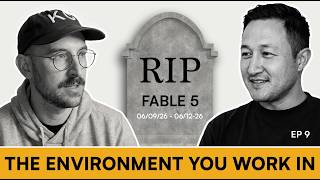
Bryan Takayama joins to discuss how physical and digital spaces shape work. They cover van-life setups, custom lighting rigs, and Notion databases that function as operating systems. Anthropic's Fable model can automate ontology creation and scale these systems without constant manual upkeep.
Chapters
Everyone's heard the phrase, "We shape our tools and thereafter our tools shape us," right? We can't just look at these things as completely separated from our experience. We have beef. I'm breaking the fourth wall right here. I'm talking to our viewers. Me and Bryan have beef.
It's just Frodo is a terrible character. And not only that, Elijah Wood's even worse. And he's bad because of Frodo. Anyways, we don't need to go down to this, but great way to start us out. If you do want to do the intro, I think before we dive in, we should talk about Fable a little bit.
Fable? Oh, the game. You're talking about AI. Get out of here. I got really excited because I thought I was like, Bryan's like, we're going to talk about a video game. Are we gonna bond over a video game?
Maybe this isn't the episode for Fable.
Come on, man.
It's Anthropic's latest model. Came out yesterday.
Yeah. Yeah. But it's, it's like 2 days old, right? So it's old. It's old news.
Yeah. But I wanna know if you, are you using it?
I'm just kidding.
Okay. Sorry.
Back up. Let's talk about, let's talk about Anthropic's latest, greatest new model, Fable.
Well, it's only if you're using it.
If you're not using it, not to mention the, the regaming of one of the best games of all time on Xbox 360. Fable. Did you ever play?
Probably rebuild it using Fable. Rebuild Fable using Fable.
Yeah, maybe.
Okay.
All right. Back to, back to big boy stuff.
I feel like we should probably introduce Fable just in case most people hear it and don't immediately think of the video game, but Fable is Claude's latest model. It's their first Mythos class model. It's 5.0 and it's out in two forms right now. Fable, which is for general audience. And then they have Mythos preview, which is still only involved in Project Glasswing. Um, it's their our latest model and most powerful. And I think what's really exciting about it is it's blowing all of the benchmarks out of the water. But even while it's blowing all the benchmarks out of the water, the head of Codex tweeted in response to it saying, feeling pretty good about where we are based on what I'm seeing now, which I think shows that there's going to be some really competitive outputs coming soon for other models.
But Fable is bananas, and I encourage everyone to try it because I have never Like so many things that I've wanted to do, I always felt like I would get timed out or it still required too much oversight or too much maintenance to do. And it's now one-shotting it and it's absolutely bananas. I'm very excited for what it'll do for us, but also for clients that we work with based on the capability that it has.
Yeah. I generally just, I like to use the rocket ship for whatever I'm doing. I don't care if I'm asking it the simplest question.
Yeah. A lot of the commentary that I'm hearing on podcasts and when I'm reading online, in the different Twitters and LinkedIn spheres of the world is this is the first model where people feel, wow, this is like, I'm working with it. I can hand off activities to it and I can trust it's being done as opposed to, ah, it's doing something for me effectively with my guidance and with my watchful eye.
It seems to have intuition and know like kind of what you're looking for and sussing that out to do really cool things quickly.
Yeah, you gave me, it sparked, sparked the thought that I feel like the way that it feels like it's working with you and not just working for you is like it, it does things that are a little outside what you told it to do, but still in line with what you wanted it to do. Like it, it notices things, it surfaces them, you know, it doesn't, doesn't need direct orders. So I feel like with all AI tools and the reason why we end up with kind of shelfware is that we have the idea and we build it and we build that kind of V1 or V0, and we kind of need to spend those sessions seeing it come to life, and then we get the idea of like, okay, is this worth spending more time on? Yes, no. I think that's, that's fine. And I feel like with Fable, or as better models have come out, it's that, that cycle is getting longer and longer because it's getting better and better about building something that was originally in your vision that's actually still useful that you didn't hit a brick wall on. You probably could push through on the previous ones, but it just feels like you're hitting a wall. And with this one, it just feels like it keeps, you know, getting valuable before I start ending up in the diminishing returns.
I feel like the volume of context that I can ask it to continuously consume and consider, it doesn't feel like it's taking shortcuts like the other ones would.
Like, I always felt like I would get half-baked things no matter how much I harassed it. What we're creating now using it, at least so far in 2 days, it's not taking any shortcuts. It's developing comprehensive knowledge bases and context libraries based on what I'm asking it to do. And it's starting.
Yeah, so I believe we have, what, 11 more days of using it before we start getting token charged on it.
Yeah, yep.
June 23rd, it is no longer available in subscriptions. It will only be available for usage-based pricing or via the API. So buckle up. That's horrible.
I feel like we just need to do a hackathon for the next week where we're just online constantly and Everyone's using their tokens to do something to it to get it where we need, like get, you know, whatever you're working on. All right. It's probably time for an intro. Uh, welcome to the Notion State of Mind podcast. I'm your co-host and co-founder of Notion State and the podcast with my co-founder Bryan Takayama. And, uh, I promise we're not turning into an AI podcast, but it is top of mind a little bit right now.
Are we not an AI firm? Not only are we trying to become an AI-native organization on the services we're delivering, not almost becoming the majority AI-enabled services.
I suppose, I guess maybe what I mean is our episode actually has nothing to do with AI, or it's not supposed to. So maybe we are becoming an AI podcast. I don't know. Um, today we're talking about environment. Take that as you will. Bryan, I know that you share my sentiment that environment can have such a big factor in your life, productivity, your work, happiness. So I don't want to tell your story for you, but I know that your environment has changed quite a bit more than the normal average, I guess, Midwesterner. Um, I'm always going to make sure that you remember that you're from the Midwest.
I remember my first job was picking blackberries and baling hay. I'll never forget those days. I was a proud member of the FFA for 4 years.
That's crazy.
And attended the National FFA Convention.
So that's too good. Uh, okay. So yeah, never forget where you came from. Yeah. Tell us a little bit. I mean, I know you've traveled quite a bit, so maybe since we've, uh, you know, started Notionstate a little over 3 years ago, traveling was a big part of your life already. Maybe kind of give the genesis or I guess like, you know, the picture of where you were when we even met and started talking about doing Notion State, maybe even what kind of led to you even traveling quite a bit and now where you're at now. It's a little different, still traveling, but you know, you kind of changed the way you do that.
Yeah, I mean, I don't even know where to begin. I've been nomadic for almost 6 years now, but traveling has always just been a really big big part of my life.
My first job at Deloitte, I was traveling Monday through Thursday. So even when I was living in Cleveland or living in LA at that job, I was traveling. I worked in almost every major city on the East Coast over a 3-year period of time.
But when we first met, I was living in a van.
My wife and I had built out our own camper van and we were traveling around North America for—
we did it in total for 3 years, but I think we were just about 10 months in by the time that we actually connected and started the business.
And I think one of my favorite memories is I was living in Mexico, but we were at a Walmart Walmart and doing our first big shopping run to go live on an isolated beach for a while. And that was when we hopped on the phone and we sat in the parking lot of a Walmart for maybe 3 hours where you and I were just talking about what Mission Statement could become. So I still remember that. Nice.
Yeah, I've been nomadic for a long time, lived in a van for 3 years. Current residency is in Spain, actively in Puerto Rico at the moment.
And was in Prague last week. So I, I don't know, very, very, very big on making sure that my environment surroundings are something that's always new. And from an experience standpoint or opportunity standpoint, I think that's something that I always think a lot about is I want to be able to walk out my door and experience something brand new, um, or at least try to experience something brand new.
You know, I was just in, uh, Rogers, Arkansas. Home of Walmart. And that's where you realize that there are two vastly different meanings to somebody saying they work at Walmart. And I feel like there's also two vastly different ways of somebody saying they live in their van. Yeah, you're definitely, you're definitely in that higher level. I mean, I've seen your van. It is, it's not a joke. It's like a miniature house. Electricity, plumbing, I mean everything more complicated than a normal house, if anything, because it has to be portable. Uh, so, and you built that out with your, your dad, I believe, over the course of a few months.
Yeah, if it was going to work for my wife and I, I knew that it had to be pretty capable and pretty comfortable and something that we would enjoy being in. Like, there are a lot of vans out there that are meant for the weekend experience, which is you pack it up full of stuff, but the, the adventure is outside of the van. And my thought going into it was like, if we're gonna live in this thing, it needs to be comfortable inside and have the really great outside. So the inside has bathroom, shower, an oven, a two-burner stove. It has a projector screen for a movie theater indoors. It has enough electricity for a few days without having any sun or turning on the vehicle. Starlink Wi-Fi. The whole idea was like, I wanted to be able to live and exist anywhere in at least North America comfortably in the van.
So yeah, we, uh, we spent— my dad, who is an amazing carpenter, electrician, plumber, and then me, who was a novice at all of those beforehand and probably still today, we spent 4 months building it out. Which I think is one of my favorite periods of time ever with my father.
But, uh, yeah, it's the, the van's still holding up. It's 5 years old now and I was just tinkering around with it when I was visiting my parents and it's still holding up.
I think, you know, we're, we're considering shipping it over to Spain so we can still have the van life while living in Europe.
Yeah. All right. So more to our point, how does your, especially when you're in the van, how did that kind of affect your, I don't know, your productivity, the way you, the way you kind of approach life? I mean, like, how is it different than, you know, being in a home in the Midwest? West for you?
I don't think that I've ever been a person that has made my entire life about work.
I've always tried to not— at least, I mean, don't get me wrong, I've worked long hours, I still work long hours, and I put a lot of time into work. So no matter where I lived, the whole idea was I wanted to get all the work I needed to get done in a period of time so I could go out and do whatever I wanted to do. And being in the van just amplified that. So be as productive as I can, or be as good as I can in a short enough period, that way I can go spearfishing, or I can go on that hike, or I can go hang out with friends around the fire pit. So having that ability to step outside and experience something just made it even more amplified in the van to be efficient and be productive and, and quickly get things done so I could go do those things.
Yeah. Your, your gap between work and play was, was, I feel like pretty small. The time and effort it took to go from one to the next, you literally could walk out of the van straight onto sand. Probably didn't even have to put on your shoes right into the water. I remember suffering in this basement in the middle of winter in Kansas City, and you were literally You had posted up like a little tent on the beach in Mexico. You were on your laptop in Mexico, just chilling in the sun. I mean, hey, I'm happy for you, but, uh, your ability to kind of go from one to the other was super cool.
So I optimize for my external environment, like things around. What about you? Tell me about yours. What do you think about when it comes to setting up your physical and digital environment?
Yeah, I definitely feel like I'm, it was even influenced by kind of the lifestyle you had and still have. We still even kind of dream about getting a camper or doing more stuff outside. Uh, still figuring that out. But as far as I go, I'm kind of like your typical gearhead and like internal environment. I'm not going to call myself an interior designer or anything like that. And I probably couldn't decorate a place very well if I tried. I mean, I got some fake grass on the wall behind me.
There's a lot of really sweet stuff in that basement. We should honestly inventory it in this conversation.
Yeah. Um, so, you know, I did a little bit, you know, just try and like I guess that's a good example. I work from home and, uh, you know, the only spot we have in this place is the basement for me to kind of turn into my office. I was doing a lot of YouTube videos when I first started, you know, doing stuff down here. And so I wanted to kind of make sure that I had the space to film and to set up lights and all that kind of stuff. And it's just more turned into like where I do work, but I kind of care about the, the desk tech, um, the monitor, the vibe or whatever. I'm really looking forward to when we get into our new house and I kind of figure out like a dedicated office for some years to come, like really putting in some intentional time and effort into making it one of those places that I feel inspired to be in. And, um, that's it. I mean, I think you can swing a little too far on like caring too much about your environment inspiring you to work and then you never work. You care more about your environment. It's kind of like Notion. All you care about is building the system and you don't actually get any work done. That's not lost on me that I'm prone to that. And that's why I got into Notion in the first place was I just loved tinkering with it, but there, I think there is something to it. Yeah, I don't know, it's hard to really quantify, I suppose, but yeah, I mean, for example, I'm a musician, so I love, you know, good sound quality, so I've got studio monitors next to me. I've got this really nice walnut wood monitor riser in front of me, you can't see it. I like nice technology, so I've got, you know, Scarlett interface and this Husky workbench behind me because I've dreamed about having a Husky workbench for You know, years. I love that look inside of an office. Um, yeah, I don't know. I, I, I at least don't dread coming to the basement to work as much as I would've in the past.
Is that the reason for souping it up and decorating it, or is it to like decrease the dread that work brings? Why do you care about the DeskTek setup and the Husky bench and the, the floral wall?
Back to Notion, man. Emerging things that I wasn't even thinking about, like the delight in using a good tool. Right? The delight in having nicer things, things that I enjoy around me to do the actual work. And maybe that's just a product of like knowledge work. You know, we don't really work with, with tools or go outside or, or, you know, we're in one spot for most of our days. So we, you know, at least should invest in that and make sure it's one healthy for us, but two enjoyable, I suppose. It's the lack of a negative, but also a very good positive, like I don't know, they're kind of the same thing in a lot of ways, but—
I think that's actually really fun that that's how you think of it in Notion as well as in life.
And I really appreciate that. I always have thought of you as someone that really cares about that attention to detail in the design. Like every time we're doing swag or every time we're doing logo or, or website, you have a very intentional opinion on it where those are the sorts of things that they just don't click for me. So it's not something that I've ever invested a considerable amount of time on because I'm just not good at it.
I remember I did care a lot about building a cover photo for a demo that we were showing Francisco, and you guys both were just like absolute shit on it. And I'm like, all right, well, I tried. Back over to you, Josh. Just not something that clicks with my brain. I'm very comfortable with my laptop in the corner of a hotel room where I'll just like lock in for 12 hours straight and then be able to pop out.
The external environment's never really—
Yeah. Man, I'm jealous of that sometimes, honestly. Because it's like, it's like the curse of caring about something too much or becoming too knowledgeable about something. It means that you can further appreciate when it's done really well, but it comes at the cost of knowing when stuff is cheap. And it's almost like you lose the opportunity for blissful ignorance, right?
You're gonna hate me for this. You, if anyone, is gonna hate me for this. I used to intentionally not go to cafes with nice coffee because I wanted gas station coffee to always be okay.
And now I have a Chemex and I can't go to a place with a nice espresso machine because my Chemex is so much better.
The perfect example, because that's what it is for me. I, you know, I've kind of come around a little bit, but like, yeah, as soon as I had good coffee, I don't just want other coffee because I'm a snob. I don't want other coffee because it's objectively terrible. And a lot of times it's objectively terrible because it's not actually coffee, you know what I mean? We've become okay with a baseline really bad quality and we call that normal, so that nicer stuff, when it's actually just normal stuff— I'm— I need to get off this soapbox before I— it's like, I was just talking to my wife, it's like organic food, man. Since when? Since when do we have to now pay for certification to prove that we're making normal food. Like, what a genius duping of the American people. You know, like, instead of requiring that, uh, food tell you when it's using non-natural ingredients, those are the cheaper ones. So that's actually baseline. Get comfortable with those and then actually charge more for the people who just want normal freaking food. Anyways, what was I talking about?
Coffee. Coffee.
Folgers.
Appreciation for—
like, Folgers is not coffee. I think it's got filler in it. I don't know. I don't want to be sued. So I don't, you know, don't take me too seriously, but I'm pretty sure it has filler. Or, um, you know, like a lot of American beer is actually just made with rice. Like rice is not an ingredient in beer. That's not an ingredient, but that's what the American people now think is normal beer.
Bring this back to interior design and the environment that you're working and existing in.
Oh man.
Yeah.
So, so nicer things, I guess. Um, I don't know, being surrounded by things that inspire you, that feel natural.
No, I think it's, um, in an effort to not seem snobbish with this comment, but when you invest in high-quality equipment, you're rarely let down by that equipment because it just works. And when things just work, you're not thinking about it not working.
It just exists around you. That's why we get MacBooks and not PCs or Lenovos or ThinkBooks, right?
Like, I open up my laptop, laptop. And it's where I want to be already. When you open up a ThinkBook or ThinkPad or a PC, it takes— I remember my old laptop at Deloitte, it would take 2 to 3 minutes for me to get past the login screen and get the machine going, right? Like when you, when you invest in equipment, you just, you don't think about it not working. So it's not a drag on your day.
It's like the idea of wearing the same shirt every single day. You don't have to make the decision around it because that sort of fatigue doesn't exist. So investing in high-quality environment, just why you invest in high-quality software that you're working with. Um, and it makes so you don't have to worry about those smaller pieces.
Yeah, I mean, let's get philosophical again. Everyone's heard the phrase, we shape our tools and thereafter our tools shape us, right? It's like we can't just look at these things as, um, completely separated from our experience. And there's a reason why nice tools exist and cheap tools exist, right? There's a spectrum of care that people people put into it and willingness to, I guess, risk the, the less quality and, and stuff not working. So yeah, you can get into a spectrum also of getting into luxury. You go beyond working good and being nice, natural, and into like, you know, designer luxury territory. And that's another maybe discussion, you know. And there's, there's room, I guess, to enjoy some of those things too. But like Notion, I think everyone can agree without maybe knowing how to explain it that they just like when it's organized and when it when it's put together in a way that they understand, they know how to navigate it, they know how to find what they're looking for. Not just in a standardized Dewey Decimal System way, but in a personalized way. It's modeled to the way they think, the way they want, you know, to interact with that tool, with that digital environment. In the same way that I've got things kind of put in a way that I want to interact in my own digital environment. Some functional, some not functional at all, especially given that, you know, it's like my office. Some of it's, you know, do I need, do I need a, a Lego bonsai behind me? Is it functional? No. But do I enjoy it? Yeah. Do people notice it and they kind of get a little slice of my personality? Yeah. I don't know.
Yeah. I'm alive. What is your, what is your Notion workspace look like?
I've actually, I've gone through many, many, many phases of trying something new. Don't like it. It gets kind of forgotten. I'm actually in a spot where I really enjoy it. And it's simple and I'm using it because it is simple. And I mean, I'm not going to screen share it because some people will listen to this on audio, but let me give you just, I guess, like the basic lowdown. I call it my terminal. I've called it my terminal for a long time. And I have my main page just split where down the left side are simple pages. I'm not even doing the perspectives method. Don't shoot me. I may do that, but I'm keeping it simple. And they are based on my main kind of applications or whatever that I might use. So I can go through those in a second. On the main side of, or like the main thing of the page, I call them collections. I have it as gallery cards and I have struggled so much just trying to mental model the difference between a project and an area and how to, how to connect things. And I just decided to just live with it and don't even call it either one. Just call it a collection and it can live for as long as you want it and you can get rid of it as soon as you don't think it's relevant to you anymore. And so my collections include anything that just seems like I want to keep it there and kind of manage it, keep it top of mind for a little bit. So, uh, some of those things are like the Notion State of Mind podcast. Another one is moving house, you know, the Notion State of Mind podcast is going to keep going for, you know, probably a long time. My moving house is like, it's going to end hopefully, hopefully next month or this month. Uh, and then, you know, I've got things like cars. I actually keep a log of when my cars have something done to it and the mileage and the price that we have a history of all that. Music notes when I, when I play music. So really kind of like personal, uh, areas of life down the side. Those pages are like a really simple task management. I've got a scratch pad for notes, meetings. Where I can get to all my calendars really quickly. A journal, a build sandbox. If I wanna build something in Notion real quick, but don't know where to put it. Read later, a quick nav for like all the links that I don't own, but I want to get somewhere that somebody else owns. I'll put that in, in quick nav and that's basically it. I've got a couple others, but that's basically it.
Can we just double-click, not to say double-click, but I'm double-clicking. Do you use tasks?
I do use tasks. Really?
Huh.
Asking because when we use tasks as an organization, I don't use, I don't use Notion state tasks.
We're just left on read for 3 years.
I should look back at like the longest, the longest task that's still just sitting there.
Uh, no, that's, that's fun. And so like each page is more like a collection of where you are in life and you'll create an app within that. Basically, it's not like there's functionality across these.
It's more so you're creating containers of activity and then you'll archive them when you're done or you'll keep it going when it's live.
Yeah. So I'm okay with inline databases. Like if it's not a core piece of my data, I'm not going to put it in my, my database anymore. It just can live in that place and they are tied to like, so they are a database and they're tied to my main things like tasks and notes and maybe a couple other things. So I do use the tabbed database thing. Um, but I'm just keeping it stupid simple and it's finally working.
How long into this are you?
Uh, a couple weeks at least.
And what iteration would you say you're on in the past since Notion State started?
I mean, if I call this like my hub, uh, you gotta balance it between like what I do for me, what I was doing for content on YouTube, what I was trying for Notion State. I mean, we're, we're in double digits for sure, if not Who knows, maybe I'm in triple-digit territory for all of my Notion past.
That's wild if you are in triple-digit.
I don't know if I am, but like, I wouldn't be surprised. Depends on what you call an iteration.
Yeah.
Wholesale change is how I guess I would, I would say it.
Yeah. What's your, what's your hub look like? We're talking about our digital environments, right? So we're talking about our personal, like how do we, how do we set up our digital office? So to speak, and it kind of reflects the way you think or organize. What's it look like for you?
It's a work in progress, which I think it always is. As two people that are Notion builders and do this at scale for large companies to constantly be in flux.
I'm going to say I have two core systems that I use, three core systems that I use, and I'm going to first acknowledge that We have 20-some clients right now, and those are in different workspaces, and Notion does not allow for effective cross-workspace task management.
So I am building ad hoc tasks for myself inside of our workspace across those different clients.
And that is a long, long list of to-do boxes. And what I will do is just, I'll go in there, I'll call it today and a toggle, and I'll line up the clients that I need to do work for, and I just make a bunch of to-do boxes. Tasks, and it's everything that's in my mind, up in my catalog that I need to work on.
And then what I will do is I will ask Claude to go through everything that I might be missing and say, am I missing anything in my list? So it's my double check across all of my Slack, all of my Fireflies, all of my email messages and all that.
That's just so I can manage like day-to-day tactical task management activities. For my personal knowledge management system, it's something that I'm constantly working towards as well. But, and I think Fable is going to change this considerably. But it's essentially a, a two-database framework where one database, and it's, it's two columns on a page. One is like a folder structure using parent and sub-items where it might be Notion, say, strategy, and then finances and sales and website and podcast. Like those are my sub-items in there. And then on my right side is just one database that's called my Claude outputs. And essentially it is just a reference page of information that is some, a thought that I'm thinking of. That's filed into one of those folders. And this is working quite well. It's for me personal right now. I share a lot of things off as shared pages, but if something's good enough in there that needs to make it into the third system that I use, I will have Claude shift it to the third system. And the third system is the Notion state operating system. And that is going to be our company CRM, our company, uh, project and knowledge management system, or our company people management system.
So, uh, those are like the three core systems that I use on a regular places.
Yeah. Fascinating. Okay. So really starting with stream of thought, brain dump in a sense, but not quite trusting it to one shot everything that you need, like kind of taking it through a couple stages of filtering.
Yeah. The, the issue is, is I might have 200 tasks at any given time that I need to work on, but only like 12 that day.
And I know the 12 that I need to work on and Claude is just not good enough yet to find that 12. So if I need to sift through its output first, it's going to be less efficient. Than me documenting it.
Yeah. I wonder with Fable how well it would do if like, you know those tasks and I think that actually like the more self-aware we can be, that's the superpower. I know that you're all in on a lot of these things, but the highlights, I wonder how well it would do of trying to articulate why are these 12 most important to me right now and trying to almost build up its muscle of criteria and maybe it gets to a point where it actually can do it well enough. Yeah.
Maybe someday in the near future I'll spend time doing that.
Yeah.
I can pull together my, my to-do list in 5 minutes, which is why I'm not using it for that. But I fully agree, eventually I shouldn't have to think about that. Eventually it should have drafts for my to-dos already done and I'm just reviewing it. But, uh, we're, we're not there yet.
Yeah. I'm, I'm still thinking there's a world where like, I need to get off this. How many times am I gonna say that per episode? And then I'm just gonna do it anyways. Like building, uh, almost like a, your own world model.
Let me actually explain why I think it's been so hard before and why what I'm doing right now with Fable is how it's all coming together.
Yep.
The organizational ontology, how this, this organization structures is so hard to define. And even if you can define it, it's so hard to manage and maintain. And when you can't create that, it's really hard to naturally connect information to the right areas to be able to one, leverage AI to find it, but as a human also self-service access to it. And we spend so much time when we try to build that manually, building it and maintaining it, and then ultimately starting to file against it that after a week it goes out of date. And what I think is going to be the most incredible unlock using models that are as capable as Fable, because I've already done this now 3 times for our organization. I can't wait to share it all, but it's like you can create these sorts of ontologies really quickly. And what I think is going to be the most important part about this is it's going to maintain the evolution of that ontology as more information feeds into it. An example for us is we do so much work across every single client and so such a variety of things. But now we can leverage every single thing that's ever been talked about as a deliverable for an organization and create a services menu and let that services menu change. We've had two major new services in the last six weeks that I wouldn't have even put on that list, but it's like, these are things that you guys are doing across seven clients. And that's the evolution of this ontology. And I think that that is one of the hardest parts of organizing. And that's what, what Fable's unlocking.
No, absolutely. Uh, it's funny that, I don't know, maybe AI is just leading us all in the same direction without us realizing it. Maybe explain ontology for people who who aren't familiar with the word.
I think this is a whole episode in itself.
All right. So ontology aside, what you're doing is taking, you know, something in the way you think and kind of expressing it in your digital environment, right?
A little different actually. I'm no longer, or at least what I'm trying to get to is I'm no longer defining how it needs to be organized.
I'm creating the content, allowing it to be organized by Claude.
Okay. I'm following. Do you kind of lead it or do you just kind of trust it, or?
My goal is to allow it to use its best powers, which are aggregating large volumes of data and analyzing those to define patterns to create an output. And then I will review that and provide thoughts and guidance. For example, like when we were talking about our services menu, it tried to create one service that is just department operating systems, which is correct, but that's more of a parent item when we start to think about a CreativeOps ticketing system or an IT ticketing system. Or a bug triage system, which are components or different versions of a department operating system. So that was me adding additional context to help inform it.
Yeah.
It's—
I'm still 2 days in, but another example and where this becomes really relevant for our clients and how they organize is you can take a codebase to create this ontology now.
A lot of organizations through human decisions define their operating model, at least EPD organizations, engineering and product development organizations, they will design their operating model to match core components of their product.
For example, Notion has a collections team. They have a custom agent team.
And that's them saying, that's a core piece of our product.
That's a primitive. We should have an organized collection of people assigned to it. But now what we can do, as opposed to depending on the human to define this for an organization, because there's a lot of politics involved, there's a lot of nuance involved, we can leverage the codebase and the LLM to define that actual taxonomy, which I think is is really valuable because if it can define that, then it can define where bugs need to fit when they come into the system, or they can define what go-to-market needs to be happening after new features are deployed. And it can start to assign these components.
Yes. What I really am looking forward to, or kind of fascinating to see if this proves true, is the speed at which you can keep up as things change and allow these taxonomies to not go stale. Or at least not to be moving forward with momentum or inertia. Because like the bigger you get, you know, everybody talks about business as like a cruise ship. As you get bigger, it's really hard to turn around. And it's because you just built layer on top of layer on top of layer. And the deeper it is, the more important it is to foundationally get right. It's like one of those one-way door decisions, not a two-way door decision where you can go back on it. And I know just over time, I'm sure at a company like Notion or any other company, They've got people or teams or processes that worked when they were a 25-person team that don't work as a 1,000-person team. And who's keeping up with that, right? Nobody really, but an LLM. If you can distill the org chart and the job descriptions and the processes, if you can distill it down enough for an LLM to just make sense of it, it'd be interesting to see how much more shifting a company will get, how often people will move from team to team. Maybe their role doesn't even stay the same. We're getting to the point where we can almost shave off the layer of, I don't know even what the word is, just the way things have been, or like giving defined roles that last forever.
Bureaucracy.
Bureaucracy.
There it is.
And getting down to the roots, it's like, can you define somebody instead of by a role, by their skills and their interests? And if you can nail that down, all of a sudden you can kind of pair people better than just like a very stock engineer, right?
Yeah, I think it's going to be very fascinating to see how organizations do this. It's going to be hard for large ones that are already the cruise ship because they're already rigid.
But I think it's going to be really interesting to see this for smaller companies that scale, uh, to scale in a very different way. And I think that that's honestly where Notion states in a really interesting position is We should be scaling.
We are scaling.
There's no doubt we are scaling, but we likely have the ability or the capacity or the market opportunity to scale pretty rapidly over the next year or two. And it's, do we do that linearly with people or do we do that through an AI-enabled approach? I think that that's going to be a really interesting— the answer is going to be probably a hybrid of the two, but the ability to be an agile delivery model or to have an agile delivery model through this sort of enabled structure is going to be really interesting.
We're in a really interesting time where the environment is changing. It's not just the physical one you're in. It's not just the software that you're in. Uh, we're in a time where we can connect because our historic one was we had an environment for each app that we were in.
But honestly, the borders between apps are gone now. So our digital environment is rapidly changing, which I think is why we continue to get derailed in these podcasts and the way that we're talking, because It's new and it's amorphous and it takes a lot of new novel thinking and approach to how you organize and how you operate to keep up and to take advantage of it.
Yeah.
Yeah.
I think about this, you kind of sparked a thought that like normal homes are built with, you know, you always hear about load-bearing walls. They're, they're built with that. You're kind of tied to that. Whereas different rooms in that kind of scenario, they're very structured. You can't really break down those walls. Now we're entering like the digital open floor concept, right? Where your apps, like the walls between them are really only what you want them to be. You can design them however you want. Whereas when you build like a pole barn or post-frame construction back in my construction days, literally the outside walls are all that holds the building together. It's just a box with really strong roof trusses. All the internal walls are just, they're just there for whatever you want them to be there for. And we're going to have to do that in the digital world too. We still will operate in some boundaries. It still takes some work to set up those walls or move them around. But, uh, we're in a much more flexible world right now where apps can talk to each other directly, if not just kind of like go around the corner and talk rather than being completely siloed.
What I like about that metaphor and to kind of bring it home to Notion State and what we do is in the open floor plan or the load-bearing wall closed room open floor plan, for either of those to succeed, it requires a really strong foundation. And I think that that's the same for everything in this digital world, uh, or, or digital open floor plan that we're working towards.
Love it.
All right. With that, I think we're closing it up. This was a really fun discussion to talk about digital workspaces, physical workspaces, and how we think and approach it.
We're kind of all over the place, but I think it shows a little bit of our human side as well as how we're thinking about how new and upcoming technology interfaces with its Awesome.
Thank you all for listening.
Really appreciate your time. And don't forget to click that subscribe button and leave a comment in support or opposition of what we're talking about today.
More from Bryan



Bolt-On or Built-In // AI-native services, scaling, and the people who make it work