Bolt-On or Built-In // AI-native services, scaling, and the people who make it work
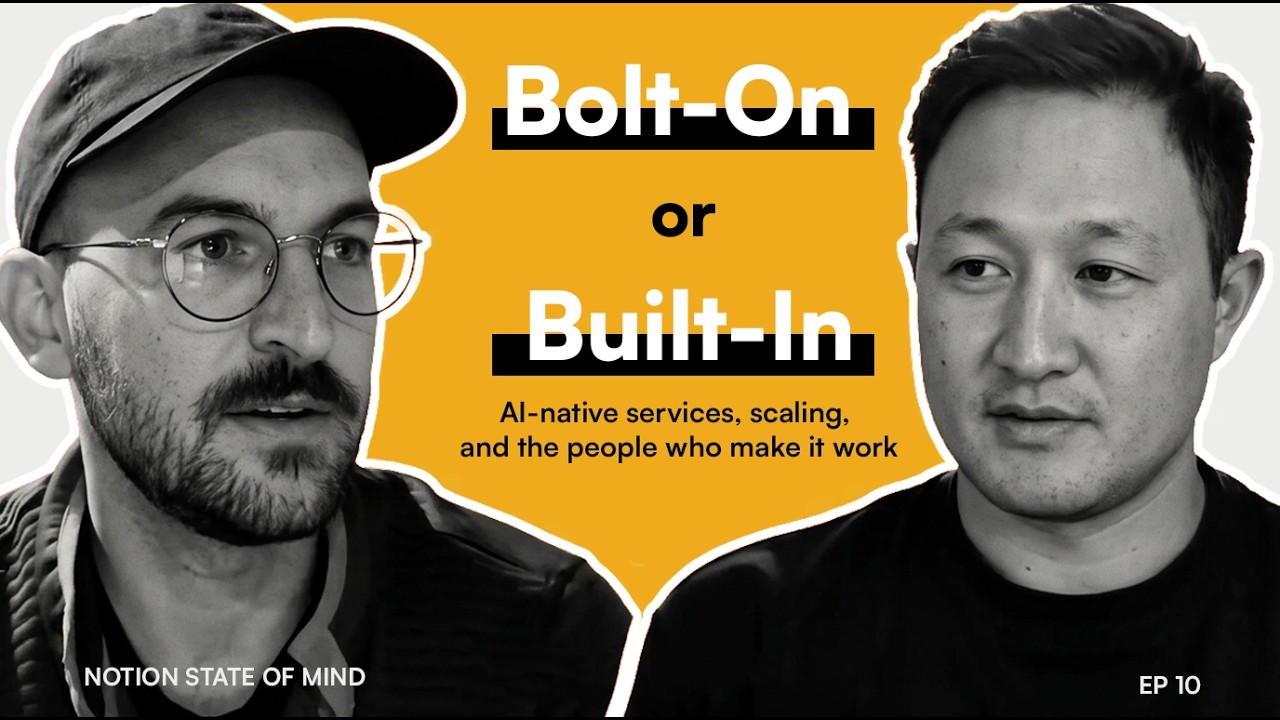
Josh Redd and Bryan Takayama debate whether AI should be bolted onto existing systems or built into a company's foundation. They explore scaling through custom tooling instead of just hiring more people, and argue that the best hires bring curiosity, empathy, and deep business knowledge, not just AI expertise.
Chapters
Welcome to the Notion State of Mind podcast. I'm your co-host and co-founder of Notion State, Josh Redd, joined by my co-founder and co-host Bryan Takayama. Today we're talking about friction and AI nativity and iteration and all the things that it takes to actually make a business run and work in the new era and what kind of person you need to be to succeed. Let's get into it. We're doing it live! Doing it live.
So wait, why does it look like you're in a dungeon and like you've been kidnapped? And why are there exposed wires?
Because I've historically worked from a dungeon. I just dressed it up a little bit. Um, yeah, moving houses in, uh, just a few days, so had to, had to tear it all down. Everything is wrapped up.
How do you feel about the move? Feeling, feeling great.
I feel great. Yeah. It's surprising how, how much just a little bit of a, you know, we should have talked about this on our environments episode. It's funny. I'm a sentimental guy and I'm realizing that more and more as I get older, but ripping everything out of this place, I just remember before Notion State started, I'm pretty sure, you know, before we actually formalized a partnership, I was recording videos in this basement and I just had this crappy desk here and I had the cheapest lights from Amazon and I shaped my light using cardboard and like just trying to get the light right and it took me hours just to get a good look. And I was on my old 2013, 14 MacBook and it could barely run Notion. Um, so yeah, now here we are. Uh, and I had a pretty sweet setup before I tore it all down, but it's back to the environment. It's funny how even still all I did was I took black tablecloths and I just stapled them up to the ceiling, you know, and I had this fake grass wall and some lights on the background and all of a sudden transformed the place. And I actually wanted to be down here. Right now I do not want to be down here, but you know, it is what it is.
I, um, I'll never forget the first time we hopped on the phone and you had your lighting set up because the first few times you didn't. And then we hopped on, maybe it was an actual client call or something. And all of a sudden there's lightsabers in the back. You taped colored tape over top of these light bulbs and I just had blue and red in the back. I was like, whoa.
It was great for the YouTube, the YouTube segments and the recording. And then as soon as I hopped on a client call, I was like, oh, I need to change up my angle for client calls.
It was great. It was, it was surprising, but no, it was great. So do you have plans when you get to the new house for the setup? Is it going to be a lot of the same or do you have big dreams for new?
Yeah, I mean, I have short-term solution is probably I'm trying really hard not to go down to the basement again so I can see some sunlight. But there's a bonus room and there's also an extra bedroom. But the long-term dream is there's a shop in the back and the dream would be to finish that shop. I want it to be a lot of things and this is why I don't exactly have it envisioned yet, but I want it to be my office. Uh, but I also want it to be a backyard hangout. So maybe open up a garage door on the shop and then there's a TV in there. People can hang out, watch a game or something. Then I also want some space to actually be able to do some work if I wanna renovate the house. So I need room for a table saw and all that. So I want it to be everything.
You want a cigar lounge as well in there?
Cigar lounge. Yeah. But that can kind of, the office can kind of double as that. The office, you know, gotta have your 3D printing zone. True. True. Yeah. My maker shop, leatherworking.
Oh, that's amazing. I'm super excited for you guys to move into your new place.
I know it's, uh, been something you've been talking about for years now.
Yeah. Yep. It's happening.
Very good.
Anyway, what are we talking about today? Do we want to talk about the importance of scaling a business and how we're thinking about doing it?
Yeah. Yeah. Well, the clips that we can get from this actually might help us hire a a few shameless plugs.
Yeah, I'm all about shameless plugs today.
Dude, Bryan plugged our podcast in a sales call. We have a podcast about this. No, it was great.
We were asking about it. I'm like, I think that it's honestly our best resource for it. If you're not going to go read through 70 pages of content in the, in the guide, we distill it down in 30 minutes.
No, actually, this is funny because one of the topics I was thinking about talking about was going from data to information, and then some people would even graduate that up to knowledge and wisdom. So maybe I'm just teasing the next episode, but just the— what we thought would be the answer. And I think maybe even in the hubris of human, I don't know, pride, thinking that we will solve it and figure out how to make it work for us and wield it. But actually it'll just wield us. It's like this information overload. Like actually knowing what to do with it and making something useful out of it. I think we're back to like the— my jab at the literacy is like the further away we get from needing these things, the less we rely on them. I think there's an old story about, you know, the gods giving us writing, promising that it will help our memory, but actually it destroyed our memory. So we rely on these things. Anyways, I'm already going way off. We need to reel this back in.
Just quickly on that same topic, because it's fun, and this is a way different example. I read this book series called The Expeditionary Force.
There's like 20 of them. And humans unintentionally get involved in this pretty massive space warfare, but we have an AI on our side and the AI is doing all these great things to help the humans get along and win the battle. And one of them was taking advantage of the most advanced race by erasing the concept of the number zero from their knowledge base. And it took the advanced race 3 days to figure it out because everyone forgot the number 0, and they didn't realize that they needed to know it. Anyways, it was just a fun corollary. It's like the more we get used to these things and these concepts and how they're a part of us, the easier it is to, I guess, lose the initial skills that got us there.
Yeah. Yeah. Like if I'm going to lament anything, I guess personally, I wonder, I really wonder, and I don't know if we can answer this, how humanity will change when we don't handwrite anymore. You know, like the really intentional, slow, thoughtful, methodical, that kind of thing. And it might even change. I actually think it'll probably— I'm not an expert here, but it'll probably change our ability to even read well because we can read well because we've spent hours and hours and hours just focusing on the very specific shapes of letters because we had to write them and we had the motor skills attached to it. And I really wonder how all that's going to change.
I think a funny thing with AI and its effectiveness in today's era is like it's better to just speak free-formed to it than it is to type to it, because when you type, you accidentally provide opinion, and that opinion dictates what direction the AI will, will respond to you in. Where when you provide just unstructured, uh, information in your stream of conscious thought, it's more effective in understanding the actual intent, which I think is the opposite of what you're saying, but I find that quite interesting.
No, that's fascinating because yeah, I, I see what you're saying, but at the same time it does prove the point that writing is more thoughtful because you are injecting an opinion into your writing, right? But I totally agree that the freeform thought is more, it's almost like you're not as conscious literally about what you're saying, so you're almost uncovering the subconscious through just speaking out loud so that the AI can make sense of it in a way that maybe another human would find really annoying.
Wild times, lots to discover, lots to deal with, but let's talk about the, let's dive into the actual podcast.
I know we've been riffing for a couple minutes on randomness. I feel like something that's top of mind and, uh, would love to just kind of riff on it is a little bit of what we spoke about with Alex Wittenberg from Air CFO a couple weeks ago, uh, the concept of becoming an AI services company. We're seeing the absolute need to, to do that and get there faster right now. We're seeing it because one, there's crazy demand for these sorts of services. We're seeing that there's not enough supply of people that are actually capable enough practitioners to, to jump on very quickly to it. So our demand is rapidly outpacing our supply. And it's something that we need to solve for from a tooling perspective and from a hiring perspective. Would love to just kind of like riff on this topic a bit to think through how do we get there?
Yeah. One thread that I want to pull on is one, when we talk about AI native services, talk about AI business, this and that, and the skillset needed for implementing or practicing AI, right? We all can just be honest, AI wasn't even in the marketplace a few years ago. So it's like, one, I think it's empowering if you know how to look under the hood to see actually there's, it doesn't matter if it's AI or this or that, what are the skillsets that actually make a good AI practitioner? So I wonder if you have some thoughts on who are the kinds of people that succeed in this world? And if we're, let's say, you know, as a good example, let's say we're trying to hire for helping us do some of this implementation and thought and strategy. If you can't hire somebody that is in the AI scene, um, or, you know, you're back to your hometown in Ohio, maybe where they don't care as much or don't interact with it on the daily on Slack or Twitter, who are the kinds of people that you're talking to and what are the skills that you think would actually transfer really well into this world even if they're not exposed to it?
Let's definitely pull on that thread, but before we pull on that thread, let's open up a new one first because I think it's actually really important when we say AI.
Native services or AI services, what do we mean? What would you say are the components of it or how is it different than services?
Yeah, there's, there's a, I don't know a good analogy here for how I feel about this, but just talking about AI native services, like saying those words, I just, I feel like I cringe, like I hate talking about it in that way or like that we have to talk about it in that way. So I don't know, it's like maybe just use the words that people can understand. AI AI obviously is high lever, so I don't think it's quite apples to apples with other tools, but again, every tool that you use should be lever, right? In your business. And AI just happens to be a, a tool that can also build tools for you. So it's, and it goes across your entire organization. It's not necessarily point specific. So in some ways it's similar to Notion in a way, right? But yeah, I mean, anybody in business should just be thinking about How do we use this to get towards my goal and get familiar with, you know, how to use it well, how to use it effectively, how to use it in tandem with other people so you don't step on each other's toes, how to set it up to make your life easier and, and work better. But it's gonna introduce— I keep coming back to the concept of gaps. There's always gonna be a place for humans. Maybe those gaps don't exist right now, but think of all these high lever workflows or processes that get taken over by AI because they've been implemented correctly. Now there's just going to be new gaps. People are going to find new opportunities to do something even better and lever on top of that, you know, those, the shoulders of the giants that they stand on. And in some cases, maybe that'll be AI agents. I don't know. Or maybe we're just making a giant fragile system that relies on AI. And as soon as one piece crumbles, it all comes falling down. I don't know.
Or one model gets taken off the market.
That too.
Or the model is offline for 2 hours, causes catastrophic impact to your business.
It's a really interesting world, but I don't know that and not to call you out on this, I don't know that you answered the question.
I think there's two things here.
We're saying AI services and we're also saying AI native services.
And I actually think that those two are different things. Do you draw a distinction between the two of them?
When you say AI services, what do you mean? As in the LLMs and the clouds, or as in shops that provide AI services as their service?
Yeah, I actually think it's really important for our business and to draw the distinction here. So when I say AI services, it is the act of us providing services to enable AI across an organization. This is your, AI strategy, these are custom agent creation, cross-platform agent creation, uh, building the foundation for them is arguably a component of AI services. So normal Notion consulting work.
I would consider that just consulting.
Yeah, it is just consulting.
We're just calling it AI services now because, you know, forward deployment engineers are the new big thing. Um, but, uh, AI native services I think is very different and we need a combination of the two, not a combination. We need both of them to scale our business. AI-native services are how are we leveraging the tools to deploy our services more efficiently, more effectively, faster? And it's like, what is our toolkit? What are our solutions, our workflows, and how are we leveraging them to do our job better? I think that's the distinction that I would draw between the two of them, and I think it's important to separate them out.
Yeah, what's really hard here is actually not to deflect, but like the semantics of even the title that we're saying, like AI-native services. Because AI native in software, you know, is completely different than talking about a service company, which we are. We're providing services, we're providing AI services, and we're AI native, right? So are we AI native AI services to AI native AI companies? Like, you know, where do we draw the line here? But, but yeah, I would, I would push back just a little bit in that I think what you're talking about is the service we provide and then our own internal operations. And we could be AI augmented on our internal side and still be considered AI internal. But where I see the flip being done on the, what you consider AI native is that your entire infrastructure is built where AI is a primitive in the building blocks and not a bolt-on. And you see that in Notion where like Notion, rather than bolting on AI, you can always kind of feel it. It actually, and I'm not, I don't, I don't see their code base or anything like that, but you can kind of tell They didn't just bolt it on, they kind of restructured from first principles and primitives how AI fits into everything they do so that it actually just feels like another piece you can grab, not something that you kind of have to like jerry-rig together.
Yeah, I think that that's fair.
I think it's funny because when we were talking AI services versus AI-native services, it, it is very much just our internal business versus the services we deliver and then just infusing AI into it.
Yeah.
When you think about it for us, what is a primitive, like if we were to say AI has become a primitive for Notion State in our operations, what would you say? Are we there? What would it take for us to get there?
I know we're definitely building it in, but if I could put my, my head in the clouds, not even close. I mean, I guess I just see I mentioned this before, in a business process, there's steps that need to be done and there's— this is actually why I hate that we've termed AI things agents, because I think the better term is actually to use agents for humans and AI bots, because we have agency. I think this concept of agency is actually really important. You have processes and automatic steps, but it takes agency to push them forward, to have opinion, to have judgment. And so AI obviously needs to be built, you know, you have to precede it from a human, but there's a world where like AI agents could be preceded with judgment by other AI agents. So anyways, I see this like agency umbrella around humans and AI, but I digress. There's a socket in each of the steps in process where you can fit a human or you could fit AI. And even some of the actions inside the step, retrieving this information and that information itself was put together by some AI native process, right? When I see that web of process in a business, I don't think anybody's coming close to that right now. Um, but I think we're, we're, uh, I see the vision.
Yeah, I'm directly aligned.
Also, I am very aligned on the, uh, agent versus AI bot, uh, concept. I was trying so hard to not refer to things as agents, but the momentum of the market just took over.
Yeah.
Yeah. Losing battle.
When we think about scaling our org, there's ways to scale.
One is linearly through people, one is nonlinearly through tool and solution development. And there's also the concept of building our own custom tooling to enable. What do you think is most important for us right now?
I'll try to avoid being too meta here, but honestly, the process, the web, that map vision that I just mentioned, I think is actually the most important. And it takes a human to have ultimate judgment of that map and where things go to make the process actually work, not just effectively, because you can work effectively but be going in the wrong direction, right? So we don't want to build tools that are really good at doing something that doesn't actually help our business. We need to guide it towards— ultimately, we're a human at the very top, because a human, or two humans in this case, own the company, and we decide where it's going at the end of the day and what we should be doing. And it's up to us to have a vision for building out that, that map, because I think that map is the ultimate leverage layer. It is understanding the business really well, understanding the process, you know, having— what's the word? I don't know, like strong opinion on how things should be done. You know, what we kind of refer to as the Notion State way. We refer to that usually within the delivery function, but there's a Notion State way on how we onboard and how we do culture and how we, you know, uh, do all these things, like what we're looking for, what we're not willing to do. I think there's a saying that strategy is actually more about what not to do than what to do. But anyways, am I answering your question?
No, no, it's good stuff. I would agree.
The most important part to be an AI-native organization, what you're saying is like getting there is going to take time and it's hard. So it feels like, uh, even if we invested all our time and effort into it in this moment, I don't know that it would solve the challenges that we're facing. Over the next quarter or two.
Yeah, I mean, I don't know, even practically, it's like you think that your business is one process. You think that you have an onboarding process, but there's a hundred subprocesses within that and they all interlink based on, you know, those processes like rely on other processes to feed them the artifacts that they need. And, and yeah, it's a really fascinating thought to me, it's a kind of a graph model of your business and I'm even, you know, trying to vibe code something to do this. But in the meantime, yeah, I mean, we're just, we're, we're still humans. We're still picking what is the highest priority thing or the highest leverage thing. And I think there's still value to it right now in the same way we were talking about earlier, we were kind of riffing on the value of handwriting. I mean, like, look at handwriting. There was a superior method for writing that we've had for decades now, and we still handwrite. It still has meaning, it still has purpose, and there's still gonna be a long trail of humans in the loop, human judgment, human figuring it out. And I, I don't know, I am optimistic, but I also see in the same way that software was supposed to solve all of our problems of information sprawl, it made it worse. And people spend their time looking for information. Rather than actually doing their job. I don't think AI is going to be any different. I think it's just going to compound the issue and it's always going to take intentional thought and decision and opinion on what you're going to do, what you're not going to do, and keeping things in line for the ship to relatively stay on course.
So you don't think that there's a future state where the context is just created and something else organizes it? Because if that context could just be naturally organized or organically organized, the process could be organically defined.
I'm losing you, but I think I'm aligned as well.
Well, I think what you're saying is defining the process and all the subprocesses and the intention behind them, that's a human's job. I guess my argument would be what humans actually do will define what the process actually is. And one of the things most equipped to find that pattern is going to be an LLM today or tomorrow.
Yeah, interesting. That's a good thought.
Quick side note, when I worked at Deloitte, there was this tool called Process X-ray, I think is what it was titled. And what its job was, was to plug into an ERP. So an enterprise resource planning application like SAP or Oracle, and it was to understand what people are actually doing because you build these 100-step workflows, which means somebody said this is the workflow that should happen. But in these apps, no matter what, there's different ways that you can go about things. And what it would do is it would map. Every single time someone has ever done this workflow, what the actual path would be. And what you would find is the defined path is like 11% of the time. And then there's 6,000 variants that people are also doing, sometimes greater than that 11% ideal path. And this tool, the whole purpose was to find the optimal path to take because what humans actually do and what humans think we should do doesn't always align or doesn't often align.
Yeah. I think you can look to physics for the answer here and it's the conservation of energy and people will take the path of least resistance. That sounds like a critique, but it's like, if you harness that, you kind of understand human behavior and you make the most of it, right? So, and it ties directly into why actually Notion State is so valuable and why clients keep us around for 3 years, uh, because it's not about the tool, it's about the adoption and the change management. It's human behavior. So when I say people will take the path of least resistance, the better process that's mapped out by somebody who actually knows, you know, let's assume they actually know what they're talking about. This is the better process. This prevents downstream effects that will affect other people besides you, even though it's not, you know, affecting you. The path of least resistance for that person is going to be sending a Slack message because that's just what feels most natural. It takes change management to really train that person up, let them see the entire system or what's relevant enough for them to see. Okay, actually, I see why this is better, and I've done it enough times that now this is actually less resistant to me because I'm now familiar with the process. But it takes repetition, just like it takes repetition in training and sports to like, or music, to like learn a rudiment or learn how to do a certain dribble or whatever.
So why you still revert to handwriting your to-do lists?
I'm trying not to.
No, it's the path of least resistance. But I actually think the important thing to call out here is We're not aiming to change what is the path of least resistance.
We're aiming to make the— this is actually going to be interesting to articulate effectively. Um, like a Slack message might be the right path. Always. The solution is not to change the behavior from the path of least resistance. The solution, or I guess the goal, is to figure out how to incorporate the path of least resistance into the optimal workflow. And I feel like that's where leveraging Notion and leveraging the other tools that we have access to now is the interesting solution or puzzle to solve right now.
I think that is, there's like a yes and it's like, yes. Um, sometimes Slack is often the go-to because that's what we've ingrained to. But then it's like when you see the entire system and map, and I don't have a good example here, but let's just say Slack is the least resistance, right? And that's your communication platform. Let's say you use Slack for every interaction. Now all of a sudden you're bloating, you know, you've got hundreds of channels. It's actually unmanageable for a person. That's where it takes a holistic Overview of the entire system and, and where each piece kind of interplays to decide, okay, let's integrate this as the path of least resistance, or let's make this better path turn into the path of least resistance where that's actually where somebody wants to go because it alleviates them from the resistance of having hundreds of Slack channels, right? I'm just using a dumb example, but—
No, I'm aligned.
I mean, that issue is going to follow wherever the path of least resistance exists, but being able to organize it effectively and sift and find the Insights is going to be the key piece. Like if we shift from Slack to a message thread in Claude, the next issue is figuring out how do we optimize for efficient organization of your message threads. Right now, the red and white number 1 is the most efficient way to let you know where your attention should focus. And no matter where the path is, that needs to be solved for.
And then you run into, you know, credit limits, right? So then you've got another one. I actually think we're circling around the idea of bottlenecks. And this is actually, I think this all comes back to Ops 101. This is like, yeah, just business building 101. Uh, if you think about it as a factory, yeah, we're just finding the next bottleneck. And what's fascinating is as soon as you start solving the bottleneck, it'll create a bottleneck in another spot, and then it might actually wrap around to the same spot you're at, but in a different way. So it's just a never-ending, um, you know, system of trying to solve these things.
Ideally, the throughput becomes faster the more technology you have. But the point you were making earlier in the call is when SaaS was unlocked for every company, we created many more bottlenecks and throughput slowed because the ability to find information became the bottleneck. And what we're trying to solve for now is how do we increase throughput and alleviate these bottlenecks? I guess not very eloquently stated, but yeah.
Well, and for a company, maybe this is why so many people are jumping on this idea of the company brain, right? It's like this centralized one application that just stores all data and there's no limit to the amount of data. There's no limit to the context. There's no limit to how much it can parse and bring back to you in a relevant way. You just interact with it. You know, you just ask it questions and get answers and you tell it your opinion, you give it your world, you know, so like maybe that's why people see this company brain concept as the endgame, I suppose, of SaaS, like the SaaS-pocalypse, but.
I think we're learning quickly that SaaS will forever exist. Not only that, it's going to further proliferate, but the world model or worldview or like the, the company brand model is so cool because I can just see a world where the brain is just this sphere. And then inside of it, you can click on person A and you see their sphere within it, or you click on client X and you see its sphere. And when you have that ability, the, the world of opportunity is just open.
Yeah, I went down a short little, I started going down the trail and I realized, oh, it's Mount Everest. I'll, let me turn back and come back later. But it was like, you know, if we're truly going to build a company brain, who is the ultimate authority on what is, um, uh, there's, there's probably a better word for this, but like, what is factual? What does the company consider factual? So what does Notion State consider factual?
Yeah, no, 100%.
You've read the Jack Dorsey, uh, post on building the world model, but I don't know that you're familiar with Dan Shipper and in the Every company. So Dorsey went with the world model view where it's like, let's build the brain for the company. And Every went with like, let's build sidekicks where every person has their AI sidekick. And that sidekick grew and evolved with them in their role. So their sidekick became like, if they were a growth engineer, became an excellent growth engineer where data engineers became an excellent data engineer with them and expanded in that way. And I think that there's a world for a hybrid. Of, of these two, and we need to kind of figure that piece out.
Yeah, I guess we're really trying to digitally recreate human collaboration and models and reporting and knowledge, facts. We're trying to, I guess, take all of these concepts that we interact with in reality on a day-to-day basis, and we just kind of store in our memory. And our working knowledge of the world, and we're trying to store it as pure logic in a computer. And it's tough because we don't actually have a good grip on what is reality. Maybe that's what I'm, what I'm getting to.
The Matrix.
Um, but I know we're running up on time, so I want to get you back to the thread that you opened on.
Because you've highlighted what's most important for us is to become AI native. We need to build this worldview. We probably need to create sidekicks and we need to figure out how to leverage the human-defined processes and create tooling to help us move through those faster. That's an absolute for us, but it's not necessarily a near-term or immediate solution that we can have. We can start building it, but we also have the gap where we need people. We need more humans in the loop to be able to scale our capacity. And the question that you asked was when we think of AI services or whatever we want to call them, services in this world, what are the key components to it? I have a point of view on this, but do you have any ideas right off the top of your head?
No, no, not off the top of my head, but maybe once you start saying your ideas, I'll start stealing them and saying them in the same way.
I'm going to break them into kind of two categories. One that I think is necessary for just humans to succeed in this era and why we look for this in them. And then two is what I think we need immediately from people in addition to these. So the first is all of your natural human emotions. I think are really important today. Curiosity, empathy, uh, integrity, having the ability to be a contrarian. All of these are really important today because the model is just going to do what it predicts that everyone else is going to want. And we need people that are going to go against that grain and work with it to find the optimal output. And so in these AI services area, people that have those skills and can exhibit those Live and human conversations, but also through AI chats, I think are mission critical for success in this era. You also need to be enthusiastic about the direction we're going and work with it to go there. I think most importantly, or more importantly, in addition to those for Notion State specifically, we need people that understand how businesses work in the human era and then can leverage those skills we were just talking about to design new systems that that still enable the way that businesses work today. Like being able to understand how a go-to-market process works or being able to understand how an EPD process works and then how they're going to use Notion to make that work is just, it's critical. And we need people that have that ingrained experience that can then leverage these tools to make it better or build the view of tomorrow. I think that's my point of view on it.
Yeah. So if you're that person. Contact us immediately, right now.
I don't know. Do you mean, do you disagree with any of those?
No, no. And I mean, frankly, from my perspective and one of the reasons why we, I think, succeeded when we co-founded this was I came with the product expertise. You came with the professional consulting expertise. So happy to defer to your articulation of that. But that said, I can definitely, without maybe being able to articulate it, There's just a difference when we talk to people that are, you know, maybe interested in working with us, and I'm always super appreciative of people's interest. There is that, that special tact and poise that I think needs to be exhibited that probably just comes from professional experience, from existing and succeeding in a professional, maybe you could even say corporate environment, but just somebody who can interact on a level that instills confidence. I guess I always kind of— I'm not joking, but I kind of joke like we sell confidence because at the end of the day, people will buy confidence that we can solve their problems. And so, yes, you have to have the chops, but you also have to instill confidence. And that comes from soft interpersonal skills. And within a professional context, the relevant soft interpersonal skills are probably going to come from experience in a similar environment. Not saying that you're limited to that. You can definitely grow and learn and probably even just be a sharp communicator or thinker. Without coming from that background, but it certainly helps to see that background and experience.
Yeah, I think that that's a really great call out and I'm 100% aligned to it. I think I've said that 6 times today, so I'm glad that we have alignment between us. I do want to highlight that I feel like the criteria that I put in that second category made it seem like people that don't have the experience can't add value in this world. And I'm not going to walk it back, but I'm going to highlight why I think that's important. We work with organizations that are established, 300, 500, 1,000, 2,000-person organizations, and you need to be able to work within their flows. These organizations are relatively rigid, even though they're still scrappy in nature, and we need to be able to manage stakeholders and do it. You can't just invent something new and expect people to do it. For newer organizations that are smaller, that are starting from scratch, that are designing, there is a world of opportunity to come with novel solutions to design the organization of the future. And that's incredibly valuable and you don't need 20 years of business experience to get there. You'll probably end up recreating a lot of issues that other people have already experienced, but there is a world where you don't have the 10 years of experience and still be able to add value in this.
I love, you know, I know we got to wrap up here. I've even personally been coming around to this in my own life, but the idea of not needing to get it perfect, but making progress and iteration is kind of the key to true knowledge and wisdom. And that even comes back to doing things the slow way, having to learn it your own way. I feel like I only really ingrained stuff when I've learned it the hard way, when I've done it wrong. I'm like, okay, this is why we don't do it this way. Not, this seems novel and interesting, let's do it cuz it sounds great, but when it doesn't work. So yeah, I, I love that thought. You know, I think of the people that, you know, they build things and they could do all the research and do it perfect the first time, but actually they just go after it and they just build, they get it wrong. But man, that's what makes a master craftsman. So that's, I think that's what it really takes to succeed in any sort of world, whether it's AI native or not.
1000%. Heck yeah.
What a conversation.
This is fun. I can't wait for us to put a lot of these into practice and really start to scale and build these tools for us.
All right. That was the Notion State of Mind podcast. Hope you enjoyed it. As always, check out that like button and subscribe button. Check us out. Ask any questions, leave comments, leave a bad review. Whatever shows us that you are listening and that you have a strong opinion, whether great or terrible, we want to hear it. And, uh, we'll see you in the next episode.