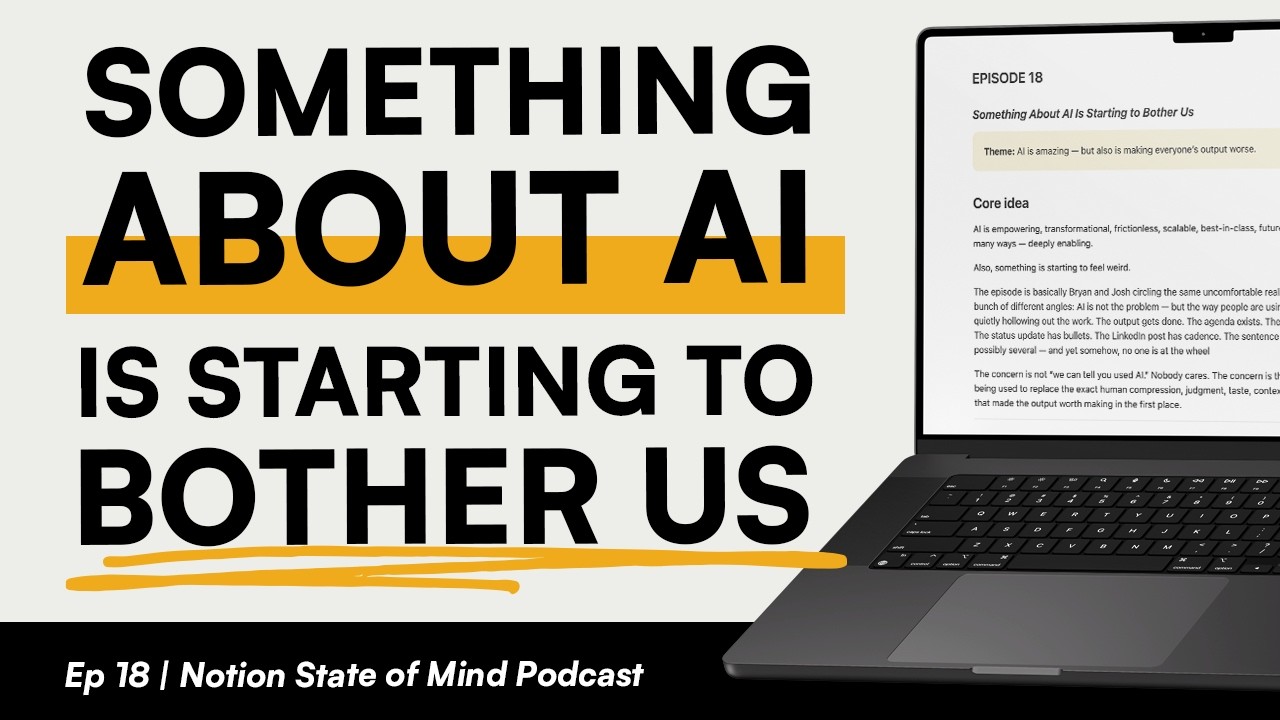
In this episode of the Notion State of Mind podcast, host Bryan Takayama joins two co‑hosts to discuss the growing pains of AI adoption. They begin by questioning what happens if AI suddenly goes offline, prompting a broader conversation about how reliance on AI threatens human agency and the craft behind professional work. The speakers argue that while AI can automate tedious tasks—such as drafting meeting agendas, status updates, or email replies—it often strips away intent, spirit, and the learning process that gives those outputs value. They stress that effective AI use requires a solid understanding of the underlying workflow and careful prompt engineering; otherwise, users risk losing skill, pride, and accountability. Real‑world examples (buying a house, building checklists, coding) illustrate where AI can augment human effort by aggregating information, but the panel warns against off‑loading responsibility entirely to AI, especially as legal and ethical frameworks lag behind. The discussion repeatedly returns to the metaphor of power tools: they speed up work but do not replace the need for craftsmanship. The episode concludes with a call for listeners to retain ownership of their output, embrace AI as a tool, and keep a human touch—typos and all—when interacting with AI‑generated content.
Chapters
Just imagine tomorrow AI goes offline for months. Will you still be valuable at your job? Can you still answer the questions of the conversations you've been involved in and using AI in? All right, we're talking about something we all love to hate and hate to love again. Actually, AI. Let's talk about in the realm of what's actually annoying about it. Okay, so everybody talks about how great it is. And you know, we run a business. We obviously want to take advantage of AI. We don't want to just swallow the red pill. Is that the right pill? I don't remember the movie. And I just believe that's going to solve all of our problems, but it does great things for us. But there's a few things I think along the way that we just kind of notice as people are using it more and more. That I'm trying to lead the question, but, uh, that, that kind of grind our gears. So Bryan, what grinds your gears about AI?
New segment for the Notion State of Mind podcast. What grinds my gears?
Yeah.
As, as I grow up into an old man, what grinds my gears? It's one of those things where we've gotten access to this tool that has helped us do so much more and helped us do so many things quicker and has helped us change our own behavior.
And I think there are some negative side effects that just kind of come with this that we want to call attention to and talk through in this conversation.
And it's not necessarily that anybody's doing anything wrong.
It's just we have a new tool and we need to learn how to adapt to it, but without losing the human aspect of life and the human insight that makes us the people that were able to create AI and makes us the people that were able to be really impactful in the world. So yeah, I guess that's kind of what I was hoping to talk about in this one.
What do we gain from it?
What are some of the things that we're losing as users of it? And what should we be mindful of if we were to talk about gotchas that we're seeing that are happening and how we would go about the difference?
Yeah, it's one of those things in my mind where we, I think we all kind of still know or want to believe, I believe that people will still be very valuable in AI era. And while we may not be able to point to super deterministic kind of logical, like AI can never replace humans because X, you know, and it's super obvious, like the side effects of using AI start to come to the surface. And it's to me, hopefully I'm not calling anybody out here, but it's like when I see, because I came back from the airport the other day and I see this all the time, like when parents just give their kids iPads or phones, it really affects their behavior long-term. It has serious, serious effects on their behavior. And who knows what AI is going to do to people when they just start relying on it to think for them instead of think with them or, you know, have it like think first and then have AI execute in ways, you know, that can help leverage what they do, not replace what they do. Because I think we're gonna pretty quickly erode our agency and our expertise in the area that we're using AI for if we just throw all of our problems and questions at AI and then just expect it to be, you know, better than what we would've done if we would've taken the time to think through it and write it ourselves. So I think that's to bring up maybe the first point is like, or maybe it's the main point, seeing AI output everywhere and just clearly seeing the markers of it. What I would be interested in, in you kind of talking about a little bit further is not just, it's, I don't think what grinds your gears or what grinds our gears is seeing AI output or markers of AI output. Like, MDash is like, that's the super, you know, easy to pick on ones, right? It's like. Actually, I don't care if I know that you're using AI. The problem is deeper, right? What is it about output that's really obviously AI? It's not about it being AI, but what is it that is actually more harmful sometimes than it was helpful?
Yeah, I think you've already used the example of writing. Like, if we let it write for us, the thought is gone. But the area that I continuously see the most glaring issues is any task that historically was a tedious Task, if it is replaced entirely with a prompt, the output is missing the intent or missing the spirit. An example is the agenda for a meeting, or it's a weekly status update, or it's an email reply on the 4th reply in a thread. All these tasks that we think of as tedious tasks, we want to automate away because we don't like tedium as humans, but it's tedious because it requires a compression of knowledge to be able to answer or provide effectively. And right now, we don't have the tooling that gives us the ability to get that right 100% of the time. And you said it already. I want people to use AI. I don't care if it shows AI markers. What we want, though, is effort, the human-level effort to make it relevant and make it real. That's, I think, what is grinding my gears and what I'm getting to with this.
The old man.
The old man.
Yeah, what comes to mind is like, so using the email as an example, a really good reply is the result of a distillation of thought and opinion in a really well-packaged, well-worded way. That took a lot of effort. And over time, as you're a professional for years, you get better at it, right? But it takes real work, just like, you know, distilling something. You know, you don't get it right away. You got to go through the distilling process. And when you give it to AI— so distilling, you have to start with something, right? And you've got to take away all the things that you don't want. It's more like a removal process and making it really strong in the essence of what it is that you wanted it to be from the beginning. Alcohol is obviously what gets distilled a lot, so, right, like you want something really pure in your distilling process. When you just ask AI to do it, you're trying to skip Past all of the hard work that goes into making that output really effective and, you know, really something that is well received and not just— I'm trying really hard not to go through the image of alcohol and drinking it, but, you know, receiving something and enjoying it rather than like, oh, that was a lot, or that definitely wasn't what I was expecting. Or anyways, I'm not going to follow that trail anymore.
I think there's an interesting component that you highlighted there with the email response piece where over time and throughout your career, it becomes much easier to respond to those quickly. And there is this component of adopting these new tools at our disposal as well, where it's like over time, your personal AI agent that you've curated and crafted over time should be able to effectively do all the things that we're saying pretty efficiently. Probably not 100% of the time, but pretty efficiently.
I think what a challenge that many people are facing today is before they build up that experience or before they build up the right rituals and understand and provide the prompt with the clear expectations. They're just prompting away the activity. And that's really the issue. It's like we're trying to replace our lack of experience with this prompt when it really does still take going through the motions and learning the skills to be able to do it effectively.
And honestly, once you do that, you'll supercharge yourself.
Yeah. Yeah. I mean, it's the classic new technology does not make you a better craftsman. You know, you see this in, I think, let's say woodworking, for example. It's like, Imagine, you know, an expert craftsman using hand tools and then all of a sudden power tools become available. Everybody can use power tools. Like, it might make them faster at cutting or faster at planing or faster at sanding. It doesn't make them make better furniture. They do get to like iterate faster and make things faster. And if you're using them correctly, maybe you do get to that point faster and then you can get past it. But again, technology does not make you a better craftsman, just like AI does not make you a better Professional, right? Everything gives you, gives you the tools to be able to be a better one, but, uh, you gotta use them well and, and learn the fundamentals, uh, what they're used for.
Yeah, I think a pretty funny concept when it comes to it is, is if you don't know how to do it, then you shouldn't be using AI to drive the outcome.
You should be figuring out how to do it. Then you can use AI to reproduce that outcome. Everything's a process flow and you can't just Prompt the middle 10 steps in between the start and the finish.
You need to first understand the steps before you can automate them away. Yeah.
Yeah. Yeah. I mean, this ties directly to kind of how we would, I guess, coach people to use it. It's like, you need to know the output that you want and the less you're able to tell it the output, the more, you know, just kind of generic vanilla bland stuff it's going to return to you. Cause that's just an LLM. It's, it's pattern recognition. It'll get better, right? Like over time, maybe. The more the LLM understands what you want, and it might start being able to pick up, oh, you're asking this. Like, this is probably as the model gets smarter. Like, you probably want something that's, you know, shaped this way that has a stronger opinion, less vanilla. So, you know, I guess it'll get better. But for me, I think what's important is what I was talking about at the beginning that I don't want people to lose, or I think is at risk of being lost, is human agency. I am, I don't know if this is a crazy thing to say, but I'm pro-human in the human-AI era, right? Like, I'm— I think humans are the ones to be served by AI, not AI be served by humans. Like, it's a tool for us. We're not a tool for it, even though that's a very dystopian view that might happen in the next few or 10 years. So we have to continue to have agency and know what we want out of it, not just spill our thoughts and hope that it does something that we want. And expect that to be value creation in the world.
Are there any cases that you can think of where it's okay to just let AI do it? Sure.
Yeah. Yeah. I mean, I'm even trying to use some of my own examples. And what I do like about AI and when you don't know, there's very distinct things here. Like when you don't know, I'm all for using AI to figure it out. And I use AI in this way all the time to get a better understanding of something like, Bought a house, you know, a couple months ago. I would not have been able to get through that. I would not have been able to get through that without completely stressing, without having AI kind of help me through the process. I definitely make sure that I'm not missing anything, and AI is pretty easy about confidently giving you something with gaps involved, but you don't know if you don't know, and that's a real risk. And so I need to be the one that's ultimately responsible. Accountable and culpable for buying a house. AI is not, right? And I think in work, too many people start to give over their accountability to AI, and it's going to come crashing down on them. They're not actually going to know. Like, there's a world where you could build up, you know, your working life, and then all of a sudden the foundation kind of caves out from underneath you because you don't actually know what your role is or how to do it. You just been relying on a tool to do it.
I think that's a really good one. It's like building how-to guides based on things that we don't know about. And that makes perfect sense. But I think that that's an outcome of one of the things that AI is really good at.
It can distill infinite, not infinite, but seemingly enormous amount of information to provide you a view of what do the best practices look like out in the world for any sort of activity. That feels like a really good use case is like organizing and aggregating across a ton of information, um, to understand what does a good checklist look like to do.
Yeah.
Yeah.
Yeah. And you know, that way nobody is just frustrated that I have this really short-sighted view of AI. If we get to the point where AI is actually just incredibly good and really better at everything that we want it to do, and we can literally just say like, I need this done and it just does it flawlessly. Coding is getting there. It still needs work, but it's like, I wouldn't even come close to coding. And obviously I can't code something enterprise ready right now. That's not happening, but I can make my own apps and they're really useful. help me do my job better. That if we get to a future where AI is just genuinely better than everybody else and the accountability of doing something gets transferred over to AI, now all of a sudden we're just in a different world. Like right now we're a very human accountable world, but when we start dealing with the ethics of like, should we hold an AI accountable for doing something criminal? Right now the answer is always and very clearly emphatically no. It's like if you set up AI to rob a bank, You're, you're going to be prosecuted, right? But when we get to the point where AI is able to, I don't know, maybe you create a thing and it's got this emergent personality that, that robs a bank, even if it's for you. When a court prosecutes that AI, that's when we can have a different conversation than we're having right now. That's the point I'm trying to make.
Come back down. Come back down. We're going crazy.
I'm trying to highlight What I think is actually a really important concept, which is human agency, and people still need to maintain agency. If you just want to offload everything to somebody else to do your job and think that it's going to be quality and really well received and create value, like, we're just not at that point yet. Yeah.
What do you think's important from a human agency point of view? When we talk about the output, what do you think's important?
What do I think is important about the output of human agency?
No, like you, when, when a human has agency and they're using it and applying it to what they're doing, what are the important concepts or things that come out of it?
Oh, um, yeah, I think the person needs to, I guess it's probably similar to, uh, let's talk about entrepreneurship and leverage and what is the highest leverage thing you can do? Well, I guess for us, or owning a business, it's the vision. And direction and understanding the things that you don't like. Strategy, you know, if you define the essence of strategy is what not to do, right? You have to have a clear picture and you have to gather a clear picture. I don't know, I'm a video gamer, I guess, at heart at least. I don't have time for it anymore. But if you have a fog of war, you can't just— so let's go way back, Age of Empires 2, when I was a kid. Like, you have a fog of war, you can't just type, you know, win the game, or you can't just immediately know what's out there. You have to go out there and gather information. You have to know what's out there. You have to know— What other factions are building up? How are they building up? What's their unit type? Okay, if they're building up cavalry, I need spearmen, right? So like you have to understand the environment around you first to even know how to interact with it correctly. So if you just don't know anything and you say, build me a business, it's just gonna build you a thing, right? But it has no bearing on what's going to be effective or strategic. Around it because you haven't gathered any information, right? You haven't taken the agency to understand what you should even tell it in the first place. So what are we trying to do, I guess, is define what human agency is, which maybe is tricky, but it's like own your life's output, own your life's work. Even if you use AI, have ownership of it. And I have even deeper held philosophical beliefs behind that I root that in, but that's where I see agency.
Yeah, that's wonderful. I— journey to get there. I don't know where we were with Age of Empires 2 there, but I love where we landed.
Clearly never played Age of Empires. I didn't, I didn't.
Uh, um, my brother would just destroy me at video games when I was growing up, so it made them not very fun for me to play.
Well, then you got into business and crushed it.
Uh, work in progress, but the output ownership is exactly right. If you produce something, whether it's Human done or it's AI done, you should be proud of the output.
You should know, one, you should know what's there, but two, you should be proud of what's there.
And you should be able to explain why the words are in the order those words are in that sentence and be proud of that. But I feel in some of the things that's happening because we use these tools and people are all asking us, everyone's asking us to use these tools, we're losing a little bit of that ownership and that pride in the output.
And I see it Not only within our business, but I see it everywhere. I see it in LinkedIn posts. I see it in cold outreach emails. Where, where did the spirit go in fun cold outreach emails? We see it in advertisements now. It feels like we're losing a lot of pride in the ownership and what the outcome is. And I think that's one of the things that's what's grinding my gears is that piece.
I don't care about the steps to this.
It's the pride in what you're delivering that feels like it's becoming less valued, at least by the people that are producing it.
Yeah. Yeah. And I don't wanna, I don't wanna overgeneralize here, you know, cuz I think the coding example is like a little different.
For sure.
Obviously very different. You need to own, you need to own it.
Right.
But it's like what I'm about to say, I think there's a difference. I think in most cases you just imagine tomorrow AI goes offline for months. Will you still be valuable at your job? Can you still answer the questions of the conversations you've been involved in and Using AI in. You should still have an expert opinion. And that's the problem is use the AI to like compress your work, not do your work. That's like the replacement that is becoming a problem is one, if you don't even know how to do your work, you don't know how to tell AI how to do your work effectively. So then it's not gonna do your work effectively. But if you do know how to tell AI how to do your work, what you're actually doing is compressing your work because you know how to do it in the first place. Going back to power tools, you have to know how to be a master craftsman to be able to make good, beautiful cabinets and make them fit, you know. Um, power tools help you do it a lot faster, a lot more effectively, but that's not the skill.
Should we get off our soapbox? We're just—
I feel like we're circling around it because we want to, we want to like get— we want to— we just want to dig up that thing, and I, I don't know if we've fully gotten it, but I don't know. Do you feel properly vented?
I do. I think just this last part where we were talking about pride in the output, if we can get people to have that, let's go.
Well, that's what grinds our gears. Uh, if you liked what you heard, make sure you tell your agent to press that subscribe button and, uh, send a prompt to like the episode, but have some agency in it. Make it your decision, have some ownership, and, uh, leave a comment or have your bot leave a comment.
Put a human touch in there. Drop a typo in there for us.
Yeah.
Yeah. Tell your agent to leave some typos so that we believe that you left it. All right. Uh, we'll see you in the next one.
More from Bryan



Bolt-On or Built-In // AI-native services, scaling, and the people who make it work