Going All In on AI-Native Services - Featuring Alex Wittenberg of airCFO
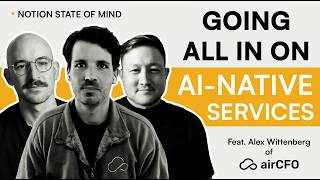
Alex Wittenberg, co-founder of AirCFO, explains how his back-office services firm became AI-native by partnering with Anthropic and building internal tools like the "Mean Machine" for month-end analysis. He argues that services firms that adopted technology early are uniquely positioned to use AI to deliver outcomes at scale, and that AI now lets them do a full-time employee's work at a fraction of the cost.
Chapters
Many of the tasks that make up our team's jobs today are going to be automated with AI. The tasks that AI is going to automate are those non-value-added ones, the ones that our team does not get up in the morning excited to tackle. And I think automating those rote, mechanical, those things that should be done by AI will allow our team to really step into the full vision of their role as like a trusted advisor. For the clients that we serve.
Welcome to the Notion State of Mind podcast. I am your co-host Josh Redd, joined by my co-host and co-founder of Notion State, Bryan Takayama, joined by Alex Wittenberg. Bryan and Alex have quite the history. So really fun to have you on the podcast, Alex. And I actually want to hand this over and maybe Bryan, why don't you give a quick little intro to Alex?
Yeah, absolutely. So Alex, incredibly excited to have you on. Yeah, I know we've been talking about doing a podcast for like maybe, maybe 2 years now. So excited that we're finally following through with something that we've been talking about. Uh, but yeah, so we met freshman year on one of the first days we moved in on campus. You beat me in a 3-on-3 basketball tournament that I'm not still a little salty about, but, uh, we've been, we've been buddies for, for quite some time. We college roommates, worked at the same employer for our first job. And then, uh, you're actually the person that really introduced me to Notion and kind of, uh, started me on this career that led me to Josh and led to Notion State and all the crazy things that we're doing. So really excited to have you on here, but I think more importantly is what you're doing today to pioneer AI for the industry that you're working in and, uh, the, the really incredible stuff that you're doing at their CFO. So, um, tell us a bit more about you, your background outside of the, the craziest that I just shared. And, uh, then we can dive into a lot of the cool topics that we have planned.
Yeah, Bryan, Josh, thank you for having me. I'm excited to chop it up with y'all. So my company's called AirCFO. We are a full-stack back-office partner for high-growth startups. We have been in business for just about a decade at this point, and we have always prided ourselves as being one of the most tech-forward firms in our space. Going all the way back to 2014, 2015, We were thinking very deeply about how we could leverage technology to do our work better. So providing clients with accounting, finance, tax, and people ops support. And we have come a long way over the last decade. Today we have about 75 team members. We work with about 200 clients on a recurring basis. And we continue to lead the charge when it comes to tech and most recently AI enablement. Our company AI journey, I would say, started back in 2021 when we onboarded a company that had spun out of OpenAI and was putting together a safety and ethics-focused artificial intelligence platform. That company has turned into Anthropic. Uh, I was actually Anthropic's fractional CFO for their first year and a half after they spun out of OpenAI, which was a pretty mind-blowing experience. But it opened our eyes to kind of what was coming. And so we've had a front row seat along the way as these tools have developed. And we are pushing as hard as we can to reimagine AirCFO in this world where we have this on-demand intelligence, this unlimited horsepower for running the cognitive workflows that really sit at the foundation of AirCFO. And we're making some really good progress. Progress on that front. And I think that ultimately within the next 12 to 18 months, we're really going to see a shift in how services businesses operate with AI underneath them. And it's going to lift a lot of the constraints that have traditionally held back services firms from being able to scale. And I think it will allow us to just provide significantly better services for our clients and a better experience for our team as well. So I think, yeah, I'm, I'm excited to talk to you guys about how we see the services industry shifting with this new AI-native services terminology. I'm also excited to hear what y'all are seeing on your side with NotionState and being one of the leading firms and leveraging some of these top platforms. And yeah, maybe just talk a little bit about how leaders can kind of manage the transition into this new age, because it is, it presents a lot of opportunities, but also some really tricky challenges to navigate. So yeah, I think there's a lot of surface area for different topics that we can cover and yeah, I'm excited to get into it.
Yeah, man. So many things to talk about. We'll see, we'll see if we can hit 'em all in this conversation, but such an incredible flex that you guys had Anthropic as a client and you were helping them become the company that they are today early on in their journey. That's so cool. Did they, did you get any early access to the models?
No. So we were supporting Anthropic before Claude even came out and it's actually really funny because one of my first responsibilities as their fractional CFO was building their financial model for them. And I was working with a couple of the co-founders and we were putting together, you know, the expense projections. They were going to have to spend millions and millions of dollars on compute, which at that time was absolutely insane. Now it looks a little bit more normal, but we finished up the expense projection side and then we moved on to the revenue side.. And I asked the co-founder, I was like, hey, so what's the business model here? How are you planning on making money? And the co-founder, his name is Tom, he's now their chief compute officer. He goes, we don't need to worry about the revenue side. Uh, let's just keep it at zero. And so we had this 5-year model that went out to 2026 and the entire like horizon of the financial model just showed zeros across the board for their revenue. Um, so we were off by just a little bit with them. I think they, they just crossed like $40 billion in run rate revenue as of last quarter. Definitely the prob— the most off financial model, the most inaccurate financial model that's ever been created, potentially, which is a fun flex. But yeah, it's been very interesting just to kind of have a little bit of the inside track on where all of this has been heading, even though we didn't get to see Claude itself when they were a client of ours.
That's so fun. I hadn't heard that story before about the financial model, but I enjoy that. That's, uh, that's something that you hold near and dear. Um, being off by just $40 billion, casual. But something that I think you have a point of view that you shared with me recently is the idea that services companies or tech-enabled services companies are uniquely positioned versus like post-ChatGPT-created companies in the market that we're heading. And I think a lot of it comes to you starting the AirCFO tech enablement journey 12 years ago. Tell us a little bit about the arc of AirCFO that tech enablement journey and why it's positioning you so well for this AI enablement or AI augmented journey.
Air CFO is in a very unique position compared to your standard back office services firm as a result of the client base that we serve. So all the way back in 2015, 2016, when we were getting off the ground, we were among the first firms to really lean hard into this new wave of back office tech tools that enable our team to do their jobs more effectively. So back at that point, it was tools like Gusto, Bill.com, Zenefits, and a lot of these companies have either gone public or been acquired at this point. But we've seen, say, 2 or 3 successive waves of back office tech tools that have come to the forefront over the time we've been running Air CFO. The most recent wave includes companies like Ramp, Mercury, Rippling, and each new cohort of tools has unlocked new capabilities for our team, increased efficiency. And just in general, a better client and employee experience. So because of the fact that we serve venture-backed, high-growth startups, our clients have always been pushing us to be among the early adopters for these types of tools. They expect that their back office runs on the latest and greatest tech. And so that's been a big advantage for us compared to a traditional back office services firm that might have clients who are a little bit more risk-averse or aren't as likely to be early adopters of this new tech. Technology. So our client base and then the team that we've put in place to serve those clients, those two components have led to us, I would say, like being a little bit more aggressive with pushing the envelope on adopting new technology and just changing the way that we operate. One, uh, example of that is one of the first things that I remember doing in 2016, 2017, after I joined Aircfo full-time was we made the switch from billing on an hourly basis to billing on a flat fee, you could say outcomes-based basis. And that was a really tricky transition to navigate, but it's a transition that has set us up really well to productize today. It actually aligns very closely with how these AI-native services businesses are talking about this new pricing paradigm that's going to come about with agents as the the new form of software as opposed to software as a service, which is charged on a per-license basis historically. Another example of how Air CFO has really kind of taken a leap with a tech shift and it's come back kind of out of pure chance to really benefit us is with our adoption of Notion. So we first started exploring Notion as our companies wiki, I think would have been the way that we framed it back at that point. That would have been in 2019, somewhere along, uh, somewhere around there. And at that point, Notion was just a small sliver of what it is today. Um, it's obviously grown quite a bit over the last 6+ years, but we had this vision of Notion being our centralized operating system. For everything related to the internal ops of AirCFO. And 6 years on with the implementation of Notion AI and all this stuff, I feel like we're, we're finally getting to that point where we're able to realize that vision. So yeah, I guess I would just say like the, the tech enablement piece has been a core principle of AirCFO going all the way back to the beginning. And we have seen that when we make a change to implement a new piece of software, we tend to see that payoff happen a couple of years down the line. Once the software fully matures and we're able to integrate it into the way that our team works in the day to day.
I would kick myself if I didn't take this opportunity to rabbit trail just a bit because Alex, I don't know how, how much you realize that you and Air CFO and your, your vision to do Notion at Air CFO really kind of sowed the seed for what Notion State became. Uh, and me and Bryan have, have talked about, you know, kind of our perspectives on it. So I'll give that one real quick and then I would love to kind of hear your side of the story. Um, but yeah, I mean, as far as the reason why Notion State even started is, you know, going back to what you just said about wanting to use Notion at Air CFO, um, I believe from what Bryan has told me, you know, you kind of had Bryan helping you do some consulting and then kind of mandated him with the task of finding a Notion consultant, right? Is that correct? Am I on the right track there?
Yeah. Yeah. Um, well, so when we started building out our Notion workspace, We realized, one, how powerful the tool could be potentially, but then two, how big of a lift it was going to be to actually stand this up in a, an organized, sustainable way that wasn't just the wild, wild west. And so we worked with, um, a one-off Notion consultant for a little bit and we didn't have a lot of success there. And then we were sort of regathering ourselves and planning to tear everything down and start from square one with rebuilding our Notion workspace. And at that time I sent Bryan a link to, I think it was literally just Notion's landing page. And I told him, hey, you're going to love this tool. You need to check it out. Because he was at that point, I think figuring out, I think Bryan, you were figuring out what you wanted to do post-Deloitte. And Bryan totally ignored that first message that I sent. But then I sent him the same link a couple months later and I said, hey, if you haven't checked it out yet, Notion, really sick. And then I think that time was the little nudge that sent him down the rabbit hole. And then yes, once Bryan got in, I was like, Bryan's going to be great at this, but we should probably figure out what best practices actually look like today from people who have been doing Notion consulting. So I sent him a couple of profiles of folks who seemed like they were doing good work. And I think. I'm not sure what your firm was called at that point, Josh. You may have just even been an independent consultant, but you were one of those profiles that I shared and, and I guess the rest is history.
Yeah, I love it.
I think it was Notion State at that time, although it wasn't the same LLC, obviously, but, uh, was doing Notion State. And even, even more color to that story was we talked and I, so I remember, I don't know if you've heard this, Alex, but I remember talking to Bryan and we didn't even start Notion State together for Brian, I wanna say it was like 9 months, maybe, maybe somewhere around there. It was a long time.
Yeah, 9, 10 months after, after that conversation. Yeah.
After that initial conversation. And, uh, I actually remember Bryan and I was like, this guy sees right through me. Like this guy, of all the people I've ever talked to, this guy is a consultant, he's a businessman. He's asking me all these like really pointed hard questions. And I left that conversation thinking like, well, he's, he's not gonna hire me. Uh, and then, you know, turns out talking to Bryan a little bit later, he's like, well, actually I'll have You know, I don't want to speak for you, Bryan, but out of all the people I talked to, maybe you were, you were the one that I actually really wanted to work with, but you know, the pricing or the project, uh, you know, the way I was going to put together a project just wasn't what you were looking for.
Well, you didn't price the project and you didn't give me a quote. You just let me tweet at you for the next 9 months and you gave me free advice on how to implement and do things. Uh, so that's what I, that's what I did. And then, then you caught up with me. Uh, you're like, wait a minute. That's the guy that I was talking to that, that and then we started. Yeah.
Yeah. So I'm fully, fully willing to be candid about the origination of Notion State that like from the very beginning, I've just been the Notion nerd. Like I just, I love tearing apart Notion, but definitely couldn't have done it without your, your business chops. And it's just funny that I remember it from the very beginning, like, oh, this guy, this guy knows what he's talking about. So anyways, I feel like had to, had to go down memory lane there because it sounds like Alex, you are kind of the reason. Maybe Notion State exists, pushing Bryan towards Notion and then even, uh, even kind of giving him the idea to look for somebody. So I don't know if I've told you this personally, but thank you for that. Uh, I appreciate that Notion State is doing really well and, uh, you played a part in that.
Y'all are crushing it. And I take basically zero credit because all I did was send Bryan that link, even if I sent it twice. Uh, and almost everything after that has been you two building this thing from the ground up. And it's been really cool to see how far you've come and how you've established yourselves as like the, literally the leader in building these Notion operating systems, which I think is a concept that's going to become much more common in the next couple of years based on some of the stuff that we'll probably talk about later in this conversation.
Yeah, no, absolutely. And I'm going to say thank you as well, Alex, because again, even though you're not taking much credit, it was pretty pivotal and valuable for us. And I feel like you always just toss these software across the fence to me and And like one out of every four that you send to me, I pick up and like it's an integral part of my life. Like the first one was Loom. Well, we just left Loom. We're now with Supercut, but the concept of Loom, then it was Notion, then it was Whisper, um, then it was Cloud Code because you're the one that got me into Cloud Code. And every single time one of these happens, uh, just, uh, it sends me down a new rabbit hole that transforms a new component. So keep doing that.
I think I have a higher hit rate than one out of four, man. You gotta give me some more credit than that. I think That's like, I think that's like a 75% hit rate or something like that.
That's fair. I'm not going to go down the list of the ones that didn't hit. Anyways, we don't have to go down.
This is interesting because it sounds like, Alex, I'd be really interested. What is it about software? Because it sounds like you're doing this with Bryan, but you even kind of mentioned, uh, with Air CFO and clients pushing you towards software, you kind of mentioned like you get into them because you see the vision, but it sometimes it takes a couple years for that to to fully materialize. Um, maybe it's a personal question, maybe it's business. I don't know, but like, what is it about software that you're so interested in that you're not only pushing, you know, you see what software will become before it even becomes that and you, you latch on and you're also just like throwing it over the fence to Bryan, you know, as you said.
Yeah, it's a really good question. I mean, I think it goes back to our early days at Air CFO. Because getting over that hump, that initial hump as an early stage consulting firm is such a grind. You are in this dynamic where you have to sell, sell, sell to build up a book of business that can support your current team. And then you need to sell some more so that you are like just at the limit where your team is a little bit overworked, but they're not completely burned out. And then you need to hire. And hope that that hire hits so that you can redistribute work. And then you kind of have to do the same thing over and over again. As a bootstrap company that has to, you know, maintain profitability or break even on a monthly basis, that is just such a— it's such a fine line to toe. And so I've always kind of seen software as an opportunity for us to give our team additional leverage, and just make that journey a little bit easier. And I mean, I fancy myself to be a bit of a builder. I think that's one of the other things that really just draws me to software because especially a general purpose tool like Notion or like Claude Code, it really does just widen the aperture of what is possible to build. And that experience of being able to sit down at your computer and fire off some keystrokes and then have this new artifact or this new piece of software sitting in front of you. It's just like a really, uh, yeah, it's an intoxicating kind of experience. And so I've loved having that experience with tools like Notion and Claude Code. And I know that Bryan is the same way and some of our other friends are the same way. So whenever I find something like that, I can't help but just like share it with them to try to send them down their own little rabbit holes.
On the note of you being a builder and leveraging these tools, I feel like that pairs quite well with AirCFO going down this journey of becoming an AI-native org or AI-first org or AI-augmented org. I don't know what the right framing is, but tell us about how, how did you get on this, this path and like, where is it, where is it taking you in AirCFO?
Yeah. Um, I've been talking about turning AirCFO into an AI-native firm. For probably the better part of 3 years at this point. I've had this theory that's just kind of been bubbling around that at some point in the future, services firms and software firms were going to converge and they were going to become this one, this one thing that is able to deliver the outcomes that a customer is looking for. Through a combination of technology and human touch. And when I first started talking about this, it hadn't really entered the public consciousness. But as of the beginning of this year, I think with the introduction of Claude, Cowork, a lot of other people within the startup industry have started to come on to— they come to see things from my point of view. The frame that VCs have coined for this new type of business is AI-native services. And I think it's a pretty good encapsulation of where we are trying to go with Air CFO. However, I asked one of my former colleagues at Anthropic what Anthropic's definition of AI native is. And they told me that they define AI native as any company that was started post-ChatGPT, which obviously doesn't apply to Air CFO. But I, I think that that definition is going to shift over the next couple of years because I believe that companies like AirCFO or NotionState who have that foundation of service delivery with that tendency to lean into new technology, I think these types of companies are perfectly positioned to retool themselves to become AI native and become some of the big winners in this transition. AI is going to lift the constraints that have previously prevented services businesses from being able to scale infinitely like software businesses have been able to. And we can talk about what some of those constraints are and why I'm so excited about implementing AI at AirCFO. But, uh, yeah, I think that we'll look back a couple of years from now at this point in time and realize that the services businesses who leaned in hard to leveraging AI were always the ones who are best positioned to really bring these tools to bear for the benefit of their customers and really like adapt to this new era that we are in.
Yeah. Is it because these AI native companies post ChatGPT, they're built with a much more malleable and younger infrastructure that they can leverage them versus the services companies from before? They have the strategic context and then Canmore. Is that the distinction that you would make between the two?
Yeah. So, well, the VCs sort of have a vested interest in saying that the companies that they're investing in are the ones that are going to, you know, be the big winners. So the companies that VCs are investing in today are the ones that start with the technology platform. And to VC-backed businesses, services have always been a little bit of like a, 4-letter word. Software businesses have always shied away from spinning up a services component because the margins on those types of businesses have not been at the same level as what you could get to with software. But, and, and also VCs are not used to investing in services-based businesses. Like, that just hasn't happened historically. So you kind of, on one side you have companies that are starting with building out the platform. And once they build the platform, I believe they'll be building the service layer on top of that. You can already kind of see that happening with the new joint ventures that OpenAI and Anthropic recently announced around deployment. But then on the other side, you have companies like Air CFO or Notion State who start with the services. And I think now have a really great opportunity to build the technology on top of those services. So it's kind of like a race to the middle. Both types of business will ultimately have the software component and the services component. And then the question is, which path is going to lead to the better business long-term? And I actually think that it, starting with the services business, makes a lot of sense because software is getting much easier over time. Arguably, services are getting harder over time. Uh, so the fact that these businesses grounded on the service side now have this superpower to be able to build software, I think is a really key point that's working in our favor as we race to this convergence point of software and services.
It's a really awesome point of view and I'm pretty directly aligned with it, especially with how we're starting to think about things over at Notion today. Josh, not to put you on the spot, but I'd be curious to get your take on this.
So this is a fascinating discussion and I feel like my, my mind is just reeling, but doesn't know where to like latch on to something. So maybe we'll just pull on some strings and see what happens. When we talk about software and services, you almost described it as on, on sides of the spectrum, and now we're kind of racing to the middle. Do you think that software and services share a common denominator in their purpose? Candidly, I'm asking that because I think I believe that there is a common denominator. I don't know how to put it into words yet. Maybe it's like work, but would be curious on your take on that.
Yeah. Um, I think the common denominator is both types of businesses are at the end of the day aiming to drive towards a specific outcome for the customer that they are serving. And what I mean by that is you could think of— we could take the example of like a CRM tool. The objective of a CRM tool, a SaaS platform, is not just to house a company's prospect and customer data inside of a database. The purpose of a CRM tool is to help customers sell more clients and then maintain those client relationships. And you could think of a services business that has that same outcomes, but instead of just building the platform, they're actually the ones who are managing your CRM for you, or they are a consulting firm that is helping you get new leads or close those leads. And with this new AI-native services or services as a software, pick your buzzword, VCs have realized that now instead of software just being able to create that system of record, software will in the future be able to actually do the work that has purely been kind of the domain of humans. So at the end of the day, and this holds with these agentic companies as well as like tech-forward services companies. We're trying to achieve outcomes. And I think that the, the best way to achieve those outcomes today is some combination of software or agents and then the human-centered service component. And over time, I think the, the breakdown of that pie is going to shift. I think software is going to be able to do more and more of the work, over time, but the services component is still super critical for plugging the gaps with the current model capabilities. And so there is going to be a need for a human in the loop for the foreseeable future. And I think like the, yeah, the, the best version of this is humans leveraging software kind of behind the scenes. To provide that 100% pie for 100% achievement of that outcome that the customer is ultimately signing up for. Does that make sense?
Yeah, I think so. You, you, uh, and I don't know if you did this on purpose, you, you grouped agents and software in one group and then humans in another. Do you actually see a framework where, is that an actual framework in your head? Do you kind of see, as you're talking about like software and and services, I kind of see like tools and hands, right? Like the people who need to use the tools and the tools that actually help them do the work. And they kind of come together to actually get something done, right? And do you see agents as more like on the tool side or on, I guess the, I don't want to call it human side, right? Because AI don't listen to me, but AI isn't humans, right? Is there some sort of framework you see that might just kind of like throwing spaghetti at the wall? Is any of it sticking? You know, Do you, do you see any framework there?
Well, all of the traditional software tools are building agents today. So I think that's why as of right now, agents are a little bit closer to being traditional software than they are to being humans. But it really is this new category of technology. And interestingly, I think that working with an agent is much more similar to onboarding a new employee. Than it is to onboarding a new SaaS platform because you need to, you know, provide it with the context that it needs, like the kind of onboarding phase, and you need to give it feedback over time and measure how its performance is shifting. So yeah, ultimately I think agents are going to take a lot of the tasks that humans do today. But as of right now, there's still a huge need for hands-on support from the humans. So I would say that it's much more of like a tool today, but it's definitely heading towards being a little bit more of a standalone entity that can accomplish work on its own for an organization.
I think we could continue going down these paths for many hours, and we only have so much time left, and we haven't even started talking about how InterCFO is starting to merge those two together. And I know you're cooking up some really cool stuff. Tell us a bit about what is the merging of those two at Aircfo and what does it look like over the next 12 to 18 months?
Man, where to start? So I guess, I guess I'd say there are kind of two big buckets of opportunities that we are pursuing at Aircfo right now. Number one, the barrier for creating software is lower than it's ever been by a country mile, and it's getting lower every single week. So as of about a year ago, Aircfo has started building its own software platform to support the work that our team does. The first tool that we shipped to our internal team we call Mean Machine, and that stands for Month-End Analysis Machine. This is an AI-powered reporting platform that sucks in all of our clients' context and combines that with the financial reports that we produce for each client, and that gives every client CFO-level reporting that just wouldn't have been possible to provide in a pre-AI world because it would've taken each team member several hours of heads-down time to produce that level of detail and thoughtfulness inside of a report. So Mean Machine is the first example of a fuller platform that we are building at AirCFO. Which consists of a— we call it like our company brain or our company world model, our context store containing all of the information that we gather on our client throughout the course of our relationship with them. So not just the stuff that you could find on the internet, but also recordings from our meeting notes and from our Slack conversations. And emails, and it pulls everything together and just gives our team a 360-degree view of what's going on with our clients at any given point in time. And we can also feed that context into an AI model to help us run different types of workflows. So that's piece number one, is the AI-powered coding being just a huge opportunity for services firms to build their own platform. And the second one is the internal AI enablement. And we are partway through a 7-week AI enablement sprint at Aircfo, where the goal is to infuse AI into just about every workflow that we run internally to save our team hours every single week and also unlock new capabilities that wouldn't have been possible pre-AI. One framework that I keep coming back to over and over again when I think about what the opportunities are for companies like AirCFO when it comes to AI is there is the bucket of opportunities aimed at doing the same things that we've historically done, but doing them in a fraction of the time. And that is valuable, but I think ultimately is going to become kind of table stakes. As these models get better. The second, much more, I would say, promising or higher potential bucket is enabling us to do things that just wouldn't have been possible pre-AI. And the mental model that we use for uncovering those types of opportunities is, I tell my team, imagine that you have an army of 100 analysts who are able to run around in the background and take the work that we're doing to the, like, you know, 2 to the 10th power, like just really ramp it up the exponential. Like if you had 100 hours to prepare for every single client meeting, how would you show up for that client meeting? Or if you had 100 hours to put together a package for a client who is about to step in front of their board, like what would that package entail? And those are the opportunities that I'm super excited about. But as far as how we're kind of— we're running both of these plays at the same time. On the internal AI enablement side, our first priority is giving our team time back because our team's heads are spinning from all of the change happening within the organization. And they also have a full workload that they need to balance. So we are trying to take as many of the manual, tedious tasks and workflows off of their plates so that we can just bring down the amount of time that they're spending on the non-value-added kind of like admin work. And then once we have cleared up that time, we will reallocate that time to helping our team leverage AI in the ways that really level them up and unlock those new capabilities. So, uh, that's kind of how we're thinking about it with the, the, platform and the workflow side.
A lot of really crazy things happening all at once. And I think you highlighted it there. I mean, one amazing things that the clients are going to be receiving. And I would love to talk more about the world model that you're building internally. Just hearing the terminology, I think indicates that you're, you're taking a chapter out of, uh, out of the Dorsey Block playbook. But before we dive down that path, if we can find time for it, I do want to touch on the, uh, you moving a million miles an hour kind of a thing. There's like, you operate at a completely different level and you're producing new things and building new tooling. And your team members are having to receive all of that. And to receive all of that, they have to understand it and they have to know how to apply it. And that's one aspect of the change management. Uh, but the second is like clients. This is a whole new way of them getting information and trusting that information. How are you managing the change across those two different entities to make it fair and trustworthy?
Yeah. I mean, change management, I think, is probably the number one challenge that any leader is grappling with today when it comes to infusing AI into their organizations. The two types of approaches that people are taking are either like trying to stoke excitement with their organization by talking about the unlimited upside of AI, or some people play into kind of the fear angle, like your job is going to go away, you need to adapt or die. And I think a healthy mix is probably ultimately like what any company kind of needs to adopt, but we try to lean much more on the positive side of things. So we've spent the last 6 months running our team through a series of AI enablement or AI fluency courses, as we called them. And I've been putting these together myself just based on my own experiments with these tools. And the goal of those was to help our team wrap their heads around what is possible with these technologies and allow our team to view the AI capabilities as tools that they have at their disposal that can make them significantly better at their jobs, as opposed to a threat that's going to take away their role. And to be clear, I, I do think that many of the tasks that make up our team's jobs today are going to be automated with AI. The tasks that AI is going to automate are those non-value-added ones the ones that our team does not get up in the morning excited to tackle. And I think automating those rote mechanical— those things that should be done by AI will allow our team to really step into the full vision of their role as a trusted advisor for the clients that we serve. So we are asking our team to level themselves up. Up as part of this transition. But we think on the other side of this transition, our team will have much more impactful roles, much more fulfilling roles, and roles that are much more valued by our clients as well. As opposed to having our clients think of us as, hey, Air CFO manages our QuickBooks and produces our reports for us at the end of the month. I think that we can bring our clients to see Air CFO as that trusted advisor who understands their business better than they do and helps them make better decisions and ultimately increases their chances of startup success. So, I guess bringing it all the way back, like, trying to bring our team around to this, I've tried to help our team just clearly see the benefits that AI can bring to their roles so that they get excited when they hear about a new AI tool that we're rolling out instead of having them think, Oh, this AI tool is just a way for Air CFO to automate away my job, which is a situation that a lot of companies find themselves in right now. And yeah, it's been going really well. We have 80% of our team using Claude on a daily basis right now. We don't have a lot of visibility into how they're actually using Claude, but that's kind of our next step is to gain that visibility. And now that our team is a little bit fluent with how the tools work, I think it'll make it so much easier for us to actually start to see value out of the platform that we're building in these AI-powered workflows.
I feel like there's an important distinction there on the fear of automating away your, your, your job is like, what is your job? Is it, is it a list of tasks that you currently do or is it your role? You know, and if you see it as a list of your tasks, it probably is going to take your, your task list, right? But if your role is, is outcome-based, if it's that trusted advisor, um, kind of place in a, in a company and what they're willing to trade value for, you trade your advice. Your advisor-ness, you trade your advice for money, really. If you're willing to make that value trade, that's where it is. And important, I think, for services especially to consider the role, not the tasks. And that's where I feel like we're, you know, learning to evolve in our client delivery, but also in our internal side. I mean, yeah, it's no surprise that everything just feels tumultuous, right? But keeping that frame of mind of like outcomes first, not tasks. I think is what keeps at least my head above water of seeing we can stay alive, we can stay afloat when we constantly think like, how can we continue to deliver outcomes that are still valuable in a, in a whirlwind of change?
Totally. I mean, traditional back office firms have not achieved their goal of helping their clients succeed. A lot of times finance and accounting people are spread so thin just trying to get the books closed. That the only thing they're able to do at the end of the day is fire off a report that shows that the financials have been updated inside of QuickBooks. But there is so much of a gap between that and a partner who understands your business deeply and can help you make better decisions that, like I was telling Bryan the other day, I think Air CFO's value proposition historically has been we will do 70% of the work. Of a full-time person at 25% of the cost. I think with AI, we will be able to bump that number up. I think we'll be able to do 100% of the work of a full-time person, or maybe even more than 100% of the work of a full-time person based on the infrastructure that we have. And so we'll be able to expand the nature of our relationship with our clients, charge more for it, obviously, and then be able to pay our team more as well as they step up into this elevated role.
That brings to mind, I feel like we're just heading towards a world and especially with the previous conversation of service as a software, we're combining all these things and now you're gonna start paying for outcomes and for work. I'm just gonna be able to start a company or, or put together a business idea, put together a business plan where my entire business plan is like, I'm going to hire out AirCFL for this. I'm gonna hire out NotionSafe for this. I'm gonna hire out this for this. And I'm the business owner by having the agency to come up with this, but Really, I may not have to do anything if I find all of the, the pieces that go together. Maybe it's just up to me to, to coordinate, right? Maybe I'm painting like the, um, the optimistic future, like the, the utopia rather than the dystopia. Do you see that kind of utopian future and Air CFO kind of playing that kind of role or you see it differently?
Yeah, I mean, it's the feasibility of like hiring outside resources to do non-core functions of a business. Is growing every single day. Um, and a couple of years ago, this guy named Sahil, who runs a company called Gumroad, he had this line that I think about often where he said, in the future, the only roles that you'll need to hold internally for a business are building the platform or building the product and selling the product, and everything else can be outsourced. And I think that remains true today, except even building the product can kind of be outsourced to an AI coding tool. So the important part there is like actually knowing what to build. So having that empathy for the customer's problem and actually selling— now that I'm thinking about it, selling the product also involves empathy for the customer's problem, which could probably just boil down to the main thing required to start a business today is having a deep understanding of a problem that needs to be solved and clear vision for how your target customers want it to be solved. And pretty much everything else can be handled by either AI or like a fractional AI-powered service provider.
You could almost say it's self-awareness, right? Like to have the self-awareness that there is a problem to be solved. Because you could, you could say that your customers, you know, as these tools become more and more approachable, like your customers, if they were self-aware enough, could recognize the problem, could bring that problem up to a tool that can help them solve the problem, and then they're off to the races, right? But we still have, you know, in your, in your mind, in your view, there is still a world where you can start a business and still have clients and customers because you have the awareness to see and solve those problems. Is that fair?
Uh, yeah, I think so. Honestly, that's a very deep philosophical view on what businesses are going to be in the future. I'd love to get into that. I don't know if we have time on this conversation, but maybe we could save that for round 2.
Amazing. Well, this has been fantastic. I know we are out of time and I feel like there are so many questions we didn't even get to, but it's really cool, Alex, to see what you guys are building over at Air CFO. Excited for the mean machine, excited for how your team starts to adopt it through the AI enablement workflows that you're doing. And, uh, really excited to see the merging of services and software and what it could, what it means for the businesses that we're both running. It's a, it's an exciting time for us.
Yeah, very exciting. It's a great time to be a services business, I would say. Just a quick plug, if anyone listening to this wants to learn a little bit more about what we're doing at Aircfo, I write a newsletter called The AI CFO, a little bit of foreshadowing to our future name change potentially, and very active on LinkedIn, just kind of sharing my random musings on how all of this is changing for the finance industry and where it's heading for services businesses generally. So, um, yeah, that's where people can find me. But, uh, yeah, thank you so much for organizing this and for having me on for this conversation. I'm excited to see how it turns out and who we're able to reach.
Likewise. And I'm an avid reader of it. So I encourage everyone to read it as well. We'll link to it and all the places where this is posted. But Alex, thank you so much for your time today. We really appreciate it.
Thanks, y'all. Yeah, have a good rest of your day.
More from Bryan



Bolt-On or Built-In // AI-native services, scaling, and the people who make it work