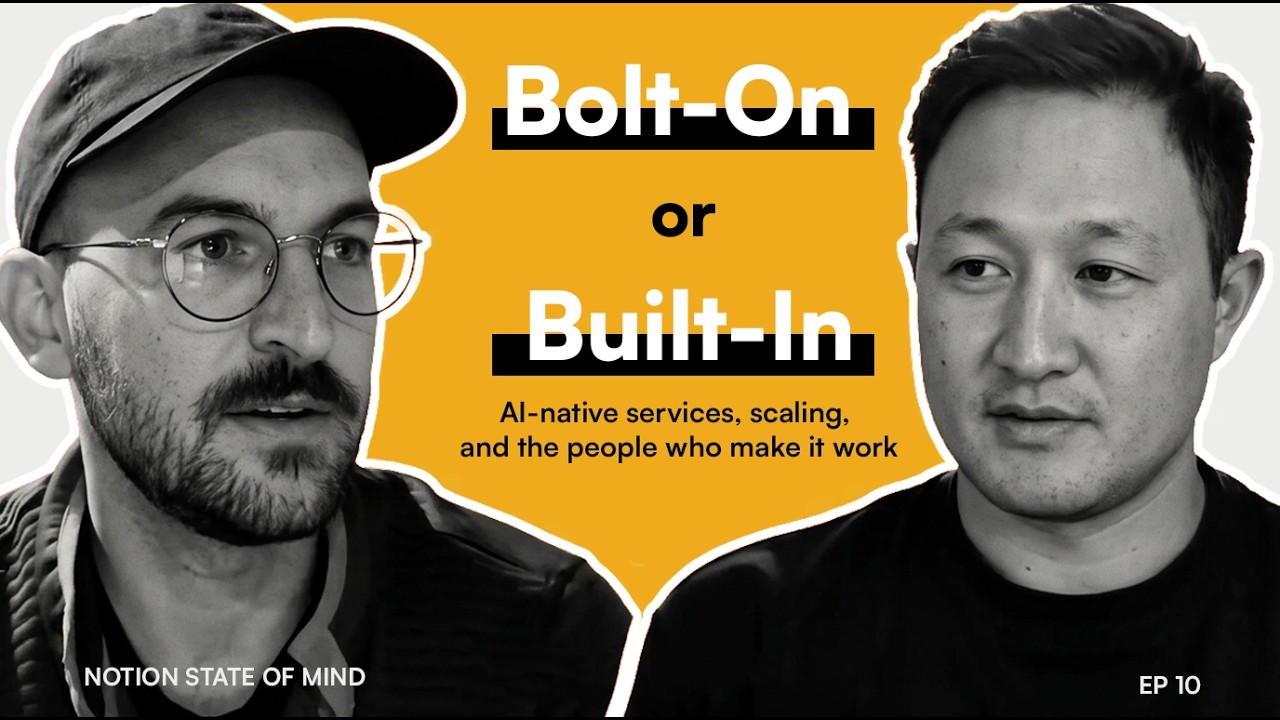
In this unscripted episode of the Notion State of Mind podcast, co‑founders Josh Redd and Bryan Takayama riff on the future of work, AI‑native business logic, and the limits of current tooling. They explore the idea of a “screenless” AI‑driven workflow where the underlying knowledge model, not the UI, defines business processes, and they identify the biggest technical barrier as permission and access‑control across knowledge artifacts. The conversation then shifts to concrete Notion‑centric design patterns: stage‑gated workflows, column‑based permissions, data validation, and AI‑powered tagging, with a focus on how to build scalable operating systems for startups and legacy organizations. They debate the relevance of traditional PRDs, the need for simplicity (Gall’s Law), and the role of human judgment versus AI. The dialogue expands into broader societal reflections—UBI, AI ethics, optimism vs. pessimism about humanity, and theological musings—before concluding with a call for listener feedback. The episode is informal, exploratory, and peppered with personal anecdotes and speculative predictions.
Chapters
Welcome to the Notion State of Mind podcast. I am your co-host and co-founder Josh Redd, joined with my co-host and co-founder Bryan Takayama. And today, uh, we took a bit of a different track. We did have a plan for this podcast. We had a script and we got into the recording room and we started talking and it was recording and we just decided to go where the conversation took us. And so, uh, we'd love for you to follow along and, and let us know what you think about it. We're gonna talk about things from the future of work to AI, Do we think that AI is going to be good or bad for humanity? I actually don't know how much our producer is going to cut, so we'll see. But we get into it and we'd love to know what you think about this format. So without further ado, this is the Notion State of Mind podcast. Always a fan of doing a podcast, but I was, I was on a nice little, uh, little thought flow about what is, what does knowledge work look like in the, in the AI future? It's fun stuff to think about.
It's a hard one to think about.
It's clicking. Actually, I'm so totally, you know, revealing my sources here. Not that it was like the, the original, like, seed of the idea, but, uh, in, in Eva Gutierrez's, one of her things, she said screen screenless, a screenless future or something like that. And I was like, man, that's the perfect litmus test for your business. Like what AI, like what your business should be in the AI future is like, if it doesn't make sense or if it requires UI to make sense of the logic, the logic lives in the UI and not in the actual artifacts. That's, that's broken. Like that's AI bolt-on. AI native is when the entire thing is modeled without ever having a screen necessary to render it. Obviously you need a screen to like interact with it, but maybe, maybe you could do it without even a screen. Like you could talk to it and it could talk back, like if that's the future, right? But the logic, the business logic in the SaaS era has existed on the UI or in other areas and not in the actual knowledge.
I don't know the stats here, but the visual processing power is, I think, exponentially higher than both our audio and our vocal processing power.
This is okay. So what you're saying is, is yes and a no here. I totally agree with you.
Everybody says yes and a no.
I totally agree with you. Uh, the point here is not that, not that you interact with or cannot use a screen, but it's that the screen is a. Or like the UI that you see is surfaced from the logic that comes from the model itself. The model is just knowledge and logic.
And then when I'm aligned to 100%.
Yeah.
Yeah.
You ask it to surface you the perfect UI for it, but the UI wasn't required in the first place to model it. Yeah.
Conceptually, I'm aligned to this. I think that it's a pretty— I don't think we're close to that.
With Notion or just in the world or what? In the world. Yeah. I mean, what's, what's the barrier though? What do you think?
The ability to traverse walls with maintaining permission sets.
Okay. So like the permission matrix, like the access matrix.
Yeah. Like every, every piece of knowledge that needs to be able to be surfaced to the right person at the right time in this model. And we can't even, we can't manage permissions correctly in any software. We can't even use multiple email addresses on one Claude account, let alone Claude can actually even get into most banks right now. I don't know if we want to. So like the actual ability to surf it, like right now, that I think is the biggest hurdle to get there.
Yeah. Yeah, I could see that fitting in. So what it actually came up with, and before I even started talking to Claude for like my thought partnership, I boiled it down to 3 things. If I was going to build the structure or whatever. And it was, the first one was decisions or agency, which is like your humans and your AI agents. The next one was your systems and rules, basically like if this, if this, then that, your inputs and outputs. And then the other one was context, which is like the actual knowledge, the pieces of information, the artifacts, the ideas. And then as I was talking with it, it basically, it said there's 5 and those, and I didn't even tell it this. Like this was not preceded by my idea, but it basically came back with 5 and it was those 3 plus, uh, states of, of the, uh, artifacts. And, um, it's not just a simple change the status from this status to the next status, but it's like even the stage gates, that kind of concept built in where like you have to follow like the lifecycle and the workflow. Uh, and then history. So not just the current, but the entire audit trail of everything that's ever happened. And when you do that, you can literally just you could have a timeline and just scroll backwards of everything that happened in your business to get to where it is. All the decisions, ideas, you know, installing new logic and, you know, creating new artifacts that would all be there. Who did it? When? Why? The rules on what can interact with what.
I don't know.
Pretty fascinating.
Exciting future we're entering.
Too bad that wasn't the podcast topic.
We are recording.
Yeah, I noticed.
My biggest thing on this thread, and maybe it'll get good enough to just, I don't know what I mean. I don't know why it doesn't already do this, but the ability to organize all of the outputs into an easy-to-index manner for human digestion or even system digestion is really hard, even for the individual. And it's something that I'm spending a lot of time on. So I love that you're thinking about the same thing. I'm just trying to build it for myself at the moment. And even just building it for myself, this, this Bryan Operating System Index is quite cumbersome. And this is one person, six different software, one index in class or an information classification system. And this is something that I'm thinking about a lot is like, how do you scale this? And I, and I don't know the answer to it yet.
Yeah. Yeah. I mean, one of the, one of the main things that really caught my attention, or at least was like a big area of opportunity that came up in my mind as I was thinking about this was like, what has— the idea has probably been thought of already, right? Like somebody's actually probably come up with the right framework here. I don't think we're actually in any sense probably reinventing the wheel. It's very possible that somebody in the '80s has already come up with a system that is perfect for an AI world., but the, the cost for actually maintaining the system is just completely, you know, untenable for a normal worker in the '80s or '90s or even 2010s or 20, you know, or so what, that's, that's kind of the whole like AI compresses work is like now what I think people are thinking still in the same box of systems that we currently work in and how to make them more efficient, but it's like what happens when we, when we think outside the box, you know, if you'll allow me to say that. And, uh, and build from first principles, right? And, you know, maybe somebody's actually done some of the heavy lifting on the thought side, but maybe they were ahead of their time. And now we actually have the tools in front of us, AI, who can just work endlessly without any sort of complaint unless you're Ava, our team member who loves to get AI to trash talk her. But yeah, in a world where you have this kind of really inexhaustible labor, so to speak, what is now available to us, and I think this is a really fascinating one to kind of go further down the path on, is like, maybe let's rethink how business logic and tooling works in the first place. Not that I'm trying to, you know, create the next Notion or anything, but, you know, if we can understand it from first principles, we can kind of see when you know the rules, you know how to deal with the exceptions. And I wouldn't put it past Notion to already be kind of doing this kind of, uh, you know, thought experiment.
AI data tagging.
Yeah. Yeah.
Thinking about— you should have the ability to use AI, like use tooling on the backend to attach interesting tagging to make it more effective for the workspace. Like anything that appears to be a knowledge database, just tag it as a knowledge database. Anything appears to be an operational project database. To like have that sort of backend tagging to create this backend matrix that is more accessible to AI. And eventually maybe the blank page shock doesn't actually exist. It's just a, I don't know, image of the galaxy.
Yeah. Well, users, I mean, you currently still have to, you have to think in systems a little bit to really use it, use it the best. And Notion, I think is really good. The best of all consumer-accessible software for using databases, modeling data. And if you even put it up against those 5 layers that I mentioned earlier, it's like the, the states, like it's actually really close. It just doesn't have any sort of stage gating. You know, it's not a first-class principle that there's workflows that in a particular type of object has to go through this lifecycle and go through these these rules and gates, like you can just kind of change it. So when, when that's not first class in the software, it has to be, it has to be in the discipline of the user and the knowledge of the user to be able to do it correctly.
So it's one thing that Salesforce gets really well that Notion can't do yet. Uh, but column-based permissions would enable this, uh, and data validation, uh, would, would enable this. I guess those are both individual criteria for it. Nothing you're saying is. It's crazy though. It absolutely feels reasonable. And in the future, I think there's, there's two things that I, that I think of. One is organizations that already exist today going from current legacy to that, probably not possible. Um, not without AI doing the vast majority of it. So like how, how does an organization transition to it? But another thing that I'm thinking of is how do we test this on startups or companies that are new to Notion? Let's figure out how to build an operating system of the future. And test drive it with them to make it happen.
Yeah. Yeah. I mean, if you can't, if you can't fully realize the future from like a first-class approach, because we have to deal with Notion and its current limitations, but also features, there's, there's a lot of areas where like you can build a system on top of the system to kind of give you that same, same layer. It's like a pseudo layer in a sense. And before I just lost everybody listening. What I mean is like a database view that is specifically for managing the system, right? It's like an admin level view of data. So maybe it's a property utilization view, right? So if it's not, if it's not baked in, we can create a view that is specifically for a user to see and very quickly get the context they need to make the decisions or, or whatever to, to do, you know, this layer on top of the actual. Actual data. And maybe that's the weakest example I can think of. I don't know if maybe you have a stronger example of that.
I don't at the moment, but it's something that I'm going to be thinking about quite a bit, probably after this.
Great.
Cheers.
What you just told me is that I didn't make any sense, and that's totally acceptable.
Well, I was going down this rabbit hole in my mind. It's like, you can actually probably create column-based permissions now that we have can_create with, you you can't create data validation. That's just not possible. But you could have like a, a core object that moves through a series of other databases where you can't edit this other database until it, like, all of this is populated. And then it, it creates an automation or it triggers automation to relate it to the second stage. And then you get assigned to that stage. The can create permission comes available and you could technically create a stage-gated cycle through this. So like say there's 50 properties, 20 proper, 50 divided by 4, whatever that is, uh, in each of these databases, you could, you could enable that through Can Create and, um, and automations.
Yeah. Interesting. So if I'm, if I'm tracking you correctly, what you're saying is the, the stages would be a database in itself and you only get to unlock the next kind of, um, editability or information or whatever, if that stage is attached to the object.
Correct.
How would you, I mean, how would you keep somebody from, how would you actually keep somebody from like changing a status, for example?
Like, so this is what I mean, the data validation aspect is not possible, right? Like in Salesforce, what's really great is it moves on to one stage. You can't go back to the previous stage, but it opens up the next 10 properties. In this system I'm talking about, anyone could go just change the status to stage 1, stage 2, stage 3, and then get access to all the databases. But if you weren't being illicit in that flow and were following the system, you could do stage 1. Once you have all of these, that triggers the completion of all of these, triggers a status change or triggers you to move to the next database.
Yeah, yeah, yeah. Okay, yeah. So each, you've got your almost your columns, your column permissions. They're visible, right? Like everybody would see them, but actually having the access to edit them is only kind of layered through going through the stages, which is correct.
And you only have access to edit them if, if you have access to one record, or you only have access to see them if you have access to one record within the database, because it's can create, right? Like you don't see the underlying database unless an object has been added to you.
Yeah, yeah, that's actually That's actually pretty, pretty novel.
Pretty fascinating.
Yeah.
Well, I think it's how stage-gated systems actually function today. Um, plus data validation that just can create is opening up a whole nother avenue of Notion use and data validation will come. I'm confident.
What would be the first use case that like, let's say we get off this podcast and, and you go in and validate it and test it. What are you, what kind of workflow are you testing that with?
For me personally, and I don't think anything would really fall into this one, but there's a lot for clients that are really interesting. There's two for clients that are— there's a few for clients that are really interesting. CRMs are the natural one, right? Salesforce CRMs. Each stage has a specific set of things that you need, right? Like as the deal progresses, you need more information. Um, that's natural. Content management workflows is another one. In the initial drafting phase, you don't need as much metadata associated with the object, or you don't need as much review data associated with with it. So as you go through stages, it goes through a maturing of what sort of data is going to be associated with it. But I think a really interesting one is more like a, a contract workflow or a procurement system where it's jumping from function to function, where initially in procurement it's the submitter, and then it goes into finance review, and then it goes to InfoSec review. And each one of these, it's essentially a new workflow instead of properties connected to one object. That only this entity is working with. And I think that's a pretty interesting use case. In that one, you're actually doing column-based because technically you can make it so only InfoSec sees InfoSec pieces. No one else does, even though it's connected to the broader item. I think that that's an interesting use case.
Yeah, I think what this, what this is actually reflecting really well, or at least surfacing about what we actually do is, you know, when people think about Notion, they think about like the artifacts, like the knowledge and just structuring it well. And Notion is a really good surface area for thinking on screen, for putting logic on screen. But, but what we're actually doing is we are, we are thinking on a more, you know, rules or logic kind of level and layer where we can actually not just think about it in our heads, not just make a presentation, not just include it in a document, but build it into the tool itself. And that requires a certain level of thinking, uh, to be brought to the table.
That's more— and business acumen, like the ability to apply new features and functionalities to a use case is— I, I think it's something Notion sits uniquely positioned to be able to do, but something that I think we should do whenever we find the time in the day to do it is like, imagine if we were able to envision new features. What systems become available with those new features? And that would be a really interesting point of view that we could share with Notion themselves. It's like, hey, these are the types of use cases that could be unlocked for your customers if you gave us this ability. And I think that's a, that's a really interesting, um, thought exercise.
Yeah. Well, that, that's always the frustrating question you'll get from any Notion person. Like if you have the, the opportunity to request a feature, um, they're going to ask what's the use case, but. What's, I mean, what's great about Notion is that they really welcome that kind of feedback. But, uh, you know, just a little preparation for you to, you know, if you ever get the chance to, to talk to somebody as a listener, you know, any of our listeners, uh, definitely come with the feedback, but, but have the use case in mind because I mean, I come from, you know, even just like the community of really Notion purist builders and we just want the features and, and I don't even, I'm not even going to say that we were we weren't right. I think we have a lot of the correct ideas because we have this kind of gut intuition on what a, like a primitive is, or like a, like a first principle kind of building block is. We see when it's at its most basic level that there will be emergent things that come out of it rather than very prescribed software pieces. So what, what I'm saying is like, that was our strength, but our weakness was probably not actually seeing the use case or, or thinking through the use case. And of course, as we've built out Notion State, that's become a lot more clear. Uh, we've actually got a lot of reps with, with, but for me in particular, coming from the builder side, that was, that was probably the, the lens that I was lacking 4 or 5 years back in the past.
I still think about early on when we only had HoneyBook as our main retainer. There was a use case that was requested from their fintech team, and it was to do a really sophisticated user story sprint management system. That was really tailored to their team. And I wasn't very good at Notion in those days. We actually were on the phone for, I don't know, maybe a week and a half straight building out the craziest workflow diagram because you knew how to build it. You had no idea what a user story was or what this sprint management system was. I had a little bit of an idea of what they needed at this time because I was pretty new to product development from an actual tech firm. So we were trying to like mix these two and I don't know, it was a, it was a massive Miro diagram and some of the boxes we had to zoom in that had an additional 30 steps into it. I still remember that back in the early days.
Yeah. I mean, it was, it was the right approach though, or at least like in general, like let's, let's think about the process. Let's actually uncover what's happening, whether it's messy or not, you know, I, I'm a pretty firm believer in like, and actually the longer we do this, a firm believer in like just just make it work first, make it happen first, make it exist first, then make it good. Or, you know, the saying like, do things that don't scale. I'm definitely minded towards how can we be the most efficient? Let's build something that scales. But that's also like a huge problem, especially in the Notion world. Uh, when you, when you get a lot of people that love Notion, they, they think 5 steps ahead. They think 5 phases ahead of where the business should be going. And the system that could be, and they don't think about what needs to just happen right now. What's the most valuable right now? Not to mention that it's, it's almost like a proven law. It's called Gall's Law that any system that is complex and not validated by a previously built simpler system is bound to fail. You have to make the system actually work and run at its simplest level first, then add the complexity to serve the real need. And so many Notion people, I think, get that wrong, myself included back in the day, just building something totally unnecessary.
We've, we've actually gone through an interesting hill or learning, learning journey at Notion State where at the beginning we didn't really know how to build a system that was scaled. So we worked with them to build a system and then we like kind of clunked along until it started to work with them as they grew. And then we, we rebuilt, rejigged, right? So it was like, we were very much figuring it out as we we did it. And then after that project, we're like, we know how to do this at scale. Let's just deploy the system that works at scale. And we would do that, and then people were like, this is— how do we use this? Uh, and we realized, wow, there's actually a long journey between these two items, and we need to be able to take them there. So it's start with a simple system and force them into it through teaching them the value and teaching them how to use it. And then we very intentionally expand properties or expand databases or expand systems from there because we know If we give them what they need at the beginning, it just won't necessarily turn into what we need. And it's been an interesting journey to get there.
Yeah. Yeah. I mean, it follows kind of the same, I think, rule that a lot of people also subscribe to, which is don't automate unless you do the same step, you know, more than twice, right? Don't make it complex unless you actually like hit a wall in the system more than twice. It's this whole idea of just like keeping it simple.
Yeah, that applies so heavily to this AI era that we're in as well. I think that people just knee-jerk into, oh, I should cloud code this, this activity out, or I should use Cowork to just do this when it's like, if it's, if it's a novel thing that you don't know what your inputs are, your outputs, don't do it. But if it's something that you now have done a couple of times and over and over, and you know what the output should be, then do it. Then you can create a reproducible output.
Yep. Yep. Uh, yeah, there's probably so much to talk about here, but, um, I guess, I guess what, what I'm also seeing in this whole discussion or even thought is like, there's just so much still left. How do I want to say this? There's still so much value that we as humans need to bring to the table. So much opinion that we need to bring to the table. And not rely on AI to do it for us because it just doesn't have the framework. And I think about like you've got pure business logic and process that you could think about it in terms of like just the process without a tool. Then you've got a pure tool and we love Notion, being really good at Notion. We're at the intersection, we're at the applied, you know, business logic to the tool. That's our intersection. And what is the future of that intersection going to look like? I think there's, there's still so much like thought that needs to go into it that you, you can't count on the pattern recognition of, of Claude right now to do it for you. You need to be able to think in terms of like, this is my, this is how, this is how I see the model of my business working. This is how I see the customer lifecycle. This is the, these are the stages I see. This is what I want to happen when this, when the customer goes through here to here, to here, to here. And even if AI was really good at defining those for you, which I don't think it's going to be that clear yet, you're going to end up with something really vanilla and everybody else is going to have something vanilla because you're all just doing the same thing. And if we believe in market differentiation as a fundamental concept, you're still going to be competitive by injecting your own opinion. Um, I don't know, like it needs to be a stronger opinion or at least more valuable and valid opinion than what the vanilla Claude will give you. But I think that's where people will still find an edge. Is having those, those strong business logic opinions and how are you going to layer all of these things on top of each other to have your unique visual of your business, not just the vanilla one. Plus ones. Step off my soapbox there. No, it's important. Either I'm a, either I'm a prophet or I'm just like giving myself copium, you know, I don't know. Time will tell.
Copium or hopium.
Yeah. Yeah. Hopium.
I think what I would say is just in response to that is there's so many things that are happening right now. PRDs are dead is like the big one that's trending on Twitter right now. PRDs are not dead. Shitty PRDs are dead. Irrelevant PRDs are dead. PRDs that are built by product managers that are just passing time and are not being thoughtful about the product, those are dead. But PRDs built by the people that are really intentional with their thought and strategic direction and their design and their intention and the acceptance criteria and the core components of what it needs. Those fuel AI to do what it needs to do much faster and much more efficiently. And the point that I'm getting to here is that the AI is only as good as the strategic direction that it is provided. And this applies to every facet of it today. So the ability to be at the top threshold of that strategic direction in any sort of activity, I think there's still a market to be be made. That probably doesn't exist forever, but today, absolutely. For the near future, absolutely as well.
Yeah. This is where you get the concept of like, you know, who's going to be the first one-person billion-dollar business if that hasn't already been accomplished.
Um, I think it did. And he's being sued by the FDA and like 300 other agencies right now.
Yeah. Yeah. There are consequences in the world.
He also out— it's like outsourcing work to like tens of thousands of people. So one, two employees. Billion dollars, but outsourced to thousands.
Yeah. Yeah. I mean, I'm still, I think we're all still kind of wrestling with, I, and I keep thinking about like the gaps, like what are the gaps that people will always fill and they can fill it themselves or they can fill it with like really levered up AI, but there's always going to be a gap for somebody to do something in. That's, that's kind of where I think a lot of people are thinking like, oh, if all this just gets really good, we're good. We're just going to sit back and take our universal income and, you know, sip margaritas on the beach or something. But I'm kind of anti that.
Oh, it doesn't sound like a bad life. Max, the head of product at Notion, he was just on Lenny's podcast. You guys are hearing me talk about Lenny's podcast a lot. Shout out Lenny, great podcast. He said his bold take, uh, in the contrarian corner of one of their recurring themes was, uh, UBI already exists today and it's knowledge work. Uh, anybody can access, or like, not anybody, but many people can access a computer and be able to accomplish a job. And I thought that was a pretty interesting, uh, take, is like equating the ability to generate your income doing knowledge work that basically exists in many, many parts of the world today.
As far as I, you know, so, so as far as I understood, like, the UBI— tell me if I'm wrong, you know, I, I don't actually know— I imagined it was like you get an income to kind of like get your basic necessities and live and have a quote-unquote happy life without having to even do the work, without having to do the knowledge work. Am I incorrect?
No, that's correct. That's generally what UBI is. There's likely going to be some sort of work associated with it. Anyways, I don't want to go down the UBI rabbit hole. That's not a conversation for this podcast. We're done.
I don't know, man. I think people will not be happy. I think people will not be happy without work and a purpose. I'm reminded of, I don't know which president it was. It was a famous one. It was during, I think, the Depression. I don't know. You can look it up. The Road to Nowhere. To give men work to do and they made money and they worked. They built roads, you know, in wherever in America. When people found out that it was a road to literally nowhere, It failed because nobody actually wanted to do it anymore. The purpose was gone, even though they were doing work, making money. So even when you're doing work and making money, if it doesn't have any purpose, and I don't know, I just think it's in everybody that they will find real satisfaction and purpose by actually doing work and putting value into the world rather than just like taking it and being like a net negative on the world value.
Yes, but I don't think it's work. It's the feeling of being valued and driving impact. And a lot of things that exist today in the workspace or in the workplace are not value felt or making impact, but we still do them. Action items after a meeting or sending out this newsletter or what have you. And AI rightfully should replace that, but the question I would would pose is how do, how does AI not just replace that individual? How does that individual adapt to a position of where they are feeling valued or they are making impact and, and justifying their place in the organization?
Yeah. Yeah. I think, you know, if I think of artificial intelligence as a moral neutral, the same way maybe nuclear, you know, um, understanding was maybe a moral neutral, it can go two vastly different ways, right? Nuclear power, nuclear bombs. AI can go like actually helping people be a lot more valuable, like actually do more valuable things in the world. Or it could go another way, you know, maybe like the Terminator Skynet kind of reality, or, you know, or other things. That's the one, that's the piece that I kind of see as like, oh, this, if we could do this right, this is actually like a really good thing for the world. With, with a lot of potential for really bad. And if there's bad actors, you can guarantee that they're going to try and use it for those kinds of things. So we have to be vigilant on that. But anyway, I digress. What's your prediction?
Give me, give me your prediction ratio of Terminator to Star Trek.
Ooh, that's a good— I probably actually think more in terms of like Blade Runner, you know, if we combine the Optimus robots with with, with AGI, like, what world are we going to live in? My prediction. Oh, man, this is actually such a tough and revealing question that maybe I don't even have resolution on because, like, in one sense, it's like, do I think the world is going to get better or do I think it's going to get worse? Maybe the real question is if we're actually going to cut this. So anyways, my personal take, and, you know, happy to make this a totally different discussion. Oh, this is tough. I actually think humanity in general is— how do I say this the right way? Humanity is not good. It's that age-old, like, debate question: is mankind good or bad? I think it leans bad. Now, do I think that mankind governs the way the world goes by itself completely? No. I believe in, I believe in God personally. So I think that we're not just left to our own devices. So then it's a question of where do I think these two things will meet in the future? Where do I think, where do I think the world will end and how? I don't know.
Fascinating take. Very opposite, uh, end of the spectrum. I'm a forever optimist. I, I believe people are inherently good and unfortunate things have made them bad or influenced them to make bad decisions. Um, there are bad actors, don't get me wrong. But I, I, I'm heavily optimistic on this side. I also have this belief that it takes so much energy to be angry and mean. It's like, there's not, there's not enough energy in the world forever for more than 50% to be angry and mean.
Yeah, no, I think it's a really respect respectable and honorable, I think, worldview lens to live in. And honestly, if anything, I kind of wish I had it, right? It's like one of those things that's like so deep. Is it possible to change it? You know, I think you can obviously influence yourself and, you know, kind of proactively. For me, it's like, yeah, I do think this, but also at the same time, I'm not living in, in like an eternal gloom. It actually just gives me a lot of clarity and peace. When I see bad things happen. Like, bad things happen, and that can give people a lot of really understandable stress and a lot of confusion. Like, why are these things happening? And for me, I kind of understand. It's, it's a not a reality that I love. I don't love that I believe that mankind is inherently, you know, on the bad side of the spectrum, but it actually— the world makes sense through that lens for me. And it highlights, like, the good things that do happen, because I do think that, I do think that people can can and are good for sure. I guess it depends on where you like draw the line on good versus bad. Is it 50%? Is it, you know, that's, I'm not going to go that far, but. So wait, what's your prediction? I didn't answer your question. Oh man. You know what it actually comes down to? I don't, I don't know what I believe about the end times yet. I guess if I lean one way or the other, I actually lean towards Uh, things will— all right, just, I'm just gonna lay it all out there. In Revelation, you know, in the Bible, it really talks about a pretty bad ending to the world, a bad ending to the current world, the current universe. That is all in a final, you know, day of judgment, so that when that day is gone, the world will actually be recreated and perfect, where everybody will be good. There will be pure goodness, no evil left. There is evil currently in our world, and I think it's active, and I think I— if I'm going to believe what, you know, I do about, about scripture, about the Bible, that it will end in, in judgment. I think it's pretty clear, but it's not like a final state. It's actually so that God can restore all things to be the way they were intended to in the beginning before evil entered the world. You know, if you read Adam and Eve, that whole, like, you know, Bible story in Genesis, God actually created the world to be good. And perfect, and evil didn't exist until, until evil entered the world. And so we're kind of in the middle between those two bookends of actually it was meant to be good. And I think that's where like the optimism is actually really, I think, not unfounded. That's what we actually desire. That's what we want. That's what we're made and wired to be because that's how we were created. And we just happen to live in this place that is unnatural and we have to kind of live our lives in that reality.
I don't know if I should be optimistic or pessimistic based on that, that, that part.
I don't know. There's, you know, there's— it's two sides of the same coin, right? Yeah. Of reality. Reality is complicated. It's not— it's usually not so simple.
But what is reality?
This is the Notion State Theology Podcast. We're glad that you tuned in and Uh, yeah.
Oh no, it's good stuff.
It's really interesting.
Just to, to, so yours is 100% bad, 0% good, I think is where, where we landed.
Um, depends because, because AI, AI could be like a great thing that actually allows us a lot of good, you know? So maybe AI isn't the, the final day's judgment. I think a lot of people would, would maybe talk about that for a little bit. Ah, fair. You know, so it could or could not be. I actually don't know. And then of course it's like, what do we, what do I actually care about? Is it like end of the universe, the current age, like Lord of the Rings? Like we're talking about an age and the defeat of Sauron, right? The very, very end I think is very good. But yeah. All right. That's my disclaimer.
I think I was thinking quite binary on AI is either going to be the end of us or the beginning. Or the salvation. And I think your take there at the end is, is quite mature in saying it may or may not be.
It depends. I'm a true consultant.
Yeah. Welcome, welcome.
One of us. One of us. You know what's fascinating is actually how close our current reality is getting to Blade Runner because they, they literally have, they're like, humanoids that are completely AGI that don't even realize, like, almost don't even understand their own difference. And you've got an off-world planet that humans have escaped to. And we're talking about Elon Musk and NASA even going to other planets. You know, Elon is building robots, other people are building robots. All of it is towards this futuristic interplanetary end of, you know, that humanity will spread beyond Earth. And it's like, wow. We're actually, um, we're actually heading in that direction.
Data centers in space by 2030.
I wonder if Notion will, uh, they'll, if they'll have like a policy for where your, your, your data is stored. What was that called? Not governance.
Data residency.
Residency. Yeah. Data residency. You can choose the moon.
The whole reason for data residency today is for regulation on your data. Like I don't want my data in, in the United States because it's not as safe as it is in the European Union, right? Uh, based on the regulations. So I don't see why that wouldn't be a thing.
All right. How do we sign this off? I don't even know where we're stopping.
All right. So this has been a wild journey that we've been on. I don't know how we got here or why we ended up here, but Josh, tell us where we ended and where we're going.
Well, you know, the finality of this episode is going to be about as clear as our thoughts towards the end of this podcast. So, you know, that's just what happens when you're thinking out loud. And actually, that's maybe my favorite type of of discussion. I think something that we've done really well over the history of Notion State and why we've probably been so successful is like early days, we just, you know, we were really good at idea sharing and talking back and forth. So we'll finish it up wherever it finished up. And if we need to continue the conversation, we would ask anybody listening to this podcast to just let us know, leave a comment, let us know what resonated, where we need to kind of tighten up our thoughts. But that's the whole point, right? Is that we're thinking in public. And if we didn't want to hear from people, we shouldn't be doing this in the first place. So, uh, we'd love your feedback. We'd love your thoughts, whether they are on board or completely hostile to, to our own, uh, you know, let us know. That's, that's, uh, that's respectable. So with that, we will call it an episode and we will see you in the next one.
Let's go. Fantastic. The, uh, I don't think— I mean, we, we chose like two pretty antithetical points of view, so one of us is gonna get flack and the other ones—
or maybe we both will. That'll be incredible.
Let's just get roasted. Like, that'll be amazing.
More from Bryan



Bolt-On or Built-In // AI-native services, scaling, and the people who make it work