Navigating Life with Ease – What Making Time Means from a 3 Principles Perspective
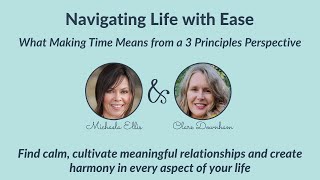
A recorded conversation between Clare Downham and Michaela Ellis that examines the common phrase “making time” from a Three Principles perspective. They reframe "making time" as a matter of choice and prioritization, contrast managing time with managing oneself, and describe how the inner critic and habitual beliefs ("predictable BS") interfere with following what feels authentic. Practical takeaways include breaking tasks into small segments, reframing language ("I prioritized" vs "I didn't have time"), and pausing to notice bodily sensations to access present-moment clarity about next steps.
Chapters
Welcome. This podcast is a series of candid conversations exploring the human experience from a completely new perspective. In it, we will be diving deeply into the meaning of commonly used words and pointing you away from that old, stressful way of looking at life towards a new paradigm. This will help you find a sense of calm, cultivate meaningful relationships, and create harmony in every aspect of your life. Here is Navigating Life With Ease with Michaela Ellis and Claire Downer. Hello.
Good day. How are you there?
I am good. I'm good, yes.
Good.
How are you?
I'm well, I'm well. And I have a word for us to explore.
Cool.
Well, actually two. Making time.
That's really. That's. Oh, now then, I don't know where to go with that one. Because you can't do that, can you? The first thing that comes to mind when you say making time is, well, you can't do that. But we use that phrase, don't we, to mean. I guess it's about the things we're avoiding, not, not making time to do. And I think the time always exists, really, like it's there, isn't it? But we can do other things instead of the things. I'm gonna shudder fires now. But you know that we should. Or even, even that, like, what's coming to mind is that once you've got something that you really feel passionate about, like your authentic thing, you know, I feel like that's a current that's. That's moving you forward through life and that, oh, yeah, now go do a bit of this and I'll do a bit that we're kind of following that, that intuitively led sort of flow and then that little tinker of a voice in our head distracts us from that. That's there. I feel like that's there all the time. And we all know kind of. Well, we sometimes know when we're doing it, don't we? When we're just avoiding, I suppose, really showing up how we would like to really doing what we would like to do. Because that voice in our head is just trying to keep us safe all the time. So it says there's not enough time and, you know, I have to have to make time to do that thing. Well, the time is probably there. I find that when I've got like a back a busyish day. Today is quite a busy day. It's quite a lot of little appointments and things that I think, oh, I'm really, you know, I'm working on a landing, couple landing pages and things at the moment. And I haven't really got time to, oh, look at my day. And actually if that's what I focus on, if I think to myself, right in between the appointments, I'm going to do five minutes on this thing and just do another little bit of it, you know, I, it will probably get done. But if I, if I kind of go, oh, it's only five minutes, I'm ready, I'll just scroll on my phone or I'll just do something else, then I can easily get distracted and end up not doing the thing that really in my heart is the thing I want to do. And sometimes actually that, that makes those things a little bit easier for me because then it isn't just right. This is the next. Like, for example, I'm building this web page. I've had some feedback from somebody else and now I'm listening to their feedback and just doing the, the suggestion. They've made some great suggestions. I'm kind of putting those suggestions and it is with just one little bit at a time. Make this text narrower on the page. Make a video for here. They are all just little jobs that I can do in and amongst the other things. And I think kind of when you go into, I mean your time management, which again is a phrase I'm not really keen on because we don't really mean time management, we mean self management. We don't. We can't manage time, but we can manage ourselves a little bit better maybe. Yeah, you can. It can get really tangly. I just think. We'll find a reason why we can't do a thing. If we're listening to the voice in our head that says, you really shouldn't be doing that thing. You're not good enough or you're not quite there or you're not where you should be, that, that voice can like obviously I talk about the inner critic doing a knowing journey. That inner critic is so clever at convincing us by sounding really sensible or, you know, you really do have to make time for this thing. But then look at how busy you are. You're so busy you haven't really got time for that thing. You've got far too much going on, you know, just do the other things, you know, because. Because there's something there that bless the inner critic. And it's funny little ways, but it's something there that it wants to. We want to be protected from in some way. That, that voice is a protective voice. It means well, but it gets in the way. But yeah, that's my first little kind of ponderings on that. I'd love to know why that came up for you or whatever else you want to say about it.
Yeah, well, I'll speak first to. Or just respond to. Yeah, it, it, you know, it always starts with what's going on in your head, with what's what. The voices in your head are telling you are guiding you to or poking at you or pushing or you know, whatever, whatever experience you have of it. And it came because, you know, it's early morning here and Rob and I are leaving together. Go, you know, going, going out. Right. And there's a time frame that, to do all these things and, and you know, there was an embrace and it's like, you know, okay, we'll, we'll make some time for us to actually connect because we haven't, there's. It's just been busy. So it's like, wow, how are you? What, you know, so I said about making time and it's like, oh, and that's a choice. Like it, it all kind of boils down to. It's like what are you prioritizing, right? What are you choosing? You're choosing something over something else. And, and, and that's what we do. I mean we live on this material plane. There is time and there's. We, we fit our lives into some of it and some we don't have to. Like we get to even choose that. Right. I choose to align up a time to come and meet with you and, and do the, and do this. And there are some things that I, I could if I wanted to, but I don't have to. It would be a choice. But even in all of that, like when you think about your day to day life and that's what I was thinking about. All the things about getting ready to go in the morning, what I do to get ready, you know, at the end of. And for the next day even, or tidying up. There's always something that is either like, it's like, how do I say? I just had this little vision, not time blocks kinda. There's a time where Rob and I are going to be in the car together and there's a time where we're going to be on the train together. And then there's a time where we're going to be walking and then a time at the end of the day when we're going to connect again. Right? And then there's a time where we're going to make a meal and have it. So it is almost like these little things. But in and amongst there, there is these choices, I just kind of saw that. Yeah. That making time, it's just a bunch of bs and it's really about making a choice. And where do the choices that. The choices in how you spend your time, which is another phrase we could get into it really how your experience of it is either, ah, feeling good or feeling a little, you know, scratchy. And if it's feeling good, it's likely because you're following what your heart, your soul, your inner wisdom, whatever you want to call it, is guiding you to. And when I said these words this morning about making time, it. When I hear it and even feel it in that moment because I was in a hurry, it was obligation. And it's like, no. And that doesn't feel good. Obligation didn't really feel good in, in this respect, in this particular moment. It's a very. You know what I know though is I enjoy spending time with him. And when I let all the rest fall away and I'm just with him, it's like that if I'm going to make time, it's like, I want to make time. Like, let's. I'm going to change the words a bit and say it almost feels like making space, like clearing the deck. And it's like, ah, here we go. Now we can just be together and, you know, talking, whatever, going for a walk, bike riding, whatever. Yeah, but it was interesting. There was so much tied. There's so much tied up in time, you know, making it, obligation, choices, preferences. I went to a talk about time. It wasn't exactly about time, but there was someone who said he was listening to this person. It. She was his client, talking about how she didn't have time to. To work out in the morning and then she didn't have time to have a proper lunch or whatever it was. And then he said, I'd like you to tell me about your day again. And instead of saying, I didn't have time, say I pr. Prioritized and then say what you chose to do instead. And it's like, oh, that was a really interesting, very interesting ex. Experiment. Because when I did that for my day, it's like, ooh, ooh, that's. That's telling and doesn't feel so good. And that's not following, you know, the, the deeper wisdom connection that I have, it's not following that. And I can tell because it feels sticky or heavy or. Yeah. And it could also be just the thinking about it that I have sticky or heavy thinking about it. Maybe it is what I'm being guided to do, but I'm avoiding it because I'm afraid or that kind of thing. I'm getting that inner critic that you talk about. So it's kind of a, it's, it's a funny dance, isn't it, throughout our day and time.
Oh, yeah, yeah.
All the time.
I think that's one of the things I noticed with a lot of the people that I work with who've perhaps come into this three principles conversation and heard the thing about the good feeling. You know, following the good feeling is a phrase that's often shared amongst, you know, people in the three principles community particularly. And the issue with that is that the little bit that's missed is that as you move towards a good feeling, often that is going to take you to the edge of your zone of growth or your comfort zone, whatever you want to call it. And the, the inner critic is stood there with a big spear going, no, you don't, don't you dare come over here. This is not safe. And that's, that's not our authentic, that's, that's, that's not authentic expression of us. That's our thinking that's saying, don't come over here. You know, and then we don't feel good. And I think a lot of people then go, oh, no, I can't do that then, because it doesn't feel good. The fact that it's our thinking about the action that's then come up. And, and I think Dominic Scafidi expressed that. He just called it the predictable bs, you know, literally, that is, that is gonna happen. That is gonna happen as you move towards, authentically speaking, your truth, authentically kind of showing up wherever that is in the world that you want to show it could be in a relationship, in a business, wherever. Yeah, you are going to bought up against the predictable BS of you in a critic that says, no, stay in your little box, little tiny safe box. Don't come out, don't step out. And don't say, don't say that, don't share that, don't put that out there. And then of course, again, like I said before, then using the time thing as, oh, we haven't really got time or you haven't, you know, but like you said, it's a choice. There's a. I like that, I like what you said about that coach who said to his client, yeah, just change the whole change. Flip the, flip the script on that. Flip the perspective on, you know, I didn't have time. Well, you had the time, but you chose to do something that wasn't aligned with. Well, it sounds like self care and not burnout in that particular person's case. And that's another one, isn't it, that's so easy to not prioritize is care of. Care of the body and prioritize the busyness and that. You know, a lot of people I work with are high achievers and they will prioritize everything over looking after themselves to the point of really getting quite sick without kind of realizing that there's a different way to do things with that. My. I mean, and of course I'm speaking about myself because I burnt out, didn't I? So I totally did that one to death. You know, I would have said, I've got time for this, I've got time for that, I've got time for the other. As I, you know, fed my kids pasta every night because I didn't have time to cook apparently, you know, is it really pasta again, Mum?
They used to say.
All I could manage a jar of sauce from the shop and a bag of pasta was my limit. But yeah, it's, it's. And it's so easy to believe. Well, it's just so easy to believe what we believe, isn't it? Like, it's not. Bruce and I would often have. We often chat about the weather, but we were chatting really deeply about beliefs today and just you believe what you believe until you don't believe it. And so in that moment when we choose apparently to not prioritize our health or not put ourselves on our business, there's something deeply key there about compassion that, you know, we really are believing what we're believing in that moment. And until we don't believe that anymore, we will continue to run that script and do that behavior or not do that behavior or, you know, prioritize one thing over another, because that's what we believe.
Yeah, Yeah, it's, it's, it's one thing to see it and if you can, you can just choose something different, but it does sometimes an understanding, like a flipping of words like this is this, you can see that. And just like shifting over here and looking at it from this perspective, like the I don't have time or instead I prioritized or I chose this. It really sort of, it brings some kind of clarity and then you have, and then you have a choice. It's like, oh, it's kind of like it's getting real with yourself. It's like seeing what's there, like eyes Wide open, you know, look at it all. You don't have to go digging down and see what's happened over the years since you were. But maybe those things will come up, you know, be open to seeing how something. If something's not, you know, if you're noticing that something isn't. You never have time for something that it. But you really want it. It's like maybe you don't. Maybe you just think you should because other people do. Maybe you actually want something else. Maybe, you know, it's kind of like this on, you know, sort of like letting all of those bits sort of fall away and. And see what's. See what's really there. It's getting quiet. Right. And like really being present with that. I love, you know, in talking about. I've started to change the. You know. You know, if it feels good to. It feels right, it doesn't always feel comfortable. It doesn't always feel good per se. But they'll. Deep down there'll be a feeling of like, right. Rightness, you know.
Yeah.
And that's neither feeling good or feeling anything. It's kind of a neutral almost. For me, it's like.
Wow.
I was going to say certainty, but no, because that word has a lot of garbage in it too. Just right. It just feels right. Settled. Feels settled. Even though there's. There's things to do that might be uncomfortable.
I think. I think for me there's something there about pausing because I think. I think as we do move towards something new or something that's a challenge or something that's a growth area for us, which often is the authentic thing and the predictable BS comes up and then there's this fear in the body of some description. For me, that's when the pausing is so important to just allow yourself to just have that emotion, to be with it, to observe it in a very almost, I often say like a childlike way, just naming the. Oh yeah, my stomach feels all jelly and my knees feel a bit wobbly and just very gentle kind of noticing of the. The sensations in the body without getting into the kind of traditional labels for those sensations. Just the sort of how a child would say. You know, how a child describes how they're not feeling. Okay. They have very simple language about it because they haven't got all those labels yet. And when we do that, I think it. It just draws us back into the present moment because that's. That's where we can really answer that question about like, what is authentic for us? What is the right next step is from the present moment. Not with the stories about where it's going to lead and what it's going to do, but just this. So. Oh, yeah. That just feels. That just feels right. Just feels. Yeah, it just feels right, like you said. Yeah. We can set. I think I find if I get kind of overwhelmed often about something, then if I sit with that feeling, it just sort of. Yeah, it settles itself, really. And then I feel inspired to move forward again with the thing. Whatever. It was.
Nice.
Yeah. Cool. Thank you. That was a good one.
Thank you, too. Yeah. Very nice. My skin is burning.
Yeah. Bless you. Yeah. Oh, not nice flashes. Hot flashes.
Yep.
Yeah, it's good.
I have time for that, obviously.
Yes, obviously your body. Maybe you need time for a hot, cold bucket of water at the end.
Yeah, this is good. Thank you, Claire. Appreciate your perspective.
Thank you. Ciao. Bye. Hey.
Thank you for being a part of Navigating Life with Ease. We'd love to hear your feedback and receive a review on your favorite podcast platform. This will help others who'd also like more ease in their life to find us. We're here to support you, so if you've any words you'd like us to explore or you have a question, please reach out to us@navigatinglifewitheasemail.com Again, thanks for listening and stay tuned for more episodes of Navigating Life With Ease.
More from Clare

Navigating Life with Ease – What Nothing Means from a 3 Principles Perspective
Navigating Life with Ease – What Abundance Means from a 3 Principles Perspective
Navigating Life with Ease – What Burnout Means from a 3 Principles Perspective
Navigating Life with Ease – What Obligation Means from a 3 Principles Perspective
Navigating Life with Ease – What Intention Means from a 3 Principles Perspective

Navigating Life with Ease – What Seeking Means from a 3 Principles Perspective
Navigating Life with Ease – What Thought Vs Thinking Means from a 3 Principles Perspective

Navigating Life with Ease – What Magic Means from a 3 Principles Perspective