Navigating Life with Ease – What Regret Means from a 3 Principles Perspective
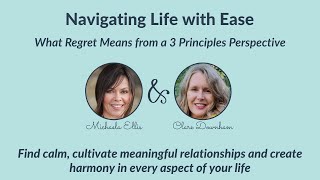
A podcast episode (Navigating Life with Ease) in which hosts Clare Downham and Michaela Ellis discuss the meaning of regret from a '3 Principles' perspective. They argue regret arises from new hindsight and thinking after an action, emphasize that in-the-moment choices reflect what was available psychologically at the time, and suggest replacing self-recrimination with curiosity, bodily awareness, accountability and constructive action.
Chapters
Welcome.
This podcast is a series of candid conversations exploring the human experience from a completely new perspective. In it, we will be diving deeply into the meaning of commonly used words and pointing you away from that old stressful way of looking at life towards a new paradigm. This will help you find a sense of calm, cultivate meaningful relationships and create harmony in every aspect of your life. Here is Navigating Life with Ease with Michaela Ellis and Claire Downer.
Hi, Claire.
Hello. That we have this moment where nobody knows who's going to say hello first. We should that before we, shouldn't we? Anyway, what we do know is that it's your word.
Yes, we do that much. Ready? Let's talk about regret.
Yeah. Not so. I don't have so much of that these days. It's quite good. I do have things that I look back and think I didn't trust myself when I made that decision. Like there was a knowing that it wasn't quite right and I still went and did it. Or there was a known that it was right and I didn't do it. So said there's an awareness around that. I think that I probably. I was a bit of always a bit of a bull in a china shop through life really. I think just would get on with it and yeah. Not worry too much about that. So there's a bit more reflection now. But I don't know if I'd call that regret. Yeah, it's not a nice. Well, it's Thor, isn't it? It's Thor. If we're going to call talk generally about regrets. Just another thought that says something in the past you. You didn't do right or you made a mistake or you made the wrong decision or you did something wrong. I think fundamentally. And. And I think I've got like a. A really different view about mistakes, I suppose because regret generally will come with a mistake, won't it? There'd have to a decision to say something was a mistake before you could get into regret. I suppose. But I really see mistakes in a very different way now that when we think we've made a mistake and therefore might feel some sense of regret about something, we. It's because we believe that we could have made a different choice. And that can happen in a second, can't it? You know, like we. We might say something unkind to somebody we care about because we've got into a mood with them of whatever and then we say something and then set literally like a second. Like as soon as the words are out of your mouth. You kind of go, oh, no, shouldn't have done that. But in that moment when we said that thing and did that thing and spoke with that tone, whatever it was, there was, there wasn't the level of choice that we believe that there should have been. And the reason we now see it as wrong is because we now have new thinking. Because the person we've spoken to unkindly or us, there's been some evidence of why it wasn't such a good idea what we did. Because something's gone wrong or something's not working out now and something. Or something's, you know, let's say money for an example. Isn't we, you know, perhaps people who gamble, there's a regret because I've lost a load of money. But in the moment when we do something, we just know that we don't know. We don't know that in few seconds time there'll be some new thinking and that might not quite look like a good idea, but also the circumstances changing, give us information, give us input, and then we go, oh, yeah, that wasn't okay because we've shouted out our child and they're now crying. Or we shouted our other half and he's now stomping around the house. Or you know what, whatever's happening, we can see some evidence. Or we've suddenly got a lot less money in our bank and we can't pay for the food this week or whatever, whatever it is, or got a stinking hangover. Maybe that would have been one of mine, you know, like. But I think what's really, what's the dissolver of regret for me is seeing that in that moment when we did whatever it was, we couldn't really have done anything else. It wasn't like all the options were available to us or we could see all the options, or we had all the. Or we could choose from the thoughts. Yes, we may have had a choice of thoughts, a choice of decisions to make, but in the moment when we made that decision, that was the only thought that looks to be right. And, and that's due to a lot of things. You know, it's our conditioning, what we've learned to be right and wrong, but also how we feel in our body and where we think that feeling is actually coming from. If we think the feeling is coming from the person we're about to shout at, then of course it will make sense to, you know, vomit that force towards the other person, because it feels like that will bring us some relief from the horrible volcanic eruption up the middle of the body that we've got because we're feeling angry. The same with anything really. We do things because we think they're going to make us feel better and then we believe a thought in that moment that says, oh, this is how you can feel better. And all this is a bubbling semi unconscious kind of thing that's happening. All very innocent or psychologically innocent, I guess is really important when we're, I guess in this conversation we want to be dissolving regret. We want to be seeing it for what it really is, which is a thought saying that you could have done better and you didn't, but what if you couldn't have done better in that moment, really. But now what you can do is have some accountability for the mess you've made in the world. So if you're in, I think if you're in regret, you tend to then be also a little bit probably in guilt and you're very inside yourself going, oh, I'm terrible and I shouldn't, that in the meantime there's a person or a situation or something in the real world that's. That needs support. So, you know, you might say sorry to somebody, you might need to work out how you're going to put that money back in the back. You might need to drink two pints of water. There's things to do to resolve the result of the action and the result of the decision. But often if we're in regret, we're sort of squirreled away in the corner going, oh, I'm just terrible and I shouldn't have done that. And we think that that's how to get ourselves to change and do better next time. But I just don't. I think you end up in a, a lower mood and then you must much more likely to do more of the same low mood behavior, you know, it doesn't really work that way. That's quite a long ramble on regret. Good word.
Yeah, that was really good. Really good Claire, really good response. What and what I. Two things I want to speak to on that is that yes, in the moment, every moment we're only doing what we know to do in the moment. That's it. That's all that's ever available to any one of us. And often, not always, but often in, you know, we call it hindsight really, whatever. It's just in another moment we've seen something more and now, yeah, we may wish we had done it differently or whatever. And the other thing was, yeah, you know, burrowing, borrowing the regret, you know, like taking a thorn and, and pushing it and poking different spots. With a regret, really, it's not changing anything. But what is? What is. What you can trust is that you've already seen something different about it. Your awareness, your consciousness around that similar situation. You'll get to know what it is, the feeling of it. It's just like, oh, there's that. You're not going to likely respond the same, or you might, you might remember it and still choose what you chose before, that you regret it for whatever reason, or you will choose something different. You'll choose to do it differently. So either you're going to feel more regrets, like, oh, I did it again. I've done that before. You know, where there's something that, oh, I'm aware that that wasn't a great choice back then, and I might make the same choice again, maybe because I'm afraid of what the change will be. Maybe, you know, who knows what it is? But you're doing it with awareness. You're doing it consciously. Consciously making a choice whether it's to repeat or whether it's to like, oh, yeah, this feels right, and I'm going to do that. And you'll get a different result. Yeah. And this came. This idea of regret came out of conversations, you know, with someone who's lost someone and, and there's regret over things that could have been different. I think with many people that I've lost in my life, you know, same. There was things that I regretted, things that I. It's like, oh, I could have done this, or I, I shouldn't have done that, or I could have had this conversation or whatever. And it's like, done. It's done, but I can take that forward. There's no sense in, in, in just wallowing in that regret. It's just like, okay, I learned something, I see something, and yeah, there's an opportunity for something different. Yeah. In things within relationship, all kinds of things. Like, we have regret in so many different kinds of things. And it just provides information, really good information. We learn something through it. We learn something by taking action on our thoughts, whatever they are. In this case, regret, you know, or you know it, and it's like, is it. What is it getting you? Is it helpful? And it's something to kind of. To notice. And when you notice, when you're really ready to see, okay, this isn't helpful. And what you had said about there's going to be someone in your life, how I see it as well, is that you now have an opportunity to Be of support. Just what you said to someone else with your increase in awareness around this whole topic. Because I don't know if you've noticed, but have you noticed that when you tend to be going through something, all of a sudden you're attracting other people who are going through those things and because you. You're learning some things, you're actually able to help them. So, you know, it's. You can. Yeah, you can just easily, you'll. You'll be given opportunities to make. I was gonna say good use not good or not. It doesn't mean now you have to go out and help someone with the same issue. Not that, but it kind of opens.
You up.
To be in a place where, oh, you could offer something that could be helpful to someone. You know, isn't that what we're always doing? And you know, in our everyday life, we're experimenting, we're doing things, we're trying things, and as we learn, we become a better resource for other human beings going through their everyday life stuff. So kind of, I see what we're sort of doing here too.
Yeah, I see that with my clients that they quite often show up and literally put a mirror right there in front of my face. Oh, God. Yeah, the same, you know, they exact same thing, maybe. Slight difference, but in the main, very, very similar. You're right, that does happen. Definitely. There's something about as well, like you were saying once you. Once it's happened once that, well, you may not even catch it the next time or the next time or the next time. But I think if you, if you can be in a conversation like this where you're bringing some level of awareness, I think particularly to how. How did I feel in that moment when I did what I did, you know, that I now could be regretting. There's something powerful there to, to go, oh, yeah. Actually, when I think about it, I was really revved up in that moment. I can fit. I could feel that. That level of sort of emotional. Yeah. Discomfort. That's of course, letting us know that we're a little bit off in our thinking and. And maybe rather than regret, there could be more inquiry or curiosity or, you know, because sometimes, sometimes I think there's probably a remnant of that feeling still there. You know, when you, even when you're going into the regret, you can still feel there's. There might be anger or there might be tension in some way that. That's then something that you can kind of go, oh, yeah. When I'm feeling like that, I tend to do this. And that tends not to be so helpful in my life. You know, the more. The more for me we can become aware of what's going on in the body and leave the mind to sort its silly self out because it's usually off on one anyway. The more we can be in the body, the more we're really tuning into that continual signal. I can't remember which three principals teacher called them love notes. It might have been Bill Pettit, I think. Love note that they're literally like love notes from your system to say, you know, now it's time to stop. Now might be time to be on amber or orange. I don't know if you call that. You do call the middle one amber. Yeah.
The us.
They don't. And I said it on a live sometime and somebody said somebody had to translate in the comments. They don't call a mamba anyway, you know, and when you really calm, you kind of know that you're at green. And I don't think we're ever gonna avoid those situations where we go, you know, that wasn't the best, but I think maybe we can. If we can just keep tuning in that it's like a tuning fork, isn't it? We can just keep finding that resonance of calm and love as we move forward through life, which I think is most well done in the body. Then we'll. Yeah. We'll step into less of those situations. Maybe that could result in us feeling. Wish we hadn't kind of thing. Yeah.
Yeah. I love that visual. And I got a visceral feeling of the tuning fork. Yeah. And the resonance. Very good, Very good.
It's all the same thing, isn't it? It's all. Well, the words we explore, they all end up in the same place, interestingly.
Right.
I suppose that it's a conversation about principles and it doesn't matter what word we explore here. We're always going to be pointing in the same direction to how our experience is being created. Yeah. Is by understanding that. That we understand ourselves. Like you, you know, talk about a lot. You know, we just. We just get ourselves more. We understand. Well, we just understand what our state of mind is. And we all. You know, there's certain states of mind that we just work better in than others.
Indeed. It's good. Thanks, Claire.
Yeah, yeah, I feel that we've stitched that one up as it were. Conducting or sewing here. But anyway, that's the visual of this. Yeah.
Thank you.
Good words.
Yeah. Appreciate it.
I'll see you next time. Cool.
Yes.
Ciao for now. Bye bye. Hey.
Thank you for being a part of Navigating Life With Ease. We'd love to hear your feedback and receive a review on your favorite podcast platform. This will help others who'd also like more ease in their life to find us. We're here to support you, so if you've any words you'd like us to explore or you have a question, please reach out to us@navigatinglifewitheasemail.com Again, thanks for listening and stay tuned for more episodes of Navigating Life With Ease.
More from Clare

Navigating Life with Ease – What Nothing Means from a 3 Principles Perspective
Navigating Life with Ease – What Abundance Means from a 3 Principles Perspective
Navigating Life with Ease – What Burnout Means from a 3 Principles Perspective
Navigating Life with Ease – What Obligation Means from a 3 Principles Perspective
Navigating Life with Ease – What Intention Means from a 3 Principles Perspective

Navigating Life with Ease – What Seeking Means from a 3 Principles Perspective
Navigating Life with Ease – What Thought Vs Thinking Means from a 3 Principles Perspective

Navigating Life with Ease – What Magic Means from a 3 Principles Perspective