Former pro Zev Taublieb maps the path to professional soccer in the U.S. and abroad. About 80% of American pros come through Division I college, so securing an offer by junior year is critical. Moving overseas early can hurt college recruiting, and clubs want to see players in person multiple times a year.
Chapters
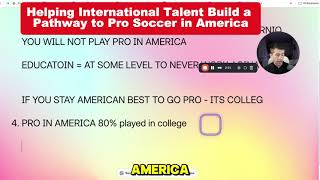
I saw your video and it's quite good. You're a good soccer player. If you ask me what level do I think you can play, you are a potential Division 1 soccer player in my opinion from what I've seen in the video. So here's what I want to tell you. If you want to play pro, which I did— my name is Zev Taublieb, you can look me up on Wikipedia— I played pro soccer for 10 years. If you do not get an offer to play college by junior year, you will not play pro in America. It is in America. Now if you want to go somewhere else, you have a Greek passport, I don't know anything about that. I played for Fulham when I was 18. I then went on to play college soccer and then And then I played pro soccer in Sweden and I got to play in the Europa League game and it was awesome. And then I played pro for Toronto in MLS, didn't play very many minutes, and I jumped around the USL for a long time. All the reason I'm saying this is unlike my other kids who also want to go pro, you have a Greek passport, so you actually have the opportunity to go abroad. So if you want to go pro, if you stay in America, the best way to go pro is to join an MLS team and then work up the ladder. If that does not happen, it's college. If you look at the pro world in America today, 80% of the kids played in college. So you have to go to college if you want to go pro. Those are the statistics. If you want to go pro in America. Like I said, you want to go abroad, different story. But you want to go pro in America, every pro team here is going to ask you what college did you play for. And if it's not a top Division I school, which are done recruiting so much earlier, then you're in trouble. So as a freshman, if you want to go pro in my world, meaning if you want me to help you, college is first. That's number one. Number two, your Greek passport. You want to go abroad, so be it. Now, Dad, you were talking about him, uh, maybe not going straight out of high school. You can definitely still do that. You can wait. Here's the problem: if you go abroad so that way you can come back because they love internationals, they will not recruit you, in my opinion. Most of the time in the recruiting process, and I get this all the time because we have a lot of MLS Next kids, senior year, go play in Spain or Germany, and then they don't get recruited. The coaches need to see you in person 4 to 6 times every year. So FEST, for example, which I think you're probably a part of, or if you're not, we'll talk about that, or FLEX or whatever it is, they have to see you in person. Now, if you're— if to your point, they love internationals, these internationals, because I know them because I played in Sweden, are professionals and they're 21 years old. So if you tell me you can go play for the professional team in Greece and then you have to work with an agent, which is technically illegal, and you're asking a lot of things to go in your direction, I don't advise it. Which brings me to, if you work with me, you can still choose to take a gap year. Like, I think that might even be a good idea. You want the coaches to know who you are well before then, because if you wait till after high school to then start getting in touch with these coaches, they've already recruited people. Like, that's crazy, especially the schools you want to go to. Somebody says to you in your world, internationals are really competitive and, um, I want to go pro. And then you wait till junior year and realize, well, I'm not getting as much traction as my friends, and/or God forbid you get injured, or you realize you don't want to go pro, or you do want to go pro but you also want to get an education, which is what happened to me. I was the same as you. I did not want to go to college. My parents, they were like, I moved to England, you know, I've tried. I really did not— my parents were even supportive, but they were always You're gonna get education.