2:56
A soccer player's guide to emailing college coaches. Research the program first, keep it short, include your position and stats, and only follow up with real news like awards or tournament selections. Spam kills your chances.
A soccer player's guide to emailing college coaches. Research the program first, keep it short, include your position and stats, and only follow up with real news like awards or tournament selections. Spam kills your chances.
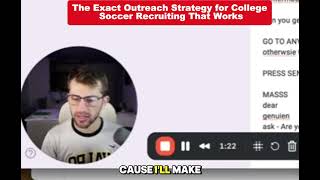
the school so they know you did 35 seconds of research on their website. I wanted to connect with you because of my whatever, you know, whatever your thing is, whatever you do well. Hopefully you do something well, right, that would benefit your program. I'm this number and I play, you know, for this team, right, U16 girls, BCNL, whatever, um, that you play. And here's my coach name, they'd be happy to provide a recommendation, their email and cell phone is this. So now you made it easy for me in basically 2, 3 sentences. Okay, I know your name. You've done a little research. Great. Oh, you're good. You're a good fast winger. Awesome. You play on the 2010 ECNL team. Great. And your coach is so-and-so. I know that coach or I don't know that coach, right? Easy, simple. It's not a lot of fluff, right? You attend this high school, you do this GPA. Okay, great. And again, I should be high, I should be bold there. You again, one other thing about you, right, as well that excels in this thing, right? And if you have awards, great. If you don't have any awards, fine, you know, but just something not too long, but something super concise, but really specific too. You can view my profile here. Our team's competing here. Then are you attending? If not, can I attend some camps that you'd be attending in the future? So that can be an email template sent the first time. You're not going to keep sending the same template, right, to, to a coach, but that can be a template email that you can freely and easily send. I'll send this recording so you can have it. It's super easy template email that's effective to get us interested to see what you know, who you are. How often should you communicate? Generally speaking, When there's a significant update, of course, I like how in this picture the— I didn't even notice that until now. It's like the computer's backwards almost. Anyway, so when there's a significant update, or it's getting like projected onto that screen. Maybe if your computer does that and you can't see what you're sending, get a different computer. But how often should you communicate, right? When there's a significant update, you've won an award, tournament, you've been selected to participate in something, you go on a big showcase, head into the camps, playing near them, you know, all sorts of things. Maybe there's not a specific formula of like once a week or something. Maybe Zev can— maybe has a formula that he's spoken about. But the reality is I think you should email coaches when there's an update, you know, as opposed to just like a random checking in email. Having said that, consistent communication is important. And so my general rule of thumb on that is you should be creating enough content with your play to be able to warrant these things. So for example, If you're not— I won't necessarily say winning awards because it depends on what level you're playing. There's not always awards there. But in high school, if you're not winning awards, I suppose, if your team is not playing in showcases, if you're not playing around that