Corrado Fontana interviews Rapaille Clotaire
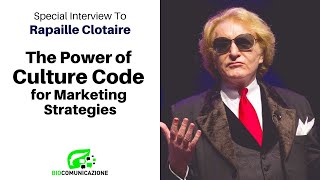
This content was created by Corrado Fontana. This content was uploaded by Corrado Fontana. This is a YouTube interview titled "Corrado Fontana interviews Rapaille Clotaire" (published 2019-09-16) in which host/interviewer Corrado Fontana speaks with Professor Clotaire Rapaille (founder of Archetype Discoveries Worldwide) about Rapaille's Culture Code and his application of the three-brain/reptilian marketing theory to cross-cultural marketing. The conversation (in English) covers Rapaille's research method (identifying first imprints and emotional codes such as aroma for coffee), common marketing mistakes (relying on surveys and what people say), case examples and clients (e.g., Boeing, Procter & Gamble, Barilla), cultural comparisons (China, Japan, Russia, Switzerland, Italy, Brexit/London predictions), and broader ideas about protecting and respecting cultures. The exchange is an interview-style dialogue focused on marketing, cultural psychology, and practical business examples.
Chapters
Hi, this is Corrado Fontana from linguajobiological.com I'm the inventor of biocommunication marketing. Biocommunication marketing is the marketing strategies based on the biological language that let you increase the trust with your customers and your sales team and through their biological and subconscious needs. Today I'm going to share with you a special interview with Professor Rapail Clothe, the founder and CEO of Archetype Discoveries Worldwide and the inventor of Reptilian marketing. He's the author of the book Culture Code where he reveals for the first time the techniques he has used to improve profitability and practices for dozens of Fortune hundred companies. Without further ado, let's join the interview with Professor Rapay Clother.
Well, welcome everybody to this interview. I'm honored to guest Dr. Rapaille. I supposed to be the right pronunciation this one.
Like apple pie, Is it right my first name? Yeah.
Let's give The welcome to Dr. Repael Clotaire. He's the founder and CEO of the Archetype Discoveries Worldwide and the inventor of the reptilian marketing. It's an honor for me for this interview Mr. Repai because maybe you are the first marketing consultant or expert with the Trion brain that I met over my country and I read your book. That is the culture code that I suggest the people to read because in my opinion is a sort of matrix that is inside every one of us obviously and will teach right how we should consider not only marketing but every job in my opinion or every people. And so let's start with the first question. Dr. Pai, you wrote this book the Culture God, right? And I read it and I find it awesome as I told you because it adds many information to the common theory that we know as the Trion brain. Would you explain to our viewers, to the people that is just looking and watching this video, they don't read the book already? What do you mean for culture code?
Well, you see, every culture has an unconscious. I'm sure you remember that Carl Gustav Jung spoke about universal unconscious and Freud spoke about individual unconscious. I'm the one in between. I think that every culture has an unconscious which means that according to the culture where you were born, in the language you speak, the way your mother fed you at the beginning, you have a way to look at the world that is unconscious but that pre organize or everything that you do, everything that you feel, the way you buy food, the way you buy clothes, the way you vote, the way you get a wife or a husband, the way you teach your children, everything Is pre organized by the culture. Now, how do we access to this collective unconscious? Cultural collective unconscious. And this is what I developed for many, many decades. Try to get away to the first imprint. The culture code is imprinted in everybody's mind at the first experience of something. The first time you experience coffee, the first time you experience milk, shoes, mother, love, work. There is always a first time. As a joke, I say you never get a second chance to have a first experience. Right? So your first experience, the first experience, but it creates some mental connection in your brain that are going to be reinforced by the culture. You know, my first experience of coffee, I was born in France, was a big bowl of milk and coffee. A little coffee, a lot of milk. And I was a kid, and I would drink coffee as a kid, But I will use some tartine and put some bread inside. And that was breakfast. But that was big. Nothing to do with Italian coffee. Yeah, when you see Italian coffee this big and so dense, you see? So I can't help it. I might drink Italian coffee, But I still imprinted by my first experience of milk given by my mother. Milk and coffee. So that first experience is what we discover. We discover the first imprint, and when we get the first imprint, we found a pattern, a structure that is repeated. Everybody's unconscious. People are going to tell me, oh, we're different. Sure, you are different, but you still speak the same language. And there is always this. And you belong to the same culture. So we have things in common with a lot of larger people. Of course, everybody is individual. Everybody is unique in some ways. But even when you are unique, you still share something in common with a group of people. And so that's what we discover. We discover the first imprint and the emotion that is associated with the first imprint. We cannot imprint anything in the brain without emotion. Emotion is what produces the neurotransmitters in the brain and the synapse. So a strong emotion, strong imprint. This is why usually people remember when they had a very dramatic incident in their life, but they don't remember, you know, things that are more mundane, like where they put their glasses and things like that. So the stronger the imprint, the better. And so what we discover, we take people back to the very first experience and we ask them to bring that back is more than just to remember to bring it back. And they do it in an anonymous way. And then we look at all these texts because they write down what they did remember in an anonymous way. They don't put their name there. And we look at pattern and we know we have a method of pattern recognition and we discover at a certain time the same structure, the same order of the way people relate to the subject that we want to understand. I can give you an example. When we did the study for coffee in Folger Coffee in the US we took people back to their first experience. So at that time, everybody in marketing, we're trying to sell taste. Oh, my coffee tastes better than yours. What we discover in America is that the first imprint is not taste. You imprint coffee in America when you are two years old. When you are two years old, you don't drink coffee.
Yeah.
What do you imprint the aroma? Aroma is a trigger that opened the door to all the reference system that has been imprinted at that time. What we discover is when we trigger aroma, people say, oh, mother is in the kitchen, she's preparing breakfast. She's going to feed me. I'm home, I'm safe. I mean, all that is part of what is triggered by the code. The code is that you punch a number on the door to open the door. But what is key is what that leads to, that leads to all this reference system, every word that we use. And my life is going to be too short to explore all these codes around the world, which I've done already in many countries. But this is fantastic because it's more than translation. You see, when you look at translation, it means different things. I've done a lot of work in South America, and the word family in Mexico, for example, is not the same word as family in the US and it's not the same word as family in France or in Germany. So we say family like we say we know. We think we know what we're speaking about. But if we don't know the code, the culture code, we might make a lot of mistakes.
Yeah. And in your book, you share several experiences with the most famous companies in the world. I could mention NASA or Chrysler Wrangler or different. Also different companies. Do you have any one experience that market you more than the others? Would you share any experience that market you more than others?
Well, I'm not sure I understand the question, but you know the difference between different companies? What you mean?
I mean, you worked for the most famous companies in the world, Right. Is there anyone that your memory is market more? I mean, you lived a different experience that you remember most of all?
Yeah, you see? Well, there are so many memories. You see, first of all, I think that these companies, usually they have very brilliant people, very intelligent people. Yeah. You know, coming from Harvard and Oxford or whatever. But what my experience is, is the answer is easy, the question is difficult. The question, they usually have the wrong question. And so when they ask me to solve something, my task is to help them to become aware that they have a wrong question. They think already in terms of solution when we need to discover what is the first imprint. And if they tell me, what are you going to discover? Well, I say, I'm sorry, I don't know. Otherwise it wouldn't be a discovery, obviously if I knew ahead of time. So my experience with most of these big companies is that they have hypothesis, which means they already have an idea of what is the solution to. And they're not doing discovery. They just try to verify to keep their job and to be consistent to what they think is the right answer. You see. So that's my first concern. And sometimes it's difficult to help them to understand that they're going to spend a lot of money. But I don't know what I'm going to discover. Oh, so what are we paying for? You discover what is the code, But I don't know what we're going to discover. My experience also is this is like a blind, mind blowing, if you want. This is such a big discovery. When they discover something like that, say, wow, this is like for example, I remember many companies like P and G, for example, that was Procter and Gamble, one of my big clients. We've done 25 codes for them, 25 codes. And after a while they have their own language and say, okay, let's discover the aroma of this one. You know, this is a new brand that nothing to do with coffee. But for them, aroma was a reference system in their mind that they want to go beyond. Beyond at the deeper level of understanding. My best reward with all this company is that they reorder. You know, at the beginning is very difficult to convince them. You see, I want one of my big clients and I love them dearly, is Boeing. Boeing. The first time I presented my work at Boeing in Seattle, I was a bunch of engineers and they asked me, say, where are your numbers? Why are your numbers? And I said, well, I don't know what you mean by number, but I don't believe in statistics. You know, if you look at Brexit, 52% of the people said they wanted to stay and 48 wanted to leave. And the results were the opposite. So I don't believe what people say. Oh, so that was already triggered their interest. Then I say, look, I designed the PT Cruiser for Chrysler and you know, Bob Lutz and Bob Eaton asked me to create a car that would sell at least 500,000 units. And if you want numbers, we sold more than 1.5 million. So that's my number. You know, it's not statistics, is results. You see. And that's what I like about my work is that, for example, with Boeing, they still my clients today. They've been my client for 15 years. You know, we have done work with them in India, in China, in Brazil, all over Europe, in the US they reorder. So it's difficult to convince them at the beginning. But when they see results, wow. Then they become my friends and we work together in almost forever.
Is there the beginning, the hardest part, based on what you say? Because they measure you in the beginning, right? They ask you for statistics, for numbers. But first of all, I have to taste. You say, I have to try to ask to the people before to find the answer. The first, the main part is the question, right?
You see, one of my way to show the power of the code is once we discover a code, we look at all the competitors and we look at who are the ones that are on code, the one that are not on code. And then we have numbers here because we can say the one that are off code, they should not be successful. Obviously, the one that are on code should be successful. So that's a way to verify to, you know, one thing that they used to say at PNG, they say Dr. Raphael can predict the past. Okay, so of course this is kind of looks like a joke, right? But no, because at a certain time they did show me something that nobody knew about it. They had a project and they try something and they say, okay, you don't know what happened, but we know what happened. That was five years ago. Tell us what happened according to the code. And I was able to tell them, this will be a mistake and that will be a failure for this and this and this reason. And they knew I didn't know, but they knew the data. And they said, well, you write that was a failure. You see, there is many way. Once we get the code is amazing. One thing that is so powerful too, is when you get the code. My clients send me males all the time that reinforce the code. They say, oh my God, this is happening again. You see, this is. They call that the code in action. Oh, this is again happening. This is happening. Wow. And so because the code doesn't change, you see that the difference between people that study trends is that the trends keep changing, but the code is imprinted. At an early age and it lasts for several generations. You see, I've done this kind of work for half a century. And the code that I discovered 50 years ago, I still working today. So I can tell you it will last more than half a century. But at least you know that if I discover a new code today, there's a good chance that for the next 50 years it will be working.
Yeah, yeah. According with what we saw before about the people that you face in the beginning, right. Did you find a better way during these years when since the beginning of your job on the code and to show them before the trends, before the statistics, your work, do you find a better way to let them understand you and your job? Or because you now you are famous? Because you're famous is not necessary anymore because you're famous now they believe you? Or do you find a way that to show them your value today that is easiest.
Yeah, yeah, certainly, certainly. You know, because they know me, they know my work. They saw many case studies that. And successors. So they listen to me. Right. But they still need to be convinced. You see, I think that even if I have a certain prestige, you know, I wrote 17 books, I taught in several universities. So sure, the Culture code has been translated in 14 languages, and it's just been translated recently in Polish in Poland, and I'm going to give a speech there next month. So that creates a certain expectation, of course, but they still need to be convinced. And my experience is that the best people to explain what I do are my clients. Okay, you see, I remember I was in Argentina. I mean, I saw. Sorry, I was in Brazil working with Americans and Argentinians for Fox, Fox News and so on. And the Argentinians came to the meeting late and Boeing was part of the meeting, Ms. Falkley was there. And so they arrived late and I was supposed to go to an interview. And so they say, well, can you explain what we're going to do? And I said, well, you know, you are arriving late, I have a meeting, I'm sorry, I don't going to have the time. And the people from Boeing that were there say, oh, doctor, we can do it, we can explain. Wow. And my client, Boeing, explained to the Argentinian everything that we were going to do. I think even better that I will do myself, because they are in the business, they are either. And so that's what I like the most, is when. When my clients start speaking my language, which is very interesting because they start using, you know, the reptilian brain, Reptilian marketing The logic of emotion, the first imprint, you know, the, all this language. And, and then they explain that to others. And, and for me, this is fantastic. This is my best, you know, but now because of my experience, you know, I have my own language, of course, and this is part of the methodology. But sometime, you know, for example, a company called alliance, which is a big, big insurance company in Germany, and I work for them several times they sell my client today. But at the beginning they say, okay, Dr. Rapai, we don't really understand everything that you say. And so they, they ask a gentleman, multicultural gentleman, fantastic, very brilliant. That understood better than anybody else what I was doing to translate, what means to translate is not from one language to another, is for, for my mind to their mind, if you want how to help them. And he did a fantastic job. Absolutely fantastic job. And you know, so at a certain time, some people need to go into the detail of explanation and understanding the. Who are the people you're speaking to? You see, this gentleman is English, Dutch and German. So he understand the different languages, speak the three languages. And it can go deeper than just a pure translation from one language to another. It does cultural translation. And so this is what is very interesting. You know, I'm doing a lot of work in China and last time, again, a few months ago, I was in Shanghai. And to speak to the Chinese, you need to understand the Chinese code. Otherwise they don't get it. They just, you know, they think you're following a structure that doesn't resonate with them, you see. Let me just give you a very simple example, and I'm not giving you any secret, but food in China is not just food. Food in China is medicine.
Oh, right, yeah.
So when you have a problem, headache or stomach, whatever, you're going to eat certain food to take care of that, you see. So if you don't understand, if you treat food like just food and you put numbers and vitamins and protein and things like that, you meet the point. You meet the point. So that's what I mean by cultural translation. We just need, and this is one of my mission in life, I think that cultures don't understand each other. That's why we have so many wars around. You see, for example, the American believe that all South American are the same. Well, I mean, come on, you know, and most of them not even know that Brazil doesn't speak Spanish, you see. So they have a vision that they have one guy in charge of all South America. And sometimes they call that Latin America because they don't want to be Spanish, but come on, there is. You know, I spend many years in South America and all these cultures are fascinating. Very interesting, brilliant, but very different.
Just to be curious, have you ever worked with any Italian company?
Oh, yes, yes, yes. I've done work with Barilla. Barilla, you said the past.
Okay, yeah.
And we work with them. We're very happy. And we went to Russia with them. They wanted to. Yeah. And one thing we discover in Russia, for them, because they wanted to sell dessert.
Dessert, not pasta.
Desserts, Desserts, dessert. But for them, a dessert in Italy is something sweet, gelato or whatever. And what we discover is that dessert in Russia is salty. Really salty. So. Oh, what is that? So for them, he said, this is not dessert. I said, well, is not Italian dessert, but this is Russian dessert. Obviously, you want to sell it to the Russians, so you better understand that.
The imprinting of the Russians.
Yeah, yeah, yeah.
Curious. Extremely curious.
Yeah, yeah. You see, there is one culture and country that I like very much, and I was there last week, is Switzerland. Why do I like Switzerland? Because they have four official languages. Four.
Not for the chocolate, for the languages. Right.
Well, they have four official languages, but they have subcultures, you know, like, they have an Italian subculture, a French subculture, a German subculture, a Roman subculture, and they have four official languages. Everything is in four languages. So how come you create a unity like Switzerland with all the different subcultures and all different languages? Right? Because there is a common reptilian dimension. You see, the reptilian always win. That's my theory.
Yeah, yeah, yeah.
Switzerland was created 800 years ago, and they had a big horse. And they swear that they will never be divided and never be invited by the Austrian again. And so they decide together to become strong soldiers. You know, that the mercenaries, Swiss mercenaries, are very well known to be the best in the world. The Popes still have a guard that is a Swiss Guard. So Napoleon used to hire all the Swiss mercenaries in his different battles. So the army in Switzerland today is incredible. You know, you have 500,000 soldiers ready in five minutes in Switzerland, right? They have guns, machine guns, ammunition, uniform at home. They're ready in five minutes. And then two weeks every year, they have to go to a camp to practice shooting, to practice, you know, to rehearse what will happen. I mean, the Swiss are ready now. Who is going to invent Switzerland? Tell me. I mean, nobody's going to invite Switzerland, but just in case they're ready. But at the same time, because of this reptilian survival, Dimension they are together. And the Swiss culture is very, very, very strong. I can tell you. The German are afraid of the Swiss. German. The German Swiss are more German than the German. It's incredible. So that is what I think is interesting, you know, how a culture is built around the survival dimension and the reptilian dimension. I've been interviewed many times about Brexit. I predicted Brexit. Really, I predicted Brexit very easily. Why did I do that? First, because I don't believe what people say. Second, when you see that the bureaucrats in Russell that are not accountable and not elected decide what you're going to put in plate and eat every day. I mean that goes against the, the basic island mentality of the Brits, you know, and, and the British always saw themselves as unique and different. You know, they look down to Europe. They look down to Europe, but they're not European. The English and British first. And so it's one of my prediction, if you want is that London is going to be very successful and is going to be the next Singapore. The European Singapore is going to be in London which means very, very low taxes, going to attract a lot of business, a lot of business worldwide to have all the headquarters, but a lot better than Brussels or Paris or Frankfurt.
It's a strategic place. Yeah.
The survival dimension of Brits is very strong and they will survive.
I noticed what you told about the Switzerland people, considering French people and Italian people, because what I ever saw is that while French people during difficult times are united and they did the revolution for instance, or last year, the Giles Jean. The Giles Jean. And here in Italy instead we are not united, we are all divided because we are not a nation. We have 200, less than 200 years of a nation. Veneto is not according with Lombardia or Campania.
Absolutely, yeah, yeah. I love Italy. I love it because it's beautiful. There is so much art, the food is fantastic and the people are so friendly. I love to go to party in Italy, but when I say Italy, I mean several things because when you go to the south is not the north. When you go to, you know, it's a different subculture there. But more than because they, they knew, you know, Napoli was occupied by the French. You had the French king and then the Spanish king. I mean this is so many influence. I remember I was Venice and some people spoke a kind of a mix of Spanish and, and Portuguese. So Italy is new, but we have to remember Germany is new also 1870, that when Bismarck decided to invade France to create Germany, Germany, the Kingdom Bavaria was not German, really, it was Bavarian. And they didn't have any choice because they said, if you don't come with us to attack the French, we attack you and we destroy you. So no choice. So it is still a work in progress. You see, on the other hand, the Italian culture is very obvious. I mean, it's fantastic. I mean, it's just incredible, you see. So what I would like to see is a unity created around some of the basic values and principle that are the Italian values and principles. But politics is difficult.
Let's don't talk about the politics.
Very difficult.
Yeah, we lost the government yesterday. We got the last two questions. Mr. Dr. Rapay, according with your opinion, considering from one side that what you have discovered during these decades lived and proved, what is the main mistake that the marketing consultants and agencies do when they deliver their strategies? Well during these years, you use the code and you showed how the code is important, right? So what about the marketing consultants that you meet that don't use the code? What are the big mistakes that they still are doing?
You know, my answer is very simple, very simple. The big mistake is to believe what people say. Yeah, that's it, that's it. You know, if you believe what people say, you're going to make big mistakes, big mistakes, you see, so they go to questionnaire and survey and polls and they ask people what they're going to do. And I, but you know, when you are on the phone trying to answer a question, it's not the same that when you have to make the right decision at the very moment, you see, this is different. You know, I can tell you without going in politics that before Trump was elected, all the survey, all the politicians, all the marketing people say no question, Hillary has 100% chance. Everybody, everybody, not one person say, now why? Because when they question people and they say, oh, tell me, you're not going to vote for Trump, right? You're not going to vote for Trump. So it's not a question, it's already an answer. And the person already say, of course not, of course not, I'm not going to vote or not. But when they are voting, they don't care. This is anonymous. And then the majority of the people that were relevant voted for Trump. So which was a big surprise, big surprise. You know, I remember all these big marketing people were crying. They were crying. How come we simply so wrong? You know, there is a journalist Krugman in the New York Times that wrote a whole page explaining why he was so sorry that he didn't understand. He said, I don't understand America. Well, no, you don't. That's clear. So this is what is interesting here. The reptilian always win. Not the cortex, what makes what is logical. That's what you're going to pretend you are intelligent. When people interview you, ask you questions, but at the gut level, you know, you know what is better or you feel the way it is better. And this is what you're going to do. And the same with Brexit. The same with Brexit. You know, this is all the intellectual in London were against Brexit, but the large majority of the people in Great Britain were to leave. They wanted to leave.
Yeah. The last question. Do you think that the triumph brain theory will have any additional discovery in the future?
Yes, yes, yes, absolutely. And this is part of my field and my fight, if you want. I believe that every culture has three brains.
Yeah.
So every culture. So the next move for the three brain theory is to say, okay, what is the cortex of the Italian culture? Right. What is a lambic of the Italian culture? But what is the reptilian? You know, for example, one thing that is very reptilian, and it's a core center for almost every culture is food. Foods. You see why it's so important because you have to eat every day. And that come from your mother. Your mother was maybe breastfeeding you. So the food is a key element. So it might sound strange, but if you want to understand how people are going to buy or vote tomorrow, you might understand how they relate to food. Even if you're not selling food, you see that what is the key? And then there is sex and then there is violence. Sex is creating life and violence is killing people. So, you know, it's quite interesting to see again that we can understand these aspects in every culture. They're very different. You know, I discovered a code recently about sex in China. Yeah, absolutely fascinating, fascinating. Then I compare China with Japan, because I've done the code for sex in Japan also. And in Japan they say sex has nothing to do with love. Okay, why? Because love is a temporary disease. So you don't create a family based on sex and creating children on a temporary disease. So you are in love. By the way, every Friday night in Tokyo, on the beaches of Tokyo, your teenagers send, you know, text message to everybody and they get together and they are in love and they're going to kill themselves. They go to kill themselves to commit suicide together. You know why? Because they are in love. Okay, so this is you know, so if you don't understand the code here, because I work for Match.com in Japan.
Yeah.
Match.com is trying to make people getting together to get married, but they don't understand the recipe, the formula, the code that is very different in Japan, in China, that it is in America. And so that's why I think the three brains are so useful if we apply that to cultures. You see, when you see American gun violence, which is always on the news all the time, you see, it's just so powerful. But if you look at the German, when the German Panzer division attacks you, they kill millions of people. So they might not shoot people. Kids in school today. But there is a dimension. The French are not better, by the way, because look at Napoleon invaded all Europe, killing everybody. But there are different structures. Sure. In this violence, you see violence. So that. I think it's fascinating. I think it's fascinating to look at cultures because my mission is try to, to help cultures to respect and understand each other.
Good purpose. Good purpose. So we are at the end. Dr. Rapay, there's anything that you want to add to this interview?
Yes, yes. You see, I believe that the notion of nation is obsolete, you see, and one of the reason why there are so many wars still around the world today is this nationalistic dimension there. I'm not against protecting your nation, protecting your culture. I understand that. But if you look at the Kurds, the Kurds, they have a culture, but they are in three or four different countries, different nations. So why are they fighting? Because they want to preserve their culture. And I wrote many years ago what I call the rights of cultures. I think cultures should be protected so that the right to exist should be the right to promote their values and things, but at the same time, they should respect other cultures, you see? And I think the big issue here about immigration is that, you know, people are afraid to lose their culture.
Yeah.
So if we have this notion of. Develop the notion of respect, respect the culture, respect this culture, and, you know, be proud of your own culture, but in the same time, respect the culture that you meeting or. And so I believe that there is a way to create what I call the peace of culture, la pas de culture. I think that's, you know, and my crazy goal, but I like to be crazy, of course, more than often, as often as possible, is to create a substitute to the united nation, which is completely obsolete and completely irrelevant today, to have the united cultures of the world. And so then, you know, united cultures, we all together and we respect each other. And we want to promote each other culture. But this is not a power game anymore.
Yeah.
It's seeing the value of the cultures.
Just to be in peace, everybody, and to live a good. Yeah, I'm according with you. So I want to thank you for your time for this pleasure.
My pleasure.
The pleasure is for. For me extremely high because I repeat, I find your work awesome. Your book, I want to repeat to people, please buy it and read it because it's awesome. And I hope to see you soon. Maybe another interview. I don't know, maybe in live. Thank you for to be here and see you next time or have a nice day.
Thank you so much. Thank you.
Thank you.
Bye. My pleasure. Thank you. Thank you very much.
Bye.
Bye.
More from Corrado

Quando non chiudi, oltre ai soldi perdi la moglie e la famiglia - Episodio 258