Live Q&A with Danielle & her Coaches
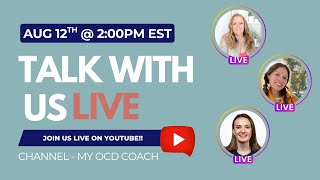
Danielle Jhiani from My OCD Coach sits down with coaches Erica and Allison to answer viewer questions about OCD recovery. They share personal experiences and discuss strategies for managing OCD symptoms.
Chapters
All right, Allison's here. We're adding Allison in. Hi, Allison.
Hi.
How are you guys? Good.
Good. We are Now Live on YouTube. So.
This is. Since this is our first time, there will be a learning curve. Doesn't look like anybody else has watched. Oh, we've got five people on. Awesome.
Good.
All right.
So we should have Daniela joining us, which is awesome. We'll load her in once she joins. But for anybody who is here watching, welcome. It is really gl. I'm glad to have you here today. My name is Danielle Gianni. I am the founder and coach at my OCD Coach. And we've got Erica and Allison, who are also coaches who have been through my recovery programs. They are either close to or in the recovery stage, and they coach other people. Hi, Jess. I'm glad you're here. Hi, A.J. that's my husband, everybody.
But, yeah. So let us know what your questions are about ocd, what you're struggling with. We're here to answer those questions and help you today. And we're going to start doing these once a month for everybody. So it's a great place to hop on, not feel so alone, get your questions answered.
Recovery is not an easy process, but it's very possible. So that's what we're here to do. So definitely pop your questions in the chat. We'll be answering those. And for now, when it's a small group, we can kind of all, you know, give you our input and.
Different opinions on recovery and tools and things like that. So. So just post your questions in the chat. We'll get to those as they come in. For now, I'll just tell everybody a little bit about myself.
I struggled with multiple OCD subsets, Relationship OCD harm, OCD, health, OCD just Right OCD and somatic ocd. Those are the ones that have come up for me, and I've been in the recovery stage since 2021. And basically, what that means for anybody who's like, what does that really mean? It basically means that I know how to handle any uncomfortable, uncertain thoughts or doubts. I do that pretty easily. It's not about perfection. Doubt and uncertainty is part of life for everybody. Anxiety, to some extent, is part of life. Our goal in recovery is just to be able to handle doubts and uncertainties in a healthy way, which you can get to the point where either you don't really feel like you have OCD because you handle them so well, or because OCD doesn't go away, we just learn how to handle it so we don't end up in the obsessive compulsive cycle, basically.
And so the recovery stage is a great place to be, but it doesn't mean no uncertain thoughts, no imperfection in life, because that is very normal and part of the recovery process. So that's kind of where I'm at. Do you want to introduce yourself, Eric and Allison, while we're waiting for some questions to, to post in the chat?
Okay. I was gonna say go for Allison, but I might as well just go. My name is Erica.
See, what can I introduce? So I'm one of the coaches for Danielle.
My.
My main OCD subsets are rocd, socd, say just right, ocd, even some PET ocd. Now that's been coming up a lot for me.
As I go along the recovery process and I learn a lot more. I start to. I mean, I guess that's the OCD part in me. That's what like puts titles to everything and is still trying to figure out like what kind of OCD I have. But I would say it's pretty, it's expansive and the themes switch depending on what's going on in my life. But.
It'S more manageable, manageable now than it was when I don't. When I joined your program, Danielle. But yeah, it's just, it's an ebb and flow and I try to use my tools and techniques that you've taught us and I keep trying to learn so that I can get better and better.
Yeah, it's a, it's an ever flowing process, so keep working on it and you should continue to see those results. Awesome. Allison, you want to just share a little bit about yourself and then I'll get to Jess's question.
So my name is Allison. I'm the associate coach at my OCD coach and I was diagnosed with OCD in 2012, so quite a long time ago. And my first ever theme that I dealt with or subset was sexual orientation ocd.
So that is kind of how I entered the world. I found out that I had OC. Officially I was showing symptoms from like 16 to 18 smaller. Not so much intrusive thoughts, but just, you know, I would check the locks on my doors of the house all the time and I just didn't really realize what was going on. But I had this fear that the house was going to burn down if I didn't check the stove. So that's kind of where it started. And yeah, since that time, it's been many years, I've had almost every subset of ocd. They're each very scary and distressing in their own ways. But at the end of the day, I just see it all as ocd. It's just ocd trying to find something that's gonna scare your brain.
So it takes time to recover, but you will get there. And, you know, the more time that goes by, the less fear I have of it coming back, because I feel like I'm. You know, it feels like a video game sometimes. Like, every time a new theme pops up, it's like, that's the new level that I'm at with oc. That's the new level that I have to overcome. And every time I beat a new level, a new subset, I feel like I'm stronger and I'm, like, closer to, like, winning the game.
I love that analogy.
So my most recent theme that I've dealt with, and that's how I found Danielle's program, was rocd. And that's actually been probably. Probably one of the most challenging themes for me. And I still have my days where I feel very uncertain. I still get triggered. I mean, somebody triggered me yesterday. So it's very. It. It es and flows, like Erica said. And it's just all about how you handle it, how you handle those things. So.
And how's a trigger? What is a trigger? Not what does it look like, but how do you hand it now? Handle it now versus maybe five years ago?
Yeah. So a trigger is something that will increase your anxiety. It could be something that someone says or does, something you see, something you watch, something you hear, and it gives you a lot of anxiety in the moment. And maybe five years ago or.
Yeah, even before that, I would have really allowed myself to ruminate on that anxiety that. That distress that that trigger is bringing up in my mind. So I would just kind of think of different things to calm myself down. Whereas now I just allow myself to feel that anxiety in the moment to feel that distress, and I do not ruminate on it. And if I catch myself ruminating, which I did a little bit yesterday, I say, no, I'm not. I'm not going to solve this right now. I'm not going to figure this out. And eventually that anxiety dissipates into nothing, and you're fine. But it just takes. Sometimes it takes a day. Sometimes takes a couple hours. Could be a few minutes. It really depends on the person. So for me, it was like a couple hours, and then it kind of went away because I did not allow myself to ruminate. Yeah. Or compulsion. So.
Yeah.
Yeah.
Did you do Any exposure?
I did not. I did not. I was pretty busy yesterday.
Yeah, I just.
I was like, I'm not ruminating and I just went about my day and now I feel fine. So. Yeah.
Good. Good job. Good job. Well, Jess says I am in a big ROCD spiral. The OCD thoughts are constant. It's horrible and making me feel depressed, which makes it harder to start the recovery. What's the first stage to start recovery despite this?
So, you know, I've. I've tried to make recovery as simple as possible. And one of the reasons why I asked Allison about exposure is that for me, what got me to and keeps me in the recovery stage is getting really, really good at the method that I teach. It's a four step method, and the first step of that is recognizing the discomfort. And the second step is exposure. And a lot of you may have heard about exposure before, you may have learned it before. But why.
Why this is important is because when. When we get a thought or a feeling, right? You said the thoughts are constant.
When you.
Whenever you get a thought.
If you are responding with compulsions, and let's just throw out some examples like ruminating, trying to get rid of the thought, even just not wanting it to be. There is a subtle form of trying to get rid of it. You know, I tell people you're here and you get this thought, and OCD is wanting to pull you over here into doing something about it. Right. And the real method teaches you to immediately expose because exposure is pulling you in this direction. And so when we have an uncomfortable thought, feeling, or situation, doesn't matter whether it's real, not real, whatever it is, if you are responding with exposure, you are automatically pulling your brain in this direction. You're automatically pulling it into, leaning into the uncertainty, accepting the imperfection, and almost asking the discomfort to come. And what that is doing is that it's. First of all, it's pulling you away from compulsions. Right. But it's teaching your amygdala that you can handle. And Jess, I don't know what your. What your thoughts are. And if you want to throw one of your thoughts into the chat, we can tackle that for you today. But if.
When you do exposure, you lean into the uncertainty of that thought, which of course is uncomfortable in that moment. Right. That's why we don't want to do it, and that's why exposure isn't easy. But I'll tell you why it works so well in a second that you're training your amygdala in that moment. Now, when we can just not give the thoughts attention like Allison mentioned, if we can just choose not to ruminate or doing anything about it and not give the thought attention, that can be effective. But the reason why I suggest exposure immediately is because it's very, very easy to get caught up in. And even I've done it, guys. And I've been doing this a long time. I've been in the recovery stage for a while. It's really easy for your brain to do a little bit of compulsions, a little bit of ruminating. It's really easy to push it away in that moment or want to get rid of it instead of truly accepting it or leaning in.
And so recognition and exposure immediately sends the brain in the right direction. So, Jess, you said many themes. Yep, I get that. One of them is, let's see. One of them in a moment is, what if it looks like you're typing? So let me go with it. It's pop it up here. Okay, what if I'm making excuses for his behavior? Okay, so hyper focusing on.
Hyper focusing on his behavior, what he's doing, right? So when something happens and you're triggered with this, and this is the one I wanted to show, and your brain says, well, what if I'm making excuses for your. His behavior. Brain is either.
Trying to figure this out, thinking about his past behavior, analyzing what he's doing in the moment, right? All those types of compulsions, thinking about, comparing, googling, all the stuff that we might do in this moment, right? When we respond in the healthy way with exposure, this pulls your brain in the opposite direction. So the way that you would do an example of that here would be to imaginal exposure, to say to yourself, yeah, maybe I am making excuses for his behavior. Right? And so the quick versions of this are great because we can use them anytime, you know, any place. And so when you say back to your amygdala, yep, maybe I am making excuses for his behavior, right? That's leaning in just a little bit. Eventually, we need to lean in more. But this is a beginning beginner's exposure. So when you lean in just a little bit to this, you're teaching your amygdala that I can handle the uncertainty, and maybe I am, but then I'm not going to give this attention, right? And it's training your amygdala to let go of this, to stop paying attention to it. Hopefully that makes sense. And even if you don't feel like it, right? Even if we're telling ourselves, yeah, maybe I am and deep down, we really feel like, oh, my God, what if I am? By telling ourselves this and we have to do it over and over again, you're training your amygdala that. Yep, maybe I am. But I'm not going to give this attention. And it's. It's training your brain now. Not giving it attention can also do the same thing. But again, there's subtle things that can happen there. And that's why, you know, doing the exposure is so key.
Yeah.
I want to say, like, I forgot. I did do that in the moment. I just totally forgot about it. I did. I kind of agreed with the thought. I was like, yeah, that could be me in 10 years.
Yeah.
Yeah, that could be my situation. Good. You know, responding to the thought, the thing that triggered me. So, yeah, yeah. That is a very quick way to lean into the discomfort, like you said, Danielle. So that's the easiest exposure. You can do that response, doing this for a while.
Right? How, How. How does this work for you? How does this quick exposure technique work for you?
For me, I mean, I just. I respond, I agree with the thought. For example, if the thought was, what if I murder my whole family tonight? I would say, maybe I will. Maybe I will. I wonder if It'll be in five hours, maybe. Maybe 4am, maybe 5am I will do something like that.
Yeah.
I don't know. I don't know. Ocd. We'll see. And then I just redirect my attention back to.
My present moment as best I can. Like, I can allow that discomfort to be there. It's like a be on the shoulder, but I don't have to do anything with that.
So awesome.
Just an example. Yeah.
Yeah.
Those responses help the brain let go of it. Right. Because you've just taught your brain that.
Yeah.
Maybe you don't have to pay attention to this anymore and it lets go. Has this technique worked well for you, Erica?
Yeah, it has. But I do want to say in the beginning, when you're just starting out to do exposure, I think it's easier when it comes in a moment and you're trying to do exposure. Once you've actually, like, sat down and done an imaginal exposure session at first, when you're starting and you gotta say, you gotta agree with the thought, it's like, very scary. And it can almost cause more anxiety or cause you to ruminate. So once you kind of get the idea of what exposure is doing for you, then it'll be easier to be like, yeah, maybe that'll happen. And then you could just, like, move on with your day.
Yeah, I love that. That's a great point. So when I'm about to update my programs, so for anybody listening, one of the things that we're going to do is my programs are going to include coaching, and one of those first sessions, we're going to sit down and do the exposure together. Because when my programs don't include coaching, it's. Sometimes people can do it, and sometimes they struggle with it. So that coaching is so important. And I think that's a really good point.
Eric.
Erica, thank you for sharing that. Jess says this makes sense logically. I suppose my fear is that by doing that, then I'm agreeing with that thought. And that's scary. Yeah, absolutely. But we're learning to face our fears, right? And facing our fears is how we train the nervous system to calm down. So we have to face every single fear that comes up. Because otherwise, as you all can probably relate, we're actually causing our nervous system to become more afraid by avoiding.
And yes, logically, it could all make sense. And it's a little harder to put into practice, which is why getting the right help and support, you know, coaching with one of us is so helpful, because I couldn't have done you guys. I could not have done this alone. I don't know about you all, but I could not have just kind of taken an online program and not had someone or support. That would have been really hard for me.
Yeah.
All right, Alexandra, Erica, you want to tackle Alexandra's question? Can you see that?
Yes. Let me make sure there's no more up here. Okay. Alexandra said, hi. How can an exposure look like for HOCD and ROCD in the middle of the day? I mean, I do planned exposures and audio prepared by my therapist, but what about exposure in the middle of the work? So, Alexandra, same thing as we're talking about, like, when the thought comes in and you're aware of it, you want to. You want to kind of agree with the thought and move on with your day and not ruminate or do any other compulsions that add to that. That thought.
Yeah, yeah. And when you say thinking about that scary thought, I want to just note that the way you think about it is important.
And one of the reasons why I don't really go deeply into exposure in, like, my YouTube channels or anything is because we kind of need the back and forth to. To clarify, you don't want to ruminate about it, but you do need to lean in. Right. So we mentioned the quick imaginal Exposure, where.
You just say, yeah, like, let's say the scary thought is, what if I, you know, get murdered tonight?
Right.
You're going to say back to yourself, yeah, maybe I will, maybe I won't. Who knows, right? That's a way to lean into the uncertainty. That's the easiest way that we start. And then you work on not doing anything about it. Yeah, but you don't want to sit and think about how it happens and what it would look like, because that's the problem. Right. If I sit and think about being murdered, I'm probably not going to feel very good. So that's why we don't want to think about it. That's why we want to stop those compulsions. But, yeah, that's a good way to think about it. Like Erica said, you know, agreeing with it, like, yep, maybe I will.
Hopefully that makes sense. And if it doesn't, feel free to post another question.
Oh, it looks like she has one more. What about uncertainty? It is essentially to accept the uncertainty, to recover. Or is it enough just to say, I know it's OCD and it just feels real? How would you answer this one, Allison?
I think the first step is to accept that you will feel uncertain for the rest of your life. At times with everything, everything is going to feel uncertain. And so with ocd, it is the doubting. It's called nickname, the doubting disorder. So I think the best thing you can do is just to accept that you don't know. You don't have all the answers. You may never get an answer to whatever your question is, whatever the OCD is bringing up for you. You just have to accept you're never going to be able to answer that question. You're never going to know for sure. So, yeah, it's. It's like the most important part of recovery is just accepting the uncertainty.
And then there will be times where it's very clear to you, like, yeah, that was an intrusive thought. There's that OCD again, trying to get me to react. And it's definitely going to feel real in that moment. But the power is the more that you do this, the more that you're going to recognize, oh, yeah, there's that OCD again. There we go. And you can move on easier. But, yeah, the uncertain, being uncertain, it's. It's going to be a thing that's going to come in and you're out, in and out of your life frequently. And to recover, to be in that recovery stage, you just have to always accept the Uncertainty.
And the reason being, guys, is certainty doesn't exist for anybody. Right? It's it, it's something that people think they have, but it's really not there. It. Nobody has certainty about anything or perfection. Right. If we're talking about just, right. Ocd. So it doesn't exist. Which is why you know, you're always going to chase it. And the more you try to teach your brain, the more you try to give your brain certainty or perfection, then ocd, the part of your brain, your amygdala, needs more and more and more of it to feel okay and it doesn't exist. So that's why the cycle continues.
I do want to say, Danielle, to add to what you're saying.
Aside from obviously learning erp, but one of the biggest things that helped me was just really changing my perception on what I thought. Like relationships were supposed to be like, like really zooming out and see the narrative that we've been programmed to think how relationships are supposed to be or how it's supposed to feel or not even just relationships, anything, just life. Like how's it supposed to feel and how's it supposed to be and latching onto that way of it being and then really zooming out and seeing like, oh, this is a skewed narrative that's been programmed and that's not how life really is. Like, remembering that while you're on your recovery journey has helped me so much.
Yeah, absolutely.
I love that.
So true. We tend to hyper focus on our feelings and the way we want things to be. And yeah, a quick note on just saying, oh, this is just OCD and trying to let it go there.
Not saying that that isn't ever helpful. Again, it's not that black and white. But again, OCD is the brain wanting certainty and perfection.
Right.
So if you can truly. If you're truly just saying, yep, this is ocd, you're not upset that it came, you're letting discomfort be there, you're okay with a thought coming and you're just choosing not to give it attention. That tactic could definitely work for you, but again, I'm going to go back to my method of recognizing and exposing your.
You're going to get a better benefit if you lean into the uncertainty. So whatever that topic is that's coming up for you, it's continuing to come up for one reason only, because you're doing compulsions and you're still looking for certainty or perfection in that area. So if you can really get in the habit of exposure, you're. You're training your brain to, you know, really just accept the uncertainty there, which is going to have a better benefit. But knowing it's OCD is also important, by the way. You're knowing.
Knowing it's OCD is important so that you can respond appropriately. Right. But that being said, you actually don't know. Have to know that it's ocd, because these responses work for uncertainty, doubt, anxiety, fear, discomfort, annoyance.
Right.
Which usually comes from wanting something to be a certain way. So that's why my method tackles all of that. And if you're using these tools for all of that, it doesn't matter whether it's OCD or not, because that's often a compulsion. You're trying to figure out if it's ocd so you know what to do. And that eliminates that whole problem of trying to figure out if it's OCD or not. But knowing what OCD is also very helpful. Right. But OCD is the obsessive compulsive cycle. OCD isn't your topic.
That makes sense. Hopefully for everybody.
Let's go back to Alexander had another question. The hardest from thing for me to study or read books because my brain just distracts me with these thoughts and I can't function. Has it happened to you guys? Has that happened to you? You all.
Yeah, all the time. All the time. Many times. Thousands of times.
Can't even count how many times.
Yeah, I've been distracted by OCD during a movie, reading a book at work.
Yeah, it's even. I. Even during special events where I didn't want it to be there. And, you know, I've always looked at it like, okay, maybe I should just invite OCD to be there like a guest, like a special guest of honor. Like, if I was going on a vacation and I was worried that OCD was going to be there or bothering me, I would just say, hey, I hope you pack your bags, because we're going to Europe for four weeks. I'd love for you to come.
Or you can also just say, you know, not right now. Ocd. We can talk about this later, but I'm busy. I'm reading my book. I'm studying, I'm working. I don't want to talk about this right now, but maybe in a few hours we can talk. And that's another tactic called delaying a compulsion, which can also sometimes be helpful. We don't want to do any compulsions at the end of the day, but at times, even just delaying a compulsion for a few hours, a few days can Be really, really helpful. So especially in the beginning if you're really struggling to let all of those go.
Absolutely, yeah. What about you, Erica? Distraction.
Yeah, I was just gonna say adding humor like Allison did, speaking to the OCD or even giving it a name, which I have done.
Is a great way to kind of like, detach from it and just kind of like hold it there and then kind of be aware of, okay, what I need to go do now for myself if I need to do something right now. Or, you know, it kind of gives you that. That space to make a plan of action so that you're not adding, you're not ruminating, you're not doing coulsions, you know?
Yeah, yeah. All really good tips. Good. Allison, you want to tackle this one?
So would this be best way to deal with avoidance compulsion? So I avoid a certain co worker due to imprusive thoughts and feelings in my head. If I speak to them at all, it means the thoughts are true. So that would be. I. I would just face that fear of, like, the OCD is trying to keep my life smaller and smaller right now. So this is your job. I'm sure this is very important to you. And if you avoid this co worker, if you keep avoiding them, what's going to be next? What is the OCD going to take away from you next because of that fear?
So I think it's better to just face the fear, face the OCD and say, I am going to go talk to this co worker. I'm not going to avoid them.
If I don't. If I allow OCD to have power in this moment, it's just going to grow. And it might be I'm going to avoid my job next. It might be I'm going to quit my job. So it would be better to just face that fear. This is a moment for you to do an exposure, actually. So face your fears, do the exposure, go talk to that coworker. Actually make a goal to talk to them every day if you can.
Consistency is helpful. A lot of people avoid because they're afraid they're going to do compulsions later. Kind of like you mentioned, too. And here's the thing. We can work on the compulsions, but avoidance is never a good tactic, right? Unless there's a true danger. A bear, an alligator, a car coming towards you. Avoidance is not a good tactic. And so do the thing right, do the exposure, face the fear, and then work on that second part, which is the compulsions.
So. Absolutely. Because, yeah, like Allison said, it definitely does shrink your Life more and more.
Yeah.
So good.
All right, let's see what's next. How do you deal with intense guilt of rocd? This is a great question. I actually.
Am redoing my course right now, and one of the new lessons is on shame and guilt. So guilt is often a compulsion driven by the need for perfection. Shame is often something that just needs reframing. Shame is just the thoughts that we're believing about ourselves.
So I don't know if you're referring to the guilt of just having the thoughts in general or maybe the guilt of having OCD and having this affect your relationship more in your head than in real person, or the guilt that just comes along with, you know, your partner having to also deal with certain things that come along with rocd. But the key here is, you know, back to exposure and acceptance. Accepting that we have ocd, right? Accepting that these thoughts are there. I don't care if I get a thought anymore. And they rarely even cause any discomfort for me anymore because I truly don't care what comes. That takes. That takes time to get there.
But for me, the thoughts don't really mean anything anymore, and I've learned that they're just thoughts. And again, this takes time for this to really click. But the more you do exposure, the more you follow my real method, the more you do the recovery work. What will happen is you will get better at accepting a thoughts of thought, not. Not doing compulsions, leaning into the uncertainty, right? You just slowly accept more and more and more, and you just allow what to be to be. And that is. That's key with any OCD subset. When you allow yourself to just have OCD and you allow it to be a thing in your life, whether it's a big thing or a.
And you just focus on your tools. You focus on what you can control, right? You can't control what thoughts come into your head for the most part. You can't control that you have OCD rocd. You can't control everything that happens in your relationship, right? So when you start to just accept what is and not try to change it, there's a lot more acceptance, and that releases some of that guilt. But also what you're telling yourself, if you're telling yourself, I shouldn't have these thoughts, you're going to have guilt. But that belief isn't true. If you're telling yourself that I'm ruining my relationship.
You know, that's not something that's going to be beneficial for you to help. Guilt actually helps us take action sometimes it can be a good emotion.
But when it's not benefiting us, when we're over shaming ourselves for something we can't control, or we're over compensating and thinking that something is worse than it is, then it can really be detrimental. So work on reframing those thoughts that you're telling yourself.
You know, I have ocd. Thoughts are just thoughts. I'm gonna get thoughts.
This is what it is. And then re. Refocus on who you want to be. Right. Refocus on what you can control, and that's going to help you feel better. Let go of what isn't going right, and refocus on the positives, which is what can I do in this moment? How can I positively contribute to my mental health? How can I positive positively contribute in this relationship? Hopefully that's helpful.
All right, we've got.
Yeah, don't quit your job. Definitely don't quit your job. Don't ever avoid due to discomfort.
Right.
That's just never, never, never going to be helpful.
All right. Going back to the certainty doesn't exist. The first thing that came to my mind was how to live life with the fear of loving in love with. I'm guessing being in love with someone while married to my husband, it feels so awful. So I'm guessing, Alexander, that you are obsessing about somebody else other than your husband in your head. And if I'm wrong, you can post something there, but there's where the compulsions are the problem. Right. If you stop thinking about.
Oh, the fear of being in love with someone else while married to your husband. Okay, sorry, I read that. So.
This is just fear. Maybe you will be right. Usually these thoughts, they're not reality. And. And the fact that you're afraid of this shows how much you value your husband. It's just a fear of something.
And so when you say, yeah, maybe that will happen, maybe I will be in love with someone else while I'm married with my husband.
We'll see.
As much as I don't want to give you guys reassurance 93% of the time, I think statistically is what they say, our fears never happen. And when they do, it's rarely what our brain is telling us it's going to be. So you have to learn to respond differently to fear, because how long have you had this or other types of similar fears? Right. We can't predict the future, but what you're doing is you're creating a future in your head that's not even real.
Right. And that's why the compulsions are so detrimental.
All right, moving on.
Yeah. Again, we're trying to get rid of discomfort with ocd. We have to stop trying to get rid of it. It's part of life. We're making it worse. So learning to respond to discomfort is what recovery is all about. And I promise you, and we've all been there, the more you respond differently, the less of it you'll have. But we have to be really consistent about that. So.
Yeah.
Allison, you want to take this one?
Sure. So I'm often scared to talk to my boyfriend because I am scared about all the potential triggers and responding suddenly by compulsing, ruminating, and overanalyzing what he says, how to overcome this. So I think it's the fear of what could happen is keeping you from talking with your boyfriend, if that's correct. So in this situation, I would talk to your boyfriend and just say, I may. I may have some triggers there when I talk with him, but I'm not gonna let that stop me from communicating with my boyfriend, because communication is a part of relationships. So if you.
If you allow the OCD to tell you what could happen, or you fear what could happen, you're not going to communicate with your boyfriend and what's going to happen to your relationship, you know, so this is just another example of that fear keeping us from living our life.
So I think you have to just say, you know, what if OCD comes up when I talk with him, that's fine, but I'm going to talk to him anyway, because that's what I want to do. That's what I want to do with my life right now. That's how I want to live.
So that's what I would do. Jess. I hope that helps.
Yeah, I think that's awesome. And again, guys, this is retraining your brain to stop fearing, talking to your boyfriend, talking to people, bringing something up, expressing yourself. Right. It's tackling all those fears and it literally changing your brain.
So.
Yeah, improvement with SSRIs, prior prioritizing, self care, and some supplements. That's awesome. All of that can be really, really helpful.
Yeah.
Strangely, thanks to Rocd, I rediscovered my love for reading and found Pilates. I love Pilates. Focusing on self care and hobbies. It's helped a lot.
Yeah.
Yeah. Because here's the thing here. When we're busy, have you guys ever noticed when you're busy, does your brain quiet down?
Yeah. That's because your brain can't be focused on obsessions and fears and other things at the same time. So we can't distract our way out of ocd, but we can direct our brain to healthy things, and that's what helps stop those compulsions. So I'd love to hear from you guys, and I think everybody else would, too. Allison and Erica, what has been the positives of having ocd? And I know this question sounds really crazy. I have a bunch. But there are always positives to struggle, and we often don't see them. So what have been some positives for you guys, for. For going through, you know, having OCD or through the recovery journey.
Upon. Well, that's a big question.
It's allowed me to become, like, a more courageous person in my own life. You know, if I'm ever scared to do something, I just. I don't. I don't wait around and allow that fear to overcome me. I just do it anyway.
And I think a lot of times in life, we are going to experience a lot of negative things that. Some pain, some trauma. Right. And sometimes the biggest changes to you come from. Comes from those difficult things.
So maybe the. I think the person I am today was shaped because of OCD in a very positive way.
So I think maybe I owe my whole being to OCD in a way.
And I probably. Yeah, I just wouldn't be the same person without it. Like, there's a lot of good qualities that I have because of the ocd.
Yeah.
And maybe if I didn't have ocd, I just wouldn't be the same Allison that my friends and my family love so much. So I look at it in that way, like I am who I am because of this disorder, whether I like it or not.
I love that. I love that. What about you, Erica?
Yeah.
Same. I feel like when I discovered the ocd, I had to go through, like, a grieving process of who I was, who I thought I was, and what was existing in the moment, and then, you know, trying to allow myself the space to grow into, basically, like, what's really in alignment for me and my values and what I really cared about. Because when. When you're trying to go through the recovery stage.
You'Ve got to kind of be disciplined about your recovery to recover. And so it makes you refocus into what's really important in your life. And that's been a big factor in molding who I am now. But, yeah, there's so many endless things benefits from ROCD that I've learned to love.
Yeah. Yeah.
Hi, Jane. If you can see us, I Just wanted to say hi, Jane.
Hopefully she can see us. She said she is having a hard time, but. So glad to see you, Jane. Yeah, for me, obviously, getting to do this now for a living is one of, one of the biggest joys of my life. It's, it's really been life changing and it really helped me with my own recovery journey, but.
I just didn't have coping tools before all of this, which is, you know, why a lot of us end up with ocd, at least to some extent, is we don't know how to deal with discomfort and we don't have those coping tools. And it usually gets worse and worse and worse and worse until we learn how to respond properly to discomfort, to uncertainty, to imperfection in life, whatever kind of bothers us. So it's this, you know, this method and, and my recovery journey, and I'm 10 years in now, really turned my life around in a positive way. Even though at the time, fast forward 10 years ago, it was the worst time of my life and there were some really, really difficult times.
Every time I've had a really difficult time in life, guys, once I get past it, it really turns out to be an amazing thing or something amazing is about to happen. And so we just have to go through those hard times. But These tools before OCD got bad for me when I was about 38, I just didn't have coping tools. I was in and out of therapy. Nothing was really helping. And after ocd, I feel like I have tools to cope with just about anything life throws at me now. And that's a really big deal because my self esteem was kind of plummeting over the years before that because I was dealing with uncertainty and discomfort and anxiety and I had no idea what was going on or how to deal with it. So it really has turned my life around. So for anybody who's really struggling, really in a dip, in a relapse.
Every single one of those relapses is there for a reason. I know that sounds weird. It's there to teach you what you still have to learn through. And they're hard, but if you get help and you allow them to teach you what you need to learn, you'll learn something from them every time if you've got the tools to kind of put into place. So. So that's.
Yeah.
Hopefully that gives you guys some hope and helps you see the silver lining and something difficult.
Yeah. Alexander says, I don't want to fall in love with someone else because I love him. So again, the fear of Falling in love with someone else. So I don't want to give you reassurance here.
But you. Until you accept that this could happen.
This will continue to bother you. And that's the bottom line. Every obsession that we have, we have to learn what our obsessions are. And we have to get to the point. Not overnight, but we have to get to the point where we can completely accept that, yeah, maybe this will happen. And once you do that, you won't even care about it. But every time you engage with the fear or try to push it away, get rid of will absolutely bother you.
Easier said than done, I know, but. And for anybody here who is wanting support, I'll share a link at the end if you want, if you need help, if you're not working with somebody who is helping you with recovery, and we'll talk about that. Because.
It'S important to get the right help. And finding the right help can definitely be challenging.
So my husband says, I think you having to face these uncomfortable situations have helped with your communication in our marriage. Oh, that makes me emotional probably. Absolutely. Yeah. I kind of. Kind of. Like someone said earlier, I kind of used to be afraid to share my feelings.
Because I felt, well, maybe it's too much or maybe I'm, like, too sensitive. And there are times where I had to learn to not share, and then there's times where I had to learn to stop not sharing out of fear. So thank you, babe. I appreciate that. I think it has. I'm a pretty good communicator now. Yay. Jane sees us. Oh, and let me share that. So I don't know if everybody can see that, but thanks for listening. All right.
Yeah. Jane has done such an awesome job in her own recovery. Super proud of her. Her journey was not a quick one. Nobody's as quick. But some is quicker than others. And. And, you know, Jane's a little bit of time, but, man, Jane, you did not give up. You kept going. And no matter where you guys are at in the process, keep going. Your goal should be getting those compulsions to zero and keeping them there. And most people don't learn that. That clearly.
You know what recovery is, because we think that we can just do those. How many of you thought I can just do compulsions sometimes? I know I do. I did. Not anymore. And you're not going to be perfect, meaning, you know, every once in a while, I'll catch myself wanting something to be perfect or wanting to be a certain way, or I'll catch myself overthinking something. But I ran it back in pretty, pretty quickly.
So.
Michelle says, is skin picking a form of ocd? If so, any suggestions on how to stop doing it? Yeah, skin picking. It's not considered ocd, but it is considered.
Very similar to ocd.
They're like cousins. They're like cousins with each other.
Yeah.
Do you. Do you struggle with skin picking, Allison, or.
No, I have. I have. I have. So that you know how to stop. That is a little bit different.
Because actually, we're. We're doing that to calm our anxiety again, to calm our discomfort could happen.
This will continue to bother you, and that's the bottom line. Every obsession that we have, we have to learn what our obsessions are, and we have to get to the point. Not overnight, but we have to get to the point where we can completely accept that. Yeah, maybe this will happen. And once you do that, you won't even care about it. But every time you engage with the fear or try to push it away, get rid of.
Will absolutely bother you.
Easier said than done. I know, but. And for anybody here who is wanting support, I'll share a link at the end if you want. If you need help, if you're not working with somebody who is helping you with recovery, and we'll talk about that. Because.
It'S important to get the right help, and finding the right help can definitely be challenging.
So my husband says, I think you having to face these uncomfortable situations have helped with your communication in our marriage. Oh, that makes me emotional, probably. Absolutely. Yeah. I kind of. Kind of. Like someone said earlier, I kind of used to be afraid to share my feelings.
Because I felt, well, maybe I'm. It's too much, or maybe I'm, like, too sensitive. And there are times where I had to learn to not share, and then there's times where I had to learn to stop not sharing out of fear. So thank you, babe. I appreciate that. I think it has. I'm a pretty good communicator now. Yay. Jane sees us. Oh, and let me share that. So I don't know if everybody can see that, but thanks for listening. All right.
Yeah. Jane has done such an awesome job in her own recovery. Super proud of her. Her journey was not a quick one. Nobody's as quick, but some is quicker than others. And. And, you know, Jane's a little bit of time, but, man, Jane, you did not give up. You kept going. And no matter where you guys are at in the process, keep going. Your goal should be getting those compulsions to zero and keeping them there. And most People don't learn that. That clearly.
You know, what recovery is, because we think that we can just do those. How many of you thought, I can just do compulsions sometimes?
I know I do. I did. Not anymore. And you're not going to be perfect, meaning, you know, every once in a while, I'll catch myself wanting something to be perfect or wanting to be a certain way, or I'll catch myself overthinking something, But I rein it back in pretty, pretty quickly.
So.
Michelle says, is skin picking a form of ocd? If so, any suggestions on how to stop doing it? Yeah, skin picking, it's not considered ocd, but it is considered.
Very similar to ocd.
They're like cousins. They're like cousins with each other.
Yeah.
Do you. Do you struggle with skin picking, Allison, or.
No, I have. I have. I have. So that you know how to stop that is a little bit different.
Because actually we're doing that to calm our anxiety again, to calm our discomfort. So I think just bringing awareness to. When you do start doing that, bringing awareness of, like, I'm trying to get rid of my discomfort, my anxiety, my stress by doing this, and what else can I do instead?
And there are different things. There's like, I think fidget spinners, some people use those. But sometimes it's about keeping your hands busy with something else temporarily or just recognizing when you're doing it and just saying, like, no, I'm not gonna do that right now. But, yeah, I've struggled with that.
Yeah, any of those. My suggestion with that would be to literally, because I've had not skin picking, but I play with my hair sometimes and biting my lip. Those are common ones. Some people, like shake and tap.
My best suggestion is.
To, like Allison said, it is just a way of trying to alleviate anxiety, like other compulsions. So my suggestion is literally just don't do anything, because sometimes other things can then become just a replacement of that. But I find that if I'm, you know, kind of playing with my hair, biting my lip, I just tell myself not to do it. And of course, like other compulsions, it feels uncomfortable at first, and then about five minutes later, I'll feel my nervous system just kind of calm down a little bit. So it's hard. Like all the other compulsions. Erica, do you have anything skin picking or anything like that?
Yeah, I. I skin picked for a long time. My scalp before I knew I had ocd, and my thumbs. But one thing that I noticed now, when I am more aware of the skin picking with my thumbs, is if you catch yourself skin picking your thumb and then you kind of tune in to like, what's going on in your mind, you'll notice that, like, maybe you're having some negative thoughts related to your OCD theme. And that kind of gives you cue for like, what you need to do or if, you know, it's just OCD related. And that's why. So to me, I thought skin picking was like a compulsion, a form of compulsion.
Right.
So then that tells me like, okay, I'm having these thoughts, but I'm skin picking, I'm doing a compulsion. So you can like link the two together and then you can stop skin picking knowing that you're causing the ocd. You know what I'm saying?
Yeah, yeah, yeah. It's just our. It's just a. I don't know about you guys. I've done it since I was really little. But yeah, it's kind of like a self soothing technique that is very similar to compulsions. And they don't. They're different than certain compulsions will really rev up anxiety in the OCD cycle. And the body focused, repetitive behaviors that we're talking about here, they don't feed the OCD cycle quite as much as other compulsions, but they will, you know, rev up your nervous system and cause you to be more triggered. And if you don't do them, they will definitely calm your nervous system. So that's one of them. That like just literally kind of just sitting there and doing nothing for a minute has really helped me. And it feels weird, it feels uncomfortable because it's like you just want to do it or do something. But yeah.
Yeah.
So, you know, again, awareness is key.
There's also noticing when you do it can be important. Alison, I don't know if you ever know, kind of paid attention to when you did it in certain times. But noticing that can be helpful too. Like, oh, I tend to do this in the car, or I tend to do this when I'm on my way to this particular place, or I tend to do this before I go see this person. Those awarenesses will help you to.
Understand the cycle and stop it a little bit more.
Yeah.
Yep. Yes. Very much linked.
Biting your nails. I did that for a long time too. Yeah. Some people will pull, you know, some people will pull out their eyebrows or pull at their hair. Shaking, tapping. There's all kinds of different things people can do.
Ticks, you know, those. That's related to ocd. Not necessarily the same thing, but. Yeah, and that's a good point. So you stopped biting your nails and you went to skin picking. This is where we want to be careful about replacing one compulsion or one unhelpful behavior, let's call it, with another.
So just kind of be aware of what am I putting in its place and is it kind of something similar or am I truly, again, the goal. Expose. I'm uncomfortable here. I need to expose myself to the discomfort. So how do I do that? Maybe you just sit with that discomfort or like Erica said, maybe you notice what thoughts are going through your head and then you can deal with what's actually going on at the core. Core.
And similar with what Allison said too. Yeah.
I also had to put band aids on my thumbs to stop myself for a while. And even now if I start doing it, I go and put the band aid on to stop myself before it gets out of hand, you know, so then I have like two. Two band aids on my thumbs all the time.
Yeah, yeah. Looks horrible. Whatever works. Yeah, Sometimes that just works to get us to break the habit. Yeah, for sure. Yeah.
All right.
Michelle said yes. I deal with very repetitive looping thoughts, and I think this is a newer behavior to distract myself. Yeah, yeah. Really, really common. Guys, there's so many compulsions possible.
I have found with my clients, most people think they do like 10 compulsions, maybe more. Especially with contamination OCD. There can be a lot of rituals with certain subsets, but most people are doing a lot more than that. And.
When people ask me what's the number one thing I could do to get better, it's stop compulsions, period. If you're not doing compulsions, there is no OCD cycle. Right. You have a thought, you have a feeling, but there's. It doesn't loop, it doesn't continue. So. But you need other tools to be able to stop those compulsions. Right. Asking, telling somebody, just don't do compulsions. And that's. It isn't going to work very well. That's where the exposure and the self compassion and the acceptance and where to focus your attention.
You know, and everything else Allison and Erica have talked about here is so helpful. We have to have things, healthy coping mechanisms to put in its place. So, yeah, lots of. Lots of education, lots of things to know for sure. Any other questions today from anybody before we go? You've had a lot of really good questions, guys.
I'm going to put a link to.
My website, myocdcoach.com if anybody is looking for help for OCD.
We. My method takes ERP just to another level. It helps you understand more about response prevention. It helps to have a easy for not eat well, I shouldn't say simple, not easy, simple four step method to use anytime there's discomfort, OCD or not. And it teaches you how to get to and then stay in the recovery stage. So it does include erp because that's crucial. But I want to teach people some of the things that I didn't get. I worked with four very good ERP therapists, but there are some things that we're missing. And so that's what my programs teach. But otherwise, if you decide to go elsewhere, ERP is very important. If you haven't done that yet, really learning.
What ERP is is crucial for long term recovery. There are some things that will help a little bit. Kind of like somebody mentioned medication and stuff like that. But. But yeah, there is.
There are things that are just much better, more effective than, than others. So yeah. Jess said you mentioned that you have a new program starting in September. Is it still worth joining your membership in August despite that? That's a great question. Yeah. So my new program, it's a new relationship OCD program coming out. It's just kind of a revamp. You know, I've learned coaching over the years. What works, what doesn't. And I'm refreshing the course with just a couple new things and you know, obviously to update things. And so the new program starts September 15th and if you want to share your email address in the chat.
You.
Can do that and I'll make sure that you're on my email list for it and you can actually, I'm going to give you the link for the, the waiting list. There is a waiting list. It is ROCD specific. I have another program and in the new programs called the Path to Love. The Path is going to be general OCD subsets and let me share the link for.
The wait list for the Path to Love. And it, it's not a commitment, it's just a way to get more information.
And I'm posting it here.
Okay.
And so yeah, that'll be launching September 15th. It's. I've learned that coaching is important. So this program is going to include coaching sessions, it's going to include three courses, it's going to include four weeks free into my level two program. So you can continue to work on making the real method a way of life and getting those compulsions to zero. Because ongoing support with that is so important. I think for me, coaching was that ongoing support, coaching other people.
You can though, if you go to my website. You can absolutely join a program right now, and because I know four weeks is a little ways away, and if you do that, you'll have the option of either staying where you're at or you'll have the option of upgrading and having different options for upgrading, too. So there will be options for you. You'll get more emails on that. And then once the Path to Love has launched, the Path will be updated as well. And it's also going to include coaching sessions and a few other things. So we're always improving, trying to make the programs better for you so that you are successful in your recovery, which means learning how to get to, helping you get to the recovery stage and then teaching you how to stay there the best that you can. So hopefully that's helpful. So everything will be updated on the website. But yeah, you can definitely join the wait list there if you do have relationship ocd. And if you don't have relationship ocd, you can join the path now or upgrade when that. When that happens later.
Alexander asked, can watching the videos about OCD become a compulsion in itself? Who wants to answer that one?
I will. Before.
Yes, it can definitely be a compulsion.
Yeah. I think there's a fine line between gathering information that's necessary for recovery and watching a video once a day to calm yourself down because you feel really anxious in that moment. I mean, there was a time where I was using, like, true crime videos as a compulsion.
So anything can become a compulsion, really. But yeah, Alexandra, I think that. Nothing wrong with watching videos, but just be very careful about how many you're watching, how often. If you're really anxious, that can become of a compulsion. So just say, you know what, I'll watch this video tomorrow when this anxiety has dissipated a little bit. I don't need to watch it right now.
So, yeah, absolutely. Compulsions are the things that you're doing to get rid of your discomfort, to get certainty, or to gain perfection. Right. And if that doesn't answer the question, when you're about to go do something, ask yourself, could I not do this right now? Could I wait a week or two? And if that is at all uncomfortable, it's a compulsion.
So, yeah.
I was going to say.
For you, Danielle, I don't forget your words. You would say, if it feels urgent, then it's probably a compulsion. So that's a good cue. Yeah, yeah, yeah.
In fact, if it feels urgent, it is a compulsion. If it feels a little bit urgent, probably, yeah. But absolutely, that urgency is a huge telltale sign.
Yeah.
So how much will the Path to Love cost? I was previously part of the normal Path program, but I felt like I needed something more specific. Yeah. So I'd love to hear from you. What? When you say I needed something more specific, what would that be? Just curious.
So I'm not sure what the cost is quite yet. But the launch, you'll get this in the information. In fact, you'll probably be able to schedule a free call with either me or one of us to talk more about the program. And it's probably going to be like a thousand dollars off at the launch. So it is going to be more because again, it's going to include at least three coaching sessions. It's going to include the break free from ROCD course, which is the old course updated. It's going to include.
The support your loved one with OCD course. It's going to include a relationship course, which you'll get after you finish the OCD course. Because I want to make sure everybody's taking care of their OCD before they start trying to perfect their relationship.
It's also going to include a weekly group coaching call. Danielle 24 7, the community support. So there's support in this program 24 hours a day, seven days a week. And then you're also gonna, I feel like I'm missing something. But you're also gonna get four weeks free in the Level 2 program, which is pretty awesome. So yes, there will be payment plan, but it is a it instead of being the weekly cost that it used to be, it's going to be a three month program. So a little bit more specific in timeline and then kind of a next step. And that's because I found that the ongoing program.
A lot of people didn't finish it. And when it's more of a time specific program and a one time cost, people go through the program more, which means they're getting better results. And that is why I'm making that change. But I still want to make sure that, you know, I do understand not everybody can afford it. So there will be other options, payment plans.
We will, you know, I'll probably be offering just Danielle 247 alone for those who just want to be able to ask me a question anytime, day or night. So I'm always looking at options for people who can't afford it. But I don't have a price quite yet. So hang in there. Stay, you know, stay close to your emails. I'll be sending that out.
And let's see if you answered.
Yeah, all right.
Yeah.
So There will be a payment plan. And is this every Tuesday? These live Q and A's we're going to do probably once a month. So they will be on Tuesdays at 2pm I just haven't decided if we're going to do every four weeks or what's this? This is the second Tuesday of the month, I think.
But stay tuned. I'll post that.
Okay. Hopefully that's helpful. And I can't tell who this was, is who was talking about how they did the path, but they needed something more specific. Email me what that is because I always am looking for feedback on what people need. Again, my goal isn't about just creating something, it's about getting people results. And so, yeah, so you can email me@supportyocdcoach.com and just say, hey, I was on the call, went through the program, here's what worked here, here's what didn't. And letting me know if you finished the program or not is helpful too. So good. I'm so glad this has been helpful. Allison, Erica, thank you guys so much for joining. Any parting words for everybody?
Thank you guys for, for your questions. Those are all amazing questions. Thank you for sharing some of your stuff story and yeah, I think you should be proud of yourself for being brave to come on this call.
So, yes, absolutely.
Thank you guys. We hope to see you again in the future. Yeah.
Erica, any parting words from you?
No.
Other than if you're up for it. Danielle, I'd love to do this maybe a little bit more often, more than once. It was helpful.
Definitely. We can, we can definitely look at doing that once I launch this program and things slow down a little bit. We'll definitely look at doing them more often if that's what people want.
Yeah. Yeah. Thank you guys for your questions.
Absolutely. Absolutely. Thanks for joining everybody. Thank you, Erica and Allison, for your time. You guys are awesome and we will talk to everybody very soon.
Bye.










