ROCD Recovery - No Anxiety Getting Married!
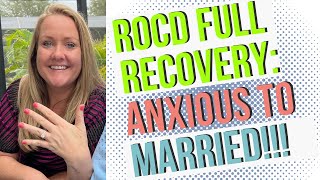
Danielle Thornton, an anxiety and OCD recovery coach, describes her recovery from relationship OCD (ROCD) as she prepares to get married. She recounts years of avoidance in relationships, initial intense anxiety for months before finding ERP, working with multiple ERP specialists, and the pivotal realization that eliminating all compulsions (to zero) and fully engaging ERPs led to full recovery and minimal anxiety around marriage. The video mixes personal anecdote with practical guidance for others.
Foreign.
Welcome back. My name is Danielle Thornton. I'm an anxiety and OCD recovery coach who has gotten to the full recovery stage for multiple OCD subsets, and I've been helping others do the same for years. So today I want to talk a little bit about my recovery journey from one of my OCD subsets, which was relationship ocd. Now, I am getting married next week, and I'm coming on here to give you gu some hope. No matter where you're at in the stages of your relationship, you may be single, you may be dating, you may be married. I have had relationship OCD in every single one of these stages. Okay? So it doesn't matter where you're at or how similar or different your story is. For mine, OCD shows up differently for everybody. Although there are some similar themes that can be there, it is different from everybody. So it's important that you don't necessarily compare yourself to me, comparing as a compulsion. But I wanted to come on here and share my story to give you guys some hope. So I am getting married next week, and although anxiety is quite normal when you're getting married, I actually don't have any. Now, will I be a little nervous that day just because, you know, it's a big deal, I want to look good, all that kind of stuff. Course. But for the most part, I am super excited and not anxious at all. And in the past, I 100% would have been. But I have done the work. I've done the work. So that OCD doesn't bother me anymore. Uncertainty doesn't bother me. The thoughts don't bother me. Remember, uncertainty, doubt, that's part of life if you're a human being. And when we can learn what to do with those types of thoughts, they don't show up very often. And when they do, when I do have any sort of uncertainty or doubts or whatever, my brain wants to worry about something, I just don't go there with it. I don't let it go there anymore. It took me time. It took really learning what was going on, learning about OCD and how it works and learning to use ERP every single time a thought showed up that caused doubt or uncertainty and how to use exposure and then the response. Prevention is so key, you guys. And that is one thing that, you know. I worked with four ERP specialists. They were all good. They all helped me a lot. But there were a couple missing pieces that I had to learn the hard way that got me from feeling a lot better to that full recovery stage. And I'LL talk about that in a minute. But I've had OCD and anxiety and looking back in every single relationship that I had, I didn't always recognize it at the beginning. When I was young, it showed up as a lot of discomfort around intimacy and, you know, putting myself out there in different ways with dating or flirting or all that kind of stuff. So there was just some anxiety which I didn't recognize as anxiety at the time and avoidance in some of those areas. And after a long term relationship, it didn't turn out so good. It kind of made things worse. Again. The issue wasn't that relationship. That relationship played a part in how I, how I felt and how I dealt with anxiety. But that wasn't the reason for it. It did contribute. And I went on to have a lot of avoidance in relationships and broke up with people because of the anxiety and the discomfor and the thoughts. And then nine more years of a lot of avoidance in relationships until I finally realized that I was the common denominator there, that I wasn't married with a family because of my own stuff and issues. But for a long time it just felt like avoidance or I just felt like I wasn't attracted to people. I wasn't.
My brain was finding things wrong with everybody. It didn't feel like anxiety, it didn't even feel like discomfort. It was looking back. And then when I decided to kind of work through this, it got difficult and hard because I'd been avoiding for so long. And when we avoid, we just make reinforce the fear and discomfort and it gets worse. So when I learned that I had OCD and relationship OCD as one of the themes.
It was like a lot of you can relate to. I couldn't eat, couldn't sleep. I mean the anxiety was really, really bad. And luckily I only struggled for about six months trying to find the right treatment and found ERP after that. And ERP helped me a lot. I'm really thankful that I was able to get that type of help and that it helped a lot and it made things a lot easier. But my, my OCD was still there. Sometimes it was kind of up and down, it would come and go, but it was still kind of always in the background. And I started coaching and helping people with erp, even at this point because it was so helpful and I saw so many people struggling and I wanted to help. But it wasn't until, you know, a couple years ago that I learned some really important things by. I don't like to say that we relapse but we go in and out of the OCD cycle, and I had to learn the hard way of some compulsions I was doing. And I was like the third person that I worked with that said, your compulsions need to be at zero to be in that recovery stage. And that was really eye opening for me because I knew I wasn't supposed to do compulsions like a lot of, you know, but I thought my brain was making excuses for continuing to do them sometimes. And so the zero thing was really eye opening for me. And I realized at that point, after I had a really big dip, that over learning, over researching courses and all of this stuff had gotten very compulsive for me, and I went down the rabbit hole again. So I realized that not only do I need to stop all my compulsions, but I need to make sure I know what they are. So I started with myself and helping my clients identify all of their compulsions. And we worked both personally, I worked on my own and helping other people get those to zero. So this is crucial to get to that recovery stage, because if you're doing compulsions, even 5% of the time, you're going to feel bad 5% of the time, and full recovery as possible. So we need to eliminate all of that. The other thing that I learned through coaching and helping people was, and again, through my own journey, was that.
When I worked with ERP specialists, they had me, you know, take that discomfort and go down to half. And it was a little over a year ago where I said, why in the heck are we stopping at a 5 if your discomfort's a 10? So I started going all the way with people and then using this technique myself when I needed it. And it's been a game changer because a lot of I work with people all the time where their therapist is saying, oh, you know, if it's there a little bit, that's normal, it's going to be that way. And that's absolutely not the case. They've got the right idea, and they're not taking it all the way. So as soon as I stopped all compulsions and stopped engaging 100%, and I'll tell you, the thought that got me with my boyfriend at the time was that, you know, there was just my brain would sometimes barely, but sometimes still focus on this incompatibility that we had, and I thought, well, I feel like I would feel this way if I didn't have ocd. And one day it occurred to me after really digging deeper with myself and my clients, that how Do I know how I would feel if I didn't have ocd? Because I have ocd? I have no idea. And that's just another excuse that OCD in my brain was making to stay engaged. So I quit 100% engaging with it, and OCD hasn't bothered me since. So when we completely quit engaging, get compulsions to zero, it will completely go away. And when we engage even a little bit of the time or do compulsions a little bit at a time, and that's why it's so important that you know what they are, it will continue to bother you a little bit at a time. And my goal for myself and my clients is full recovery, not engaging at all, stopping at all. And it takes time. It took me time.
And I'm so grateful for not only, you know, myself and the work that I've been able to do, which you can all do, too, but I'm so grateful for all the people that I work with because you guys have taught me so much through your journeys about my own journey. And being able to help you and apply it to myself in the past has gotten me to that full recovery stage. And I'm now able to use the experience to help you, no matter what OCD subset you've had. I've had other ocd. I've had health, harm, somatic ocd. So it doesn't matter what OCD subset you have. OCD is ocd, and the solution is erp. And it's a matter of learning it fully, properly, effectively practicing it consistently. It's a way of life. I don't go back into the OCD cycle because I'm aware that uncertainty is part of life. And I'm aware when it shows up. And I use the ERP techniques. They're quite easy and quick and automatic now. And it took time to get there, but I got there, and you can, too. So I just want to give you guys hope that you can be very happy in your relationship. You can get through any OCD subset. You can eliminate this pattern from your life fully. The caveat, again, is uncertainty. And doubt is part of life. So the goal is to eliminate the OCD so that the types of thoughts that we get, the doubts, the uncertainty, they're normal, whatever normal means. But essentially you get them, but you don't get them very often. They don't bother you. You know what to do with them, just like anybody else without OCD does. So I hope that this gives you hope. I'm gonna share some information with you all, you know on my wedding next week and on how everything's going. And I just want to give you guys hope because I know how difficult it can be to have relationship ocd, to have multiple OCD subsets. We all think that our subsets, the worst, they all suck, right? But recovery is possible for every single subset. It's just a matter of finding the right help and taking the time and practicing and making the effort to get there. And you can all do it. Believe me, if I was in a bad spot and if I can do it, you can do it, too. So we will talk to you next time. I hope you're all doing well. If you want help, check out the link in my bio below or in the description below of this video. And check out the different programs I have for all financial levels. There's a lot of new stuff coming this year, you guys. I am. I've got a lot of new things coming out this year. Training an associate coach to also help with all of you that are wanting coaching. So thank you so much for listening. Thank you for letting me help you and believing in me, because I believe in you, too. We'll talk to you soon.










