How Much Should You Charge for Web Design? (One Rule, Five Formulas)
Dan Mall argues you should charge 10% of the monetary value your client gains from the project. He walks through five value drivers (order value, business valuation, conversion lift, time savings, support costs) with a beverage brand example, then shows how to build three genuine pricing options that feel fair because they are.
Chapters
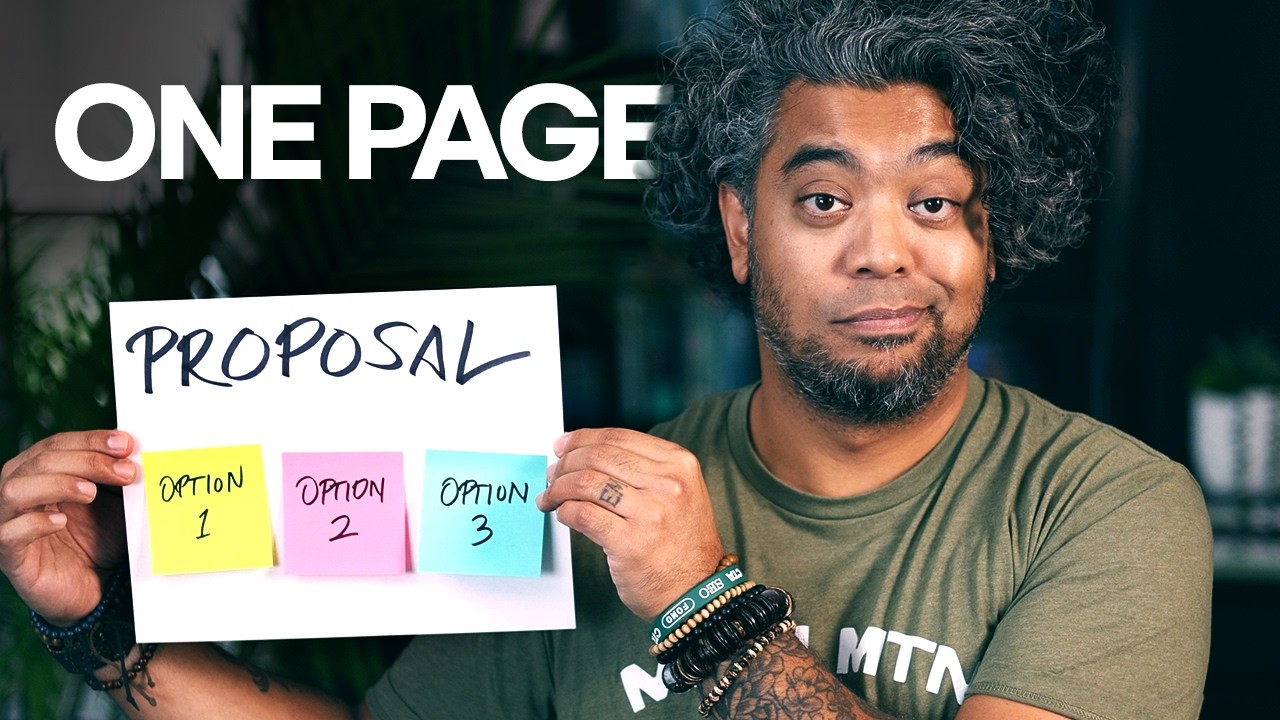
It's actually pretty easy to figure out what to charge for a website, but most design agency owners struggle with it because almost all the pricing advice out there is complicated, misleading, or irrelevant. I've spent the last 20 years pricing projects. The most I've ever charged for a website is $689,032. The most I've ever sold a single project for is $1.8 million. So how much should you charge for web design? In this video, I will show you the one simple rule that you can use every time to set a price without feeling like you have to be an accountant or an economist. you'll understand how the exact same website redesign project can be worth $54,000 or $1.5 million. Sound impossible? It'll make perfect sense by the end of this video. Before I give you the simple rule, I have to take a few things away from you first. The things that you've probably been taught that make pricing feel really complicated when honestly it doesn't have to be. So here are the 3 things that I want you to put out of your mind right now. First up, pricing models. All the typical pricing talk about hourly billing versus fixed prices and loss leaders and retainers and subscriptions— we're not going to talk about any of that stuff. We don't really need to. The only model that you need is common sense. Second, market rates or industry rates. It doesn't matter what other people charge for a website. It's like saying, well, I'm only going to buy size 12 sneakers because that's what most people wear, even though you wear a size 9. It's ridiculous. Market rate only matters when you're competing against And by the end of this video, you'll see how to price so that your clients don't need to talk to anyone else. Third thing to ignore, minimum level of engagement. That's the fancy term that agencies use to say, there is a price that we won't go lower than. And I get the logic here, but I think it's actually holding you back. We'll talk more about that later. Now, all 3 of these things share the same common problem. They have nothing to do with your client. Pricing models are all about economics. Market rates are all about your competitors. Minimum level of engagement are all about you. What does any of that stuff have to do with your client. The biggest shift in pricing better is putting all of your focus and attention and energy on helping your client win. If you can do that, the rule for setting your price becomes very, very simple. If you've ever gone looking for pricing help, you've seen the formulas, spreadsheets, calculators, hourly rate math. I'll show you some real formulas in just a few minutes, and they're easier than you think. But the thing that actually sets your price is not a formula, it's a rule. So here's the rule that you can use every time to arrive at a price. Your price is the client's win divided by 10. If, as a result of your work, your client wins $100K, your price is $10K. If your client wins $500K, your price is $50K. If your client wins $1 million, your price is $100K. If your client wins $5 million, your price is $500K. Now, where did this 10% number come from? There's no law that says it has to be. Why not 25% or 50%? Well, I call it the one-slice rule. Think about it this way. Imagine your best friend gives you a call and says, hey, I'm coming over. I'm gonna bring a large pizza. And you're like, yeah, that sounds great. How much do I owe you? How much can I chip in? And they're like, oh, no, no, it's on me as long as I can have the first slice. Would you take that deal? I would take that deal. I get a whole pizza and all I have to give up is one slice. What a steal. Most pizzas have 8 slices, so giving up one slice means giving up about 12.5%. Which is pretty close to 10%. Giving up 10% or 12% doesn't feel like giving up much at all. And that's what it's like when you say it to a client and when you say, I'm going to make all these great things happen for you as long as you don't mind me having the first slice. And this rule never changes, not for a website or a brand or a million-dollar project. The only question you'll ever have to answer, the most important work in pricing, is figuring out what the win is worth, which we'll do in just a few minutes. And what about the rest of this amazing pizza? What does it actually mean to show up to a client with a gift of 88% of a pizza pie? When you listen to people who teach this style of pricing, you come across a common mantra: price the client, not the service. I have a version that I think is a little bit more helpful, but that's not to say that this one's bad. There's some good wisdom in it. A lot of agencies try to price the service as a way to start. Here's our price for a website or a marketing campaign or a brand identity. And every agency that does this runs into the same problem pretty quickly. One price for a service is somehow too expensive for one client and then also way too cheap for another, all at the same time. So then you hear, price the client, not the service, which seems to solve that problem. But what does it actually mean? Most agencies take it to mean, go find a client that makes a lot of money. This is why so many agencies chase Fortune 500 clients. They think that Lots of revenue means big budgets. Please believe me when I say that that is not always true. My agency's work for companies like Nike and ESPN included some of the smallest budgets we've ever had. Money is usually not the biggest reason to work with clients like that. The opportunity is. Our most lucrative projects and accounts were with clients that you've probably never heard of. Besides, asking the client to pay you a lot of money just because they have a lot of money is a little bit weird and kind of entitled. Just because they have it doesn't mean you should get it. You need a different approach. So here's the version that I prefer. I suggest you price the moment, not the client or the service. Think about a startup, a new company. On day one, they're in stealth. Weeks or months later, they come out of stealth and they want to officially announce themselves to the world. In that moment, a website might be really important to them. It's their chance to make a first impression, and they only get one chance at that. Now, because the website matters so much to them in that moment, they might feel like it's worth spending a lot of money on. 2 years later though, the same startup raises their Series B. It's the same company, but now a new website barely matters. They have customers, they have revenue, they have momentum, they have traction. A redesign is a nice-to-have, not really something worth spending big on. But a few years after that, maybe they're getting ready to go public. Every investor and every analyst and every journalist is about to look at one thing. Their website. Now a new website might be worth more than the first 2 scenarios combined. Same company, same deliverable, same service, a website, but 3 completely different prices because each of those moments is different. Price the moment. The key to making this work is figuring out what that moment is worth to them in actual dollars. Most agencies never learn how to do this. And to make it even trickier, sometimes the same moment is worth 5 or 10 different amounts. Let me show you what I mean with an example. Allow me to introduce you to a fictitious company. Ridgeline is a functional beverage brand and they want a new website. Now, here's the mistake that almost every agency makes at this point. They hear a new website and they start figuring out a price. You can't price the moment yet because you don't have enough information on what this moment actually is for them. A new website isn't worth anything on its own. A website is only worth What it unlocks for the client and what it does for them. So the project is never a new website. The project is always what the website needs to do. And there are so many different ways that a new website can be valuable. You don't know yet which ones are the most valuable to the client. Only they can decide that. And it's not like you can just ask them directly, what do you value most? That's a really difficult question to answer. So what you do is you put different illustrations in front of the client to give them something visceral to react to. Your illustrations are just guesses, and it's totally fine to be guessing at this point. Here are some guesses as to what might be valuable to Ridgeline from a new website. It could increase their average order value so every customer spends a little bit more per order. It could increase the valuation of the whole business because they're a startup and startups get bought and funded partially on how they present to the world. It could convert more visitors into customers. It could save their team time. It could save them money in support costs. Same client, same service, even the same moment, but very different kinds of value to deliver. Let's run the first one together: increase average order value. The first question to ask is, how many orders do you do a year? This is a question you can just ask the client because it should be easy for them to answer. They should be able to pull up some dashboard somewhere and then tell you. That's it. That's the sophisticated data gathering technique. So they say 80,000 orders per year. Alright, next question. How much could we realistically add to each order? Based on what's worked for brands like this in the past, let's say an additional $8 per order. Third, how long will they keep this new website? Most brands redesign every 3 years or so. Now, one more number. I don't know for sure whether we'll be able to increase the average order value by $8. I'm not a fortune teller, and neither are you. So I add a confidence multiplier. What's the likelihood that we could get $8 more per order? I say 50%. If I was totally making it up, the confidence rate would be something really, really low, like 0% or 5%. But maybe I've worked with one other beverage brand before and I've helped them increase their average order value by $8. That doesn't mean I can definitely do it for Ridgeline, but there's a chance that's higher than zero. Now, what if I've helped 10 clients raise their average order value by anywhere from $5 to $12 in the past? then maybe that confidence rate goes up to 75% because I've done it a lot of times before. There's a high likelihood that I could do it again within that range. What I like about including a confidence rate is that it's honest. It's counterintuitive, but clients don't lose trust when you show them that you're not certain. They lose trust when you pretend to know something that you couldn't possibly know, like a definitive stance on what's gonna happen in the future. So 80,000 orders times $8 times 3 years times 50%, that's $960,000. That is objectively what this moment is worth to Ridgeline. And our price? 10% of the value, which puts our price at $96,000. I see you squirming. You're staring at that number going, I have never charged $96,000 for a website in my life. And you still haven't because this isn't a $96,000 website. It's a $96,000 increase in average order value project. The website's just how it happens. And here's what makes this number the tightest number you've ever given to a client. Every number in that formula is theirs. Their orders, their prices, their timeline. You can feel completely comfortable showing this formula directly to your client. Let them play with it. That's very different from a price that's built on your numbers, your hours, your rate, your minimum level of engagement. When a client asks, why is it going to take so long? Or why is your hourly rate so high? Those are hard questions to answer. We would rather not answer them, so we try to hide the math most of the time. But when you price with their numbers, they don't scrutinize you. They scrutinize their own numbers. Most of the time when they push back, it sounds like this. We actually don't do 80,000 orders a year. It's closer to 100,000 orders a year. When I've done this with a client, I realize I've underestimated the value, not overestimated it. So great, let's redo the math. We put 100,000 in here and the value goes up to $1 million. Which means that your price can go up to $100,000. Or even better, you can say, oh, no problem, we'll still do it at the same price even though it's more valuable for you. And that's how you win a client for life. Okay, let's quickly run the other 4. For increasing business valuation, startups get valued at a multiple of their profit and owned channels get appraised as higher than paid channels. So for a brand like Ridgeline hoping to get bought or funded, that math pencils out to $1.5 million. Converting more visitors into customers. Their traffic times a bump in conversion rate times their average order, $360,000. Saving the team time, hours saved every week times what those hours cost times 3 years of living with the site, $120,000. Saving support money, fewer confused customers means fewer tickets. Tickets saved times cost per ticket, $54,000. Look at that spread. $54,000 all the way to $1.5 million in value. Same client, same website, 30 times apart. Very different kinds of value from the same deliverable just by changing the focus of your work. This is why pricing a service is broken. Say you charge $60,000 for every website. A website, if it increases the valuation of the whole business, you're robbing yourself. If all it does though is save them on support, you're bankrupting the client. A great price is always affordable for the client, and it's always a deal for them. This is why I recommend the one-slice rule. You charge 10%. And and they keep 90%. If they have a whole pizza, they can always afford one slice, and keeping 7 slices is still a great deal for them. Build this table for every client that you have. List every way that you can create value for them. Run the formulas with their numbers and look at what you've got. I gave you 5 examples here, but I suggest you try to come up with 10 or 20 or 50 or 100. This will test your creativity for sure. It won't be easy, but it'll definitely be worth it. Most agencies spend 10 minutes with a simple spreadsheet and they wonder why they're not getting paid a lot. If you want to make $12,000 or $96,000 or $150,000 from a client, it makes sense to spend an hour or 2 or 6 coming up with ways to give them the most value that you can. Now, even though I suggest that you come up with 100 different options, that doesn't mean you should present 100 options to the client. I suggest that you show them 3. But which 3? Most agency owners would pick the 3 highest prices. That's not a great way to do it, and most times doing that will cost you the deal. So let me show you a much better strategy for choosing the most effective options to put in front of a client. Before I show you that though, I just told you to come up with 10 or 20 or 100 of these, and I know that's a blank page problem. So here's a head start. I built a free resource for you that's called Six Figure Pricing Teardowns. It outlines the 5 pricing formulas that I just showed you for Ridgeline, and then I also created more for brand identity projects, marketing campaigns, and pitch deck projects. 24 different ways to quantify the value of projects, every one torn down to the arithmetic. The value driver, the story, the formula, the price. 6 of them clear $100 grand. It's totally free and it's linked below. I keep adding formulas to it when I come up with new ones, so download it and the next time a client says, well, what do you think this would cost? You could have the table pulled up before the call ends. Okay, so how do you decide which 3 prices to show your client? This is a number. You might have a reaction or a thought or a feeling about this number. I can't really know what those reactions or thoughts or feelings are because I don't know you. Your experience with this number might be traumatic or beautiful or neutral. So my job in presenting a number to you is to tie it to something that we both have in common. And if I can do that, then I can influence how you think about this number instead of leaving it to chance. The easiest way to do that is to compare it to something that we both understand the value of. So what if I did this? And I tell you that the number on the left is the price for the thing on the right. You might have a reaction to that. You've probably bought a bottle of water before. You may have even bought this particular brand. You have a reference point. Like most people, you probably think the price on the left is too expensive for the thing on the right. Now what if I change this thing on the right to a used PS5? If you're a gamer or you've bought a PS5 before, you might think that this price feels like a pretty good deal because a new PS5 goes for about $500 or $600. What if I change the thing on the right to a brand new Lamborghini? Now the price is so low that it doesn't even feel like a good deal. It's in that zone where it feels untrustworthy, even scammy. So check this out. The number didn't change in any of these scenarios. The only thing that changed is what we compared it to, which then changed the feeling about it. This is the key to making more money through pricing better. You make thoughtful comparisons that turn abstract prices into something that a person can feel. So imagine you presented this to a prospect. I'll convert more visitors into customers for $36,000. You're asking a closed-ended question. Do you want this? Yes or no? What happens in your prospect's mind, either subconsciously or consciously? They look for something to compare that price to. So maybe they go get other bids for the same work. Maybe they think about what they paid the last agency that they hired. Maybe they think of other things that they've spent $36,000 on, like that branding project last year that was a total dumpster fire. You have no idea what they're going to compare this to. It could be great for you, or it could be horrible for you. So what do you do? You give them something to compare it to. You add another option. In the first option, I'll increase your average order value in order to get you an additional $960K in revenue. My fee for that is $96K. In the second option, I'll convert more visitors into customers to get you an additional $360K in revenue. My fee for that is $36K. Which one sounds better to you? If you are or were a parent to young kids, you know this trick. If you ask a toddler, what do you want for dinner? The answer is always, ice cream! So you don't ask that. Instead, you say, would you like rice or pasta? And if they say ice cream, you say, rude. Your options are rice or pasta. The same thing applies here. And of course, don't stop there. Add a third option to round it out. I'll save your team $120,000 in time for $12K. The nice thing about these 3 options is that it feels like a lot of choice without being too overwhelming. With 3 options, you're signaling that you have a lot of room to work with them as a client on the terms that suit them best. They don't have to shop around for a comparison. They can compare all of your options to each other. Here are some guidelines for where you want each of your options to be. Option 1 should be the price of all their hopes and dreams. If they could ask for anything they wanted and knew that you could give it to them, what would this option contain? This should be your top option. You have to show it to them. They can't buy something from you if it's not on the menu. This option is probably many times larger than what they're initially talking to you about right now. That's the point. You want to show them that your ambition for them is just as high as theirs, if not higher. Option 2 should be priced somewhere around what their budget is or might be. Maybe you know their budget because they told you or you asked. Maybe you're just making a guess. That's okay here too. Let's say they want to spend $30,000 to $40,000. Give them an option for $30,000 to $40,000 that you would be happy to do for that price. The difference from your normal pitch process is that you've given them this in addition to a way to pay you more to get something more. Lastly, option 3 should be something lower than their budget or what you think their budget is. This situation happens all the time. They say, we have a $30,000 budget, so you pitch a $30,000 option, and then they go with somebody else and they say you were too expensive. But maybe the truth is they just got cold feet, or maybe another competitor pitched the same scope for cheaper. Option 3 is the insulation against all of that. If they have, or you think they have, a $30,000 budget, then give them a $12,000 option, something you'd be happy to do profitably for $12,000. This option gives them an out, If their budget changes, but they still wanna work with you. This is exactly why I don't like the minimum level of engagement thing. So many agencies scoff at the idea of doing an $800 project because it's too low. If a client said they have an $800 budget, they would usually get turned away. Now, I've done million-dollar projects before, but I could easily come up with an $800 option 3. What if the $800 project was a 30-minute consulting call with me where I just give them some pointers on what they should do? That might be all that client needs. And hey, for me, that's $1,600 an hour. Can you say that you've gotten paid a higher hourly rate than that? The real reason that most agencies have a minimum level of engagement is that they're not creative enough to come up with low options that are profitable for them and valuable for their client. Now, you might have seen something like this before as you've learned about pricing. A lot of people call this 3-option approach Goldilocks pricing. 3 options: large, medium, small. And the client picks the one that's just right. I taught it for years, I endorsed it in my book Pricing Design as my go-to framework, but somewhere along the way I noticed how most people actually use it and it totally changed my mind. Here's how it usually gets taught and implemented. The top option is a decoy. It exists only to make the middle option look reasonable. Too expensive feels like a stretch, too cheap feels risky, so the client lands right in the middle, right where you wanted them to. It's a psychological trick. And I get why it's popular. It totally works. But think about what that's actually doing. You built 3 options and then you engineered them so the client picks the one you chose in advance. That's not giving them real choices. That's manipulation. I've even seen agencies do Goldilocks pricing where option 1 and 3 are horrible on purpose so that the middle option looks the most desirable. The whole point of everything we've been talking about so far, Pricing the moment, using their numbers, the one-slice rule, is that you're advocating for your client to win. That's what makes all of this work, not psychology hacks. Most people are misreading the fairy tale anyway. Goldilocks is not a role model. Go back and read it. She breaks into someone's house, she eats their food, breaks their furniture, and sleeps in their beds. Goldilocks is a snoop and a thief who should have gotten eaten by bears because she wasn't respecting their space. The true heroes of that story are the bears. Papa Bear loved his porridge piping hot. Mama Bear loved a soft bed. Baby Bear had his cute little chair. Nobody envied anybody else's stuff. They built a life together that catered to what each of them enjoyed until Goldie showed up and committed several felonies. So I don't do Goldilocks pricing anymore. I do Papa Bear pricing. It's still 3 options, but with a completely different intention. With Goldilocks pricing, the top option is a prop and you're just nudging the client toward the middle. But with Papa Bear pricing, I'm nudging them toward the top option because that's where their biggest win lives. I'm not leaning toward option 1 because it's my best payday, even though it is. I want them to pick option 1 because it's where they get their best bang for their buck. They get more of what they want, and it will challenge me and my team to bring our best to the table to make it happen for them. Remember the numbers we ran for Ridgeline? Option 1, increase average order value, $960K of value, $96K fee. Option 2, convert more visitors, $360K of value, $36K fee. Option 3, save the team time, $120K of value, $12K fee. Each one came straight off the value table. Each one is a real project I'd be excited to deliver, valuable for them, and profitable for me. That's the test for every option. Exciting, Valuable, profitable. If an option fails any one of these 3, it doesn't go in the proposal. There are no decoys on this menu. Okay, one more tip to make this even clearer to your prospects. Add titles to your options. Yeah, large, medium, small, or gold, silver, bronze are the obvious names, but that's just lazy. If you wanna get hired for your creativity, this is your first chance to show it. Try to come up with option names that mean something to the client. For Ridgeline, a functional beverage company, I might call the options the Case, the Six-Pack, and the Sip. If it was a literary company, I might call the options the Lion, the Witch, and the Wardrobe. The cool thing about this, and I've seen this happen literally hundreds of times with clients, is that they latch onto the names. They start to have favorites. They talk about them internally like, well, I really like the timeline of the Witch option, but the Wardrobe option has some things that we like too. It's so good. It's so cool. It makes it so much more human and so much more fun. When my agency pitched BMW, we had the 7 Series, the 5 Series, and the 3 Series. When we pitched United Airlines, we named the options according to the seating classes. So Polaris is what they call their most premium first class option. Then we had Premium Plus, and then we had Economy Plus. They chose Polaris, the $1.8 million option we proposed. When you use names that the client can relate to, you give them yet another reference point that they understand. It makes all the weird money stuff less abstract. And a lot of fun. My agency's best year was a $3 million year, and all of our proposals looked just like this. 3 named options, all on one page with an outcome and a price for each. And only now will we bring it back to a tiny bit of the methodology talk. What we just did here is a simple approach to value-based pricing, and I hope it showed you just how easy it can be when you use common sense and you make it all about the client. So now you've got 3 options on a page. If this is the first time you've ever done this, I promise you these are probably the best 3 numbers you've ever had in a proposal. And here's where most agencies fumble the whole thing. They email it. Ah, they attach a 30-page PDF, they hit send, and then they just wait. What you actually do with these 3 options, how you say them out loud, in what order, and the exact amount of silence that closes the deal, that's in the next video, and you can watch it right here.