How to Present a Proposal to a Client (No More Waiting to Hear Back)
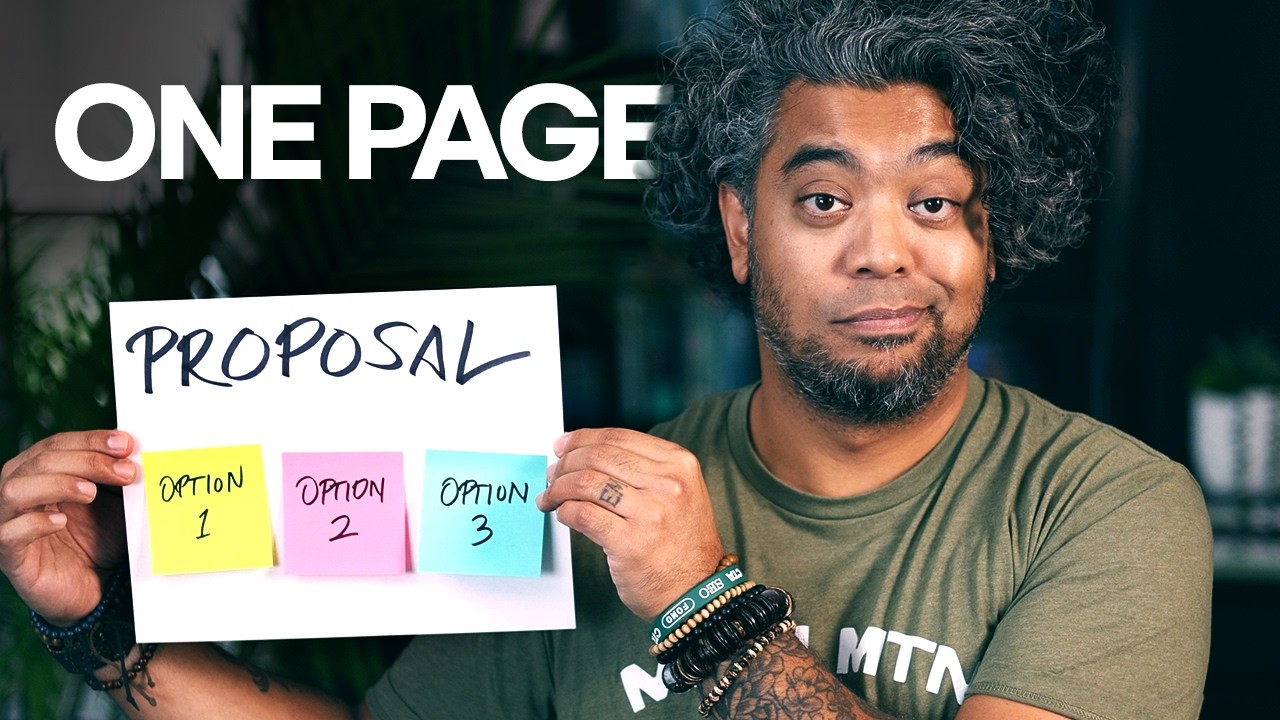
Designer Dan Mall argues proposals should be live conversations, not PDFs. He introduces the DOPE framework (Dream, Outcome, Price, ETA) and a five-point conversation flow, with strategic pauses backed by MIT research on silence in negotiations. Three tiered pricing options and a downloadable script help agency owners close deals on calls instead of waiting for email replies.
Chapters
This is how I present a proposal to a client. The whole thing is one page, but the real proposal is what I'm about to say out loud. No sending it off and waiting to hear back. No—
Just wanted to check in.
Messages. I'm going to show you the exact script. If you're new here, I'm Dan Mall. I ran a design agency called SuperFriendly for over a decade. We sold 6-figure and 7-figure projects to companies like Harvard Business School and United Airlines, and we presented every single one of them This way. Now I coach agency owners on making more money, and this is the first thing I teach them about proposals. I call it the DOPE proposal. Yes, that's an acronym, and I'll spell it out for you in just a few minutes. For now, just know this: most proposals get a nope. Yours should be DOPE. Most agency owners spend days or weeks on a proposal. 30 pages with info about scope, deliverables, timelines, case studies. My most dense proposal was 82 pages. We attached it to an email, we hit send, And then we just waited. And the waiting is the worst part. A week goes by and you draft a follow-up.
Just wanted to check in to see if you had any questions about the proposal.
Crickets. Another week. Now you're wondering if you should follow up on the follow-up. We tend to rationalize it like this. Well, if they really wanted to work with me, they'd reach out. That belief is arrogant and misleading, and it's costing you a lot of money. The client isn't quiet because they don't want to work with you. They're quiet because you asked them to make a massive decision alone in their inbox With a 30-page document and no help. When you buy other 5 or 6-figure things like a car or a house, the salesperson sits with you for hours. What makes you think that your prospects should do this without you? The general advice that you'll find on this topic makes it even worse. Most of it teaches you how to write a better document. Add this section, always include this page. The other half teaches you to defend your price when the client pushes back. Both of them, though, accept the same broken premise. A proposal is a document that you send, and then you brace for impact. Here's the flip: you never send a proposal. At best, you leave one behind. The biggest mistake agency owners make when it comes to proposals is thinking a proposal is a document. So they spend most of their time designing the document, and then once they're finished with the document, it feels weird and stupid to read a document out loud to another adult. After all, the client is smart and they know how to read. So the agency owner just decides to send it over email. See what happens there? You spent all of your time designing this thing, and that's the exact thing that pushed you into the waiting room. So if a proposal is not a document, what is it? If you look up the word proposal in the dictionary, you'll find this definition: to suggest for consideration. And there's already clarity in this. If a client came to you and said, we'd like a website, please, you can't suggest for consideration that you make a website. But that's what most agencies do. Client asks for website, proposal contains costs for website. There's nothing to consider. That's not a proposal. That's an echo. Echo. Echo. Echo. If we look at the root word of propose, it's made up of 2 parts: pro, which means toward the front or in advance, and pose, which means to put or to place. So the idea of the word propose or proposal is to put something in place in advance before it's about to be done. If a client came to you and said, we'd like a website, please, a true proposal would be you saying, great, here's the plan that we'd like to put in place for getting you this website that you want. And the plan could be, here's how we'll get you a website that increases your average order value, or here's how we'll get you a website that converts more of your visitors. And you can't just say that. You have to explain it. You have to show it. You have to walk them through it so that the idea in your head that makes sense to you because you're an expert can actually make its way into the mind of the client in a way that they can understand as not an expert. That is what a proposal is. It's the conversation around the ideas that you're putting forth for their consideration. Now, that's not easy to do, so I suggest spending as much time as you can on designing the conversation, not the document. Luckily, I have a script for you to make that a lot easier. And I also suggest that you create a visual aid for that conversation so your client can understand it more easily. I have a template for that too. Conversation first, visual aids second. Let's design both, starting with the conversation. The conversation has 5 talking points. 1, remind them how you got here. Probably you've had a few conversations with this client already, maybe over email, but ideally real-time somehow, like on the phone or on a video call. You asked them some questions, they gave you some context, so you open with a quick recap of what you've done together so far. 2, You confirm what they came for, and then you open the door wider. A great partner sometimes believes more for their client than the client can see themselves, but you can't just ignore what they initially asked for, so you acknowledge it, and then you tell them that you're going to think bigger on purpose on their behalf. You tell them what you want, and you ask for consent to proceed. There's specific feedback that you want when you're proposing something. You tell them what it is upfront so they have time to think about it while you're showing them some options. You'll see what I mean when we get to that part in the script. Walk through your options. You might be tempted to make this the densest part of your conversation but it doesn't have to be. Keep them really high-level here— the gory details are for later. You ask the question that you promised and then you shut up. This is the biggest say-nothing moment in the whole conversation and I'll show you what that feels like in just a minute. That's it. That's the structure of the conversation— 5 talking points, no longer than 10 minutes. Resist the urge to overexplain. The more you say, the harder it is for them to hold in their heads. Okay, enough theory. You might pick it up best if I just show you what it sounds like. Pretend you're the client. You work for a functional beverage company called Ridgeline. You came to my agency for a new website. In my last video, I worked out the best options that I want to put in front of Ridgeline in a lot of detail, the prices associated, and the rules and formulas that it took to get there. If you're interested in the details of that, the video is linked below. Now you get to hear how I would say it to them out loud. So here we go. Thanks again for meeting with us. Over our last few conversations, we asked you a lot of questions and you gave us a ton of great context. We did some brainstorming and research around everything that you shared, and today we have some ideas about how to get you where you want to go. Now, you originally came to us for a new website, and you'll see what we propose there in just a few minutes. But we also landed on some bigger opportunities. I have 3 options that I want to put in front of you to show you how many different ways we could help you. And the feedback that we would love at the end of this call is to know which one of these options feels the closest to what you would hope to find with the right partner. Is it okay if I quickly walk you through our thinking?
Yeah.
Awesome.
All right.
I see some head nods and some thumbs up, so I'm going to carry on. I'm going to share our top 3 ways that we think we can help you so you get a range of choices depending on what matters to you right now. The first option we call the case. In our last conversation, you told us that most of your revenue comes from repeat orders, and that's exactly where your website can work harder for you right now. In this option, we'll design the new user interface and user experience of your new website to increase your average order value so every customer spends a little bit more every time they buy. I want you to think about things like bundling or tiered incentives, one-click upgrades, and things like that. Our initial research suggests that we could increase average order value by about $8 per order. You told us that you've had your current website for about 3 years, so using those numbers, that would bring in about $960,000 of new revenue over the next 3 years with a new website. We could have the new site live by February. Our fee for the case option is $96,000. Okay, next up. The second option we call the 6-pack. This one's closer to what you initially asked about. Here, we'll design it in a way that can convert more of your visitors into customers. The traffic you already have, but buying at a higher rate. We could see building features like guest checkout and improving site performance as ways to get more people to purchase. The beauty of this option is that we don't even need a new site right now. We could start improving things today, so you would see the changes within a couple of weeks. With your traffic and your average order, we estimate it'll bring in about $360,000 over the life of the new site. Our fee for the six-pack is $36,000. We know you have a real appetite for this, but in case you'd rather start with something smaller, we made a third option. We call it the SIP. Here, we'll create a simple landing page builder that saves your team time in spinning these up. The hours they spend every week wrestling with the current CMS would be gone. It'd be about 400 hours that your team would normally have to spend that we could give back to you, and that would add up to about $120,000 in time saved. We think you'd feel the efficiency by the 3rd landing page launch, which sounds like it's sometime next quarter. Our fee for the SIP is $12,000. Okay, that's a lot to digest all at once. Of course, we'll send you this page after the call so you can sit with it, and if you want to take a screenshot while we're here, that's totally fine too. I'm going to leave this on screen for the rest of our conversation. Now, here's the feedback we would love right now though. Of course, you reserve the right to change your mind later, but just gut reaction. Which one of these options feels the closest to what you'd hope to find with the right partner? Okay. How'd that go for you on the other side of the screen? Now that you were sitting in the client's seat, were you interested in the story and the conversation? Did you have any questions? Does one option seem more attractive to you than another? Are you curious what the client would say after all this? What would you say? We're going to unpack all that in a minute. But before we do, I want you to put your agency owner hat back on. How different was that than what you normally walk your clients through when you walk through options? Maybe you've never done it this way at all. If this way of doing it feels more natural to you or you want to try it out, you don't have to build any of this stuff from scratch. The exact script that I just performed and the one-slide template that goes with it, I've packaged both of those things up for you for free at the link below. There's no email gate or any hoops to jump through. You can just download them directly. You swap in your client's words and your numbers, and you have your next proposal conversation designed before lunch. Now, let's zoom in on a few things and do a quick debrief of what makes this approach work really well. First, the visual aid. Notice it's just one slide with deliberate builds that reveal information as you're saying it. It's not replacing the conversation. It's essentially public note-taking. Each option on the slide has 4 specific parts, and this is where the acronym comes in. These are all DOPE proposals: Dream, Outcome, Price, ETA, or Estimated Time of Arrival. Let's start with the most straightforward part. O is for Outcome. You write 1 or 2 lines about what changes for them, not what you'll deliver, but instead what they get after you deliver what you deliver. More orders. Your team gets their time back. Clients don't buy websites or brands or newsletters. They buy change. So the outcome names the change. P is for price, the fee. It's one number. That's it. E is for ETA, estimated time of arrival. When will this outcome arrive for them? You'll feel it next quarter. New site by February. Notice what it's not. It's not a project schedule. It's not milestones. It's when they can expect their lives to get better. Finally, D is for dream. Every option gets a name, and the name is the client's dream stated as a title, not Package A or Premium Tier. If your beverage company client dreams about the next level of revenue for them, the option is called something like The Case, which represents abundance for them. The name should make them feel seen, like you made it just for them and for nobody else. It comes from their words and their language, from the conversations that you've already had with them. And here's the trick that makes the slide serve the conversation instead of competing with it. The slide builds while you talk. When the conversation starts, it's empty. The first option's name appears when you say it. The outcome appears when you name it. The price appears once you get there. Nobody is reading ahead to option 3's fee while you're still explaining option 1 because it's not on screen yet. The slide should follow your words, never the other way around. Now, let's look at what's not on the slide. No deliverables. No scope, no timeline, no case studies. That is on purpose, and it's the hardest part for most agency owners. In a couple minutes, I'll address why you're probably skeptical about this and what to do if your client pushes back here too. Now, the pauses. You just sat through 3 of them, one every time I named a fee, and I made you sit through every second on purpose. If it felt uncomfortable in a YouTube video, imagine it on a live call. Now, here's the rule: the fee is at the end of the sentence. Our fee for the case is $96,000.
Then? Nothing. Not—
And that includes—
Not—
But we're flexible on that. The price lands and you stop talking. Every fee, every time. Same rule when you ask a question, like the consent question at the start or the gut reaction question at the end. You ask, then you wait. And this isn't just some trick that some sales guy on the internet says. There's real research here. A team led by Jared Curran, a professor at MIT's Business School, ran 4 studies on silence in negotiations. First, they recorded real negotiations and used software to flag every pause of 3 seconds or longer. Then they went further. They secretly instructed one side to pause on purpose, and then they watched what changed. 2 findings worth knowing. First, the breakthroughs, the turning points where stuck conversations finally moved forward, happened right after silent pauses more than at any other moment. Not after a clever argument, but only after quiet. Second, they tested why it works. Is it pressure? Silence is squeezing the other person until they cave. Or is it space? Silence gives both brains room to think. The data definitively pointed to space. Pausing pulled people out of reactive tug-of-war thinking and helped them spot options that made the deal better for both sides. And here's the detail that I love. The other side didn't feel worse when someone paused. The silence didn't hurt the relationship. It actually improved the outcome. Now, to be fair, they studied back-and-forth negotiations, not proposal presentations, but I think it still applies. Saying and hearing a fee is one of the biggest moments in the whole conversation, so give it room and better decisions show up on both sides of the screen. There's one more reason to pause, and this one comes from my own experience, not a laboratory. Sometimes the biggest danger in that silence isn't your client, it's you. A fee hangs in the air, the quiet feels unbearable, and you crack.
But if that's out of range, we could probably do it for less.
You discounted a price that nobody actually objected to. So here's the trick. The MIT team counted anything over 3 seconds as an extended pause. I go longer, as you might have noticed. After every fee, I count to 8 in my head slowly. If the client speaks first, that's great. They give more information. But if they don't, I just move on to the next option. The counting isn't really for them. It's mostly a muzzle for me. And to be honest, when you heard $96,000 with no scope attached, did your heart rate go up? Good, because that's the thing about shock. We're not trying to avoid shock but we're not trying to generate it either. This isn't shock value for the sake of shock value. We're trying to surface the shock. The moment your client is the most shocked is the moment that they're trying to tell you the most. Shock is the gap between what they expected and what you just showed up with. And wherever that gap is the biggest, that's your biggest opportunity to show them why you're different from everybody else that they're talking to. Maybe it's the price. Maybe it's how simple the slide is or the option is. Maybe it's you saying, I don't know, out loud. Whatever makes their eyebrows jump, that's where the conversation wants to go next, which is the real job of all those pauses. You can't surface what you talk over. Every silence you leave is space for the client to show you where the shock lives. Now, I've presented hundreds of proposals like this one, and the next 60 seconds always plays out one of 3 ways. First, they lean towards an option. They say something like, we love the case option. Great. The key for you is to stop selling at this point. So many agency owners get excited and they continue pitching options and upsells and future possibilities. Don't do this. There's only one right thing to do in this situation. You say, Great. We'll write up the paperwork. Do you have time later today for another call to review it? Now, even though the scenario where they chose an option is possible, it is rare, I'll admit. Which brings us to the second scenario— they're between options. Now, I love this scenario and I think it's the one that you should expect most. When you say at the end, which one of these options feels the closest to what you'd hope to find with the right partner? If you've created 3 valuable options for them, it'll be a hard choice, which means they'll probably say something like, well, we really love the case option, but there are aspects of the 6-pack that we love too, which then cues you to say, That makes total sense. Would you like us to come up with an option that blends the two? They'll probably say yes. So then you say, Great. And in terms of price, want to split the difference between the $96K and the $36K and call it $66K? They'll probably say yes to that too. And then you tee up the last question. Awesome. We can have that ready by the end of the day. Want to hop back on in, say, 3 hours from now to review? Now, the third scenario is less desirable, but it happens sometimes too, which is that the person or the people on the call, they can't actually say yes even if they wanted to. Ideally, you'll have asked who the decision makers are earlier on, but sometimes you miss it, and sometimes the client says they're the decision maker until they actually have to make a decision. It happens. So you say something like, it sounds like your VP really needs to be part of this decision. Want to set up a working session this week and we can present to them together? You can't close the sale on this call, but you can close this conversation because it's over, and you can open up the next one on a specific date with a real buyer in the room. And in any of these scenarios, there's one question that you should expect because it's the one that I promised that we would come back to. That question is, what exactly do we get in this option? Now, remember, there's no scope on the slide, so this is exactly what I say. Uh, I'm not entirely sure. We didn't get to that part yet. Our next step is to go further with the option that you're most interested in. Is that the case? Is that the option that you would like us to do that with? Now, when a client asks, what's included? Too many agency owners take that as pushback or as an objection. It's usually not. It's usually interest. If a client hated all the options, they wouldn't ask you anything. They would just thank you for your time and then hang up. A question about more information is actually a really good sign. They're leaning in. That's a buying signal. Scope lives in the most formal of formal formats. It's called an agreement, and writing it is part of closing, not part of proposing. So when a client says, what's included? You say, we'll write it up for you so that you can see all the line item detail about scope, services, deliverables, timelines. We'll walk through that in our next call. Does that sound good? They usually say yes, and you know that the thing that you'll walk through in the next call is a statement of work, which is probably the next and final step of your sales process. Now notice what's true in all 3 of these scenarios. By the end of the call, you know exactly where you started, what each party needs to do next, and when it'll happen. There is no version where you go home, refresh your inbox for 2 weeks, and have to send a just checking in email. That is the real point of a good proposal, to move you forward to the next step of your sales process. So here's the one thing to do today. Look at the last proposal sitting in your drafts, the one that you are about to email. Don't send it. Book a call instead. Design the conversation first, the 5 talking points, and then build the one slide that helps you have a dope conversation. Dream, outcome, price, ETA. Then go talk to your prospect. One slide, 10-minute conversation, and you'll know where they're leaning before you hang up, which is more than a 30-page PDF has ever done for anybody.