Full Time Forex Job as a Student? Here's His Journey
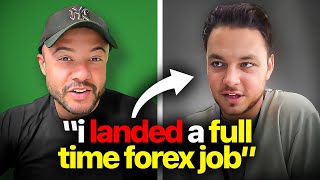
Marley Wetherill went from economics student to prop trader to sales at 24 Exchange by age 24, crediting the Think community's newsletter, Discord calls, and Academy for trade ideas, networking, and job leads. He learned to book profits consistently and understand NDFs, concepts that helped him land his interview.
Chapters
Take a look, you know, Microsoft, take a look, Meta, Tesla, especially during the times where everything's dipping and everyone thinks it's going to be the end of the world. The community understands that actually buying dips is quite important and the risk has paid off quite well. Go into investing and trading thinking I need one hit and it's going to make me a mill. That just doesn't really happen. I didn't really understand what sales was and you very kindly and a lot of other members in the group basically said, why don't you give sales a go? Trading is tough, especially if you don't have the code, which I don't. So I said, okay, let's try sales and since then in the finance space, and currently I'm working at one of the largest FX NDF venues.
Today we've got Marley who's decided to have a chat with me. Me and Marley have known each other for a long time now. I think we met because you joined the previous business, which was Macrodesiac, didn't we?
Yeah, it was one of the first few subscribers during the time I was at university trying to work out what I do post uni. I was studying economics and management, and yeah, saw your tweets on Twitter, was like, okay, this guy knows what he's talking about, or at least I think he does. And yeah, you launched your newsletter and then the Discord group and basically been in that group ever since, to be honest.
I think it's been like 6 years, isn't it?
Yeah, I think that's how long it looks, yeah.
Which is insane. I guess then the question is sort of what benefit have you got from it over the last couple of years? Because you're probably the longest serving member and now we're obviously like friends in real life as well. Do you want to kind of explain the benefit and maybe what you do now?
Well, yeah, no, 100% it's helped. My career path. When I was at university, I was studying economics and management, was looking for jobs, didn't get into any of the investment banks. So thought, let's explore some other opportunities. Managed to join a prop shop in the crypto space. You know, I was speaking to you about what I should do. I think you mentioned B2C2 and a few other names, but I managed to get into a prop shop, started trading there, managing a book, and that was a good experience. And then through that, joined a fund, was trading and managing a DeFi book there. And then through that, we had a conversation because you said I should join sales. And I didn't really understand what sales was. And you very kindly, and a lot of other members in the group, in the networking career business chat, which is a section in the Discord, basically said, you know, if you understand markets and you can talk to people, why don't you give sales a go? Trading is tough, especially if you don't know how to code, which I don't. So everything was going systematic. So I said, okay, let's try sales. I joined company and the rest is history. I've been in sales since then in the finance space. And currently I'm working at one of the largest FX MDF venues called 24 Exchange. And, you know, predominantly when I joined was focused on crypto, but now focus on FX. And so having, you know, the Discord, the newsletters, the daily calls that we have, 8, 9, 9 AM to go over the market, it's super helpful for me to have good conversations with my clients, right? I'm predominantly speaking to traders, FX traders, both buy side and sell side, and just knowing what's happening in the markets. I would put that all mostly down to things, just knowing what's happening and even just seeing the stream of conversations, not only just you and Tim, but all the other members. I mean, you can just draw a lot of, you know, information, trades, trade ideas, where to look for things, all from that Discord.
Yeah, I think that's one thing that we do quite well. We've curated the community so there's not idiots. It's not that, you know, they've not got knowledge gaps because everyone has knowledge gaps, but people that are really, really keen to learn and not just to make you know, a million quid overnight. I think that's absolutely key. If we talk about the actual sort of trade ideation and what the real benefit has been to you personally, what would you say? Do you think it's more the ideas are just streamlined so you don't have to do as much research, or are there examples where you've actually made money off of some of the ideas that we've generated?
Both. I think what, what are the journeys that you develop as a trader or an investor or whatever you call it? I think one of the steps in the journey that you take as a trader or an investor is drawing on ideas. And getting pointed to where to look, but then also building your own framework around what works for you. So for me, you know, one of my biggest issues was that I was never taking profit. You know, any trades I was taking, I would just watch them round trip. And so I would see someone post something about a stock or an FX trade or a crypto trade, like, okay, cool, let's put it in. It would make money, but then I would never take it out. And so then for me, my personal journey has been rigorously taking profit, and through that also withdrawing profits away from my investing account or my crypto wallets into my bank account. And that's been like a massive shift. And the community is great for that. You streamline the time and the effort it takes to look for trades. So I know there's been a lot of focus on the equity side. Never really dabbled in equities, but you know, I've opened up my stocks and shares ISA and it's outperforming purely because, you know, you're saying, hey, take a look, you know, Microsoft, take a look, Meta, Tesla, especially during the times where everything's dipping and everyone thinks it's going to be the end of the world. The community understands that actually buying dips is quite important and the risk is off quite well.
It's funny, isn't it? It's, um, when you've got a community of relatively smart people around you, the market naturally gets very, very emotional and, you know, i.e., stupid, because people make money trading against stupidity. It's exactly what happens all the time. Now, we obviously launched the Academy about 4 or 5 months ago now, and you joined that as well, even though you're a mate. Didn't give it to you for free. The thing with giving things away for free is that people actually don't value it as much and put their time and effort into it. So we've mentioned your career previously. How do you if we delve a little bit deeper into that, the actual community and Think has really, really helped you and what benefit could there be for other people? Because there's another young lad actually who we helped with trade ideation when he went for an interview at Morgan Stanley and he actually got it. And then another guy got a job at a hedge fund over in Sweden and now he manages—
Yeah.
So it's very, very interesting some of the steps that people are taking directly from Think. But I think extending a little bit further, how has it really, really benefited you and what examples or help could you give to others as well?
As I mentioned earlier, there is a specific channel for networking, career, business development. And you know, when you're starting out and you've left university and you have an idea of, okay, I want to be in finance, but finance can mean, you know, a million different things. Having people post jobs at companies, you know, that you might have never heard of, that actually are mega beasts in the FX space, for example, some of these brokers, you know, they're mega. And, but you would never have heard of them because all you know is Goldman Sachs, Morgan Hong Kong and Stanley and so on. So having experienced people post where to look has been super helpful. Also, you know, when you have questions about interviews or interview prep or just trying to understand something about a role. I remember when I was applying for 24 Exchange, well, I didn't really fully understand what an ECN is and why they operate in the FX space. And you explained it to me and you're like, no, they're an ECN, they're focused especially on NDFs. You explain what the NDFs are and that 100% in my interview helped me get the job, you know, and I've been there since what, for 4 years now. Again, kind of similar to the trade idea. It just streamlines a lot of the effort and the understanding and the work that it would take to just scroll through LinkedIn, try and understand yourself. Having someone say, look, there's a job here, go apply. Because I felt that Think has really helped me, I try and spend some time helping others in there. So when I see people saying like, I would like a sales role, I want to do this, you know, I had a call with one of the guys, Pablo, trying to tell him where to look outside of, you know, think a little bit outside the box in finance. You know, there's a lot of opportunities and I think that helped him, right? Yeah. I like to give back because I felt like it's given me a lot and I'm still very active in there. And then finally, yes, business development. I've met a few good people like the guy Ellis from Marix, few others who I'm doing business with now. So there's multiple benefits in that sense. And for a young person, I think it's just a nice community to have where you don't get judged for not knowing something.
Yeah.
Exactly.
Because when it comes to certain things about, say, derivatives or options, I wouldn't have really the first thing to go and explain that to people. So I always need someone to explain things to me. It's not in my wheelhouse. So I think if you've got people from different disciplines, because a lot of the guys in Think are professionals themselves, you know, we've got an FX fund manager in there, Mark. We've got the head of credit at one of the investment banks. I'm not going to say which one in there as well, in there too. So these people are in there with multiple different disciplines. And I think that is a massive, massive benefit.
Okay.
Combining then all of that in one sentence, give me what you think gives to people.
Streamlined information and a proper community.
That makes money.
That makes money.
That's the key bit. Without being advisory, your knowledge just develops in my view, rather than telling you exactly what to do, you just end up sort of knowing what to do. Is that something you'd agree with? 100%.
I don't need now to constantly be asking people about my trade ideas. I will take my ideas because over years I've practiced, I've learned a lot through making mistakes, but the ideas and, you know, just simplifying how to trade is, I think, one of the biggest steps that a trader can take. So many people try and overcomplicate it, add all these indicators, add all these theories and things, and at the end of the day, you don't need all that. You just need a bit of a framework, which the Think Academy teaches, a simple framework that allows you to scan the markets, to have some rule-based system, and to execute, you know, that's risk-managed so you don't lose all your money on one trade. And if you do that over the years, you will make money. And that's the other thing is teaching patience. People go into investing and trading thinking I need one hit and it's going to make me a mil. That just doesn't really happen. As soon as you change your framework to, okay, as long as I'm making a good amount every year, adds up. And you know, from external sources, maybe you get a bonus or whatever, and then you could top up your accounts and it all accumulates quite nicely.
Yeah, no, that's a bang on point there because I think there's two things. There is any percentage growth, as long as it's beating inflation, is good. But also retail investors have an advantage because you can actually make more than the S&P 500. It's just lots of people are listening to the institutions with a load of money that makes it far, far harder to deploy that to actually get a market-beating return. Mr. Marley Wetherill, thank you very, very much for your time. Really appreciate that.
Anytime.
We shall, uh, we shall meet up again very, very soon.
Sounds good, mate. Appreciate it. Cheers.