This is a YouTube video titled "Why Don't Brits Invest?" created in July 2025. It features a detailed discussion between two speakers, David Fink and Tim, about the cultural and economic reasons why British people tend to avoid investing in stocks and prefer property or cash savings. The conversation covers topics such as property market misconceptions, risk aversion, inflation impact on cash savings, and the benefits of long-term stock market investment. They also discuss practical advice for new investors and promote an investment education program. The content is an informative talk aimed at educating viewers on improving their investment habits and understanding financial markets.
Okay, we're live, mate.
Welcome to our first YouTube stream that we have done and we think it's a really, really important topic here, especially after this Mansion House speech. I'm joined with Tim today and we're going to run through the reasons as to why Brits don't invest. We're also going to look at some of the kind of solutions, I guess, that we can put forward on a more personal level. We're not talking about like an economic level here. We're talking about how to nudge people along the risk curve because we think it's so important. We've been doing it for years. We've taught other people how to do it and I think. So some people will really, really benefit from some of this insight. But I think the foundational component of this is that there are lots and lots of issues with regards to British investing culture, as we all probably know. So I guess, Tim, should we kick it off and run through the initial charts and the reasonings and some of the things that we, we desperately need to tell people about?
Yep, let's go. Okay, so we'll bring that up there. So why don't Brits invest.
Now? Are we able to see this?
Just check. Can everyone, anyone see that? Just check. In the chat there, that should be showing there on your screens.
Yeah. All right, perfect. So this is the, the head title here. Because it is an absolutely key question now, I think, Tim, it's not, I'm not seeing it on Google Meet. So where are we streaming this?
Okay, I'm doing it directly through there. So that is going to be a bit of a problem for you. Give me one second. Right, let me just, let me just fix that so David can follow along. Okay, one second. Right, one second there, guys. Just going to bring this on and adjust it. All right, can you see that now, David?
Perfect. So I think there's some key reasons and we can kick off with the first slide. Thirteen, let's go. It is mainly to do with property. I think everyone sees property around them. We see the income to, you know, the average cost of house ratio and it's insane in London, it's over 10 times income. We have a serious, serious problem with thinking that property is a source of investment. And you can see here that people think that their property is their pension. It's probably also why we have such a massive debate over this inheritance tax as well, because people think that they've worked so hard for this property, this real, real enthusiasm over buying a property. And when it comes to the End of their life, they're like, I want to pass it to my kids, but then I get taxed in some cases, 65, if you're over a certain threshold. And I think that this diverts capital away from capital markets, but at the same time it keeps people in this bondage with wanting to be invested in property. Now, I'm sure people have followed me on Twitter for long enough, you'll know my views on the economic relationship between land and property. I think that leveraging up to get mortgages to chuck it into the ground is not a productive use of that capital. That capital could be used to grow businesses, could be put into people's pockets in the form of wages. My view on how to rectify that is a land value tax and untaxed capital and income. But if we get to JP Morgan's research here, we can actually get to the objective facts behind this. Tim, do you want to explain this a little bit?
Okay, so, yeah, this was a survey that was done by JP Morgan recently of UK savers in particular and their attitudes towards investment. And you can see the respondents are extremely optimistic about house price growth over, over the next 25 years. I mean, why, why wouldn't they be? Based on what we've seen in the. In recent history, you know, property prices have gone up exponentially over the last 20 years in particular. But do we think that that can continue when we're living in a situation where there is a constant affordability crisis, where nobody's, you know, everyone's complaining that they can't get on the housing ladder? You know, it seems unlikely that property prices can continue to grow at these kinds of rates. I mean, you look there, in the past 25 years, house prices have gone up by approximately 200%, which is absolutely insane. So does it make sense to expect that price appreciation to continue? Well, they say, JP Morgan in the same document, that it's entirely unlikely. All right, so UK households could end up very disappointed by how little wealth their house has created over their lifetime. And again, if you look at mortgage rates currently versus what they were before COVID that definitely makes housing less affordable. It makes the leveraging up that we've seen from many property investors, it makes it much, much harder for them to continue to do so. Which obviously, if you haven't got that constant demand for more property because people can't afford it and interest rates are higher, the likelihood of property prices continuing to rise is much lower.
And of course, the irony is that wage growth is relatively crap as well. Let's Face it. And so I think today, for instance, the BoE have said, oh, yeah, we're going to allow four and a half times salary for your income assessment for a mortgage. So it's kind of showing that they're willing to upgrade the ratios just to kind of game the system. And I think that if property, if wages, sorry, have remained so stagnant and are probably going to continue to remain stagnant, that's probably correlated to house prices as well, because if they're flatlining, there's not enough growth in the wages to allow those income assessments to let you know the house prices rise because there's less leverage being taken out, basically.
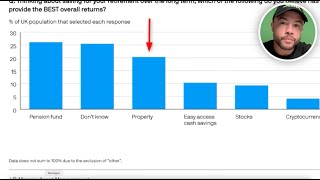
Exactly right. And that brings us on nicely to the next slide as well, which is really, I think, the crux of what we're talking about here today. Yeah. Which of the following do people believe has the potential to provide the best overall returns? And you can see there that Property, just over 20% of the UK population believe that property and cash, surprisingly, will actually be a better investment than stocks, for example, or even cryptocurrencies.
I think the most, the most worrying thing about this chart is, well, four things, actually. So you've got a conflation of pension funds as an asset class for whatever reason. You also have, obviously the property bonanza that people love. You have the fact that people prefer cash isis effectively over stocks in terms of return. But the other massive worrying thing is. Don't know. Don't know is astounding. Why don't you know out of those, what are likely to return more? Even if you do say property, I don't mind that. But the fact that so many Brits do not know what might return enough over such a long time period, perhaps they're so disenfranchised that they don't have to worry. But this is something that is really, really concerning, especially from an economic perspective, because it shows the extent to which people are completely misunderstanding a whole massive important part of the economy, which is capital markets. And so we desperately need to try and rectify this. And interestingly, in the Mansion House speech just this evening, they have noted that they want to increase investment knowledge. Now, I do not trust the government to increase investment knowledge. I think it's absolutely insane. And one of the interesting things that they've put in there, and I've sent my quotes to media tonight, is that with the Long Term Asset Fund, I think it is, they're willing to say that people can put two grand in and in 20 years they can get £9,000. Now, if a fund were to do that, you know, to retail investors, they would probably get a slap on the wrist from the fca. So I don't really know why the government are also allowed to say things like this is the kind of investment returns you're going to get, especially when I'm highly dubious as to whether they can actually get those returns. So it's a worrying situation all around here. I think this chart really, really says it very, very well. But I think that big component there, easy access, cash savings there is a relatively simple maneuver that can be done that we're probably going to explain later on in the presentation, whereby we can get people invested into stocks. Now, if you're in a cash isa, there are some considerations to kind of go through. What is that cash ISA being used for? Are you using it for a return or is it emergency funds, for instance? That is probably a trade off we can look at towards the end.
Yeah, most definitely. All right, so I think the first thing that we need to do is look at why, aside from. Well, I mean, it's part of the same thing, why property isn't fantastic investment. Yeah, all right.
I don't. They don't, they don't rise forever. You know, we saw in 1990, 1991 there was a big housing, housing market crash in the UK, naturally, 2007 and 8. The only reason it was reduced after that is because of QE and low interest rate policy. And of course, you know, you'll know from your previous career, Tim, the hidden costs of maintenance, repairs, insurance and taxes. I'm sure some of the people who bought those posh villas in Spain wouldn't have envisaged the extent that it would, would have cost to, you know, service a pool, for instance.
Absolutely not. Absolutely not. It's been known. Pools, funnily enough, are known as just expensive ornaments after you've owned one for a while because they don't get anywhere near the amount of use that people think they'll get. And they do. They are just absolute money pits.
Yeah. And I guess you know the cost of a mortgage these days with interest rates where they are, there's probably a bit of a legacy thing there with 15 years of interest, low interest rate policy, whereby people are stuck in this view that, you know, their mortgage is cheap and always will be. Whereas now they have the big post Covid shock where interest rates have risen and now they're stuck. The US has a different issue where it's actually much, much easier because you can get 15 year plus mortgages so many people locked in the low rates for 15, 30 years, which is part of the reason maybe why a lot of the middle class Americans are quite wealthy.
Yeah, yeah, I think it's definitely that. And also the fact that they have a much, much healthier attitude to investing in the stock market as well.
Yeah, exactly.
We'll come on to that though. We'll come on to that. All right. So yeah, so I think it's fairly self explanatory here. I think one thing that people very, are very unaware of is the fact that when they're buying with a mortgage, they are someone else's yield. Okay. So the mortgage is someone else's investment and you're entirely reliant on the value of property prices rising. All right. And also the liquidity risk that you have when you're a property investor is that when you most want to sell is usually when it's going to be hardest to do. So it's going to take longer and if you need to raise cash, it's usually going to be very, very expensive to do so or it's going to take quite a lot of time.
All right, Yeah. I mean if you go on to. Right, move now and you look at a lot of the properties that have been on the market for months, they, they're down maybe like 20 from their list price because everyone's trying to do it at the same time. And so that's what happens in markets. You know, you see a lower and lower offer because no one wants to bid at those higher prices. It's just a fact of how markets work.
Exactly, exactly. And sellers are all dropping their prices to try and meet that best, that best bid.
Exactly.
Okay, so what drives this kind of terrible attitude that Brits have towards investing?
There's a multitude of things. Obviously there's the misallocation of capital element whereby they think the property is the primary way to invest. But also there is a culture of stiff upper lip, risk aversion, perhaps a bit of tall poppy syndrome as well. A lot of the guys that I know in the US are very, very happy to discuss their portfolios amongst friends. Whereas here it's all quite hush hush. The investing culture is just very, very different and we can see some of the reasons as to why people have put down, you know, why they, they don't really like stocks here by JP Morgan. It's easy to access the money if needed. Is why people like cash Isis. Do they not realize that I could buy a US equity right now and sell it again in one Second and get my cash back. No, they don't. This is one of the biggest problems. I think there is a real misunderstanding as to how electronic markets work and in terms of how liquid buying and selling is these days, especially in U.S. equities. Brokers hate U.S. equities because they are so cheap to trade. And their cheapness comes from the fact that they are so liquid, US UK equities have a much larger spread. And so you're spending more when you buy UK equities than you do in the US but the second reason is quite insane. And we're going to get onto some good charts on this. I'm afraid of losing money if I invest in stocks or other assets. Oh, my God. God. They don't realize they're losing money by keeping their money in a cash ISA due to inflation, especially over the last five years. Look, someone on Twitter messaged me when I was talking about the cash ISA thing, and he said a financial advisor told him to put 60k into a cash ISA in 2020. He's had an annualized return of 2.02%. The S&P 500 has done about 100% since then, perhaps.
Yeah, and a bit more.
And that's from a financial advisor. That financial advisor should be struck off completely because he's foregone so much cash there.
That brings us. Nice to. Onto the next slide here as well, actually.
Yeah, you can take this one, mate.
Yep. Okay, so that's the. The other myth. Okay, so aside from property, is the idea that, you know, you can just keep your money in cash, you can make a little bit of return, and everything will work out fine. All right? But in reality, what happens is that cash is constantly losing value over time due to inflation. It's called currency debasement. Essentially, your money buys less every year. All right? It's a feature of the system. It's not. It's not a bug. It's not something that should surprise anyone. You know, if you go to the shops, take a year off from buying something, go back and try and buy it again, it's usually more expensive than it was the last time. All right? So even when savings accounts offer you some interest, it's often below the rate of inflation, which means you're losing purchasing power. And you can see that over the last 10 years, we've had a 38% increase in the inflation rate. So that means that £13,800 today has the same value as £10,000 did in 2015. So really, what you're looking at There is. If you're keeping cash under the mattress, it's constantly losing value. And generally the interest rate that you can get in a savings account is not going to beat inflation. It's going to be below the rate of inflation. So you're losing purchasing power. It's not a good investment.
No. And I think this is where the post 2020 inflation spike actually benefits stocks, because what people were seeing was, okay, this is super high inflation was supported by central banks. Suddenly, stocks become the way to actually beat inflation. And this is kind of what we're going to get onto in a second as well. But the most insane thing is that 20% of those as a preference for cash cited being afraid of losing money if they invest in stocks. This isn't so much, I guess it is a risk aversion culture, but it's also a belief that there's no opportunity as well. I do think it's been beaten into the UK citizens over the last couple of decades. The opportunity is a bad thing, almost. And they see opportunity as almost something that is unattainable. You know, not even the success from opportunity, but merely the opportunity itself as being too unattainable. Oh, I'm not going to get that opportunity. I can't do that. It's insane to me. It truly is insane. But the other interesting thing here that we've highlighted is I don't trust financial institutions or the stock market. Bit of a vague question. Why don't you trust financial institutions or the stock market? Is it an overhang from 2008, perhaps? It definitely could be. However, why do Americans not see it in the same way, considering they had an even bigger financial crisis there? You know, most of the main investment banks had to be bailed out. Something that isn't really highlighted that much anymore. Everyone talks about Lehman Brothers. No one really talks about the others. That needed a hell of a lot of capital from the US Government. So it's. It's interesting to see the extent to which there is a divide between Brits. Well, Brits and Europeans and Americans at the same time, even though we're relatively similar, there is a huge, huge divide when it comes to investing. It's absolutely insane.
Yeah, absolutely. Absolutely. And there is the attitude as well that stocks are perceived as much more risky. And there's a lot of reasons for that. There's a lot of reasons for that. You know, they, again, they feel riskier because you can see their value changing constantly. All right. One of the things that we were just talking about in terms of property you know, you don't know what your property value is until you actually go to market to sell it. You know, you can just continue to believe that your property is worth as much as you paid for it, more than you paid for it, whatever the neighbor sold it for. Any number of things that you can, you know, use to kind of happily deceive yourself about what the current price would be of your house if you were to sell it today. But that doesn't. You don't see that price in real time. But if a company's value falls by, say, 20% in a day, it's on the news, right? But the only reason it's newsworthy is because it's a rare occurrence. And they won't mention that the share price was up 100, perhaps over the past five years before it felt 20 today. So all people hear about is, oh, it fell today. There's bad news, obviously dominates everything. So what you have there is, you have a different type of risk then of the risks of property and cash, which are slow and stealthy because you've got inflation quite quietly eroding your purchasing power. You've got properties, costs, ticks on a dog just sucking away the lifeblood of your investment. And then you've got the much more obvious kind of risks of stocks where you're seeing a constant price and you're constantly marking them to market. Do you want to take this bit, David?
Yeah. Look, I mean, I've done my compliance exams and quite frankly, it's all nonsense. No one thinks in the way that regulators do. No normal person thinks in the way that regulators do. I'm pretty sure that the way the human mind works is that the more they, you know, if we look at FX and CFD brokers, they've got a highlight. Oh, 80 of people lose money with this broker. I think most day traders quite like that because they think they're special. And so regulators always get things wrong because they think of things not from the perspective of the user, but from how the user should be told to do things. They never ever actually think about the consumer. And so I think it's quite a strange dichotomy that we have whereby we also have, on a bit of a broader and more complex sense to find benefit contributions, which also are quite a suck from the economy too. A lot of that capital should actually be invested in the UK economy or even elsewhere. The Ontario Teachers Pensions plan, they invested in ftx, right, which is just showing you the extent of risk that some of these places elsewhere are looking to take. Now their pension plan is overfunded by about 7 to 8%. That's fantastic. That is excellent. That means that, you know, they don't have to worry at all about their pensions pretty much here, you know, for a lot of the public sector, we're relying purely on future taxation. You know, it's absolutely bonkers and I don't really understand why it happens. Now. The regulators have also kind of mandated a lot of pension funds to switch from 60% of equities in 2006, 2007 to now about 30%, if not less than that. So there's been a real, real change in risk appetite right from the top, right from regulators. And it really, really is a shame because these are the people. We all know what the politicians are like and that's a discussion for another day. But these are the people that are dictating capital flows and it really, really does lie at their feet. It really does. In America, for instance, people are encouraged to trade around their 401k, which is sort of the equivalent of our sip here. Not at all here you're probably instructed. Well, you're not really instructed at all. Or even, you know, there's no enthusiasm towards taking a little bit more risk on. Because I think people. Yeah, as it's entitled, it's not framed as a, as a positive thing, it's framed as a negative. Risk is. Whereas you and I, Tim, we see risk as a positive.
Absolutely.
It's, it's something whereby you're putting money on the line to make more of it. That's all risk is. But these, these people see it completely differently. They see it as something that people shouldn't do, which is completely wrong and completely bad.
Exactly. Because it causes this, I mean, this chart just, it, it tells the entire story. Right, so this is from this chart is one from Schroeders. We're referencing quite a bit of their research in these slides. And it's more about the risk of not taking enough risk. All right. It's the thing that people don't see, right. They don't realize that this stuff is going on in the world beyond their kind of immediate perception. And that means that as you can see here, UK households missed out on more than £500 billion in returns over a 10 year period. And you can see the chart here because you know, if you put money into cash ISAs, that's what you're going to get. If you manage to earn the average rate on an instant access cash isa, that's what you get. The Value if you manage to find an ISA which actually tracks the bank of England bank rate, which a lot of them don't. And then the value, if you just simply invested in global equities in that period is basically double any of those. And from the, the report that David mentioned at the start here, you know, the UK also has the lowest level of retail investment among seven countries. It's just a really, really sad state of affairs and so much opportunity missed from this lack of, this risk intolerance that we, we seem to have as a.
Yeah, that's literally what it is. You know, it's a massive risk intolerance and there needs to be some, some solutions which we're coming on to now. And the only way that we can come to these solutions is by understanding the alternatives much, much better, by understanding what the actual stock market is, what it's designed to do and what its past trajectory has been like. I think when it comes to trying to convince people of it, it's difficult. However, it's not impossible and this is what we're here to try and do. So US stocks consistently beat US Cash. I don't really know how much more we can try and pummel it into people that investing purely in cash is one of the stupidest things that you can do. What do you reckon?
Honestly, we just keep, got to keep banging the drum. I think that's what we can do.
Yeah, this chart's very, very good one. You know, it pretty much shows that is actually less risky than cash when it comes to delivering long term inflation beaten returns.
And that's the key emphasis as well. Right. Because when you've got the, this loss aversion problem that people tend to have is that they're very, very aware that stocks tend, you know, stocks can go down and they do. You'll see that most, you know, more often than not we'll have a 10% drawdown in the stock market. Sometimes we'll have 20%. We had, we had a 20% drawdown in U.S. stocks earlier this year, but we're back at all time highs, you know, and that happened over a very, very short period of time in both directions. All right, so the way to kind of solve this as well is by encouraging people to zoom out and focus on the long term returns rather than any losses that might be suffered on paper. But as long as you don't have to immediately sell your stocks, which the idea of investing is that you don't have to do that much more about a long term game, then you'll be fine. You just ride out the peaks and troughs.
And yeah, by recognizing risk, that is the only thing that you can do. Look, if you walk down the road, you can get hit by a car and you're dead. I don't know why people, you know, don't stop walking down the road. Do you know what I mean? If you go to, you know, if you jump on an airplane, all right, the chance is low, but also the chance of, you know, losing all your money in the US stock market if you're holding the S P 500 is extremely low as well, pretty much zero. Because you're betting then if you are going to say that it's going to go to zero, you're betting on the US Economy blowing up forever. So the way to interpret risk is, yes, different and dynamic in different tasks, but when it comes to deploying capital, it's actually relatively easy when you're taking a long enough time frame and you know what you're doing as well.
Exactly, exactly. Just to answer one question there in the chat, retail traders are basically individual traders, not institute. Okay, so us as individual investors. Okay. Then we'll come on to the another thing that comes up quite often. I can't invest now. Stocks are too expensive.
Yeah, I love this one. So from our perspective, we're very much momentum focused. So what we're looking for is the market to shift relatively quickly up and to the right and to sustain a trend. We effectively trade like CTAs. So that's how we invest over a much, much longer time period. Taking quite a quantitative perspective and then adding in some discretionary elements. Right now we're getting very, very bullish and we're actually looking to put into our system an identifier for stocks that are literally hitting their highs so that we can jump on because they tend to push higher. That is a fact. Now, people's brains are sort of egotistical in this sense because what they start thinking is, I'm getting in at this high, the market's going to reverse. Why would the market reverse and care about your ten thousand dollar order or less? It's not okay. So this is something that is really, really difficult, especially when people are so used to reading charts and looking at some of the nonsense that you see, you know, on YouTube, Twitter, tick tock, whereby people say, oh yeah, it's going to run above this high and then completely, you know, tick down. Doesn't work like that. In U. S Stocks, you're focused on fundamentals, you're focused on businesses. So one of the core tenets of momentum investing, slash trading is that you kind of want the highs to be there with a good enough case, that means that it's going to shift higher. That prior high then becomes sort of a, a new low, if you like.
Yep, exactly, exactly. And you can see here from this chart as well. You know, one of the reasons why people say, you know, people that are saying invest, because the stock markets at all time highs will often be left behind because stock markets are making new all time highs all of the time. It's quite funny, almost a third.
I saw a post on LinkedIn about Bitcoin today. And it doesn't really matter what asset it is, to be quite honest with you. We focus purely on up and to the right. I might coin up into the rightism as a kind of political phrase. But he was basically saying, oh yeah, it's like 120k, now's the time to sell. And for me, I was looking at that, right, I was like, okay, sell, that's fine. Because when you see momentum, you do not want to just let go of it. Momentum carries on for a lot longer than you think. And when you're focused on something with certain fundamentals that say Bitcoin or the US equity market has, that momentum is likely to, over three to five years, keep going. Pretty much.
Yes, exactly that. And that kind of adds to the point here as well. You know, staying invested when the market is in at an all time high has been far more profitable. Having to sell an all time high. Okay, Very, very obvious how that compounds over time as well. And if you compare it to the returns, if you switch to cash, cashed out just because the market was high, your returns would be honest, ten times less. Exactly.
Insane.
And that is also true over shorter, shorter horizons as well. Shorter time Horizons, not just 100 years. You can see it very much the same how much you miss out on. And again, this is kind of a theme of all of this. The kind of opportunity cost of, of being in cash rather than being invested is really, really significant. All right, let's jump on here then. Okay, so the goal that we've got with all of this, that knowledge defeats fear. Want to hide this?
Yeah, sure. I think we've just had this chart previously, but I think this is something that we really, really. Oh, sorry, no, I'm on something different. Cost of living pressures and lack of knowledge are weighing on the UK population's ability to save and invest. Absolutely. But also there's kind of a vicious circle there whereby the wealth isn't being taken in from being invested, which leads to this cost of living pressure as well. America's haven't, Americans haven't faced the same cost of living pressure even though they think they have. They are far, far more wealthy with a much, much larger savings buffer which has directly come from being invested in the US stock market. It's a normal thing for them to do. It's not so normal here for us to do, which is why it needs to be pushed down people's throats. And I think, look, if we have a look at the top reason here, I don't believe I'll earn enough income to save invest in the future. I don't think that's a good enough reason and I'll tell you why. Because unless you're completely dirt poor, which, look, I don't think, you know, 45% of the UK population are completely dirt poor, there are ways to get invested for as little as 85 pounds for instance, in the US stock market and that would cover, you know, an S&P 500 tracker listed in the UK. VUAG. Those of you who are in fink, you know about that because I bang on about it all the time. The second top reason my current financial situation is too unstable to think about long term saving or investing. Well, that instability tends to come from not having a specific view to how you can make it stable. Even if it's a little bit okay, you can feel like you're much, much more stable because you feel like you're doing the right thing for the future even if you've only got two grand invested. You know, over the last 12 months, someone on, on Twitter mentioned to me a little while ago it might have been TikTok that they took one of my videos and they started taking one of the meals out that they would have a month, which might have been 90 quid, 100 quid, and started to get invested. They got up to three grand after about a year or so. That kind of psychological shift for people can be absolutely huge because then what happens is they say, I'm comfortable with this, I'm really, really comfortable with doing that. Now I'm happy to add some more or realize that there is opportunity out there so that they can add more, so they can do more things. Once you take that first step, that is one of the biggest things that can come into sort of your, your psychology and the way that you think about everything going on around you.
Yeah, 100. 100. All right. So when we're talking about risk Just want to sort of sum up everything that we've spoken about so far. The biggest risk is not getting started. All right, so we've seen long term growth. The stock market has delivered higher average annual returns than property or cash over decades. Right. Compounding reinvest dividends. Actually, the ETF tracker that David was just talking about, the, that will do it automatically for you. You don't even need to do anything to put the money in and continue to reinvest in the same market in the US Stock market for you, which can obviously compound and snowball your wealth. You know, one of the most successful investors of time, Warren Buffett, he's constantly said that that compounding is the eighth wonder of the world because that really is how or a large part of how he's made his money. All right, Again, that perception about liquidity, we touched on this earlier. Shares can be bought and sold easily. All right, Almost as easily as cash, really, which gives you flexibility. So if you do need to get your money out, you can do so obviously in property. Absolutely not the case. And it's easy to spread your investments across industries, across geographies. Again, even The S&P 500 is a very, very diversified market and you can start with tiny amounts. You can buy just one share. So go on. And David, you can go with this one. I know you love this.
Yeah. So the bank statement challenge I've used for a few people, they tend to be a little bit younger, you know, 18, 19. But what I say to them is take your latest bank statement, right? Find the last listed company. So one that's listed on the stock market that you spent money with in this case, could be Tesco, could be Amazon, could be Starbucks, could be McDonald's and then buy one single share. Obviously some of these companies might the, you know, two, three hundred dollars a share, find a company. Then if the, you know, the last one is a little bit too expensive, find the next one that's a little bit cheaper. You're then a shareholder, wait a month and then see what happens, see how you feel, repeat it. This is the snowball in effect of then you becoming more interested because you spent money on doing something to get invested. You will automatically then go and look at, you know, the company that you've invested in, old Tesco, you're going to find out a little bit more about them. When you go to find out a little bit more about Tesco, you're going to think of, oh, what's this thing? What's this price to earnings? What does that mean this is how. Then your knowledge starts compounding and it's the easiest way to do it. Just get started, open up an account. We've got a link to a broker in the, in the description. Open up an account with them. It can be a standard investing account, ISA sip and just get started. And then, yeah, for those of you who have already started, but who are still throwing darts at a dartboard and gambling and there's plenty of people out there. We came up with the Academy back in May because we were tired of seeing the amount of day trading stuff out there. We were tired of hearing the stories of people who had tried day trading for years, who got somewhere, then got knocked back, then they got somewhere again and they thought, I'm really confident, then lost all their money again. And we just said to so many people, look, just do this whereby you're, you're focused on the longer term, extending your time frame so you're not competing with the likes of Citadel in the order books. You're not competing on the people who can compete with tech latency arbitrage, statistical arbitrage. All of these things that none of us have any access to, but we're getting absolutely decimated by, on an intraday basis, by day trading and just focus on picking quality with a system that works over time. And this is where the Academy came in. We teach you, you know exactly what to do, whether it comes from a risk perspective, how to harvest volatility. You might not know what that even means. Many of you will how to understand concentration, risk, correlation risk. All of these things that actually matter that CTA's commodity trading advisors will be focused on. It's not difficult to do Asian risk. All of these things that actually matter that CTA's commodity trading advisors will be focused on. It's not difficult to do. Anyone can do it. As long as you're willing to understand core components of the market and to understand that you can do things loosely, that loosely the same things over time that will make money. But the benefit is naturally you're not day trading. You're doing it without any intraday anxiety. So we're looking at, you know, actioning trades maybe once a week, if that, sometimes once a month genuinely. Now in the description again, we've got the investment readiness assessment. If you think this might be for you, then click through it and we can have a chat and see if the Academy is really for you. We, we like to disqualify quite a lot of people with had to say no to a few People, because it's just not going to be for them. We know. So we like to keep it relatively confined to exactly the right type of person. So run through it. I'll get sent an email, we can set up a call. I think that's the best way to go with it, I think. Tim, is that. Is that everything that we've got to say?
That is almost everything we've got. One other point to add here is that it doesn't have to be complicated.
No, no.
You can just find one stock, one company, one theme, and it can be absolutely monumental for you.
Yeah, I said this yesterday. Apparently long beta, which is what this is basically beta is the extent to which stock is more volatile than a benchmark. Long beta can't make money. That's what so many people love to tell you. Well, it's just not true. You can do very, very simple things in the market. You just need to have a process and having that process is what unlocks the ability to have zero anxiety, to let you get up and know exactly what to do or what not to do. They're the key things. Most people are throwing darts at a dartboard.
All right, so let's wrap things up there and open everything up for you guys to ask us any questions that you might have.
Yeah, let's chuck a load of questions in there because this could be really, really useful. This is what we wanted to do here. Just drop them into the ch. There's no questions. What platform do you recommend? So in the description after the video, there will be a link to Saxo. They're the one that is trusted right now. But that, that changes all the time. IG is also a very, very strong one because what we're looking at is who offers ISAs and SIPs for the tax efficiency. Basically ISA, you can obviously put in 20k a year SIP, you can do 60k, and if you've got a child, you can do 9k in a junior ISA as well. So I just buy the S&P 500 for my little girl and in 14 years time, hopefully she's completely rich. What are your thoughts on Footsie global all cap versus S&P? So the Footsie Global All Cap, if you look at it from this perspective, the top end is going to be US companies anyway, right? So you may as well just be invested in the S and P. Now there's an interesting thing whereby when you have more than eight stocks in a portfolio that are of different beaters. So different sort of. How do I put it? How do you Explain that a little bit better.
So, so they're, they're essentially uncorrelated to each other. So if you have like eight tech stocks, for example, then they'd be quite correlated. But if you have, you know, sort of eight stocks that are from different, different sectors, you know, and slightly different behaviors, maybe a couple of banks as well as some tech stocks, you know, just sort of mix things up a little bit. As soon as you've got eight, then you've really diversified enough to reduce 80% of the, of the risk that you would, you know, that you would get from diversifying any further.
Exactly. And so if you consider the S and p has got 500 stocks in it, I think your question is it doesn't really matter. What you need to look at is the longer term returns basically. And I would argue that because the S and P is, I guess looking at the 500 biggest companies in the US there's more chance of success there. I think the All Cap is just very, very, very, very diversified. For what reason? Not too sure. But I would just stick with the S and p. Is trading 212 okay? Yeah, trading 212 is okay. I'm. No, I'm not 100% sure, but they might have some strange things going on with who they send their flow to. So who they send their orders to, which is Interactive Brokers who I believe might end up sending orders to Citadel and the other hedge funds who market make. But that's not really something to worry about, to be honest with you. What's your thoughts on index investing? Purely long term. And do you Recommend A minimum 10 year hold? No, I don't recommend a minimum 10 year hold. Purely in index investing. This is my opinion though, and naturally I've done this for a long time. I tend to have 50 in the S P500 and then the rest I will look at single stocks because I really want to get that out. Performance, it's what we teach in the academy is how to juice above the S P500 because let's face it, no one wants to sit with 20 returns a year. We want more, not 100. Don't necessarily want 100. It'd be great if we could get that year on year, but we definitely want more than 20 and so that's what the academy is designed for. S P and All Cap. Then you'll still be diversified. You'll still be diversified with the S P. Yeah, exactly. And then you're looking at, you know, the biggest companies. Oh, premium bonds. Brilliant question. I have to say that premium bonds are the worst thing ever. Now I have a real gripe with Martin Lewis who is money saving expert and now I'm. I'm sure he's not really advised to buy premium bonds before, but I do think a lot comes from money saving expert that leads to people putting their money into cash. And yes, premium bonds. I think it's just that risk aversion again, you know, they're happy to think, oh yeah, I've met, I've had a win. It's like the lottery. Why do people do the lottery? It's completely pointless. But it's that excitement, it's that buzz rather than any kind of invest in now, if that makes sense. So I think the premium bond thing is a very, very outdated thing. I personally don't know any younger people that, you know, invest in premium bonds. I tend to think of it as kind of an older thing, but I think they've just cut the actual prizes down just recently as well. So perhaps, you know, the demand for them is, is waning. But yeah, they're a terrible thing to get involved in. Worse than cash ISAs. What would you say to someone who's in retirement at 55, whose final salary, pension, never invested, but again, a lump sum of 300 grand, but saying they don't want to, they don't want to be rich when they're 80? Yeah, I mean, 300 grand is not actually a lot of money. If they're looking at 30 years, it's only 10 grand a year. Well, 25 grand, just over, you know, it's not a huge amount of money. So it depends on, I guess, the, the rest of their contacts. Do they have a mortgage, do they have, you know, all of that stuff? But 300 grand for me anyway, wouldn't be nowhere near enough.
Using that and trying to get the returns on it that we're talking about to make sure that you can afford any kind of lifestyle when you're 80, rather than being seen rich when you're 18. It sounds like they're just using as an excuse to go and spend the money, to be honest.
Yeah, the, the thing that they should probably do is take even 30 of that. So 100 grand, chuck it in the S P 500. If they wanted to, you know, they would receive the dividends, they'd receive income at the same time and that would compound over that same period and they can, you know, again, withdraw it when they like. What are your thoughts on emerging markets? There's the lost decade from 2000 to 2010. When the S P return was practically negative. Plus quality stocks in EM like TSMC, SK, Hynix, etc. Emerging markets, look, the current destination for capital is the US. Their capital markets have been so much deeper than 2000 I think.com was very much a bit of smoke and mirrors. So there was no real backing behind a lot of the dot com firms. Whereas the real buzz right now is naturally AI. And there's a hell of a lot of backing for those. Whether you look at military, whether you look at government, whether you look at know the social media giants. No matter where you look, AI is becoming more and more ubiquitous and that's a really, really key term here. It's been integrated into our technology. So if you were to look at a thematic basket of stocks right now, it would be AI right at the top in terms of pushing, you know, the, the, the returns since probably 2020, 2021 Tim Nvidia AMD if you look at, you know, even to an extent, Tesla integrating AI, all of these companies are the ones that have been driving the returns of the stock market. Nvidia just hit $4 trillion in market cap just yesterday. So for me I look at what is the highest probability of making money and in the easiest way that is in US large cap stocks, 100% emerging markets, there might be some good opportunities. If I could access India, I probably would have a punt there. But I still think that the US is the easiest place to make money. And even if, even if there's a down market, there's still stocks that are rallying. This is the beauty of systemizing. You know, again I'm going to refer to the cat, the academy because what we have is the system basically spits out single stocks according to our kind of quant model and then we're able to investigate them further. So even if the S P500 is coming down, of course you want a rising, you know, overall market because that leads to high probability of those single stocks that have been spot by the model to go up in value. But even if the S P 500 is decreasing, there are some stocks within there, the US market that is that are also increasing. So this is the beauty of what CTAs do and what trend followers do is they don't necessarily care about the entire market. We care predominantly about what opportunities are being signaled at the time. What are good ways to get exposure to real estate sector? Well, you probably want a real estate investment trust. I just don't invest in real estate though. I don't touch them. I just don't really look the, the best way. Actually that's, that's not true actually. So directly, no, I don't touch real estate investment trusts. However, one of my favorite stocks is Caterpillar. Caterpillar makes the diggers, excavators, etc so if you want exposure, sell pickaxes during a gold rush. There's something we always say to the guys in Fink because what that means is you're not directly correlated to the high operational costs of the actual activity. Where there's loads of risk, you're selling the tools to let them go and take on that massive amount of risk. That's why I like companies like Caterpillar. A recent one is Kratos, which is going to be doing a lot of the drone stuff, hypersonic travel boom, that's probably going to come. So I think that's probably the best way. I mean one of the best examples is likely Nvidia. Nvidia powering the social media giants to get their chips in to, you know, do whatever they need to do in their massive data warehouses. You know, Nvidia is providing the pickaxes during a gold rush. Mortgage is paid off and they have a final salary pension. Oh look, if they're getting 75k a year mortgage paid off, they're all right. It's gutting that they don't want to invest it. But I can understand if they're going to be able to live off of that relatively, you know, probably low overheads generally, they're probably living life. Alfie, to be honest mate, if you're into bitcoin, should you still diversify into stocks as well? If you are young, yes, you absolutely should. It's absolutely vital to. The reason I say that is naturally bitcoin doesn't provide a yield, provides fantastic price return. But if you really want that compounding effect where your capital can effectively earn extra and extra over time, that that's where you should be looking I think at US equities. Remember though, there are some US equities that have done insanely well. Not similar returns to bitcoin over the last 15 years, but over the last five years, you know, plenty that have done insanely well. So I think one of our best ones. What's the return on Bitcoin since 2020? Tim, let me just have a quick look. 2020, 10K. So, so Bitcoin's done about 10, 11X since 2020, which is ins. No, it's done more than actually from the bottom, it's done about 33x since then. So there aren't. So this is the way to think of it. Bitcoin is a very, very high beta asset. We keep mentioning that, that term beta. And it's important to understand because as a portfolio, what you want to try and do sometimes is smooth your variance over. You want to try and smooth your volatility. Right. What you can do, while bitcoin, for example, has a really harsh down move, is you can be long something else in the stock market which isn't going to go down as much, that might actually be increasing. That way, you're then smoothing over your equity curve. So you're not seeing this. Now, the problem with crypto is that it's all relatively correlated, right? We've all seen, you know, bitcoin goes down, Solana goes down, Ethereum goes down. So when you're able to, you know, allocate to the stock market, which is a different asset class as well, and I'm talking about single stocks, too, you're able to smooth over your overall equity curve, which is a massive, massive benefit psychologically, too. Palantir stock took me out of debt. You're a risky man to be in debt and get in long Palantir, but well done. I like that. You know, I think this is the other thing. I like that. But then lots of financial advisors will say to you, that's completely the wrong thing to do. You should have paid off your debt first. But you probably took the view that your potential return on Palantir is greater than your interest on the debt. Right. Plus, obviously the principal. So that's probably the way to look at that. I think that's a really good way to do things. It's also why I say to uni grads, if you think that you can earn more in the stock market by investing than paying off your student loan early if you earn enough. So if you're a higher earner, not always should you go and pay your student loan off down, not always should you pay extra towards your student loan. Because you should really, if you think that the US equities is going to be greater than the interest on your student loan, you should allocate to US equities. So that's an important thing to note as well. I just wanted to head back to this. Just what Tim's got up there. So we received this message today. We're just having a discussion. This is with one of the grads that has gone through the FINC academy. So this is where he's come to now. He's been Able to go from pretty much knowing nothing to then going and discussing his own thesis on, you know. Tim, go back to that one.
This one?
No, no, no, the previous one.
Oh, the what, the. Which one? The Nvidia one.
The message. Yeah, the message on Discord.
That's this one.
No, maybe am I delayed? I might be heavily delayed here. Sorry. I think I'm heavily delayed. Sorry. Yeah, so my apologies. So he went from basically knowing nothing to now being able to discuss looking at things that aren't even popping up with the strategy that we provide. You know, he's, he's really going out and being able to come up with his own thesis, which is exactly what we want. We want people to be completely independent of us once they go through the academy. And he says the trend following strategy has been successful for me since joining the academy and that is the main focus. Look, if you were to follow that and understand that you can make your own alterations to it, as long as the key structure and key foundations are kept, you will be able to make money. That is not a promise because I can't say that people might go and do their own thing, but we can pretty confidently say you'll be able to do it.
Your question there, Alfie, as well, about dollar cost averaging versus lump sum investment. Yes, market. I, I honestly don't really think it makes that much difference. I wouldn't focus on it too much. You know, it all depends on when the capital is available. But I would probably say that dollar cost averaging is just more comfortable. You can kind of get in the habit of, you know, if you've got the money coming in, if, you know, it might be that some people receive bonuses, for example, at the end of the end of the tax year and then they want to just sort of lump it straight in. You can absolutely do that. Or if you have extra money every month, you can just allocate or excess to investments.
So I'll, I'll tell you what dollar cost averaging is good for. It's good for people who don't know what they're doing, who don't have a plan. That's who dollar cost averaging is good for. I do it for my little one purely because it's 14 years and I'm not going to trade around her Junior Isa, because you can't really anyway. But what I would say is dollar cost averaging is a good excuse for people who don't know what they're doing. Jaspreet converted it to 0% and made payments monthly. The capital gain was much Higher then if I paid off. Yes, bang on. It's exactly the right thing to do. Smart guy. Right, have we got any other questions? Do fire them away. No, I think that's everything. But listen guys, if you are still throwing darts at the dartboard, you really do want to optimize your investing to know exactly what you're doing. Whether it comes down to risk management, the actual trade management, managing position sizing and also the most important thing, how to pick good stocks. Then do come and chat to us. One more question here. Sorry. Are there any other companies like Rolls Royce that are looking to ease the energy problem in the uk? Not sure how much headroom there is in Rolls Royce and whether there are better opportunities elsewhere. Did you listen to the part where we mentioned about investing at all time highs there. There is still a lot of headroom in, in Rolls Royce considering and I'll give you a re kind of part of the reasoning for this. The UK government is set to make another decision on rolls Royce in 2029 that extends that up future earnings to then they're going to have to be preparing and ramping stuff up until 2029. But not only that is once we get over this tariff issue with the US there's going to be a hell of a lot of jet engines I think being ordered by Boeing from Rolls Royce as well. I think it's going to be a massive, massive, massive bit of business for them and I think they started ramping it up already. So. Ah, sorry. Okay, got you. Yeah, sorry. So there's a component in the, in the webinar that we just did whereby it shows that if you invest at all time highs you actually earn more money. The returns are greater whereas if you invest at lower prices you actually don't. So buy the dip is definitely a thing. However, over a long enough time period, buying all time highs rather than going to cash at the previous monthly high is, is a better strategy. But to answer your question again more specifically as well actually because the UK government has awarded the contract to Rolls Royce they pretty much have primary ownership of that SMR capability. So I don't know if there's many companies you know that would be able to to do it in terms of what you're. You're looking for that criteria. It's a good question. I have a think and get back to you. If you drop me your or I'll message you on, on YouTube. I don't even know if you can message on YouTube. Yes, it will be available to re watch. Absolutely. I think it will just be Uploaded straight to YouTube, Tim, is that right?
Yeah. It should save as soon as we finish the stream. It should. Should be available as a replay.
Yeah, perfect. So as soon as we're done, it will be there. I think that's everything. We've done an hour. I quite like that timing. Everyone happy? Well, I hope everyone's learned something. Even if you already knew stuff, hopefully it compounded certain things in your head. We're always open to have a chat. That's one thing I'll say. So if you've got me on Twitter, if you've got Tim on Twitter, if you want to email me my emails. David Fink, money. More than open to have a chat, even have a call. All I do is spend my time on the phone with people, having discussions about the market and all sorts. So please do get in contact and we shall chat again. I think we'll do this more regularly. Find interesting topics to go through live.
Fantastic.
Thank you, everybody.
Thank you very much, guys.