Financial Literacy Mandates Fall Short
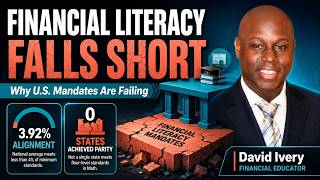
A National Financial Educators Council report found that financial literacy programs in U.S. schools align with academic standards only 3.92% on average, with the highest state at 16.7%. The problem: most programs are single-semester courses with no real assessments and almost no funding. The speaker proposes dedicated funding, integrated curriculum, and post-graduation reinforcement to fix it.
Chapters
Welcome, school board members and administrators, to this explainer. Look, across the country right now, states are proudly rolling out new financial literacy graduation requirements. Sounds great, right? But today, we're gonna dig in and evaluate whether these state-mandated programs actually meet the baseline academic standards we hold our core subjects to, or if, frankly, they're leaving our students dangerously unprepared. Here's our roadmap for today as we unpack a massive policy analysis from the National Financial Educators Council. We'll quickly hit: The Financial Literacy Illusion, The 3.92% Reality, Failing Baseline Academic Standards, The Economic Impact on Students, and finally, A Blueprint for Standards Parity. Section 1: The Financial Literacy Illusion: Mandates vs. Reality. And hey, let's start by validating all the hard legislative work being done out there. Over 30 states now require some form of financial education to graduate high school, On paper, that sounds like a huge win for student readiness. But let's pause and ask ourselves a really tough question: Are these shiny new mandates actually working to create financially competent young adults, or are we just checking a giant administrative box? Like, are we truly equipping these students with the exact same rigorous instruction we demand in, say, math, science, or English? To get to the bottom of this, the National Financial Educators Council, the N-F-E-C, did an incredibly deep dive. They applied 12 strict criteria across all 50 states, which gave them 600 distinct state-level data points. And get this, they weren't looking for pie-in-the-sky best practices. They simply looked at how financial education stacks up against the bare minimum foundational requirements we already expect from core academic disciplines. Moving to Section 2: The 3.92% Reality: A Systemic Failure. Well, the results from those 600 evaluations, they are a massive reality check for educational policymakers everywhere. The data here is a stark wake-up call. The national average alignment score for financial education parity is just 3.92%. I mean, let that sink in for a second. Out of a maximum score that represents full alignment with minimum core academic standards, our nation averages less than 4%. To put that into perspective, the depth of this problem is staggering. Sure, the national average is sitting at that dismal 3.92%, but even the absolute highest-scoring state in the whole country only hit 16.7%. Every single state falls drastically short of the baseline 100% target that we rigidly enforce for subjects like English or history. No exceptions. Section 3: Failing Baseline Academic Standards: The Structure Gap. So why exactly is this happening? We really need to look at the structural reasons why these mandates keep missing the mark. And to be clear, it's not about a lack of good intentions from educators; it's a fundamental gap in policy design and institutional infrastructure. Think about the crazy contrast in how we treat these subjects. Core academics get multi-year sequencing, formal assessments, and real dedicated funding. Meanwhile, financial education? It's usually shoved into a single terminal semester. In fact, the NFVC found that financial education is underfunded by roughly 97.7 to 100% nationally compared to the infrastructure investment for core subjects. Plus, it almost universally lacks performance-based assessments. We literally treat financial literacy completely differently than algebra. The NFEC report absolutely hit the nail on the head here. They noted that without rigorous structural guardrails, we're basically pushing students through a system that fails to verify their real-world mastery. We're giving them credit simply because they sat in a chair and were exposed to a concept, not because they're actually equipped to make major life financial decisions. Which brings us to Section 4: Economic Impact on Students. The human cost. As administrators, you know firsthand that this lack of instructional parity isn't just some bureaucratic hiccup—it has serious, compounding, real-world consequences for our graduates. Just think about the immediate paths your diverse student populations take. Some jump straight into the workforce, some are signing complex student loan agreements that will follow them for decades, and others immediately have to help support their family's household income. A generic, one-size-fits-all, single-semester course completely fails to address these wildly varied realities. We just aren't adapting the instruction to what our learners actually need right now. And here's the kicker: the moment they toss that graduation cap, the instruction completely stops. We basically abandon our students to aggressive credit card marketing, confusing health benefits, and binding apartment leases exactly when the stakes are at their absolute highest. Research shows young adults forget these concepts quickly if they aren't reinforced, yet we offer zero post-graduation reinforcement, even though districts already have alumni contact systems that could easily send out just-in-time life event reminders. All right, Section 5: Blueprint for Standards Parity: Actionable Policy. Let's pivot to the solution. How can school districts and policymakers actually fix this curriculum structurally? The good news? We don't need wild experimental frameworks. We just need to apply the exact same governance practices we already use for everything else. So here's a totally actionable blueprint for your districts. Step 1: Secure dedicated infrastructure funding and real professional development, just like we do for science or history. Step 2: Build a dual framework. That means protected, standalone coursework paired with grade-aligned interdisciplinary integration. And step 3: Set up low-cost post-graduation reinforcement using the communications channels you already have, so we keep supporting these students as they figure out early adulthood. To truly achieve parity, we've got to adopt these structural criteria across the board. Implementing needs-based adaptation is an absolute must, so we can differentiate instruction for those varying financial trajectories we talked about. You also need to require specialized, subject matter training for your educators, because right now, many are delivering this content with barely any support. And lastly, embedding structured family engagement is crucial. Why? Because let's face it, financial behaviors are largely shaped at home. I want to leave you with this thought for your next board meeting: Why should financial education be the absolute only exception to the academic rules we already know work? Preparing our students for financial survival isn't just some fun bonus elective. It's a fundamental requirement of a fair, equitable education system. Thanks for tuning in to this explainer. Now it's time to ask your district: Are you just checking a box, or are you actually building a foundation?