Breaking Barriers: Christine Zeitz on Dominating a Male-Dominated Industry
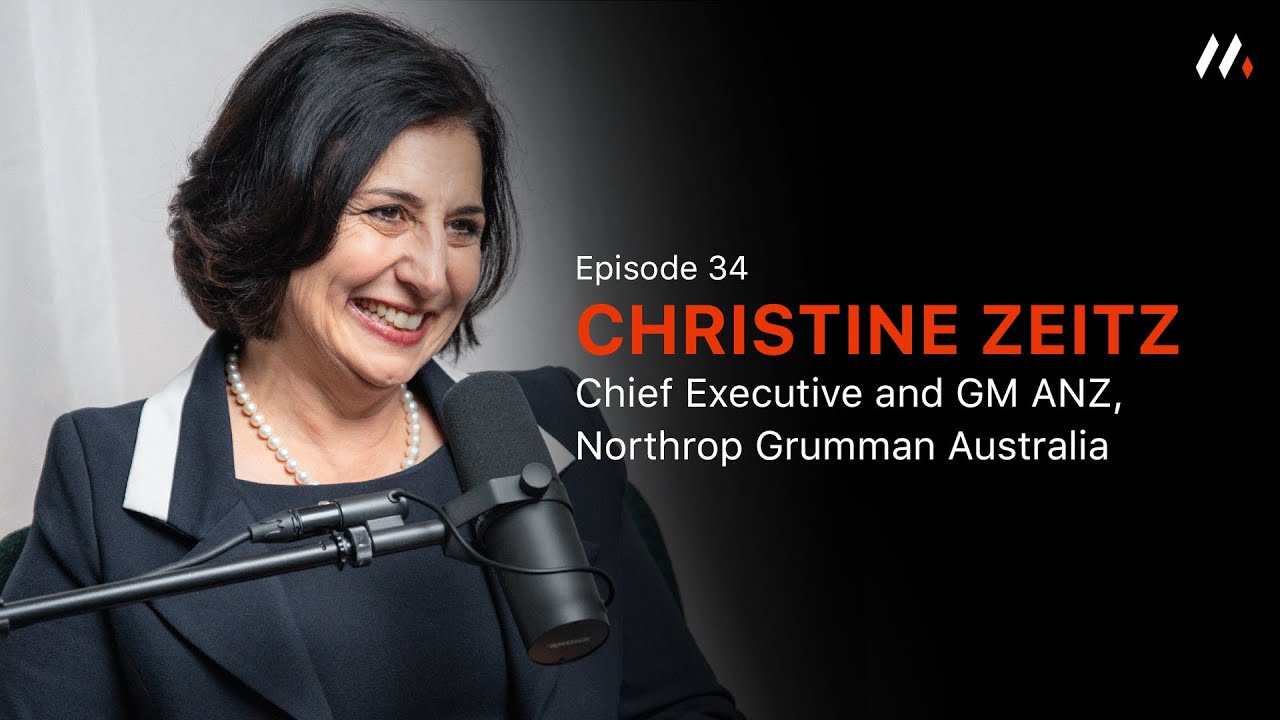
Christine Zeitz rose from graduate accountant to CEO at BAE Systems and Lockheed Martin in Australia's defence sector. She credits P&L responsibility as the proving ground for leadership and describes how female representation in defence grew from 10% to 20%. Zeitz now focuses on board roles and bringing gender-equity perspectives to organisations beyond defence.
Chapters
What we find in our industry, our standards are so high, so it costs a lot of money. So to make something, we have what we call military standard, not commercial standard. So everything has to be quality accredited to a high level. The components are normally to a higher resilience level. You know, the cybersecurity around every product is to a higher level.
Right.
So we're very used to building into our solutions this kind of multi-layer of security and complexity because we do protect people's lives. So if there is something that, you know, we need 17 different ways to qualify something because we have to absolutely ensure that it's fail-safe, because if it fails, someone will die.
So Christine Zietz, welcome to The Mentor List.
Thank you, nice to be here.
Well, it's great to have you here. I know you've got a conference tonight, so we've got you in between a meeting and a conference. So great to have you here in the studio and really looking forward to having you chairing our Adelaide Mastermind groups.
Thank you.
So, so welcome. So today's theme, it's a long one, dominating a male-dominated industry. And I'm looking forward to unpacking this because I think, is it 35 years in?
Yes.
In career, I guess. And yeah, rising through sort of BA Systems and then into Lockheed Martin, Leidos, and into your current role now, and soon to be sort of on to new endeavors sort of later in the year.
Yes, exciting.
So, um, you told me before that you knew you wanted to be the CEO, or you knew you wanted the top job. So tell me a little bit more about that and where this drive and purpose has come from, and how did you end up in such a male-dominated industry and dominating that, if you like?
Yeah, thanks, and it's great to be here. Look, it's interesting, I, I started, I actually fell into the defence sector through just chance, really, not really knowing what I wanted to do. And I had the opportunity for a job at what was called British Aerospace back 35 years ago.
Yeah.
And started as a graduate accountant, actually, into that business. So at that point, if someone asked me, are you passionate about security or defence, I would have thought, no, not really, no, no, you know, I wouldn't have really thought about it.
Yeah.
But having started in the industry and then starting to understand the capabilities that we were guiding the military, you know, getting more briefed into the security settings. You know, you get to have a top clearance and you understand a bit more about what's going on. You know, I now find myself a huge advocate for the prioritisation of securing our, you know, our region.
Yeah.
And the importance of our allies, such as the United States. So it's interesting seeing that that growth. But starting with Defence, I started to really get a job. And then as I started to work in the company, I always wanted to do my best and finish the job.
Yeah.
And have another challenge. I loved having more and more and more challenge. So I did get a little bit of knowing of the person that if there's a problem, give it to Christine. And with that challenge, I was then had the great opportunity, and I do believe this in terms of, you know, talking to people about their careers, I had the opportunity to zigzag. So I started in finance, I moved to pricing, which then led me to commercial, looking at all risk contracts, legal. And then I went across to procurement, and then I went across to government relations and communications and business development.
Yeah.
So I had this wonderful opportunity to move across the business. And then I think that's when I got the desire to, seeing all the pieces, to kind of be the integrator and pull it together and manage the business. And I really wanted to do that and, and then got my first P&L role. And then I felt like I was equipped to, to have a go at being the CEO of the company.
Because that, that's interesting, um, first P&L role, because I, I find in some of the mastermind sessions or podcast conversations like this, P&L roles are so important for upwards progression. So maybe if you could talk about that a bit more and why is it so important to have a P&L role than just a functional C-suite role or P&L responsibilities? And why does that make you more of a candidate for sort of bigger roles?
Yes. I mean, it is like I use the word integrator. It is really the, the pinnacle, it's the decision maker. It's, you know, for P&L you do need to decide all of the aspects. And so quite often, of course, you have a cross-functional team of experts that are all advising you from their expertise and their perspective. And as the P&L leader, you, you absolutely need to consider all of that advice and work out the prioritisation. And sometimes you make a call that one of the areas needs to prioritize over the other. That's with budgets, that's with, you know, activities, it's with challenges. So I do think the P&L role, and it gives you also the balance of, you know, obviously in a commercial sense, delivering a return. And that commercial balance of delivering a return and keeping your customer happy It is a delicate balance and one that really drives the company's results. And so I think the P&L role is really a very good foundation for then moving to the CEO role.
Right. And you mentioned before about, um, you know, doing these different moves, you're getting different clearance levels because that's a big sort of military thing, you know, it's above my pay grade.
Yes.
And there's certainly a shift now, you know, across corporates to be much more of a sharing of information and sort of stopping some using information as power. Has that played out in sort of defense military as well, or is that still very much a hierarchical, if you're at this level, you know this, and how is that sort of playing in? What are you seeing there?
I think it does. And, you know, we, I don't think we've quite got to the place of knowledge sharing, you know, knowledge management. And it's an area that I think would be great discussion for the Mentor List, you know, roundtables, because it's one of those that's logical around sharing information across not only your peers but up and down. The more knowledgeable the organisation is, one would think the more effective, the more empathetic one area is to the others. challenges, you know, all of those things make it, I think, make sense to share knowledge not only at hierarchical levels but up and down. But I find that it has been one of certainly my biggest challenges of how to actually enact that, and it often gets pulled down to being a tool. You know, the solution is someone talks about a collaborative— collaboration tool.
Yeah.
And that's, that's a mechanism for you know, for helping, um, do it. It's not the answer of how you actually change the human behaviour to, to, uh, have the discipline to share knowledge.
Yeah.
And so I think, uh, I think that's, that's interesting. In terms of the defence sense of, you know, needs-to-know basis, uh, we do get to that in a sense of some security settings that can't be public. You know, we call it classified. Classified, but we're able to talk in unclassified ways that give enough sense to the issue that we can act on it within the company. So I don't see that there is limitations on either in the security sense or, or the typical company sense. Uh, you know, I would always be an advocate for sharing as much across and up and down the business as you possibly can.
Well, because I guess you would have— I mean, obviously your clearance level would give you this privilege of the real awareness of threat.
Yes.
Um, and we're talking about, I guess, the head of ASIO coming out publicly talking on an issue.
Yes.
Which was quite a lot of sharing of information, which maybe is a different style. Or, um, yeah, so I mean, do you become— it's okay for me, I have no idea what's going on, so I'm in my happy place.
Yes.
But is that ignorant or like, you know, what do you sort of think about how much to share or this whole awareness of threat?
It's really tricky. And I do actually like the quote, ignorance is bliss, not because I think it's good to be ignorant, but I think it explains a lot. You know, it really is true. Ignorance is bliss 'cause you're not aware of what's going on. You can't worry about it.
That's true.
I think that, you know, the government has a very tricky balance to strike in sharing enough with the public such that they understand there is a threat and there is real activity going on in Australia at the moment. And we see most of it through the cyber threat that concerns, you know, the security of our infrastructure, the security of our IP, the security of our nation.
Yeah.
And if we don't talk about that, then when the government put forward you know, the $58 billion defence budget, you know, we won't get public support for it. So there's this balance of sharing enough information that they understand that this is really imperative that we do invest in these capabilities, but not to the point of, you know, people putting their, you know, cans of beans under there and money under their mattresses because they think it's all going to break down.
Yeah.
And the world's going to come to, to another, you know, major conflict across the You know, the whole of our world.
Yeah. So it's sort of, I mean, it's, it's, I'm sort of picking up on a counterintuitive sort of, if you're more effective in delivering what you're delivering and therefore we're having a better defense system which is capturing more and we're seeing less immediate threat, then, you know, my Joe Public is who I am, then I perceive, oh, we need to spend spend less on defence.
That's right.
Um, and therefore we should vote in the pollies who were going to support that. Oh, it's kind of like a reverse cycle. I mean, you've been in, in the business for 35 years. Have you, have you seen this sort of—
Yep.
Where it's sort of like a lag catch-up, whether—
yeah, we have seen a lag and a catch-up. And, and again, it's like anything, it's like being a CEO. You've got to prioritize your resources those issues, and it doesn't say that the NDIS is not important. There's some really big budget pullers there that are critical to the environment in Australia. So it is tricky, but I do feel like there is now bipartisan support for the commitment of expenditure to ensure that we are kept current.
Yeah.
So, so I don't see a great difference between the, the kind of ends of government, which is helpful for an industry that I'm in to, to assure ourselves that there's commitment politically. I think this pulls into the fact that we can't defend ourselves without our allies. And so the US is critically important. Britain's important. Japan's important. South Korea is important. So there's a, there's a greater web of, of engagement and commitment to this than just Australia.
Yes. Oh well, so that— so all this is playing out and this could impact your business model because—
Yes.
I naively— this whole conversation is going to be how naive I am, but, um, I naively thought, oh, okay, you're managing the P&L and you mentioned sort of keeping the customer happy, which I imagine the lion's share of that is the government. It is. being the customer. And I'm like, okay, well, that's a nice customer to have, so it must be pretty easy. But then I guess if the political landscape's obviously playing into that, that could really impact your top line P&L from a funding perspective or public sentiment into defence. Wow, okay, so that is—
Spot on, yes.
And sort of looking at that global shift. I mean, you know, if we— if China went and invaded Taiwan and then America put a trade sanction on, like, yeah. So is this the sort of things that you're looking at in scenario planning?
That's right, yes. And it's— I mean, that's certainly my world. And, and, you know, I suspect— I assume when I talk to colleagues, I hear that whatever sector you're in, there's those what we call environmental landscape issues, you know. And as you're deriving your strategy You know, the CEO needs to understand all of those aspects to paint the environment you're operating in, the threats, the challenges. You know, I'm a huge fan of the 7S model and kind of positioning where we are as a business. Then I'm a huge fan of a very basic SWOT analysis.
Yeah.
And then, you know, a fan of pulling the opportunities and threats forward to create your priorities. And I quite like McKinsey's 3 Horizon framework to, uh, to map out, you know, how we're going to get to where we need to be. But, you know, that's my landscape, defence, and they're the triggers for that. But I would presume that, you know, most CEOs and CXOs are dealing with understanding their landscape.
Yeah, yeah. And, and speaking of the landscape, you mentioned when you started, there was 10% female representation within industry. The good news is that it's doubled to now being 20%, but obviously still, you know, a way away from what the public representation is. So maybe just to get your perspective on that and, you know, how did you navigate through that to end up, I guess, running some of the larger companies or bodies within that?
Yeah, no, it was interesting. I mean, I think a case, I think for me it was quite helpful starting in this industry. So I never knew any different.
Right.
I worked for and with men when I started. And so it became the norm a bit. I will tell you that I am quite an AFL, I don't know, diehard.
Tragic.
Tragic. Port Adelaide is my team.
Oh, great.
It actually has been a currency that's been helpful to me because as I deal with men, most actually men, especially in the military, get posted. And they, even if they're from born in Brisbane, they might've been posted to Adelaide. So they've been in the football world. So I often use that as a currency of conversation and it's very authentic for me.
Mm-hmm.
So it's not as if I'm talking about, you know, do you go fishing or golf on the weekend? I actually quite like fishing, but golf, is not my thing. So I think having an authentic conversation point to have with men has been good for me. Funnily enough, that was so well known across and kind of resided across people I met that it got back to the chair of Port Adelaide and I was offered a position on the board.
Wow.
So that was quite interesting, which I did take up. But look, I think, Having currency with talking with men, it was a bit of a norm for me. I actually became very comfortable. And if I walked into a room with tables and tables of women, I felt very uncomfortable. So that was quite interesting.
Where would you experience that? It's like a CEW event or something?
Yes, exactly. Exactly. And so that's really interesting to me growing up in this environment. But in the end, you know, we talk about quotas, we talk about merit, you know, when we talk about diversity and gender equality, which I'm quite interested in and done a lot of research in. And I think it's a bit of both. You know, the merit is you need to have merit, you need to be able to do your job well.
Yeah.
But for— I think for all people going through the organisation, they have to understand influence. You know, and, and there's a model I like called PIE— performance, impact, exposure. And the research is that 10% of career progression is through the P, the performance. 90% is through the impact and exposure. So if you're burrowing away in the corner doing a brilliant job, yep, and no one's seeing you, and, and, you know, you're not getting yourself out there, then you're probably going to keep burrowing away in the corner.
Yep.
Now that advice is for any gender. For women, it helps very much to be very conscious of getting out and the exposure and the impact. And so I did that. And this is where I'll say that there's actually a real benefit of being the only woman in the room, which I often was for very many years.
Yeah.
Everyone remembers you.
Right.
I go to a conference and the next people come up to me and say, hello, Christine. And I think, oh my God, is that David, John, Bill, Philip? I can't remember, but they remember me. And of that impact exposure, so I naturally have the gift of standing out.
Right.
So there's a benefit actually. So it's a bit this balance of taking what's good And then the challenging bit, which sometimes you feel quite alone. I remember a work trip I did when in my late 20s to Indonesia. I think there was 35 of us, Indonesians, British, and Australians, and I was the only woman.
Oh my gosh.
And the men chose to go to a very shabby bar and drink pints after work. And I felt extremely out of place. Probably talked about football for a bit and then ran out of anything else to, Yeah. To say. So there's been times where it's been quite confronting and lonely. And then what I would say, and again, probably for any person, it's the support you have around you that's so important. Male and female mentors that have helped me through. And then back to this subject of Mentor List, you know, the great benefit is building a peer group that you can actually lean on. when you do feel quite alone, whether it's because of, you know, being the minority or whether it's just being thought, thinking something completely different from everyone else.
Yeah.
But I think that support, you know, is really critical. But look, I like to say, you know, being a CEO at the moment, the top 20 defence companies in Australia, all of the all of the leaders were men until about 6 ago, 6 months ago, where the Boeing Australian MD was appointed, Amy, a woman. So that was nice to see. But look, my management team is 60% women, so I do think there's something there, something there about bias, because no other executive team in the defense industry has more than 20% women.
Right.
But I seem to have found them to have 60% women.
Yes.
So there's an alignment there of, you know, is that just weird chance or is that just, you know, trying a bit harder?
And that was why I was asking you before about the importance of the P&L responsibility. And we see it through our C-suite mastermind groups. We've pretty much got 50/50 parity, which is fantastic. If, and we've never done this exercise, you could do it within that cohort or within corporate Australia, but if you look at the gender with P&L responsibility, it's still quite male dominated.
Yes.
And these are the roles that then lead into the CEO role. And so finding that sort of C-suite level, it might be the CFO, CMO, CPO, the functional roles that, can be, you know, ambidextrous, women, woman, male, doesn't really matter. But the chief operating officer or the P&L responsibility roles are still quite heavily male dominated. And yeah, just wondered how you were drawn into that, or was that sort of consciously you knew you had to get the P&L responsibility 'cause that was the tick? And is that still the case now?
I think it is. And I was very conscious of that and I was looking for the opportunity to, to do that role, to move into— now I'm sure there's examples where a CEO has been appointed from not the P&L.
Yes.
So I don't wish to make statements that are blanket, but I think often, you know, it does feed from a P&L role. And so the opportunity to move to different functional roles and to broaden the perspective I think really is important for someone who has their eye cast on the CEO role. And there does get to be, I think, a time when it's a little late. You know, if you don't invest in that some earlier on, you might be— it's harder to broaden your—
Yeah.
Your expertise when you're very senior in a functional role. It may mean that you need to step backwards. And that's always very difficult.
I bet. I bet. Okay, so another thing about your industry is it's very, I'd call it a very serious industry, you know?
Yes.
So if you don't rock up to work, then we don't have defence and there's gonna be consequences. So, you know, and you're a public profile and I imagine there's an expectation that you hop up and you are serious and you talk about the results and you talk about the threats in a way that doesn't alarm but gives enough. So it's very considered. So, I mean, is that, how does that sort of contrast to, you know, maybe your personal life? And then how have you been able to develop that seriousness? And then how do you switch off? It's a lot of questions all in one.
That's true, really. And actually that's a really interesting question that I've not been asked before. So it's a really great, it's a really great question. And you're right, it is very serious. And what we find in our industry is, again, being in it all my life, is you get used to it. Our standards are so high, so it costs a lot of money. So to make something, we have what we call military standard, not commercial standard. So everything has to be quality accredited to a higher level. The components are normally to a higher resilience level. You know, the cybersecurity around every product is to a higher level.
Right.
So we're very used to building into our solutions this kind of multi-layer of security and complexity because we do protect people's lives. So if there is something that, you know, we need 17 different ways to qualify something because we have to absolutely ensure that it's failsafe, because if it fails, someone will die.
Yeah.
So that is extremely serious. But actually I've never been asked the question, how do you pull out of that and kind of, you know, have—
Do you overextend socially and like you're the life of the party or like—
And maybe that's what happened because I've actually, my husband is a very funny person and a very creative person and someone completely different to my world. And I think that has been a tremendous balance. And I'm— one of the skills that I do have, and I'm not quite sure why I have it, is I can leave work behind and turn around and go into my family or a social occasion in a flick of a, you know, hang up a call and then I'm into a different social. And I'm really comfortable with compartmentalising that. I don't bring it with me.
Right.
I don't really know why, but it's a skill that I've had. It's helped me a lot with the family and has helped me have a very high pace of work, but then enabled me to continue on with my social side.
Yep, yep.
So, but interestingly, as I say, I've never been asked that question, but I do think in reflection that there is something about the lightness of my personality personal life that probably does balance off that serious side of work.
Yeah, well, and soon you'll be all one-sided because I hear sort of you're finishing up in your current CEO role. So yeah, what's sort of the, what other male-dominated industry can you dominate or what are you dominating next?
Well, it's interesting. I'm very keen to, Yes, I finish on the 30th of September 2024, and so I am really interested in picking up my board roles, non-executive board roles. And I have had some discussions, and I suspect that I'll have, you know, some of my portfolio will be defence and security, which I feel very comfortable with.
Yeah.
And I feel actually quite passionate about some of them because I do want to continue to support the security of Australia. So that's privilege. And the other part of my portfolio, I am looking to broaden into different areas. I'm currently the Deputy Chair of SBS, the public broadcaster, which is a very different world, and I enjoy that. And so to pick up a couple of others on, you know, non-defence will be good.
Yeah.
But I do feel like I will bring with me the gender equity side, you know, I will be interested and, and really looking to think about that for the organisations that I join. Yeah. And have a, you know, have an impact. I'd like to continue to do that.
It sounds like, and this is just replaying back sort of this conversation, but it's almost like you leverage some part of your experience into a new experience which has elements of what you've experienced, like the football board role, for example.
Yes.
But knowing you love football, and so there was that, and being, I guess, a leader in a male-dominated industry in a town running one of the biggest companies, you know, within Adelaide. And so being able to leverage that, then you're into the board role. And yeah, the SBS ones are interesting. It was that leveraging board experience and then how did that one come about?
Well, that was interesting because actually what attracted me to SBS was my heritage of Greek and being different. So growing up at school, really into university, I was always asked where I was from, even though my parents were born in Adelaide. So it struck me, and as I grew older, I kind of got it. But when I was younger, I used to get quite frustrated. Why am I being asked where I'm from? From Adelaide, you know, I was born here, my parents were born here. Where are you from? You know, so it was quite an interesting growing up.
Yeah.
Being a bit different. And so when the board role for SBS came up, I had someone call me and ask me if I was interested. And I actually really was, you know, I really love the service that SBS provides for the multicultural Australia. And a lot of the, you know, we have 68 radio stations in language. And the way that helps all of those different cultures kind of fit into Australia. I did have some kind of empathy with being the person from somewhere else.
Yeah.
So funnily enough, SBS kind of fits into my world in that way.
Yes.
And I've just become to, you know, enjoy that and learn more about it in terms of other, you know, nationalities across Australia. So I do love it.
And I guess, you know, we were talking before we started recording and we're talking about role models or, you know, being able to see Yes. Role models. And, you know, in some ways you've been a trailblazer. So where did you draw your role models from if they weren't so obvious?
Yeah, it's interesting. And I, I, um, for business, I really, you know, my father ran a business. A lot of, again, the culture of Greeks in Adelaide, a lot of them ran businesses. So I, I always was attracted to running a business. When it started to, you know, be apparent that there weren't a lot of women running businesses, you know, I did kind of need to find my way. But interestingly, in the US, Lockheed Martin, who's the largest defence company in the world, appointed a woman to be CEO.
Mm-hmm.
And that was, that was, probably a few years before I became a CEO. And that was really interesting to me. So I did watch that with great interest. And then BA Systems, the UK global CEO was a man, but they appointed a woman in to be CEO in the US. So it did become easier, I think, once I saw women Operating at that level, you know, being extremely professional and, and being extremely effective gave me more confidence to, to get on and do it.
And you mentioned before you had both male and female mentors. How did you find, I guess, each side? And was it a mix, or how do you seek out your mentors? Is it for a time and season, or—
Yeah.
How have you done that and has that really helped you?
Yeah, also, oh, it's, it's something that I, you know, really encourage people to, to think through. You know, I've, I've had— and they're ex-bosses, okay, you know, people that know me, um, some family, people that I've met along the way. You know, I've met some fabulous women. We talk about CEW, uh, is a, is a group. IWF, International Women's Forum, is a group. And so just forming relationships across to various women and men, what I find is when I, when I come up against a challenge, I'll actually think through the wonderful people that I have in my network and I'll call upon that particular person for the particular time. It might be a man, it might be a woman.
Yeah.
You know, to just talk through and help me through. So I'm a huge advocate of mentorship and, and it can even be peers, you know, in terms of mentoring.
Yeah.
And so, so I have done that. And even this time of moving from chief executive to non-executive board roles, I've reached out to a couple of people I know, mentors that are experienced ASX board members, actually, funnily enough, both women. and sought advice from them and they've been fabulous.
'Cause that's sort of a decision now. Like it's not just, okay, I'm going down an NED path, but sitting on a listed board versus sitting on a private advisory board is obviously very different.
Yes.
To consideration. So interesting that you're getting, yeah, feedback from 2 that are sitting on ASX listed. Do you have like a bit of a compass or a guide around, you know, what you won't, you know, some execs say, I won't work in tobacco or gambling and, or, you know, I'm open to all the opportunities. I'd have to work in that industry 'cause they need all my help or—
Yeah, it's interesting, isn't it? And I do think I mentioned before, I will definitely do some in defence and some non-defence. You know, I do think I have the opportunity to work in a sector or company that I really believe in. I'm not sure I'll work in a sector that needs my help that I'm not really passionate to believe in it. Yes.
No, it makes sense.
Yeah.
Makes sense. Yeah. And one thing, like, so moving into the NED role, how have you found that? So you're not technically, you're not on the tools anymore. You're not the chief exec. So how have you found that transition? Has it been easy? Has it been difficult to not stand into the space?
It was a bit challenging. My first board role was Flinders University, which is my alumni, right? And I joined that probably 12 years ago, 13 years ago now. The, the chancellor of Flinders University was the ex-CEO of Santos, right? So a very commercial person. And, uh, I learned a lot from that chair as to that what he had to learn was he's not the CEO anymore, he's the chancellor or the chair. And so it did take some biting my tongue and a style of questioning which isn't more like chasing up a person on what they should be doing because I would be doing it as the CEO.
Right.
To more, appropriate questioning of which you'd expect from a board member.
Yeah.
So it is different and it has taken some learning and experience to position myself. I hope I'm there now. I've had, you know, over 10 years of, of experience with that.
Yeah.
But there is a difference. And I do feel like being a CEO, I have some affinity with the leader of the organization because being a practicing CEO, I have an understanding of, you know, sometimes in the boardroom an issue can be raised and you're only seeing the tip of the iceberg. And then all the board members can be having a discussion about that with not really understanding the bottom. And the poor old CEO is trying to say, well, hang on, don't react to this bit. You know, there's all this going on underneath the bottom of the ocean. And, you know, you're just seeing the tip of the iceberg. And I feel like, well, I hope that I can help the context in the room when I see the CEO getting a bit worried that there's going to be a reaction to perhaps a little bit of information when there's a lot more. So I hope that I do that. And as I go on and finish being a CEO, I need to remember that that's the case.
Well, and it's hard because, I mean, depending what your board cadence is, but And I know, you know, there's a lot of accountability that you're accountable for everything that goes on in the business. But the reality is you get your board pack and you'll get, have your sessions and it's only so much you can really know what's going on in a business. Yeah, but I'm sure the CEO will be looking for you because you've had that lived experience as a CEO and know how dynamic a board can be. Yes, yes.
And how people can kind of get alarmed at perhaps a comment and kind of that spins off an activity and you think, hang on, hang on, let's just consider whether that's a real issue or not.
Yes. So moving into short questions. So just a favorite quote, is there? And maybe more importantly, why that one sort of stuck with you?
Yes, I do like the, you can't be what you can't see. And that was Marion Wright, I think, Elderman, who was an African American woman. And I do feel that people even, you know, I went to Garma Festival as the Deputy Chair of SBS.
Yeah, what's that?
That's Indigenous Festival in East Arnhem Land in Northern Territory.
Fantastic.
And it was quite extraordinary to be there and to, you know, I don't intermix with a lot of Indigenous First Nations people in Adelaide. And so being on their country and hearing their stories and hearing their leaders. It was really amazing.
Mmm.
And at nighttime they had First Nations people playing in bands. And along the front of the— just out of the stage they had chairs. All these gorgeous little kids were grabbing chairs and standing on the chairs and leaning over the stage. And they were looking up starry-eyed at these rock and roll stars. And I thought how interesting these little Indigenous kids see, you know, you can't be what you can't see. It's so easy for them now 'cause they would've seen it and they would've thought, well, I can play the drums like him. I can be in a band like him. Whereas, you know, if you don't see it and you can't, you just don't know you can do it.
Yes.
So that really came to me when I was watching these gorgeous kids lined up in front of the stage. But I think that really, matters across many areas.
Yeah, and back to sort of what we were talking about before, being sort of pioneering in your industry, it was great that you at least had some international rock stars on the stage to keep that scenario going. And great that, you know, you've been able to be a role model for, you mentioned someone, was it BA, the new MD of Boeing is now a female?
Yes, yes.
So was that part of, oh, finally I can hang up the boots and be the role model? It's actually quite good, isn't it, that there's someone else And hopefully, yeah, maybe you're up on stage for her, I would imagine. So you may have covered this already, but just any advice for your former self or any advice for someone that is in a— do find themselves a minority in an industry or feel like a bit of an outsider, how they can— sorry, I'm sort of guiding you into the advice.
Yes, yes, yes, yeah.
If that was where you wanted to take it.
No, look, I think it took me a while to realise I could, lean on people to help. I'd leant on my partner, then husband, and my, you know, really dear friend that knew me since school. I could have leaned on more people. I could have expanded my network earlier. And so I think to my former self, I would have encouraged me to do that probably 10 years earlier than I did.
And what does that look like when you say leaning on your network, or like, what, uh, what, what does that mean? What are you doing?
Yeah, so when, when I, uh, I remember there was a time, probably, uh, probably 15 years into my career, and I thought I might change jobs. And then I realized that I didn't know anyone outside of Defence, and it would be quite hard. I had no reputation outside of Defence.
Yeah.
And I decided to network. And I went to a Cedar conference and I actually met Carlene Maywald, who was a Minister for Water for the South Australian Government. She's now a friend of mine.
Yeah.
And I was determined to talk to people on my table and, and then perhaps ask for a coffee. And I did that with Carlene and we had a coffee and I started to do that more and more and build up a You know, some people you have a coffee with and it was tremendous exchange and that was great. And some you have a coffee with and you think, gosh, you know, let's have another coffee.
Right.
Or gee, now that I have a broader network, I say, you have to meet this person.
Right.
You know, and I didn't really know about that, you know, how to do that or the worth of that. And I think probably 10 years later than I could have Yeah.
And so is that something you can be deliberate with or do you need to have the coffee and have no agenda? Like how does it, how I imagine it, how do you sort of manage that dynamic?
Yeah, I think it's the latter. I think it's have the coffee with no agenda. And we're all people. So we either, you know, connect on some level or not. And I think a lot of the times I connected with people, male or female, on different levels.
Yep.
And kept a relationship going from that. And so, you know, that was watching other people. And then there was a woman in Melbourne that I think is the most extraordinary networker who brings people together. And I actually, really gives me joy now when I can connect people For the benefit of them.
Yeah.
You know, talk to someone and say, you'd be really good if you met this person who can help you with that. And I think that's a real gift and I love doing that now.
Yeah. And you can open that door and the door will be open because you've recommended that they meet. Fantastic. Okay. Thank you for sharing that. And just any books or reading, you mentioned actually quite a few great sort of models there, but Any books that you'd recommend people pick up and all that's been impactful for you?
I really love, and even though it says Don't Be Too Polite, Girls, it's Wendy McCarthy. I don't think that's a book just for women. I think it's a fabulous story of a woman who has trailblazed and made some incredible impacts to the way we live and the way she's carried herself. I think that's a fantastic book. I do like reading, I like reading fiction.
Yeah.
And then I like reading nonfiction.
Okay.
And I especially like reading people's stories. So Gail Kelly's book was really good. From the mentor list, Kevin Hartzner's—
Oh yes.
5 Points of Leadership. So I really enjoy a lot of those, but Wendy McCarthy sticks out for me. as a really important book to show the impact you can make, but also how she's alive. She's, she's still, you know, working in the, in the non-executive director roles. But when you think about it, when she was in her younger years, she was fighting for women to have contraceptive.
Right.
And you think, really, in our lifetime? And then it brings it back that we've kind of really, you know, how do you change the fundamental culture of the country you live in? So I think it's a really terrific example of that.
Which isn't that long ago, which is quite scary when you think about it. So whilst we're hard on ourselves that we're still not there, you know, obviously things are—
We've come a long way.
Yeah, and rightly so. Okay, great. Thank you for sharing that. We'll put some links to that book. There's probably 3 books there you've mentioned that we'll put links in the show notes. on the website. So now we're going to move into rapid fire. Oh my gosh. So sorry, I don't know if I should call it rapid fire when we're talking to someone that works in defence. For this, I'm just going to throw as many questions as I possibly can within 60 seconds, and the idea is just to answer A or B.
A or B, okay.
One or the other. So without the context, that's why, that's why it's kind of interesting, because it could be either, obviously. All right, ready to roll? Entrepreneurism or corporate leadership?
Corporate leadership.
Free market or government intervention?
Oh, free market.
Defense technology or aerospace innovation?
I'm not sure of the difference. Defense technology.
Coffee with a mentor or solo brainstorming session?
Coffee with a mentor any day of the week.
Breaking barriers or building new opportunities?
Breaking barriers.
Career milestone or personal achievement?
Hmm, personal achievement.
Stealth aircraft or spacecraft?
Stealth aircraft.
Breaking new ground or solving complex problem?
Solving complex problems.
First job lesson or current job challenge?
Current job challenge.
Beach vacation or mountain getaway?
Beach.
Biggest area of growth, cybersecurity solutions or aerospace systems?
Cyber.
Technology or physical?
Technology.
Defense or self-defense?
Defense.
I don't know if that makes sense, that question. Sunrise or sunset?
Oh, sunset.
You know, okay.
Definitely sunset.
I think we, uh, we put a few in, in there that didn't quite make sense, so that made it kind of interesting. Well, thanks, Christine, for your time today. I know you're jetting off to a— jetting off. I couldn't end the podcast without letting you know that you're responsible for that amazing jet in the Tom Cruise Top Gun movie, or your company, I should say. But it's been fascinating having you so generous with your experience. I mean, congratulations.
Thank you.
Rising to the top in an industry where obviously you're the trailblazer, you're the role model for women and men coming through now. So, so thank you. And looking forward to working with you in Adelaide with our execs joining the Mastermind. And thank you again.
Thank you, David. Yeah, great. Thank you.
More from David

2026 National Networking Event | Melbourne Grand Prix Featuring Guest Speaker, Molly Taylor



HR Connect Leadership Series | Peitta Dyball on culture, strategy & the evolving HR landscape

HR Connect Leadership Series | Elevating HR through community and mentorship





Uncover Neurodiversity: Empowering Hidden Strengths in Society and the Workplace w. Dr. Shae Wissell
