Creating a Culture of Excellence: Leadership Lessons from Kate Reid
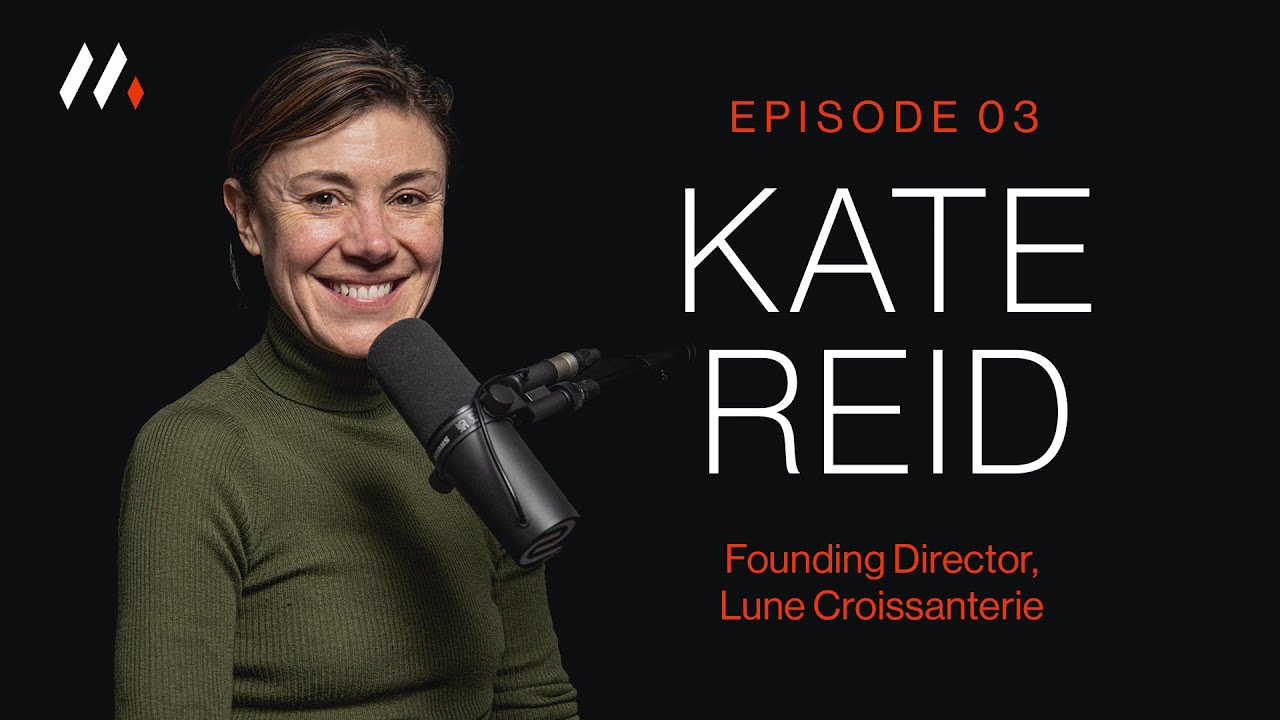
In this episode of The Mentor List, host Dave (joined by Alex) interviews Kate Reid, founder and CEO of Lune, a Melbourne‑based croissant bakery that has grown from a one‑person operation in 2012 to a 200‑staff, multi‑location business. Kate recounts her personal journey from hands‑on baker and aerospace engineer to visionary leader, describing how her early passion for making croissants evolved into a broader role overseeing strategy, culture, and growth. She explains how Lune’s core values—developed in 2018—are woven into recruitment, onboarding, and daily operations, and how this values‑first approach drives an unusually high employee retention rate in the hospitality sector. Specific HR innovations are highlighted, such as paying above award wages, offering generous maternity/paternity leave, and providing an Employee Assistance Program with funded psychologist sessions. Kate links her relentless focus on continuous improvement to her engineering background and Formula 1 experience, treating failures as learning opportunities and iterating on both product and processes. The conversation also covers the scaling of the business, delegation of operational tasks, promotion of internal talent into leadership roles, and the upcoming challenge of international expansion. Throughout, Kate shares personal reflections on her leadership style—becoming more patient, inspirational, and inclusive—and reveals her emerging passion for writing, including a forthcoming memoir and a recently published cookbook. The episode concludes with a rapid‑fire segment that offers quick insights into Kate’s preferences and motivations, underscoring her drive, love of speed, and commitment to ongoing growth.
Chapters
If you start cutting corners, it's a bit of a snowball effect. Every single system and process is up for scrutiny and critical analysis and improvement. Both of them, 3 months after quitting Lune and starting their new job, sent really beautifully worded emails saying, can I please have my job back? My leadership style is constantly evolving. Early on, I'm incredibly impatient. How can we improve the experience from a customer perspective? Probably from the instant they decide they want to even show up at Lune. There's not a long-scale timeframe. You have to work As hard as you can all the time to continue pushing it.
Hi, Dave here. Hope you're enjoying the show. Thank you for tuning in. If you like what you're hearing, you want to become part of the conversation, please just click the show note link and we'll connect there. Bye. All right, Kate, welcome to the show today. Welcome to The Mentor List. It's great to have you here. Thank you for having me. Great to have you on the podcast. I know we recently had you live at the Grand Prix in front of lots of our lucky members. So let's just get straight into it. First question is around sort of innovation and passion, being the founder and that sort of evolution from doer into manager and so on. Maybe if you could just maybe share some of your journey through those layers of management or leadership through Lune.
Well, I think the word that springs to mind is it's been incredibly challenging. Because from someone that started a business out of passion rather than maybe seeing a clear business opportunity, Yeah. I was deeply in love with the process of actually making the croissants and everything that was involved in the running of the business when it was just me, or even when it was sort of maybe 10 staff or less, and I was required daily on the tools to actually produce the croissants. I had a prep list. So I mean, I love a prep list when you start the day and you can work through it and cross it off. And at the end of the day, you can go home and it's not about writing emails or worrying about something that the boss has asked you. It's very doing and production rather than computer-based and vision-based.
Get that dopamine hit of ticking something off.
Yeah, it feels really good.
You've actually achieved and accomplished something.
Yeah, and I think coming from a corporate background as an engineer and working in an office where really your work is never done, I mean, you will clock off at, you know, in Formula 1 you'd clock off at, I don't know, 10 o'clock at night, but you'd know that when you turned your computer off there was unfinished tasks there that would be waiting for you in the morning.
Yeah.
But by the nature of a bakery, you have to bake X amount of products every day and finish them and present them. and then sell them. And at the end of the day when they're all sold, the work that you intended to do when you showed up at work is done. So it's, um, it's very goal-driven and based, and you can achieve those goals on a day-to-day basis. So as you said, there's that dopamine hit and the knowing that what you set out to achieve when you got to work in the morning was done, and you can go home and sleep well at night.
Yeah.
But also in the creation of Lune, I essentially created what was probably my perfect job for me. And it wasn't just about making the croissants, it was about the creation of the different pastries, it was about building the supplier relationships, building the customer relationships, the invoicing, the accounts, everything. It was a really diverse job that gave me satisfaction and creativity from all different angles of running a business. But I think going back to that passion piece, because I created something because it was something that I loved, other people cottoned on to that. And when you are exerting a positive energy about something, other people want to be around it, whether that's from a customer perspective or an employee perspective. And so I think Lune grew quite organically because not only was the demand far outweighing the supply that I could produce, but it was also something that other pastry chefs and eventually other entrepreneurs wanted to be involved with. And so organically the business has grown to meet the demand from both an employee and a customer perspective. And when the business starts to grow, you have to start handing off all those jobs that you loved doing that made you feel fulfilled and satisfied at the end of the day. And I mean, I sit here now, it's almost to the day, uh, Loon's 11th birthday.
Wow.
1st of June, 2012.
What's on your checklist?
Attend a podcast today.
Fantastic.
Yeah, like literally the to-do list apart from incredibly high-level things like maybe what international market will we attempt first? When is Sydney's opening date going to be? And then maybe, oh, I need to look into that collaboration with that brand that's reached out. Apart from that, The to-do list is very high level and very broad, but it's not something that you can tick off at the end of the day as a completed task.
Yeah.
So every single job that I used to love doing is now done by one of my nearly 200 staff and my 2 business partners that weren't with me at the start. So it's, the role has changed dramatically and it's gone through many evolutions and phases over the last 11 years. I've gone through the, oh, I've got to do recruitment now and I'm responsible for posting the SEEK job ads and conducting the interviews. And then we've hired someone and, oh, it's now my responsibility to be the trainer and to onboard this person.
Yeah.
And I mean, that wasn't my job at the start, but then for a period it was. And now that's not my job anymore because I have, you know, an HR coordinator and above her, a business development manager. And I've got, managers in every facet and department of Lune that do their own recruitment and onboarding and training. So it's not even my job now to write the process for onboarding. That's the business development manager. I just have to approve her process.
Yeah.
So I think going through the phase of the being everything to every single job and department of a business to managing those different sections to now being the leader that oversees the management of those sections. And I guess 11 years later, that's the seat that you find me in today.
Yeah.
Long answer to a question. Sorry. How long do we have?
Creating that vision, you know, creating that culture. Yeah, it's all part of it, I guess, now.
Yeah.
Yeah. How do you instill the culture? How do you ensure that it maintains and thrives?
Well, that's been something that I've had to learn over the last decade as well, and it's certainly not something that as a pretty new entrepreneur, like 11 years ago, I didn't understand how important that would be. And I mean, I think I've probably learned it through making a lot of mistakes over the years.
Mm-hmm.
And ultimately, in order for a business to succeed that is growing, You need to make sure that the people that you are hiring have the same values that you have and that therefore your business or your organization has. And typically the values that are instilled in an organization come from the person that founded it and that's what ensures that the business is successful in the end. So, I mean, a good example is recruitment. If you're not hiring people that share your values and therefore your business values, there's going to be a mismatch of employee to employer. And that's always resulted in that employee probably not working out at Lune.
Yeah.
I think someone who thinks that they can bring a better process than what they're doing or doesn't buy into it, they don't care about things like respecting other team members, positivity in the workplace. And I'm listing all of Lune's values at the moment. wanting growth within themselves and also within the business. If they don't believe in those values intrinsically, then they're not going to work out. So maybe, I think we developed the Lune values back in 2018. And once we developed them, we needed to figure out how to decision make considering the values and then also how to build those values into things like recruitment, onboarding and training. And once you've recruited someone that shares the values that you and your organization have, how do you then continue to build those values in day to day into the onboarding and training of that staff member and just constantly reiterating them that like, that they're just so important. I mean, I'm sure everyone listening out there is probably a CEO of an organization and intrinsically understands the importance of values as well.
Yeah, and I guess just from the listener's perspective, it does get a lot of airtime, the dynamic of a founder, whether they're still operational in the CEO capacity or whether they've sort of stepped aside, perhaps sitting on a board, but it is sort of, yeah, every dynamic's sort of different depending on the individual. So it's great to sort of hear your personal journey through that.
Yeah.
Just on the retention, That's also a big topic and has been over the last sort of 12 months in our various sessions. And we've got, for example, CEOs working in construction industry with sort of 40-plus percent turnover.
Yeah.
And even sort of some of the businesses operating above 50%. So that's very different to what's happening in your business. Maybe if you could share sort of what your attention is, or sorry, what your attrition rate is in terms of staff leaving. And why do you think it's so where it is today?
Look, I don't, to be completely honest, I don't have hard statistics on that in my head today. But I do know that we have an incredibly high retention rate. And that is opposite to the industry that Lune operates in. So hospitality typically has low retention rate. It's high turnover. People always think that they can get a better job out there. And it's typically because historically in the hospitality industry, conditions aren't very good. So people will jump at the opportunity of like grass is greener, you know, like trying somewhere else.
Yeah.
I would like to attribute, I think our retention is very much down to One individual who we hired back in 2016, and she was the first pastry chef that we had ever trained my unique raw technique in making the croissants.
Yeah.
Her name's Jane. And Jane joined us. She is an incredibly earnest, hardworking person who has always been deeply loyal and committed to Lune. In 2018, she went on maternity leave for 6 months and had always expressed that when she finished maternity leave, she wanted to come back and continue working for us. But at the time Jane went on maternity leave, she was managing, I think, probably a team of between 6 and 8 pastry chefs in the Cube, which is the glass room in Fitzroy, doing all the raw pastry.
Yeah.
And like, she worked up until, I think, a few days before she gave birth. Like, she was heavily pregnant working long hours a day. When she came back, she approached my brother and I, my business partner, and said, Lune is really important to me. I'm really committed to the business, but I would like to come back in a different capacity. I have no experience in human resources, but I've spotted a lot of ways from working in the business, how I think we can make Lune a preferred employer and how we can improve the employee experience. If you guys will give me the opportunity, I'd love to do some HR study, and then I'd like to take on a human resources role.
Mm-hmm.
And I think understanding when you put a lot of time and effort into not only the recruitment, but the training of someone in such a unique business like Lune, losing that embedded knowledge and experience in one employee can be damaging to the business growing and moving forward. And Jane had expressed to us how important it was that she stay at Lune and that we hold on to her experience, but we use it in a different facet in the organization. So we very happily agreed to take this journey with Jane and retrain her in human resources.
Yeah.
And I think putting somebody in an organizational role and out of an operational or a production-based role, we got all her experience from working within that side of the organization and how it could be improved. I think going along this journey with Jane, a lot of changes have been made that really have separated Lune from a lot of other businesses within the hospitality industry. So I think pretty quickly we realized that operating above award rates for the hospitality industry was important to acknowledge the— the hard work and the hours and even like the things like working weekends. We started to introduce an EAP. So we partnered with a psychologist's rooms based near Lune in Fitzroy. And now confidentially, any staff member at Lune, if they're having any mental health issues, whether they happen to be outside of Lune and not related to work or within work, they can confidentially approach their manager or the human resources coordinator. And Lune pays for up to 3 sessions in a 12-month period. And then we support our staff member in getting onto the mental healthcare program. So for ongoing, ongoing support with a psychologist, we've improved our maternity and paternity leave programs to be above the minimum of what's expected of a hospitality business from the government's perspective. We're just constantly adding small things that make working at Lune a greater experience. We've actually got a couple of examples of pastry chefs that handed in their notice because they'd been offered a job working at another bakery within the inner Melbourne area. And both of them, 3 months after quitting Lune and starting their new job, sent really beautifully worded emails saying, I didn't realize how good I had it at Lune, can I please have my job back? And I think not only— having good retention, but having staff that think it might be better somewhere else and realize what a dog-eat-dog world it is out there in the hospitality industry and how well supported they are at Lune.
Did you let them back?
Absolutely. And they've been like, I think they probably came back more committed and more loyal than ever knowing how supportive the team was. I think we've also like, Jane is one example, but we now have, I think, examples of up to 5 employees working in our executive team that came from operational roles, whether that be on production, in back of house or front of house roles. Now, our general manager started as the front of house manager at Fitzroy. Our HR coordinator was a full-time pastry chef. And one of our HR assistants also came from, I think he started as a barista at Lune. And just to retain all that knowledge and experience of the organization, but be able to now communicate it, whether you're managing employees or you're managing direct communication with customers. It's— we've just— it's been critical to the success of the growth of Lune.
Yeah, I mean, that's, that's fantastic. And I guess that, you know, keeping that knowledge in the organization, and that's those small incremental improvements, you know, throughout the process, is, is actually reflective of how you operate throughout the business as well, including the pastry making and Yeah, exactly. So yeah.
And I think, I mean, it's— I've spoken about it very in-depth publicly that the way we approach making the croissants at Lune is evolutionary. And each day we try to iterate, innovate, and improve the product. But that doesn't just go for the actual pastry, it's the customer experience. But then it goes deeper into that. It's the employee experience and the systems and processes that we use in every aspect that we run the business every single day. Everything that we do is up for improvement and iteration, and anybody can come forward to us with a suggestion on how they think it should be better. So everyone has the ability to impact and inform the future of the business.
Yeah, definitely living your values there.
Yeah, yeah.
That's fantastic.
Thank you.
Absolutely. And something you mentioned there is sort of, you know, against opposite to the industry norms, whether that's sort of the staff staying in the growing business and evolving through. But also, you know, just, I mean, I don't drive past other croissanteries. Is that the word? Croissant?
Croissanterie.
Croissanteries. Perfect.
Thanks.
I'm trying to say it how, or pronounce it how you were pronouncing it, with lines out the front. And I had the pleasure of you inviting me in. We got to skip the line. I'm not sure if I should share that, but Yeah, I mean, how do you, you know, when I think about lines and raving fans, I think about, you know, Grand Prix, but is there like parallels? How do you create such a hype and such a, and then I guess deliver on that, that people are back in the lines and having that type of experience?
Well, I think it's interesting that you raise that because I've just come back from long service leave. And one of the first things my general manager said to me was, I've got a new project, Project Loon Line. And I instantly knew what he meant. Like, we have like the Russell Street store in Melbourne CBD, daily that can have up to 120, 130 people lined up, and that wait can be up to an hour and a half.
Yeah.
But the line is constant. It's not like— and it's often repeat customers coming back. So it means that once they get to the front of the line, we're doing something right, whether it be the customer service or the pastries or the coffee. And hopefully it's all of it. But there's opportunity to engage with those people for the up to hour or hour and a half that they're standing in the line. So even my general manager is thinking about how can we improve the experience for that wait period. And it's not just taking for granted that people are willing to stand. They're out in the cold or the sun or the rain or whatever. They're willing to stand there for that period of time to have that experience. So how can we engage with them and make that experience of standing there better? And I think we never take for granted that there's going to be a line. And I think that keeps us grounded and humble in the business too, that we always feel so grateful that people are willing to stand and wait for the experience of coming to Lune and therefore—
Mm-hmm.
That customer that's standing at the end of the line is just as important as the, probably even more important than the one that's standing at the point of sale ready to pay. So it's constant gratitude for that continued support, but how can we improve the experience from a customer perspective, probably from the instant they decide they want to even show up at Lune? Did that answer the question? I think it did. Did I skirt around it or?
Well, I think it just goes back to locking in this continual innovation, continual thinking. We've got people in line, how can we make that an experience and how can we make it, what's the feelings that they're going through? So I think it brings back to your grounding around this continual innovation. Didn't quite give us a secret sauce on how you do it, but I think maybe that is what it actually is.
It's I don't think there is a secret sauce. I think like just like how we make the croissants where we don't cut corners on anything because unless the efficiency doesn't affect the quality of the end product.
Yeah.
If you start cutting corners, it's a bit of a snowball effect. If you allow yourself to be lenient on one thing, then where do you stop? So just the way we approach making the croissants, we also approach the running of the business. As I said, every single system and process is up for scrutiny and critical analysis and improvement and not resting on our laurels and assuming that what we're doing is the best, but that we could always be better. That's the secret sauce, just knowing that you can always be better and always pushing to be better. It's just commitment and hard work and determination.
Sorry, Alex, I've got to steal another question.
He's such a question stealer.
So I mean, Is this sort of going back to your time at Williams Formula 1 where you're in this cultural environment, you're doing ridiculous hours and there's these expectations around milliseconds on milliseconds for your, I think your area in aerodynamics. I mean, is that where you got that? Is it a style of thinking or is it a sort of a way of thinking?
Yeah.
Where did this come from? And it sounds like you've brought it in as the cultural ambassador or the founder.
Yep.
Is that where it came from?
I don't think it started with my experience of working in Formula 1. I think it probably like that was instilled in me throughout my engineering degree at RMIT. And I mean, aerospace is one of the most complex engineering degrees you can study. It's a—
Yeah.
Like based on the fact that it means that you can design a rocket and send it into space where, you know, it has to be millimeter perfect. or degree perfect. I think just that idea of constantly pushing and iterating to be better is something that's a very engineering mindset. And obviously that's taken to another level when you get to Formula 1 because, you know, if you're working on, say if I worked at an automotive manufacturer, you're working on a car that might be delivered 10 years from its inception as an idea.
Yeah.
But in Formula 1, you are essentially delivering an iterated version of the car every single race, which means that you constantly have to be pushing for it to be better and better. And there's, there's not a long-scale timeframe. You have to work as hard as you can all the time to continue pushing it. So yes, maybe that concept started during my, my studies, but it was certainly instilled in me throughout my time at Williams. Yeah.
Hey everyone, thanks so much for tuning in. If you're loving this podcast, please give us a 5-star review. So it sounds like with the constant experimentation and improvement, there's got to be obviously some failures along the way. So obviously creating an environment where that's fine and you're testing these things obviously matters as well.
So what's— I obviously the word failure is a word, but it's— I prefer to look at failures as an engineer as an opportunity to learn. And I think that's maybe one of the things that, that wasn't happening for me when I worked in F1. If something did fail, we just discarded it. But for me, something that's a failure is actually just something that didn't turn out the way you expected or hoped that it would turn out. But there's always a lesson to be learned from that. And at Lune, we've had many things that we've tried that didn't work out the way we expected. But there's always a learning or There's something that you can take from that that you can move forward with. So I prefer to take a failure as like, okay, well, like, let's understand why it didn't turn out the way we expected it would. And sometimes you get something better out of a failure than you would if it had just worked out in the first place. You certainly understand it better.
Yeah, absolutely. The hard lessons are the best, right?
Yeah, absolutely.
So, Kate, If you had to describe your leadership style, what sort of 3 points would you want to highlight?
I think my leadership style is constantly evolving, firstly, especially learning how people respond well. I think early on, without trying, I think it was somewhat fear-based. Can you stop with the croissant? I'm incredibly impatient. And if I— if you were to come and work for me at Lune and I was the one responsible for training you in how to roll a croissant, if I explained it to you, I would expect you to understand first time. And if you didn't get it right, I would feel incredibly frustrated that I had told you how to do it and you couldn't do it. Bless my brother, he— patient in his own way. He was the one that taught me that if you are training something to someone or teaching them something, if they don't understand it, it's not their failing that they haven't understood. It's actually that you haven't explained it to them in a way that got through to them, and you need to try and find a different angle. So that's been a lesson that's taken me a little while to learn over the last decade or so, but I think I am getting better at it. I think I'm more patient and I'm understanding that everybody learns in different ways. I think, I hope that my team would describe me as an inspirational leader, an inclusive leader that makes people feel part of what I'm doing. So inspirational, inclusive, and... innovative, I think. I'm definitely, from a leadership perspective, I'm definitely within the 3 directors at Lune, I would probably call myself the creative one, less the executional one, maybe.
Okay.
That was much more than 3 words.
That was pretty good, that's all right. Let's get an explanation.
So just on that sort of theme of creativity, Kate, I can tell you've got the sort of, and bearing in mind you're a rocket scientist, so having that sort of analytical mindset or thriving on a complex issue or challenge to solve, I mean, are they sort of chalk and cheese? 'Cause you tend to sort of switch between both quite well. So what's your approach to creativity.
But I don't think they are chalk and cheese. Like, imagine you're an aerospace engineer working for NASA in the '60s and you've been given the directive by JFK that you're going to land on the moon by 1970. I mean, you have to be a pretty damn creative engineer to figure out how to do something that's never been done before and you don't even know if it's possible. So creativity takes many forms. I mean, I'm probably hopeless with a paintbrush. I wouldn't call myself artistic in that aspect. I think that I'm— I understand how to use the creative word well to describe something. And I think it's probably a little-known fact that up until very recently, I was the sole content creator on the Lune Instagram. So every post that went up, I had written all the content for.
Wow.
And I responded to all the comments and all the direct messages, but It got a bit challenging for my mental health. So now I've got one of my beautiful admin assistants that helps me out a lot with that.
Great.
But yeah, creativity can dance between being creative on something that requires an analytical brain and also creative more in that classic sense of how we would talk about it probably from an artistic side. But for me, the two have to come hand in hand.
Yep. So I guess making, so the creation of the croissant, is this a science or is it an art?
It's both.
Okay.
Yeah, absolutely.
So it's back to your, you're not, yeah, you're not sort of choosing one or the other, but you can see it as sort of, is it?
Well, I think that's probably why I chose a baked product or pastry over like classic, cuisine. Yeah, like, you know, savory cooking. Because I think in savory cooking you can be a— have a little bit more creative flair that, you know, if you're— for example, if you're making a pasta, you taste it as you're going and you maybe want to balance out.
Chef's kiss.
Yeah, exactly. Or you want to add acidity or salt or sweetness or texture, and that can evolve as you're making it. But with a baked good, you You rely on how those ingredients interact with each other and affect each other. And you can't just mess around with the croissant dough when you're making it because there's science behind the bringing of it together. But then you can be creative in, like for example, the technique we use to create the layers in the pastry is unique to Lune. And that's something that I evolved through experimentation and testing. We can get really creative with how we use that finalised pastry to add in different flavours and textures to change the, like, the end eating experience. But ultimately, until you deeply understand how using those ingredients and how they interact with each other, how that works, you can't start to be creative with it. You've got to have a deep scientific understanding of it first.
Got it. Okay, well, yeah, thank you for sharing that. I think we're probably going to move into some more rapid-fire questions, or not quite rapid-fire, but maybe Alex, do you wanna kick us off with the first 5 and 5?
You can do that, yeah. Actually, I have one question before we started, which was, Kate, along your journey, what have you really learned about yourself through F1, through owning a business, and through becoming the chef to now the leader?
Hmm, what have I learned about myself? That I constantly need to be challenged and stimulated. And when I start to get comfortable in something or if I find that it's not giving me what I need, I probably become quite agitated knowing that I don't have something that fulfills my soul. And like it's— up until starting Lune, I don't think I'd ever held a job for maybe more than—
2 years.
18 months. And so for me to have stuck out Lune for 11 years shows that I've really found something that continues to challenge me in different ways. And probably going back to the early questions, talking about how my role has evolved over the last 11 years, potentially if I'd never grown Lune and just kept it as a small one-woman business, I don't think it would have lasted 11 years because I think that—
Yeah.
That initial stimulation would have become mundane routine to me and probably I'd have needed the business to evolve to continue to be really engaged in it.
Yeah.
And what a great sort of business to be involved in. So much organic growth in terms of day one managing yourself to now 200 great staff.
And more big challenges to come.
Yeah.
And now you're thinking international. Yeah, plenty of growth. You're obviously very growth-minded.
Yeah. Well, it's one of our 5 values, so yeah.
Good. All right, so just on that sort of, let's jump into some quick questions, see if we can catch you off guard.
Is this where you hook me up to the lie detector?
Lie detector, yeah. Excellent. Kate, did you have a favorite quote?
I do have a favorite quote actually. It's, I read it in a Bill Bryson book, If you're skating on thin ice, you may as well tap dance. And I think it does sum up, while I can be quite calculating and there's that analytical side of me, I am incredibly spontaneous as well. And I think for me, that saying means if you're gonna try something, don't just dip your toe in the water. Like, you may as well go full pelt and see what happens. So yeah.
Awesome, I like that. You just mentioned that Bill Bryson book, but is there another book or something or an individual that you think has really been a big influence on you?
An individual that's been, I think from a, in hospitality, yes. It's actually one of Melbourne's and probably Australia's greatest restaurateurs, Andrew McConnell, who owns many of my favorite establishments in Melbourne. And I think while obviously Lune is growing and evolving as an individual experience, it always constantly amazes me that Andrew can continue to open up venues that have a completely different look and feel and cuisine and menu and experience. But at the bottom of it all, there's still that attention to detail, focus on the customer experience, doing it the best he possibly can. He is such a master at what he does and incredibly humble at the same time. And he's been a role model of mine probably since I returned to Melbourne in 2008 and first went to Cumulus, which is still one of my favorite restaurants.
Fantastic.
Nice. Kate, what's next on your bucket list?
I'm currently in the process of writing my memoir, which has been something that's been on the back burner for a number of years. I've been approached by several publishers And I've also had a couple of people approach me about essentially ghostwriting it.
Mm-hmm.
But I went through the process of writing the Lune Cookbook, which was published in November last year, and it reminded me of how much I love creative writing. So I'm dabbling on that in my spare time at the moment, and I feel like it'll be the project that goes for as long as I want it to. So hopefully my life isn't gonna end in the next few years, and if I wanna keep writing, I can keep writing. Thoroughly enjoying having that to tap in and out of.
That's an exciting project.
It's very exciting.
Yeah, it is. And it may even answer sort of this next question for you. So a passion or hobby that you're not known for?
Maybe it is writing. I think passion or hobby I'm not known for. Maybe the best answer to that question is I— it is physically impossible for me to have a hobby. Like, I loved Formula 1 when I was a little kid, and it couldn't just be a hobby that I turned the TV on and watched it every 2 weeks. It had to become my passion in my life. Uh, just like baking. I loved baking, and I couldn't just live with that being something that I did on the weekends or in the evenings. It had to become my everything. And typically, when I find something that just really pushes my buttons I'm consumed by it. I'm probably— I have a bit of an addictive personality, and therefore it means that I can't just have something that stays at hobby level.
Right.
And then speaking about the writing, maybe writing is the thing that has come the closest to being a hobby because it is just something that you can pick up whenever you want to. But right now I feel quite consumed by the process of writing, and every spare minute that I have— like even on the tram on the way here, I had an idea and I was tapping away in Notes on my phone Because I didn't want it to— I didn't want to forget it. So yeah, I don't think I can have hobbies. Oh, one hobby.
Yeah, I think so.
I really love driving. Well, yeah, I really, really love driving. And if I'm ever feeling anxious, if I jump in the car and go for a drive on a really windy road or even go go-karting, it's the one thing that I can get out of my head And just enjoy in the moment.
So is this like driving where you're like intensely sort of accelerating and cruising through these winding streets?
Well, I mean, where you're allowed to do that, yes. I mean, I'm not driving intensely through the streets of Fitzroy.
Oh, fantastic. So it's sort of that hyperfocus. So you're driving, you're driving fast, you're sort of, everything else can tune out and you're in that one zone.
Well, you have to tune out because yeah, if you're driving quickly, then you have to have your focus and attention on your surroundings.
So very cool, very much in the moment there. Exactly.
Yeah, I think people might think you're into that given your Formula 1.
It might not be the biggest surprise.
Exactly. But go-karting for the next offsite, that could be something.
Yeah, I like that.
Oh, can I come to that one?
We'll give you a handicap of a couple minutes or something. And just the next question, yeah, beginning or end? Where do you sort of see yourself in terms of You know, are you winding down or is this just the beginning? Where are you?
Winding down professionally or with Lune?
With Lune, professionally. Like, you know, you work so hard, you've done multiple career changes. Is it time now to, you know, relax? Or is it, no, actually there's a driving force that this is just getting started?
I feel like I'm just getting started. I'm 41 years old and I think as a professional, surely that decade is where you've earned a reputation and you've built a foundation for a career. And surely your 40s are where you can just really take it to the next level.
Yeah.
And we've done a lot of the hard work with Lune. It's hard to go— I think probably the hardest step is going from zero to nothing, turning like a seed of an idea into a viable business. But then once you've, like, once we had Fitzroy, the hardest step is opening a second store and figuring out how you're going to manage. You can't be in 2 places at once. So that's probably the next hardest step. And then we've already gone interstate, but I do feel like the next great challenge is going international. And that's a really, really big challenge.
Yeah.
That's focusing on a different demographic, a different market, different councils and, and Different red tape and so like different time zones, everything. And the prospect of that challenge just fills me with such excitement that hopefully the learning curve hasn't slowed down at all and that it's gonna keep filling me and making me grow.
Yeah, I can definitely see this growth. You're sort of slipping in the slipstream, that growth's there and you're just driving the company. So yeah, absolutely beginning for you.
I also think for someone that isn't really a hobby person, deciding that you're going to semi-retire at 41 isn't a great idea.
Yeah, I couldn't see that working.
Yeah, exactly.
All right, Alex, so time to turn it up a notch, mate.
Oh God.
This is rapid fire.
We'll be in a second, but do you have a favorite racing movie?
Senna.
Senna.
Yeah, I get emotional every time I watch it. And I mean, it's Oh, this is rapid fire and now I just started talking again.
He was teasing. But we were talking about what that would be. I thought it might be Bullet, which isn't really a car chase. But what was yours?
I thought it might have been Le Mans.
Oh, Le Mans is great as well. But I think I know Senna is a documentary style, but probably when I— the age I was when I really fell in love with Formula 1, he was at the height of his career and then obviously tragically passed away. But we're recording this podcast only a couple of days after the Monaco Grand Prix, and I still don't know who won. So I'd appreciate no spoilers.
No spoilers.
But watching the preamble in the lead-up to the Grand Prix and hearing Martin Brundle talk about how Senna is just the master of Monaco and no one's won it more times than him. And they spoke about one particular qualifying lap he did where he was 1.3 seconds faster than his teammate and 1.5 seconds faster than everyone else. And he had this out-of-body experience doing the lap. It's just he is— he transcends human in a car. And it's just hard not to be absolutely caught up in the magic of that man and what he did for Formula 1. So yeah, it's easily Senna.
Yeah.
Cool.
Well, thank you for sharing that. We'll put a link in the, in the show notes. So maybe we should explain what rapid fire is before we start firing away.
One answer.
There is no lie detector, but it's, yeah, whatever comes first to mind.
Okay, great.
And I'll put my alarm on so we keep this to a minute, and let's see if you can beat your PB, Alex, and how many questions you can get out. All right, 3, 2, 1.
Here we go, Kate. Cats or dogs?
Dogs.
Netflix or YouTube?
Netflix.
Calls or texts?
Texts.
Beach or snow?
Snow.
Home cooking or dining out?
Dining out.
Passenger or driver?
Driver.
Tea or coffee?
Coffee.
TV or book?
Both.
Okay. Beer or wine?
Wine.
Pineapple on pizza, yes or no?
Yes.
Electric or petrol?
Petrol.
Controversial.
That's it. Cash or card?
Card.
Apartment or house?
Apartment.
Formal or casual?
Casual.
Run or walk?
Walk.
Butter or olive oil?
Butter. Yeah.
Still or sparkling?
Still.
Entrée or dessert?
Entrée.
Manual or auto?
Manual.
Heels or flats?
Flats.
City or country?
City.
Sleep-in or early riser?
Early riser.
All right, I think that's everything. That'll probably be the time.
Well, that was a surprise for myself in there. It's like a Freudian test.
Yeah, I saw your face when you said Porsche. You're like, oh my gosh, maybe in your— deep in your conscious there's this sort of love for Ferrari.
Well, when I was 21, I lived over in Germany and worked for Volkswagen for a year as part of my degree. And at the end of it, I hired a car with 2 friends and we did a huge trip around Europe for a few months. And the only place on the list that I insisted we go was Maranello.
Right.
So maybe there is some deep untapped love of Ferrari in there.
Yeah.
Yeah.
Or I'm just looking for my next car sponsorship.
Who knows?
Maybe. Maybe.
I hear you're— yeah, you want to get the loon brand on a Ferrari one day. Oh, you've been provoked.
I think I've told you the story that at the Grand Prix last year, a friend who works at Red Bull introduced me to Christian Horner.
Yeah.
And explained my background and that I now own Loon. And I said, oh, Christian, how about Loon on the side pod? And he just looked at me and went, you're gonna have to sell a lot more croissants than that, and then walked away.
So there's your, uh, yeah, there's your, uh, motivation, the global ambition.
I do think as well that if it was on a Ferrari, they'd probably want to change it to Luna. So I'm not sure they'd be happy with the French version.
Well, yeah, thank you for— let me just check, Alex, any more questions you want to throw out?
Well, yeah, possibly one more. Kate, also, do you have any last words of wisdom, or is there anything else that you wish we'd covered that we haven't spoken about?
I actually think that that was such a great interview. There was several questions in there that I've never been asked before, and I'm really thrilled that some of my interviews now are starting to lean more towards me as a businesswoman rather than a Formula 1 engineer or a pastry chef. Because as we spoke about earlier, I don't get up early any morning and make the croissants. I have incredible chefs and a team that does that for me, and that's not my role anymore. And it's nice to be able to be talking about what I actually do now.
Yeah.
So thank you, I really appreciate the, um, the level up in questions.
Thank you.
That's very kind.
And I think deep in your subconscious, you're still an early riser because that was your answer to that sleep-in one.
Yeah, but I mean, what, like, what do we classify sleep in? Like, I probably don't— I'd never get up later than like 7:30. And sometimes you hear about people getting up at 11 AM, and I think you've just wasted half the day. So I could never get out of bed at 11 AM.
Yeah, yeah.
But then I'm not a, not a 2 AM early riser anymore. Yeah. Bugger that.
All right.
Well, yeah, thank you for your time today. Thanks for coming down to the studio here and really appreciate you speaking with us and really excited to watch your sort of journey as you're looking at these big strategic decisions and wish you all the best.
Thank you so much. Thanks for having me.
Hey, this is Alex. If you enjoyed the content so far and you want us to do more, if you want to hear more, click the subscribe button. It allows us to bring on more guests in the future.
Thanks.
More from David

2026 National Networking Event | Melbourne Grand Prix Featuring Guest Speaker, Molly Taylor



HR Connect Leadership Series | Peitta Dyball on culture, strategy & the evolving HR landscape

HR Connect Leadership Series | Elevating HR through community and mentorship





Uncover Neurodiversity: Empowering Hidden Strengths in Society and the Workplace w. Dr. Shae Wissell
