Google Cloud's Approach to Transformative Problem-Solving and Sustainable Growth
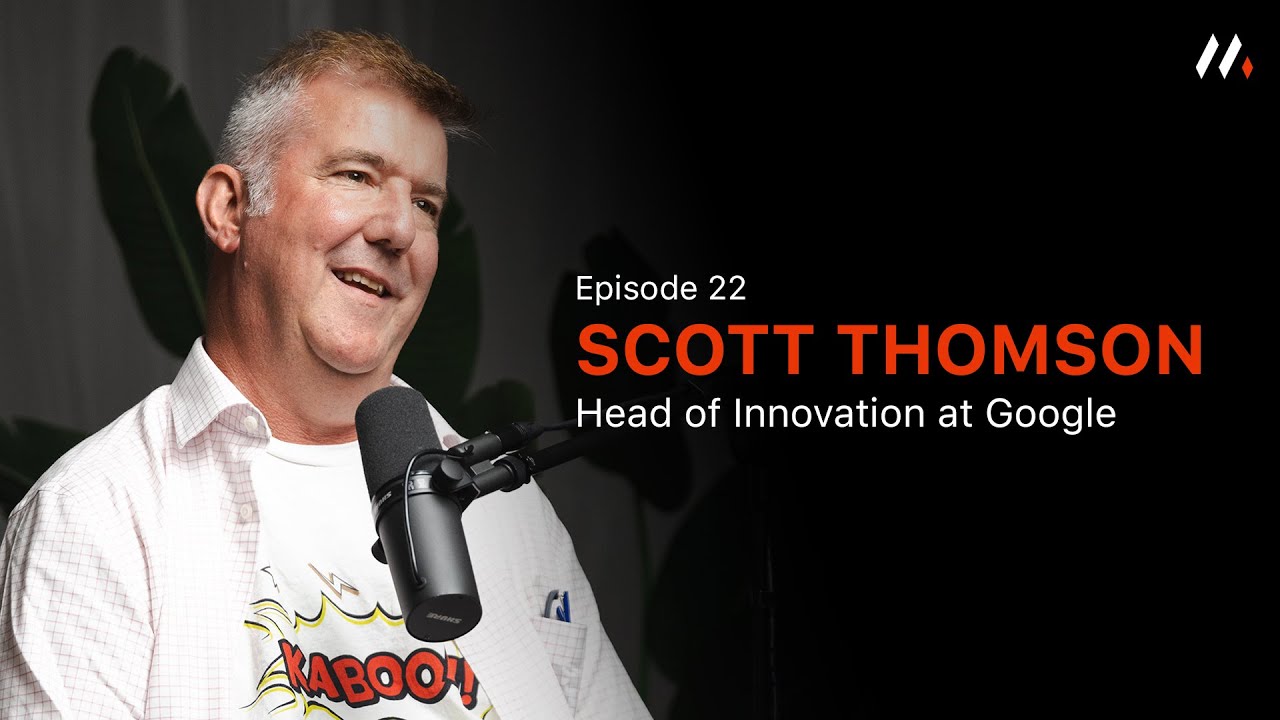
Scott, Head of Innovation at Google Cloud, explains how to solve problems by understanding them first. He turned a $53 million RFP error into a $553 million opportunity using AI with human validation, and breaks down hiring, mentorship, and why AI alone won't fix broken processes.
Chapters
What are we actually trying to achieve? What kind of society are we trying to create? How do you define a successful company? And I said, I don't know, one that makes a lot of money, I guess. You see, all the people in my office that work for me, they have jobs because I run a successful company, and they have houses and they have kids that go to school. And it's not the way we are thinking about it at the moment. We're thinking, how do we make things more operationally efficient? How do we cut jobs? How do we get more productivity?
Scott, welcome to the Mentorless Podcast.
Thank you for having me.
Yeah, it's a real pleasure to have you today. Thank you for coming in. Scott, I thought we'd dive straight in and perhaps it would be useful if you could just shed a little bit of light in terms of what you do at Google. And what your job description means.
Yeah, it is a long one. So Head of Innovation for Customer Engineering at Google Cloud. So it involves helping customers with big problems they've got or transformation challenges they're having, but specifically outward focused. So I don't do innovation inside Google, I do innovation outside Google. Yeah, to be specific. And it's around Google Cloud more than Google Ads side of the business. But because I started at Google on the main side of the business, I, I have enough knowledge to be dangerous. So I tend to just say, whatever, let's just do the whole of Google and bring that to the party, which I think is much more interesting to people than just one side of the business.
Absolutely. And I love that whole sort of transformation angle as well. So it's that sort of reimagining. Can you talk a little bit more about your process?
Yeah, so number one, you need to give me a problem.
Okay.
Or what do you want reimagined? Like, I want us to be specific. So if you can't define a problem you're having, if you can't define something you want to be reimagined, then I'm— that's probably the end of the conversation right there. And no one ever really has a problem with it. I just want to find the right thing that we can work together on. And it's about finding that partnership, that strategic fit where I think, yeah, that's a real problem, I agree with you, and yeah, I think I've got something that might help, and then we can start. But I try and keep away from the solution for as long as possible and just try and dig down, dig down into that problem first. So my first rule is fall in love with the problem, not the solution. If you can do that, the problem contains all of the good bits, right? You might not think it because you've, you've been sitting on this problem for a long, long time, but this problem, when you dig into it, you can see where all the blockages are, what it's costing you, and ultimately the cost that it's costing you today and/or the benefit you're going to get out of fixing it. That's your budget to pay for a solution.
Yeah.
Right? If it's not a big problem, then, then why are we doing it, right? So that's why I spend probably an uncomfortable amount of time digging into the problem with people, because I think I want them to see what the opportunity is in fixing it. And sometimes you just have an inkling that you want to fix something, but you can't quite put your finger on why. Focusing on the problem more than the solution will let you understand the why you want to do it.
Yeah.
And that's great for prioritization. It's great when you get up to board-level conversations. You can very simply say, this is costing us X today. If we change this, it'll cost us Y and we'll unlock this much opportunity in terms of growth.
Yeah.
And that's where I kind of want to get to before we start thinking about what's the technology we get to play with.
Absolutely. That sounds like a very consultative process. Yeah.
I start with this, I start with this thing, the voice of the customer. So, you know, like, have a lie on the couch over there, tell me about your problem. So it sounds like group therapy and it really does end up being a little bit like group therapy because you've got all these different people from around the business. And then I say, bring a couple of young people too, some people who haven't been in the organization very long, but they're the right age that these are your future. or these are your future customers in one way, shape, or form. And so when you start talking about this problem, you've got lots of different viewpoints on it. You might have a more business-led approach, you might have a more technology-level approach, you might have a graduate-level approach, you might have the, you know, the old-timer view of the problem.
Yeah.
But you get all these different angles, and quite often, well, I'm gonna say all of the time, I never allot enough time for that therapy session.
Yeah.
Because it's just, it's, people start talking about it and they really get into it and then they start saying, yeah, but you, and, but we do this and what, well, we only do that because you do this. And you get to some really good problems that can be solved. So ultimately the problems we end up solving aren't the first problem.
Right.
They're these layer cake of problems that exist underneath the key problem. And then you sit there and go, well, you gave me one problem and I'm gonna give you back 10. And if we solve these 10 problems, then we're part of the way through to solving this big problem that you gave us at the beginning. And so that part is fall in love with the whole problem, not just one part of the problem. Yeah, because it's easy for us to be siloed and say, well, our part of the problem is this, so we'll just solve that. Yeah, but then you haven't really addressed the problem at all.
Yeah, so go deeper and find the root.
Find all of the root causes and all of the ugly in the problem, and then you can you can prioritize how you start fixing these pieces, but you can also see how those pieces start to come together.
Absolutely. That's interesting. And I guess to sort of attract— well, when people are pitching their problems at you, have you got a good example of sort of, uh, you know, something that would pique your curiosity?
There's, there's one. Um, I, I worked with a company. It doesn't sound terribly exciting, but they, they quoted to put in Ethernet cables. So these are little network cables that bring the internet to your computers at your desks, or the internet to your, um, your, your rack of computers in your data center. And to bid for this work, they would get a highly paid electrical engineer to look at a piece of paper and count the triangles on the piece of paper.
Right.
Because everywhere there was a triangle, that was where you had to stick a cable. But of course, lots of different companies put out to tender with lots of different diagrams. So a triangle is not a triangle is not a triangle. Everyone's triangle is slightly different. But you have a highly paid electrical engineer counting triangles for a living. And you can guess how many electrical engineers lay on the lawns of university thinking, you know what I want to do for the rest of my life? I want to count triangles. Not many.
No.
So they count those triangles, and then we got into the process and I said, so all right, the electrical engineer counts the triangles. triangles, what happens next? And they said, well, a second electrical engineer counts the triangles. And I said, now hang on a minute, why does the second electrical engineer count the triangles? And they said, well, obviously because if we miss a triangle, it's bad. And I go, okay, why is it bad? And they go, well, it's a fixed price quote. That diagram might represent, you know, 58 racks of computers or 58 floors of a building. So missing a triangle could be a million-dollar mistake.
Wow.
I said, well, how many triangles do you miss a year? And they said 53 on average.
Okay.
I said, okay, so we have a $53 million problem to play with here. And, you know, let's say we find a way to count triangles more accurately, we've got to— we just want to keep it under $53 million in terms of a solution. And so we came up with using AI to count triangles because it's pretty good at looking at basic shapes and identifying that.
Okay.
But we kept a human in the loop, so that human would check 10% of the count and ensure that, you know, it was accurate. And if they found a problem, we'd dig deeper. So they said, well, this is great, you know, so we only really need one electrical engineer. And I said, well, hang on, you're going for RFPs, so how many RFPs do you not go for because you don't have enough electrical engineers? And so we did a market size analysis and the number of RFPs they were missing. And when we ran their win rate through that and then halved their win rate, yeah, we got a missed opportunity of business of $500 million a year.
Wow.
Right. So now we've got a $553 million budget to fix that problem and we're probably going to need to hire a few more electrical engineers. So we took away what was an annoying and manual process And we solved it with a simple technical solution, but we solved it towards the right end, towards the right process. Like, how are we unlocking the efficiency of the process? How are we delivering top-line revenue growth into that? You compare that to the strategy you had before. So they'd just gone digital.
Okay.
So they'd shifted from a paper-based system to a PDF-based system. I said, well, what did that cost you? And they said, $14 million transformation, which is pretty cheap actually in the grand scheme of things. But I said, so wait a minute, you're telling me you paid $14 million to shift your problem by 90 degrees? You just lifted it off the paper and you put it on a screen? And they said, well, you know, we got infinite number of colors now and the highlighters never run out of ink. But you can see how if you tackle problems the wrong way, you end up with a solution that seems like forward progress but hasn't really solved what you hoped it would solve.
No, indeed. Yeah, that's extraordinary. That's funny. What was the tagline in that email? Can you remember now the question they came to you with originally?
Oh, it's simply like, how can you improve our RFP process? So, and that's if you think about the RFP process, you have a language component, a pictorial component for some use cases, and a mathematical component. If you break them up, send the language-based stuff and the pictorial-based stuff to an AI and you send the financial stuff to a calculator.
That's it.
You don't need an AI to do maths, you just need a calculator. Then you can solve that in pieces rather than just throw everything at the AI and get great language results and terrible maths.
Yes.
So sometimes it's about splitting the problem up as well. But yeah, how can you improve our RFP process? So a bit of, almost a bit of reg tech that we did on that one, right?
Yeah, yeah. And again, without the, the transformation piece, effectively you're not— it doesn't interest you in that sense?
Yeah, well, at the end of the day, I, I do enjoy solving hard problems. So if you don't bring me a hard problem and somebody else does, then yeah, you might have to wait a while.
It's the priority.
Yeah.
Um, do you ever come across sort of clients who, I think when you're providing this this sort of innovation and this transformation option? Do you find them going for the easy fix, the short-term solution, versus the— because I assume it would be an investment in time training everything else, is potentially implement what you're suggesting.
Yeah, so you need a mix, right? So you do need a fast time to value for, for certain things.
Okay.
But if you're trying to build sustainable competitive advantage if it's that easy to do, then your competitor won't be that far behind you.
Yeah.
So if all you ever do is go for the low-hanging fruit, then you're probably more on a race to commoditization than a race to true transformation. So true transformation looks more like you're gonna go build a nice piece of infrastructure. And so the trick in that is how do you get short-term value while you're building long-term infrastructure? When you're trying to, solve a really hard problem, do a really big transformation, you want to make sure you prioritize some business value. Don't just build it and they will come. You kind of think of it like if your infrastructure is building a pier, you want to roll out some big pylons and drop those pylons down into the beach soil.
Yes.
And then you want to lay the planks over the top. If you don't get enough of those pylons in place, you know, it'll slow down even the planks being laid. So you wanna make sure those pylons of business value are being delivered early. And later on you can sort of lay the planks, pave it, make it look pretty, put concession stands and rides on it. At the end of the day, if you just go and build all of that first without ever delivering those pylons of value, it'll probably be pretty shaky.
Yeah.
And there's plenty of transformation projects that have ended with multiple years Hundreds of millions of dollars spent and no business value delivered.
Yes.
So we want to avoid that.
Yeah, no, that makes total sense. Now, that's quite funny, actually, just thinking about one of the last companies I worked for and their sort of spend in terms of IT innovation and transformation. And just, it always wound up being, yeah, that was a great project. Thanks. Another 3 years of going nowhere.
Yeah. And then it sort of the cycle repeats every sort of Yeah, part of it, part of the business process seems to be we need the capital to keep running the business, so we need to come up with, you know, a technical strategy or a business strategy that allows us to get the capital to keep running the business.
Yeah.
There's— I think you need to start looking at these things from a value perspective, as what are we going to measure success by, right? And how do we prove we've made that, that forward progress? And then as you build Do have those benefits in place. A lot of business cases I see in companies don't have clear benefit statements, right? Okay, which, which is a hygiene issue. Yeah, but it's an awful lot of people who don't do hygiene, and without that business value proof, you can end up in multi-hundred million dollar project cycles with no business value being delivered because you never asked for the proof.
Yes.
Yeah, right. And you— maybe it's because you like successful launches And not successful landings.
Right.
If I get on an aeroplane, I'm very interested in the landing.
Quite right.
So I want to see the business results at the end of the day.
Yeah, that's powerful. I guess that comes, sort of rolls back into, you know, what you're famous for at Google and potentially yourself and setting up the office in Melbourne and hiring everyone there. That whole sort of measure what matters and then, you know, the OKRs and all that sort of stuff.
Yeah, and all that work is, that's not ours. Like, that came from Intel.
Yeah.
A man by the name of John Doerr. He wrote a book, Measure What Matters. And that, I think that's really important to understand. People look at Google and say, we can't do that 'cause, you know, we're not Google. And my response to that is, well, we're only Google because we listen to Intel, you know?
Right.
And we're only Google because we listen to Amy Edmondson, who worked in healthcare and came up with the concept concept of psychological safety. So, you know, we got our measure what matters from Intel. We got our psychological safety from the hospital systems and the healthcare systems.
Yeah.
And they were both— Amy was a research scientist around behavioral management. So I think understand that Google found things that worked and put them into place and measured that success and then was willing to throw things out, pick up other things and put them in place. I think just understand a lot of these things didn't come from within Google. They came from without.
Sure. I guess on that point, when you're dealing with these companies who have these issues, they come to you. Do you find that actually a lot of it is down to their culture potentially? Did they not have that psychological safety which allows them to identify problems and dig into them in the first place?
I think when I look at most companies, they have all of the right elements in place. In general, they might not give it a name. They might not have it officially codified. One really great example of that is 20% time. So Google famously has this, you know, it's, it's— Yeah, it's often translated as you can do whatever you like for one day a week, which is not what it is. It's if you're getting your day job done, then you can have a side project. And every company I've ever worked for has had that concept, but not without approval. You know, Google's dirty secret around this is that Google gave it a name, Google put a process around it, Google trained managers how to deal with this.
Right.
And so then when somebody comes to their manager in Google and says, I wanna do this as my 20% project, the manager says, well, let's just have a look at your day job. Are you getting it all done? Is everything good? All right, what's the side project? Now at this point you can branch. You can say, well, is it business related? But you might also say, you know, what value does this have to my employee value proposition?
Yeah.
So is this employee motivated by the fairy penguins and everything to do with fairy penguins? Well, maybe it's not that bad that this employee does stuff with fairy penguins. Is there a way you could report on that for our sustainability goals.
Right.
If we give you not a day a week, but we'll give you half a day a fortnight, you know, we'll give you a day a fortnight to go do that, right? Let's talk trade on this, right? And now I get to keep this amazing employee because their true motivation isn't really coming to work for me, it's fairy penguins.
Yeah.
And so you need to balance what is the trade that is happening in terms of employee motivation or employee development and therefore tenure and productivity and all these other things. But if you have no process, how do you judge any of that? Totally right. So again, measure what matters is absolutely critical.
Yeah, no, that's, that's really interesting actually. I hadn't heard the 20% rule being explained quite, quite so well.
Thank you.
Scott, how would you go about sort of building your teams? And I know there's a whole sort of Google process behind this as well, but yeah, curious to hear.
So do you want me to describe the Google process or my process?
Perhaps where they differ as well, you can point out.
Right, uh, so the Google process I think is, is, is very well defined. Mine is probably more gut-driven than this, if I'm 100% honest. But Google has a very algorithmic approach. So they're looking for 4 things when they hire. First thing is something called general cognitive ability, and the way that's tested is you ask a tricky problem, not an impossible problem, So it might be, um, oh, the one I got asked was, um, Google is down. You have— you can bring up enough servers to get the largest customer back online, and they are responsible for 50% of all of our revenue, or you can get every other customer back online. Which do you choose, and how do you go about doing it? And so the trick to these sort of questions is rather than shoot your mouth off, you stop, you think, you write the question down. When you think, you think, what questions can I ask to get more clarification around the problem? So if you stop, you think, you ask questions, if you ask enough questions, you may find the interviewer gives you the answer.
Yeah.
Which is the ultimate achievement in general cognitive ability, is not to answer the question at all. Because it is a no-win situation, and it's not designed to be no-win to be tricky. It's designed to say, well, would you contact legal? Would you contact sales? Would you ask for help? Yeah, it's just how would you tackle this sort of a problem? So general cognitive ability, I think, is the easiest thing to fake.
Right.
Just write the question down and ask a bunch of questions, and they'll think you're really intelligent. Then the second one is leadership, and leadership is what kind of presence do you have? Can you engage with 1 person, 10 people, 100 people, 1,000 people? Can you hold a room? Can you hold a stadium? That's pure personality and presence. There's another part to it as well though, is when you try and solve a problem, do you try and solve it alone?
Yeah.
Or do you think, who can I bring in to help me? Where can I get help? And so leadership is those 2 things combined, a presence and a desire, or at least an ability to see the need to collaborate with others.
Yeah.
Then the 3rd thing is culture, and that's— we call that Googliness. And it's not cultural fit. It's what do you bring that we don't already have?
Yes.
And I think I put this to you privately previously. Um, we, we don't want you to blow the place up, but we're really interested in what kind of dynamite you're packing.
Yeah, right.
So it's, it's a little, it's a little hard to explain, but we want you, we want you to be edgy, but we don't want you to create fights.
Yes.
You know, we want you to not like the way you see the world as it is. We want you to want to change it, but we don't want you detonating large parts of the business in the process. So it's a really hard one to ride, but it, but it is You, you've got to be a challenger. You've got to have a growth mindset. So, so cultural fit is the wrong way to describe it, but cultural add would be the way I describe it.
Okay.
And the last one's role-related knowledge, which is what do you— how well do you know the area we want you to work in? Now that's 4th because if you have the first 3 things, we can teach you. You can be taught.
Right.
The 4th thing we can educate on. So we try not to over-index on the 4th. It's a hard thing to do because you want to hire the best. But trust me, if you find those first 3 things, you can mentor the 4th.
Right.
And nobody, nobody is going to fit like a glove on the 4th thing ever.
Yeah.
Right. So you're better off front-indexing the other 3. And once you start down-focusing the role-related knowledge a little bit and accept that everyone you hire is going to need coaching in your organization, You'll actually set up a program to coach people.
Yeah.
Which most organizations don't have.
True.
You'll be able to support people who you want to hire because you want to give an equal opportunity to, because you'll accept that even the people that seem perfect have probably lied on the interview.
Yes.
Right, exactly. So I think just accept that everybody needs mentoring and coaching, set up the systems for that, and then you'll find you have a much greater team cohesion and much greater leadership capability within your companies as well.
That makes sense.
How do I do it? So I'm— when I do my startups, which I do every now and again to my employer, obviously not while I'm employed by you, the way I do that is I look for work-integrated learning courses or industry-based learning courses, and I go and I get students who are final year or final year looking to do a master's, and I'll hire them through the universities for 6 to 12 months.
Okay.
And I do that because these people have the freshest training, the freshest ideas, and they're affordable from, from a startup perspective. Yeah, they're a great opportunity to bring new ideas in, and also you can formulate a culture with these people in a way you you can't by grabbing people with 10+ years experience.
Sure.
I think that's because I'm building startups. I think as my businesses grow, I tend to lean into more experienced people, but I don't wanna start that way when I don't even know which direction the business is going in. And if you are on the bleeding edge of a transformation, you could, and you're dropping a large amount of money on it, you can probably afford a few work-integrated students Yes. Into the program. And you never know, you never know just what kind of new thinking those people are going to bring, given you're trying to think differently in, in that process. Yeah.
I think coming back to a little bit what you were saying about needing a mentor, um, so what sort of— I guess what cadence does that look like, or what— how does that demonstrate itself where you are?
Yeah, so I, I, um, I've had a very varied career. So I started in medicine doing a medical degree.
Okay.
And then through a lack of interest in studying medicine and an interest in enjoying the most I could out of university, I decided to leave medicine and do computer science. So I ended up coming through computer science doing research and development and becoming a, I guess, a product leader at a very technical level would be what you'd call it today. And from there, I then ended up in IT operations, built, you know, maintaining massive digital systems for advertising. And from there, I ended up joining a marketing team to run data-driven marketing for Telstra.
Yeah.
And from there, Adobe poached me into sales where I advised senior leaders on digital marketing strategy. And from there, Google poached me into do more of the same, but in sort of ad analytics, you know, attribution of value in terms of whose ad got what value.
Yeah.
And then I got distracted by cloud, being an IT person at heart. But that journey from research and development to operations to marketing to sales, I needed a coach.
Yeah.
Like I couldn't just jump across all of these careers without somebody helping me. And rather than leave any of it to chance, I just hired one.
Right.
I grabbed one and I paid him.
Okay.
And he helped me a lot. And over time we became friends and I started doing quid pro quo stuff back and forth with him. But I think mentors are invaluable. You never know when that big leap is required between roles to go from a practitioner to a strategic advisor to a marketer to a salesperson. There's a lot that has to shift in that to get it to work. And without a coach to help drive you, I can't see how anyone manages to do it.
Yeah.
So I've been very lucky and very blessed with the mentors I've paid for and also the mentors who've volunteered time to me. And I would say I, a few years ago, made a decision that I wanted to concentrate on what life after Google might look like. And so in that equation, I said, well, you know, I probably want to be on a board.
Yeah.
You know, I probably want to go back to looking at startups and being an executive founder again. And so, um, I found MentorList, or they found me, or you found me. And so when I saw that, I thought, this is another thing that's worth investing in because it's an investment in myself. And so I joined that 3 years ago, and then this is my 3rd year. Yeah, it's, it's bloody brilliant. So yeah, thank you very much.
Oh, thank you for the plug.
Yeah, uh, you know, you're welcome for the plug. I think everyone who's in the program knows how good it is, so, um, it's great. And I think we get to help each other, but we also get the best speakers to talk about the things that matter. And I think that's really helping me at the moment, and I've managed to secure a potential board position, you know. So I've got, uh, now it's, it's, it's all working as, as intended.
I'm happy to hear that.
Yeah, no, it's good, it's good. Uh, yeah, I, I did my AICD last year just in time as well.
So nice.
Nothing like being foreplanned. Exactly. But I think without MentorList, I wouldn't be on this road. So yeah, well, good.
That's good to hear, Scott. Thanks. How would you implement mentoring in your, your businesses, hypothetically or otherwise, or indeed at Google?
Well, I would take patterns from what Google does, and I would take patterns from, you know, the paid mentors and, and free mentors around, um, around what I've experienced in life.
Yeah.
So inside Google, we do most of our training and mentoring internally on a volunteer basis, and I think Most companies will have a volunteer mentoring program. There are also paid mentors within Google, but you need to be at a level to access those, or you need to be being considered for a certain level to access those. I also think even if your company does offer professional mentoring internally, Mm-hmm. it's always valuable to get an external Yeah, because that's— that's— those people are paid just to index on you, right? Not on other things, right? Yeah.
Well, that was going to be sort of my— I guess pointing towards my next question, which is how does one go about identifying their own blind spots if you're thinking about going for a leadership position? Or—
Well, number one, you have them.
Yes.
Yeah, in case you need to be told. Uh, I, I have them. I still have them. Every time I face a new challenge, a new blind spot pops up because I've never experienced that challenge before. So the first, first step in fixing a problem is acknowledging it exists.
Sure.
So when you talk through things with a mentor, what are you trying to achieve? How are you going to set goals to do that? Then you do follow up and you say, how did that go? A good mentor will say, Do you think you handled that well?
Yeah.
Now, this isn't your boss. This isn't, you know, a company employee. This is the person you're paying to help you out.
Right.
So you're honest with them. They're honest with you. Sometimes those sessions are painful, right? Sometimes you have waking moments where you need to go deal with something.
Yes.
But you find out your blind spots by sharing your successes, your failures. Talking them through with another person and then hearing back from them what they think you could have done better.
Yeah.
And then you've got something to action, something to read, something to practice.
Yeah.
And it's not easy, but it's, it's worth, it's worth the investment of time.
Absolutely. A lifelong process.
It's a lifelong process.
Yeah.
I think hopefully I, I don't need it in retirement, but I haven't got there yet.
Before I sort of move on to I guess sort of AI and everything else like that. I'm quite curious to know as well, just in terms of managing your time and prioritization when it comes to work and everything else in life, like, do you have any frameworks or tips that you could potentially share?
I've got a, I've got a personal one, at least I think it's mine. Sometimes I see things I like and they become mine when they were never mine to begin with. So I call it 3 lists. Make 3 lists. The first list is everything you want to achieve in life. Like, it's a deeply personal list. You can't go get this from anybody else. Like, what do you actually want?
Right.
What does a good life look like for you? And this can include, you know, passions, family, spirituality, holidays. What is it you actually— you've got one run around this hamster wheel of life. What is it you wanna get to the end of it and have achieved? Your bucket list goes on list 1, I assume.
Yeah.
And then list 2 is you've got to pay for this somehow. So list 2 is what are you going to do to fund, to get the funds to do the things on list 1? And then in list 2, you have to put everything you need to do to excel enough. And I'm not talking about quiet quitting. I'm not talking about just doing enough. I want you to excel, be excellent.
Yeah.
at list 2 so it pays for list 1. And hopefully there's an overlap between list 1 and list 2. Hopefully there's something that gets you out of bed that you're good at, that you're passionate about, that someone will pay you to do.
Yeah.
That's an ideal situation. There's a lot of people who do list 2 and there's no intersection with list 1 and they're miserable.
Right.
Every waking moment of their life because list 2 isn't aligned in any way, shape, or form to list 1. And after you have those 2 lists, the list 3 is for everything you're never going to do.
Okay.
Because there is no time.
I see what you're saying.
And the older I get, the less time there is and the more militant I get about saying no to everything on list 3.
Right.
And it doesn't mean you have to be rude about it, but maybe you know somebody who does that. So you can refer, you can bounce, you can do these things, but there's not enough time to do my list 1.
Yeah.
Let alone my list 1 and list 2. So why am I wasting time on list 3? So prioritization is just focusing on what you want to achieve and having some means of measuring that you've done it. And then the rest is easy. I've got a calendar. It either fits in the calendar or it doesn't.
Right.
It doesn't fit in the calendar. I don't need a backlog of stuff that didn't fit in the calendar because that list is just going to grow forever.
Yeah.
So if it doesn't fit in the calendar, it's not getting done. I, I know there's more advanced ways of doing those things, but that's my, uh, my approach.
That's good. That sounds like it provides real clarity as well.
Oh yeah.
Especially around what you don't want to do.
Timeboxing is amazing. That's not mine. I've been reading a lot about it.
Okay.
But just, you know, if you have some tasks to do, put them in your calendar.
Yeah.
When you run out of time, it's not getting done. So then you have a choice. Do you hire somebody to do that? Create a job for somebody because you're passionate about that getting done?
Yeah.
You know, do you invest in a, in a company, in a charity or something that does that because you really want to see that thing get done, but you just got no time to do it? It doesn't have to be you. Go back to the leadership thing. Who else can you work with to get list 1 done?
Yeah.
All right. Who else can you work with to get list 2 done is an even more interesting conversation.
Definitely.
It fits some business models but not others.
Any other frameworks or life hacks, should I ask?
I think that's, that's, that's mine.
Yeah.
With the addition of timeboxing, which is not mine, but eventually if I talk enough about it and the other people die, it'll become mine.
I know you talked about sort of coming to work, all the Googliness, with a bit of dynamite.
Yeah.
How would you describe your dynamite?
Oh, what a good question. Uh, so I'm one of these people that really— I, I don't want things to just go along the way they are.
Right.
So this is my dynamite, is what we have cannot be, cannot possibly be the best we could ever do. So there's got to be something we could do better. There's some process improvement. There's something that, you know, if we tear this thing apart and have a really good solid look at it, we'll find a way to get more throughput through this thing.
Yeah.
And if we tear it apart, we can like work out all the stuff we no longer even need that we're doing because we always just did that.
Yeah. Right?
So maybe technology has changed. If I give an example.
Please.
Those of us that are old enough will remember going into a restaurant and paying for something on a credit card and they would take the piece of plastic That had raised numbers on it.
That's right.
And stick it in the machine and go chk chk and grind the living daylights out of this plastic to create an impression. And 3 little carbon copy pieces of paper came out of that, and you got one, the till got one, and one got mailed off to the bank. And then they got batched up and payments occurred once a week, or if you were lucky, if you're very lucky, maybe it was once a day. But 2 days later. And so the bank would transfer money back to the restaurant by taking it out of my account, bundling it up, and putting it back into the restaurant's account. Now you walk into a restaurant, you pull out your mobile phone, you tap the little square thing, and it goes doop, and all that happens. And the card we carry, still some of them have raised numbers.
That's right.
But we don't need the numbers to be raised anymore. Right? So there are parts of the system. You think about how much that has changed, how much all the jobs and all the processes have changed around that in the last— in under 30 years, how much of the world has changed. And then you ask yourself, how much has my business changed?
Yeah.
In the last 30 years?
Yeah.
How many raised credit card numbers is my business still carrying around? And you don't know that until you start pulling things apart to look at it and go, hang on, why are the numbers raised on the credit card if we're no longer putting them through a cab charge or a restaurant sliding machine. Yeah, no need, no carbon copies, no paper.
No, that's interesting. I guess if you're not just relying on the fresh eyes of the new graduates or whatever, I mean, it sounds like a business should be dedicating some time just to sort of reevaluating why they're doing things.
Yeah, I call it, um, process belly button lint. You know, it's like there's, there's just the stuff that collects in processes, and it collects because it was useful once. It did something once, but that doesn't mean it needs to be there anymore. And unless you're going around looking at your processes, tearing them apart, saying, how could we put this back together differently?
Yeah.
Then you don't find this stuff. So I'm the person who likes to pull things apart and put them back together again. That's my dynamite. So the more exciting end of that is how do you pull it apart and put it together while it's still moving?
Yes.
But I think there was some beautiful ads in the '90s and early 2000s about re-engineering a Boeing in flight. And you don't want to necessarily be doing that, but how could you safely run a transformation in parallel and then do a hot swap? And these sort of things I think I enjoy a lot more. That's sort of what gets me out of bed.
Yeah, that's, that's the real challenge.
Part of my list one, tear things apart, put them back together again.
When it comes to sort of tearing things together and building them up and transforming them, where would you say AI, or rather AI has a place to play?
So AI is being tied a lot to operational efficiency or process improvement. It's not a new thing. We've been doing operational improvements, automation, robotic process automation for years. a lot longer than the recent wave of AI hype, if I can put it that way.
Yeah.
If you think back to a couple of examples, automotive manufacturing and automation of that manufacturing pipeline has been going on in some way, shape, or form for decades. If you look at using matching engines, rules-based expert systems, fuzzy logic in master data management in banking and finance, that stuff's been around been going on for decades, right? So any intelligent system that replicates what a human can do, we, we call that an expert system, or, you know, a system that's capable of working with probability, we tend to call a fuzzy matching or a fuzzy logic engine.
Okay.
Which just means it makes some statistical guesses. This new wave of technology is really good with language.
Right.
And there's a lot of language-based processes that we work with. And so it's a new kind of AI tool, but it's still just an evolution on these process improvements we've had for a long time. The thing I want people who are listening to this to understand is there is no such thing as the AI. There is no one AI that's going to do all of this.
Yeah.
The second thing is the AI is not the car that's going to get you from A to B. The AI is a part of the car, right, that can do these things, but it's more like the automatic transmission than the car itself. You need safety features on it.
Yes.
You need seat belts and airbags and windscreen wipers. You know, you need a frame to go around it. This is the application that is the bulk of the car that the users use. So all of your workers will be using, you know, the user interface is the steering wheel, the seats you sit in, the car frame that sits around you.
Yeah.
To keep you in the car and on the journey of that process. So it's not that you can take one AI and just wash that one AI across your entire company and it'll fix everything.
Sure.
It's that you need to build these vertical solutions into the processes that matter in your organization. And the first trick is to find the processes that can afford a car.
Yeah.
Because you could spend a lot of money building a car for a process that didn't have that 50, million dollar problem or that $550 million problem.
Yeah.
How much did it cost you to build the car? Right.
Yeah.
So you've got to think about sensible investment of capital into the processes that will make a real difference. So start with the problem. Don't get obsessed by the AI.
Yes. Yeah.
Don't say we have to use the AI. Say we have to fix this problem. Once you uncover the detail in that problem, you can apply AI and other tools as part of an application.
Sure.
To solve the problem. And, and whoever has these AI tools, they need to be wrapped into an end-to-end solution that's bundled up. It can bring and work with the data securely, and it can keep your customers, your workers safe.
Yeah.
You know, these things are all part of the application, and the AI, any AI, is not going to deliver the end-to-end solution.
Of course.
It's an application.
No, that makes total sense. It helps I guess separate a little bit of the promise from the delusion as well.
There is a lot of promise.
Yeah.
And, and I mean, it's great. Like, it's great to have everyone excited, you know, and everyone wanting to see stuff. I think at the end of the day, one thing I learned on the board of directors is it's not my job to tell you how to run the company, but where's my operational efficiency?
Right, right.
So give me operational efficiency. How you give me the operational efficiency is— there will be governance There's governance issues to that. But, you know, I want operational efficiency because I want return on equity.
Sure.
I want top-line revenue growth because I want return on equity. You know, it— yeah, it— don't tell me how to do the job as a board member. I, I won't tell you how to do the job as a board member.
Yes.
But don't tell me it has to be AI or death.
Right, exactly. Yeah, yeah. You say, what the problem?
Yeah, tell me the problem, give me some strategic options, I'll give you some strategic alternatives, and then we'll approve it at the board level.
And where would you say startups and venture capitalists have a role to play in this development of—
Yeah, look, a lot of these vertical solutions will get explored in venture, like outside of enterprises, because innovators move a lot faster.
Yeah.
And they tend to not, you know, true innovators who are really packing the dynamite, they tend to not work in enterprises, or if they do, they're on the fringe in the corporate incubators. So getting some startups to work with you and your processes is incredibly valuable. Understand that anyone that's coming from the startup arena has a very different risk appetite to your enterprise, and so you need to set up some things in your board to work with them.
Okay.
So the board has to approve the risk appetite to work with the startup. So I went from my AICD straight into venture capital training through Wade Institute.
Right.
And the difference in the 2 worlds is astounding. In venture capital, you're investing, you know, tens of millions of dollars into companies that, you know, 65-odd percent of which won't exist in 2 years' time.
Right.
But you are not betting on those 65%. You're trying to find the like less than 2% that'll be breakout successes.
Yeah.
And you can only do that because you invested in all of these and then you give them the years to wash out what will work and what won't. So they are an experimentation in new value chains and new business processes that may get traction, may get growth.
Sure.
Specifically in venture capital, they're looking for explosive growth. So explosive growth, low capital costs, and a large-scale market.
Yeah.
And if you hit those 3, you're a venture capital. If you miss those 3, you may be private equity. If you miss enough, then you, you may be a successful business, but neither private equity or VCs will touch you because you don't tick enough of those boxes. But, you know, when you look at those things, I can go and sit on a board of a company that has zero revenue and $10 million in outflow a year because it's private equity and venture-backed.
Yeah.
So it's not having to generate revenue to be a going concern. It's understood that the capital's gonna come from private equity or venture.
Sure.
And these are great places to experiment in because you can set up the governance rules that are different operating a normal business. Yeah, different risk appetites, different market conditions. And so this is why enterprises should work with startups. This is why enterprises should give these technology providers room to play with them, because these technology providers will bring them the skills and the vertical solutions of the future.
Yes.
Boards of enterprises need to find a way to onboard these solutions, right, without breaching their risk appetite.
True.
But being, we are an enterprise and we only do this stuff this way and we're not willing to flex on our risk appetite—
Yes.
Locks you out of all of this opportunity.
Yeah.
Where you, you could borrow some of these skills, inherit some of these competencies purely because you're willing to do the work with them. So I firmly believe enterprises should have these corporate incubators as part So they can absorb the skills and the things that do work. Equally, I think enterprises should have their own internal innovation functions functioned on value, right, and experiments around those value points. So I think it's a mix of internal and external innovation that works, but it all starts with working out what the problem is you're trying to fix to begin with.
Indeed. And I'm sorry, would you briefly mind unpacking for me Apologies for my ignorance there. The difference between sort of internal incubator, incubated team and a startup, for example.
So internal incubators, you've got to— it's got to be under— everything is a business case, we say in Google.
Okay.
It doesn't matter what you're doing. Everything is a business case. It has to be how is the enterprise going to profit from this? And so you can put people on to an an experiment, but that experiment has to be driven by a value-based business case. You can't just have people off in the corner playing with no business model.
Yeah.
Right? That's especially if you're a listed company, the share market really doesn't like that.
Yes.
Um, you can through corporate incubators work with external venture companies by giving them a vehicle to play in your processes. And maybe that's with some of your internal innovation projects and teams.
Yeah.
No one company, no one individual in your company owns innovation. There is no department of innovation, but you want innovation to be in all of your operational processes. People looking at the process all the time, people who are willing to break down the processes and reconstruct them, but everything has to be a business case. And the thing about working with externals is there's a different kind of business case. And that business case is the VC, venture capital power law model, which is I just took $100 million, invested it over 10 years, and it must return as a fund more than 8.5%, more than 12.5%.
Yeah.
It has to do better than property. It has to do better than the stock market. This is the riskiest asset class in the world. But it has to guarantee a return on that fund greater than all of the less risky ones.
Yeah.
Or you'll never get another fund.
Yes.
So there is a business case. If you can't see that business case, I've got some VC training courses I can recommend. But trust me, the money that's put into those funds is designed to return outscaled growth, not waste money on failed startups.
Yeah, it makes sense. And as a general comment, how would you say that the boards in Australia are geared towards sort of working with enterprise versus, say, the US, for example?
So you want me to insult every listener? And, um, I, I don't— I think we're too conservative. I, I'm— I'll say it. I think we want to see who else in the world has done it before, and so we don't, we don't try and push what we could do. We also have a tendency to over- index on what's here, right, and not look at what's elsewhere. If you think about the Australian market, it's a tiny part of the world market, and the companies like Canva and Atlassian that go outward create massive markets for Australians and Australian jobs. The ones that just focus internal have a limited market opportunity, you know, driven mostly now by immigration.
Yeah.
So you really have to ask yourself where your business is going, where your top-line growth is coming from, if your future business is only here.
Yeah.
There are businesses that only want that, and that's probably fine. But even if it's just here, there will be businesses coming from outside that have different risk appetites that will come, like Uber for taxis and others. So if you're not going to these lands where the rules are different.
Yeah.
Where the technology risk appetites are different.
Yeah.
Where the business model risk appetites are different. You're not really being able to experiment in what the future threat or the future opportunity of your business might be.
Yeah.
It's one thing to go on a tour of Silicon Valley as a board. It's another thing to say we're changing the risk appetite. As a regulated bank, we're willing to put data in the US to access technology that's only available in the US. And the US is a Five Eyes security partner. So honestly, I have no idea why we don't allow data to be put in the US.
Interesting.
Now, I'm willing to have a talk with anyone who thinks differently about that. So you have my details, come and have at it. But we wait 5 to 8 years for technology to mature to the point in the US that it can be hosted in Australia, right? And so we follow the US by 5 to 8 years rather than doing stuff where it matters, where it's available now, where we can access everything now. Yeah, right. And that's why I think we're followers, not leaders, at the moment.
At the moment.
I'd love to see it change.
Yeah, if we can get into that maybe next time.
Ah, yeah, well, I'm going to change it.
Yes, there you go. So, Scott, coming into the next segment of our podcast, I'm going to ask you a couple of questions. Please do expand on the answers. I'd be very curious to hear why you've chosen what you have.
Awesome.
Do you have a favorite quote?
Favorite quote? So I have a number of favorite things that I say. And as I said before, I'm not often sure whether I made it up or I heard it from somebody or I mangled the words. But it's a Scott Dynamite.
Yeah, it's a Scott Dynamite statement.
The one I'm using a lot at the moment is, um, the AI works well when cornered like a rat and micromanaged.
Okay.
And it kind of goes back to what I said before, uh, this AI that we're talking about, all these different AIs, they need to have guardrails, they need a safety mechanism, etc. I tend to like statements like that that are sticky, that people will remember.
Yeah.
And I hope the thoughts are transformational, that they go, yes, I can't just plug this AI in without making sure it's doing a decent job. I've got to govern the AI. I think if you think that the AI works well when cornered like a rat and micromanaged, and you remember that, you can even maybe attribute it to me or steal it for yourself.
I'll attribute it to you, of course. Thank you, Scott. Do you have a favorite book at the moment?
I've— I'm influenced by what I've done most recently a lot. It's one of my cognitive biases. So I just did the venture capital course and I read a large number of books on venture capital. And the one that I quite liked was, it was The Secrets of Sand Hill Road by Scott Kapoor. And it's a story of the Marc Andreessen Fund.
Okay.
That started out of Netscape in the battles for the internet in the early Silicon Valley era. And it's just talking about how venture capitalists look at megatrends, how they try and predict what markets will do in the future, and how they make portfolio investments across a wide range of companies following those trends on the belief that if those trends come to be, there'll be breakout business model disruption. Yes, in those sectors. So I found that to be absolutely astounding. And, you know, just having people like that write books that share a lifetime of experience that I can just pick up and read, I find just wild.
That's fantastic.
You know, it's— I, I could probably never get a coffee or a dinner with Scott Kapoor, but I can buy his book.
Yeah, exactly. Next best thing. Uh, just quickly, how many hours do you say you dedicate to reading these sorts of things a week?
I am— I, I am not as good at reading as I should be, but I only, I only sadly read educational material. Yeah, so I spend a lot of time reading online. I buy books that I see online that I think might be interesting or that are heavily recommended, and I tend to focus in areas on my lists of engagement. So either list 1 or 2.
Yes.
From earlier.
Yeah.
So, you know, it's usually data, AI, innovation, investment in innovation, data, AI, science about data, innovation, AI. These are my passions that have driven me most of my life, and so most of the reading is around that.
Yeah.
And it's, it's at every level. Like, I have all the way down to technical data and analytics and all the way up to, you know, investments in data and the value of individual data ownership versus collective data ownership and things like that. So I try and go as deep as I can and as high as I can.
Yeah.
So not saying I necessarily write AI in my spare time, but I have in there somewhere the capability to do it. It's just, it's not where I'm going to spend my time.
Yeah, yeah, that makes sense. It's not on list 1.
It's not this one, but maybe on list 2 if I get the wrong employer. Yeah.
Okay, Scott, I know you love to cook, travel, you drink wine. Is there any— do you have any other passions that we might not know about you?
Uh, cook, travel, music. Um, so I love doing cooking, uh, at home. Uh, it's, it's the one thing I can really bring to the relationship, if I can put it that way. My wife does a lot of the heavy lifting at home, and increasingly she's doing more of the cooking as well. So I'm really— I've probably got to pick up a bit more list to action in, in the kitchen department. But I do really enjoy it. It relaxes me. I like all kinds of music.
Yeah.
One guilty pleasure is Eurovision. Oh yeah, it is, it is an absolute train wreck.
Especially with a, with an Aussie commentator. I think it's—
Yeah, the Aussie commentators do a great job. And, and I think, um, it's a once-a-year thing. Like, I know we just had Easter, and next on the calendar of festivities is Eurovision in May. And, uh, you know, it's just a fond memory that my family and I share now.
So that's great.
Uh, yeah, and I think, yeah, any form of music, any era of music. I adore music.
That's great.
Yeah.
Are you an LP man or?
I would be. I tend to be a person who hangs out in cafes that play LPs, but I don't own an LP. I have all my music on subscription services.
Yeah.
So yeah, I'm a bit of the, I carry my music library in my pocket, thank you Steve Jobs kind of person.
Sure.
Um, but I do love a good LP on a cafe, um, and hopefully one I've never heard before.
Yeah. And out of curiosity, do you have a go-to dish or something you're particularly proud of making?
Uh, so I, I do slow cooks.
Okay.
Uh, and, um, what, what would best be referred to as peasant cooking. So, um, slow-cut, um, meat dishes.
Yeah.
I was also a vegan for 5 years.
All right.
So I tend to veg up whatever I'm doing a lot.
Yes.
And think, oh, maybe I could put a pulse or a spice in that that the recipe maker didn't think of. And I'm a terrible recipe follower. I will go through the recipe and I go, why would I do that?
Yeah, exactly.
So I tend to steer clear of baking because there are train wrecks in that. My wife says I have one clanger a year, right, where I really shouldn't have done that thing. Um, but you know, you live and you learn.
Absolutely. Well, I agree with you with the whole recipe following thing. So yeah, that's good. Um, Scott, if you could speak to your younger self, what advice would you give you?
Wow. Um, so my younger self made an enormous number of mistakes, and I would say just keep doing that. Um, everything— like, I took 9 years to get through uni. Uh, first year was the best 3 years of my life, um, in, in every sense. Uh, but you know, everything, every mistake I've made, everything I've done wrong led me to a different place. If I had taken safer choices at every stage of my life, I wouldn't be where I am today. So I, I'm never interested in the safe choice.
Yeah.
I'm interested in what if we go over there? Yeah, what if this worked differently? Um, so I guess maybe I would tell myself to put more money in superannuation, but I did that as well, so I think we're all good. I'm not sure I would change a thing because you never know what your future will be if you went back and changed something.
Well, there's that as well. Yeah, paradox.
I'm happy, no regrets.
I'm happy to hear that. No, that's fantastic. If you could be remembered for anything, what would that be?
Oh, if I could be remembered for anything, um, I, I think I, I did this, um, I did a couple, a couple of early life experiences. I worked for a company, there was a CEO there, uh, and he, he and I got along very well. And we were driving in the car somewhere and he said, so what do you want to do with your life?
Yeah.
And I said, oh, I want to run a successful company just like you. And he said, well, how do you define a successful company? And I said, I don't know, one that makes a lot of money, I guess. And he said, well, that's not how I judge a successful company. And I said, well, how do you judge a successful company? He said, well, you see, all the people in my office that work for me, they have jobs because I run a successful company, and they have houses and they have kids that go to school because I have a successful company. And if I can hire a few more people into my company by making my company more successful, then I make the community and the society a lot more successful. So that's how I judge a successful company. And it's not the way we are thinking about it at the moment. We're thinking, how do we make things more operationally efficient? How do we cut jobs? How do we get more productivity? But I think we need to think about what, what are we actually trying to achieve? What kind of society are we trying to create? And on the basis of that, what does a successful company look like and where does it fit in society? And then what did we want to do with that AI again?
Put up those guardrails and make sure it works for us, right? Yes, correct.
Well, the AI should work for the humans and not the other way around. Be careful what you wish for.
Yes. Yeah. Thank you, Scott.
Most welcome. Thank you for having me.
That's been an absolute pleasure. I really appreciate your time. Thank you.
More from David

2026 National Networking Event | Melbourne Grand Prix Featuring Guest Speaker, Molly Taylor



HR Connect Leadership Series | Peitta Dyball on culture, strategy & the evolving HR landscape

HR Connect Leadership Series | Elevating HR through community and mentorship





Uncover Neurodiversity: Empowering Hidden Strengths in Society and the Workplace w. Dr. Shae Wissell
