Master the Mindset of Winners | Mike Smith EP01
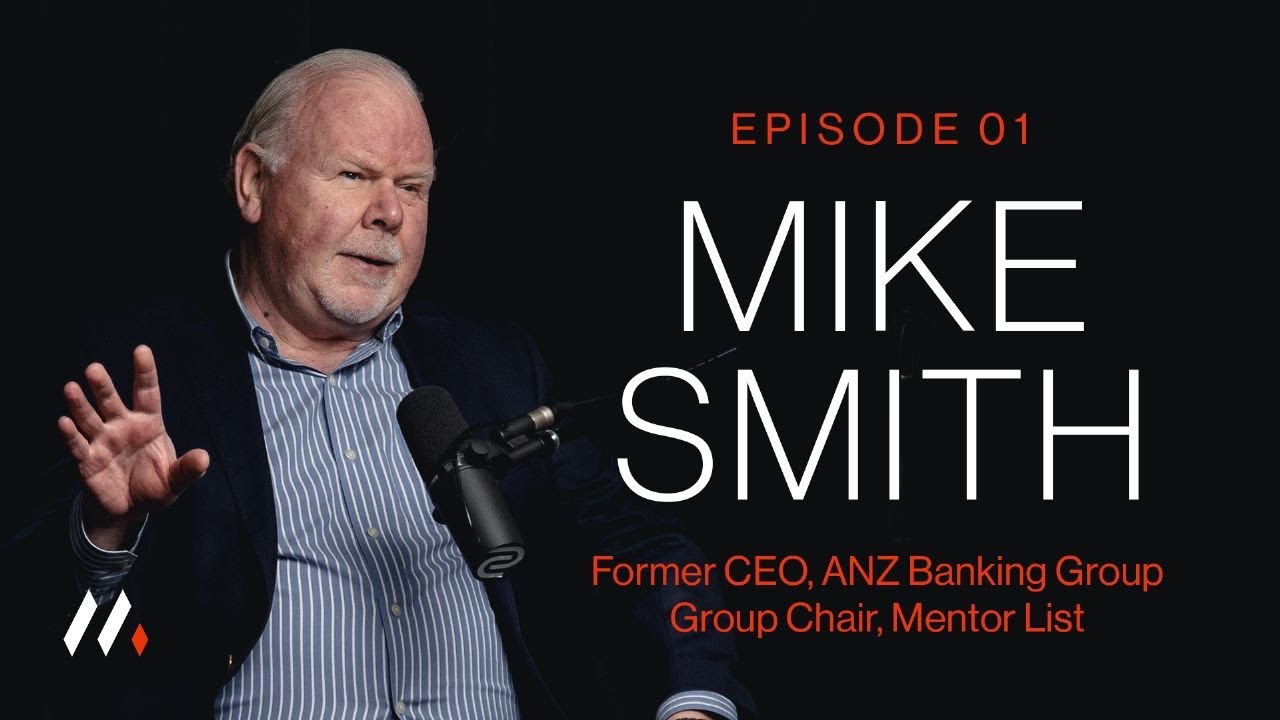
Mike Smith, former CEO of HSBC and ANZ, discusses his rise from bank clerk to leading global organizations through crises like the GFC and COVID-19. He credits burning ambition, calmness under pressure, and storytelling for aligning teams and steering companies through uncertainty.
Chapters
I was always burningly ambitious. You've got to aspire to something. I think there's nothing worse than aspiring to mediocrity.
I think the sad reality is 70% of businesses fail.
There are winners in life and people who don't win. People now, oh, you're not allowed to lose, you know, you've got to participate and whatever. Well, we all participate, but there's always going to be winners and losers in life. That's how it is.
Hi, this is Alex. Are you a business owner, CEO, or C-suite executive? If you're interested in finding out more about learning from lived experience, click on the link in this episode and get in touch.
Okay, welcome to the Mentalist podcast. Today we've got Mike Smith joining us and Alex Smith as our co-host. Sorry, Alexander the Great Smith. Can't forget that name. So Mike, it's been a while since we've sat down and had the microphones on in this type of environment. I think it was back in 2016, just once after you'd left ANZ, I think we had that first conversation. I remember coming to see you and you had this humongous office. It was almost half a floor, must have been on level 40 or something like that at the top end of Collins Street.
Yeah.
And yeah, in one of the ANZ buildings there. And I think you sort of kept that office for a little while after you officially resigned, which was a great scenario, I think. But great to have you here again. I guess a lot's happened since then. We've sort of— podcasts sort of lead you in weird and wonderful directions, and now you're sort of part of the Mentalist family. We were talking earlier with Alex around the culture and what we're sort of trying to create there, and you've obviously been a A very big part of that. And now sort of, not personally, but sort of chairing groups across Melbourne and Sydney in the Mastermind and helping, I guess, today's leaders learn from maybe the mistakes that you made or some of the, well, maybe some of the successes. Some of the successes.
Yeah, it wasn't all bad.
Yeah, no, I'm painting a doomsday reality. But yeah, I guess Alex and I were sort of thinking, you know, what's the conversation going to be like? I told him to ask him who his favorite child is, but he sort of wasn't going to go there. I know we're not going to talk about Argentina, which is maybe an inside joke for some of our— not a joke, an inside one for some of our members who have heard that one over dinner, which is an amazing story. I told you I wouldn't talk about it. Now I'm talking about it in the first 5 minutes. Sorry, mate. So I guess As a theme today, we've got a broad overarching theme. You're known, Mike, internally within the Mentor List family, family being within our mentor membership group, as the raconteur. And I think it was Malcolm Jackman who first labeled you with that, what do you call it, label?
Monica.
Monica. Thanks, Alex. I struggle with the English language, so it's great to have you here. And I actually had to look that up, and Malcolm finds that ridiculously amusing. So thanks, Malcolm, for taking the piss out of me. So resident raconteur, storytelling. But I thought what we might do is just ask you a couple of questions which will demonstrate your ability to tell stories, but maybe talk about sort of that burning ambition and where it came from, where it started, and then maybe now with sort of a bit of hindsight some of the learnings and some of the benefits, some of the drawbacks of having such a large ambition in life. So I don't think there's a question in that yet. Maybe I'll throw to you, Alex, put you on the spot. But why don't you throw one Mike's way and we'll get underway?
Yeah, I mean, what propelled you through the ranks of HSBC and sort of starting as a bank clerk and working your way up to CEO? How did that happen? What helped you on the way?
Well, as Dave says, you know, I was always burningly ambitious, you know, and I've always felt that ambition is actually a good word. Ambition is a word that, you know, you should aspire to. You've got to aspire to something. I think there's nothing worse than aspiring to mediocrity. If, you know, if you can be— if you can aspire to greatness and to lead, I think that's what you should do. In terms of banking, I think I was very fortunate actually in that regard. I mean, I actually walked into the office in Bishopsgate in London for HSBC for my first day at work, and I just realized I got it. And that was totally fortuitous. I had no idea what banks really did.
How old were you there, Mike?
Sorry?
How old were you there?
I would have been about 21, I guess, you know, straight out of uni. And, you know, when I think back, that was incredibly fortunate, and I just felt I got it. I was just a natural.
Yeah.
And I never looked back, but I felt on that day one Oh, one day I want to run this place, you know. And to me, that seemed to be like a good ambition. I mean, if I, if I go back further, I didn't particularly enjoy school, you know. I, I wasn't academic. I think I was a little bit, um, uh, different in some ways.
Where are you when you're in school? Is this London or are you in—
No, well, in, in the UK, you know. I went to boarding school there at Cheltenham College, and then before that in Nottingham. But I never really enjoyed school. I mean, I enjoyed my friends, and I think it— particularly Cheltenham had a very important influence on me. But to me, it was about getting good enough results to get to uni, and that was about getting a degree that got you a good job. And then that's what I was really interested in. And and the you know the the actual process I probably didn't make enough of it. But you know going into the bank, I suddenly thought, okay, this is it. This is where I need to be. And you know sort of whatever it is, eight or nine countries later, you know I became the CEO and and of the old Hong Kong and Shanghai Banking Corporation, which is. job I wanted. And after I'd done that for a few years, you know, the job in ANZ came up and, yeah, it was a challenge. And I'd been to Australia some years before and had enjoyed it. In fact, 2 of my kids were born here.
Hmm.
And so I felt, yeah, there's another Great opportunity. So let's, let's go for it.
Well, that's, that's 10 countries and 30 years experience. We might just cut into that a bit more. I think we've, uh, we've, we've, we've, um, maybe missed a couple of little pearls in there. But tell me about, um, you say— I, I tend to agree with you, there's a bit of a stigmatism around having an ambition. People tend to, I don't know, feel a bit awkward about it, or—
Well, it's like winning, isn't it? I mean, You know, everybody has to get a prize now.
That's right.
Frankly, that's bullshit. You know, there are winners in life and people who don't win. And I've always thought it's more fun to be on the winning side. But, you know, people now, oh, you're not allowed to feel— you're not allowed to lose. You know, you've got to participate and whatever. Well, we all participate, but there's always going to be winners and losers in life. That's how it is.
Yeah, yeah. If we're free, if we're free, we're not all equal, and if we're equal, we're not all free.
Very profound.
There you go.
Yeah, so I guess, um, you know, thinking back to, you know, I don't— I think it'd be quite rare to have the privilege of at 21 years old sort of knowing so clearly where your path was. Um, certainly a lot of 21-year-olds that I'd speak to— I don't actually speak to that many 21-year-olds, but the ones I am fortunate that they trust me to speak to them, um, certainly don't have that, um, that clarity. And even if they did, I think role tenures tend to be a lot shorter now.
Um, but I, I think that's probably true, but I've met people who've gone on to be, um, to become, um, you know, generals in the army or who've become captains of really successful football teams or cricket teams, rugby teams. And, you know, there's an ambition there within them. And they were, you know, they were in their 20s when they had that. So it's not unusual.
Yeah.
I think you just have to— in business, it may be a little bit different because people are not very clear when they leave uni what they want to do. And as I said, I'm, you know, I'm— I was very lucky because I just walked into something that I happened to be good at. And I've always believed that if you're good at something, you're going to be more successful than if you don't enjoy it, you know.
Yeah.
You know, Mark Twain said, if you have a vocation and you treat it like a vocation, you're going to be successful. He actually had quite a good few quotes actually, Mark Twain.
We'll put them in the show notes.
Yeah, come back to that.
So just back to sort of, I mean, you know, 10 countries. Do you find, so with that sort of benefit of experiencing these different cultures, do you find in Australia, you know, is that where the sort of hesitation around ambition Is more prevalent? Like when you compare it to America or other cultures?
I don't think it is because I think when you've got a country which has a large element of immigration and immigrants to it, I mean, what do immigrants bring to the country? They bring that entrepreneurial flair. They bring that have a go. They've often come from nothing. And you look at the really successful business people and, and actually in other walks of life in, in Australia, a lot of them come from that immigrant background.
Right.
Where they have been, you know, they've given it a go and they've succeeded. So I, I actually think that Australia represents ambition really well. But in these days of political correctness and everything has got to be equal and égalité and whatever. I mean, if you ask the French, what does égalité, liberté, and fraternité mean? You get a different answer from every one of them. You know, they're still struggling with the, you know, with the concept of their revolution. Well, we don't have that in Australia. We have We have, I think, a very equal society and community, and you really do have the ability to succeed despite your backgrounds, despite where you've come from, despite what you've done.
You touched on ambition as a trait you shared with other business leaders or, you know, successful sporting people. Is there anything that— any trait that set you apart potentially? That's unique to you?
No, I doubt it. I think there's a few things I probably do better. I think I'm more courageous and I certainly found that out. What are you like under fire, literally? You know, that sort of thing. You just don't know how you'd react. And I'm incredibly calm in a crisis. And that, I think, is very helpful. But you've got to be— you've got to be very confident. And most leaders Most leaders show a self-confidence, but inside they're not. They're always doubting themselves and they're always doubting, can I do better? Because I found many, many really good leaders are actually quite insecure inside. And I would class myself as that too. But you've got to show confidence.
Hmm.
And that's— and the ones who don't often become arrogant. So there's a fine line between confidence and arrogance. And I think if you do truly believe in the hubris, then you are arrogant. And I've seen a few of those, believe me.
Excellent.
So just on that point, Mike, don't know how you'd react and you're fairly calm in a crisis. Like, you know, our whole ethos is around sort of that lived experience. And I guess, you know, how you would react and the role you played in Australia in the GFC and that calmness you brought when you talk about coming back to the office from the Kimberleys, I think you were on family holiday.
Yeah.
And the sort of relief that your executive team felt. Is that what you were always bringing, or is it because you've been conditioned, assassination attempts, Molotov cocktails at head office in Argentina, runs on the bank, cash out of helicopters in Brunei? Are all these experiences that are so extreme then putting you into— I would consider a GFC a pretty— well, not an easy day at the office, but—
It wasn't, believe me. I mean, the GFC in Australian terms was actually quite serious. I mean, it really was. It was a crisis that was actually probably more profound or potentially profound than COVID. Now COVID sort of affected everybody, so we're all sort of used to it. But actually what happened within COVID, it was not so much the issue with the disease itself, it was the government reaction to it and what they insisted people do. In the GFC, the government was very unsure about what the potential was and what was going to happen and relied very much more on the professional, well, on people who both in government and in business understood the markets and took advice. And I think that that enabled Australia to come through in a very good way in terms of the the GFC. But I mean, I'd seen dozens of crises in my career. I mean, I'd lived through a lot of them. And the implosion of Argentina at the turn of the century, in 2000, 2001, in terms of what you could do to a country— That was cruel. That was really cruel.
Hmm.
And, um, yeah, so I, so I guess the, um, the learnings from that mean that, well, you know, let's put this into perspective. Um, is it as bad, um, as, as we think it is, or is there a clear way through? And I think, you know, the— that concept of having different options when you're, when you're in these situations is incredibly important because you know that certain routes will get closed off. So you must have optionality to move forward. And a lot of executives do not like living with ambiguity. They don't like living with uncertainty. And I'll tell you now, and this is a truth, that the only certainty in life is the uncertainty. That I can guarantee.
Reminds me of, you know, the most unprecedented thing right now is the use of the word unprecedented, which is a bit of an in-joke within the memberships.
Yeah. I mean, you know, what goes around comes around and always has. But if you imagine what it would have been like running a business during the war, for example, both, you know, the First and Second World War, it would have been extremely difficult. I've just read a book about D-Day. And if you think about the logistics and the management of an operation like that, And in terms of what casualties you were prepared to accept, you know, these are callous and difficult decisions which make dealing with COVID look like small change.
And just sort of back onto that ambition, Mike, you know, what was sort of sitting behind that? Like, Why? Like, you know, you could say that financially you probably could have stopped, um, and been quite comfortable before ANZ or even roles before that. Like, um, you know, you'd, um, like, what, what was the ambition? What was sitting behind the ambition? Was it— what did— and I, and I noticed that you're— sorry, just, it's a long question, but, and now you've sort of selected not to go down the, the NED or sit on boards, um, you know, deliberately, as a deliberate choice. So yeah, what was sitting behind that ambition? And then, you know, with finishing up at your time at ANZ, how does that play out?
I guess I was trying to prove something to myself and possibly to my family. My mother was pretty tough on me emotionally. I mean, and my father was very supportive of her. And I think that they went through, you know, the war in the UK and whatever, so lived through very frugal times. And I was driven with this sense of responsibility and, you know, you had to get on with it.
Yeah.
But I was sort of quite dyslexic. You know, I used to write backwards, being left-handed, and things like that. So at school, you know, I had quite a— in the early years, I had quite a hard time. So I think I was trying to prove a lot to myself.
Mm.
And from that, I just wanted to succeed. Yes, I wanted the finer things in life. You know, I felt I wouldn't say I was materialistic, but some people would consider me so, in that I do like nice things, you know, that I can now afford.
Yeah.
And certainly that's something. Do I have enough time to enjoy them all? No, possibly not. But it's not the having, it's the Being able to have, I guess.
Yep.
Does that make sense?
No, yeah, it does. And I guess, so, I mean, being so driven and, and focused in that ambition and, and the career and, um, I guess the development that that took, were there other parts of life that, um, you know, now you're sort of, you know, it was— was there any regrets, I guess, having such a focus on And clear direction from that age of 21.
Yeah. Look, I've always sort of regret being a wasted emotion. I mean, I think the important thing to do is to learn from your experiences. And you probably learn more from the bad experiences and the things you got wrong than the things you got right. And I think it's very important to observe people as well. You observe people who are doing stuff, be it government leaders, ministers, be it business leaders, and you can see what they do wrong. And you think, oh, why didn't he just say, or why didn't she just say that a little bit differently?
Yeah.
I'm, I'm in a very fortunate, fortunate situation now in that I don't care. Um, I don't have to be politically correct, and, or, or I don't have to be, um, that's right, you know, beholden to the, um, to the politicians. It doesn't worry me.
Uh, I think that's what our members enjoy with you as well, Mike, when you speak with them.
Well, to be probably, to be fair, I never did worry too much about what they thought. But I've always felt it's good to be honest and call it out. You know, I think being honest is a very— that requires strength and courage. And I think that that as a value is a really good one.
And a few of our politicians could do with a Do you think that willingness to be honest and have that strength to speak your mind hindered you in any way?
Well, it certainly didn't make it easier at times. And there were moments when I got into verbal fisticuffs, you know, with some very senior people. But I felt that their actions at the time needed calling out. And I don't think I ever did something that was silly. And to be fair, my board never called me out on it either.
Mm-hmm.
They said it might be a good idea to find a way of repairing the relationship afterwards, but they never— They never actually called it out and said, no, we don't want you to do this stuff. Yeah, they might have said it privately, but nobody ever said it to me.
Yeah. And that also reflected itself in how you manage your teams at ANZ?
Yeah, it was a very open discussion. I mean, I was probably regarded as being quite I was demanding. You know, I demand excellence. But I always felt that I was approachable. And I always felt I was fair.
Mm-hmm.
There are always 2 sides to every story. And I, you know, I've always believed that. And as I've said to many of the members before, when decisions reach you at— as a CEO, it's 50/50. You know, you should only be looking at the really difficult decisions because that's what you're paid for.
Yeah.
You know, that's your role. And if stuff is getting to you that's 80/20, then frankly, some of your team are not doing their job.
Yeah.
So, look, I mean, you know, some of my staff thought I— some of my executive team thought I was great and some of them probably didn't really like me very much. But, you know, you have to have a disparate group of people I mean, if you all— if your whole executive team is in your image, your own image, you'll get on famously. It'll be brilliant and you'll have great fun, but it will be hopeless because you won't cover off the complementary areas that you need covering off that you know that you can't do.
Yeah.
So you've got to have those people who you might not be really that comfortable with. But you need them to fill those capabilities within the team.
Yeah.
So you're sort of talking about different leadership styles there a little bit, Mike. And as our sort of resident raconteur, which is basically when I did look it up, so I'll just share, is basically storytelling, but doing it in a way that educates or passes on insight. So I think it's quite— when I did actually look it up, I think it is quite a good, what do we say, label or—
Moniker.
Moniker, thanks, Alex. I guess thinking about ANZ, there was a huge Asia strategy which you brought in, which was part of why the chair got you across from Hong Kong in your role. I guess, you know, tell me about being the storyteller in your corporate career. Was that something that you were consciously aware of or something you look back now and think, actually, I was a bit of a— that's maybe what I did? And, you know, you talk a lot about putting a light on the hill, which solidifies a strategy. But I'd like to hear maybe a little bit about your thinking on that.
Look, I think everybody in life wants to know what they're going— where they're going within an organization. That's human nature, you know. What was that expression somebody used the other day? All roads—
If you don't know where you're going, all roads will lead you there. Yeah. I think it was a Roman—
Alice in Wonderland.
Alice in Wonderland.
There you go.
That's right. Thanks, Alex. That's exactly right. And it's a classic case. So you've got to make sure that you are very clear with what you're trying to achieve. Now, you also have to articulate and explain why that is good for the business. And that's the storytelling. So that's where you have to really bring people on board. with your concept and ideas as to why you're trying to do this.
Mm-hmm.
I mean, again, you think of someone like Eisenhower wandering around the troops talking, and his generals talking to the troops who were going to go on the beaches at D-Day. I mean, not one of them would have wanted to have done that, right?
Mm-hmm.
But they did it. because they understood the need to do it and the fact that this was the choice that was being made. So it's not always a pleasant thing. You know, you might be talking about having to close businesses or to, you know, to shut areas down, as well as growth. I mean, growth is generally more fun. It's, you know, it's about But, you know, I think in terms of looking at how to run a business, the growth cycle is the fun part, you know.
Mm-hmm.
The business as usual, the business as usual, which is what I call the incremental growth, is frankly boring. And the downsizing is brutal. It's not easy. It's not easy stuff. But Often more interesting than just incremental growth. I always love to look at dynamic or quantum growth, because that makes a difference. That's when your share price really does take off. And it's very hard to shrink to greatness.
Hey, everyone. Thanks so much for tuning in. If you're loving this podcast, please give us a 5-star review.
I agree, growth is fun and it can subsidise any inefficiencies that might be sort of floating around. But I guess I look at the current environment and some of the murmurs from the members around the current economy. It's almost like we are in that boring, not boring, but it's not all about growth and we've got a cash rate that's increasing, cost rate, cost of debt's increasing, etc. I mean, this is an environment that a lot of our senior leaders haven't experienced in their lifetime. Maybe if you want to share a little bit about that.
And I don't think it's, it's that different. I mean, you know, these interest rates were, were pretty common, what, 10 years ago? It, it's not It's not that unusual. And I think my first mortgage was 19.5%. That was a long time ago. But I think that when— and somehow you managed. You just adjusted. And I think for businesses, the cost of borrowing Yeah, is there. But the cost of lending, of course, is going up as well. So it's both sides of the balance sheet. So if you're a big borrower, you get hurt. But if you're a big lender, you're going to benefit. So it's both ways. And I think the important thing is you don't look at— you don't run your business by looking in the rearview mirror, right? You know, that's not going to help you in this situation. You've got to anticipate, okay, what is going to happen? What are the issues? What should we be looking for? And I think, you know, one of the most important things now is really to It's really to secure your supply lines and the whole supply chain. You know, I think for industry that is critical. You know, we're seeing problems now with the, you know, the waiting list for cars and whatever because of the lack of chips, you know. And why has that happened? Well, there's only about 3 places in the world where chips are made anymore.
Yeah.
So that is a strategic problem, and government should be doing something about that.
Well, because, you know, in probably most of your working career, it would have been all about this whole concept of globalization, and now what we're talking about is this localization.
Well, no, I mean, I, I, it's, it's still globalization. I mean, the, the model is still globalization, but it's globalization with much more national interest.
Right.
And I think that that makes all the sense in the world because you can't have globalization with parties like Russia and China behaving the way they are right now.
Yeah.
you can't— you cannot rely on them completely. You know, it's just not possible. So, and there are others, you know, there are other countries. Argentina's another classic one. You would never know what they're going to do next.
Yeah.
And they're a very rich resource country, you know, but you don't know if the stuff coming out of there is going to actually Um, arrive or were at the right price that you agreed or contractually agreed on.
Knowing what you know now, if you had to start out again, where would you position yourself?
That's an interesting one. I actually, I actually probably would have started my own business. Um, I feel I felt that during my life, I've given my life and soul and every waking hour to organizations who looked after me, to be fair. But I could have done that for myself and for my legacy. And I think that's probably what I would have done.
Yeah.
Had I started out again. It's the old Rod Stewart classic, isn't it? You know, if I know now— if I knew then what I know now, life would be different. Yeah. Very smart guy, Rod Stewart. Still going strong.
I think that's sort of a bit of a theme coming out now. even the word entrepreneur. We were talking about it earlier, which is another label for business owner. And I think it's interesting to hear you say that you would start your own business going into your career now. And I think there's probably a few maybe exceptions like the Atlassians, the Canvas that really give a lot of profile to what that could be like. And then there's probably more the reality of what that looks like for most of us. I think the sad reality is, I don't know what the statistic is, but I have a crack. I think it's like 70% of businesses fail in the first 5 years. Does that sound about right?
I mean, you'd know that's probably about right. Yeah. But I think the key there is is really to establish what type of business, where there is a gap in the market, where is your expertise, where, you know, um, what sort of thing could you do, um, and in what country, you know. And I, I actually, um, look at my father-in-law who, who had an extraordinarily good business in agency work in food and beverages in Iran, of all places. Of course, that finished after the revolution.
Hmm.
You know, when his business was decimated. But he'd seen that niche. And there are other countries around that, you know, some businesses are very— Very interesting to, uh, to set up.
Yeah, well, it's interesting. I mean, it resonates with a lot of the, the themes you were talking about, sort of owning your own business or starting your own business, having ambition, having that sort of strength of character, that belief in yourself, and that ability to communicate and to have that vision.
But also, uh, David said it earlier, in that you've got to be a bit of a pioneer. You've got to try something different.
That risk tolerance.
Yeah. I mean, if you were raised— if you're born and raised in Australia and said, okay, this is the only place I ever want to go, well, good on you. You might be all right, but you're not going to have a really interesting life because you won't have experienced other cultures, other things, other experiences. To me, That's sort of boring. But, you know, to some people, the thought of what I've gone through is a nightmare. So I get that too. You know, it's horses for courses, isn't it?
Just on that, Mike, around sort of other cultures, just, you know, recognizing you've been sort of across 10 different countries, was there one in particular that you— or a handful in particular that you sort of looked back and made a Maybe the big impact on you?
Well, they all did, really. I mean, you know, when I think back, all the experiences I had were genuine— genuinely positive. But I guess the place that probably must have really resonated was in the mid-'80s. When I came to Australia from '85 to '90 and then wanting to come back here and wanting to stay here. So that says a lot about Australia.
Because that was a big time of ambition, I think. America's Cup, you know, I mean, tell me about that time.
Well, '85 to '90, anything was possible, and there were some real cowboys. out there. Oh my God. I mean, it was just, it was really full on.
So you're running the bank and dealing with these individuals?
Yeah. And I thanked all of them, you know, and they, oh boy, some ended in tears. Most of it ended in tears. But a lot of good lessons along the way. But yeah. But I mean, other than that, I think every other country has given you a— or provides a different way of doing something. And I think what is incredibly important is to be curious about how those cultures work and can you take that idea, that way of doing something, and apply it to somewhere else. Because that really is, I think, the massive opportunity of that. And I think over the years, you know, when I look at my time at ANZ, I'd pulled all this stuff that I'd learned from different parts of the world and different cultures—
Yeah.
And pulled it all together and actually then created a story for the, for the company.
Fantastic, thanks for sharing that. And I just had a question which just came to— well, I have lots of questions, but just on the entrepreneur side, I mean, you're sort of sitting across the other side of the desk in banking. There must have been some bets, or, you know, was there one founder or entrepreneur or Something, some sort of enabler you did through banking that you sort of look back and you go, I'm really proud that we sort of backed that one, that really worked well, or maybe didn't work so well? Is there sort of someone you can think of, or an airline, or—
Yeah, look, I mean, I, I think Hong Kong was probably the most important. There were a number of people there who were, who were clients who I Backed both in the good times and the bad times. And when you back people in the bad times, they never forget it. Never forget it. You stand by them. And yeah, I mean, I've probably created a number of billionaires in my life. And I should be proud of that.
What was your experience like on the advisory committee in Shanghai? Or the Economic Advisory Committee.
That was really quite interesting because— and really, the more interesting one was being on the Chongqing Advisory Panel because that was multi— every type of industry, totally global. You had the CEO of Ford, of a lot of the major European— Suez and the major European and American companies as well. And what they used it for was to test theory and to test opinion because In the communist regime, of course, you don't get feedback in a way that you would do if you had a free media or whatever. So they used to like to create these committees of the most senior executives globally, and they would get all this free advice. So it's better than any bloody consultant. You were getting the very best advice on what to do about a certain topic, because they would have a topic each time. Shanghai was very much more financial. And that was more about the financial market structure and how that developed. But again, it became the predominant capital market in China.
Yeah, it's funny, it sounds like the, the model for Chongqing was sort of used in Mastermind mentor list.
Well, to a degree I suppose, but not quite the same way.
We take little bits from everywhere. Yeah, so just back on ambition, Mark, and just calling out that you haven't sort of actively pursued an NED path. Do you want to maybe talk about Your decision there and, um, the different models between maybe an Australian government— government— Australian governance structure or board versus maybe an American, or, um, you know, and maybe talk through your thinking about why you're not sitting on 20 boards now.
Um, look, I've been a, a director of a public company for 25 years or something.
Executive director.
As an executive director. And, and I felt, um, I had nothing to prove to anybody, particularly myself. Um, I'm still a, a director of a couple of private companies, mainly out of Hong Kong. And what you find in private companies, that 90% of the board meeting is about business and 10% is about process and compliance. In a public board in Australia, it's exactly the opposite way around.
Yeah.
So if you're interested in business, why would you go on a board? I mean, boards are full now of people who like compliance and are comfortable with it and process. So, you know, there are a lot of accountants, there are a lot of lawyers, or with accounting and legal backgrounds, who, who are quite comfortable in that stuff. And that's fine, but it means that those boards become very risk-averse. And you haven't got that entrepreneurial flair that you actually require. And I think regulation has just got out of hand in Australia. I think it's just gone too far. So much is required from the regulators of boards, which is totally inappropriate. So you're spending a huge amount of time doing stuff and getting the executive, you know, the executive resources to provide information which is not going to make an iota's difference to the performance of the company.
Right.
Well, apart from the fact that they're not doing their day jobs. So you're actually— in fact, you're making the performance of the company worse by having to hire more people to do what is process, unnecessary process.
Yeah.
And I think that that's a real shame. Now, the US and And Europe have similar problems, probably not as extreme, but they're still a similar problem.
OK. So it's probably not geographic, but maybe the board structure. If it's an advisory board, then you don't have to be—
Well, advisory boards are great. And I'm happy to do that, because that isn't— you're not doing the fiduciary stuff and process. They're actually looking for opportunities and business outcomes. So I think that's fine. But look, I had a long and full-on career. I mean, I didn't have any time to myself.
Yeah.
And I felt after I'd finished with ANZ, I thought, well, it's time to do a bit of stuff on your own. do things like this, you know, where I'm, I'm really helping up-and-coming CEOs.
Yeah.
Um, just by imparting my experience, um, and, and helping them, you know, travel through the, um, you know, some of the murky depths.
Yeah.
Um, and, uh, and, and trying to give them advice on, on the best way forward. And I think that, that That is a practical help. And I think it would be a shame for me and a number of other people in my position who we use as mentors to just lose that experience. Yeah.
Yeah, we didn't really know where it was going to go back in 2019, but we've certainly got you busy these days, Mike, which is fantastic. Just one more question, then Alex is gonna fire some pretty rapid questions and change up the energy in here and maybe catch you off guard. I know you're well when you're not prepared. You work well when you're not prepared. Just something you mentioned at the start was you had something to prove to yourself, and then talking about not going into the NED role, having nothing to prove. So at some point there was a trigger. Is that something you can pinpoint? When did you realize that you'd achieved something or had a change in thinking?
Ah, well, yeah, there probably was a time, and I don't know, it would have been during my time with ANZ where I no longer needed to feel relevant.
Okay.
Uh, if that makes sense.
Yep.
I didn't need to have a role that— people could take me for who I am, and that's fine by me. And I got to that at some stage, but when it was, I don't know.
Yeah.
It was probably later rather than earlier. But yeah, I got to a stage where I felt, you know, that's—
yeah.
I've done it.
Yeah.
And really, what else do I really want to try and do? And I actually did think that I might have had a couple of years just considering that, and then maybe doing something else. But as it has turned out, I got a couple of quite big job offers.
Locally or another country?
Internationally.
Right.
And I really didn't want to move again. And I felt it would have been also very difficult on my wife to move again because, I mean, I think if we'd gone to London, that would have been okay. Anything else, that would I think would have been very difficult. And I think she's now really set her, you know, set her feet down here. And also she's got roles where I can support her. And it's time that I gave that support to her.
Yeah.
Which I think is appropriate as she has spent her whole life supporting me.
Yeah.
Because you couldn't do this on your own. You know, you have to have that incredible support.
Oh, great. Well, thank you for sharing. Alex, it's time for your rapid-fire questions.
Yeah, here we go. Brace yourself. So who inspires you and why?
Who inspired me?
Who inspires you, living or dead?
What, great leaders or—
Whatever comes to mind.
Yeah.
I mean, I think in banking it was probably— I mean, the chairman of the bank who became chairman when I was sort of in my formative years was Sir Willie Purvis. And I think he was one of the great bankers and great human beings I've ever come across, and I certainly was inspired by him.
Hmm.
I think in terms of overall leadership, I've always been an— I think Winston Churchill was a remarkable figure and what he managed to achieve. And someone completely different, Nelson Mandela. And if you can have gone through what he went through and then to be able to take the reconciliation of a country forward like he did, I think that that is truly remarkable. I mean, I think he was one of the, you know, the great leaders of the world. I had a huge amount of time for Margaret Thatcher. I mean, what she did— she's vilified now for no reason, because she changed fundamentally the UK from being a complete and utter chaotic mess to being a very serious economic powerhouse. Well, that was since Brexit. But it's now going back the other way.
Yeah.
But yeah, so there are a number of people I'd look at and think, God, their leadership was iconic, you know, it really was extraordinary. I mean, we were having a conversation the other day about Charles de Gaulle.
Hmm.
Again, what an extraordinary man. I mean, you think of how did the French become part of the victorious Allies, you know, sharing up the— the spoils, so to speak, of the victory of World War II, when most of the country had been Vichy and supported the Germans. So that was extraordinary how he managed to do that.
Yeah.
You couldn't like the man. I mean, reading his biography, You respected him, but you couldn't like him.
Yeah.
But I admired what he was able to do. Yeah.
Cool. It was meant to be quickfire, but that's right. That was a good segue.
Yeah, exactly.
What's your favorite quote?
Probably from Mike Tyson. That other great intellect. No, I love the comment about when he was asked if he had a strategy, he said, everybody's got a strategy until they get punched in the face. And I think that is relevant because whatever strategy you have has to change.
Yeah.
You know, it will never be the same as when you've written it.
Yeah. That's good to plan.
Yeah. Right.
Which book or poem has had a big impact on you?
I think the— I would say it would be a poem. I always thought it was Rudyard Kipling's If. I think it says so much about the values of people, and it was something that I always thought was Resonated, you know. I always loved it. Yeah, thanks.
What would 10-year-old you say to you now?
You should have given the Navy a go, mate. I don't know, I don't know.
Well, you could have pioneered a life. Yeah, you would have certainly probably seen 10 or more countries.
Yeah, possibly.
But, um, it's not too late. You can Hop into the local regiment. You did some work with the Navy recently. Yeah, yeah.
But I feel the— as a 10-year-old, what would you say to you now? Maybe you should have become a bit more techie.
Yeah, I've seen your AV setup.
Well, 10-year-olds are extremely tech-enabled now. They'll show you how to use your own iPhone.
Exactly. What do you want to be remembered for?
I think I'm— what, sort of like a legacy?
Yeah.
Um, I think my children probably is my, my biggest legacy, and that they turn out to be decent people.
And so far, touch wood, I was going to say 2 out of 3 ain't bad.
So far, that's pretty good. And I think that ensuring that the values that you live by are followed, I think that that's quite a nice thing to happen.
If you had to live in another time, when would it be?
Oh, I'd have loved to be a pioneer in the 19th century. I mean, I— and it would have—
oh yeah, pirate.
Not a pirate, a pioneer. Um, no, well, you could have been in the Navy then. Well, oh yeah, yeah, no, that would have been a Fascinating time. Anything was possible. Well, if you came from, you know, like I do, from a British background at that time. I wouldn't have wanted to have been a laborer or miner or whatever at that time.
Slightly harder. Yeah, that's it from me.
That's your rapid fire. All right, well, we might sort of close it off there, Mike. I did have one other question for you just in the spirit of being our resident raconteur. One of the stories which you haven't mentioned that many times in some of our sessions because it's probably not relevant in sort of what we're talking about with our members, but there was a story or a part of your experience where you would organize large amounts of cash to be used in part of a helicopter sort of cash in the sky scenario. Do you want to maybe just tell us that story? Because I thought that was fascinating.
Yeah, well, that was when I was in Oman and I was the private banker to the Sultan of Oman, Sultan Qaboos and his family. And he would often go and visit villagers out in the desert. And his way of spreading largesse was basically to give them cash. So how he did that, he'd give me a ring— well, he wouldn't give me a ring, his equerry would give me a call. and say, can you pick up whatever, $5 million or 5 million reais or whatever they wanted at the time in new notes from the central bank? So I then get onto the central bank and say, His Majesty wants these. And there'd be this intake of breath, by when? And I'd say, I'll pick it up this evening. And they'd say, OK, OK. So they would have a trunk of money. It was all small denomination. That was what he would ask for.
Yeah.
I would drive up to the central bank, put it in the boot of my car, drive home, and just leave the car parked overnight at the house. Because there was no crime there.
Nothing.
And in the morning, I'd run it down to the palace, and somebody would just sign a chit, and it would be put in the helicopter. He'd go off, and his bodyguards, when they were over the village, would— after he'd left, would just toss out this money, and it would just be flashing around. And they'd all be collecting it. And that was one of the ways he did the— spread some of the love.
Proponent of trickle-down economics.
Yes. Wow. All right. Thanks, Mike. Well, thanks for your time today. And I really enjoyed the conversation. And Alex, I'll let you just close it off.
Yeah, well, thanks very much, Mike. It's good to have you here. Thank you, Dave. It's been a pleasure.
Many thanks indeed.
Hey, this is Alex. If you enjoyed the content so far and you want us to do more, if you want to hear more, click the subscribe button. It allows us to bring on more guests in the future. Thanks.
More from David

2026 National Networking Event | Melbourne Grand Prix Featuring Guest Speaker, Molly Taylor



HR Connect Leadership Series | Peitta Dyball on culture, strategy & the evolving HR landscape

HR Connect Leadership Series | Elevating HR through community and mentorship





Uncover Neurodiversity: Empowering Hidden Strengths in Society and the Workplace w. Dr. Shae Wissell
