Navigating the Intersection of Leadership and Well-being with Arthur Papagiannis
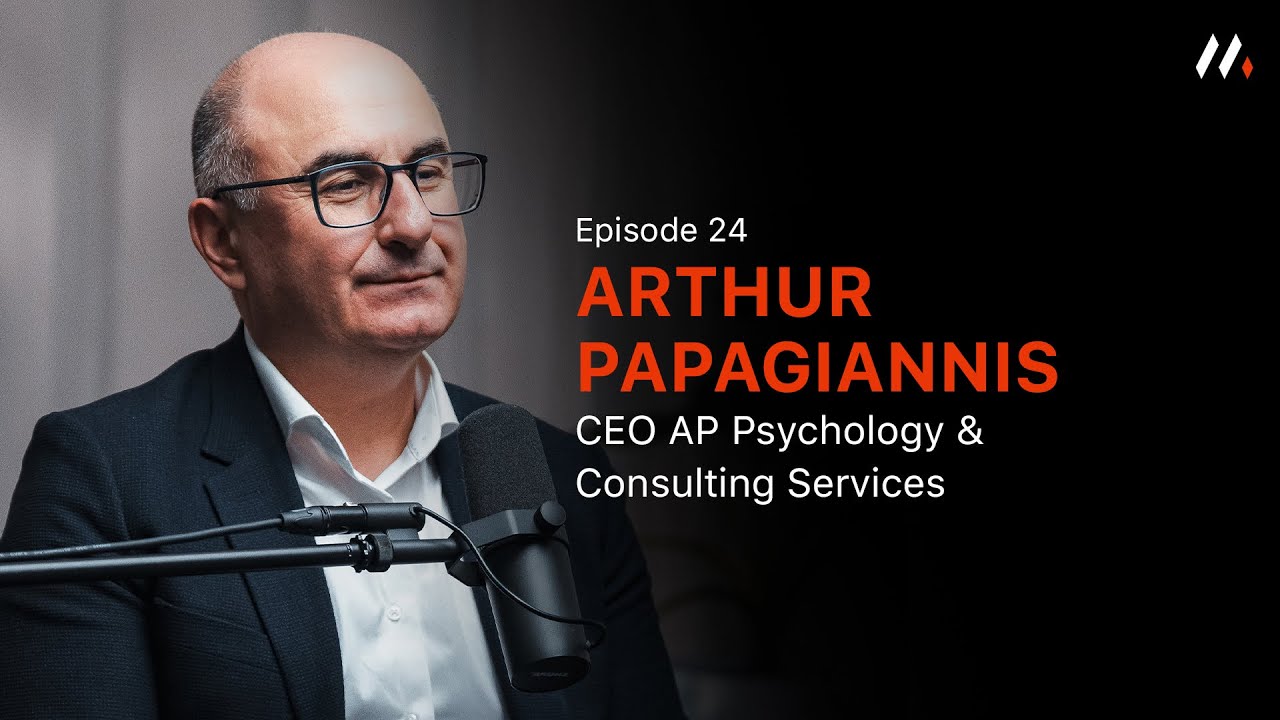
In this interview, host David Lewis talks with Arthur Papagiannis, CEO of AP Psychology & Consulting Services, about the importance of mental health in the workplace and how leaders can foster a culture of care and compassion. Arthur explains mental health as a continuum—everyone is always somewhere on it, with 1 in 5 people experiencing a diagnosable condition. He outlines observable behavioural cues (withdrawal, fatigue, cynicism) and stresses the need for authentic, compassionate conversations. The discussion covers the impact of COVID‑19 and technology on isolation, the distinction between psychological safety and psychological health & safety, and practical leadership principles: (1) lead with care and compassion, (2) be transparent, (3) truly know your people, and (4) notice behavioural changes. Arthur shares concrete interventions such as the “Healthy Heads in Trucks and Sheds” program, humanising roles, job‑design tweaks, and a 18‑month experimental study that showed significant improvements in psychological safety, distress, and incident rates when leaders applied these principles. He provides actionable tips for one‑on‑ones (well‑being barometer, open‑ended questions, memory aids) and emphasizes that caring leadership not only meets legislative requirements but also drives business performance. The interview closes with personal reflections, a favorite quote, and rapid‑fire preference questions that reveal his values.
Chapters
Saying, Arthur, you look tired, what's going on? Or, you know, I've noticed you've been really cynical. It feels like I'm insulting you asking you about your mental health.
Well, that goes to, I always believe, being an authentic and genuine leader in what you do and approaching things through a lens of care and compassion. Because if you bring that care and compassion into your conversation, it allows for a level of connection. People aren't often looking at the language or the words, even though they're important and they can play a big part really, they're reading the authenticity and genuineness in which you're approaching that conversation.
Arthur Papagiannis, welcome to The Mentor List.
Thank you for having me. Great to be here.
Well, it's, it's great to have you on the show, and we've got a big, bold topic today. Um, and maybe the first question's just to sort of big and bold and looking forward to seeing where you can take it. But Arthur's the CEO of AP Psychology and Consulting Services, so I couldn't think of anyone better to have on this topic today, which is around leading with care and compassion. We've had Arthur presenting and working with a lot of our C-suite and CEO Mastermind members across Australia, so seen you in action and looking forward to today's conversation and where it might head. So Arthur, Very broad, open question. Looking forward to where you take it. What is mental health and why do you think it's important?
Yeah, it's a, it's a great question and one many of us ask. But, you know, if we just think of mental health more broadly, 5 in 5 of us have mental health. You know, that's our cognitive state, emotional state, physical state as well. We're intertwined within all of that. 1 in 5 of us will often present with a mental health condition. So that's more so a diagnosis. And when we think about that, that refers to struggles to cope day to day, do the things you would normally be able to do for an extended period of time. So it kind of has a bit of a debilitating impact. And 4 in 5 of us can really sit anywhere on that continuum of Mental health and wellbeing.
And do you mean 5 in 5, like we're always got some sort of, we're always somewhere in that continuum? Is that what you mean?
Yeah, spot on.
Yeah, yeah, yeah.
We're all on that continuum. You know, we've all been there, you know, where we might have had some struggles with sleep. We're thinking about work. There's a bit going on. There's the children, there's relationships, there's finances, you know, thinking about the current economic climate. The world, things going on, those things can have an impact on us. And if we don't get a good grasp or handle on that, that can lead to something that can be a little more impactful or debilitating.
So when we talk about— so you mentioned a couple of sort of factors that lead to that. It's a pretty— like if you're sitting beside me, you've got a cast on your leg or a bandage on your arm, I can see that there's a, you know, you're on a continuum of a physical, you know, you've had an accident or something and that's very visual for me and I can pick up on those cues.
Yeah.
But from a mental health perspective, I can be looking at you and I'll, I actually don't know if you're where, where you are on that continuum and what the elements are that feed into that. The physical body, I can see you're all able and you're walking and fine and you seem to be moving around, but So legs good, arms good. What are the components in mental health? And then how would you be able to maybe check in on someone or check in on yourself, for example?
Yeah, and it's a—
Sorry, long question.
No, no, a really good question. And it's great to draw parallels to physical 'cause it's somewhat similar in many ways. It's just getting our heads around what does it look like from a mental health perspective? Typically, you'll see some behavior changes in people. You might see that, you know, they become a little more distracted or forgetful.
Right.
One of the most common things you'll see right up front is withdrawal and isolation. So, you know, think about just your day-to-day life. If you've had something significant happen or you've got some struggles, you don't really want to connect with people. So you start to see some of those behavior cues, people kind of starting to pull away a little bit. If they're thinking about things, they tend to turn quite insular. They might start to look a little fatigued, tired, a little cynical sometimes if they're not typically cynical. But you start to see some behavior changes and that's ultimately what we're trying to get across and understand a little more as leaders, I guess, day to day in the context of a workplace.
Yep.
But also out in the community as well.
it just seems a bit more sort of sensitive. So let's say we follow that scenario. So Arthur, you've just come in, you know, am I insulting you saying, Arthur, you look tired, what's going on? Or, you know, I've noticed you've been really cynical lately.
Yeah, yeah.
Like, is there ways to talk about that? Or I don't know, it feels, It feels like I'm insulting, like it feels like I'm insulting you asking you about your mental health or trying to get into that area.
Yeah, I understand that.
If that, yeah.
Yeah, it's, well, that goes to always believe being an authentic and genuine leader in what you do and approaching things through a lens of care and compassion. 'Cause if you bring that care and compassion into your conversation, It allows for a level of connection. People aren't often looking at the language or the words, even though they're important and they can play a big part. Really, they're reading the authenticity and genuineness in which you're approaching that conversation.
Right.
So, you know, I could come up to you and go, hey Dave, looking a bit cynical today. Now, depending on how we know each other.
Probably am.
Yeah, yeah. Or, you know, you seem a bit, you know, distant today. You know what's wrong with you? That's probably not going to go down too well.
Yes.
But if we lead with care and compassion and I go, hey, you seem a bit distant today, is everything okay? You know, you might lean into that, you might turn around and say, no, everything's fine. And I might reply with, okay, just thought I'd check in. You know, it's not normally what I see. And you may not get an immediate response because sometimes for people that can take time. I talk to this a lot in workshops I deliver or with leaders. Sometimes it's I typically find, and it's not through any kind of research, it's just probably more experience, it's about the 3rd or 4th conversation that we really start to see the opportunity or the opening up. As humans, we often try and contain our issues. I'm okay, I'm okay, I'm okay. No, I'm not.
Yep.
And the importance of being able to develop comfort and confidence in having those conversations early on means that at the right time you can be there for people. But it's for many of us today, we're trying to get our heads around that.
Yeah.
And what do I say? What don't I say? What's okay? What's not okay? Am I prying into people's lives? Not prying, you know. And—
Well, yeah, that's a good example because with COVID everybody, oh well, if you were working in the office, now you're working from home. And you mentioned before about Withdrawal and isolation, which I think is probably a bit easier to pick up on when you're physically with someone in the office. So I guess mental health, how did that sort of play out through COVID and how did you see some of your engagements you're working on? Was there, you know, is that, are we still recovering from that or what's your sort of view on that?
Yeah, it's one I reflect on quite a bit. I think clearly COVID had a big impact on all of us. I believe it fast-tracked our knowledge and awareness of mental health probably by about 5 or 6 years because we're all impacted in some shape or form, whether that be through losing people through COVID to working at home and juggling children, family, kids, new ways of working, the work environment, detaching from work.
Yeah.
And, you know, that's all made it quite challenging. COVID is a trauma we've all gone through in many ways. We often talk about pre-COVID, post-COVID.
Yep.
That period, the world was slightly different to what it is today. And, you know, through that, we've also seen many people not having accessed health support during that time. So we're seeing the aftermath of a lot of that. And equally mental health impacts. So if I was on that continuum of maybe not coping as well and now I've isolated myself over that, you know, those few years, you know, am I struggling to come out of that coming back into the workplace? But at the flip side of that, it's also created some positive opportunities, you know, greater connections with family, what's important to me. Is work the only thing?
Yes.
You know, and I still think back to the days Pre-COVID, I'd get on a flight, go to New Zealand for a 2-hour meeting, and then fly back. The thought of that today is just, you know, it would never go there unless it was clearly necessary.
Yeah.
And this was happening, you know, week after week. But I think what it's created as part of an aftermath is us working differently and living differently. And something that's kind of front of mind for me a lot is the risk of creating loneliness today. And there's a lot of talk around that because we've got the flexibility to work differently. I'm conscious, or I think about the risk that we run of creating a siloed world in the way we work, a disconnected world. So how do we put that front of mind? Because we know that that's one of the biggest contributors to poor mental health.
Yeah, I guess technology being a big enabler of allowing us to do that, I guess it also has its side effects. And what are some of the— I don't know, is there any tips or tricks that you see that can work well with these weapons of mass distraction that we carry around everywhere and we always seem to be on?
Yeah.
From a mental health perspective and some of the things you're seeing, what's your sort of advice or summary around that kind of—
Yeah, mine's probably balance. How do you take a balanced approach in all of this? Technology is great, it allows us to connect, it allows us to engage in ways we probably couldn't have done 10 years ago. I was just sharing the example of travelling, I can FaceTime with my family and kids, we We can spend time having even dinner if I'm in a hotel room together. So it allows for those opportunities, but at the same time, if we consume our lives with technology, clearly that can have an adverse impact. So it's becoming a little more deliberate and thoughtful around technology, how we use it, when we use it, and when we need to disconnect from it.
Yeah.
You know, if we even think about, you know, schooling, bullying, the extension of that going into the workplace through digital means, means it can become a little more relentless for, let's say, children. Whereas probably back in my day that may have existed, it was at school, but I'd come home, lower levels of technology, connect with family, the safety there, which gave a bit of reprieve possibly at the same time. If I think about it from a workplace perspective as well, you know, it's how do we make sure we create depths of connection, not just transactional connection. Technology can sometimes be slightly more transactional.
Mm-hmm.
I feel we're gonna become exceptional project managers and leaders 'cause we kind of deliver, you know, through virtual means you can deliver it a bit more like a project management flow process. So how do we bring in more depth of connections? So that could be even a phone call. That could be, hey, let's have this meeting face-to-face. How do we mix that up?
And is there any areas or generationally, did certain generations do this better or more organically, or is there certain industries and maybe referencing the great work that you and the company have done with Healthy Heads in Trucks and Sheds? It'd be interesting to sort of get a bit of a summary about what that was about, what was sort of driving it, and maybe some of the realisations or things, outcomes you could share.
Yeah, I mean, Healthy Heads in Trucks and Sheds is an amazing foundation. It was set up for industry by industry with a view to really tackling the mental health challenges the industry faces. And some of those challenges are in the transport logistics and distribution centre space is long levels of isolation, disconnection, fatigue, critical incidents. They have some of the highest rates of mental health conditions. So a group of CEOs, Paul Graham being one of those who kind of championed this from the outset, kind of brought some key players together to make an impact on industry. with a view to educating people on mental health.
Mm.
So people have that awareness and understanding, 'cause I think that's the first step in all of this, having an awareness and understanding, and then championing change through education, technology, putting initiatives and activities to decrease things like isolation and disconnection right through to healthy eating habits. Truck drivers stop at various petrol stations and moving some of the healthier foods up front, giving them discounts on healthier eating habits.
Yeah.
Right through to facilities where they can stop and pause and take a break. And even pre-starting all of this work, something that I wasn't aware of and conscious of when you go to the the truck stops, you'll often see people parking in the truck bays.
Right.
And what that can often mean is a truck driver can see that that's happening and they go, I won't stop at this truck stop because there's nowhere to leave my truck and I'll keep going.
Right.
Which ultimately increases risk.
Yes.
Within that, which increases fatigue, you know, and then the probability or the higher risk of an accident occurring. So all of these considerations were laid out and going, hey, how can we make a bit of an impact here? How can we contribute more positively, create awareness, champion the change in that space?
Wow. I mean, yeah, it is quite— when you sort of break it down like that, there is a lot that goes into that. And when you're sort of listing those items out, you're right, the environment, wasn't really setting them up for success. And some of the demands of moving carriage, I mean, couldn't think of anything more isolating. Also makes me think why they're so active on the CB radio when you're sort of driving out through the country, 'cause what a great way to sort of connect with your other, or a peer group of people on those citizen broadcasts. So yeah.
And even humanising roles, if I go into the distribution centre space, I was running a couple of workshops with some leaders in that space, and it was about how do we lead with care and compassion? What does that mean day to day? How do you build that into the way you operate every single day? And we're about 3 quarters of the way in, leaders were grasping it, we've got to do this better. And then on the loudspeaker, we hear something along the lines of, can 1478 come to the front?
What?
Come to the office, please.
Wow.
And you could see how unhuman that was.
Yeah.
And there was just this light bulb moment from everyone. Why are we calling people by numbers? I worked in prison for a good 8 years.
Yes.
And, you know, there were numbers attached to prisoners. So that dehumanizing, how do we humanize people's experience day to day? I mean, that's an example there. And that was a quick shift and change. How do we call people by their names? Is it only on loudspeaker when somebody's in trouble? And how does that change right through to pickers in those roles hearing numbers every day when they're loading up pallets, box 148, 149, 147 for 8 hours straight, quite isolating.
Yeah.
So how do you create a level of connection within that? Right through, you know, the way they do their breaks, the way their supervisors check in, to humanising that role.
Yeah.
When it's quite automated.
And just maybe a follow-on question with that. So, you know, chasing business performance versus, you know, having a caring work environment, are these— is business performance and care for the team and staff, are they mutually exclusive or are they like, It'd be interesting to get your perspective around what the best approach is with those 2 dynamics. Are they, is it one or the other? Are they both?
Yeah, I don't think you can have one without the other.
Yep.
I believe that's the reality. You know, every day how do we lead with care and compassion? And you've heard me say that a couple of times now and I deliberately say care and compassion 'cause you can say you care. Compassion's a demonstration of behavior.
Right.
In doing that, we need to make sure we're clear on success measures for people, accountability is brought into that, but we'll always lead through that with care and compassion. So I'm going to always be really clear on having a conversation around performance with people, but I'll overlay that with care and compassion when I do that.
Yeah.
I don't have to be rude about it. I don't have to be angry about that. But I'm going to be very clear around expectations, but always through the lens of care and compassion. In doing that as well and leading with care and compassion first and foremost, you create the opportunity to understand first. So if I have a performance concern of somebody, I'll always start with, hey, I've noticed Is everything okay? It could be I've noticed you've missed a few deadlines or you've been late on a couple of things. I just want to check in with you. Is everything okay? I'll put the human first.
Yep.
That allows me then to understand. That might create a discussion around, hey, I've actually got a couple of things going on. Now I've got context as a leader, which becomes important.
Yeah.
I'm still going to address what I need to address, but I've got a better understanding of the lay of the land and what's actually going on, which allows me then to transition to, or address that and support the person clearly if that's what's needed, and then transition to what does it actually mean from a workplace perspective? And you'll often find you get better outcomes that way because the person on the receiving end says, you've put me first. I'm more willing now to engage with you and probably resolve and troubleshoot the best way forward. Whereas where I can see us or leaders often getting it wrong is they start with, you've missed 4 or 5 deadlines, what's going on? And they can get into a bit of a battle because then the employee gets defensive, which then can mean the leader gets defensive and it kind of can go down this path that can become quite challenging to kind of recover from.
Which, yeah, if you sort of generalize most, well, if you generalize a one-on-one in a corporate-style situation, I guess the demands of the role and the business would put the actions and items up front. And I can certainly see this playing out whether I'm the manager or the person who's employed into that individual. But yeah, usually it's all about outcomes, what's missing, more of this, more of this, getting involved in more of whatever it is. And then at the end it's, oh, how are you going by the way? It's like, good. Okay, good.
Yeah.
What's the actual question that you would ask? Because I was thinking about that before we sort of started chatting, like, thinking about, you know, how do you come onto sort of social cues? And I imagine emotional intelligence got a lot to do with this, but how do you have a conversation? So we mentioned before, I can see you got a broken leg, that's easy, it's a cue. Tell me about the leg, what did you do? We could laugh about, you know, maybe it was something funny, but—
Yeah.
How do we, how would you go about having a sort of conversation about mental health?
What's that one? Yeah, look, I go by 4 good leadership principles, or principles probably more broadly. I've shared this one quite often in our conversations so far. The first one I talk to is lead with care and compassion. Fundamentally, I believe that's 80% of it. Am I bringing care and compassion in my dialogue and conversation? Am I creating a culture of civility, respect, and care and trust in how I lead every single day? Now, sometimes my care barometer might be a bit off, but that's about me recognising that and thinking, gee, I better not have that conversation with Dave today because I'm not in the best place for it. So that's that self-checking, but that leading with care and compassion is a real big driver. The second principle I like to draw on is Being transparent in the conversations and interactions you have with people. Don't say things like it's gonna be confidential and then you go into the office next door and say, you're not gonna believe, I'm using you as an example again here, Dave.
Yeah.
But, you know, what Dave just shared with me, 'cause that's where things can really go wrong. 'Cause then that person, which may be my manager, walks by 3 weeks later and says, hey Dave, I hear you're not doing too well.
Right.
I've said it's confidential. All of a sudden you're thinking, what are they talking about? Are they planning on getting rid of me? And all of a sudden that can play out in a whole range of ways. I kind of eliminate that word of it's strictly confidential. But what I will say, and it's about being transparent, I'll say, look, I'll respect your privacy. I want to make sure I'm managing it in the best possible way. I wouldn't mind letting my manager know just some of the things we're trying to work through together. What are you comfortable with me sharing and not sharing, Dave? And you might go, oh, can you just say it's something private going on at the moment, but I'm struggling a bit. Or maybe don't include this, but I'm comfortable with you sharing A, B, and C.
Yeah.
So we're negotiating that. So every step of the way, I'm taking you on that journey.
Yeah.
The 3rd learning principle I like to pull in is get to know your people. And that's going to go to the broken arm. Principle, the more you know your people, the more you build trusting relationships, connected relationships, and the opportunity to notice changes. I'll often ask leaders, how much do you know about your direct reports' personal lives? And I'm not saying learn all the ins and outs of their personal life, but do you know if they've got kids, their names, what their hobbies are, their interests are? We're taking a personal interest. in the people we lead every day, 'cause that pays dividends when you need to. If we know our people, we've built a strong connection. It goes to my 4th principle, which is noticing changes in behaviours. You're more likely then gonna notice any changes in behaviours, and that's what we're looking for when we're talking about mental health. Even as a psychologist, if I put that hat on for the moment, I don't greet my clients and say, how's your depressive disorder today?
No. Yes.
You know, it's a bit of a conversation stopper. It doesn't really go anywhere. But I will say, hey, you know, how are you going with the strategies we put in place to help you manage your sleep? Is that working? Not working? Put that in a workplace context. You know, last time we spoke, you said you were, you know, struggling a little with fatigue. You know, we've adjusted a couple of things in work to make that a bit easier for you 'cause you've got a couple of things going on at home. Is that working, not working? So you can see I'm tackling the behavior rather than the diagnosis. And if we translate that to physical, you know, I don't greet, you know, let's say someone's got a back injury, I don't go, you know, how's your L5 disc today? You know, usually you're saying things like, hey, how's your back going?
Yeah.
You getting treatment and support for that? What does that look like? But for some reason when it comes to mental health, we fear it. We think, hey, if I ask the question, am I have to— do I have to become a therapist, a counsellor? And I say, yeah, you want to ask the question, you want to understand, but then your role as a leader is to coach them to the right supports and resources, whatever that might be.
Yeah, and I think that boundary between work life, home life post-COVID is certainly become, well, the line doesn't become closer, but maybe there's a blurring of those conversations. Is that what you are seeing? So we're more involved in someone's life as opposed to it's 5 o'clock, I'll see you tomorrow.
Yeah, it's a little more intertwined these days. Even pre-COVID, you'd hear things in leaders I'd be engaging with, oh, they just, that's their personal life, they need to leave that at home and this is work. And I was constantly challenging that concept with people. Okay, someone breaks their leg on the weekend or strains their leg and they come in on the Monday and they can still work. Do you say to them, hey, you strained your leg on the weekend, you can't come into work, or that's personal, you need to leave your leg at home? Because that happened outside of work hours. We probably wouldn't.
Yeah.
But we would do that with mental health. Now it's become slightly more intertwined. Because many of us are working from home, also the office setting. So establishing those boundaries and clarity can become a little more challenging for people. But we need to factor all of that in now.
Yeah, right. And just on your second point there, or your second principle around being transparent, I sort of got the feel that that was about creating almost a safe space And maybe you can help me just explain if there's a difference between psychological health and safety and psychological safety. Are they the same thing or is there a difference there by adding the word health and safety?
Yeah.
Yeah, I'd be interested in your take on that.
Yeah, it's a really great question. It's, we see both of these terms being showcased quite a lot, and they're quite different from one another. So if we think about the concept of psychological safety, Amy Edmondson's really kind of championed that more recently over the years. And what that means is creating the environment where people feel safe to share thoughts, opinions, views without any fear of retribution. or consequence within that. So in that second principle, it is about creating that safety, that environment that if I share or if you share something with me, Dave, I'm going to treat that with respect. I'm going to create a safe environment for that and there isn't going to be a consequence associated with that, which is a really important factor and construct When we talk about psychological health and safety, we're talking about the mental health and wellbeing of the work environment or the environment of which one concept or factor is psychological safety. So what are all those different factors that prevent harm to our people, protect our people, and support them during recovery? Psychological safety is one component of that. Other components within psychological health and safety might be job design. It could be broader culture, it could be leadership, it could be early intervention. So there are a number of factors within that, and these concepts can get a little confusing at times, but it's important to distinguish between the two.
Yeah, it's an interesting one you mentioned, job design there, because If you're— I mean, I imagine if you're working in a company that's creating a crappy product and you get it, you're working in the complaints division. I mean, I can't imagine that construct and job design. You're sort of— how are you— how do you go from that, attending that each day, to then move into this sort of other space? You'd want to have a lot of influence from other factors, I would imagine.
It's a good example. Even if you look at that, so let's say it's complaints, crappy product, constant complaints around that, which can take an emotional toll on people. So when we look at that from a psychological health and safety perspective, we can say that can potentially be a risk factor. Creating psychological safety in that environment becomes important.
Yeah.
So can that person approach their leader and say, hey, I'm struggling with this. I've had 20 really terrible phone calls in a row. So that's one component of that. How do we create an ecosystem of support around that? So let's say we've got the role, could be, is there good leadership? Can I approach my leaders? Job design, are there things we can put around the role to protect it a little? That could be role clarity. how they debrief people post-session or post a phone call right through to early intervention. Do leaders regularly check in with their people? So in their weekly one-on-ones, they're saying, hey, how's your week been? You had quite a few challenging calls. So all of a sudden we're putting an ecosystem of support around that.
Yeah.
And it's not just one intervention. 'Cause you may not be able to tackle them all. The reality is you're gonna get inbound calls maybe of complaints. That's the reality.
Yeah.
But once you've got the ecosystem around that, we know that they become protective factors. So I can have those inbounds, but I know I can go to my leader, the culture's good, they check in with me, they gimme some skills-based training. Anything does happen, they support me well. And all of a sudden we've created a psychologically safe and healthy work environment.
Right. And just another example that came to mind, which I think was yourself that mentioned it in a session, you're working with, I think it was a transport logistics business, and one of the jobs was effectively moving things around a warehouse, but very little connection with the end.
Yeah.
I guess connecting with the purpose of what they were doing, because they had a job that was to move things and structured around so it could get to the next destination. I think it was you, I'm going out on a limb here, but there was a sticker initiative. Was this something that you were involved in that you might be able to share?
Yeah, and that's about roles that can be quite isolating at times, lacking some of that human connection and also purpose. Why do I do this? this role and how do we create a sense of purpose in roles that can, where people might feel like they don't quite have that. And one way that led to creating some of that was looking at some stickers that could be put on there that say you're feeding X hundred families, you are contributing to watering. X amount of plants. So it ultimately then started connecting people to the greater purpose of what they're doing. So what could feel like a task where I'm loading pallets in particular ways and that's all I'm doing, it led to, hey, I'm actually contributing to something greater. And as humans, that's what we're often seeking, that greater purpose.
Yeah, fantastic. So I was sure it was you. I've had the pleasure of sitting in on a couple of sessions with you now. working with some of our executives. Next question, just sort of coming back to maybe the 3rd of your 4 principles, getting to know your people. And I've seen this play out in different ways around feedback in the sessions. I always admire those individuals that come up to you, you haven't seen them for whether it's 3 days, 3 months, 3 years, and they come up and say, hi Arthur, how is your wife going? They know your wife's name. They know potentially where one of your kids are in school, and they have some other information about you that makes you think, wow, this person really— Well, coming back to your first point, care and compassion, and I know this is not in the leadership sense, but is it— do you think there is a system and process that sits behind that? Are they born with that gift? How do you sort of, how would you support someone getting to know your people? If we use me as a guinea pig again, I'm in one ear and out the other sometimes.
And—
Yeah. Hi, I'm Dave Lewis. And it's like, I immediately, like my brain just does not grab the information and I can recall it at the right time. So is there any, Anything you can offer, well, me and the listeners too, that you've seen work well or any role modeling or anything you can help us with.
Yeah, yeah. I'll kind of have 2 parts to this. One, let's look at it through a workplace setting because you're connecting with the same people regularly.
Yes.
So that is being deliberate as a leader and saying, hey, I actually care about my people. I want to learn a little more about them. Get to know them a little and build that into my leadership, which is about being a good human being ultimately. It's not just about work, it is about the connections we form with our people and empowering our people. So putting that at the forefront allows us to strengthen those relationships with our people every single day. And also creates the opportunities for conversations when they can be a little trickier or they've got something challenging going on in our lives to have. Compared to the leader that doesn't really quite— doesn't really want to get to know their people, they're quite transactional in nature. It's about performance and outputs, and I don't really care about what my people do, how they do it. Unless it's specifically related to work and performance. And that in and of itself can make it harder for the leader because they tend to come in heavy-handed when something isn't working well because they haven't got an established relationship.
Yeah.
Or even if they're trying to tackle it, it becomes harder because again, they haven't established that relationship, so they have to work harder. So in the context of work, investing in that front end, the relationship, the rapport, or your people pays dividends. Now, if we look at it from a social setting and meeting people for the first time, I'm someone who probably has the same challenge as you at times.
I do.
Someone mentions their name and 5 seconds later I've forgotten their name within that because we can be distracted at times. It could be we're uncomfortable, it could be the environment or I'm thinking about something else. And something that can be quite helpful is deliberately preparing before you go into an environment, whatever that environment might be. So how do you park whatever might be on your mind? That could be a couple of minutes. That could be, hey, going into this social setting, there's gonna be a lot of new people. Arthur, stay present in this. What have you got on your mind at the moment? Can you park that, leave that? I'm just mentally preparing.
Yep.
And then I might even say things like, okay, I'm gonna meet some new people. I wanna make a conscious effort to remember their names. That in and of itself helps. But then, you know, a little trick I kind of have up my sleeve is trying to use multiple parts of my brain. So one is clearly, you know, them mentioning their name, but I might think about a feature on someone's face. or body to connect the name to that feature, and that's just an association tactic. So what that allows for is a memory then.
So something you're visually seeing, like—
Yeah, that's Arthur with the glasses.
Right, okay.
I'm more likely to remember that person's name next time around. Or Arthur with the bald head.
But that helps though, because I mean, anybody could have glasses, but You associating Arthur with glasses helps you recall the name, your name.
Yes, it might be next time around, it could be a couple of weeks later. Yeah. And I see that person, the fact that they've got glasses, it can activate the memory.
Yeah.
Around that. And just by finding out a little more about them, you know, walking away and going, what's that? What are the one or two things that I'm really intrigued about what they shared? And again, that connects back to the individual 'cause you're deliberately placing purpose or you're being purposeful in wanting to know more about that person, you know, and their life or whatever that might be, which increases the probability of memory.
And that's different parts of the brain you basically get. I often recall a lot of the conversation, but the name doesn't connect with that conversation. I can see, an individual and know, oh well, there's 5 things that are really important in their lives at that moment. But I couldn't say, oh, that's Arthur Papagiannis, for example. But are they different parts of the brain?
So yeah, you feel that connection. Yeah, you're using your, you know, the auditory part, the creative part. So you're just trying to bring the different parts of your brain together.
Yeah.
'Cause that's what adds strength then to memory. And it could be as simple as, 'cause you might be someone who remembers the whole conversation, But it could be as simple as at the end of that recalling all of that and going, and that's Arthur Papagiannis with those 5 things that I learned about them. So it's just again deliberately repeating the name within the context of the conversation, which can help recall. Doesn't mean it always will.
Yeah.
I still have, you know, some parents at school school and I'm constantly asking my wife, who's that person again? Sorry, who's that? And my wife will keep saying, you've asked me like 20 times. And there's always that one person I can't quite get right, their name right.
Yes, I feel your pain. Oh, fantastic. You mentioned, I guess, something just in noticing changes in behaviours and getting to know people. But also you mentioned sort of, you know, not having it as a transactional sort of exercise, getting to know people and keeping it humane. I guess there's not many board packs at the moment that doesn't have health and safety on it as a key metric. And this is something that's been going on for probably— I feel like health and safety slips and trips, you could look at it and it'd be a red, green, amber. And there'll be an expected amount for next month and an expected amount for the year, and there'll be a historical categorisation of, of these, which obviously has things like WorkCover claims and implications sort of in that sort of direction. And whilst it is somewhat of a tick box exercise, there is a positive humane impact that people aren't getting injured at work. Um, and again, it comes back to that's easy to see. Did Arthur fall over? Yes, no. Okay, if it was yes, then there's an incident form that's— it's quite a well-structured, I guess you could say, and thing, machine that, that, that, um, has the right escalations and things. So where do you see sort of mental health with that as an example? Are we following in that example? Is it a new— dashboard in a PowerPoint pack, or is that happens, are we missing the point? Um, you know, is this on the WorkCover claims agenda and how does that differ from a traditional, uh, claim that they may have physically?
Yeah, yeah.
So a lot of questions in that.
I'll try and answer all of those. Um, the first one is, you know, a physical injury or the reporting of physical physical injury has been around for some time. It's matured over the years. But even if you go back, and I'm going to use a personal example here, my dad died in a workplace site.
Right.
So he was someone who didn't come home from work one day having a fall. Pre that incident, he also had an earlier incident. In the '80s where he fell off a 2-story building and scaffolding at that time wasn't a legal requirement.
Right.
Which we think about it today, you go, how can someone be on a 2-story building and that not exist? Now you could not go into a workplace with that.
Yeah.
Wouldn't be present.
Which is seen in third world countries and you just, it looks so ridiculously dangerous and foreign. Yes.
So just looking at that, we've matured over time, but accidents still happen. We know that. Whereas mental health, it's been part of our acts and legislation since about— well, in Victoria in particular since 2004 and similar across other states. But it was always one line. Look out for the physical and psychological safety. If you'd go into a workplace, there's documents on risk assessments for physical and you look at psychological, there'd be one line. psychological health and safety. No one really knew what it, what it meant.
Yes.
You know, and what we're seeing probably over the last couple of years, the regulatory bodies have really advanced that and said, hey, it is part of the Act. It's been part of the Act for some time, but now we're publishing some codes of practice. This is what we expect workplaces to be doing.
Right.
So we're taking people on that journey to mature people's awareness, education on what is this comprised of. The questions you're asking, how do we look for it, what does it mean, what does it mean in a workplace context, and they've spelt a lot of that out.
Right.
So now a lot of workplaces are saying, gee, how do I do that, what does that look like, gee, it says workload in there, how do I manage that in a workplace? You know, everyone's different, everyone manages workload differently. So how do I actually capture that? What does that truly look like in a workplace? And we're trying to— workplaces are trying to get their head around it. So it's allowing us to mature, to go on that same journey as physical. And I think, you know, over the coming years, we'll just get better and better at that.
Yeah.
And it goes back to my earlier conversation. It's not always about being able to completely eliminate things. But let's say if I use the example of workload, workload could be high, but I'm still okay. So it could be a hazard, but it's not a risk. I go, yeah, I know there's always a lot to do, but I'm okay.
Yeah.
There's a lot to do forever in many ways, or there's a lot to do, it exceeds my personal capabilities, the duration of that is consistent and the frequency around that, which is having an adverse impact on me. So then a workplace would go, okay, if that's the case, what's actually contributing to that? And that could be a poor system. I'm using this database that's archaic and I'm having to do 3 times the amount of work. We all smile when we hear that because the spreadsheets get pulled out or whatever it might be, and it's overly onerous. So that creates a level of stress. Within that, we go, okay, but it might take 2 years to upgrade that system. So that's still contributing to that stress. But we can build protective factors around that. And that's what I was talking to a little earlier. But is there good leadership capability and support around that? So can my staff still talk to me about that workload? Am I going to say, hey, how are you going with that? What are your pain points? How do I help you readjust that? What does that look like? I know we're upgrading the system or we're not quite there yet. What are you doing now? How do we reprioritize? They're all the great questions to ask as a leader.
Yeah.
Have I created the right culture around that? People feeling safe to put their hand up. A lot of times if people just know they can put their hand up, it alleviates stress and they may never come to you. It's when I know I can't that my anxiety levels go higher.
Got it.
When you know you can't speak to your leader, that's more stressful than knowing I can, And I may choose to access it or I may choose not to around that. Coping, are we giving our people the right coping skills? Are we intervening early? So you can see I've put a bit of a protective factor around workload.
Yeah.
Even though the system upgrade might take 2 years.
Yes.
Compared to system upgrade for 2 years, can't speak to my leader, culture's terrible, not addressing any of the work design challenges, no one ever checks in with me. Well, guess what? That's a workers' comp claim waiting to happen.
Yes.
So when we look at that from a regulatory perspective, it is taking a bit more of a systemic approach to it. And it's about being able to showcase, hey, what are you doing to mitigate that as much as possible? And that's why I go back to the fundamentals a lot of times. Lead with care and compassion. If you lead with care and compassion, you're more than likely adhering to all legislative requirements.
Right.
Why? 'Cause if I care, I'm gonna have a conversation about that with you typically. If I don't care, I'm probably not. If you think of discrimination.
Yeah.
If I don't care, I'm gonna make decisions never consulting you. If I do care, I'll consult and I still might make the decision I need to make, but I've consulted. So you can see how that principle is a very powerful one because even if you're not across a lot of things, you're more than likely gonna be doing the right thing.
And self-fulfilling in some ways because I think you mentioned the subline of being a decent human being is all part of leading with care and compassion. So if you're being a decent human being, surely your own mental health and wellness and psychological health is moving in a good direction. So just on, I mean, yeah, we're sort of getting into a bit of an area where, I mean, I don't know, we've probably got a bit of an auditor community listening in and they're thinking, okay, this is going on the risk register because are we, yeah, how does a company or a manager or someone that's sort of looking at getting better in this space for all the right reasons, not have it turn into, I guess, a litigious strategy where, Arthur, we're rolling out a health and safety, you know, we're going to really stretch out because the regulator is getting a bit more prescriptive on the requirements and what they expect. So we want to have all these green boxes ticked so that we are not exposed to a, WorkCover claim, which sounds a bit robotic, transactional, and certainly not in the spirit of what it's about. But yeah, how would you sort of— what advice would you give someone that's starting to set that up? Because it sounds like it is early days, so there is a bit of shaping for it to happen.
Look, we've got legislative requirements. That's the reality. But that shouldn't be our only driver. And I know I keep harping on this, be a good human. How do we create humanistic cultures? Because it allows us to move upstream to go, well, what do I want this workplace to really look like? I want my people to be their best. I want them to come in healthy every single day. I want them to be productive. I want morale to be good.
Yeah.
I want good productivity at the end of this business performance, individual performance. people being present every single day. So what are the levers we need to pull to create that? And that's what this really ties into. And that's kind of coming back up and going, okay, we're conducting these risk assessments to recognise and identify what the risk factors are within our workplace, but then we're building it into our overarching strategy.
Yeah.
'Cause if I'm recognizing a risk factor is my people are exposed to traumatic events every day, that's a risk, inherent risk factor. Okay, what am I doing to protect my people? So you're kind of elevating it back up. I can say, well, okay, that's a risk factor and I need to make sure I'm adhering to the legislative requirements and ticking the box. But I think it goes beyond that.
Yeah.
And going, okay, there is a risk. We want to make sure people go home safe safe every single day, whether that be from a physical perspective or psychological perspective. How would you want your son, daughter, loved one to be treated in a workplace? Ethically, respectfully, humanely, in a decent way. So how do we build that into our strategy? Well, that ties into how do we build a good culture?
Yeah.
It goes to the concepts I was talking to earlier. a culture of safety, good policies around that, good support mechanisms, organisational justice. When something happens, the workplace takes the right action against that. We tackle some of those work design challenges. Yes, we're not going to get them perfect, but we're making attempts to tackle those things rather than this is too hard, we'll let that go.
Yep.
To good leadership. I mean, the success of all of this hinges on leadership a lot of the time. How do leaders set the standard on this? It's 80% of it. That's the reality. Because if leaders come in with the right mindset, culture, approach to this, everything else kind of starts to flow on from there.
You mentioned that metric of 80% before around if you get the first principle, lead with care and compassion, you're there. So I think we're getting a bit of the secret sauce. Thanks, Arthur. No, I think you're absolutely— I mean, it makes sense just listening to sort of how you've answered that. I mean, you know, the, the great initiative of Healthy Heads and Trucks and Sheds— you don't get innovation and ideas around, well, let's get the healthy, let's look at the diet, let's look at, um, you know, how long— and even finding out about if cars are parked where they can't park, they'll skip ahead, which puts them in further high risk. That goes so beyond what the checkbox exercise is of of the regulatory requirements. So yeah, I think it's, well, it's much more impactful, I guess, the approach that you are suggesting and that you're working with clients on.
I can share a bit of a case study if you don't mind.
Yes, please.
You know, this was again in a distribution centre space. We seem to be picking that work environment, but all equally very relevant. And it's not often you get the opportunity to, do a piece of work where it's run like a bit of an experiment. And what I mean by that is you have an experimental group, a control group, and baseline measure at the front end, back end measure, hopefully with some performance along the way.
Yeah.
We had the opportunity to do that with another consulting business as well. So we partnered up on this to deliver on this piece of work. work. So we assessed 4 sites, distribution centres, on a set of factors which are known to be risk factors in psychological health and safety to get a baseline on all 4 sites. 2 of the sites, then we looked at some interventions that we're going to design and develop, and the control group just kept doing what they normally did every day. And this went on for 18 months. And they're still being monitored, the control group, or this Just at the end, we just let them operate the way they would normally operate. Clearly, there were other activities and initiatives rolling out as well, which they might have possibly a part of as well. And then we measured them at the back end. But with the experimental group, we built some leadership capability programs. So for the frontline supervisors, how do you have psychologically safe conversations? So how do we have the supervisors creating the environment where they're talking about problems, creating opportunities for dialogue around that, troubleshooting, raising risks in the workplace, checking in with their people around that. We also looked at, you know, changing some of the ways of working, humanising some of the roles. And this went on, you know, for a good 18 months. And there were a series of other things that were rolled out as well across the workplace. And then at the 18-month mark, we wanted to do a remeasure to go, okay, has there been any change? And this is where you get nervous as a consulting business because you go, okay, quite a bit's gone into this. Deep down, I know, you know, lead with care, all of these things we're talking about today.
Sure.
But you also wanted to have an outcome both from a humanistic perspective but also business. Clearly, we're looking for that. And what we found across the experimental groups, so the ones that went through the interventions across—
Was that ongoing training or was it a training program rolled out and then they had the skills to execute?
Training rolled out. They had TMX partners who helped facilitate that further ongoingly, embed some of those learnings. There are a range of other processes that were bought in, other training as well within that skill uplift. There was also changes in reporting lines and how many direct reports they had. So there were some operational changes, greets at the front end, just changing some of the human interactions at the beginning.
Yeah.
And other activities that were done outside of what we had been engaged in, just how people come into the workplace as well. And, you know, access to car parks, not delaying them coming in for a shift where they're, you know, highly anxious or angry beforehand. And then the supervisor saying, why are you 5 minutes late? So, you know, addressing some of those things, logistical things that can be done quite easily, or those moments that really matter, I guess, for people.
Mm-hmm.
And what we found through the bit that we were measuring at the 18-month mark, there was a shift in 11 of the 13 factors by close to 10%.
Wow.
So improvement, psychological safety, feeling supported by my leader, role clarity, recognition within that. There are a whole range of factors there. So that's a 10-point shift. We also assess psychological distress pre.
Right.
So how distressed is your workforce? And it's not uncommon to get a reading of about 30%, 20 to 30, which is atypical of even when we look at mental health conditions, 20 to 25% of people will have a mental health condition. So you always kind of land somewhere in that 20 to 30. It doesn't mean they have conditions, but there's distress, some level of distress. So at the 18-month mark, we saw about a— I think it was about a 4% drop in distress, which is quite a bit.
Yep.
Within that, the control groups, they either remained the same or went backwards.
Right.
On those 13 factors that I just spoke to earlier, psychological distress remained the same. So there was no shift in that. And when we look at it by sites, we even saw business performance output.
Right.
We also saw with the experimental group higher levels of lower reporting of incidents, lower incidents, and the control group had less lower reporting incidents but more catastrophic incidents.
Right.
Whereas the experimental group had less of the catastrophic ones, more of the lower level, which created that safety Yes. Factor in that. So these are the metrics. These are, when you're saying what are the metrics, what are businesses looking for? Well, safety is one, incidents. How are these things contributing? How present are our people? Are they operating at high levels of distress every day? Well, if they're coming in with lower levels of distress, there's support around them, they're probably going to be more present, less likely to have an accident in the workplace. Over time, we didn't measure the workers' comp side because that takes time to kind of get that measure. But you would hope through that you're having less of those reporting mechanisms, sorry, less workers' comp claims because people are raising things sooner and earlier. The culture's right, the environment's right. We saw 13 factors, 11 of the 13 shift.
Yeah.
All of a sudden, that's painting a pretty good picture.
It is. Well, there you go. If you weren't convinced.
Sorry, that was a bit of a long-winded way of sharing all of it, but I think it's an important one because workplaces often saying, how do we do this? What does it look like? Mental health or the poor mental health is the impact. So we've gone a long journey on developing awareness around mental health. What is it? What am I looking for? But if you look at it through a workplace lens, you're saying, what are the factors that actually contribute to poor mental health? We've got that awareness now, but we don't want to be tackling it when somebody is impacted. We're saying, what are those things we can be doing in the workplace to mitigate that?
And of those 11, 13 sort of factors, is there one or two that you think, yeah, these are the ones you got to look out of? This is your red flag zone or?
Yeah. I mean, the one we drove a lot 'cause the project kind of started down this pathway of psychological safety, a culture of psychological safety. So feeling safe to share thoughts, opinions, views without fear of retribution. We built that into some of the training. So how do leaders lead this way?
Right.
How do they create safety? And that goes into that leading with care and compassion. We brought those principles in there. So we started shifting the culture. which ultimately starts shifting behavior.
Yeah.
And it starts to create that environment. So that is a big driver because ultimately you want to get cultural shift within that. Even just the skills for leaders to know how to support their people. And it's the questions you were asking earlier. What can I ask? What can't I ask? What's right? How do I consult with my people? How do I engage? If I see someone struggling, but I know we've got performance outputs, how do I actually have that conversation? I don't know how to have that conversation. I know they've got a few things going on at home. So how do you build the skill of your people to be able to do that?
And just on that conversation, Ben, I know I keep coming back to it and I'll take you with care and compassion to the next part of the show very shortly. But just out of interest, and I've heard you sort of mention it in in a couple other sessions about talking about a number instead of talking about what it is. And I've heard, you know, you talk about examples, you know, on a scale of 1 to 10. What do you think? You can put what, yeah, what do you feel about X? Maybe, I found that really, really valuable. Maybe you could share that with the listenerships and then I'll zip you into the next part of the show.
Yeah. We're often trying to find ways to engage with people. You know, especially, you know, as a leader, I think it's really important you have dedicated one-on-ones and I'll get into that barometer kind of check. And how do you build it into, how do you build wellbeing conversations into that? Okay, so how do we not become transactional in our conversations during our one-on-ones? So not coming in, you sit down, Dave, and I go, so where are you at with? Immediately we've gone straight into work. I haven't humanized that interaction. It's about business outputs that we need. So how do we build that wellbeing conversation in at the front end? And that's why regular one-on-ones become important. And we're saying it can be 5 or 10 minutes, or sometimes it could be a whole hour.
Yeah.
Because that's what you need to be addressing. And there's— people are often unsure how to do that because they know how to ask, how are you going? And then the instinctive, you know, a common response is, I'm good.
That's right.
And then we move on.
Every day, pick up my daughter from school. How was school? Good.
Good. That's right.
Okay.
Where do we go from here? Where do we go from here? So I'm gonna give you a couple of tips here and a couple of strategies, one for your daughter, but also I guess in the Workplace environment. So how do you allocate the first part of your one-on-one? So, you know, if you've got your— what is your one-on-one comprised of? First part is check-in. What does my check-in comprise of? Well, I'm going to ask, how are you going? How are things going at home? How are things going at work? And I still might get good and good. Hopefully over time, when you build that in and it's just part of your flow, People build trust and connection, so they're more likely gonna be sharing. Initially, it can feel a bit clunky, especially if you've never done it before. And if you're doing it for the first time, just a suggestion here, please take the time to set the scene for it. So if I've never, you know, we've had one-on-ones, you know, for the last 12 months, Dave, and today I'm gonna shift and start asking you about your wellbeing.
Mm-hmm.
Don't just launch in and go, hey Dave, how's your wellbeing? How are you going? You're probably going to look at me saying, you've never asked me this question. Why are you asking it today? It's been 12 months. Are you up to something? Something going on?
The cynic's out.
It really stays, yeah, what's going on? So set the scene. It could be, hey, do you know what? I was listening to this podcast. I thought, gee, I don't really incorporate some of the wellbeing. I took some good nuggets from that. I want to build that into my leadership. So I'm going to make a part of my practice every time we have a one-on-one. And you're going to hear me introduce it a bit more because I do want to get to know you more. I think it's an important part of what I do as a leader. And I want to make sure I attend to that. So that sets the scene and it's less of a surprise.
Yeah. Even just hearing you say that, I'm like, oh, this is good. Okay, I can relax.
That's right. I felt like I was in a war. Is my job on the line? What's going on? Is something else going to follow this?
Yeah.
So yeah, and then there's different ways. So one way is, how are you going? We might get good. So then I just have 2 or 3 different things up my sleeve for that and everyone will respond differently. Okay, I've heard you say you're good, Dave, but if I was to put that on a continuum or a barometer, 10 being exceptional, 0 being I'm really struggling and you were to give that a number, good a number, what would that be? And you might go to me, I'm a 6. Then I might follow up with, oh, tell me a little bit about why you've placed it as a 6. And that's quite deliberate from me. I don't bring my own judgment because I can go, oh, 6 means this. I let you explain that. And all of a sudden you're going to start to talk about what the 6 represents. And it's the bit you were asking earlier, you You know, why numbers? We can often find it easier to talk to a number than about ourselves, even though I'm talking about myself.
Yeah.
It depersonalizes it a little bit. So having worked in the emergency services space, predominantly male-dominated environments where there was less comfort to talking about emotions, how are you feeling, using a number, you know, you could go around, where are you at? You know, people are gonna go out and respond to it an incident or a situation, it's really quick check-in. Where are you at? 7, 6, 5, 8. Oh gee, I better catch up with such and such. They're at a 4.
Yeah.
Before I head out. So numbers can be really helpful in being able to unpack that. And even, you know, a lot of good reflective listening. I think this, you know, psychologists do this a lot. You might say good, and I'll follow up with, oh, tell me a bit more about the good.
Yeah.
I'll just follow up with another question, ultimately asking the same question, but just paraphrasing what you've said.
Yes.
And you go, well, and you'll just give me a little bit more.
Yeah.
You know, from that, and that can start to unlock a bit of a conversation around that. Also our line of questioning, you went to your daughter, you know, you say, how was your day? Closed-ended question.
That's true.
Oh, semi-closed. You know, it's trying to open that up. Up a little bit, and they'll usually say, good, my kids do the same thing. But I go by the acronym TED, tell, explain, describe. A neurolinguistic study was done on the most powerful of open-ended questions, and tell, explain, describe kind of hit the top of the list. There's other ones as well. And we know open-ended questions encourage more dialogue. So I'll say, oh, tell me about your day.
Yeah.
Rather than how was your day? Explain to me what happened today or describe to me, 'cause you're basically forcing someone to elaborate a bit more. So those questions can be really helpful at that front end of a wellbeing conversation 'cause you can say, you know, how are you going? Good, bad?
Yeah.
Tell me a little bit about what's going on for you at the moment. That's encouraging a bit more of a dialogue in that conversation.
Well, I'll let you know how I go on school pickups.
It doesn't always work. It still doesn't always work, but you're increasing the chances.
That's right. No, I think something you mentioned there is around, well, maybe when you ask that closed-ended question around how are you going after you've created this environment and had the relationship capital, then yes, you will start getting a different answer. I think that's, yeah, very eloquent. I'm really glad I snuck that question in right at the end. So Arthur, we're about to move into sort of a more shorter and sharper part of the show. We've got sort of 2 parts left and these are, I've just got 3 sort of planned questions. And is there a quote that you go back to or that you'd like to share with the listenership?
Look, it's a little bit boring, but I use it all the time. It's by Henry Ford or Einstein. There's a bit of a debate over that, but I do believe it came from Einstein. If you continue to do what you've always done, you'll continue to get what you always got. So I have used that in the past a lot in counseling, when counseling people, 'cause people often come with a range of challenges and you can see patterns, the same pattern, the same behavior continuing to end up in the same place. So that was a quote I often used. And when I think about it today, it helps us when we think about that quote. It's about how do we continue to evolve, develop, and grow? How do we remain relevant today?
Yeah.
And that is through that growth and development and knowledge and pushing ourselves and stretching ourselves Yeah, to go further. Fantastic.
Well, thank you for sharing that. Next one, which these are not too curly, so I hope I've created a trusting environment here. I mean, the third part of the show might catch you off guard, but any favorite books or reading that you can recommend?
Yeah, I don't get to read too many books these days with 3 little ones, but I do listen to a lot of podcasts, microcasts, probably shorter. casts, if you kind of think about that, either on my way into work or home. But one that comes to mind, not necessarily a podcast, but a show, and I don't watch a lot of TV either, but one I did see recently was Ted Lasso.
Mm-hmm.
A great series, strongly recommend it. But a lot of great learnings and aligns with a lot of the things we've been talking about today.
Yeah.
You know, we're talking about mental health and leading with care and compassion, vulnerability in amongst all of that. And Ted Lasso was the epitome of that in many ways. You know, going in and joining a soccer team, not actually knowing anything about soccer, you know, that's pretty courageous. You know, we talk about being vulnerable, you know, vulnerable people. are the most courageous people in many ways. And him also confronting his mental health challenges in amongst all of that and how that played out, him trying to contain that but bringing that to the forefront. You know, being an inspiring leader, how he, you know, invested a lot of time and energy in building the connections with his people, still not knowing anything about soccer.
Yep.
The whole way through, but really championing good values, behaviors, being inspiring, inspiring others to inspire others, you know, is very powerful. I think there's so many learnings in that series that can be applied to leadership today, but also more broadly to the conversation we're having Yep, certainly.
Yeah, if you haven't, if you're listening and you haven't seen Ted Lasso on, it is the Netflix and it is a docuseries. So it is a real story. But yeah, certainly the poster child of just someone who you'd look at and you think, wow, that is a very optimistic, energized individual and very, yeah, you could see yourself being led by an individual with those sort of traits.
And always felt good at the end of every episode.
You do, don't you?
Yeah, you don't get that with many shows and I'm not someone who watches too many. But, you know, I just said, oh gee, that's again, we're good human beings. You know, it kind of goes back to some of the fundamentals here sometimes.
Absolutely. Well, it sounds like you've got some good habits and disciplines, but any advice you would give your former younger self or someone that might be following or at an earlier stage in their career and anything you could pass through time to them?
It would be be yourself. You know, that's a big one and dream big. You know, if I think of my younger years, you know, career, you know, less comfortable.
Are we going back to Mykonos as a DJ?
Yeah, yeah, yeah. Oh well, once upon a time. I was a little more comfortable there. Yeah, yeah. But dreaming big, that's something my father passed on and, you know, really gave a lot of opportunities. Whether that be joining a soccer team to next week I want to play tennis to, you're not going to believe this, but velodrome cycling.
Oh yes.
Which lasted only 2 weeks and I won the handicap race.
Oh wow.
So I thought I'd take that victory and never do velodrome cycling ever again. But what I'm trying to get at there is that have big ambitions, have big dreams, but be comfortable with yourself. Be yourself all the way through.
Fantastic. Well, really good advice and thank you for sharing, Arthur. So the last part of the, um, this sort of interview is I'm just going to throw as many, um, option A, option B questions at you as I can in about sort of 60 seconds.
Yep.
So the idea is that, yeah, we're getting into your subconscious and I've planted a few in here, so we'll see which way you fall. And there's no right or wrong answers and some Some interview guests actually say both, which I think breaks all the rules and the point of it. But I'll just start firing them at you and then we'll see how we go. So I'll see you in a minute on the other side. Mindfulness or therapy?
Start with mindfulness.
Okay. Western or Eastern?
Eastern.
Group or one-on-one?
One-on-one.
Medication or natural?
Preference of natural.
Art or music therapy?
Music.
Emotional support animal or human peer support?
Oh, human peer support.
Gotcha. Prevention or crisis management?
Prevention, of course.
Privacy or openness?
Openness.
Conscious or subconscious?
Conscious.
Intelligence or personality?
Personality.
Emotional focused or solution focused?
Emotional.
Intrinsic or extrinsic motivation?
Intrinsic.
Resilience or adaptability?
Adaptability.
Freud or Jung?
Freud or Jung? Jung.
Soft skills or technical skills?
Soft.
Nature or nurture?
I think it's both. Done.
Pretty much done.
I'm gonna leave you one with both.
I think there's some clear ones in there that both are good.
Yes.
Yeah, yeah. So thank you for—
Depends what we're talking about.
Well, that's right. And there's zero context in that. So it's very, very much just trying to catch whatever's in your subconscious. But thank you for sharing. So Arthur, this is your chance maybe to ask yourself a question 'cause we're drawing the interview to a close. Was there anything that you sort of thought, ah, You know, I'm going on the Mentalist podcast today, I'd probably want to talk about this because we've taken it through a few different twists and turns. So any closing remarks I'll just throw to you?
Yeah, yeah, I think we've, you know, firstly, thank you for having me. 2, this is a topic that's very near and dear to me and, you know, really champion this change in this space. And we've spoken about a lot. and some really great, great things in there. So the things I probably want to reinforce probably more so, really set the standard as a leader every single day in this space. And I think that principle of leading with care and compassion, putting mental health at the forefront, building it into your business, making it a priority will lead to greater success. Yeah.
Well, thank you again, Arthur. And it's great to, I guess, share some of these conversations with a wider audience today. And I know some of our members, whether they're CEOs or C-suites, getting a lot of value out of, you know, being able to talk and just explore ideas. And you're the master at creating a safe and trusted space. I've certainly felt very safe in this environment, although that probably was my job for today. So I hope you felt okay, and I really appreciate it.
We can have that counseling session just after this.
We'll move straight into that. But thank you, Arthur. And, uh, yeah, on behalf of the listenership, um, thank you for your openness and candidness today.
Thank you, and thanks for having me. It's been great.
More from David

2026 National Networking Event | Melbourne Grand Prix Featuring Guest Speaker, Molly Taylor



HR Connect Leadership Series | Peitta Dyball on culture, strategy & the evolving HR landscape

HR Connect Leadership Series | Elevating HR through community and mentorship





Uncover Neurodiversity: Empowering Hidden Strengths in Society and the Workplace w. Dr. Shae Wissell
