20170404 movies ORIGINALS MADS Sam Yagan
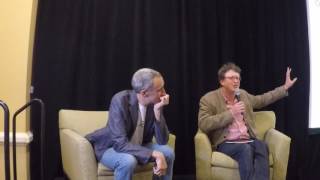
Recorded interview between host David Boyle and Sam Yagan (entrepreneur/investor and then-CEO of ShopRunner) discussing the disruption of the dating industry, origins and design choices behind OkCupid and Tinder, and how data/analytics changed matchmaking. Yagan describes three eras of online dating, recounts early skepticism about Tinder, and summarizes investor criteria for early-stage startups (market size, real problem, solution, team). The session ends with audience Q&A including specific claims: ~1/3 of marriages now begin online and OkCupid’s dataset contains over 4,000 profile questions; three small-question predictors (horror movies, solo travel, desire to live on a sailboat) were highlighted.
Questions this video answers
April 12, 2017.
ShopRunner.
More than 150 retailers.
Co‑founder of OkCupid; former CEO and vice chairman (and at the time vice chairman) of Match Group (includes Tinder, Match.com, OkCupid).
One in three marriages.
Chapters
Thank you for promptly joining us back after the break and we've saved the best for last. I'm really looking forward to this conversation. We've got some great questions lined up already and I know after a full day of practice you're going to have some great questions to send through as we go through. We're going to have a lot of fun over the next 40 minutes or so before we do a quick recap on the day and then get a much needed drink. So welcome.
Sam.
Thank you for joining us today. Sam Yeagen is the CEO of ShopRunner, an Amazon competitor helping with shipping and e commerce services to more than 150 retailers. If that isn't enough, co founder of OkCupid, former CEO and vice chairman of, currently the vice chairman of the Match Group. So that's Tinder, Match.com, okCupid and some others. Also, if that wasn't enough, passionate about working with early stage entrepreneurs, whether that's through labs or accelerator type programs or running his own investment fund, which would be a great topic to spend time talking about. Was Time magazine, Time magazine's 100 Most Influential People in the world pretty good there?
My wife said I was number five in our house. The other 95 people are in trouble.
So again, I wanted to give you an overview so you know what questions you can start asking, questions you can start thinking about. And as they pop up on screen, we'll weave those into the conversation. If you don't like technology, as I know some of you don't, then wave and we'll bring a mic around as well. We could do it the old fashioned way. Let's have a really fun conversation. So I want to start by talking about disruption if we could. And you know, I've worked in the music industry and book publishing, now in television, some industries that are facing or have faced pretty significant disruption. But I don't think anything's disrupted anywhere nearly as much as the dating industry has. I mean, it's radically different how you do dating now than how you did it 10, 15 years ago. Like, how did that come to be? Did you realize the potential disruption at the start?
I think there are certain there are different kinds of disruption, obviously. And I think the there was a big question in the evolution of the dating industry about whether what people needed, what singles really needed, was help figuring out what they wanted or whether they needed help sorting through all the people that they knew to find what they were they wanted. And that may be a distinction without a difference. Let me clarify if you remember back about 15 years ago now that dating shoes, basically Dr. Phil was with match.comeharmony and that really old guy on the commercials, you all know, and, and their belief was that people needed. They were going to look into your soul and find you a soulmate. Right? You were going to answer 135 questions and at the end they were going to say, this is what you're looking for. When we started OkCupid, it was four math majors starting a dating site, which talk about like terrible tagline for the marketers, don't use that. But our premise wasn't that you didn't know what you wanted. We feel that over the millennia that humans have been around, we've gotten pretty good at figuring out after you meet someone, is this someone I want to spend more time in? That's a really simple human function. However, think about for each of you, how many new people have you met in the last week? Right now you're at a conference now, so that's it. Maybe not the best time to ask the question, but in general, the number of new people you meet at any given time is very low. Right? That's the first problem. The second problem is they all tend to be very much like you, right? You're meeting them in places that you conquer in which tend to be either socioeconomically or ideologically similar. And so you get very little diversity. And of course, all of you in this room know that if you're looking for outliners, you really want the diversity of input so that you can figure out who that very best person is going to be. And so our approach to constructing the online dating industry was to totally turn the n. Say you know what you want. We are disposable. The however, we're going to aggregate this massive pool of people and from those millions and millions of profiles, we're going to surface the top handful that are the best for you. And that's really what we built our reputation on. And that's what we've sort of. I think what OkCupid is the best.
In the industry and was there a lot of pushback at the time from people saying format may just can't help you to find a date?
OK, stupid was another reason not to call your company OkCupid was with all the various plays on our name. So yeah, I think there was this idea that math was sterile, that being too data oriented would take the magic serendipity out of romance. But my answer to that is the story is yours to write. Once you meet someone that's your story from that first date on how you got to that first date. I mean, whether you met in line at Starbucks or whether your mother set you up on a date or whether you met on a dating site, it doesn't really matter. That's all incidental. The real magic happens once you read it first.
It's funny, so many different businesses in the room, conversation had today literally the same story, which is. No, no, no, like AI or data analytics.
Can't help that.
Oh yeah, actually it's fundamentally transformed.
Okay, next.
No, no, no, hey, I can't help here. Don't worry, it's not make a difference. Never ending story maybe. And then there's so many different innovations in the dating space now, not just the math model. Okay, Cupid. Like, did you see all those different options in the early days or some of those surprises even to you at the heart of that field?
Well, I think, you know, Tinder, obviously there have really been, I think, you know, sort of three eras of online dating. There was the, there was the Machi Harmony Yaku dominated sort of V0, then there was sort of the OkCupid and maybe playing the fish down in V1. And then there was sort of Tinder sort of dominated over the last three years. We started Tinder inside of Match, which is something that most people don't know. So yeah, we had a quite roc during that development. And I think some of the things that made Tinder magical, some things that users might believe about what made Tinder special are different from, I think what I believe made Tinder special. But how can you. That's useful.
Yeah, I would love to hear more about that, please, because then we're going to do the quiz for you which one time about and I'll tell the details of which different type of people use which dating site.
I'll certainly fail that. You know, I think the thing about disruption, you know, is sometimes very hard to predict what disruptions will work. I think a lot of people find the challenge of seeing a possible disruptive force and then wrongly predicting that that disruption won't work. Right. By definition, if it was something you thought would work, it probably would be disruptive. And so I remember the first time, I remember the first time I saw Tinker. And I don't know if any of you who were active who follow the online dating space closely. There used to be a site called Hot or Not. Remember that back in like the late 90s where you like rated people on a scale of 1 to 10. And so I being the Old graveyard guy who had seen Bear on the Block a zillion times. I was like, okay, number one, I've got hotter knot in my head. Number two, and for all you people who are a B test lovers, you'll probably appreciate this. We a B tested native login with Facebook Off a zillion times. We tested it on OkCupid, we tested it on Match, and everywhere we tested the dual option, that path was less performant than just Native on, right? So in my head, we have proved that Tinder that Facebook off doesn't work on dating apps. And once you see some data, you then create a story for it, right? That story is people want to keep their dating lives separate from their social lives. So here I get presented what is effectively hot or not with Facebook off, right? So I was like, there's zero chance this is gonna work. That was my first reaction. And in fact, like was my first inclination was not to put dollars behind it, right? To not see if it would take off. Fortunately, the Executive Match and IEC had the good wisdom of saying, okay, well, it's definitely worth. It's definitely a slick product, and let's go ahead and go to market with it. And now here we are, billions of matches later, by far the most disruptive force in the category, the history of the category.
That's remarkable. And we'll see some of that in the quiz, I think. So if we could pull up the PowerPoint for a moment. Let's see. Take a quick look at some different types of dating site users. And then the quiz for Sam will be, if I give you a type of dating site user, can you tell me which of the three sites is the most popular? I haven't seen this. I think apologies. Right, so first of all, then what we did is to take all the followers of Bash, of tinder and of OkCupid on Twitter, all the people, anyone who follows any one of those. And we used Ophelio, who was sat outside, to segment the users and cluster them into different types of people, had similar behaviors otherwise. So there's a bunch of people who are movie junkies. They may follow one or more of these sites. There are a bunch of people who are in the startup community. They follow one or more of these sites, Entertainment, news and fashion. Lots of different types of people, right? So then what we've done, we go to the next slide.
Right?
Go to the next slide and pick one of those segments. This is the startup community. So just amongst people who identify from all the interests and engagement on Twitter, just some people Identify as being in the startup community. The quiz is can you tell me which of the latest Tinder match or Egg Cupid is the most popular?
I think I should have gotten the answers to this in advance. I will say four math major started. 80 seconds. It's got to be OKT.
Any views from the audience?
Tinder. Tinder.
Okay, let's say it is.
Okay.
Quite a lot to try to say.
Next.
Okay. University, pop culture. So tin by reasonable majority, Tinder started.
On two college campuses.
Any dissenting views from that? They didn't want to go dating better than Sam. Okay.
Oh, drop the mic. Is that what you're supposed to.
Okay, next. Engineers and techies. We saw a bit of this.
Yeah, maybe you don't want to go there.
And then welcome modern times political junkies, people obsessed by politics.
I would bet this is pretty evenly distributed because I think people who online date are just. I think that's dating. Online dating has not yet made it fully, fully, fully into the mainstream. So I would bet there's correlation across these. So probably, I would bet probably dead match, But I think it'd be close.
Let's take a look. It is. Well, yes, they match, but it's close. It's almost like you can see the answer going to make it more difficult next time. So is that it? That is it.
So one out of 81 that I would have guessed those right randomly. One out of 10.
And it's fascinating for somebody who's not dated for maybe 10, 15 years and happily married, I know nothing about any of these things and how different and how popular they are amongst different groups. The disruption is immense.
One in three marriages now started online. It now surpassed all the friends in school and church and all that kind of stuff. So it's pretty amazing.
One of the questions was, have you personally used any of these sites?
No. And in fact, back then there used to be slow news days. I got an email from the person who runs PR for me and says, hey, there's an article about you on Time.com. it's like, okay, great, what did I do now? And it said, king of online dating has never been on an online date. So I emailed the reporter. I'm like, what? Like slow news day? I mean, come on. It's not. That's not a thing. So, yes, in fact, none of the founders wrote to Cupid ever been done at an online day, probably because we're math majors.
So one of the hot debates earlier was do data science? Entrepreneurs need domain experience in order to be successful. That's a pretty clear answer to that question. Presumably two people finding a match detrimentally impacts revenue. How does Master.com reconcile this?
So this is my favorite. This is the single most asked question that I've ever gotten. So here's the deal. If each person, if each one of you thinks how many relationships have you been in in your adult life? Just think through whatever you want to define a relationship as. My guess is that for most people it's somewhere around 10. That's the average. So if you think about it, what that means is there's roughly a 1 in 10 chance that a relationship that you will, that you started off notch or anywhere becomes terminal, let's call it. Or blum like Hapsam. We're all data scientists here, come on. But there's a 90% chance that relationship ends, right? And so the way I think about it is I find out that two people have left one of our dating apps. There's a 1 in 10 chance, there's a 9 in 10 chance that, that, that those people will be back in the market, right? And they'll probably say, well, where did I get the natural literature from? Great, I'll go back there. Or two, there's a 1 in 10 chance, let's say that that relationship becomes organized. In which case all you have to believe is that over the course of their lives, word of mouth effect, hey, how do you meet? That's like a common conversation starter. All you have to believe is that in their life they will sort of sell to people to join. So there is no better, there is just no better marketing for a product than for people who are getting married.
I want to switch gears from dating then to talk about startups investing or partnering and mentoring. How do you look for, what do you look for in a startup, in a company to be worth your time or your money?
So I do very early stage investing, seed stage, primarily some series A. And the nice thing about investing early is it's really basic. So if you do late stage investing, there's a lot of math and cohort analysis and all kinds of stuff that's hard. But I get to ask four simple questions. When an entrepreneur, when I'm looking at an entrepreneur, the first is, is the market big enough? Almost always the answer is no. Entrepreneurs always overstate. Number two, is the problem real? You have to realize we live in a pretty good world right now. Like most people are fed and they have, you know, we have cars, all this kind of stuff. So how the world currently exists without your product, right? So Is the thing, is the problem you're solving really a problem? And most often the answer is no. The third is does your solution, let's say we've agreed that you've identified a problem. The third, my third filter is does your product actually solve the problem? You'd be surprised how often somebody's actually identified a problem, but then the thing they've built doesn't actually solve it. And then the fourth is the team, the right team to go. Do we believe that team can go and incredibly execute on all of the above? And if you can answer yes to probably three out of four, then that's probably worth the best answer.
And quite a lot of those sound like gut instinct based answers rather than heavily analytical answers.
I think market size is pretty analytical now you can debate, you know, where the boundaries of a given market are and what the potential is for add ons and adjacencies. Yeah. Is the problem real and is the solution valid? Whether you call it intuitive or qualitative, they're not answerable, defined, quantitative necessarily. And then is the team right, that's also very intuitive. So I'd say the market size is pretty quantitative, the rest are more qualitative.
And what kind of technologies are exciting you at the moment?
I mean I think anywhere that people are bringing data and analytics to a problem that previously did have data in analytics is super interesting to me. That's kind of what we did with OpenCupid obviously before that I started a company called SparkNotes in the online study guide space and we did a lot, even way back in the 90s, we did things that plus notes was just unable to given the fact that they were their format constraints. So I think anytime you're bringing data and analytics to a problem that hasn't that superstring to me outside of that world. I mean, you know, autonomous vehicles are going to, are going to have a bigger impact I think on our lives than anything else that we've seen in our lifetimes.
On the data side, do you think it's. Are there enough problems left that you can bring data to the problem versus having to bring advanced data analytics and machine learning to the problem? I mean where on that spectrum of analytics do you.
Oh, I think it's. I don't look at it so much as a spectrum, as much as it is like a self fulfilling loop. I think the more, the more of one you have, the more machine learning you have, the more analytics you have and vice versa, a lot of it. I'm surprised at how many organizations, big companies you go to and they're still non data culture. I was just having a conversation earlier today that, you know, here in the last couple years, you know, data used to be a thing that you'd have to beg to get a resource for. And just now you're starting to get to the point where people are saying, okay, you get a seat at the table. But how many CEOs come from a data like, come from a data science path? Right. There's like the era of the CFO becoming the CEO. Then there's like the marketer becoming a CEO. Recently a few CTOs who become CEOs. But can anyone name a data scientist who's the CEO of a company that owns her? That's going to happen. That will blow people's minds.
Whole new world. How do you think the startup landscape has changed in the last couple of years versus a few years ago? What trends are you seeing? The application of data to old problems is a consistent trend over time. But is there anything that's different about it today?
I think one of the challenges, and this is a little bit of insight, basically boring to people, but I think the, the labor market is having a hard time keeping up with the demands of companies. And it used to be just like programming language. Programming language, which was easier because a good engineer can learn any programming language effectively. But the number of people who have been trained mathematically, statistically, data science, so few. Just so few. And so the biggest company, the biggest problem facing most of the companies I'm involved with is their ability to hire great people. And among the great people, they can't hire. The harvest is in data science. Think about every function, every function now needs, you know, just, just in my own company, you know, we've got. Our marketing team wants data scientists, our analytics team wants data scientists, our engineering team wants data scientists. And like there's. Who's training these people? Like, where are they coming from? Very hard.
And then is there anything in particular that's exciting at the moment? A new technology or a new startup that you're looking at?
Oh, I have a lot of startups, but I don't want to sit and pitch my portfolio. Please.
No, no, no.
If anybody wants to, you can talk about.
Well, change the name if you want, but give us something you're really passionate about.
Sure. So I'm hugely interested in marketplaces of all kinds. Marketplaces and networks. I mean that's really where I've growing up. Whether it's aerodynamic. You've been with a shop owner. Now I'm on the board of a company called Spothero, that's a parking marketplace. On a board of a company called Shift Gig, that's basically on demand hourly labor. So if you're the JW Marriott and you need six extra servers for a conference, you just hit a button in a mobile app and six people show up. I'm just really fascinated by how to build. There's going to be called foods be that I just invested in. That's a restaurant marketplace. There's so much power. Marketplaces are so hard to build. Networks are so hard to build, but they're so lasting. And I love the challenge of building a marketplace and then I love just how durable they are.
Yeah, that's really interesting. And we've seen a lot of huge disruption in that space. But you think there's another wave coming?
Yeah, they're just coming to more and more places. And mobile makes that easier. Obviously the data makes that easier. And just more and more ability to do things on demand in real time will continue to change more and more markets.
That's very interesting. And then what about the other problems that are not yet solved or problems that are frustrating in place, but you just haven't found that someone is practicing?
Yeah.
Is there anything on your mind?
Yeah, I mean, you know, the fact that we still have so many startups starting, you know, every single day, I think is a testament to the fact that there are, I do think more and more startups are not solving real problems. And so to your point, you know, what are they? Look, there are challenges everywhere. I mean, right now I spend a lot of my time thinking about E commerce. And, you know, just the landscape in that marketplace is so dramatic with having one player that's just so much bigger and has R and D budgets bigger than market caps of many of their competitors. And coming from a marketplace and network background, I spend time thinking about how does one compete with that? What are the ways to aggravate and to create consortia and other structures largely leveraging data? That's what I think. Ultimately, the biggest asymmetry is in E commerce. Right now it's just the lion's share of data. It's all in one place.
Any questions from the audience? Are there any more mics at the back?
You know what?
I'll stretch my legs.
Excuse me. I can also predict whether your relationship year will succeed. Yeah, I don't know if I won't go down there. That's why I didn't tell you. Forgive me. As I'm struggling to articulate this with respect to disruption, and you mentioned, say, for example, driverless cars in general. What is the risk of underestimating the broader impact of that disruption? For example, with digital cars, you need an entire infrastructure to go around it and so on. What is the risk as an investor of either underestimating the broader impact of that disruption? Yeah, I think it's very hard to imagine. I think certain disruptions are more localized, and you can sort of put a box around them and say, okay, I can understand what the magnitude of that is. I think with something like autonomous vehicles and the reason I'm so interested in them, like, I think it's gonna change the real estate market. Like, all of a sudden, where you're willing to live is gonna be dramatically different. Think about where people live. It's so, you know, it's so defined by highways and bus stops and, you know, train stops and all those kinds of things. And all of a sudden, if you imagine a world where commuting is just pleasurable and faster and all these things, like, all of a sudden where you live could be totally different. So I think it is very hard to get right. And it can sometimes be the difference between making the right bet. Like, you can secularly understand that autonomous vehicles are going to be the future, but if you don't understand how the disruption is going to be distributed, you might not be able to bet on what is going to be benefited or hurt by that disruption. Like, are the incumbent automakers going to be better or worse off with autonomous vehicles? It's not obvious.
It's funny. There's a passion debate either way happening. I feel like we should be able to be clearer on what the future will look like. There's people who are passionately arguing that they'll be fine and cities will be the same. There's people arguing, no, no, cities will mean something very different. We don't have parking spaces and partying and all these things. Is there a way that we think we could be clearer about what those futures look like?
I think in general, I think when people. Sometimes it's hard to sort of capture because our lifetimes are so short, but the rate of change is just accelerating so rapidly. And just think like, you know, it wasn't that long ago there were no cars, there were no planes. Right now we just think all that. Like, my kids just take so much for granted and didn't even exist when I, I. When I was born, right? And just in one generation, you went from, I rode a, didn't have a seat belt, you know, and you know, my kids, cars aren't gonna, you know, they're not gonna, My kids have learned how to drive. Right. That's, that's one that's in one generation. Right. And I think like if you just think about the aspirations people have, Elon Musk is gonna put someone on Mars, right? It wasn't that long ago we had into the moon, right? So just think about what that piece of change applies and why do you slow down instead of accelerating?
Yeah, that's a good point.
Why would that happen? Why not go with flying cars? Well, I think the only question there is battery. Yeah, right. So you just have to like how fast do you believe we can figure out? I think that's my understanding is the only limited limitation to flying cars is we don't have a battery. That's long enough. That's light enough.
Question on the back, I think.
So this question is for the investor in you. Most of the startups today, they tend to focus on funding followed by revenues and distantly followed by profits. Do you see that trend changing? Because the first few days you find that trend disturbing at all in the long run and you see maybe some trends. So how do you advance new startups on what they should be prioritizing in the first three to five years of their existence?
So I, it does not concern me that early stage companies do not focus on profit. And the reason is, I mean, that's nothing new in a company. I mean, think about that long ago, if you were going to open up a, a butcher or a bakery, like you've got to invest in the capital expenditures. Your first day you open, no one's going to show up. The second day you open, no one's going to show up. And so you're not profitable from day one. I think having unit economics that aren't profitable relatively early on is disconcerting. Or there's no path to that. That's disconcerting. But I go back to my basic principles, which is if you're in a big market, solving real problem with a, attacking a real problem with a real solution with a great team that's going to get funded and those things should. And again, if you just think about it like the first thing that people would be able to do is attract funding, right? If you had all those boxes checked, the first thing you would do is you'd go to someone like me, you'd be great, and then you'd go off and you'd build a bunch of technology and then the next thing you would do is you start generating revenue or usage or engagement or whatever it is, then revenue, and then the next thing is profit. So I think that's actually a pretty logical. It'd be hard to do it the other way. Imagine I'm going to be profitable before I raise money. Being profitable before I have revenue. You can't do that. So I don't know another way to get there. We've now seen so many companies get to massive profitability down that path that investors have enough confidence. Investors are largely pattern recognizers. Right. And so which is, by the way, bad for issues of diversity and inclusion, for example. But when you see something that looks like it's following all the other successes that you've seen before, you're willing to back it more easily.
So I want to say it was.
You or somebody over.
I read a few years ago said.
One of the greatest or most significant.
Variables or data points for a successful relationship was if they both like hormones. And I want to see if that's true of you. And also there are other significant indicators that are almost like anomalies you wouldn't expect. Great. There are three. So this is. This is where I was going earlier. So you don't have to just think about yourself and your significant other if you have one. There are three. So we have over 4,000 questions in our database. There are only three that stat sig predicts whether or not your relationship will be successful. Right. And what you're looking for is agreement with you. And your significant other on these can be yes, yes or no. No. The three questions are, do you like horror movies? So you're looking for agreement there. The second is have you ever traveled alone in a foreign country? And the third is have you ever wanted to chuck it all and live on a sailboat? And if you and your significant other agree on all three of those, again, could be yeses or no's, then your stats seem more likely to stay together.
Thank you for how would you read?
So yes, that was me. And those are the three.
Have you got time for maybe one more question? Pause now, because people here with questions, I'm sure they want to put their hand up and get the mic. So come on, somebody, somebody be that person. Grab them.
Right.
Ask the last question right there. Need somebody. Susan, do you want to go your magnets question?
Magnets question.
It was not my question. It's been a recurring question all day. You can't think how do magnets work? Which I think might be a mem or a joke or something. Do you have any idea how magnets work. That has moved the magnets conversation forward actually, since actually. So thank you very much. In that case, I will thank you very much. Thanks so much for all the advice help. It's been a great conversation.
More from David




How Can ChatGPT & AI Help You Make Your Business Better? - Guest: Marketing Strategist, David Boyle

youBEAT Cafè - Prompt for Artists / AI Revolution / ChatGPT with David Boyle (Audience Strategies)

Now that's Significant - Ep 52 - Reimagining the Future of Marketing with AI - David Boyle




