Jasmine Next Level ChatGPT with David Boyle WebinarNinja

David Boyle shows small business owners how to use ChatGPT for market research, content creation, and SEO. He walks through building audience segments for herbal remedies, generating FAQs and product descriptions, and connecting ChatGPT to tools like MidJourney and Sheets. The key: add context to your prompts and stay in the same chat so the AI remembers what you've told it.
Chapters
And this is Jasmine Powers over at All AI need. And I'm so happy that you were able to join us today. Today we are going to be talking to one of my favorite people in AI right now, David Boy. I'm going to bring him on the camera. But as just to get you all in the room, we let's do some housekeeping. In your right hand pane you have the chat and so you're able to ask us questions, reply to some of the things that you're seeing on a stage or on the camera. Also you should see a question bubble where you can ask questions, questions that we can address at the end and we'll answer them in the order that they come in. So if you're asking a question in the chat, we may see it, but if you want to pin it, make sure you put it in the Questions tab as a question mark. We also have an offer for you. If you click on that gift box, you will be able to see a way to purchase David's book. And so we look forward to engaging with you today. And thank you so much for joining, Katherine. We're going to get ready to get started. So again, this is Jasmine Powers from All AI need. And today we're joined by David Boyle of Audience Strategies and the co author of Prompt, one of my favorite books and resources on artificial intelligence and specifically ChatGPT. I literally like, I couldn't get up the next day. David gave me a copy and I did not get up the next day because the whole night I was running prompts and doing market research using Chat GPT. And so I would like to introduce you to David of the author of Prompt. David, how are you today?
I'm all the better for seeing you and I'm looking forward to these questions. You are such an inspiration to me though, so thank you.
Thank you, thank you, thank you so much. And so you probably were one of those people who has been playing with Chat GPT. Tell us a little bit about like how the book came about and then like we'll start to ask a few more questions about like what your viewpoints are on Chat GPT and how it will impact micro businesses specifically. But first tell us about how the book came about and which you use to help write it too.
Absolutely, yeah. So Richard and I, my co author, we've worked together for like 15 years. Market research strategy for lots of big brands in the world, like he worked at Unilever, lots of small brands, like artists who are starting out their careers as well, a lot of music and entertainment along the way. And so we thought we were pretty good at what we do there. Then this thing came along which changed everything. Like, it literally just changed everything about how we work. We played with it for a few days and we looked each other in the eye and said, oh my God. Even though we're pretty confident in what we do, this shakes us. This changes everything.
Right?
This is more powers, it's quicker, it's better. Are we crazy or is this real? I think this is real. And so we said, let's stop everything we're doing and let's just work out how to use this to do the things we've been doing for 20 years. And then pretty quickly we said, look, we need to write this down and share it with everybody else. We love the power of technology to democratize decisions and insight and things like that. So our job is then to share this with the world.
Yeah. Now this was a really cool thing. How long did it take you to write the book?
Yeah, two and a half weeks.
Two weeks. Two weeks. I've been trying to write a book for like 20 years. Yes. And so how did you expedite the writing of the book?
Yeah, because I had a book that I wanted to write like three years ago and I've been like, noodle on it for three years. But, like, where's the imperative? Where's the deadline? Like, where's the pressure? This thing comes out and it just feels so urgent to us. Otherwise we're going to fall behind in our craft. And it feels so important because we've got this chance to help so many people at such an early stage. We just. That's the deadline, that's the imperative. And then Christmas is coming up. So like Friday the 23rd, we'll publish then, and then we can switch off and actually enjoy Christmas with our families. So that's like a very hard deadline. But I think in all seriousness, like, one of the big lessons for I think any AI is like, if you know what you're doing anyway, then it's a superpower. And again, like, we've done the stuff in the book. We've done that for 20 years the old fashioned way. And so adding AI to our craft was relatively straightforward. And so the book is partly our craft, 20 years hard work.
Right.
Partly, like how to enhance that with AI along the way. But if we were starting and just writing the book without the 20 years of craft, I think there's no way it would have been possible.
Right, right, right. So one of the things I wanted to Call out is in the book, you detail that you also used ChatGPT to help you write the book. Tell us about that part, because I think that's going to be. That's particularly interesting and lends itself to the conversation of how to use ChatGPT.
Great. Yeah. And I think, by the way, we didn't use it nearly as much as I wish we could have done. And if I knew what I knew now, we could have used it more. So this changes quick. Right. So the first thing we did, we had an idea. We knew our craft and we knew we wanted to use ChatGPT. So we told ChatGPT that here's our craft, here's what we want to write a book on. How might we position this book? What would be some good titles for the book? What would be a good layout for the book, a structure for the book, an outline, things like that. So positioning the book and helping us just think through, like, how might we do this? That was. ChatGPT was a helper in thinking, in doing that kind of stuff. Then what we did is two things. One is like put it on the web and write. To put it on the web, we need R. We typed basically the title of the book into mid journey and one of the first thing that comes up is pretty good and we like it, it's evocative. And so we're like, done, done. So basically we were able to get the book up. Oh, and we said, write an FAQ about the book for us for the website. And it was pretty good. Didn't take very much editing on the website. Great. Now the website's done. Now we can focus on writing. But that website would have been a distraction otherwise. But it was quick and so easy done. Now just. Let's just spend two weeks writing.
Right.
In writing the book, I think that the biggest use was really things that we couldn't be bothered to write ourselves and we trusted the AI. So I'm passionate about, like, audience segmentations. I love audience segmentation. So powerful. I can't be bothered. I can't be bothered to write that out. So I just asked Chat GPT to explain that for me, then edited its response.
It is a response. Yeah.
Save my time and my expertise and Richard as well. Save that for the hard things. That's not a hard thing, that's an easy thing. The hard thing is then to test Chat GPT and evaluate its performance. It really takes away the basics from your work and it lets you step up and be more strategic and more.
Thoughtful on the parts that you really need a human to be involved in. So let me just back up and call this out for my very new, you know, new to AI Chad GPT. Like, you know, what, what is this thing? Basically what he's just broke down is that the book came about 20 years of expertise. He knows his stuff, just like you all know your stuff. You're experts in, you know, fashion or E commerce or whatever your expertise is. But they were able to consolidate or use, not consolidate, but use 20 years of expertise. Use ChatGPT to help bring about a book that ordinarily would have taken them a lot much longer time to compile and pull together and then spin out something that's useful to you and I so that we can learn how to use ChatGPT. And then even better, instead of paying thousands of dollars in usage rights for Illustrator, now you use another AI tool called Mid Journey. I'm going to put that in a chat midjourney to put the COVID together. That means both the book and the illustration was brought about through artificial intelligence. This is how I want you all to start thinking about the usefulness of this tool and start to pull it into your day to day work. This isn't something that you just use sometimes everything that you do, you can start to be, start to think, how can, like I wonder if ChatGPT can answer this question or help me to go deep on this subject. And so AI is the future, baby. Definitely lean in. So let's get a couple, I want to ask you a couple more questions just to get your insight and allow a few more people in the room. But most of the businesses that are here are small businesses, micro businesses, solopreneurs, maybe no more than five employees. How should they be thinking about AI in general? Because we know that ChatGPT is just one AI tool and then how can they start to think about it for their daily operations?
Yeah, well, the first thing is like I love that this is democratizing stuff that was only available to large corporations. Right before this call, I did a similar workshop presentation for the leadership team of a global pharmaceutical business. And you're going to learn as much and get as much value out of it as they will, because anybody can do this stuff. So totally democratizing. I think if, if you take some of the advice from the book on who's my audience, what, what do they want from me as a brand or as a company, what can I do differently to meet their needs? If you, if you use some of the book to help you there, that's the Kind of thinking that used to be $100,000 for a major corporation. And you can do just as good work with almost no time and almost no effort and just $13 to buy the book. But it's amazingly democratizing.
Yeah. And when, when we talk about democrat democratizing, one of the things that stands out to me is in my work as a marketing consultant though a large part of what we need to do the person isn't prepared to pay to do, which is deep market research. They're like, well I kind of know who my audience is and I kind of know, so let's just throw something up. And if you needed, you know, these large surveys, you, number one, have to recruit, recruit people that are going to give you good enough answers that you can extract good data from. You have to pay for it to be analyzed. If you're not, you know, somebody who understands data or analysis and can extract something that can be useful, you're talking about a lot of money, thousands and thousands of dollars. And so a small business probably isn't going to do it. We're going to go with Survey Monkey, a 10 question survey to our email list and that's it. But what you're saying is that with ChatGPT, even though you still might have to do some, you know, traditional research methods and you should do some research, you can start this process for free and get insights that would have taken you a lot of time and energy to do on your own with this tool. Let's talk about it. Tell us a little bit about how, like what, what the premise at least of the introduction of the book and some of the things that you're able to do with it.
Yeah. So let's take audience understanding because that's where I always start when I work with any brand, whether it's an artist or a startup or a major corporation, you start with the audience. That's my philosophy on all things. And exactly like you say, most of my career has been hundred thousand dollar or million dollar research programs. So I know that world very well. What I'm telling you is somebody who makes all his income from those, those things. What I'm telling you is you can skip that quite often, not always still need it, but you can skip it quite often. Particularly like exactly like you say, if you never otherwise would have done, this is about as good. And so the way I would think of it is this is the biggest data set of human attitudes, needs, wants, reviews, behaviors, opinions, the biggest data set that has ever existed, the biggest data that's ever been anywhere near queryable and you can query it. Prompting is the technical language, but I think of it as you're querying it. You're querying a massive data set to extract insight. So if you write the right queries, prompts, then you can extract insight from this data set. It is qualitative research at vast scale. It is analyzing every review that ever has been for the product or the category or the attitudes or the needs that you're serving. So it's just a matter of writing the right prompts. On Monday, for example, I did a Little challenge on LinkedIn and Twitter and I said to people, tell me what your business is and I will build you a segmentation of audiences that get under the skin of the different types of audience needs in your category. And I built them for everything from menopause related content through to music festivals, through to religion, an unbelievable variation of different types of industries. And every single time, with a little bit of nudging of the prompt, every single time, I got to a really deep understanding of audiences, needs and wants and frustrations that are super actionable for a small business. So it's always possible with the right prompt, with a bit of nudging and poking maybe it's always possible. So there's so many places where you wouldn't have got audience understanding before now you can, and it's very, very good.
Right? In the past. So historically we're talking about million dollar budgets for doing market research. These big, big major companies. What does that type of audience research allow a company to do and why do you think that's important for a small business?
I think every business, every brand, every artist, if some of you are artists of any kind, you exist to serve the needs of an audience in some way. And the clearer you can be about who you're building for, the clearer you can be about what it is that they want. And the clearer you can be about what their frustrations are with your product or category right now. The easier it is to know what to do differently, which products to build or which product features to add or, or which marketing to add, which FAQs to put on the website, which keywords to optimize for those things are all easier if you're clear on your audience and their needs. And this enabled us the heart of everything, I believe, about how to grow a brand. And we'll show you later some really clear examples of exactly how to do that.
Right. And I just want to call out Donna, she's done some, she said she, she did some Research last week, that would have taken her five to six hours. But with Chad GPT, it took her 15 minutes. Donna is a PR executive, someone that I've known a long time, but as marketers and strategic communications professionals, we see it. We see it. But you know, for E Commerce, like one of. One of our attendees, Amina, she has. She's an E commerce brand. She sells earnings herbal remedies. You know, we worked on our Shopify site. How can I really write about these herbal remedies and write, you know, great product descriptions, ChatGPT or how do I know what type of person would want these herbal remedies? What. What is their mindset and how do you call it in the book? Like, their category needs so that you know exactly who to talk to and how to position this herbal remedy so that now she wants to buy more, you know, she wants to spend more at this particular store. Incredible, credible tool that we have available to us.
And I think what we're doing here is in audience understanding. What we're doing is clarifying our thinking. And I think in the old world, without good audience research or without this tool, I think for herbal remedies, we think about all the different needs for herbal remedies, and there's so many different types of people who want herbal remedies for so many different types of need. Well, that might mean we position the brand in a way that's all things to all people but is exciting to nobody. And I think that's a big mistake. And so with this tool, it can help you to think, what are the five or six different reasons why somebody might want herbal remedies? Which one or two of those do I want my brand to really speak to? And therefore I can do better keywords, better SEO, better shopify positioning, like, everything's easier because you're clearer who the audience is. So I think of it as clarifying your thinking, actually, as much as anything else.
Yeah, definitely. So we're already getting questions. We're already getting questions. And I think that. But instead of getting ahead, I want to go through a couple of prompts and see this thing in action. And I think, Doreen, that will partially answer your question. And like, outside of market research, like, what can I think about ChatGPT for product delivery or content strategy or, you know, copywriting and all those things. So we're going to get to that. But first, let's have David take it away. Let's have you open up your screen, and I'm going to minimize myself so that you all can get a look at. Let's see. Let's put this at the top and me at the bottom. Let's see. Can you all see us? Okay. Or see the screen? Okay.
I can't see anybody now, so I'm trusting you all to be able to see.
Okay. Yeah, I can see the screen, but I can't see like us. So let's try to. Let's try. Okay. Let's do it like that. You see us, but you also see the ChatGPT really big. Everybody says they can see the presentation and chatgpt to the right.
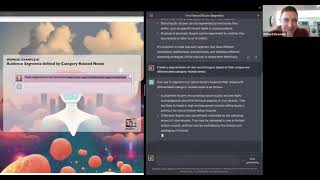
Great. There's an unlimited number of use cases for this tool. I'm not joking. Unlimited number. And that makes it really hard to know where to start again. What we did was just take our process and then codify it and chatgptify it. And so this is our process. This is just one way of using it. Right. But it's to start by going to obsess over audiences and really understanding them. I'll show you some of that in action. Then, like really picking an audience that you want to go after working out what products, positioning, media partnerships to do. You could put SEO in there and website copy. And then maybe that's not enough. Maybe you need some big picture innovation. That's the structure of the book. And the book goes through examples in every single area. But what I thought we'd do today is just pick an example. And I was going to do podcasts, but let's do herbal remedies instead. I just want to take maybe 10 minutes and walk through some different examples of how to use it, how to think about it, and learn some lessons along the way. Does that sound okay? 10 minutes or so. The first thing we'll do is come up with different audiences who are interested in herbal remedies. And the really simple version of that query, that prompt might be something like this. Hey, segment people interested in herbal remedies. But as it usually does, what it's done is tell us more about the process than actually answering our question. That that's not an answer that we're excited about. The lesson being the clearer you can be in the prompt, the more rich and relevant the answer will be. So I say here, like, this is a really simple version of this prompt. Simple sometimes works, but it's sometimes not good enough. So let's go to a good version of this prompt instead. And let's say segment people interested in herbal remedies and let's use some more precise language based on their unique and differentiated category Related needs. So let's see if that works this time. Bit more specificity, see what happens. People interested in herbal remedies can be segmented. Blah, blah, blah. Number one, prevention and wellness. Okay, so that's one group of needs that you could target your business around. Next, natural and holistic approach. Okay, great. Another possible option, ailment specific. Yeah. Okay. People with one very specific thing they need help with convenience and accessibility. So already with a relatively simple prompt, we're getting an interesting list of the different types of people that we could position our business around. But this is the good version. I'm going to tell you we can push harder than the good version. We can go to a better version. This one has more language there to specify more clearly what we're looking for and should give us a much more useful, richer, more actionable set of segments. This time we've said please make sure that the needs are deep and underlying. Please give each one a catchy title and a unique emoji. Always ask for an emoji. Also give each one motivation for each one. Give me their motivations to. Oh, this should, this should say motivations to buy herbal remedies and a unique herbal remedy moment that defines their week. This should say. So let's see. Yeah, let me stop this. Let's put herbal remedies. Still thinking about podcasts. Give each interface into by unique little remedies moment that defines their week. Here we go. No more podcasts. Get rid of podcasts. No one wants to think about podcasts. There we go. This should give us much richer, again, more actionable segments. Let's see if it does. Nature nurturers. Motivation to live a natural, eco friendly lifestyle and support the environment. The herbal remedies moment. Preparing a homemade herbal tea blend using locally sourced organic ingredients. That sounds pretty good to me. And so what you, what you'll get here is a really rich, deep understanding of the different, again, different audiences that you could target with your brand. And then.
Can I pause just a second? I'm going to minimize and get take us out of the pick frame because some are saying they're having trouble seeing, seeing ChatGPT. So I want to just maximize that. So I'm going to go ahead and do that if that's okay, please.
And then I'll zoom in a little here as well. Maybe that will help a bit. And what we'll do as well, we'll take the content we produce here, we'll put it into the slides and we'll send that around afterwards as well. So you'll have all of this take away with you. Okay, wonderful. So what we've done so far, if I recap quickly, we started with a very simple prompt which actually didn't work. We added a little bit more complexity and we got something that was quite useful. And then we added even more specificity about what we want. And now we've got something which is pretty rich and brings them to life in a really nice way. But let's say we want one segment that we really identify with and let's say you want to drill into them a little bit. Well, here is a. I'm not going to read this prompt to you, but here you can see the power of a very complicated prompt. If we run a much more complicated version just for that Nature Nurturers segment, we can really drill into them better, understand exactly who they are, exactly what their wants and needs are, and get a sense of the kind of thing we should do differently if we want to engage them. So here it's going to go through many more of their needs, really bringing to life what they want from us, what their needs are that we could meet. It's going to go through category related pain points. What are their frustrations now with the herbal remedies and what pains are they causing that you could overcome by doing it differently or positioning it differently? And it's going to come up with some innovations. Hey, if you wanted to come up with brand new ideas or brand new positioning really meets the needs of that audience, how might you do it? And looking through this, you might say, this is awesome and I really gives me some clear clarity and direction and I know how to do my business differently. And it might not because you might need to go back and reposition it. Nudge the segments suggest that it's more focused on product or pricing or SEO. If that's your thing, it doesn't matter. But I'm showing you you can dig deeper and with more clarity about what you're looking for, you can get a lot more clarity out in terms of who the audience is and what you might do differently for them. Then to show you some more simple examples, there's an almost unlimited number of ways that you could do this. Let's say we're interested in website coffee. A really simple query might say, hey, what are some FAQs I could put on my website for this audience? A very simple query like this, hey, just give me some FAQs for this segment. For this category. Really simple query will give you some pretty good FAQs. But much like the other audience queries, the more complicated you are, the more specific you are, the more power you get out of ChatGPT. Here we're going to take a much.
More.
Complicated version of that query and specify, we want headings and bullet points and unique content and just get a much richer version of a set of FAQs out. I'll probably stop there for a minute and see if there's any questions or feedback, but I hope I've given you the sense that. Yeah.
Oh, put that. Put that back on there. I wanted to see the rest of what it was gonna tell us. Okay. Okay. I think this partially answers Doreen's question in. In the part where it talks about strategy.
Sorry, this is onto podcasts again, because I've left it in the text here.
Okay, wonderful. So, as you saw Doreen, he was walking through the different stages of, you know, what he called prompt engineering. And so it started with one thing, one question, and then went deeper to the point that now he's able to write a frequently asked question page specifically for that group of people. So once you are clear on a top target audience and those needs, now let's start to produce content for that specific group. But I'm also going to read your question in full, and let's see if we can get David's perspective on it beyond market research. How does this affect the product delivery of content strategy? In other words, how does a copywriter, PR professional lean into ChatGPT without cutting out their own product value? And Doreen, please clarify in the comments. If you mean, like, I'm a copywriter, I'm a publicist. Now does a people. Now, does a person just completely exclude me as a professional if they have access to ChatGPT? I think that's what she's asking. And then, David, please dive in.
I think that's such a great question. So, first of all, what I'm doing on screen is taking the word podcast out and rerunning it. Just. Just remedy. So excuse that, but yeah, my strong lesson here is that ChatGPT is like an electric bike for the mind. And so if you're already willing to do some pedaling, it will accelerate you. It means you can tackle bigger hills or longer distances than you ever would have done before, but you still got to pedal. And so if you're already. If you already have ideas about how to understand audiences or how to do copywriting or how to do SEO, if you're already doing that pedaling, then this will make it faster and make you able to tackle bigger problems and do better work, but it doesn't replace the need to pedal. And so what I'm saying is, if you've got a very junior researcher, they can act more like a middle level researcher. Middle level researcher could accelerate their skills and act like a senior level researcher. So it levels everybody up. What that means is if you're already a copywriter, it should level you up to the next level. And yeah, it'll level your juniors up to your level, but everybody's better. Every boat is lifted in this exercise. So I don't think it replaces anybody at all. Not at all. I think it accelerates everybody, makes everybody stronger.
Right. I would agree. I do a great deal of writing about really boring topics. I won't even bore you. But just to give you a couple of examples, like divorce lawyers, you know, who wants to write about divorce all the time? But if I want to think about unique angles about that, I'm using ChatGPT to help me to do some of this research, but also maybe keep me from spending hours on Google reading through all of these other articles. Sometimes I have a divorce lawyer available to interview, but what if I don't? How do I access reliable information or just at least enough information to put together something substantial or, or what are some questions that I may have not thought about asking or answering in this article? ChatGPT can help me to say, maybe I've covered three topics or three subheadings, but maybe I need to add a fourth and a fifth that I hadn't considered. I can use it as a tool to kind of uncover and help me uncover what I may have missed or help me organize maybe even something that I already have written. And so it becomes a tool like, like you mentioned a bike. Like I could walk if I wanted to, but if I could have a bike or a motorcycle that can help me get there faster, I'd want to deploy it. So yeah, it's definitely a tool. And I don't think that the average person is as dedicated as maybe a marketing professional right now to learn this tool. I still feel like we'll still be needed to help provide services.
Yeah, I definitely agree. Even with great prompts, even with the best prompts, you still have to know how to slightly reposition the prompt because of the client and their unique needs. You still need to change it so that it matches your style. And some of what it writes is still going to be terrible. That's only you can tell which bits are great, which bits are not, which bits do you need to reposition or reword, which bits do you need to remove? Sometimes you look at it and you say, huh, it's most of what I want, but there's something else I want that's this other thing. Let me add that into it. And so that's all skill and expertise which comes with being a great SEO person, a great copywriter, or a great researcher. And so I really firmly believe it accelerates everybody, but raises all boats and that nobody's going to be replaced by this. I don't see that at all. Just makes us quicker and quicker and better and better able to communicate than we were before. That's it.
Yeah. Wonderful. Did you want to move on or do you want to take a couple other questions?
Yeah, let's take some more questions, I think and I'll send this deck and again I'll pace through the the work that it did as well. So you can see the work and the prompts at the end of this. But I don't think you need to see a load more different prompts now. So yeah, I would say we just go on to stop sharing this. Let's just go on to questions.
Okay, great. So just another thing to go deep on your prompts. I think that you should do what I did and get a copy of the book prompt. The website is prompt mba so there's no dot com is prompt MBA and check out the book. You'll get immediate access to it. It's an ebook. You can put it into Kindle or Google Books however you read it and take a look. So that will help you to start playing with ChatGPT so that you can start to see how to use it in your day to day life. Now we have a simple question. This is more like text, you know, tech support. How do we copy and paste the text? Tell me how you're doing it. I really wish that Chad GPT will help us to just like export as a document. But are you just copying and pasting directly into another tool? How are. What's your workflow?
Yeah, I mean it's terrible the copy and pasting method. So honestly what I do, even though this comes out to be clear, if you tell it to write in markdown format, this is a good trick. Write in markdown format. Then what it will do is it will bold headings, it'll change font sizes and it just makes it a lot easier to read. But it's very hard to take it out of this. If you copy this and paste it into a Word document or let's Paste it here. That's pretty bad. So you've got two options. You keep the formatting and then you fix it. But honestly, what I do is paste it with all the formatting removed and I just add the bullets and the bold myself, which is very laborious. But, yeah, I think there's no good way to overcome that. Some kind of copy and paste and then work it out from there. That is a real pain.
Yeah. And then alternatively, darn. This is my other hack. Even though ChatGPT has a lot more powerful features, when you think about going deep on a question or deep on a thought or a conversation with. With this thing. My other hack is using Canva's writing Doc. Let's see. I'll show you that it's. It's built on OpenAI, which are the makers of ChatGPT. But, well, what it allows you to do is have it already in a document format. I'm pulling up the screen for everyone now with the Magic Write tool. So what I've done, just to kind of go back to the beginning, I've gone into Canva, a tool that most of us have access to. Go to Doc. I think I lost my shared screen. And then you click the plus and Magic Write is the OpenAI integration or ChatGPT integration. And you're going to write a prompt. So the same prompts that David shared, I can enter here and it's going to start spitting out things. So if I just said write a FAQ for a herbal remedy company and this is overly simplified, I just want you to see it in action. And I'm going to hit enter and it's going to be in this document. Now, you still can edit it in the way that David mentions, but then you don't have to go and do the copy and pasting. It's like now it's already in a document. If I want to reformat it and change the fonts and do all of that thing, I can do it directly within Canva. And then even better, this is just a bonus. Just because I'm a geek, if I wanted to turn this into a PowerPoint presentation, I can then do that too.
I didn't know. Thank you.
So I love. So I would have to obviously edit at the end. But you have. Have this tool that most of us have access to and it's always. Most. I shouldn't say always. It's most of the time it's up. When ChatGPT is like, overwhelmed and broken, I always run to Canva to run my prompts. And there you go.
That is a very good tip. So you're teaching me as much as I'm teaching you.
Yeah, I definitely love it. Donna asked the question question. Now this is. This might be one of the Google Chrome extensions. She said, what are your thoughts of web chat GPT? Do you. Can you tell me a little more. More of that or if you know anything about web chat GPT? And Donna, feel free to clarify your question and let us know more in the chat in case we're not going the right direction.
Yeah, there's a quite a few extensions that. What they'll do is to add, add, supposedly add Internet access into chat GPT. So the background to this is that one of the big problems with chat GPT, and there aren't many, but one of the big problems is that its data, its training set cuts off like late 2021.
Right.
If you're trying to query anything that's like a deep underlying human need, no problems at all because that did not change since 2021.
Let me put that on. You wanted to open, open the screen back up. I didn't know.
Yeah, but yeah, one of the problems is if you want more recent data, ChatGPT itself cannot do that. So there's a number of web extensions and tools available that will supposedly go find relevant websites, pull them in and let you use them. I've tried some of them. I think they work pretty well. By the way, another method of doing that is just to go find the website you want, copy the text you want and just paste it in to your chat window and then query against that. It's another way of doing it. See, there are ways of doing it. I thought what I'd do on, on that topic is just give you a brief overview of the kind of Data that's inside ChatGPT to give you a sense of it. So English Wikipedia up until late 2021, like tons of books, including fiction, nonfiction, scientific publications, et cetera, a crawl of the web, at least a few different methods of crawling the web and then news. So real focus on like credible news outlets. So, yeah, it's trained on quite a lot of very rich data. But yeah, it all stops late 2021.
Wonderful, wonderful. So thanks so much for answering that. Now, Catherine asked a question that was going back to canva. I, you know, through the prompt into canva. Is it going to pull the same results? No. So let me. It's a couple of reasons why ChatGPT. Is there a way you can pull open the full chat GPT Window where you see all the chats on the side. I don't know if that may reveal more data than you want to share, but basically, let's see what I've been.
Up to, shall we?
Let's see what you've been searching, David. I want to know. So you see all those chats on the left hand side where it says new chat, new chat, new chat. Each chat represents a conversation that basically if I go and do a whole new chat and I ask the same question, it's going to give me a totally different answer. And so it's really ideal to go to a chat that you've already been talking like communicating in so that it can remember the context of what was happening before. And essentially each time I open a query in Canva, it's the same thing as me opening up a new chat. So it's like, yeah, I never heard of this conversation. Even if you just asked it a question, it's like what, I never talked to you before actually I took myself off the, Let me put myself back on here so I look like I'm still here. But it's the same thing as it starting a totally new chat so there's no context and so it's not going to pull the same information as you would have gotten in chat GPT. Even if you ask in a new chat in chat GPT, it will give you a, you can ask it five times and it'll give you five different answers because there are new chats. And so what I recommend is ideally if you want to like stay in chat GPT, just keep your chats there and keep it on the same chat thread. I guess that's what you call it. Keep it in the same chat, don't open a new one and then keep working with that one thing. But that is the one downfall with working with Canva. Jasper Writer like there's a few different writing assistants. They don't give you the ability to kind of go, go deep and kind of build on your prompt engineering it and going deep to the point where you're extracting all of this, all of the information that David shared with you. But I still find it useful because Chad GPT is down. But for the low price of $20 a month, you can get access to premium chat GPC now. So that's also a really exciting news flash that I got this morning that soon they'll be premium where we hopefully don't have as many outages of the tour.
Yeah, and I would say that that idea of one chat Being having memory is a really, really important, really, really, really important tool in chat GPT. So just to reiterate, then, as long as I'm in the same chat, then it remembers quite, quite a lot of what we've talked about in that chat. Quite a lot. Because its memory is about 3,000 words. And so after a while, if you keep asking more and more questions, after a while it will remember everything but like a higher and higher level so that it fits into 3,000 word limit. So it'll start to get a bit fuzzy on the details of earlier conversations, much like me. So that's really useful in one chat because then what you can use, the way you can use that trick is to build up its thinking and you can ask it like, who are the audiences? And then once it's got that in its mind, you can then say, what do they want from me? Once it's got that in their mind, you can then say, write me an SEO optimized article. And it's remembering everything from before. So your SEO optimized article is richer, more engaging and more relevant to your thinking than if you just asked that one prompt in a brand new chat window. So there's real power in building up thinking and elaborating before you then condense down and ask for the ultimate end product of what you're asking for. Also, it can get stuck in its thinking sometimes though. Like if it's giving you an answer. If you don't like that answer, you try and ask it to change the answer. It can get really stuck in its groove, like, no, I've told you the answer. I'm not changing my mind. A fresh chat window is a really good way because it blanks its memory. You can approach the topic from a different angle. Like I was playing earlier and I tried to get it to answer in German for one of the participants and it said, I can't answer in German, I'm English. And I was like, but I know you can. So we just start a new chat window and it's like, yeah, totally, I can answer in German. Of course I can.
Right? It's so crazy. So that brings up something like that we haven't talked about is if ChatGPT doesn't give you an answer, how do you get around? Like, it's like, oh, I'm a large language model. I don't know the answer. But what do you, how's your work around to get it to really do what you want it to do?
I mean, I think the first thing is knowing what you want honestly and just being clear what you want and then absolutely not being afraid to do some of what we did here. What we did. The first trick was to try again with a more sophisticated prompt. Another trick we did here was just go back and edit the original prompt and try that. Another trick is try a whole new window. But yeah, some combination of those things will always get you what you want. Although sometimes you have to try all three before you get there. My advice would be never, never accept. No, never accept an answer you're not happy with. Always think, okay, it's not that it can't, it's that I can't. And then, and then reach out for help. So by the way, I'm very happy if you all want to message me and say look, I'm trying to do this, but it, it gives me this, that's garbage. How do I fix it? Just message me. I'm happy to try and help but all but never give up. Always think it's me. I can't make it work. How can I learn how to do that and phone a friend.
So we have a couple questions. So the immediate response to what you, what you were asking as far as how to like how would somebody get in touch with you? How can they get in touch with you? What's the email?
Great question. Yeah. So on the website there's a chat bot that goes straight to me, my phone, my email, I'll put my email in the chat as well.
Also drop the chat the prompt. MBA is the website to chat with him.
Yeah, that chat just goes straight to me. That's my email. And on Twitter I am that. So anywhere you like.
Wonderful, wonderful.
Somebody in one of the questions mentioned spreadsheet excitement. So I was going to show you a spreadsheet trick.
Okay. Okay.
Because I do love a good spreadsheet and so there's, there's a, there's so many third party extensions which use, which draw on chat GPT in one way or another. And so hopefully you can see a.
Spreadsheet screen Now I, I need to pop, pop this.
There we go. There's one. If you search in Google sheets, if you search under add ons, search for this. GPT for sheets is really good. Now it says for sheets and docs. I wonder what that means. I want it right. What that basically allows you to do is to query GPT which is a bit like ChatGPT. Query it from here. So there's so many more functions than last time I tried it but you can say, Please give me 10 keywords related to and then you can do something like that. If I can remember the function, then that should run that query against that cell. There you go. Boom. I think there's unlimited use cases here. List all your products. Generate product descriptions or text or SEO or 10 audience segments or whatever you want. But this is a whole nother way of querying it. I love it.
Wonderful, Wonderful. That's awesome. I'm going to. We have a couple more, more questions that I really want to get to as we wrap up. So Bintou asks, is Canva and chatgpt free? As I'd answered in the chat, they both have free and premium models, so check those out. Elaine, ask if we lock in at 20 per month, will that be the price? It's a beta, so I doubt it because I've also seen $42 a month, so I doubt it. And they might have tears, so we'll see. They're still trying to find their model, you know, so that right now the main way they're selling is to enterprises like Microsoft and they're making their money primarily that way. But having us pay for different accesses are going to be another way and we'll have to see what they end up doing as far as their final product pricing and packages. Jolin asked a question that I think most work here to find out, you know, what's the formula of a prompt that will help with drilling down. I feel like we kind of did a few just examples of how to drill down. Are there some others on how to, you know, you start here, but you go there and love to hear your answer. But I also would love to share what I've done. Great.
Well, why don't you go first, tell me your.
Oh yeah, I want to go. I gotta with that. Well, look, the problem is like every time I try to go to chat GPT, it's like, yeah, we're, we don't want to work, but I'll give you. Yeah, I'm still getting the error saying it's that capacity. So this is what I'll tell you to Jolen, I had a playwright so out of Los Angeles. She's like, I'm stuck on my play. Can I use ChatGPT? I'm like, yes, give me the scene. And the scene was, you know, a couple is walking down the street having a conversation. What are some options for like drama or problem that we can throw at them to test their relationship? And I'm like, let's try it. And so what we ended up getting was and I asked for like three different scenarios, like three different ways we can take it. So we looked at three scenes that were probable scenes we can choose from. There was one scene that we liked the most. So then we said, okay, write three different scripts for scene three. And it gave me the dialogue, potential dialogue for scene three. And I said, well, how about we merge all three dialogues to together and change a couple of things, then emerge that dialogue. And now we have like this explosive scene. There's an argument, there's a running out to call a girlfriend on the phone and say, oh, that was a horrible discussion we had. It was a phenomenal scene. Like, now I want to see this movie. But it started with this first scene and you saying, okay, well, hey, I like that point. Tell me more or give me a few options to choose from. How can we solve this problem in this way? And so it's really like, really the natural progression of a conversation where you're truly interested in the answer. And it requires a level of curiosity that I frankly feel like everybody doesn't have. But if you just, you know, maybe just the natural questions that pop up in your mind when you see the output can help you to start to drill down deeper than I write one prompt, but that's it. This is the only outcome that we can get. And then the other thought that I think is useful, we didn't talk about was like, regenerate. You can ask ChatGPT to like regenerate an answer. Like, maybe you don't like the output, but regenerate. Maybe that will. Reading the regenerated answer or output can give you additional questions that you might want to ask. And you just say, expand on that more. Tell me more about this or edit this, you know, so that, that. But I've used it for a little bit of everything. Even, you know, sales. You know, sales info. Like write a sales email. Use the copy from my website that I've pasted. Copy from my website said, edit this, but take away that. Oh, remove those icons. I don't want that in there. Consolidate this, that paragraph a little bit more. And I'm literally telling it, talking to it, as if it was like a human and a human assistant that I'm dictating what I really needed to do. And it understands and it produced updated website copy based on the prompts that I was giving it. So it's really just like going deep in and going as hard as you want to with it. Hope that helps.
Beautiful. I learned a lot from that as well. Actually. I was thinking of It I'm so glad you answered because I was thinking from a completely different angle as well. I put into the chat some of my advice here, which is, yeah, as clear as you can be about who are you? So, hey, I run the business that sells herbal round remedies. That's context is useful. What do you want Chat GPU to act as a copywriter, market researcher? Tell it. I want you to behave in this way. What do you want the outcome to achieve? Not just give me SEO terms or give me an article, but give me an article that persuades X to do Y. What language do you want? Like please write in a informal, funny tone. But the clearer you can be on all these things and more, the better. A good prompt, a great prompt I think would at least include all of those.
Wonderful, wonderful. We have one last question before we close out today. Patrick Ask can we subscribe and integrate with an API in our website? If so, how? Truthfully, I think I would need to understand your use case a little bit more. But. But can you integrate ChatGPT with a website? The answer is yes. People are using it primarily as their chatbot and integrating it with their chatbot. But it's gonna probably depend on which website service you use and. Or if you are familiar and can connect to Zappy. Is Zappy Zapier supposed to be sound like happier? Zapier integrate with Zapier and open AI. So you go to OpenAI and integrate it not, not to chat GPT but to open AI. How I know because of course I've been playing with Zapier integrations and so you're able to integrate your website and other like technology and operational tools with OpenAI and, and help it to do some of the things that basically what these SaaS software companies are doing behind the scenes to power their company. So absolutely, you can probably need a developer. Yeah, go ahead, go ahead and answer. I'm sorry, sorry.
I was going to say if you need any help with it, of course you just asked Chat GPT how to go about it and they will tell you how to to write the API.
So true. Because I asked it like how can I use this with HubSpot? And it was like yeah, actually you need to be a developer. And I'm like well what if you were a developer? That's my true. Now that I learned that from you, David. Well, like, well, what if you were a developer? How would I do it? And it's like okay, yeah, just use this script and then drop this in. And I'm like Oh, thank you for giving me the script that I need to pull put in my, you know, in this sandbox to help make this thing work. So, yeah, Chad, GPT is awesome, but that's our time. Thank you so much for joining. This was like my favorite webinar so far of the series. I might have to ask David to come back, but this has been awesome. Get more. Please buy David's book. David and Richard Bowman's book, Prompt mba. Grab it. We might even have to do a book club on this.
Yeah, let's do it.
Awesome.
I'm serious. Any questions, fire them over. If it's not in the book, I'm happy to help, please.
Wonderful. Thank you so much all. Thanks so much for coming. Bye.
More from David




How Can ChatGPT & AI Help You Make Your Business Better? - Guest: Marketing Strategist, David Boyle

youBEAT Cafè - Prompt for Artists / AI Revolution / ChatGPT with David Boyle (Audience Strategies)

Now that's Significant - Ep 52 - Reimagining the Future of Marketing with AI - David Boyle