Combining creativity and analytics - david boyle at Strata NYC 2019
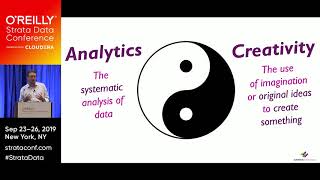
David Boyle argues that analytics alone won't drive strategy; you need creativity to interpret the data. EMI Music used analytics to find 'gadgeteers' and signed Snoop Dogg; BBC discovered hidden Doctor Who fans in South Korea. Without creative judgment, analytics can lead you wrong, as happened in the 2016 presidential campaign.
Chapters
All right, I should start by saying a huge thank you for such a great turnout at the very end of an exhausting three days. Who feels exhausted after the last three days? Yeah, me too. Who feels inspired after the last three days? Yes. Some of the talks were truly remarkable. I mean, it feels at times like we're doing magic or witchcraft. Right. What's possible with data these days is unbelievable. It's like having a superpower or like giving businesses superpowers. But it's not always smooth sailing, right? Not always. We're going to talk about that a little bit right now. Some of the speakers are really honest about that in their presentations. They talked about the challenges they have in getting businesses to use the great analytics that people have developed. Some people were really honest about that in the Q and A's, not in the presentation so much, but in the Q and A. They talked about the challenges they had and those that didn't, I bet if you got them over a drink or a coffee or a lunch, I bet they would tell you how hard they'd struggle. I bet they would. It's hard out there. There's magic on one hand of what's possible with data, but getting businesses to use it or channeling it in the right way to make it truly useful is really hard. Particularly if what you're trying to do is to help people to make decisions with a whole bunch of analytics, which is around optimizing particular business problems. That's relatively non controversial these days. But if you're trying to help people make a bunch of decisions, maybe it's about product strategy or marketing strategy or corporate strategy, all the big strategies, then yes, it's kind of hard to get people to use the right analytics, use us in the right way, and for our work to have impact. That's where my background is. My background's in all those types of decisions. In the music industry for a while, EMI Music, big record label. In the television industry for a while, the BBC, one of the big global broadcasters in book publishing and all sorts of other industries. How do we use analytics to drive decisions and how do we make it easier? So this talk is for managers out there looking to use analytics and try and harness all the amazing power we've seen these last few days. And it's for analysts who've been working hard at their craft and want it to have a bigger impact in businesses. And this talk is all about the biggest single lesson I've learned trying to do this over the years and succeeding wildly sometimes and failing miserably. Sometimes this is the biggest single lesson I've learned and it is that you need to combine analytics and creativity. So I'll tell you what that means to me and I'll give you some examples and I'll hopefully leave you a little bit inspired to go and make a bigger difference in the world. So for me, it's really about a symbiotic relationship. Analytics, on the one hand, the systematic analysis of data, like how we've spent the last three days being inspired by and creativity, the use of imagination or original ideas to create something. These live in some kind of harmony for me. And analytics is inspired by and challenged by and shaped by creativity. I'll tell you what I mean by that in a minute. And creativity at its best is powered by, enhanced by or guided by some kind of analytics. I'll tell you what I mean by that and give you some examples. It's easy to think. This is kind of obvious. Those words are simple and easy to understand and it's a pretty picture. Usually for me it's more like their intention. It's more like they're fighting each other. The analysts, when you get them on their own, will tell you the creatives don't understand the power of analytics. They don't know how to use me. They won't listen to my answers. You know what happens when you talk to a bunch of creatives as well? They say the same thing. The analysts don't understand creativity. They're telling me what I should be doing, but they do not understand. So usually there's some tremendous tension here. It doesn't need to be, though. Why do you have to work hard at this? Well, not just because I say so. McKinsey say so as well. Companies that, if you don't trust me, you should trust McKinsey. Companies that harness creativity and data in tandem grow twice as fast as companies that don't. There you go. There's a good reason to pay attention. What I wanted to do is to give you an example of this in action. So something to inspire you and something you can remember. So I thought back about all the businesses I've worked in, big global retailers as well. I've worked in finance, corporate strategy, worked with some amazing business leaders and also all the entertainment industries I mentioned. I was trying to think, what is the one best example of this in action. So I thought, why don't we give this award, an award today for the best combination of insight and. And creativity. And all the people I've worked with over the years, who would I give it to. If I could pick one person. Drum roll, please. Snoop Dogg for sure deserves this award, and I am going to tell you why. Rewind. About eight years now in the music industry and we've done in EMI Music, the record label, we've done some amazing work to harness the power of data. Um, we did more than a million interviews per year when we got up and running. Online interviews, online surveys, but generating some quite large data sets covering every topic we thought was interesting. Demographics, technology usage, in engagement with different types of music, attitudes. This amazingly rich data set and reasonably large data set, and truly global dataset. And we clustered it for each different market according to different types of audience, and for each type of audience and for each artist. We used some simple predictive work to say, if you could do one thing differently, what would you do to grow your audience? Which segment would be the best opportunity for you and for Snoop Dogg? This. All this data and all this clustering came up with the suggestion of this one new audience that were not fans of Snoop Dogg right now. But statistically, looking at those that were aware of Snoop Dogg, they were likely to be fans if only you could engage them. It's one segment, they were called gadgeteers, all excited about new cool technologies or super online just eight years ago when that was one of the segments of the population. Now, of course, it's everybody and this was the recommendation. So we had this presentation to Snoop Dogg and his manager about this topic and he absolutely latched onto this idea. He kept interrupting the meeting, going back to this point. We got to get them gadgeteers. We got to get them gadgeteers, he was saying. And sure enough, over the coming months and years, you can see him publicly go out of his way to get them gadgeteers. He's on social media like you wouldn't believe. He's partnering with tech companies and product launches. He's investing in startups. He is going after them gadgeteers. So you've got this amazing data set. There's awesome data and analytics happening, really cool analysis, beautiful, beautiful graphs, which I'd love to show you on another occasion. But you've got someone who's incredibly creative latching onto that analytics, being inspired by that analytics, going out and doing something different as a result. That analytics, driving business, driving audiences, driving engagement. You've got creativity and analytics working wonderfully well together. Well, consumer segmentations have been around for a long time and lots of businesses have them. Why was this one special? There's a couple of different reasons. I think one of the really simple reasons is that there are maybe a thousand things different from ours than everyone else's. A thousand small details that all added up. So whilst it was big data and whilst it was great analytics, it's also a craft. Picking which variables to put into the model, wording the questions statistically, throwing out people in the survey who don't look like they're really paying attention, and the genuine respondents weighting the data, deciding how to prioritize the opportunities for each artist. You know, I could go on. There might be a thousand small things that made this project awesome. So what we're saying is the analytics drove this, but we're saying also the creativity was required to shape that analytics in the first place, which is part of the symbiosis. When you get it right, even the consumer segmentation based on clustering data, when you get it right, it can be really, really, really transformative. And at EMI Music, it was the audience segments, the clusters. This big data that we used drove almost everything we did as a business towards the end. It drove our planning for artists, it drove our business cases. It meant that we had conversations with the likes of itunes and Spotify that were based on evidence and facts and hard data. In a world where they had all the data and the negotiating power, bringing your own data and your own point of view on the world to those conversations was really incredible. And also with the artists, artists that were formerly, let's say, intention with their record label or literally in court with their record label, suddenly were wooed by the idea of this strategic thinking, wooed by the idea that we had done this work for them, we had done this analytics for them, and it turned animosity into love on some of the artists and it totally changed the commercials of the business. When you have the whole business making decisions based on data, when you have this army of creative talent, from Snoop Dogg to marketing directors to A and R people, when you have a foundational knowledge for all of those people and they're all making decisions that are a little bit better and smarter every single day, it changes the economics of the business as well. And the key insight for how that happened at emi, how that amazing transformation came to be the case, how analytics and creativity came to work together, is because we focused our analytics on insights. We didn't focus it on telling Snoop Dogg what he should do next. We focused it on showing him the opportunities and giving him the insight that if he were to go get them gadgeteers, he'd have a bigger and more sustainable audience into the Future. We didn't tell the A and R teams, sign this new artist and don't sign this one. We told them the market size potential of the analytics for each artist and they could then choose which one to sign. And sometimes they signed the one with the smallest market forecast because they had this amazing vision that they could turn that person into a success. And again, you've got the creativity and the analytics reinforcing and playing off each other to get to a better answer. If you focus analytics not on telling somebody what to do, but on giving them insights to help them to make their decision, that's one way of making analytics useful and engaging in a creative business. But it's not just the music industry. Let me give you another example where it worked really well. A simple example. In the television world, working on Doctor who at the BBC and the similar analytics, plus some other methods had showed us that Doctor who was statistically underperforming in Korea, should have been generating sizable revenues in South Korea. Was not an anomaly there a discrepancy. And the BBC recognized this. They were skeptical at first. Oh, we don't see any money from Doctor who in Korea. This analytics isn't right. But they're a creative bunch. And they said, what if the analytics was right? Maybe there's an insight there. And they sent the cast and crew to South Korea on the way to Australia, had them stop off and do an event. 5,000 tickets sold out in 10 minutes. 50,000 people applied. It turned out there was an audience for Doctor who in South Korea. They were just pirating the show. And if you're creative about how you market and if you switch up distribution and put it on a different platform and some other tricks, then suddenly you can start to realize revenue from that audience. So analytics can find these amazing opportunities if there's a creative person at the other end to seize that opportunity and go do something about it. You have this beautiful relationship. It doesn't always work perfectly though. I was working at a luxury department store until recently and similar analytics showed us this one group of customers who is really important to the store overall just weren't spending enough time in this one particular part of the store. This is the Salon de Parfum, which is a really high end perfumery at the very top of the store. This one statistical group of customers that were incredibly important just weren't shopping here. And to me, that felt like the Doctor who example. It felt like the Snoop Dogg example, which is, hey, there's a gap. If we're creative, we can go Fill that gap, we can do something to get them, the fans in Korea to watch and monetize the show, or the Gadgeteers to love Snoop Dogg, or this one customer group to enjoy the Salon de Parfum. But the rest of the organization wasn't quite as excited about that opportunity. There wasn't that creative response to the analytics, and I don't think there's anything happening to drive people to the Salon de Parfum. We took a bunch of these people, statistically found these people, took a bunch of them up there and showed them around. Turned out they were really excited about it and spent quite a lot of money on perfume. So the opportunity is there. And sometimes we just fail to inspire people to respond creatively to those opportunities. So I think in all of those examples, the common theme is that analytics has showed the opportunity, it showed the gap, it's shown the landscape. And in some of those examples, you've got somebody wonderfully creative on the other end who understood the opportunity, who embraced that challenge, and it helped them to take a leap that they otherwise might not have done or might not have done as well, or might not have done as confidently. When analytics works best, it does show the landscape, it shows the opportunity, but it requires somebody to take that creative leap off the back of it. I want to take this analogy, like, a little bit further. When analytics works really well, it's like we're giving businesses a map. Like we're drawing a map, whether it's a graph or a report or a segmentation or something else, it's like we're giving the business a map. We build maps. But it's important to remember that the maps that we draw, the solutions we provide, the charts we draw, or the reports we write, they are not the territory. If they were the territory, if maps were the territory, then they would be the same size as the territory, which would be completely impractical. Maps are necessarily a reduction of the territory and a reduction in a really creative way as well. This map is an expression of the world. It's an expression that shows you some aspects of the geography, but not others. It's a creative decision, just as our work is also a reduction of the problem we're trying to solve. And just as the parameters we allow into our models or the frame that we choose for them, or the timescale we select, or the hundreds and hundreds of decisions we make about the data that we use and the problems that we frame, they are reductions of the problem. And that is a creative expression. That is our choice. Inspired by the business and in order to try and drive the business. I think as analysts, we often think that our work is the ultimate truth or an ultimate truth. And that causes a huge tension with creative people. Similarly, I think another mistake is that thinking, all right, we're drawing maps, but the map is showing somebody the way. That is not quite the role of a map, is it? The role shows you the terrain, but it takes a person to choose a route through that terrain. Even Google offers you alternative ways of going about your route. And you can choose, do I feel like walking today or do I feel like the subway and do I want the quick subway route or do I not have to change, or am I going to hail an Uber? And in the real world, it's infinitely more complex as well. You've got to decide, do I have the stomach for this business challenge or like, I see that there's a mountain there, Do I have the energy for it? Do I have the supplies and the resources? Do I have the team behind me to enable me to crack that? When Snoop Dogg looked at the map of audience segments and saw the gadgeteers, he decided that he had the energy and the ambition and the team behind him. He wanted to go get them gadgeteers at the department store. They decided that they didn't. They didn't want to go get that audience segment and get them up into the room. In both cases, the map was the analytics and the business leaders, using creativity, expertise and all sorts of other things, decided on their route through the map. So I really like this analogy for what it is that we do. And if we can remember that our maps are imperfect, if we can remember that it takes a creative response to navigate through the maps that we provide, I think our work will go a lot further and having impact. I want to give you an example where I think this has gone wrong. Particularly sensitive example with ramifications for the whole world and all future generations. Cherry, isn't that very End of conference. As we know, the presidential election was a relatively close call. Each of these dots is a number of votes in the US and the dark dots in the middle are the margin by which Hillary lost to Obama to, well, we wish, but to Trump. And yeah, particularly in three states. It was really close, Right? Why? Well, my hypothesis, strongly held view is that it was the triumph of analytics over creativity over the human element. Henry talks about this a little bit in her book. She says, if our data or anyone else's had showed that we were in danger, I would have torn up my schedule. Which was designed based on the best information we had. And I would have camped out in Wisconsin. She's saying, but the data said we were okay. They said, don't worry about Wisconsin. If data had told me to go to Wisconsin, I'd have gone to Wisconsin. This feels a little bit like, to me, like the analysts who are drawing the maps for her thought that the maps were the objective truth of the ground and we know that they're not. And it feels a little bit to me like the role of the map in this campaign was to dictate the path that should be taken instead of to allow the candidate and the campaign to flexibly choose their path. I think a little bit more flexibility in the map, a little bit more creativity in the data sources that inspired the map might have spotted trends that otherwise weren't there. I think a little bit more flexibility in interpreting the map and saying the data says we're okay in Wisconsin. But you know what, people on the ground say that we're not. You know what social media says that we're not. I think allowing more data sources into that model and allowing more creativity and interpretation of it would have changed the outcome sufficiently of the election. I think it's a triumph of analytics over creativity that's cost that election. And I've seen exactly the same thing play out in businesses. I've seen marketing directors cut budgets because the analytics says the marketing doesn't work. We are going to stop the marketing. Hang on a minute. That's certainly quite a big challenge to the marketing budget. But rigidly following analytics without taking into account lots of other data sources about the role of marketing, for example, or lots of experience and judgment on the role of marketing and the importance of marketing might lead you to not cut the budget and just challenge it a little bit more thoroughly. So I've seen exactly the same thing play out in boardrooms as I think played out here. So for me, if I look at why analytics has failed in businesses that I've been in, why some of my projects have failed, and if I look at other situations, let's say presidential election, I think it's this. When this balance is off kilter, I think when there's not the right balance of analytics and creativity, too much creativity and not enough analytics, or too much analytics and not enough creativity, and when I've seen it work the best, let's take EMI as an example, or the BBC or other places I've worked, when I've seen it the best, had the biggest impact, it follows these rules. It inspires creatives. It shapes and guides them. It gives them tools to help them to navigate through the world, doesn't tell them how to navigate through the world. And I've seen it change cultures that way. And I've seen it change the economics of businesses that way. And I just wonder if Snoop Dogg hadn't sat down with Hillary before the election and given her some advice and whether we wouldn't have a different president today. Thank you.
More from David




How Can ChatGPT & AI Help You Make Your Business Better? - Guest: Marketing Strategist, David Boyle

youBEAT Cafè - Prompt for Artists / AI Revolution / ChatGPT with David Boyle (Audience Strategies)

Now that's Significant - Ep 52 - Reimagining the Future of Marketing with AI - David Boyle




