David Boyle MOCO talk Don’t call gamers gamers
David Boyle argues that treating gamers as one group is a marketing mistake. He uses music industry examples like David Guetta and Pink Floyd to show how targeting specific segments drives growth, then applies the same logic to gaming audiences like Fortnite and Twitch streamers.
Chapters
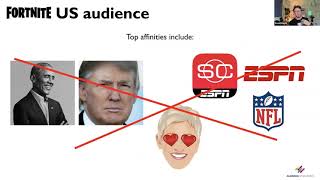
Hi everyone. I'm going to talk to you today about why we should stop calling gamers gamers and why segmenting audiences really, really matters. My background, or the bit of the background I'm most passionate about, is the music industry. I was lucky to work with all of these artists and many more to understand their audiences. But my background's not just music. I'm kind of the forest Gump of analytics, maybe. I was around helping the first mobile phone companies to embrace 3G to work out what smartphones were going to be used for. I was around to help HarperCollins work out what digital books would mean, what BBC Worldwide could do about video streaming and Netflix, what Masterclass could do to take education into the digital world, and what Harrods could do to bring digital into a big department store. Music is the place I'm most passionate, so I'm going to start there. Before we get on to gaming, let me give you an example that brings to life segmenting audiences for David Guetta. His existing audience or something we called Nighthawks. And we identified two segments for him that were key for him to grow his audience. Those two segments are Pop Idols and Casuals. Hence targeting those segments enabled him to do the kinds of music marketing and promotion that made him a household name today. Segmenting audiences made that journey much clearer and bolder. For Katy Perry, she already had the audience that we called Pop Idols, but her next audience, next segment that was most exciting for her to reach was one called Cutting Edge. And for that she did Katy Perry Unplugged, which really speaks to the cutting edge music consumer who cares about authentic real singing. For Pink Floyd, they already had the cutting edge consumer. The next segment for them to really double down on was one called Collectors. And for them, it was the first time they've done such rich, physical, scarce, limited edition box sets in their career. They didn't think that that was what their audience wanted, but it was. And so with a clear view of segments, they're able to go after that new segment, do what's needed and really engage them with what it is that segment wanted. So look, I've seen segments of audiences be incredibly powerful in the music industry and it wasn't just me that thought that. If you look at the economics of the business I was in EMI Music at the time, you see that something was going on with our profit margins. I think we were just smarter and more focused thanks to segmenting our audiences. Right. What's that got to do with gaming? Well, at the moment we are in some kind of a crazy gold rush where every brand feels like if they dive into the metal metaverse, to gaming, to the virtual worlds that are popping up everywhere, then suddenly their marketing plans are going to be easy, like consumers will engage. That's where people are. I go there and I win. I can't tell you the number of artists or brands I've worked with recently where the marketing agency has come back saying, gamers, gamers, gamers. We've got to get gamers. Okay, that's true in a sense, but today is a lesson in why that's not enough. Don't call gamers gamers. We're going to start with one shorthand for gamers that I'm still seeing in lots of presentations. People say, let's go get the Fortnite audience. Okay, kind of maybe, but if you take the Fortnite audience Overall in the U.S. let's say, and just target the Fortnite audience overall, what do you get? Let's see, shall we? Huh? The top affinities of the Fortnite audience, like big mainstream sports brand Ellen and like politicians. That's not the audience I imagined I was going after with Fortnite. That is not the audience I'm targeting when I target Fortnite. So this is a lesson. If you take the whole of an audience, whether it's gamers or Fortnite or anything else, it's going to be a train wreck. Don't do it. Mass audiences like this don't work. That's not who you think they are. The lesson, of course, much like the EMI lesson we shared earlier, is that you've got to segment your audience. And when you take that Fortnite audience and turn it into audiences, split out the individual groups that are similar to each other but different from the mass, you get some really interesting segments that emerge. And a couple of those help explain why we saw those overall affinities coming out for the Fortnite audience as the politicians and there's the sports fans. They're in the Fortnite audience, but they're skewing it. That's not who we mean. That's not who we wanted. Who we wanted, of course, was. Or all the other segments, and probably particularly this segment, the super gamers, the Twitch users. That's who we mean. So don't call Fortnite audiences Fortnite audience. Say, we want the super gamers within the Fortnite audience. We want those that are really into sites like Astro Gaming, Scuf Elgato. Like people who are into really core gaming Properties and interests and behaviors. That's who we're interested in, not the whole Fortnite audience. So much like David Guetta, Katy Perry and Pink Floyd. Don't talk about your whole audience. Talk about the segment of your audience that you're excited to reach next. And in this case, probably super gamers, not Fortnite. Now let's take a look at at 13-24s in the UK overall, let's say you're trying to reach young people. Is gaming the answer? Is gamers a good proxy for young people in the uk? Let's take a look. If you take the audience, break them down into clusters again that are similar to each other but different from the whole, what do you get? Well, you get a number of interesting clusters, but the first thing to say is that gaming is only a subset of these audiences. It's kind of interesting, right? There are three clusters here where gaming really pops out as one of their key. Key key interests. Football and gaming, motorsports and gaming, and then geeks and gamers. So there are three audiences of potential gamers here that we can go after to reach gamers or to engage young people. Now, it's not to say the other audiences don't do gaming, I'm sure they do. But to reach the other audiences, like if that was your goal, probably don't want to use gaming as like the main lever. There are some where gaming is the way to get them. It's one of their key passions. Great. Let's take a look at 23% of the audience where gaming really is key. Now let's drill right down and just look at UK gamers, people who follow gaming accounts or who describe themselves as gamers. Like, who is the UK gaming? Gaming audience. Let's zoom into that audience. This is gamers. Let's see. Well, again, we see a number of different types of people in here and the point being, you would do something really different to engage each and every one of them. If you were interested in these two on the right, there's differences between them, but if you're interested in them, maybe Twitch is an awesome channel to go get them. If you're interested in the ones at the top up here, Discord creators, then, hey, yeah, Discord, one of the hot topics. Many brands talking about it. It's an awesome channel. Right? But for a subset of the market and for this subset of the gamers market down here, anime fans, think about the ip, you'd create, the tone, you'd go for the kind of games that you'd Be present in very different. If that was the audience you're after, it might be, it might not. Take a look. The bottom on the left, gamers who are news addicted. Well, you'd do something really different. You'd be part of telling them what's current, what's new, what the latest things are. You'd want to be communicating with them regularly about that as part of your marketing or sponsoring something that's relevant to that. If it's PC gamers, oh my God, like that's a whole world. Just look at the tricked out rigs they have and the conversations they have. Very, very different from the others. What else? Football gamers on the left, totally different reason for gaming. Totally different vibe. Like collaborative together in the moment following football. And then at the top up there, retro gamers. Again, totally different people, totally different types of IP that you'd create. Games you'd be present in vibes positioning that you'd go for. So why doesn't this seems obvious to me, right? Like there's so many different types of gamer. Don't call gamers gamers within that there are so many different types. Why am I saying this today? Well, I'm saying it because people often don't segment their audience. And I've had this conversation with a number of brands or music record labels in the recent weeks and I've said, why aren't you segmenting them? You're just talking about gamers and your marketing plans. Why are you not segmenting them? And something I've heard more than once recently is, hey, I'm doing the marketing plan. But you know what? Nobody asked me to segment them. My stakeholders haven't asked me. And you know what? It's much easier to just call gamers gamers. I guess you could do that, but I don't know. I don't want to be the sunny side of the bus guy who's like, nobody asked me. I'm just going to treat all gamers as gamers. I know, like it's not a happy place, but I'd much rather be staring at the rock like, hey, we can't call gamers gamers people. We have to change this. I am a man of worry, but luckily the tools exist that you can do this. And you know what? It's our job to do this as insight professionals or brand professionals interested in insight. If you see something that needs to change, it's our job, it's our responsibility to speak up and drive that change. Our job to raise expectations in our industry. It's my fundamental belief the audience segments are the equivalent of having an X ray vision into your audience so that you can understand the parts, how they fit together and how to win different parts of that audience. So please, I'm asking you, stop calling gamers gamers. Stop saying, nobody asked me. Inspire change and tell your stakeholders that segments really, really matter. Thank you.
More from David




How Can ChatGPT & AI Help You Make Your Business Better? - Guest: Marketing Strategist, David Boyle

youBEAT Cafè - Prompt for Artists / AI Revolution / ChatGPT with David Boyle (Audience Strategies)

Now that's Significant - Ep 52 - Reimagining the Future of Marketing with AI - David Boyle




