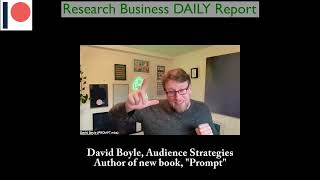
This is a transcript of a YouTube episode of Research Business Daily Report (host: Bob) interviewing David Boyle about his new book, Prompt, a practical guide to growing brands using ChatGPT. Boyle explains why ChatGPT attracted his attention, how he and colleagues rapidly experimented and wrote the book, and concrete ways the tool speeds up market-research work (hypothesis generation, industry overviews, audience segmentation, marketing strategy ideation). He characterizes ChatGPT as a ‘superpower’: radically quicker and cheaper, producing useful—even surprising—ideas that require editing; it personalizes within a chat session and will improve over time. The episode closes with a 50% book discount (offer valid until Jan 31) and a Patreon appeal from the host.
Chapters
Welcome to Research Business Daily Report, where the research industry's longest running video cast or if you prefer, podcast. We've been around for 12 years, since February of 2012, presenting a look virtually every week at a top story that's important to members of the research industry. I'm Bob, lettering my 27th year as the respected voice in market research and recently honored for a second consecutive year by SMR with its Insight 250 award. All of us have heard, and in some cases some of us may have been inundated with references to Chat GPT. It's a large language model trained on a massive trove of information online that creates responses to questions or requests. ChatGPT users can can ask this AI system to field a range of everyday individual and even business questions. A longtime research acquaintance of ours, David Boyle, informed me last week that he's got a new book coming out this month. It's called Prompt, described as a practical guide to brand growth with the use of ChatGPT. Boyle's book, in fact, claims to do more than that itself, describes as the ultimate guide to growing your brand through killer marketing and product strategies. And chatgpt. And Boyle's mind can be a game changer in a number of different ways, some of which he agreed to share with us. We began by asking David how it is that chatgpt grabbed his attention last year.
Well, I was just fascinated by its potential. I just kept seeing weird and wonderful uses on the Internet, mostly like wacky uses. And I just thought, well, if it can do all these crazy creative things, then maybe it can help me to do my job. And so the book came about from a very selfish attempt at saying, how can it help me to do my job? And we just went through like activity by activity that we do every day and said, how can we make this tool helpful? And sure enough, it turned out to be helpful in most of those ways. And then we decided, after very selfishly trying to trying to work out how to use it, we decided then to write that all down and share it with everybody else in the hope that it would be useful for everybody else. I guess it was a few days of really messing around with it before we really decided to write the book. And it really was just a few days though. And in those few days there were so many interesting examples. Like I would work out, oh, it can help do this thing. And then Richard would send a message like, oh, hang on, but also it can help doing this thing. And so it was a few days, but a few days of really rapid iteration. And then we said, look, there's three weeks until Christmas. And I think if we keep going at this pace, like if we keep finding these interesting ideas and if we keep writing down how to do it, I think we could string that together. I think that'd be a pretty valuable handbook for people like us. And so we looked each other in the eye and said, look, are we crazy or does this feel important enough to stop what we're doing, stop all of our other work and just focus on this for two and a half weeks? And we looked at each other and said, yes, this is a life changing moment. This technology really changes everything about how we work and we want to help spread that word. So we dropped everything and wrote a book. I think it makes everything a little bit easier. And something's a lot easier. I think it makes whether you're trying to come up with hypothesis at the start of the project, whether you're trying to broadly understand an industry before you get stuck in, whether you're trying to think about what audience segments might exist, or whether you're starting to think about what marketing strategies might be good responses to those audience segments, it doesn't matter where you are in that process. This helps you get to an answer like quicker, easier, richer, and in a way that's better communicated than you otherwise would have done. So my hypothesis is that actually whether you're super junior and whether you're doing very tactical work, or whether you're super senior and doing very strategic work, this tool actually just helps you to do what you're doing quicker, better and better communicated than it otherwise would have been. So I don't see it replacing anybody. I think it just gives everybody a superpower. It's definitely cheaper than any other method because it's free, it's def. And any other method takes at least time. So even if we're saying hypothesis about audience segments, I could do that myself. I always do that myself. But this is quicker because right there at the push of a button, almost instantly it's given me some hypothesis. It's quicker than I could have done, therefore cheaper, because it would have cost my time and attention to do it, or an intern's time of attention. So it's quicker and it's cheaper because it's free and it's so radically quicker and so radically cheaper that even though it's not better than the ones I would have come up with, it's very good. And therefore I can apply it in many more ways than I otherwise would have done. I can take on many more projects, work with many more brands, work in many more industries than I other would otherwise would have done. Therefore, it's better because what I have to do now is to polish and refine and edit each of those different projects rather than having to do all of the end to end work on them. So the end project better. Even though ChatGPT isn't better, but it's so radically quicker and so radically cheaper that it gets to the same answer. Let's say you're coming up with hypothesis for different category related needs. I'm studying peanut butter and I want to understand what are the category related needs that drive peanut butter behavior. Now, in the old days, how would we have done that? Well, me and my team plus the client would have had a brainstorm and we would have come up with needs. We've done some desk research and over about a week or two, practically speaking, we would have come up with a really comprehensive, really thorough list of all the category related needs to start our research with. Now, in the new world and chatgpt world, I type in chat GPT. Hey, I'm interested in what are the category related needs of peanut butter? Please give me 10, let's say, and instantly it will give me 10. Now, in my experience, probably three or four of them are really good, really spot on and you know, it's great to see. Probably would have come up with them anyway. Two or three of them, probably. Ah, you've not quite read the brief. You're not quite thinking the way I'm thinking. I'm going to ignore those. And two or three of them might be just plain wrong, you know, not, not, not necessary for this project. Not out of scope in some way, but there's some gold in there as well that you otherwise wouldn't have thought of. There's always something you're like, oh, it would have taken me a long time to think of that, that, that really niche one. So it'll surprise you in interesting ways. It does require editing and tweaking and it'll get you to where you would have got after a week or two of collaborative work. It'll get you there, meaning the collaborative work and that time can be spent enhancing, enriching and going on to the next step of the project. So it saves you lots of work in lots of ways. It's better in lots of ways. And it does require editing and tweaking though it learns in a couple of different ways. So the first way is across all of the users all around the world, the things that people use it for. It learns the responses that work, that don't get edited or that end up getting used, it learns that must be what people were looking for. So collectively, it's learning and getting smarter all the time. But also it's personally learning. In any one chat session, it remembers who you are and what questions you've asked. And so in any one chat session, it's learning about your style and what you want as well. So whenever I do a project, the first thing I do is to tell it who I am next. I tell it who my organization is, audience strategies, how we think about the world, our approach, and then I ask it for, let's say, category related needs. Then it knows exactly who I am and how I like to think about it, how my organization thinks about it, what language we use, and therefore it will give me an answer that's in our house style, in our house way of thinking, and that matches our kind of brief for the project almost. So, yeah, you can personally trade it within any one chat session, which is a really valuable way to get much better results out of it. There are so many different versions of this technology already available. So OpenAI who created ChatGPT, have like four or five other versions available that are slightly different for different use cases. Google have their own version, the biggest and best, which is not released yet. There'll be new versions coming out from all sorts of people. So I think I would recommend not worrying about the specific technology that we're talking about here. And in many ways, when we use the chase the phrase chatgpt, what we mean are sufficiently advanced chatbots and lots of what's in the book. For example, you can apply to other chatbots as well. So yeah, there'll be other ones coming. There are already other ones out there, There'll be other ones that are even better. What I'm saying, I think, is don't worry about what the future holds, don't worry about that promise, don't worry about that potential. What's much more useful is to say this one, ChatGPT is available right now for free for everybody, and it can do at least all these things really, really well. So your time is probably very well spent working out how to use what we have already. And then after that is a really good time to worry about what's coming next. But master what's already available and it can already change everything about how you master that now, worry about the future later.
David Boyle is gracious enough to offer viewers of RBDR a 50% off price. If you'd like to order his book, that offer is good until January 31st of this year. Look for the link in the description box underneath Today's Video that's a wrap for on this edition of the Research Business Daily Report, we encourage you to become a supporter of our video, what we call an RBDR Patreon supporter. That translates into an individual or a company agreeing to provide a monthly contribution to RBDR. We suggest perhaps 5 to $10 if you're an individual, $25 or more if you are a business. Either and both help us maintain the excellence of our reporting. Please visit the exclusive crowdfunding platform that RBDR has set out@patreon.com RBDR when you get there, you can literally select the level of support that you can afford and that you think we deserve. And whatever that number may turn out to be, please allow me to thank you ahead of time. We hope you have a good research day and that we'll see you soon. And until then, please stay safe.