David Hrizak on Playing the Long Game in Business Acquisitions
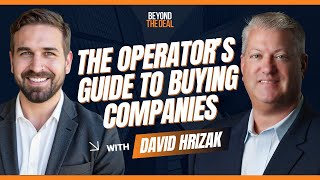
David Hrizak, CEO of Streamlined Companies, buys medical office and class B office buildings with long-term triple-net leases. He targets 85-90% occupancy, keeps no single tenant above 15% of the building, and uses in-house construction to add value. A collapsed lung in 2021 forced him to step back, but he returned to the business.
Questions this video answers
29 years.
85–90% occupancy.
No tenant occupies more than 15% of the building.
December 2021 (referred to as "December 21").
Streamlined Investment Group fund number three.
Chapters
Hello and welcome to beyond the Deal, the show where we go deeper than the numbers and we talk about all the things that lead to success in life and business. Now today on the show, my guest is David Rezak. David is a Phoenix based developer and operator in a very specific niche of medical and B class office buildings. In today's episode we're going to talk about how he ended up there and we're going to talk about the real serious nature of overcoming challenges in life and business. He's actually survived the death of a partner which led to him having a vertically integrated company in all three of construction, property management and operations and capital raising. So an absolutely fascinating episode today. Let's get right into it. All right, David Rezak, welcome to the show.
Thank you very much, Michael. It's a pleasure to be here. I hope you're doing well today.
Thank you for that. Now for our audience who doesn't know anything about you, do you mind giving us the quick little spiel? Tell us what you're doing in life right now.
Absolutely. I am David Rezak. I am the CEO and co founder of the Streamline Companies which is a vertically integrated organization of three entities working together. Streamlined Capital Group is our real estate investment company. We are actively working with passive investors to acquire multi tenant medical office and class B office buildings. Streamlined Development is our general contracting company. We are able to perform all of our tenant improvements and capital improvements through our in house construction. And then Streamlined Asset Management is our in house property management company. So these three entities are culmination of 29 years of my experience in this industry all under one umbrella.
So lots of directions we can go here. Now I do often talk to operators and I talk to capital raisers and I talk to people who've gone vertically integrated. And usually when we say vertically integrated, we're not also talking about the construction side of things, we're talking about property management. Now you've taken that a whole step further and have triple vertically integrated company where you have an investment arm, a property management arm and a construction arm. So I guess the first place we're going here is why did you do all three?
Well, because I've done all three in some aspect of my career over the last 29 years. 29 years ago I started in the real estate industry as a commercial broker. We were selling multi tenant investment properties to individual investors in the Chicagoland market and we also did property management in that firm. Typically our clients were doctors, attorneys, entrepreneurs that had full time jobs and they didn't want to be Property managers of their own buildings. So when we would sell them something, we would maintain it for them under our property management control, thereby increasing up. But they don't pay any portion of the repairs or maintenance around the facility. Doctors are typically triple net lease tenants where they're used to sharing in that portion. Doctors a lot of times consider the buildings they're renting as their home because they spend so many hours there as well. So having a triple net lease allows us to pass back through all operating expenses, thereby we have a base rent plus those triple net costs. We always know our base rent because that's negotiated in our long term leases. So it's easy for us to value future income flows based on the base rent and knowing that we can pass back through 100% of all expenses. Obviously we'd like to do a good job on a fiduciary side to keep those expenses lower. Because if your costs go too high, you are going to get upset tenants, you are going to have people put the potentially looking to move. But through our efficiencies of our own property management program, we're able to keep those common area expenses lower than most of our competition.
Right. And you know, I love what you said earlier about if you are dealing with typical multifamily property management, the calls start happening after 6pm, right. Because that's when everyone gets home from work.
But Absolutely, absolutely. I've taken many calls early in my career at 8, 9, 10 o' clock at night because there was an emergency problem. And with the doctors investing into their space, if there's X ray machines or dental equipment, those are specialty items that typically aren't covered by a landlord. So the doctors have to put hundreds, sometimes millions, hundreds of thousands or millions of dollars into their space for their own specialty practice. So if they're investing that type of space, typically it's hard to relocate it. And doctors tend to stay in their existing spaces for many years.
So when we're talking multifamily. Right. The pitch to investors is typically. Why don't you tell us a little bit about why office? Why now? Why is it still working for you?
Yeah. So we gravitated to office from a point selfish point of view. At one point in my career we obviously started at as a small investor operator. So we were doing single family residential flips. We were owning and operating multifamily buildings. I got up to 500 doors at one point in the multifamily industry. But the problem I found with the multifamily on a personal level is From a property management aspect. Property management phone calls in Multifamily start at 6pm when people are getting home from work. So it's kind of hard to have a family raise young kids when you're trying to deal with multifamily problems on the property management side. So we ultimately got away from the commercial. The multifamily side went to the commercial because those phone calls on the property management side typically stop at 6pm when people leave their business. I since taken a further step into medical office and class B office because I find it's an area of real estate that nobody's talking about. I actually had to fill out a form yesterday to describe what we do and there was not even a check mark box for office or medical in there. There was every other asset class in over the 29 years I have owned every other asset class except for mobile home and storage facilities. But I found that I liked medical office number one because it's more stable. Our tenants are typically triple net their longer term leases. Doctors invest heavily into their space so we don't lose tenants like we do multifamily on a year to year basis potentially. And overall it's more stability to the asset. I like class B office because those are the small businesses of America. We hear a lot of bad news about office in the industry, but they're talking about the class A office buildings. Downtown Chicago, New York, San Francisco, where large companies sent people home for two, three years during the pandemic. Small businesses couldn't afford to do that. They're the lifeblood of America. They kept working through everything. So I'm providing a home for those small businesses so those businesses can provide a home for their employees and ultimately succeed in their businesses and careers. The small class B buildings typically were 70,000 square feet and smaller, three stories and smaller. And nobody on a rent roll typically occupies more than 15% of our buildings. So if we were to lose a tenant, we're pretty well diversified in the rent roll that we have other stability within to help keep the cash flow moving forward.
Yeah. So you said something there that I really liked and I want to revisit it for a second. And because this topic is probably very foreign to our typical audience, you said doctors invest heavily into their workspace and you were talking about triple net. Can you explain what that means to our audience who may be unfamiliar with the concept of triple net and why it would be advantageous for a doctor to be investing into their own space?
Absolutely. So a triple net lease is where each tenant pays Their pro rata portion of operating expenses, real estate taxes, insurance and common area maintenance. When you have a multifamily property, those tenants pay rent and maybe their own utilities, but they don't pay any portion of the repairs or maintenance around the facility. Doctors are typically triple net lease tenants where they're used to sharing in that portion. Doctors a lot of times consider the buildings they're renting as their home because they spend so many hours there as well. So having a triple net lease allows us to pass back through all operating expenses, thereby we have a base rent plus those triple net costs. We always know our base rent because that's negotiated in our long term leases. So it's easy for us to value future income flows based on the base rent and knowing that we can pass back through 100% of all expenses. Obviously we'd like to do a good job on a fiduciary side to keep those expenses lower because if your costs go too high, you are going to get upset tenants, you are going to have people potentially looking to move. But through our efficiencies of our own property management program, we're able to keep those common area expenses lower than most of our competition.
Right. And you know, I love what you said earlier about if you are dealing with typical multi family property management, the calls start happening after 6pm, right. Because that's when everyone gets home from work.
But absolutely, I've taken many calls early in my career at 8, 9, 10 o' clock at night because there was an emergency problem. And with the doctors investing into their space, if there's X ray machines or dental equipment, those are specialty items that typically aren't covered by a landlord. So the doctors have to put hundreds, sometimes millions, hundreds of thousands or millions of dollars into their space for their own specialty practice. So if they're investing that type of space, typically it's hard to relocate it. And doctors tend to stay in their existing spaces for many years.
So when we're talking multi family. Right. The pitch to investors is typically something along the lines of everybody's always going to need a place to live. You're going to get some cash flow, you're going to get some tax benefits and then we're going to force appreciation and an exit in a certain period of time. When we're talking medical or office, what does the return look like to the investors? What is your exit plan when you're getting into one of these deals?
So just as everybody needs a place to live, everybody needs medical attention at a certain point in their life. Medical offices, I always say, are resilient to the economy. Whether times are good or times are bad, people need doctors in their lives. So when we purchase a property, we are able to establish pretty much steady cash flow because of the longer term leases. We're not necessarily looking at a multifamily lease that's up for renewal every year and subject to market conditions. We typically have built in escalators in these long term leases with the doctors so that it's easy for us to do some pro forma analysis on what that building is going to be worth and what we do in streamline investment group in our different funds, we offer our investors preferred returns, typical like a multifamily operator would do, as well as and splits on the profits. But because we're able to have those again longer term leases, we're able to easily understand what the future value is going to be. And utilizing our construction experience, we love to buy older value add properties. Not too different than the fix and flip on a residential side, but we're doing a fix and hold because we have the experience. Over our 29 year career. I'm able to understand what it's going to take to go into an office building, do some capital improvements to make the common areas better, the common area restrooms, the exterior, the parking lot, those things that the doctors like to have as inviting factors for their patients to walk into that building.
Now, is there a number of tenants or something that would make a deal an ideal building for you to buy? Because you know, when we're talking about multifamily, we're typically saying, well, if you have 100 unit building and you have one vacancy, well, you're still 99% occupied. But that's not usually how it works with office. Right. You're not going to have 100 office buildings. And unless you're in a high rise building. Right. So what does that kind of look like for you?
Yeah, so typically when I underwrite buildings, I always look for a stabilization factor between 85 and 90% occupancy on our buildings. And as I mentioned earlier, we look for buildings that have rent rolls where no tenant occupies more than 15% of the building. So as you said, if one tenant moves out, if they're 15%, well we're 85% occupied at that point. However, that vacancy may come up once every five or seven years based on the lease expiration dates.
Right. And with a triple net, like you mentioned before, you have these tenants locked into much longer term leases where these escalations are Built in. After X amount of years, their payment goes up and up. How does it typically handle, you know, if a business goes under, for example, and they've still got 10 years left on their lease.
I've been fortunate, Michael. Over 29 years of doing that. I had that happen to me twice. And typically we like to get personal guarantees on leases. Unless it's a major corporation or a major dental practice that's nationwide, we're not going to get and but that's a good credit tenant. But when a doctor does sign a personal guarantee, we do have the opportunity to go after them. Just like on a multifamily lease, people sign personally. But it's only happened very infrequently in my career, knock on wood. Because these are good long standing businesses that have their practices built up, their cash flow coming in and unless something earth shattering goes wrong on the operations side of their business, we're okay as landlords being protected.
Understood. All right, well, you know, that has all been very informative, not just for our audience, but for myself as well. And I selfishly like to use these opportunities to learn as much as I can about a new asset class. Hey, really quick, I hope you're enjoying this episode. I just wanted to stop for a second and thank our sponsor, which is me. Nimble Capital Group is my boutique investment firm where we help passive investors access deals built for cash flow, equity growth and powerful tax benefits. And if you think you've ever wanted to learn how to raise capital and become a GP yourself, I coach a select group of students each month, most of whom will raise over $500,000 within their first 60 days. So check the show notes in the description below to book a call. I'll see you there. Now can we go back to the beginning a little bit? You mentioned that you started as a broker. You've basically done every single kind of real estate and through, you know, 29 years now, X number of market cycles, you've ended up here. But let's talk about the origins and kind of the evolution of getting into this, this particular niche. Why did you start with being a real estate broker?
Well, I came out of college entering the financial industry in Chicago. I had done an internship during college, thought I was going to go down the investment banking route, work for a very large, well known mutual fund company in downtown. But I hated it. I was there one year and I realized I'm a people person. I need to be out there meeting with people. And I did have some real estate background within my family. My sister and brother in law were always in the high end class A office space during that time in Chicago. So I looked to them as some mentor per se, but I went my own route to do everything that those institutional investors didn't want to do. So we helped the smaller market and the middle market come together with individual investors and help them build wealth. And all of that is everything I've done is predicated based on my upbringing. When I was born the south side of Chicago, I didn't have a father figure in my life. My mom was constantly working downtown to provide for me. My grandmother took care of me most of my upbringing. So my grandmother taught me loyalty, hard work, and ethics. She said, if you're going to do it, you do it to the best of your ability and you do it until the job is done. That's still my motto today.
That's amazing. I couldn't agree more. How do you think that level of ethics, that level of being a people person, that level of, you know, holding yourself to that standard has contributed to your success? Not just in this particular industry, but let's say also with raising capital, which is particularly hard to do today compared to just a few years ago?
Absolutely. It's extremely difficult today. The biggest thing in our business is relationships, and when people get to know you, like you and trust you, they're willing to do business with you. And many of my investors today have been with me for over 20 years of my career, throughout multiple deals, and they followed me from one to the other because A they've made money, but B, they trust me. And it's because of that trust in the relationship that's made me very successful now over the course of my career. I chose wrong mentors. I chose people as partners or just people to do business with that took advantage of me because I was too trusting and too loyal. And that ultimately hurt me in a number of situations. But I was able to quickly learn from it, rebound from it, and make myself a better person. A, to make sure I was never like them and B, to make sure people truly understood the potential downsize downside with certain operators or certain partners.
I think that's something that people don't really talk about enough in the podcasting space or, you know, unless they're behind closed doors at all. But that's something that really is common in this industry, is that there are people who've been around for a while who will take advantage of younger, newer, more naive people. It's happened to me probably three or four times now, and I never Saw it coming each and every time, thinking that I'd learned from the first time. But you, you know, it will happen. And so do you mind telling us maybe like an anecdote about a time that it happened to you and, you know, how you prepared yourself to make sure it doesn't happen again?
Sure. Without giving too many specifics for protection of the individuals involved, I was involved in a situation where a partner said he was going to do one thing, did another, took money out of the company without my knowing, caused some cash flow issues, and then ultimately walked away and left me holding the bag. And fortunately, I've had great lenders to work with over my career that if there was a problem or was a situation, they trusted me. You go back to, I think there's five Cs of lending, and one of them is character. I can call up any of my lenders that I've ever done business with. And because of my character and always paying back my loans, even during 2009 and the great Recession, and not walking away from a property when I could have that character has built relationships and trust to allow me to be successful. Yeah.
Since you brought it up, I'd love to ask you about it. So 29 years, you've lived through quite a few different market cycles, right. Is 2009 the worst that you've seen? And where do you think we are now and where are we heading?
Yeah, 3009 was the worst. In fact, I was on a podcast a couple weeks ago, and we both lived and worked through that 09 downturn, and it was a battle every day. There was no money available for operators like myself. Because of the relationship I had, I was able to rebound to the point after my partner died to allow myself to finish that multifamily townhome project I spoke about earlier. We couldn't sell the units, so the lender and I came up with plan B. Hey, let's build them, let's rent them out, let's pay down the principal, and let's wait for the market to come back. If it was a larger bank during that time period, they would have just taken the property from me, sold it for pennies on the dollar. Well, this particular lender didn't want to do that to me, didn't want to do that to his bank, and didn't want to do that to ultimately the citizens of our country who ultimately paid the bill on a lot of that through TARP money and different programs that were out in the government. So we battled it out in 09 and while that project was supposed to be a two year project, ended up being probably a five or six year project because we pivoted, the lender and I, we were both able to come out whole. And I even made some money at the end of the deal when we finally sold the last unit. I just had to utilize my skills as a property manager for those five years, keep those units rented, albeit I was doing more multifamily at that time. So I was able to be efficient. And ultimately that may have been the turning point where I got away from multifamily as well.
Yeah, I mean, makes sense. I would ask two things. So you mentioned that it was supposed to be two years and turned into five. You know, in comparison, we probably are now at a point where a lot of people bought in my industry, in particular multifamily deals in 2022 that were way overpriced. You know, top of the market all of a sudden. Interest rates double in July. Everybody's left, you know, with their pants down, so to speak. But at the end of the day, if you can hold something long enough, if you can weather the storm and bank doesn't take it, you know, probably there is a light at the end of the tunnel. I mean, do you think we're in a similar moment now in that regard, or is it still just, you know, really overvalued properties?
So there's been discussion about the trillions of dollars of mortgages coming due over the next 24 months. And I've read multiple articles of some of the larger lenders kicking the can down the road a little bit on interest rates and loans that are coming due right now and just short term renewing them. So we don't have that massive influx of bad assets hitting the market. And that's something that didn't happen in 0909. The government probably overreacted and did what they felt was right at the time. Currently, lenders are working with some of the multifamily and there's commercial loans out there as well that are at 3 and 4% that are all coming due at 7 to 8% currently today. That makes the property almost, I wouldn't say worthless, but equivalent to the value they paid 5 years ago or 3 years ago or less. So by lenders helping and working with current investors, mortgages coming due. I think we're going to be okay. However, I think there's a lot of operators that have had enough and they will just sell and walk away. So we're fortunate in my industry right now we are seeing some opportunities of long term operators of the buildings. We inquire about just wanting to retire and get out of the game because, hey, this may have been their second or third cycle and they don't want to do it anymore.
Fair enough. Yeah. So real, I mean, real estate is not for the weak willed. You know, I think a lot of people think, hey, maybe I'll buy a duplex or a triplex and I'll just put a tenant in there and it'll be easy, easy. And then they find out it's basically a full time job. Right. And then that doesn't even factor in the market cycles.
Anybody that's been in this business long enough has thought about quitting at some point because of the struggles they're facing and myself included. And if you're willing to persevere, that storm, it's going to clear up and there's light at the end of the tunnel, as you said earlier.
Yeah, mean, talk about a perfect segue to the final question that I ask all of our guests, which is, you know, stress in this industry, particularly the last couple years considering the market cycle, but just in general, I mean, you own three companies, right? You've also got a family. How are you keeping on top of everything? How are you making sure that your mental health, your physical health, all of that stays in check considering the weight of responsibility of what you've managed to build for yourself?
Well, this answer is going to take me a while. So in December 21, I was sitting in a hospital bed in Puerto Vallarta suffering from a collapsed lung. I was there for my 49th birthday, celebrating with my wife and friends, and I was thrown off a horse, couldn't breathe, collapsed lungs, go to the hospital. Fortunately, I speak the language well enough to get by. And through my three days in that hospital, I said, if I make it home, I'm retiring, I'm done. I've been working like a dog at that point for 25 years. And the doctor, when he released me, said, I suggest you stay here for about seven more days to let your lung heal. Well, this was getting close to the middle of December, close to Christmas. I said, doc, I can't. I've got to take the chance. I got to get home for Christmas. So for the first time in my life, I was truly afraid. And I held my wife's hand that whole flight home, taking short breaths, not putting a lot of pressure on my lungs. I didn't know if that was working or not, but I knew that if I made it home. I was going to live my life differently and I did retire and my wife and I started traveling around the world and had a great time reconnecting. We had been married for many years at 26 years at that point and our kids were pretty much grown. We had one left in college. We took 10 months of traveling. And then I realized I was missing something in my life. I was missing my purpose. I came back and formulated the streamlined companies couple weeks before my 50th birthday with my cousin current partner who I've known for about six years. He's been. Scott Roney's been a corporate attorney for over 30 years and we serve together on a nonprofit board of directors here in Arizona. He was looking for a new opportunity and so was I. I was looking for that new purpose. So we came back and with the idea of helping people build passive income and long term wealth through my experience and the deals that I have done that made me successful, I felt I owed it to other people to help them as well. And yes, when we formed the streamlined companies and they were three, I'm spinning a lot of plates. At certain times I've taken the opportunity to meditate. Every morning I find myself listening to meditation music for at least 15 to 20 minutes before I start my day day. I'm able to reconnect with my wife over a cup of coffee before we get our lives moving. That calm before the storm of the day helps me get through the day. And ultimately at the end of the day, I look for that quiet time again over a cigar and a bourbon just to regroup over the day, reflect what went wrong, what went right. Because every day has challenges. You have to take time for yourself. And a lot of people a don't know how they eat wrong. I'm not saying I eat perfectly, but I could eat better and. But you have to take care of your mental health. If you don't have your mental health, your physical health isn't going to be there. And I do see a life coach once a month. I'm able to go in, call it therapy, call it whatever you want. I'm not afraid to talk about it. I'm able for 45 minutes to say whatever I want to this counselor. And it helps me unload weight off my shoulders, but it also gives me clear direction on how to proceed.
You know, you might be the first person who ever suggested a whiskey and cigar as a, you know, a health. I mean I talked to plenty of CEOs and they're all like, yeah, I journal at night and I write down all these things I'm grateful for. But you know what? Whiskey, cigar, same purpose. Sounds a little more relaxing to me.
Absolutely. It's 45 minutes or so of time where you can't move. You have a nice slow burning cigar, you maybe listen to some music. I'm sometimes still on my phone looking at LinkedIn and reading articles on LinkedIn, but if I can get that time two to three days a week, it helps me throughout the day, throughout the week, I should say.
Yeah, absolutely. All right, David, well, thank you so much for being here. I've immensely enjoyed this conversation for our listeners. Tell them you know who they might be interested in investing with you or learning more about you. Where can they find you?
Absolutely. So we do have a current fund that's open Streamlined Investment Group fund number three that we are actively seeking investors for. You can find me on LinkedIn. David J. Rezak H R I Z A K or send me an email djhestreamline companies.com I take every email personally and I will respond to you personally and make sure that we do connect.
Perfect. All right, thanks so much for being here.
Thank you, Michael. You have a great day. Thank you for your time.
That's a wrap for today's episode of beyond the Deal. I hope you got some valuable insights that you can apply to your own investing journey. Now, if you've enjoyed this conversation, do me a favor, hit that follow button, leave a review and share this episode with somebody who you think could benefit from it. It really helps the show grow and bring on even more incredible guests. If you want to go deeper, make sure to follow me on your socials. You can find the links in the show notes in the description below. Thanks for tuning in and I'll catch you next time. Until then, keep going beyond the.
More from David
JF 3995: Navigating Market Cycles and Scaling Passive Investment Returns ft. David Hrizak

Real Estate Investing Q&A for Women | How to Invest Safely | Titan Impact Group

How to Create Passive Income Without Burnout | Legacy Wealth Plan | Titan Impact Group
JF 4041: Tenant Credit, Triple Net Leases and Relationship Capital ft. David Hrizak
🎙️ Medical Office Real Estate Investing with David Hrizak | A Passive Wealth Strategy for Doctors