Candid Conversations for the Catalyst: Collaboration or Competition?
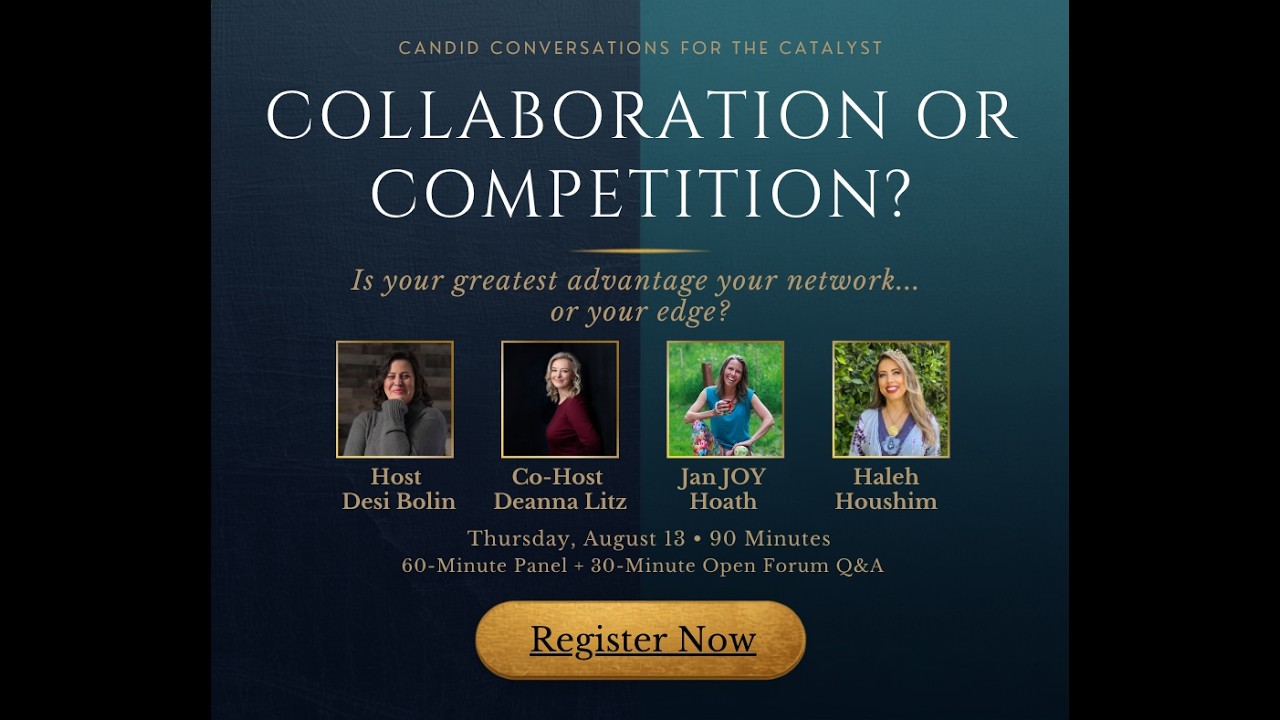
Desi Bolin and Deanna Litz host entrepreneurs Janjoy Hoth and Hala Houshime in a conversation about whether leaders should compete or collaborate. They explore abundance versus scarcity mindsets, the difference between healthy competition and toxic rivalry, and why sleep, hydration, and daily play matter as foundations for real partnership.
Chapters
Hey, here we go.
Sure.
Welcome everyone. I'm so excited to have you here for another candid conversation. Uh, for those of you who are joining us for the first time, this series was created because there are plenty of places that tell us what to think. We wanted to create a place where we could actually think together. No PowerPoints, no perfectly packaged presentations, none of that. No pretending there's one right answer, right? Just real people having real conversations about topics that impact the way we live, lead, and grow. And today's question is a juicy one. Collaboration or competition? Because we're entrepreneurs, we're surrounded by people doing similar things, right? Speaking on similar stages, serving similar audiences, launching similar offers, right? And whether we want to admit it or not, comparison can sneak in. pretty quickly, right? Who's growing faster? Who's getting the opportunity? Who's getting the client? Who's getting invited into the room, right? And somehow, somewhere along the way, we can start believing someone else's success somehow takes something away from ours. And today I wanna challenge that. I really do, because what if the next level of your business isn't about outworking everyone around you? We're gonna talk about abundance, scarcity, trust, partnerships, boundaries, comparison, competition, and probably several things we haven't thought of yet, right? Because that is the whole point of candid conversations. We don't know exactly where we're going. We're going to flow in this conversation. So before we dive in, I want to welcome my incredible co-host, Deanna Litz. One of my favorite things about having Deanna in these conversations is that she listens for what isn't being said, right? She asks the question underneath the question. And she is never afraid to look at something from another angle, which means I fully expect her to challenge all of us at least once today. Deanna, welcome back, my friend. What are you most curious about as we walk into today's conversation?
Oh my gosh, thank you, Desi. I'm always so honored to be here. You draw in the most magnetic, amazing people, audiences, and cohorts. So thank you so much for doing this. You do all the heavy lifting for us, And you are the epitome of group effort. I love it. What am I most curious about? I don't want to throw out any spoilers, but I feel like there could be some juicy conversations around gender in this.
I love that. And everyone watching, you're part of this conversation too, okay? Drop your thoughts, reactions, questions, disagreements, aha moments, experiences. Into the chat throughout our time together. We, we really don't need everyone to agree. In fact, I hope we don't, right? Because different perspectives are what make conversations interesting. Right? And joining Deanna and myself today are 2 incredible women bringing their own experiences and perspectives into this conversation. Miss Janjoy Hoth and Miss Hala Houshime. Rather than me reading some perfectly polished bio, I want you to hear directly from them. Okay. So Jan, tell everyone a little about you, what you're creating in the world, and maybe most importantly for today's conversation, are you naturally more collaborative or competitive?
Ooh. Okay. Well, I might answer the last one first. Okay. Um, I am naturally more collaborative. However, I am excited to get into this conversation because I do believe there's power in competition in a healthy way, but we'll get into that. Um, but hi everyone. I'm so excited to be here with you all. Thank you, Desi, Deanna, and Halaia. So wonderful to be in the room with you all to dive into this conversation. My work stems from a life mission of joy to the world, and starting with especially women leaders, like what we in general have here, of women who are devoted and dedicated to being wholehearted leaders. And in particular, I work especially with women who are done with the facade, they're done with self-sacrifice, and they're ready to reimagine life and leadership through joy. And my work is, um, very spiritual, very intimate, a very personal self-actualizing basis, and yet it's very holistic. So I'm really about the joy ripple effect that we get to create in the world. And I'm coming to you from Jackson Hole, Wyoming today, um, with even bear in my yard. And so I'm, I'm excited to bring the, um, you know, the animal spirit energy in. You know, I know we've got definitely different energies coming in to support this conversation, and I, just like Deanna, I'm really excited for the juiciness and, um, bringing a curious heart to this conversation. And I, I love that it's unscripted and, um, beautiful in the making.
So, Hala, same question for you. Who are you? What are you up to in the world? Where do you fall? Collaboration or competition?
First off, I am just super pumped up and excited to be in a room with all of you guys. And thank you for inviting me to be on this platform to experience this because I was just, just knowing you, Desi, I'm like, I'm in. I don't know what I'm in. I'm going with the flow, with the winds, with the jet flying to you. Let's go where you want to go. So I'm excited to see what this brings. I don't know what will come out of my now, but I'm here to share. So I'm all about— let me answer that question about collaboration, because I don't know what competition means. Uh, but everyone in, like, in the outworld, they're trying to compete. And when there's fear, there's no love. Where there's love, there's no fear. And when we focus on ourselves And do what we're passionate about and just going after that, everything else will flow. You'll be like a magnet and everyone will be drawn to you. When you focus on yourself, what you enjoy, and you create the universe. So I'm all about that. You are the universe. You are the master creator of your world. Because there's right relationships, sickness, pains, aches. Bunch of stuff going on, especially as a high performer. But the one thing that matters is keeping that momentum every day. So it could be the environment, it could be the nutrition, it could be our thoughts. But we get labeled with a bunch of stuff. So I personally am a Healthspan Cell Resonance Quantum Navigator. And what that means is living your life. to that passion every moment with that joy and playful. So that is what I want to see instead of competing, all of us coming together and play together.
Deanna, I'm gonna, I'm gonna throw it to you for a minute. I want you to introduce what you do because I think it fits beautifully in this conversation. And, and please, are you more collaboration or competition?
Well, I'm trying to figure out what part of what I do you want me to talk about.
The one that I am deeply in love with.
That doesn't narrow it down. I wear many hats, among other things, um, an organic farmer, market gardener, and a business and coach and consultant, an executive coach and consultant. And so in that work, what I have done is help people be extremely honest with themselves and see themselves from a completely different perspective and an objective perspective through the tool of Human Design and bring that into their work in terms of decision-making, influence, communication, and leadership. And that might be the one that Desi's referring to.
It is, it is indeed. Although I love every single piece of you.
I do love nature. Real, by the way. So I believe my answer depends on context.
Right.
And I think of myself and my identity is wrapped more in collaboration. And I've been surprised at times how friends have reflected back to me that I can be competitive, quite competitive in certain environments. Which is, I think, also fun.
I agree. I agree. I was playing cribbage with my family yesterday. I got very competitive. I made all 3 of them quit.
Broken all.
I love cribbage, just for the record.
We have to play cribbage next time we get together. And I want to really start right there. You know, when you, when you ladies first heard, you know, collaboration or competition in the context of this of this, uh, conversation, what was your immediate reaction? Do you instantly think collaboration? Did part of you think, well, healthy competition isn't necessarily bad? Did it bring up an experience, something completely different? Jan, let's start with you.
Well, yes. I mean, I thought, oh yeah, collaboration, that's the obvious. And then it was like, oh no, wait a second, healthy competition is helpful. When, for example, like 2 people are driven to move forward, you know, I just, my kids are runners. So I think about like, and my son's just joining the high school cross-country team with his sister who's been on it for 2 years and seeing them like look at each other and watching my son pass my daughter. And it's like, that's a healthy competition. Yeah. There is health and vibrancy that, that notion that it causes both of them to perform better, right? Unless one of them takes it to the negative and the squandering energy form of competition. And I think for me, when I first heard about it, at first I was like, oh, that's gonna be an easy conversation. I don't know if I, you know, really have that much to contribute. And then, I backed into trusting, and then I started to really sit with this and go, whoa, there's a lot here that we really can unpack. And I'm like, I don't even know if an hour is enough. So that was my initial response.
Yeah, well, hey, you never know, this could be part 1 of a multi-part series. Um, Hala, what came up for you?
That was a great point that you said, Jan, about a healthy competition, because it's burning to have to get that burning fire. Like, what is it that you want to reach? What is it, that goal you want to have so you can have something that you want? Not that you're competing with someone else, but you— for me, it came up as, oh, I want to get there. So I'm not competing with anyone else but myself to get to that destination and giving myself that energy to— it's like, you know what, I'm going to get there. Even if I take micro bites, I'm going to get there. And that came up. And obviously on a different note, because I'm in this group, those collaborations. So the first thing that the community came together to as a collaboration. Because it's great to collaborate with people too, because you get that accountability, that motivation, that inspiration as well in a community as well too. So that also came up for me when you said that. I'm like, it's good to have a community if you don't want to do it yourself, to have that go-to passion to get to that destination.
Mm-hmm. I love that. I love that. Deanna, what, what comes up for you? I know you and I have talked about this several times.
We have in preparation. I really love what Hala said about— to me, what comes up is competing against who? And when we first hear collaboration or competition, do we automatically see the competition is with other people or other situations, can we look at it as even competition with a former self, right? That's what personal bests are about. Mm-hmm. And so that comes up. I will admit too, to naturally thinking of, first of all, about collaboration. I even reached out to Desi. I'm like, is all the people that we have on here just going to end up being kumbaya around collaborating and nothing else? But I'm with Jan, I think there's a lot to unpack around competition. That isn't it. And for me, it comes down to from the place we're coming from. There's competition from strength, which I think is what Jan was referring to. There's also competition from threat.
Mm-hmm.
And I think there's also collaboration from strength and collaboration from threat.
Oh, you are so eloquent. This is why I love you. I absolutely agree. I mean, for me, I think competition has a place and a time. It just really— I think competition gets a lot of bad rap because of how people approach the competition. And I think there's something to really be said for, okay, if you're coming at it with a positivity, Then it's gonna land very differently than if you're coming from at it with that, that negative mindset, or I have to win, right? Um, so I, I very much agree with all of you ladies. Um, and I want, I'm gonna bring in the spiritual animal here a little bit. I wanna poke the bear.
I wanna poke the bear. Poke the bear.
It's so easy.
I'm glad you're not at Jan's right now.
I would say it's so easy to sit here and say collaboration good, competition bad. And I don't actually think it's that simple. You know, competition can motivate us. It can challenge us. It can show us what's possible. It can even push an industry forward. So is competition actually a problem, or does it become a problem when competition turns into comparison, scarcity, ego or needing someone else to lose in order for us to win? Okay, Holly, you're shaking your head. I'm gonna throw it to you first.
Okay, let me refresh. Yeah, that was just like, whoa, yes, it can motivate us, right? Competition can motivate us. There's time— I'll go back. Actually, that takes me back what you said that because there was a time in my life And I'm like, I felt like I'm in a competition at my younger age because I did grow up in a community which I wanted to be in the waterfalls and the mountains and in the rock. But I ended up because my family was there and I was young, I was in Beverly Hills and there was a lot of competition going on. So I found myself, I need to fit in and I need to look like this Barbie doll, and even though at that time I had a six-pack and everything, I mean typical Barbie doll. So actually, me competing to fit in, I started not loving myself. So there was a time in my life that what you just said, that it took me to that moment. There is times that a lot of people compete, or they keep. I'll just throw this in because it's coming, and I'm all about flowing and what comes in. People are constantly injecting themselves to look good on the outside or changing the way they look on the outside. And that has been really huge in the community. And because what they see on social media, so they want to keep competing. Oh, they're better. This is, this is happening. Yeah. So we're constantly competing on what we see on social media instead of coming back to ourselves. So there's that side of competition, and then there's a— this other healthy competition. Again, it goes back to getting to that destination that we want to get to as ourselves and not with anyone else. So that just threw me in that energy field.
Well, Jen, I'm gonna throw it to you. I love what you, what you're sharing though, Hala, too. It's so poignant.
Yeah, well, I mean, really interesting because I feel like I'm like the opposite in the sense that like I ran from competition, I think because I was scared of it. Like, I— so my first profession, um, or actually I had a passion for ski instructing, or skiing, sorry, back up. I wanted to ski. I was in high school. My high school had a ski racing team, and I had zero interest in the racing part, but it got me to the slopes. So I was like, sure, I'll come. And I used to joke that I was like driving Miss Daisy going down the racecourse, and I would only go when I had to, and then I would free ski and I was so happy. And so like, I ran from competition. And yet what I actually already see in this conversation surfacing that I'm appreciating is a couple of thoughts dropping in is around the fact that like we love sports as humans. And can you imagine watching the World Cup soccer and they were collaborating on the field? Like, that doesn't make sense, you know? And we as human beings by nature, we crave competition. And that I recognize there are times in my life where I ran from competition, and if I would've embraced it with all the joy work that I teach, I actually believe there are areas of my life that I could have flourished so much more if I hadn't had a better relationship with competition. But for me, it comes down to where we're coming from, the energy behind it. Mm-hmm. And what that creates. Yeah. And so, um, that's what's kind of coming up for me is just sitting inside of like, ooh, what would've been different for me then? You know, where can I obviously take this now? And then just thinking about all of us as especially women, cuz we have mostly women here, but I know at some point Deanna said we're gonna have to pull in that gender piece, which will be fascinating. And yet just really acknowledging that I think it's a fine line even where competition is healthy and helpful and it can fall into not serving and, well, they're like life-giving. I'm just gonna put it in 2 buckets, like life-giving versus life-taking.
Those are good buckets.
Yeah. Deanna, what's coming up for you on that question?
I have about 4 different directions I want to go all at the same time. I don't know how to do this. Hella, when you shared, what brought— came up for me is competing for what? And so that piece of it changes the game. If we're competing, if 2 nonprofits are competing to be the very best socially responsible giver-backers, give-backers, right? How great if that spurs them on. If the competition is for something that is life-taking, small l, small t, right? Then it's totally different.
Yeah.
I have one story to counter Jan's story about, or point about sports. Now, this is an outlier for sure. It is a story. It is told by One of Canada's greatest storytellers, Stuart MacLean. Sadly, we don't have him anymore. And you can hear it on the Vinyl Cafe podcast. And the episode would be The Greatest Hockey Game Ever Played. Long story short, end of World War II, and the senior team, hockey team, ends up in the World Senior Finals and gets sponsored to go to Europe. And they play competition, competition, totally different game. It's outside, blah blah blah blah. They end up in the final against some European team that has been really brutalized through World War II, and they find themselves competing at such a level, playing the game at such a level, having fun that by the end of the game it's a tie zero zero. They've each played, in a sense, the perfect game. And what are they supposed to do? They decide— the powers that be decide they have to go into sudden death overtime, and the first one that just happens to score wins. Both teams had developed such an appreciation for each other that didn't sit well with them because they wanted them both to win. And long story short— spoiler alert, drop out now if you don't want to hear the end— The teams decide, it was somebody else's idea, but the teams decide, yes, we're going to do this. They threw their sticks on the ice, threw it all over, and then they pick up, they go to wherever their sticks landed. And now it's a big game of shinny where you have Canadians and the other team playing together on the same team, playing for the cup. So there is no... division of country. Does that make sense?
Yeah, that so makes sense. I love that point.
And the powers that be were so angry, they, they quashed the idea that that game even happened. They said the games weren't played that year. But there was this unspoken rule between those 2. And year after year after that, Canada and this other team ends up in the top 2. And they win one year and then the next year they lose. And they literally kind of traded the cup back and forth, just to say. So my point is that, like you said, the fine line. And I have other examples, actual real examples of what I think has been called coopetition, if that makes sense.
Ooh.
Which I think is really interesting. So For me, what I would love to hear from everyone, including you, Desi, is what is your best story and best memory around competition?
Okay.
And it doesn't involve cribbage.
I was gonna say, I already shared. I already shared. Okay. I would say For me, I'll go back to high school. One of, one of those things that are immediately coming up is just me competing with my classmates to be, you know, at the top. And, you know, through that, I got a 4.25 GPA when I graduated high school, right? Mm-hmm. Um, but, and you're only not, I mean, you're not supposed to go above 4 because 4 is the top, but I went above 4. Um, But I think through that, I mean, just that, that competition of, of not, not even comparison, but of just trying my hardest to win, quote unquote, right? It's not like I was trying to win, but I think that just, it really put it in my space of, yes, I can be better at this, right? It allowed me to really pinpoint the areas where I didn't feel like I was the best I could be. So I think in that way, competition has a lot of prudence. So I'm absolutely loving this conversation. Jan, I'm going to throw it to you on that question.
Well, sitting inside of that, I'm like, oh, and look, I totally hear you, Deanna. Like, that would be my jam. I would have been like on the ice with them, like, And, you know, because I think a lot of times too in sports, we're like, hey, you know, that team, blah, blah, blah, whatever. And, you know, it is a healthy rivalry, I think, is what we ultimately crave and love in sports. It's when it starts to go dark that it's ick for everybody. And so I love this, the, what did you call it?
Co-opetition.
Co-opetition. Like, I love it. And I, I really appreciate this, like, even me sitting inside of this with you all, like, thought-provoking experience, because I'm like, yeah, what are some times where I really got to see that? And, and Desi, you, you helped me initiate, um, an experience I'm called to speak to. And that is when I was in college, I was a walk-on rower. And we had to compete for seats in the boat, but then we had to work together once we were in the boat. Um, but even training For the competition, for the seats, we would work together. We would run together, we would train together. I was a lightweight, so we had to be very trim and, you know, think about a lot of things. And being in that position where it's like, really had to be both and. I'm competing against you and with you and for us.
Mm-hmm.
And so really thinking about that notion, like you were talking about, Deanna, with the, um, nonprofits, like if there's 2 nonprofits in a healthy rivalry raising funds and awareness, like that's great. And just, you know, kind of thinking about for myself and my clients and everyone listening how this can be relevant for each of us of like, how do we apply this? Consideration to our current existence and the different roles we play. It's, it's kind of fun to just sit and marinate in
it. Right. Uh, well, and that's, I think, part of the reason we created this, right? Is, is oftentimes we just, we move through life so quickly as humans, and oftentimes we don't have that reflection time, the space to really look at it and say, Yes, and what about this? Right? So, Ahala, I'm gonna throw it to you on that question.
Thank you. So we talk about sports, and I was gonna bring up the time that I was in a tennis competition, but then I'm like, okay, we covered tennis, and I mean sports. Tennis at that time was one of my favorite sports, and besides I did gymnastics, and then I wanted to do ballet. So it's like all of those competitions that was going on in sports. But I was gonna— then while Jan was talking, it took me to— here I'm going with different things. So with Deanna, it was about the tennis that came up. Then with Jan, it was about the time when I was playing musical chairs, you know, as everyone knows, to get into musical chairs. My playful self was going towards that. But what came up, uh, Destiny, when you, uh, asked the question was about me, that I always wanted to win an eating cake competition. So I remember as a kid, and you know, I grew up with always winning, and I ended up winning because I stuff my face in that cake, and I didn't even care if there was glyphosate or whatever. I was just like enjoying, and I was like, I'm gonna win, I'm gonna win, and I ended up winning every time. So it took me to that fun moment, eating cake contest. And, um, no wonder I love cakes, right? So that's where it took me. So because I always wanted to win, but I have fun doing it. So there was a group of us on tables that we did as a kid. As we grow up, Yeah, eating cake contest. And it was fun because we were all having fun doing it, but we were all like, okay, we want to win the prize, we want to win the gift. So that's where I went. So you could have fun and compete, but it could be such an enjoyable process doing it.
I love that story. Before you came on, Hala, I said I was gonna airmail some chocolate cake to Deanna because she wanted a treat. So I love, I love that it's coming back full circle.
I'm a food lover, so yeah.
Oh, ladies, ladies, ladies, I want to talk about scarcity a little bit because I think, I think this is where things really get interesting in this conversation. Well, let's say there's only one speaking spot, one contract, one, one client, one award, one seat at the table. Sometimes there really is a limited opportunity, and that can make abundance sound like a lovely concept, That doesn't match reality. So how do we hold both? How do you operate from abundance when sometimes only one person is getting chosen? Deanna, I want to throw it to you first.
Me? I'm supposed to follow the cake eating with you? Gosh, yeah, I, I love this topic, Desi. I'm a firm believer that this— the environment we're in, the context we're in, has a huge influence on Years ago, I was on the board for our provincial fruit growers, and they tried really hard to have a spirit of everyone working together in the entire province as fruit growers. And instead of competing with each other, why aren't we competing against, you know, imports from halfway across the world of food instead of getting people to eat locally, right? Like that type of thing. And we would look at other provinces. and see that they were miles ahead of us in terms of collaborations and where they were and how much food was being eaten locally by them and what they were able to produce because it was difficult to get our growers to work together, right? And so I think it comes down to, again, who do you see as who you're competing against? Right. So we're trying to flip it from if you feel like you're in this sense of competition, Why are we not competing against the fruit that's being imported halfway around the world instead of people locally, right? The other piece of it too, again, like you said, it's so hard. I think when the idea of abundance is lovely, but when there's only one prize, right?
Mm-hmm.
And I think it helps if there's some relationships already there. So what I could think about is years ago, I was in this international mastermind Year-long program, high-level, intense. And by the end of it, they had chosen 4 people to compete within this group for the big prize at the end of Most Grown. And the way they did that was that each of us had to go on stage in Atlanta in front of hundreds of people and basically make our case.
Hmm.
And then it was going to be an audience vote, and there's only one. prize. And I thought long and hard about this because these— like, I had been chosen as one, but the rest of those people were my friends. They were other coaches, of course, but they were my friends. And I'm like, it's a hollow victory to win a prize but other people aren't winning too, right?
Right.
And so I asked everyone to get together and we decided Yes, it's perfectly fine for all of us to want to win. And does that mean that anybody has to do bad? No. How can we help each other be the very best we can be and compete in the very best light and then let the chips fall where they may? And everyone got something out of it, even though technically there was only one prize.
Right.
But it was a lot easier to do when everybody knew and liked each other to begin with. Yeah. So I think context matters considerably on this one.
Absolutely. Paula, I'm gonna throw it to you on that question.
Wow. Yeah. Listening to you and just a whole different stuff opened up again. Here I go. Okay. So it's, I said, how about competing with the I want to say it in a way that it comes out correctly. Instead of creating fear among all of us as humanity, that we come together and whatever you want to call them, the big people, whoever they are that are trying to create separation among us, how about we compete against them and we all come together and not fear, but from the place of love, that how powerful we are when we remember who we are and collectively compete against them, you know, because what we all want is love, acceptance, appreciation. So that's how I saw this, that we can all come together and compete against what is causing that fear, what is causing that separation, what is causing to that love be taken away from us. So that's where I would say is to open up and the space, the, uh, the love, the openness to come together and compete with them instead of each other.
Yeah. Jan, what about you?
Well, I'm really sitting with your original question about scarcity. And like, what is if there's only one spot and there's, you know, kind of like what Deanna was speaking to. Um, and just thinking about the— this is where I'm going to pull in some spirituality. For me, the spiritual journey that I've been on to come into another place of trust, of like, if, if it's me competing for that one speaker spot, for example, or that one parking spot. Like, it can be something very simple every day, you know, like where I don't get to sit down with my partners like Deanna and say, all right, this is how we're gonna play this game. You know, cuz that's kind of what competition can be is gamified, right? Is sitting inside of, all right, like I'm gonna show up with my best self, with what I've got, you know, put myself out there or attempt to get the parking spot. I feel like I wanna use that example because it's so relatable and just say, I'm going with the greatest intent. And then this is where I fall on my spiritual muscle now that I'm so thankful I learned and, and, you know, have the privilege to teach, is to trust that. And this is the thing, I know you believe in this too, Desi. It's to trust that like this or something even better. Like if this one's not working out, there's something else for me. Yeah. And to be appreciative of whatever it took to learn and to take, and this is what I live and teach, take the lessons and blessings from this journey. And even if I didn't get the parking spot, like look for the good and maybe parking a little bit further. And then I like run into someone that was someone that I could really use an interaction with. I mean, this happens all the time when I'm in a place of trust from the bigger context of life, and I let go of attachment to a particular outcome, that I end up intersecting with things that were far beyond what the original intent was anyway.
Mm-hmm.
And so I'm sitting inside of this opportunity to explore the notion of scarcity And competition and collaboration from even like a whole other level of even my body of work of respecting like trust in the bigger context. And then thinking about what Hala was talking about, about, you know, like a better world and certain, you know, leaders that it feels like they are driving and leading through fear. And I guess that's— Yeah. Probably not a misnomer. It's probably pretty safe to say. And also having like a higher level spiritual perspective of like, they are us too, though. Like we are a humanity together. And as frustrating as all hell as it is, part of my French, or is— You know, we're in this together. This is one big boat together that, you know, and it's not like I want to take the high road the whole way because we can't function from there, just like Deanna was citing some great examples where it was not working to collaborate. And yet coming back to our individual role in the situation and looking at how can we come from using our talents, our skills, our wisdom, our understanding of the situation. And quite frankly, in this very moment, because where I come from too is a level of mindfulness that, you know, present moment awareness, because who I am right now might very be different. And if we had this conversation a week from now, I don't know. I mean, things are evolving in my world so fast, it could be a very different conversation next week. And yet standing in where we are at right now, And looking through the lens of what we bring to the conversation and our own experience, and then recognizing we're in a shared experience here. Like, this is a, um, a me thing and a we journey. And if I'm looking at a situation where there's one parking spot and I see there's someone else over there, you know, coming from the place of my greater devotion to humanity, or I might be really tired that day and be like, dang it, I just want that parking spot. Can you just let me have it? I don't want to walk so far to the grocery store, you know. Um, but recognizing our human experience inside of what's happening and, you know, kind of what Deanna's been saying a lot of, of, you know, it's the context of pieces, it's a context of things. And then just also looking at the raw in-the-moment content of how are we going to approach this. And for me, I come at what is the highest and best good for all. Because that's how I can sleep at night. And that's what I know. And that's what I teach. And that's what I believe. And I realize not everybody has that worldview, has that level of trust and faith and spirit. And look, sometimes I forget it too and have to be reminded. Um, and yet—
Can I tap in on that, Jen?
Yeah.
Sorry to interrupt you, but directly to that point, The forgetting of it. You know, something that you're sharing has just brought up for me is that in those moments of scarcity where Desi started us at, often if we're— our nervous system goes to fight or flight, our focus narrows.
Yes.
And it's physiological. And assumptions are made. It's the classical story of the 2 parties having to negotiate and only one party supposedly can get all the oranges that they need. And so they're fighting over them and they're trying to— one party's trying to win all the oranges when if they had just talked, one party needed the rind for something, the other party needed the juice for something. Hello, right? You all could have won even though there's only one basket of oranges. And your examples are so great because I've had so many instances over the years of coaching entrepreneurs getting into brick-and-mortar retail spaces where they have lost their first choice. They did not win that retail space and they were devastated for a period of time. And to a letter, almost everyone, if they stayed in the game, found something far better. You said this or something better. And so that could be Exactly the thing that they just needed to learn something so that the one that came along that was perfect for them, they could apply the learning and get the one that was most appropriate for them.
Mm-hmm.
So was the loss and the not a win actually a win? Probably. But it takes a lot of internal fortitude. So all of your examples brought that all up for me. Thank you for that. But I think that nervous system piece and our responsibility in regulating our own nervous system or understanding Our reactions under threat go a long way to figuring out how we're going to react in any of these situations.
Yeah. This distinction so matters to me so much because to me, I mean, abundance isn't necessarily I'll get every opportunity. To me, maybe abundance is I don't need every opportunity to know there's more available to me. Right. And, and it's kind of like my core mantra, right, is I always operate with intention and I'm detached from the outcome. That doesn't make me not human. It doesn't mean I don't feel the emotion. It just means that I show up as I show up, no matter the situation, the circumstance, or the emotion that are present. Right. I love everything. This conversation is so good. I knew it would be. So good. I want everyone watching to think about something, uh, or someone in your industry for just a moment. Someone doing something similar to you, right? Maybe you admire them, maybe they trigger you, maybe both, right? Um, and I want you to notice your immediate reaction when you see them winning. Do you think that's amazing, or I'm falling behind? Do you get curious? Inspired? Jealous?
Depends if I like him or not.
Motivated? Threatened? Right? You don't have to put your answers in the chat. Just notice it because sometimes our reaction to someone else's success tells us a lot more about our relationship with ourselves than it does about them. Tiana, what came up with you sitting with that? Honestly, Yes.
What came up for me was something one of our shared mentors, um, in events we would go to together counseled us all on. And I think he was getting pretty frustrated with the lot of us not maybe moving as forward as fast as we could have on things. And he has been a professional speaker, coach, or whatever for decades. He's seen the game, as we like to call it, and he reflected to us that not everybody out there is sunshine and rainbows, that there are speakers out there that are in it to make, uh, you know, fast cash, like drop and go, like, you know what I mean? Like, they don't necessarily embody the ethics and values and, and that, that we espoused. And his point was, well, I mean, when you see somebody else making those successes, you know, you can have whatever reactions, but it brought me back to the competition and his point of just knowing your heart, knowing your integrity. Is it not helpful to— for people out there to have you as an Mm-hmm. So instead of shutting down and not competing, what if that's just an incentive to get you out there and put your brand of real goodness into the world? Does that make sense?
Yeah, it makes sense. Jan's part of that world too, so I'm sure, I'm sure she's picking up on some things there. That was the first thing that came to me. Yeah. Well, I know— how has 45 minutes gone by already? Right? But I wanna move into collaboration a little bit because we've been talking a lot about competition. And collaboration sounds fantastic, right? It's, it's until you actually collaborate, right? Then there's those expectations, there's personalities, there's, there's sometimes money involved, there's responsibilities, communication, you know, handling different work styles, right? Different standards, different definitions of what I'll get that To you soon means, right? So I want to take, um, collaboration off the inspirational quote and put it into real life here. Okay. What makes collaboration actually work? Because I know for me, like, competition, I mean, it creates a sense of urgency, a sense of drive that isn't necessarily there, um, and present in a collaboration. But what, what does, what makes the collaboration actually work? Jan, we'll throw it, we'll throw it to you first.
Well, I have to giggle because, um, I am really coming off of recent, like, raw data on a personal note. Like you're talking about in business or, you know, career. I know we have some career folk on the, the line and, um, I had some healthy conversation with husband this weekend of really looking at Like collaboration, because marriage is collaboration, right? Like whatever relationship you're in, there is a collaboration happening or not. And just like competition, it can have a funky energy behind it. So there is a conscious creation in collaboration that is really necessary for it actually ultimately to work. And Just like kind of a little side note, I do a mindful joy mantra every Monday. And so I kind of— I sit in the energy of what's wanted for my community or the world, if you will, on Mondays. And I was already feeling into this, and then I was like, oh my gosh, I've got this conversation with you all. And it's out of my raw lived experience of having a collaborative Challenging collaborative conversation with my husband. And it was, I must belong to me to truly belong to we. And I believe that's the basis of a healthy collaboration.
Hmm.
To know who you are, what you're bringing, including your, you know, not talents, your lack of Kills your, you know, downfalls, like your authentic self. That's part of that belonging piece. And then in collaboration, that's when you can create a healthy collaboration, but it's not without conscious effort from all parts and intention and clarity. And then understanding maybe there are times that a collaboration does require to be dissolved. Yeah. And really respecting that. And so, um, appreciating, you know, getting into like the real rawness of, of what collaboration really means, that no, it's not always unicorns and rainbows. And then understanding too that, you know, your level of devotion might be very different from everyone else in the collaboration and Respecting if you want to be in on that or not. Like, also, so there's a lot of wonderful dynamics that I see, and, you know, I'm feeling at another level myself as we're sitting inside of this conversation.
Yeah, I love it. That quote that you just, that you just dropped right there, that I must belong to me before I can belong To we.
Before I truly—
yeah, that, that hit me. I was like, yeah, that's good.
Sneak preview, that's next Monday's. You can—
I love it.
You can heart it on my Instagram on Monday.
Yes, yes. Deanna, what's coming up for you in that?
Yep, I absolutely love that, Jen. I really do. And I do feel like Collaborations can absolutely, if left unchecked, have a dark side for sure, and we'll get there. I think ironically competition can help people see themselves more clearly by defining themselves what they're not, or seeing themselves in the context of somebody else to get to their me, if done in a certain way. And that, that is then needed. I think ironically, when we talk about a scarcity context, environment, mentality, when collaboration can be most useful, it's sometimes the least available because of how people are feeling. I think that's crazy. And I think another dark side of collaboration, well, it's technically a different thing, but collaboration swung the other way too far. There's a word for that, and that's collusion. Yeah.
Hmm.
Right? I have certainly heard of growers, not in my area, in a different area. They would tell new growers that if they get into a farmer's market, their farmer's market would meet, decide every price, decide exactly what it was for sale, and they would never discount. And horrified to say this, they would, at the end of the day, for produce that wasn't sold, Prefer to throw it away than discount it. And I'm like, no, that's a different spin on collaboration. Nothing that aligns with my values. Right? So I do think that collaboration is not all unicorns and rainbows, like you said.
Right. Hala, what about you?
Thank you. I actually relate to What Jan said, 100%, you nailed it. And also Deanna as well too. Well, to me, it exactly goes back to what Jan said. Who are you being and what is the intention behind this? You know, is it all about yourself, what you want to create, or is it really coming together and really collaborating and being there for each other and being there for the audience, others, humanity. So what are you putting out there? So it starts like knowing yourself, you know, looking yourself in the mirror and who are you being, you know. So as I said, I relate to Jen like 100% and what intention and When you collaborate, are you fully there? Or there's gonna be obviously not all positive, but it's how you look at things, and that's what becomes of it. So that's why it's like knowing what you want to create, what you're collaborating about, and to come together in creating that. So it's being accountable for each other, being that accountability, being that inspiration, motivation. Mm-hmm. Because it's not only about you and the person that is collaborating, but what legacy are you leaving for generations to come? And what is it that you're creating for the universe that we're here experiencing in these bodies for a legacy of generations to come? So that's the collaboration that I come to.
Hmm. I love that. I think there's also a difference between being generous and being unclear. Deanna, I love that you put clear communication in the chat right before I said that. I was like, fortuitous, right? And really, those 2 aren't the same thing, you know. And sometimes in the name of collaboration, people avoid having the conversations that would actually make the collaboration sustainable. Um, so I love that. And, you know, there's another side of collaboration that I think we need to talk about. And collaboration doesn't mean universal access. It doesn't mean everyone is your partner. It doesn't mean saying yes to every introduction, it, it, you know, every joint venture. I mean, there's so many opportunities out there. Um, and sometimes we're so committed to being collaborative that we completely ignore alignment. So how do you know who the right people are is the question? How do you know? Paula, we'll throw it to you first.
I was actually typing it in the chat. A lot of people say yes, yes, because they want to look good. And they, as you said, alignment. Is it aligned to you, what you want to be, what you want to do, or you're just saying yes to be loved, accepted, appreciated? A lot of us, I have a famous thing that actually came to me with Dr. Wayne Dyer because I was personally coached by him. And he said, because I used to care before, and that's why he threw this at me. That was decades back. And he said, what people think about— I mean, I'll turn it around and say it the way I would say it. What people think about me is none of my business. So, but that is— Saying it in a loving way because you're not caring about what people think. And it's not being selfish. And a lot of times we get shamed like, oh, that is selfish. I can't say that. So it's being aligned because when you're aligned, then you can collaborate more and you can create more positive impact.
Absolutely. Jan?
Yes. I mean, I dovetailing on that, I agree. It's the alignment piece and kind of going back to my piece of belonging. Like when you abandon yourself, you say yes to things that aren't true and you say no to things consequently, possibly that are also not in your truth. And so I think it's coming into knowing yourself and what you can provide to the collaboration and being honest about what you can't. Yeah. And being in alignment with what you're committing to. Because there are expectations. And back to that point, of course, clear communication, you know, speaking your truth, being honest, owning it. And that's where in any form of collaboration, it's extremely important to recognize as you're going into it to belong to yourself. Or notice if you're abandoning yourself within it. I'm thinking about Deanna's farmer's market and how many— how hurtful. I can't stand, by the way, side note, I can't stand throwing food away. Like, that hurts me. Like, my poor kids are like, Mom, do we have to have leftovers again? I'm like, yes, we can't waste food. So that would be abandoning myself if I'm a farm stand contributor, collaborator at that situation, I'd be abandoning myself, and that would be that collusion you were talking about. So I think it's a self-check. And then I also really stand in this and can't emphasize it enough about present moment awareness. Like, we evolve as human beings, and what's true to us right now may not be true to us next week or a year from now. And appreciating that, that— I think it's keeping the collaboration relevant as well. And keeping myself or ourselves present to, again, our choice in— because it is a choice, right? Our choice in the matter of that collaboration of what helps hold us and has us be in that alignment where we are belonging to ourselves, so then we can wholeheartedly belong to we.
Mm-hmm. Deanna?
Yes, I love that. I, I guess for me, gender's coming up in this now too, in the sense that when I hear what Jan was saying, I think about the deconditioning work and philosophies we do in Human Design and how we can see underneath all the stories that we've told ourselves our whole lives, or that have been imposed upon us our whole lives.
Mm-hmm.
And I've often heard that, well, women are more collaborative. And I used to believe it, and now I'm a soft maybe, because I think there's a huge difference between what we would choose and prefer from a place of a true me versus what we've historically been expected to be or imposed to be or required to be.
Mm-hmm.
And There's conditioning around that too. So that ends us up in situations of saying yes when we don't mean it, when the alignment isn't there. And then that is, I think, an opportunity for things to go sideways, much more so than if there would be truly honest conversations right from the start.
Mm-hmm. For me, I mean, collaboration isn't, you know, how many people can I connect with? It's, it's more what can the right people create together that we couldn't create separately?
Hmm.
Right? And I, I've just had, I've had so many instances where I'm in a collaboration where it has just blossomed into this incredible, almost sentient thing that's, that is just, it's growing, right? Um, and I think there is a beauty in that creativity, right? And I know, I mean, especially here in this room with you ladies right now, um, just the expansion that happens when you bring someone else into the fold, right? Because we as individuals have blind spots. Oh boy, do we, right? We have, um, things we don't see or things that we don't think are big deals that actually are, right? Um, and, and having that different perspective, uh, really helps shed light. I mean, when I had my team before I let them go in March because I wanted to do that, right? But even like with a team, I invited them to call me out on my stuff, the things that I'm not seeing. And what that did is it made me, you know, be in collaboration with my team in a, in a way that would propel me forward. Right? So I think I love that. It's already been an hour, guys. It's insane. So if there are any questions— Karen, I see you're unmuted. Do you— would you like to share?
Well, you know, this has been a really interesting perspective between the two. And I haven't been in that world at pushing 70. I haven't been in the competitive world since I played in the band in high school and had to work for the first chair. But I wasn't into sports. So I'm about win-win. And I've tried to teach my children even in playing games. We have game night stuff that it's not about who wins. It's about enjoying the journey. It's about enjoying what we can bring and having the time together and, and being able to laugh and have, you know, memories. And when you're always competing, then sometimes you're not making the memories that you should, that you can treasure.
Yeah.
So collaborative to me only exists when you want everybody to win. And I don't see any of us or anything in the world that I'm in now as competing because we're all so different. And I really believe in the energy thing that we bring— we attract our tribe. We attract and life brings us the people that we can serve.
Yeah. Yeah.
So, you know, if I'm—
I'm glad that you brought that up. I was actually gonna touch on that next, right? Because one of the things I think about constantly in partnerships is, is what I call the triple win, right? It's you win, it's I win, and the people we are serving win. Because if only one person wins, that's not really collaboration. If we both win and the client or community loses, that's not collaboration either. So how do we create relationships where everyone involved becomes better because the relationship exists. So I love that point, Karen. Thank you. Thank you for, for hopping in. But Deanna, what are your thoughts on that?
Yes, I love it. And I love how you, you know, brought it together in that bow of the win-win-win. And for me, that's a more inclusive world. Because for some people who don't have the accesses or resources, that you and I may, but when we collaborate and we bring them in, now that is a sharing of those resources, right? I've heard the criticism, if you will, of some of the coaching is that that's great because privileged people can benefit from it.
Yeah.
In some sense, right? And so how do you create these relationships to bring in more and more and let those ripples that Jan talked about earlier extend farther and farther out, then those— that collaborational win extends farther and farther out.
Yeah.
Love that you said that, Desi.
Love it. Hala, what are your thoughts?
Yeah, so I'll piggyback on what you both said. As I said also earlier, it's about all of us coming together, and that is How the collaboration comes. It's not about me or the person we're collaborating. It's bringing it out there as we all collaborate. And then it also comes like we're all electricity. And you said it, a ripple at a time, but we're also electricity. If you've ever experienced being near a Tesla coil or machine, it lights up when it's turned on. And a light bulb without plugging it in, it turns on because of that energy. So it radiates. So once you come from that space, from that energy, that being— because everything, let's face it, it is energy, not doing the voodoo, but everything is energy made of atoms, right? It's an existence. So when we all come together, there's No darkness when we all collaborate together. When you walk into the dark room, you know, there's one that turns the light and the light illuminates everywhere. So it's all about that electricity, that light that we can be. And it starts within us to spread it throughout, I say, the universe.
I love it. Jan. Thoughts?
Well, what's coming up to me is, um, something that Deanna has brought up a couple of times that we haven't really gone there, and I don't know how much time we have to go there, was about the nervous system. Because in theory, everything we're sharing here, especially the last couple things everyone's shared, like, in theory, this is, you know, magnificent collaboration, win-win-win. But when our nervous system is shut down, when we are in a state due to experiences, things, life experiences, challenges, whatever, what I call the super sucky circumstances. And it's out of our control that we go there. Like, Desi, you know, I lost my dad in May, and then I just— Yeah. A couple weeks ago, I was at his celebration of life, which— and dealing with, you know, moving of his personal artifacts and helping my mom, you know, transition and just So present. And I'll tell you what, I was very much— my nervous system was very taxed. So it took a lot of effort to stay in collaboration with mom.
Yeah.
And my commitment to her was there, right? Like my desire to be there was there. But I gotta admit, there were times I was not in collaboration. I was a 10-year-old girl with her mom. Mm-hmm. Butting heads and just having so much respect for, and I just felt called to maybe touch on this as we close out, that it's like, this is where we have to be honest about that. We can't always have unicorns and rainbows, although I appreciate rainbows cuz rainbow includes black, by the way, includes all the colors and the gray. Um, but it's appreciating that there are human moments for each of us. And and I want to recognize that in order to have healthy collaboration, the win-win-win, to be able to appreciate a healthy rivalry, it's a personal responsibility for us to take care of ourselves so that we're available to that. And then I believe also it's loving awareness of where others are at because I could see when my mom was not in a. Right. And to have a loving respect for where her nervous system is. And then we're not gonna get into the, the science of it, but the way nervous systems work is, you know, there's our internal experience and then without even talking, all of us are having a nervous system exchange here.
Yeah.
So that, you know, energy piece that Hala was talking about, but there is something Our nervous systems are responding to that. So I was having like a hypervigilant nervous system response to my mom's state of letting go versus not versus what's for dinner and all these wonky things of you know big life choices and and big life emotions and then just the nitty gritty of little things in the day. So as we're wrapping up this conversation, I just think it's important to acknowledge. knowledge that, you know, we're having human experiences in all of this, and we can come at it with the greatest intent, and yet we're going to be still human in it. And how do we, you know, that invitation to navigate, how do you bring your best self to it honoring that you're human? With the full array of, of the rainbow array of humanity that you're going to bring, and then also others are going to bring too. And that's how we can actually Yeah,
absolutely. Well, I see Deanna's unmuted, so I know she has something to say.
I do. Thank you, Jen, for sharing. I would say huge props. I've been in those situations, and that's layers upon layers of stuff. That is not just being human. It— like, there's lifetimes of layers in that. I can think back on those moments myself, not proud, and the grace of Giving ourselves some space around that. So thank you for reminding me to do that. Thank you for that example. I think before we throw it back to you, Desi, there was one thing that came up for me when Hala was talking about the win-win-wins of the collaboration, and that I do feel like there's context. And back to what Jan started us with in terms of competition having some interesting win-win-wins. So for the coaches here, do you know who was the person to break the legendary 4-minute mile where the world thought it was impossible for humans to run a race however far in under 4 minutes, that it couldn't be done, and somebody did it? Do you remember the— what was the guy's name?
I don't remember his name, but I remember the story.
Yeah, Roger Bannister. And I looked it up. It was not a solo timed trial. It was a race that had him break something that everyone thought was impossible.
Right.
And the ripple effects of that, I think, changed the world.
Oh, I can absolutely, I can absolutely say, yeah, because my— And that's competition. Right. My husband used to be able to run a 4-minute mile. Um, and I'm like, not me. I'm at least 12. Okay. I hate running. Um, but I know I love that. I mean, it's a brilliant point. Karen, did you have a thought?
Well, the, the thought is, is that after he did it, then it was broke several more times because people said, oh, the, the, um, What came up for me is, I think it was that John F. Kennedy asked, I don't even remember the guy's name, what will it take to get to the moon? And the guy answered, the will to do it. Because everything is possible. We're living in a time that we're seeing things that were on Star Trek that are done now. Now, we haven't beamed me up yet. Give us a little time because we are all just energy. And when we, when we put our minds together to find the answers together and not try to say, oh, I want to outdo somebody else and find the answer first, then we have more success in everybody being winners.
Yeah. Oh, such great points. Such great points. Deanna, I know at the beginning of this you said you wanted to loop gender into it. So I wanted to dive a little— allow you the space to dive a little deeper into that in the last 15 minutes that we have.
Well, I'll just say, I'll ask everyone, when they think about competition and collaboration, do they consciously or subconsciously draw some gender lines around that?
For me, I don't. Oh, no. I don't. I, I am open. Right? It, for me, it comes back to energetic alignment. If they align with me energetically, if we're following the same mission, passion, purpose, whatever it is, yeah. I'll do it. Right?
Okay. Let me ask it a different way, though.
Okay.
Do you have assumptions or around gender falling either more collaborative or more competitive?
I think, I think what was— what's coming up for me is when I was a lot younger, it was kind of imprinted in me that males are more competitive and females are more cooperative. Right now, in my own spiritual journey and, and everything that I've gone through, those assumptions don't exist for me anymore. Right? Because as, as we've demonstrated throughout this entire, you know, past 90 minutes, that I— there is a place for competition, right? And there is absolutely a place for collaboration, and it's how do we approach it? Right? So I think, um, to answer your question, no, there is no longer assumptions for me about who is more competitive and who's more collaborative. Jan, do you have thoughts on that?
I do, because I've been recently getting into Alison Armstrong's work. If you haven't gotten into that, if you're curious about, um, um, one consideration of of male development and understanding so you can have a, you know, more collaborative relationship with it. She gets into, and I just really appreciate this simplicity, is that the human caveman by brain virtue, if you will, is the hunter and they're focused and they need to get the hunt. And that women are gatherers. Human cave women are gatherers. And that, that means that we go to the field and we work together, that there is an innate human, um, animal trait to us. So I will say right off the bat, if I'm not conscious of it, I would say men are more, um, competitive than women, just as an off the cuff. And I would agree with Desi in the sense that like, But when, when I, I can sit within my higher truth, I think we can both draw on both energies. And I believe from the spiritual standpoint, you know, we're a blend of male and female energies. And I believe the divine feminine and the divine masculine can have a healthy harmony between all this. And I think especially as, um, all sorts of different gender identities are being acknowledged and developed in our, you know, Western world conscious culture, I believe we're going to see more of this awareness that it's not one or the other. It's not black or white. And that we can appreciate— and I also believe with each generation, more and more conscious beings are being born into this world— that human-animal override will, um, totally take over. And yet I won't deny that there are times I have a daughter and a son, and there are times where I'm like, my go-to is that it's my son that's more competitive. And the irony is it's often my daughter. So I get contradicted all the time. So I believe it kind of goes back to what I've been saying all along. long is, is about being, you know, very grounded and aware and aligned in, in myself and each of us doing the same for yourselves because I can't do it for you. Mm-hmm. And so that you can be aware. And yet I think it's very easy to point out and honestly, like someone put in the chat, it's like we see what we wanna see. Like we can go out into our society and find a 1,000 examples to go behind any of these beliefs that we've brought forward.
Absolutely.
Hala? Yes, um, I agree with all everything that was said here. And, uh, to me, because, um, talking about the gender, right? So that's a huge topic, and I can go on and on and on about this. So to me, um, I don't put a difference in one or the other. It exactly goes back to who are you being and what are you trying to create? And we're just in these bodies experiencing, you know, we're just a spirit. So when you're a spirit, you are who you are. It's a very deep conversation. But that's where I am on this quantum universe. And it takes me back when I was 7 years old as well, too. I was living in this quantum world and then this reality world. So here I am again, living in this other world, where we're just spirit beings here. You know, all of this stuff is just not real. It's a simulation, our thoughts. And that's why I tell everyone, stop thinking, because the thoughts are programs, and they're not even ours. So it goes on a different level where I'm at right now. And I tell people, you can take it, whatever you want out of it, or leave it. But this is where I'm, I'm at. And I'm not gonna change who I am. But I feel is right in alignment with me. So it's a very deep conversation with that, with that question is because that's all we are. We're all energies. We're being, we're the spirit of life to come here, experience and enjoy and spread love and joy. And the rest is just like a matrix, right? It's just simulation that is happening around us. And it's like, When you step out of the door, if you don't look back and just keep creating, you're very powerful and you're a creator. But, um, it's a programming to forget who we truly are, how powerful we truly are. So I'll leave you guys with that.
I love it. Well, before we wrap up, I want to ask each of you one final question. And so, and that is, if someone listening today knows they need stronger relationships, better partnerships, or more collaboration in their life or business, What's one thing you would encourage them to do differently starting now? Hala, you're on screen. Go
ahead. Thank you. Well, I wanna say that I'm so grateful, Desi, that we've known each other for a long time, but we never started collaborating. So I'm actually really excited and joyful and passionate about what First of all, for me being here and meeting Deanna, Jan, wonderful ladies, and Karen, lovely to be in this energy field with us. So that is a collaboration by itself. So it's opening doors of collaborations and deep conversation, like real human conversation. And no robots, no AI, it's us communicating. And we are in reality. So that is what's opening. So I'm looking forward to co-creating and seeing what's out there.
Yeah. Jan?
Um, for me, it's the one step is to take care of you so that you feel whole and aligned, and so that you can open up your energetic magnetism. to attract people to collaborate with.
Mm-hmm.
That— so it's like step 1, then step 2. It's like, if I'm— and it's funny because I'm kind of thinking about everything we've talked about, but I'm kind of going back to like us being just this group of, of little girls wanting to go play in, in the meadow, you know, kind of pulling on everything we've been talking about here and just thinking like, I just feel so great and wonderful and and joyful, and I want to go play with these other lovely ladies.
Yeah. I
mean, step, step 1 is be so great and joyful in yourself and whatever that takes, you know, taking care of yourself, getting sleep, drinking water, you know, looking for the good, making sure you play every day, all the things that I love to teach and encourage. Um, and then, and then go play.
Yes. Go play.
Is step 2. With others. So thank you. And, and I, you know, match Helen, that like, I'm so grateful for this opportunity to come play and, um, you know, encourage everyone listening to, um, lean into what resonates and, and go, go play in your own way.
Yeah. Yes, absolutely. Deanna, after everything we've explored today, what's one, what's one thought or question you hope people carry with them? When they leave?
Well, I was prepared to answer your earlier question, Desi.
Okay. Well then answer that question first.
I will answer both, I guess.
Okay.
In the sense that, and I would like you to take the spirit of what Jan just said into this, because I think people can make it dark and I don't mean it to be. I think what I would have people think about or talk about, or the step you can do right now for free Right away is to get radically honest with yourself.
Mm-hmm.
And that does not mean to diss yourself. It doesn't mean to beat yourself up. With the spirit of play and generosity and everything else, just be radically honest with yourself.
Mm-hmm.
yourself.
Absolutely. Well, um, we are— yeah, I know it's sad, we've only got 6 minutes left. But, um, I will say, if you've gotten a lot out of this conversation, we're gonna be digging into, uh, unity a lot more. Not just unity as you typically know it, but unity within yourself, which is really where this conversation went today, right? Mm-hmm. Get aligned with yourself. Um, we are doing a P3 event in September. Gosh, it's coming up quickly. We've got about a month, a month left. Um, P3 Strength and Unity. Um, and it's gonna be a good time. It's gonna be a good time. Even more amazing conversations like this. Um, and honestly, this has been such a beautiful conversation. So, Jan, I wanna thank you for bringing your perspective, your experiences, and yourself in, into the room today. Thanks. Uh, Hala, thank you for sharing your wisdom and for being willing to explore those gray areas with us. And Deanna, as always, thank you for helping me create a room where people can be curious, challenged, and supported all at once. Um, and to everyone who joined us today, thank you. There's one thing I hope you walk away remembering. It's this: someone's— someone else's success is not evidence of your failure. Someone receiving an opportunity doesn't mean you're running out of opportunities. Someone building something incredible doesn't diminish what you are building. And the person doing something similar to you might not be your greatest competition. Okay? They might be your next collaborator, your next referral partner, your next introduction, right? Competition asks, how do I get ahead of you in the traditional sense, right? Collaboration asks, Mm-hmm. How far could we go together? And that doesn't mean abandoning ambition. It doesn't mean ignoring boundaries. It doesn't mean every person belongs in your inner circle. It means recognizing that there is incredible power in surrounding ourselves with people whose strengths complement our own, right? People who challenge us, people who expand us, people who open doors and who trust us enough to walk through the doors we open for them. Right? Because when relationships are built around trust, alignment, generosity, and shared purpose, your win doesn't have to require someone else's loss. And when we choose collaboration over competition, everyone has the opportunity to rise. So I want to say one more time, thank you for being part of another candid conversation. Keep challenging assumptions. Keep getting curious. Keep having the conversations most people avoid. And most importantly, keep asking better questions. Because better questions create better leaders. So I will end on that note, and I hope everyone here has an amazing afternoon.
More from Desi
Technology Without the Overwhelm: Using Technology to Simplify Life with John Bilicki
Building More Than Websites: Designing a Business That Gives You Your Life Back with John Bilicki

The Power of Being Weird: Radical Self Acceptance and Leadership Without a Mask with Danielle Benzon

The Power of Authentic Connection as a Leadership Strategy with Mario Brondani

Why Clarity—not Hustle—is the Real Catalyst for Sustainable Growth with Kenny Perry

Financial Clarity as Leadership: Rewriting Your Relationship with Money with Joanna Tress