Candid Conversations for the Catalyst: Grit or Grace?
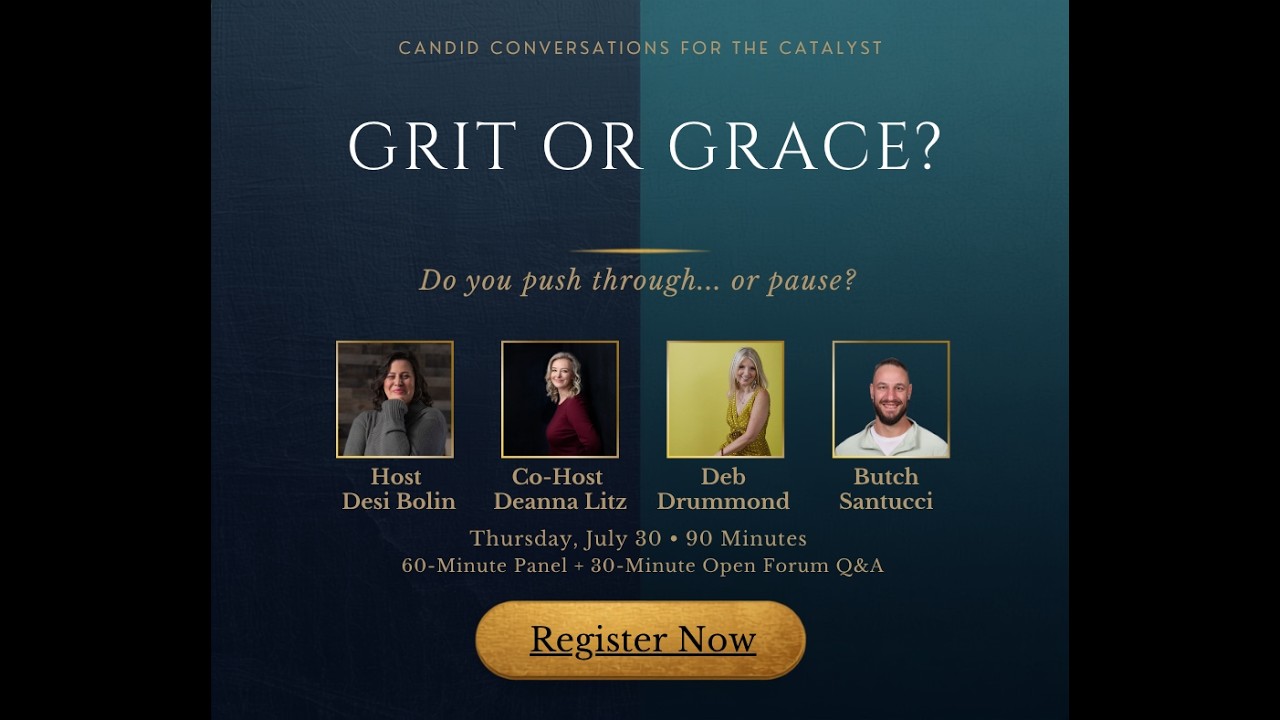
Deb Drummond and Butch Santucci debate grit versus grace in leadership. Deb picks grit for creativity; Deanna argues grace opens doors, citing The Top 5 Regrets of the Dying. They trash clichés like "work smarter, not harder" and offer rapid-fire advice for people at crossroads.
Chapters
Welcome, everyone. I am so excited you're here for the very first Candid Conversations. The reason Deanna and I created this series is really simple. There are plenty of places that tell us what to think, and very few invite us to think together. Life rarely gives us easy answers, right? So the premise is, should we push through? Should we pause? Should we persevere or should we pivot? Right. Most of us have wrestled with those questions in business and leadership and relationships, even parenting and life in general. And today's conversation isn't about deciding whether grit or grace is better. It's about exploring when each one serves us. So our hope isn't that everyone leaves agreeing. Our hope is that everyone leaves thinking, because better questions create better leaders. So I want to say thank you for spending part of your day with us, and thank you for being willing to lean into this real conversation. And before we fully jump in, I'd love to introduce my incredible co-host. One of the reasons I wanted Deanna to be part of Candid Conversations is because of the way she shows up, right? She has a gift for listening deeply, asking those thoughtful questions, and helping people see things from a different perspective. One thing you'll notice about these conversations is that they're not scripted. We don't know exactly where they're gonna go, and that's intentional. We wanna create that space where curiosity leads, where the different perspectives are welcomed, and these authentic conversations can unfold. Deanna, I am so grateful we're doing this together. I'd love for you to take a couple of minutes and introduce yourself to everyone.
Oh, thank you, Desi. Yes, I'm so excited to be here. Again, Deanna from Saskatoon, Canada. I'm an executive and business coach, and I have been working with people in really deep ways for over 15 years. Probably over 550 clients to date, and I help them through periods of intense change. Usually when people find me, they're at a major crossroads in their life, and I support them through the decision-making and seeing themselves so much more clearly so that they can show up a lot more powerfully and really let go of a lot of the stories that they have accumulated throughout their lives that just don't match them, and that block a lot of their alignment or a lot of their best ways of showing up. And so that they can live more easily, more gracefully, joyously, as they move through and tackle the big stuff that they're here to tackle. Right. So that's part of it. And if I may interject a little bit as to why I was excited for us to start these, I have done lots of interviewing on summits and Desi has brought me in before, and that is incredibly powerful and a lot of fun. Desi's also quite cruel in that we don't have a lot of time with each speaker, and all the speakers are so fabulous. And I've always stopped myself in every interview because the topics are so juicy, the speakers are so knowledgeable and juicy with so much experience, that I've stopped myself from, like, not getting into debates with them, but, yeah, that's a great point, but what about this? But what are the— and then it could be just taken away like a runaway train, right? And I thought, wouldn't it be nice to just have a topic where we could let it go and we don't have to worry about particular outcomes or particular schedules and we can dive deep? And I have to say, it Not to foreshadow anything, it was probably an interview with Butch in one of those things where I'm like, boy, I— oh, I'd love to dig into that. I've got a totally different way of looking at that, but I'm not going to challenge, right, speaker necessarily in that context. So we created this context. I don't consider it classic debate, but debate adjacent if we want.
Absolutely. And do you see why I love you? Um, as we move through today's conversation, you'll hear both of us asking questions. We're We're going to share our observations, and we're going to respond to whatever naturally comes up. We also want all of you to be part of this conversation. So keep sharing your thoughts and questions in the chat as we go. And I'd love to introduce our guests, our panelists. Today, we're joined by 2 incredible leaders who bring very different experiences and perspectives to this conversation. Ms. Deb Drummond is a serial entrepreneur, leadership expert, founder of the Show Up, Stand Up, Speak Up, Yes, You 262 movement, and creator of the Women She has spent decades helping people find their voice, lead with confidence, and step into greater impact. Deb, welcome. We are so glad you're here with us.
I'm so glad to be here. Everyone looks like ready to go. You, by the way, look great in red. I haven't seen you in red. That's your color. That's so your color.
Yeah. It's gonna be so good. And joining us is Butch Santucci. Butch helps entrepreneurs move from chaos to clarity by simplifying operations, building systems, and creating businesses that support the life they're trying to build. His work focuses on delegation, accountability, documented processes, sustainable growth. Butch is me in male form, and I love it. It's great. Butch, welcome. We're excited you're here.
Thank you. This is fun.
It is fun. I wanna start with the question we're all here for. Right. Uh, when you first heard the title Grit or Grace, what was your immediate reaction? Deb, let's start with you.
Really? Are we gonna just get right honest? To me, I was like, that's a great name for a band. Okay, so other, other than that, I mean, we got into— it was so funny because we were talking about it, Grit or Grace, and then you said, you know, dive or Pause, you know what I mean? Like driver pause. And what I thought about was that is entrepreneurship. I mean, it's really an interesting place that I think I go inside, and I think one has to go inside on where to go. Like how far do you go? When are you pausing? How are you pausing? And honestly, what does your pause look like? Because I know that when people go to my website and I meet them for the first time, they're like. Do you ever— I go, if you're gonna finish that word with sleep, I sleep like a baby. So I think sometimes people's pauses can also look differently. People that have abundant schedules or abundant lives, there's an assumption that it's always drive all the time. But what is your drive? What makes you happy? Right? Is it an extension of your business? I don't gig pickleball. And now people would be like, oh my gosh, I love pickleball. But I'm like, I'd rather think up a new book title. Like, it just really is where— and where are you at personally? So I love this conversation because I think there's a lot of entrepreneurial guilt around those that drive, or you're not slowing down, or you need to push further and you need to push harder and you need to do your business the way, you know, blah, blah, blah on YouTube University. And nothing wrong with YouTube. We're probably all on it. But I think it's a great conversation because I hope that people start to get into their rhythm. And I'm a true believer that a lot of growth comes from being uncomfortable. So it's really, it's quite a mix. It's quite a mix, right? I mean, mostly when I started becoming an entrepreneur, it was you drove because there wasn't a whole lot of paths laid out, right? It wasn't like, oh, you know. There wasn't YouTube and whatever. There wasn't, you know, all coaches. I was one of them. We all were just business coaches. There was no defining. There was no niche. There was no, like, everybody was just helping everybody in the pool, you know. Um, so I think it's been a really interesting observation of how when things come in like operations, when you're like, oh, that's awesome, you know.
Love that. I love that response, and I love that, that point you made about everybody's pause looking different. Right? I think too many times we're looking at, oh, I need to slow down. I need to pause. Yet we're holding that pause in someone else's space, not doing what's aligned for us. So I love that point. Butch, what came up for you as you heard grit or grace?
Comes back to the old sports days. It's finesse. Finesse over power. Right? It's the same thing. When do you got to be more clever and strategic, and when do you got to just put your head down and helmet on? You know? And time and a place for each.
Yeah. Yeah. Deanna, what about you? I know you and I set this up together, and we didn't really dig into it too much. What's coming up for you when you hear grit or grace?
I feel like there's a lot of stereotypes around both.
Right.
And I think that there's the common assumptions around each of them. There's probably technical definitions that are different from just common stereotypes around each one. And that alone will change the course of the conversation.
Right.
And for all intents and purposes, yeah, we end up stereotyping. And so I can see where Butch is saying, you know, finesse or power. I totally get why that's said. And at the same time, I'd say, does grace not have power? Hmm. But maybe not the exact same way he means. Right?
Right. Well, that is an interesting point.
Maybe the word in the middle is the one that's throwing everything off. The or.
Hmm.
Could it be grace and grit?
It could.
Grace with grit.
Right? Absolutely could. I love that.
And coming together.
We did set it up to be a little controversial. Right?
Right.
Yeah.
We did put the or in for a reason. And I agree with you. I have worked in my life to move away from a binary existence. And at the same time, this is where we're starting out for the fun of it.
Right? Right. Yeah. All excellent points. I wanna dig into grit a little bit more, right? Because grit has really, in reality, almost become this badge of honor, right? Working harder, never quitting, pushing through. Has your definition of grit changed over the, over the years? Butch, I'm gonna go to you first.
Yeah. Well, it's funny you say that because I, I'm not even thinking about it. I buy a set of books every month, and this is the one I just recently bought.
Yes.
So very— I'm a big believer in energies and things, right? But, um, grit changing over the years, I think it's just become more focused grit. That's it. Right? You do this kind of shit, this business ownership, entrepreneurship stuff long enough, it's going to start— you're going to start figuring out what your focus is. What are you good at? What are you not? Right. You know, so my grit has been turned into more the creative side, the writing. I'm a numbers guy. I love my process procedures, binary things, if it's this or that. But I've leaned into creativity and that's where my grit is going. Rest of the stuff I can do very gracefully. Maybe the uncomfortable stuff Deanna was talking about, that's where I have to put in more grit.
Desi, I want to tack on to that. Or attitude. So, like, Butch, what is your definition of grit then?
You know, off the top of my head, I would say it's, it's digging in, doing all the unsexy stuff that you don't want to do and you despise doing, but you do it anyway.
Fantastic.
Perseverance.
Yeah, let's wrap it in there. Yeah.
Yeah, yeah, yeah. I hear that.
Resilience kind of stuff, like, kind of all goes together, right?
Yeah.
Right.
And we all know there's unsexy things in business.
Most of it's unsexy, honestly. You know?
Deb, I want to come to you. How has your definition of grit changed over the years? And what is your definition of grit?
Yeah, that's great. I'm probably going to be— I'm a grit fan. And I know that there's been an evolution of, you know, I say pick your hard, you know what I mean? I say pick your hard. I mean, I come from being an entrepreneur for a long time and, you know, I built direct sales teams and I worked with people that were wanting things and didn't quite know and still had jobs and entrepreneur and went on and they were like, you know, I want one to be easy. I'm just like, pick your hard. And what I mean by that is that it's not that they're both unpleasant, it's just that they're both different. And For me, again, part of it was because we had to. But I also don't think there's anything wrong with grit. I don't think there's anything wrong with going all in. I don't think there's anything wrong with going all in past the point of I didn't get my 8 hours sleep tonight. Like, I'm a real true believer in kind of laying it on the table. Like, when my 15-year-old sat me down on the couch and said he wanted to be an entrepreneur, Right? And he and I asked him how much money he wanted to make, and he told me. I didn't dismiss the amount, and let me tell you, it wasn't small. You know, I could hear my mom's voice in my head. Ah, excuse me. I don't know where you think you're gonna make that kind of money. But what I said to him is, you know, this is not the easy choice, right? Like you're talented. You could go work for somebody else. You know, you've watched us not have dining room table dinners a number of times a week. That's the truth for me around entrepreneurship because. Entrepreneurship normally doesn't work between 8 and 4 or 9 to 5 or whatever it is. And particularly when you're balancing other things that are important to me. So for me, I don't care if I take Tuesday afternoon off and go to a movie by myself and work Tuesday evening. I think this is part of the freedom that I call entrepreneurship. And I think that for me, when I wanna break ground or I wanna break numbers or I wanna break patterns, right? And we do a lot of that, particularly in that sector where And look at, you know, we were in a meeting a couple of days ago with the team and we were talking about what the company produced last year, what the company produced this year, right? And what kind of activity is going to be needed or wanted to be able to continue to do our mission of what we expect the company to do. That's gonna take, in my mind, some grit. But I don't think grit's a bad word. I don't think drive's a bad word. I don't think working hard's a bad word. I don't think grace is a bad word. I don't think sleeping's a bad word. I don't think meditating's a bad word. I think that, you know, and balance is probably a bad word. You know, balance is full of philosophy. But the— so when I get excited about something, it's all I can think about. It's kind of like when you fall in love and you're like, oh, I want to talk to you all the time. Or it's your anniversary and you're like, oh, that's good. You know, I feel like it captivates me. It takes over my mind. I'm excited for this new division or I'm excited to build this. And so I don't mind that rush of energy, but I do know that when I need to break, um, something that's pattern-like, and I used to do that with people because they were running for something at the end of the month, we would call it the run. And we'd be like all in for 7 days and we'd get together and we'd cheer each other on. And I watched people break through numbers and barriers to success. So I can't say that I'm not a fan of grit. I think that it's It's— I think it's sexy.
You have so many great points in there, Deb. Deanna, what are your thoughts?
Well, Deb, I think it's interesting that to me you were also talking about passion. And thanks, Brent, for putting in the links to Angela Duckworth's work that Butch had referenced. And I think Angela Duckworth brings in passion in her definition of grit. She says it's passion plus A commitment to those long-term goals that keeps you coming back and working on them again and again. So I think it's really interesting that you brought the passion piece into that, even though I can see that as well as unsexy pieces that people have to just get through. Yeah. So I can see—
I am loving this conversation.
I'm glad everybody's saying unsexy because it's just, it's more fun.
It is more fun when it's unsexy. Deb, I love that you brought up that balance piece. I, too, am someone who does not believe in balance. I believe it as perfectionism is unattainable. Right? It's impossible for me. I believe in harmony, and that is just all pieces of my life moving in the same direction at the same time. Right? And for me personally, I used to think that grit meant pushing harder, you know, sacrificing more. Today, not so much. Today, grit for me is staying committed to my purpose without becoming attached to the path that I'm on. Sometimes the grittiest thing that I can do is to keep going. Sometimes it's having the courage to admit that strategy isn't working and choose differently. Right? So I love, I love all of this. What does grit mean to you, Deanna?
I cannot let you roll over that. What do you mean you don't believe in balance?
I believe—
It doesn't exist?
It does not exist. It's unattainable.
That's 2 very different things, my dear.
I know.
Balance can exist and it can be unattainable for some people.
Well, true. This is—
let's have you have an argument with Mother Nature about balance. I would say nature is the subject matter expert on balance. I think she thinks that—
I don't back down from a fight. And this is why I love you.
I think humans are terrible at balance. It's not our domain. We're the— the domain of humankind, I would say, is willpower.
Right.
Not balance.
Right.
But it doesn't mean balance don't exist.
Right. No, I— you are right. I wouldn't say balance doesn't exist. I would say balance is unattainable. Because if you think about it, anytime you think something gets in balance, it's immediately going out of balance again. Right?
I was going to say that. I'm hitting a moving target. Balance is a target that changes daily, hourly, weekly, monthly.
Yeah. Yeah. I'm like, Deanna, I'm gonna throw it back at you. Okay. Your definition of grit.
It's fine. I'm just gonna table that. Maybe we have a whole nother—
well, yes, you and I will have a discussion around balance versus willpower.
That's fine. I'll leave it go. Yeah, I would say that for the longest time, I would have considered grit to have a component of pushing through regardless. Right? And what I heard you say is that You no longer necessarily attach that piece to it. And for me, issues I would have with grit revolve around pushing through it for the sake of alignment or harmony or timing, which I also think humans kind of suck at. Kind of like this. Understanding a bigger picture of timing. And forcing things to happen. But I understand that many personalities believe that if they don't force something to happen, they don't believe it will.
Right.
Right. So for me, grit is that perseverance piece, that pushing through piece.
Right.
Fundamentally.
Right. Okay. Well, let's flip the script. Right? I want to dive into grace a little bit. Grace, you know, because grace means different things to different people. Right? You know, sometimes for me, it's slowing down. Sometimes it's surrendering. Sometimes it's extending compassion to ourselves. How would each of you define grace today? Deb, I'm gonna throw it to you first.
I'm loving this conversation. Man, it does. It comes in many different colors, right? So when I think of grace, I usually think of peace. Mm-hmm. Like, if I'm in a state of grace, I feel very peaceful. I feel very comfortable breathing out instead of breathing in. Um, when I think of grace, I think of when someone's like, let me grant you grace. Let me, let me just hold the space that— and right, it's like holding space. For me, grace is holding space, and it's holding space for whatever I've created. to formulate. It's holding space because sometimes when you're in a place of creating or building a business or building a family or what have you, there needs to be creativity time. There needs to be time for the pieces to come together. They, they need to blend. It's like making a marinade, right? Sometimes they need time to nurture and develop. And so there's this grace period. We know, I mean, if you've ever written a book, you've experienced grace more than likely, unless you sat there every day, all day. Or you go to a class or you go to a summit and then you let concepts digest, right? You know, I listen, you know, if I've got some time that I'm doing some things like putting on my makeup, I will put on a good podcast. And there was one that I was listening to when I was getting ready today and I was like, that was really interesting. It was talking about what happens behind the door when you decide to keep your business going and it doesn't feel like not fun anymore. But when, you know, you're doing the same thing over and over, I'm like, that's a really interesting concept. And I think things need to mature. That for me, that's around grace. I love when I make conscious decisions to give myself grace, right? Conscious decisions to go for a walk last night, conscious decisions to not answer my phone, conscious decision to turn the phone off, conscious decision to not know where I was walking. I just needed to clear my head. Conscious decision that when I come home from my appointment today, I'm going to buy myself a really big bouquet of flowers that I wanted to buy that, but I was saying, You know, it's kind of expensive today. I was like, it's the day, you know? So I think there's things that I do in relationship to grace. I also have to be cognizant of how much grace I give others as a recovering empath. And I could have wrote the book Codependent No More with Melanie Beattie. Then I have to be very careful how much grace that I give. And I think that's in relationship to value. Mhmm. So that's how I've interpreted. So how much grace do I give my 22-year-old son? How much grace do I give my mom? I'm like, enough of that. We're coming over and I'm going to help you put that together. So I think that is the answer that I have for you. I know it's multifold, but it's kind of like a wild rose garden.
Right. And I think this entire conversation, circling back to what we were talking to pre-show, is that it really just all depends on what's in the space. Butch, I'm gonna throw it to you. What is grace to you?
You know, off the top of my head again, it's— I go back to, you know, finesse. It's smooth. It's seamless. You know, it doesn't require the extra effort, just the effort required, if that makes sense. Like, that's about as simple as I can sum it up. It should—
no, I love that definition.
It shouldn't hurt to do it.
Easy is what's coming out of that for me, right? Easy.
Yeah, easier, like simple, right? But it shouldn't feel bad at all. If it's graceful, it should feel good,
right?
I don't know.
Joyful. Deanna, what's coming out of this for you?
I feel like, again, grace is one of those things where you're right, we have tons of different definitions. And there's grace from a spiritual and a religious sense. There's grace from a humanity sense. There's grace in several situations. And I feel like it's one of those things that humans have wrestled with for eons. And my definition has changed, I think, over the years as well. Yeah. I can totally see what Deb is saying about, you know, that peace and that comfort. I really love that expression though, of being as comfortable breathing out as breathing in. I had not heard that one like that before, Deb. That's great. And in my work now, what I do in some of the tools that I use, grace is a very specific energy and a frequency, and it's so— it's a different It's a, it's a different beast in a way. It's an emotional openness.
Mm-hmm.
Not necessarily in perpetuity, based on emotions. And when the opening is there, there's an emotional openness and a receptivity where others feel particularly welcomed, where they feel safe, where they feel in an alignment and a harmony. Right? And that is based on a flow and a pattern. So it's an ebb and a flow. It's not 100% universal, always there.
Right.
But I, I like that as a nuanced definition. And for me, in that definition, what I came to when I was thinking about grit or grace is this question: can grace be misapplied? To me, depending on the definition, no, not as much as grit could be misapplied. So that's what I wonder. Yeah. Oh, that's an interesting question.
It is an interesting question. Brent put in the chat, is grace something we give to others, and is grit, uh, something we have ourselves?
I love it.
You want to speak to that?
Giving it to others. That was one way. One example is when I have my guy come on or, and he's working with me or anybody, giving them access and autonomy, giving them everything they need to do well and trust they're going to do it. To me, that's the best grace in the world.
Beautifully said.
Right? Access and autonomy.
Do you want to respond to that, Deb?
I, I mean, I just think that sounds really poetic being, you know, I, I think from that perspective, grace is like respect, right? Giving people the space that they need and the time that they need to interpret. I think all of us are coaches here, right? And so when you impart information of empowerment or instruction, um, letting people digest that And move within it, yet keep people accountable. Being able to go back and have that conversation about, so what was it that didn't allow you to implement this in a way that was giving you the results that you were wanting to have? So I think grace is respectful. And then I think always being able to come in on the back end of it and again, being gracious enough to ask questions. about that particular situation, or was it received the way I said? That's interesting, right? Did you hear it the way I said it? Who's got— who's a parent, um, right? Or a partner. And so being able to grace, I think, is instead of like, hey, this is what I said and it was Saturday and you were going to do this by Friday, what's going on? It was like, hey, going a little deeper. Or being willing to listen. And then if they're like, yeah, well, then you're like, okay, let's come up with something different that's gonna give you a different result. So I think grace is variable in relationship to other people.
Yeah, absolutely. For me, I will, I will say that I look at grace in 3 different ways. Grace to me is giving yourself permission to respond instead of react. It's trusting that pausing isn't quitting, and it's creating enough space to hear the wisdom and the inner knowing before making another move. Deanna, anything coming up for you?
So is— to me, there's an alignment and a timing in that, right? And I mean, not to say that grit doesn't have it. I wonder if grace accesses a timing that grit doesn't.
Right.
That's where I'm wondering.
Right. I— we know that conversations such as these, they're solidified through stories. So I'd love if each of us could share 2 moments where grit changed everything and one where grace changed everything. And I know I'm throwing— I kind of throw it at you fast, so I'll go first. But looking back at those, would you make that same choice today? Right? No. For me, right, building my businesses while navigating real life is— that's where grit changed everything for me. There were plenty of reasons to stop, right? Those family, there's all these setbacks, there's that uncertainty, the roller coaster of entrepreneurship, right? Grit kept taking me the next step even when I couldn't see the whole staircase, right? And then for grace, it was more about learning that I didn't have to earn my worth through productivity, which is a big story that I broke through, right? Once I stopped trying to prove I was enough, my decisions became very, very clear. My leadership was fortified. And ironically, the business grew because of it, right? Because I stopped trying so hard. So Deanna, I'm gonna throw it to you first this time.
Yeah, sure. A grit story. I can think of lots of grit stories in the sense that in addition to all those other things I said I was, I am also
Mm-hmm.
And I don't think anybody would eat food that's been grown without grit. You need it. And there was a time a few years ago when it was the fall. We were in a lot of unpredictable weather patterns, as we all are now these days. And there is this massive storm coming through. Now, our farm where we grow is an hour and a half away from where our main residence is in the city. And my husband, with his 2 careers— so we know where he would fall on the grit versus grace scale— was entirely tied up. So we have these growing structures where we grow food in. They're called grow tunnels and they have steel ribs. And then we have this very special poly we put over top of them and they look like big curling rinks, but I'm Canadian, you might not curl. So they look like big Quonsets, let's say, except that they are steel ribbed with poly over top of them. And then they're all ribbed down and laced down really tightly. If this— they cannot bear snow and horrible winds will take these out. Now, these are not small things. They're hundreds of feet long. They are $15,000, $20,000. And it's up to me because he cannot get away. So I literally jump in the vehicle, had to bring my dogs. I race ahead of the storm. Get to the farm and I have— I don't know how much time to try and save all of our growing structures. Throw the dogs in the house. I am literally moving tractors onto some of our anchor points in the hope that the tractor will keep everything down or at least block some of the wind. I can't get everything unlaced in time. To let go of the extremely expensive poly. And then the storm came, and I was in the house with a furnace that would not turn on, under piles of blankets. This is why the dogs were really earning their keep, because they were big living portable hot water bottles. And I would go from that, set a timer for every 20 minutes or half an hour Go outside and with the broom as far as I could reach, knock all of the snow that had accumulated off of hundreds of feet. Go back in, rest. But then by the time half an hour went by, I have to go back and do it all over again. I did that for 36 hours.
Hmm.
Till my husband could get out. To me, that is the definition of grit. And it is absolutely required. And it can save a business tens, hundreds of thousands of dollars. It can save lives. It can do all these types of things. And so it's not anti-grit at all, right? Sometimes you just have to nut it through.
I love the way—
Or you have an order for garlic and it can't wait and you're out and it's dark. And so you Literally bring your vehicle up, shine your headlights in. So you're harvesting in the dark like some rabid raccoon really fast, trying to get everything done so they can load it in the van and take it into the city and get your order done. Right?
Right.
I have so many of those stories.
Oh, you outlined it perfectly. Deb, I'm gonna throw it to you.
Ask me the question again, because I was enthralled at that. I was like, I felt like I was there. Plus, I'm Canada, so I know what curling is.
But absolutely. Just share a moment, one where grit changed everything and one where grace changed everything. And would you make that same choice today?
Wow. So when I think about grit, the first— so the first thing that came to me, so someone needs to hear it. I don't know who. Probably someone who this recording is going to go to. But I remember, so I have 2 really great humans, children. One is in her 30s and he is in his 20s. Neither of them slept. And when I say neither of them slept, I mean, my first— my daughter's first sleep at night, she was 5 and my son was 8.
Mm-hmm.
Right? So I never thought I'd have another non-sleeper because I don't know. I don't know if I would have— I don't know if I would have signed up for that. But when I think— when I think about grit, when I think about that time That was really tough. I think, I think that, you know, it just shows that you can do anything because when you have to, you have to. People would say, I don't know how you do it. I'm like, I'm not sure there's another choice. Like Ocean. Ocean came home from the hospital. He had one nap, not two. He wouldn't take a spoon. He wouldn't take a soother. He wouldn't take a bottle. He wouldn't take a cup. He wouldn't take a glass. He wouldn't take anything. So, I mean, honestly, I thought that kid was going to nurse till he was in college. So, um, you know, so, and every 2 hours, right? And he just didn't need sleep, and he just had his way. And then he didn't have conversations till he was 3 and a half. So we were talking telepathically, and he had his own language. Like, it was a really great time. Does it— did it stretch me? Absolutely. Was I, you know, could I go back and tell you, like, all the memories? No, it was a get-through, right? Um, But that when I think about grit, you know, and then I had one and I'm like, 8 years old, he had his first night's sleep, you know, I'm like, oh my gosh. And I think, you know, I think about those times when you have to. That's why I'm like, pick your hard, right? Pick your hard. So for me, when I think about grit, I think about probably for me, it's not difficult for me to access that. You know, I came from a hardworking family and if you wanted it, you made it. That's it. There was no excuses. I love my grandmother, Barbara Brown, and most people called her Barbie, and most people in the family were scared of her except me. Right? And she would just tell you how this is. And I'm like, Barbara Brown, sit down. Right? She liked to have a little toddy at 1 o'clock in the afternoon, if you know what I mean. Wicked crib player. But she was just like— she just made things happen. And if it didn't work for her, like, if she was in a relationship and it didn't work, she's like, gotta go. Like, she just lived life calling it out. Right? She didn't hang around for the trauma and the drama. She didn't keep things around longer than needed. She talked her words, but she loved and adored and respected and was all the things. And I just really Have a lot of respect for that. So I was raised with, if you want it done, go do it. You know, chores were normal and all those kind of things. So I think that for me, I have that. I have that in my head. I have that like, you know, if no one else is doing it, go do it. And if you need it, go get it. And I'm the person that if you come for dinner and look at, I'll make you a wicked dinner. You come to my house, I will serve on you the first time. And as you leave, I'm like, okay, you've been here once. Next time you want something, there's the fridge, open the door. You know what I mean? You come to my house, there's a full like array of like treats at the front door. Just my neighbors used to walk in, they're like, I'm here. I'm like, cool. They grab stuff and go. So I think that is my natural way of being because I was raised in this, in this house where like that was, you know what I mean? Like you want to eat, get to the table, you know? It wasn't, you know, so is that grit? I don't know. You know, it's just what it is. So I think when to go back to asking about grit, that time where it was out of my control. And sometimes things are out of your control. My son's timing was out of my control. Sometimes the economy is out of my control. Sometimes my business is super high in demand depending on things that are going on in the world, and sometimes not. I mean, before we had our world health crisis, I, I was, I was gone. I was on a plane 1/3 of the year. That kind of made things a little different, you know what I mean? So then it puts you in that place where you're like, okay, you know, I'm not gonna spend 3 hours today figuring it out. I'm gonna spend 13. So I think for me, sometimes grit is circumstantial and that's what you do to— that's what you do.
All incredible points. Butch, what's coming up for you?
Let's timeline it real quick. 2014, I opened my first business. Small CrossFit gym, right? 2015, I don't know what the F I'm doing. I also don't have enough profit to outsource everything. So what happens? 2015, well, I guess I need a CRM, how to take memberships. Let me learn that. Grit. Oh, I gotta, I gotta get a website more optimized here. Can't afford somebody, I'll do it myself. Grit. The next thing, insurance. Accounting, bookkeeping, grit, grit. You gotta learn to do it. And I'm hoping other solopreneurs and the microbusiness, small business owners are hearing that because that's the grit was to learn and get my hands in as many things as I could to eventually outsource. So fast forward to 2021, shit's running good, streamlined. I'm never there. That was my first year as an absentee owner. And so I went back to school full-time, finished my degree from 20 years prior. A little more grit. But it was a professor that emailed me something. I had questions. It was— I was ranting off on something. I don't know, this and that. And you know what his first line was? And I bet half the people that ever listen to this can relate. Butch, I think you need to slow down a little bit. Holy F. That was it. That determined my grace for the next 5 years and probably eternity. And I've heard it before with how much school workbooks I was in, all these things. But somehow it hit. Maybe it's because I was in my 40s and it went, dude, this dude's right. And from there on, I've given myself the grace to say things don't have to go as fast. I don't have to start as soon, finish as quick. And that really, I mean, that's grace for lifetime now. And it just took the right person at the right time to call me out on my shit.
I love that. Right? I love that.
Grit kind of led to grace in a way.
Right.
Which is same as—
Oh, that's a powerful statement.
Right?
That's power. Grit can lead to grace and, and honestly, vice versa. Grace can also lead to grit.
Yeah. But I think it's more prevalent to say grit precedes grace because it's quality before quantity, right? You look at it that way. Or quantity before quality. You gotta do things really well and get them, get it done. Before you can optimize it or do something else, right? Which is the grace if we look at it that way. But it's just people slow down. 3-second rule before you say anything, do anything, respond to an email, take 3 freaking seconds before you do anything and just chill. All is good. Because when people like us slow down a little bit, we're still 100 miles an hour faster than most people. Let's face it. So we can afford to take a lot off the gas here.
Mm-hmm.
And be more graceful with everything.
Wow. Yeah. Deanna, anything coming up for you? I see narrowed eyes.
Yeah. In the interest of time, I'm, uh, I would probably need to hear more to understand the grit before grace. However, I love what you're saying. I think that for me, what I was hearing and what you were saying, Butch, is that there's presence. And I think there is absolutely an element of presence in grace. One thing that I think maybe other people think of, of grace— I do not— is politeness. To me, grace is not about being polite or about being nice whatsoever, right? It's a presence, it's an authenticity, it is an allowing, but it's not Being nice or being polite or letting anyone—
Patience, maybe?
I actually think patience is different than grace, although I can see them as being adjacent.
Yeah.
Right.
In that. And I can understand for me, if I think about times where I was, should we say, over-gridding, that's when I needed grace more. So I can see in that situation, grace or grit preceding grace for sure for me.
Oh, so you're saying it comes back to balance?
Yeah, there's that word again. I love it. How about this?
Balance doesn't have to be equal, right? Let's just wrap it up with balance doesn't have to be equal. When, when balance doesn't have to be equal, then balance can exist,
right?
Right. But the fantasy about balance being equal, I think, in lies the issues with balance. Right.
Beautifully said.
Well, thank you. Sitting over here thinking, thinking something to say.
Right. I'd, I'd love to invite everyone watching to pause for just a moment. Think about the biggest challenge that you're facing right now, whether it's business, whether it's something in your relationships, whether it's your health, whether it's your purpose, and ask yourself, Am I pushing because I'm aligned or because I'm afraid? Am I pausing because I need grace or because I'm avoiding discomfort? Right? You don't need to notice or, or answer. Apologies. You don't need to answer. It's just an awareness, right? And sometimes awareness, in fact, most of the time awareness is the breakthrough. Deanna, I know you want to say something. I saw you on mute.
Put her on mute.
I believe overgridding, it can— is also avoidance though.
True. Very true.
Like that avoidance, that goes both ways. That is a shadow on both sides.
Right.
I mean, it's— Balance of either of these or an avoidance or, you know what I mean?
Did you see what Butch asked? What does overgracing look like? Right? We're talking about the pendulum here, guys. You swing way too far to one side, you're going to swing way far on the other side when you come down.
I think it reveals a bias for me. I don't know if there is an overgracing as much as there is an overgritting.
Huh. Well, that's interesting. Butch, what are your thoughts on that?
Could it be that you're doing— overgracing is doing too much of the simple things that you love and enjoy? That you may not need to do and avoid the difficult things, learning something new.
I think that's a different definition of grace for me.
Yeah.
Yeah.
I don't think that's grace.
Deb, anything coming up for you on that?
Well, I think maybe grace and pause gets confusing a little bit. I would agree that, you know, there is something about not go— you know, not gritting, if you want to put it that way. I call it not going all in or what have you. That can be avoided. Absolutely. And overgracing, I would say avoid as well. I would say that if it is detrimental, I'd be like, you're avoiding. I mean, I've heard a lot of people, they're like, I do my whole business on flow. You know, if it doesn't come to me, if it doesn't show up to me, and I'm like, that's cool, right? Everyone can do their business or their messaging, you know, one way or the other. I'm— I probably, you know, for me it dances, it goes back and forth. But for some people, they're like, you know what, the answer will come to me. And I get it. I do the whole, you know, praying meditation. Let's see what happens, what book falls off the shelf that I wasn't looking for, all of that as well. But I'm probably more proactive and then wait and see, where some people are wait and see, and that's their activity piece. Here's what I know. I know what I need to do, one or the other. And I think so do most people. At a certain point, they're like, oh, I'm not getting what I need from the position that I'm taking. Like, if I'm sitting here in grace waiting for it to happen and your rent's due and it's not happening, then you know what I mean? I think we know on the inside, and I think our deep-seated stuff can sit anywhere. Are you overgridding because you are afraid of failing, or you don't wanna lose something, or you're in survival. And I think that entrepreneurship brings on a whole idea of survival because, like Butch talked earlier, I mean, I don't know, did you all go to entrepreneur school? Mine was like literally like an 8.5 by 11 piece of paper while I was taking a massage course. And I'm like, I'm gonna start a massage company. Like, literally, it was my second week and I was like, this many clients paying this much money. And there you go. That's gonna pay rent. And I was pregnant at the time. So I'm like, let's start this business right now. You know, I think that when you're in that, it looks like survival. And some of it is. So I think it's okay. You know, I— and would that be the time to pause? You'll know that. And when it— I think pausing and wisdom are interrelated. When you start to get to know yourself, when you can pull the gas back, Because those needs of the business are in play, it's a lot easier to stand back and go, oh, you know, and I think we need to be very careful when we are in a place that we've wisdomed our business and we've wisdomed our life and we're talking to someone who's 2 years in and they're going for it. They're on the chipmunk, like Elvin and Chipmunks. And for us to step in and go, hey, maybe, maybe like that was really important. It sounded like to Bush and you had someone wiser saying, hey, maybe take a breath. Right? Just remember where people are at, right? Where we're at, we earned those wings, right? Like, I got to go for a walk last night and turn my phone off. And some people, they're not, they're not able to do that. It doesn't matter. It matters to you and where you're at. And I think that's the whole ebb and flow of grit and grace. And I think they both are beautiful together and they're probably, you know, on the same coin, just on the other side. But I think it's important for us to remember where we're at and remember where people are at and that our advice to ourselves is not going to be the best advice for them.
Yeah. Oh, I'm so loving this conversation. It's so good. Right? And I think what keeps coming back to me is that everything is in alignment. As long as you're in true alignment, it's never gonna be over. Right? You can grit when you need to grit. You can grace when you need to grace, depending on where you're at in your alignment, right?
And the other thing that came up for me when, uh, Deb was sharing is that when we're— when the pendulum is one way, the one way or the other way, on either grit or grace, I think maybe it's more true for me to say then in those spots, it might behoove the person to call it grit or grace, but it's not. And so that's the out we give ourselves. Oh, I'm gonna be graceful about this. It's not grace. I'm avoiding confrontation.
Right.
So let's not blame grace. Because that's not what grace is about, right? And same for grit. Yeah. So,
yeah. Well, one of the things that I know, well, I think we all know life isn't black and white, guys. You know, most of us spend our lives somewhere between grit and grace, right? And I want to explore that space a little bit. So my question is, how do you know when persistence becomes stubbornness? And how do you know when resilience becomes ego? Right? For me, when persistence becomes stubbornness, it's when you're protecting your identity more than your vision. Right? If new information can't change your mind, it's probably no longer persistence. That has gone into ego territory, right? And when does that resilience become ego? Is, is that's when continuing matters more than the learning, right? If I'm unwilling to ask for help, pivot, or admit something isn't working, I'm no longer being resilient. I'm defending a story that is running the show, right? Deb, I'm gonna throw it to you on those.
So ask me, because I, I'm listening to your answer. And so, so ask me the question.
How do you know when persistence becomes stubbornness and when resilience becomes ego?
How do I know when persistence becomes stubbornness? Like, I'm going to make this happen.
Yeah.
Um, I think it's kind of an embodiment for me. If I'm really engaged with something that I want to make happen, My, my particular brain goes into the multitude of how I can make that happen. So if it doesn't work this way, okay, I'll go to this way. I'll go to this way. I'll go to this way. I will, you know, I will max my resourcefulness in being able to see how I can make something happen. If I have a knowingness that I need to give this a breath, and I consciously override it. I know I'm putting something at risk.
Right.
I know that whether it's ego, whether it's fear, like this is going to get done by this time because I've made up a story that if it does, if this doesn't happen, I usually, there's a story, right? If this doesn't happen, this is going to happen. And so I need to ask myself, is it? Is it? I mean, look, I studied brain health and taught it for a long time. I know the majority of the stuff we tell ourselves is lies. And the only way to figure out whether it is or not— and, you know, we answer so quickly and we dilute and nullify things that aren't true and are true all the time. But then I have to ask myself, is it true? Like, is it true? Is it true that if this doesn't happen, this will, and that's something that I don't want to happen? Is there other possibilities that helps me pull back the reins, right? Or that helps me go and make a meditation. Or go do a meditation or make another decision, or equally just put something over there. Even if I have to, in my mind, do it in a controlling manner, I'm gonna leave it there till Monday. I'm gonna leave it there. So I'm, I'm controlling when I'm putting something aside. Still a part of control, still a part of ego, if you wanna call it, because that's what I need to satisfy myself to be able to breathe and walk over here. Right. So I think that, that is, that's that. And even when you are pushing yourself, I remember first marathon I ever did, I was at mile 22 and I was running for the arthritis, into the Arthritis Foundation. And so we all had the same color jacket on. And I remember running up to this one chick that had the same jacket on. I didn't know her. And I'm like, she's like, you wanna run together? And I'm like, okay. So we're running and we got to mile 22 and I was like, what a stupid idea. Whose idea was this anyways? Right? I was like, and I'm talking to her and she's like, take an aspirin. I go, I don't take anything. She goes, take an aspirin because you're going to need it later on. And I go, this is ridiculous. And so we made a pact at mile 22 to not let each other quit. I've never talked to her since. We obviously— and I remember we're like at mile 23. She's like, I got to pee. I'm like, You're holding it. She's like, I'm stopping. I'm like, you're not stopping because I'm not stopping. Right? And, and we did that and we got ourselves through. And honestly, we both went our own ways. I've never seen her since. But that was pushing ourselves against all body and function and mental. And we were like exasperated. And it was like the best feeling, right? That was the best feeling. So I'm not gonna say that I've never pushed myself through. In that and other situations where there was a lot on the line, it wasn't just me. We were in it together. I remember, I remember pushing something through and it was— I remember someone coming to me. So this coach, we had to, we had to hit this financial piece by midnight the last night of the month. Okay. And we woke up at— I woke up at 10 in the morning and there was Nothing but magic and leprechauns that had to happen all day for this to line up. I'm telling you, I have never pushed myself like this ever. And I looked at her and I said, these sales numbers aren't possible. We're not going to hit. And she's like, we're going to hit. Now, she was cray cray. Okay? So I was like, I go, for that to happen, we would have to have this many people make this decision, this many people line up in this country and this country like it was. Country and calling and getting EIN numbers for the people that were going to do this in the US. It was insane. And I'll tell you this really cool story, part of it. You want to talk about grit and grace? So we're running for it. We've got all the calls out. And at a certain point, we had to wait for about 8 people to come back with a decision. And if one of them didn't come back with that decision, this was going to fall apart like a nice deck of cards. Okay. So it was New Year's Eve. December 31st. This was year end. And I remember there was like this break and she was in the US and I'm in Canada and I'm like, I'm gonna go for a massage. I never made a decision like that. I would never take my foot off the gas. There was nothing to do. So I went to the Sutton Place Hotel, had a massage for 2 hours, didn't tell anybody. I came back and we closed it out. So I remember I was like, it was so insane. I was in a bath. Okay. I was in bath with bath salts and aromatherapy. I'm like, lavender, let's do this. My partner at the time grabbed a chair from the hotel, brought it into the bathroom because he's celebrating New Year's Eve with me at midnight with champagne. And I'm like, in a bath. We're in the bathroom of a really nice hotel, but in a hotel, no party for us. And we're running the numbers. Thank God the people I date are entrepreneurs. So we're running it. And at 12:10, we closed the 8th deal. And it would have had to been left up to the company whether we pulled it off or not. And so I'm like, oh my God. And so we had champagne, we walked down Gravel Street, went for dinner, came back, and we found out 2 days later the company accepted it and we broke all every possible record. But in there I went for a chair massage. I don't even know if I ever told you that. I probably did, like, you know, a year later. But that was when you talk about grit and grace. That, that was, that was a really interesting experience. But I would not have done it if she had not said, let's go. So I think there's a lot to be said for someone to join in on the crazy and to either lead that crazy or partner that crazy. And it made a completely— it made a complete difference because of that decision. The company gave me a Lexus car.
Right. Wow. Powerful.
Yeah. They didn't like Brett and Grace, right? Thank you. I don't even think about those things till you ask that question.
I love it. Butch, I'm gonna throw it to you. When does, when does resilience become ego for you?
You know, you said it pretty well earlier, so I don't know if I want to read— what was your definition again, or what was your explanation? I think you hit the nail on the head.
Of, of which definition? Because I provided—
Well, meaning when does resilience become ego?
Oh, okay. When resilience becomes ego is when continuing matters more than learning, right? If I'm unwilling to ask for help, pivot, or admit something isn't working, I'm no longer being resilient. I'm defending that story.
And I don't think there's a better way to explain it. So what I'll say is to determine when that happens for each person, I think especially business owners, They got to become more self-aware.
Right.
Yeah, I think that's what it comes down to. I mean, 5 years ago, I, I started taking those Enneagram personality tests. Take an Enneagram, take any one of them, it doesn't matter. They're all going to tell you a little something about yourself that you probably didn't know or wanted to admit. And they're all— I'm gonna say they're fairly accurate. So just be self-aware. Understand when you get in your own way or when you are being stubborn, you know. Learn more about you and, and build your people, your, your ecosystem of people that are going to tell you when you're being an asshole or that's dumb or, you know what I mean? Like, you got to have people tell you when you're getting in your own way because you can't see it.
Yes.
Be self-aware and have some people in your corner. That's it.
I love that. What a way to end it. Deanna, do you have any final thoughts? I know we're going to open it up for Q&A. Um, here in just a second.
I didn't pay Butch to say that, but I'd agree 100% because I do help people see themselves so much more clearly with my tools, and they're objective, right? So that in itself changes the game for a lot of people. And I do have a lot of particularly executive coaches and executives in business folk who, I know myself, I know myself. I'm like, okay, so then this shouldn't hurt. And they're blown away. There's your inner world that you know but others can't really, and then there's an external that you put out there that they see that you don't know. Yeah. And so there are ways to look at both of those. Without your subjective input.
Yeah, I mean, I can, I can certainly speak to your work being your guinea pig. I can certainly speak to it, right? I mean, you've had me in tears more times than I can count.
Yes, it's hard to be a day when it makes somebody cry.
I know, right?
Desi, explain that a little bit more for them, perhaps.
Because of how scarily accurate It is. Right? And most of the times, it was things that I was afraid to admit to myself, right, about who I truly am. So there is a lot of power in that release. And that's what those tears are, is they are a release of past stories that you're holding on to. Right? This has been an amazing conversation. I'm so glad we did this. Butch, Deb, I know Deanna has one. I have one too. If you have a gift, Deb, I'll put yours in there. Um, please tell us about it. Deanna, you wanna start?
Oh, I am helping people see themselves a bit more clearly with a little precision insight session. It'll be objective, and we will look at one core aspect of your makeup. Your energetic signature, if you will. Yeah.
Beautiful. And you're gonna drop that link in the chat? Yes.
Perhaps.
Perhaps. But you, you wanna share about yours?
My, you saying one of my what?
A free gift if you have one.
Yeah. I had 2 of them. One, we can go through, I mean, honestly, we can go through anything you want anytime. Whatever you wanna do in your business. But ultimately, we can audit your customer journey process. We can, and find out where the gaps are, what could be automated and all that. We can look at your financial situation. We can look at how to get a better outlook on your monies, you know, and how to make more, how to spend less, whatever it is.
Amazing. Please drop a link in the chat. Deb, I already dropped yours. Do you wanna share a little bit about your media audit?
Yeah, absolutely. So there's kind of 2 that go together. One is called How to Know Your Media Score. People make decisions about their marketing and they make decisions about their media and they probably don't know their media score, which is a critical piece for the return. The other I'd like to gift is the accountability class. So we get together on Mondays, 9 AM and 4 PM, and we actually, through questions and conversation, We go through each week and we top perform our week so that you are doing top performance behavior. Therefore, you have top performance yield. And it is quite an interesting philosophy and methodology of looking at things different. So come as a gift to the accountability class and definitely come as a gift to learn about your media score so you can have a better return of your marketing.
Amazing. And if you have gotten a ton out of this conversation, as I have, Please come and join us at Strength in Unity. We have, uh, 27 speakers over 3 days. It's gonna be amazing. More conversations like this, people sharing their wisdom. We have 2 Emmy Award winners coming on and sharing the stage. Um, and it's gonna be a great time. We always have fun. Last one we did a comedy show. You never know what's gonna happen, right, Deanna?
Oh my gosh. You never know. You never know.
You never know.
I'm not sure how you're planning to wrap this up, Desi. I have a question for people.
Ask.
So, yeah. So I love your events, bar none. Totally go for that. In terms of us, you were gonna ask maybe perhaps people if they had questions for us or things like that. Yep.
That's what I'm going into.
Okay. I'll, I'll leave you do that.
Right? So we've shared a lot today, and, and we'd love to hear from all of you. So I know we've been seeing your questions dropped in the chat throughout. the event. If you have additional questions, please, you can raise your digital hand, you can drop a question in the chat, you know, tell us what challenged your thinking, um, or share something that struck home for you today, right? Do you have a specific question for guests, Deanna?
I had a question for everyone.
Yeah, ask
it. Which you and Butch and Deb So there was a Psychology Today— I'll preface it by saying there was a Psychology Today article recently about grit or grace. Of course I was interested. And long story short, she's like, if you're emotionally and intellectually mature, it's neither or, right? It's not either or, as we said, nuance, when, and all of that. So with that understanding, Just for fun, hypothetically, if you could only have one of them as a superpower moving forward in life, which one would you pick?
Grace, hands down.
Pardon?
Grace, hands down.
Grace, hands down.
Yeah.
Really? And why?
Because I'm tired of the grit. I've done so much grit for so long. It's been like a 90/10 split. I'd rather see a 40/60 split. You know what I mean? Some of us are just tired. So if I had grace for everything, that means I would be ahead, you know? Anyway, that's just mine. But I just wanted to answer that quick because I, I knew it right the second you asked it.
I love that, right?
You also answered grace, but why, Desi?
Right. Well, okay, so for most of my life, I would have told you my superpower was grit, right? Because grit built my businesses. Grit got me through those hard seasons, right? Grit kept me taking that next step when I couldn't see that staircase, right? And somewhere along the way, the way I realized that grit got me here, grace is what's going to take me where I'm meant to go next, right? Grace really allows me To lead from alignment instead of obligation. Right? It reminds me that my value isn't measured by how hard I work. It is— or how much I produce or how much I carry. Grace gives me that wisdom to pause before reacting, to listen really before deciding, and to trust that I don't have to force what is meant for me. That's why. Deb, grit or grace? One is your superpower. What do you pick?
Yeah, I don't think— I think that's a difficult question.
It is.
It's a ridiculously stupid question. I don't think one exists without the other.
Right.
I just don't think one exists without the other. And I also don't think that I have the same definition of grit as someone as Maybe someone else has. I don't see it as burnout. I don't see it as overextension. I see it as being creative, and I see it as being inspired. And I think, I think going all in doesn't have to be exhausting. I think going all in is where I'm putting all my energy, which is grand and full and life. Not— I'm not like, you know, I'm not on the end of the marathon, but even the end of the marathon. Mm-hmm. has a certain beauty to it. So I, I don't think I have the same definition or the same picture of grit. I don't see it as exhausting. I see it as really strong creative energy. But I get it. I get what people are saying. I just don't think you have one without the other. Because if you were living in a life of grace which had no tension, which had no tension, Like tension, meaning, like, you know, where the diamonds are made from, or tension where you come up against yourself, then I think the evolution of your own personal growth would be, would be at risk.
You had to pick.
Of course, I like ease. I love ease, right? I mean, if it's creativity and ease. Yeah.
So pick one, grit or grace. Pick one.
Just if you had to.
I'm gonna pick one. I'm gonna pick grit because I feel in grit creativity is, is manifested.
I love that. Deanna, you, you know you're going to answer your own question, right?
If I had to pick one, I'll pick grace. And tacking on to the whys that I've already heard, I will say, has anyone read The Top 5 Regrets of the Dying?
No.
I've heard of it.
That was originally a blog post, then she wrote it into a book. And it was from a palliative care nurse who had sat with thousands of people on their deathbeds. And she collated all of what she heard in people's dying moments into Top 5 Regrets of the Dying.
Hmm.
When— I encourage you to read it. When I read that, I read more grace, less grit. That's number one. Number 2, I don't— and again, I don't believe in either or. However, I feel like grace opens doors that my grit doesn't. And number 3, I will say, the saying isn't there but for the grit of God go I. As well, has anyone seen the amazing movie or read the amazing book Project Hail Mary? Main character's not called Dr. Grit, called Dr. Grace. There you go.
Yes. Oh my gosh. So good. Well, I know we only have about 18 minutes left. Go ahead.
I'm glad that, because it's, I don't know, we all have pet peeves and sayings and words and phrases. I am so glad this whole time not one person said work smarter, not harder, because I can't stand that. It drives me up a wall. And I'm glad nobody said that because that's just a blown-ass stupid statement. I don't know.
Do we do a lightning round of really stupid things we hear in the, in this space that we're tired of? I think— yeah, go, Deanna. Bloom where you are planted. That's the most ridiculous thing I've ever heard.
I never, I never heard that.
Bloom where you are planted.
Yeah.
If you're not growing, you're dying. Have you met nature? Nothing blooms all year. Oh my God. Anyhow, don't get me started.
Do you have a pet peeve phrase?
I can't even think of one. I don't— I mean, I can't even think of one. You know, maybe that's a reflection of hanging out with cool people at cool times, you know?
Yeah, very well could be. I'm along the same lines of Butch. I actually heard it earlier today, is the more you learn, the more you earn, right? And I think that there is a truth in that, and I just don't like the phrase.
Well, I think phrases are so— well, they're black or white. They're like, do this or don't do this. Like, do this or you're not going to succeed, or if you don't do this, you're not going to succeed. And I think there's no variable for, you know, what our dharma is. Like, what are we meant to do? Like, if what I'm meant to do is to build Hopefully it's building what I'm building because it's been going on for a while. That then demands certain things of me that I am more than happy to participate in because I'm super clear why I get up in the day. Right. So, you know.
Right. I will say, Deb, too, you brought up— I mean, when you were speaking and sharing a few minutes ago, you were bringing up things that are along the lines of language pattern shifts. Right. Talking about your, your different perspective on grit, right? What I heard in that is you are shifting your language pattern and ascribing a different meaning than most people do to it, right? So it's kind of like me. When someone asks me how my day is, I say always amazing. You'd be so surprised— actually, probably not— about how many people give me that, the what the hell are you talking about look. Right? And I say, every day when I wake up, before my feet hit the ground, I choose to make it an amazing day. I choose to find joy and laughter in everything that I do. Right? And it shifts the entire day. Um, and I think the same is true of grit or grace. It really depends on the meaning that you ascribe to it for yourself in your alignment, in your knowing.
Yeah, yeah, absolutely. And I think it's less detrimental, either one, too much of this or too much of that, if you are— if you're doing the right thing for the right reasons,
right?
And if you know what those reasons are, glory hallelujah. No, really, glory hallelujah. Right. Like, that, like, that makes a big difference. And for anyone that's in entrepreneur land or has a vision that is outside themselves, that you're going to need to do some self-examination. Like, I love what Butch said about self-awareness. I mean, that really truly is the deal. That's your barometer. Like, that's your barometer, right? Mm-hmm. And so I, I remember when, uh, we had like lots of really great philosophical conversations, uh, my staff and I, because Princess Diana and Mother Teresa passed within months of each other. within months of each other. And I said, I don't see them as different. They both did incredible work. They both poured their heart into their work. They might have chose to live differently, but I see their impact is very similar, impacting hundreds to thousands to millions, to having people following them. And I'm sure if they had Instagrams, they'd have a lot of followers. Like, you know what I mean? But they just, they made such impact. I didn't see it even though they chose to live differently. They both woke up in the morning, and they both had big things to do, and they did them. Yeah, that's what— that was their dharma.
Wow. Well, Deanna, I don't know about you, but I think this has been an amazing, amazing conversation. Yay for debates! I love debates. I want to give everyone who's watching one more opportunity to ask a question or come on and Participate before we wrap up. And if there isn't anything, then I will run into the, into the wrap-up. I'm not seeing anything come up. But I'd love, I'd love to ask each of you one final question. Really, if someone listening today is standing at a crossroads, what's one question you hope they'll ask themselves before making their next
Deb? Is there anyone I need to reach out to to help me make this decision? Because I feel that too many people try to do it alone, and I'm in there. So if you are at a crossroads and you can't decide, who is your best person to call? Not your best friend that doesn't know anything about it. You know me, I have a famous saying, don't, you know, don't go Ask your bank manager about what you should do about your marriage. That's not his specialty. Go to someone that is going to be able to give you advice from an experienced place. Go to an elder in that arena and don't do it alone.
Right. Butch?
I, I think that was a perfect, perfect answer. And that's something I kind of referenced earlier, having your people in your corner, being self-aware. Someone once told me, when you're faced with a hard decision, ask yourself, either way you go, what is the worst possible thing that can happen? And then ask yourself, can you recover from that? The answer is yes, just go do it. You know what I mean? So to, to add on to the already amazing answer, that's what I would do. Can you recover from that?
That's an incredible add-on to an amazing answer. Deanna, after hearing everything today, what's one question you hope everyone carries with them after they leave
today? How they can make their best decisions for themselves within their sphere of influence, in their arena of their lives. Everyone has their own decision-making recipe, and I don't know of a single recipe out there that's purely intellectually based. I don't believe it is. I'm a holistic person, and so the more of all of you that you can incorporate and be self-aware about, your paths will become clearer wherever you go.
That's your next topic right there.
Yeah.
Different ways. Because it is, it's a broad thing.
It really is. Yeah. Yeah. Yeah. You know, Deanna, I'm gonna pull, I'm gonna pull the transcript. There's so many topics that we could expand on in this. For me, if someone's standing at a crossroads, I would say the question that you should ask yourself is, am I making this decision from fear or from alignment? That is a big one that will shift so many different things.
True.
Right? Yeah. Wonderful. Well, what a beautiful way to launch our very first Candid Conversations. Deb, thank you for sharing your experience, your wisdom, and your heart.
Absolutely, my pleasure.
Butch, thank you for bringing such thoughtful and practical perspective and comedy. Come on now.
Oh, well, good. Glad to hear that. I don't intend for it to be. I just, I just, yeah, I'm an open book.
Yeah, yeah. Deanna, um, my best friend, I want to say thank you for helping create a space where people can choose to be curious, challenged, and encouraged all at the time. And to everyone who joined us today, thank you. Thank you for being here. Thank you for showing up. Thank you for participating. If there's one thing I hope you leave with, it's this: leadership isn't always about choosing grit. Leadership isn't always about choosing grace. It's about developing the wisdom to recognize what this moment is asking of you. Right. That awareness That, that Butch keeps pointing to, right? That presence and knowing yourself. Sometimes courage looks like taking one more step. Sometimes it looks like setting the weight down. Neither is weakness, and both require strength. Okay. Thank you for being part of the very first Candid Conversations. We hope you'll continue joining us as we explore additional conversations that challenge assumptions, really expand those perspectives, and remind us that growth often happens in the spaces between certainty and curiosity. OK, until next time, keep asking better questions because better questions create better leaders. All right, have an amazing afternoon, everyone. Bye.
More from Desi
Technology Without the Overwhelm: Using Technology to Simplify Life with John Bilicki
Building More Than Websites: Designing a Business That Gives You Your Life Back with John Bilicki


The Power of Being Weird: Radical Self Acceptance and Leadership Without a Mask with Danielle Benzon



The Power of Authentic Connection as a Leadership Strategy with Mario Brondani

Why Clarity—not Hustle—is the Real Catalyst for Sustainable Growth with Kenny Perry

Financial Clarity as Leadership: Rewriting Your Relationship with Money with Joanna Tress