When Business Has a Soul — Leadership Beyond Strategy with Jennifer Urezzio
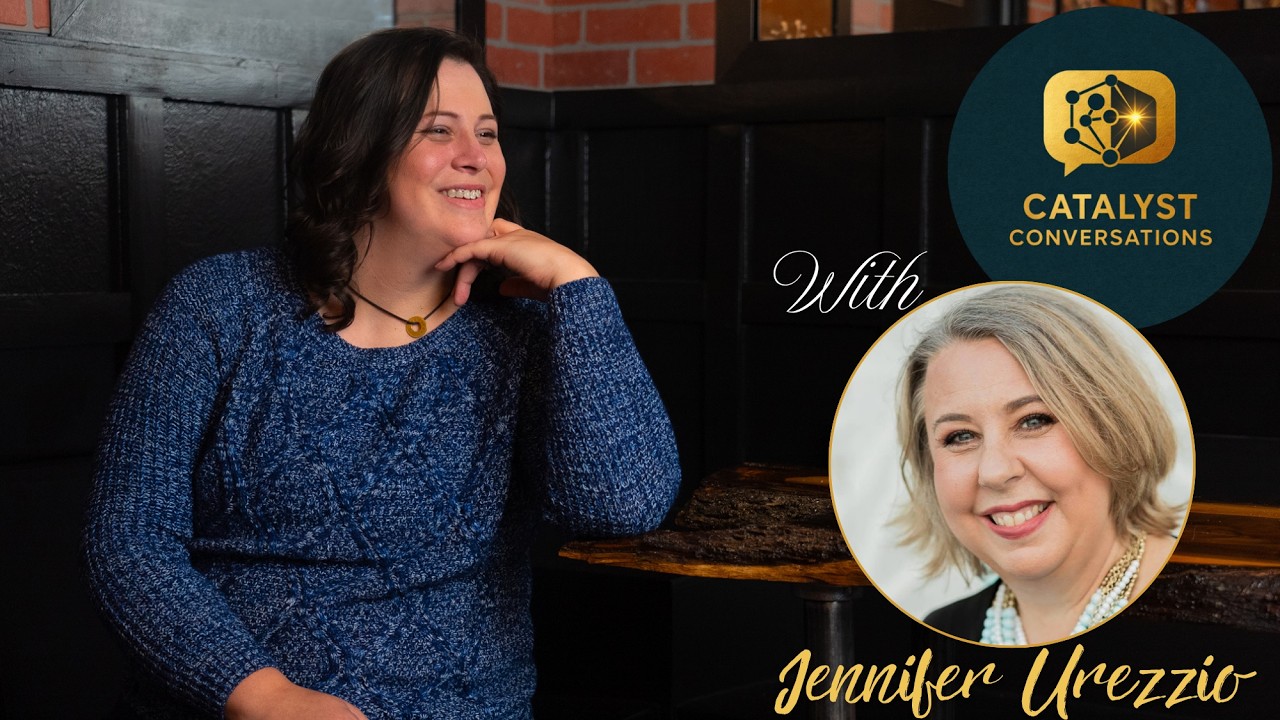
In this Catalyst Conversations episode, host Desi Bolin interviews Jennifer Urezio, founder of Soul Language, to explore a leadership model that places the soul of a business at the center of strategy, structure, and performance. Jennifer shares her personal journey from a high‑pressure corporate media‑relations role—where truth‑telling clashed with client expectations—to a realization that her body’s resistance signaled a deeper misalignment. She introduces the Soul Language framework, which uses muscle‑testing to identify three core soul energies, a mission, and a soulful personality, likening it to a “Myers‑Briggs of the soul.” The conversation details how knowing these energies transforms decision‑making, leadership style, and business relationships, turning structure into a responsive, energy‑based support system. Concepts such as “business as energy,” “conscious gardening” (balancing internal intuition with external strategy), and “internal safety” (body activation, divine intelligence) are presented as practical tools. Jennifer offers concrete practices—asking “What do I need to know today?”, distinguishing personal versus collective emotions, and daily grounding activities like mindful walks with her dogs. The episode concludes with a rapid‑fire “lightning round” where Jennifer describes aligned leadership as feeling like a sunny convertible drive, unlearning the belief that visible need equals desire, and defining clarity as ease. Throughout, the dialogue emphasizes moving from an outside‑in, performance‑first model to an inside‑out, soul‑sustained approach to leadership and business growth.
Chapters
There's a version of leadership we've been taught to trust, the one built on strategy, systems, performance, and pressure. And then there, there's another version, right? One that doesn't start with doing, it starts with being. What if your business had a soul? Not as a metaphor, but as something real, something that's guiding, communicating, even asking something of you. And what if the reason so many leaders feel disconnected is because they've been taught to lead without listening? Today's conversation is an invitation to shift that, not to abandon structure, but to root it in something deeper. Because here we believe clarity liberates, structure supports, and soul sustains. Mm-hmm. And if the soul is missing, the system will always feel heavy. Today I'm joined by someone who has spent years helping people reconnect to that deeper intelligence, not just in themselves, but in the work they're here to do. Jennifer Urizio is the founder of Soul Language, a framework that helps people understand how their soul communicates, how it leads, and how it wants to express through their life and, and business. And what I appreciate about Jennifer's work is that it doesn't bypass leadership. It deepens it. Jennifer, welcome to Catalyst Conversations.
Thank you so much. I feel all gooey now listening to you, so I'm very excited to be here. Yay.
We like gooey. Gooey is a good feeling.
Gooey is a great feeling. It's like a chocolate chip cookie right out of the Love it.
Oh, oh, now you got me. Okay. Before we get into the work you're known for, I wanna start somewhere more human. Right? Because people hear soul, and sometimes it feels abstract, but there's always a lived experience behind it. Was there a moment in your life where you realized the way you had been operating, whether in life or business, was no longer sustainable?
Just one? Of course. There was a lot. I mean, Listen, I started off in corporate America. I was really good at my job. I was in, uh, I was in the VIP, uh, well, I was the VIP vice president of media relations, right? I, I would talk to the media. They loved me because I would tell the truth. The clients hated me. They thought I was too aggressive. They thought I was too judgmental. I wasn't allowed to talk to them. I couldn't tell them the truth. And I'm like, okay, this is really hard. Why is this so hard? Like, I'm really good at my job. I know what I'm saying. I have expertise. Why is there so much friction here? Why do I feel like I'm dying every time I have to talk to a client? And I remember sitting or standing at— I took the PATH train in for years— at the PATH train in Harrison. And I remember being on that PATH train In the outdoors and going, oh my God, there's something totally bigger here and I'm totally missing it. And I don't think my current environment is going to foster what I want to create in my life, in my world. I mean, that was just many. When you're sitting and you're crying and you, you're being told that you are not good enough, that there is something wrong with you, that by asking a pen you're being too aggressive. You know, all of that kind of adds to my limiting belief of being not enough. And I knew that was a— some part of me knew that was a lie. So I went to pursue what that would look like. And I didn't start off by wanting to have a spiritual journey and teach about, you know, your internal structure. I started off because I just didn't want to feel so mad and angry and hurt and painful and like I wasn't getting what I want. I mean, isn't that why we do everything? Yeah. Because in the end, it's really all about us, which is not a bad thing.
Yeah. No, it's not a bad thing at all. And what I'm hearing in that isn't just a turning point. It's a remembering. Like something in you said, there's another way to live. There's another way to lead. What did it feel like in your body before that shift?
It felt like I always feel when I'm in resistance or I'm believing that I am separate, which is anxiety, which is fear, which is like, oh my God, my heart, my chest hurts.
Oh.
I can't breathe. Um, you know, angry at the dog, but you're really angry at that cat feeling like, you know, For me, I was screaming at bank tellers because I don't know; they just set me off. Right? Like really feeling out of control, like the world is happening to you in your body and not through you. And as I evolve, right? Those my resistance, my disconnect does always feel same in my body, and that's an indication of me like whoa pause and keep activating the knowing that I'm safe. Activating the knowing that I'm being loved, supported, and provided for in ways that are seen and unseen. Um, so it always feels the same. And I think that's kind of true to everyone when they're in resistance or when they're in fear. The kind of resistance and fear is kind of boring, right? We all kind of feel it. The circumstances might be different. It's our connection that's really enlightening and really fun to talk about and really unique.
Absolutely. Absolutely. And what you mentioned, resistance. Was there resistance for you in trusting that inner knowing?
No.
I
know that's hard to believe. Like, I've had, you know, clients and practitioners, because I teach what I do to others, go, well, how did you trust it? How do you just know? And I was like, how do you not? Like, there was never Like, I don't have that disconnect. That is not where I build my skills. I, I just knew. I always just knew. Now, did I take action on all of that? No. Right? Um, not from a lack of, oh my God, I can't trust it, but more from a lack of my, my human, my silly human was like, I know better. Like, you don't know what you're talking about. I know that. Like, the human knows better. Um, but I never had a hard time trusting it, or, you know, I didn't need the— I didn't feel the need to explain what I knew to others. Like, I just knew it. I don't need to explain. And I guess now that I'm chatting, I guess that is also part of what people thought was aggressive about me. I'm like, well, why do I have to explain this? I just know, right? And that could come off aggressive instead of, um, firm. And, you know, if I was in a higher place of power in the corporate structure, that would have come off different. But because I was in a, you know, I was a vice president and not the CEO, that came off like aggressive rather than, she's the CEO, she just knows.
I totally get that. And I think this is where so many leaders are right now, right? They've built something that works and it doesn't feel aligned. And they don't always have language for that. I'd love to kind of ground this in your work. You say you help people connect to their soul and specifically through something called soul language. For someone hearing that for the first time, what does that actually mean?
Yeah. So it's like if anyone knows the Myers-Briggs of personality testing, it's the Myers-Briggs of soul. It literally puts tangibility to 3 core energies of your essential nature, your mission, how you feel that mission, and then your soulful personality, which really means how your soul prefers to go through life. And when you have tangibility, not to use it as a crutch, but to use it as an internal structure to go deeper, it allows the human to get on board more with the soul's essential nature and information and wisdom. And so what I do is I identify through a process called muscle testing, uh, the 3 core energies of soul. And then I teach people how to move from the unconscious or pain or struggle of that energy to consciousness, right? Because we have free will and we can determine how we want to utilize our essential nature for good, yay, or for, you know, programming pain, suffering, however you want to label it.
Hmm. I love that. So I, if I'm understanding this, it's, it's not about adding something new. It's about uncovering what's already there and learning how to listen to it in a structured way.
Yes. And it's not archetypes. Archetypes do not evolve, right? The energy of soul is evolution. We've updated the definitions, uh, energy changes in kind of bulk. Right? And so, um, I often go when in a— doing a person's soul languages, like, by— I do it in phases, meaning like a whole bunch of certain languages will come and have their identification. And I'll go, okay, listen, here's what you want. They're like, oh my God, how do you know that? I'm like, because that's what the energy changing and transforming is telling me, and you're in that wave of energy. So how do you want to transform the individual as part of the one. And what I'm really good at, and what I really instill in everyone, is the answers are inside of you. So once you get this information, it's really about going inside for your own answers, not to use it as a crutch or to use it as a way to limit yourself or stop yourself.
Um, yes. Yes. Um, let me ask you this. When someone understands their soul language, how does that show up in their leadership or their decision-making?
I think it shows up in a huge way. For instance, we're going to use me. Sorry, 3 o'clock, the dip in my energy at 2. Um, so here's the, here's the thing. I'm— my mission here is called Equalizer. It's about creating that perfect formula balance first for myself and then for others. So I know when creating any group environment, it's usually the perfect balance of energy, right? That's what I do. I can profit on that. I can capitalize on that in the best way. If I was, say, a negotiator as my mission, which is about creating new deals for myself and others, I know as a leader, everyone that's going to come in contact with, there's going to be a new agreement. I'm helping them create new agreements. It allows you to understand You know, as you come into relationship with everything and your relationship with everything on this planet, what are you putting into the energy field? So it allows you to really understand what you're doing with your energy and also to, for me, plan my day, right? I'm an equalizer and I have warrior energy. I'm a graceful warrior. That's my soulful personality energy. So the warrior can do more in 15 minutes than anyone can do All day long, yet I'm an equalizer. So if I don't balance that, I will wind up crying at my desk because I can keep pushing myself and myself and pushing myself. So it really helps you understand your ebb, your flow, how you communicate, how you utilize your energy. You know who's your ideal person? I know because I have warrior energy that I don't really do well with victim energy. Like I want to eat it for breakfast. Like, what do you do, right? Right. And so I— right, so I know that, right? And I've really been clear in my internal and external marketing of who I serve because I don't want to hurt anyone, right? Mm-hmm. And the Warrior just gets all— even if I'm not saying anything, my energy will be very confrontational to Victim energy. So it really helps you understand a lot about How you go through life and how you want to create your existence.
I see such a powerful intersection there. I mean, eating it for breakfast. Let's go. Um, clarity here, it's not just intellectual, it's energetic. And when clarity comes from the soul, what I found, and I know you found, it removes the noise. Right? Structure becomes lighter, decisions become cleaner, and leadership oftentimes becomes way less performative.
Yeah, it, it's like a dance of ebb and flow, right, of energy. When you're doing leadership with your head, you spend a lot of time doing leadership through survey. Well, let me see what Bob thinks, and let Let me see what blah blah blah. And by the time you're done, you're so confused in your decision-making process that you don't know what really is the in alignment step to take. When you do it with energy and who you are on a soulful level, there's a there's a new foundation. One, you know there's no competition, right? You know that. It's a win-win situation for everyone, and then that is the foundation that you create from. You are conscious enough to lead and be led. A lot of leaders cannot be led. We see this hugely at this time in our in our political landscape, right? Like, but right, and you also know that. You don't have everything you need to know in your space. Meaning, yes, you can go in and get the right answer, but sometimes the right answer is you need another human being to help you do this. So you become the full embodiment of what is possible for you rather than clawing your way through things and having to You know, I see so many leaders afraid that they're going to be surpassed by the people that they work with, that they live in scarcity, so they don't have a generous mindset for themselves or for others. And that's not the way you create sustainability, and that's not the way you create, um, a 100-year movement or business. I help people create 100-year movements or businesses. Right? When you think about it that way, the— all the little petty things, why bother? Like, why bother?
Why bother?
Yeah.
Well, let's go deeper into this idea, uh, that business has a soul, because for some people that might feel expansive, and for others it might feel confusing. What does it actually mean for a business to have a soul?
Yeah, it has its own energy. It— in order for anything to have structure, it needs to have an energetic structure before it actually has a tangible structure. And we can put some tangibility around that. So if you don't like the word, the soul, you know, the word soul for your business, you can talk about your business energy. Yeah. When people are in business and they're thinking about, or they're just starting off and they're thinking about their business, They, whether they're conscious or not, they're like, oh yeah, that color totally feels like my business, right? Mm-hmm. They're talking about the energy of their business. When we put tangibility around it, for me, that allows people to have a direct conversation with that energy and not guess, right? So I was just talking about this the other day. So blue, this is Jennifer's, Jennifer's signature color. This is not Soul Language's signature color. It's red. When I first was like, you want red? I don't like— no. But every time I think about red for the business, I go, right? But I would never put a red wall behind Jennifer. Right. It has a different feel. It has a different energy. The business has— and actually, in reality, it's much more still in nature. It's much more loving. I got that warrior energy. The business does not, right? And so when people go, I love your energy, it's so inviting and so, you know, welcoming, I laugh because I'm like, yeah, you're feeling the business. Like, that's what Jennifer— like, right? Like, like, that's the business energy, right? But I'm wearing my business energy like a coat, right? So it is compatible, and the business is never going to tell me anything I don't resonate with. It will tell me things I'm in resistance about.
Hmm.
Right. But it's never gonna go, you know, move to Alaska and start a farm. No, because I would never resonate with that. Right? Like, right, right. So it actually gives people a lot more freedom when they think about having their business as energy rather than feeling like they have to do it all alone. Now you have another whole partner To create what you want. And your business has been designed to do something bigger, first for yourself and then for others. And most people forget about first for them, right?
Absolutely. What I'm hearing is instead of business being something we control, it becomes something we're in relationship with and work in harmony with.
If you're lucky and you're doing the work, yes. Right? I've literally broken up with my business over a weekend. Like, listen, I'm not feeling you. Like, I'm cranky. I know this is all about my stuff, but I'm just going to break up with you over the weekend and then we can get back together on Monday. Right? Because I need to— I need the space. The business doesn't need the space. I need the space. And I think so often people, when they're in this push-pull with their business, they don't realize like it's really all about you. Right? Your business is pure energy. If you put goodness and love and consciousness into it, it will expand. If you put your crap in it, it's going to— Yeah.
I love this conversation so much. How— let me ask you this. How does a leader begin to listen to their business? Yeah.
Sorry, everything went— there's so much to say. Okay, I think the first step is for the leader to understand where they're not listening to themselves and start there. Then they can move on to their business. And the most powerful question you can ask your soul or the soul of the business is, what do I need to know today?
Hmm.
Just right now. What do I need to know? Because I think we're so future-oriented and goal-oriented and strategy-oriented that— and I love big picture thinking, but if we're not paying attention to the little whispers, it's hard to hear the big picture. And with that question, it allows you to have a deeper connection with yourself because I, I laugh when people go, you know, I don't want my personal soul languages done, I just want the business. And I go, yeah, we don't do that. And they're like all pissed off. What do you mean you don't do that? I'm like, listen, your business is pure consciousness. It's what you're putting into it. So if you don't want your own, if you don't want to look internally about your own stuff, then what's the point in understanding the energy of your business? Because you're going to keep putting your pain and programming into the business. So let's start with you. Right. One of my favorite questions to ask people is, what do you want and what do you need? Because so often they're not really addressing what do they want and what they need. And, you know, I'll ask that and I'll go, what do you want and what do you need? And you can't say more clients. And people are like, what? I'm like, it doesn't matter. Like, right? And I laugh. Internally, when someone goes, well, I want more clients, I'm like, okay, so now you're not even listening, right? Like, you are so in your head about what you need and blah blah that you're not actually listening to what the universe is showing you,
right?
Right. And if a leader wants to really begin listening to their business, slow down. And I'm not talking about sitting and meditating for hours because I don't do that, right? But if you slow down, if you just wait 1 second longer, you're going to get a lot more information rather than running through life.
Yeah, yeah, I, I love this. And the what do you want versus what do you need question is so important because what do I want? I mean, I want to I want to catalyze transformation for people. That's what I want. What I need, I need space, peace, harmony, joy, right? All these deeper emotions that only come out of alignment with soul and exuding it into the business.
Yeah. And here's the thing. Sometimes people's wants are truly what they need. And they don't know, right? Like, because a need is something that you require, and if you don't get it, you will feel like you're dying,
right?
So a lot of people's needs are to be heard, and if they're not doing that for themselves, then how— they're getting all— they're doing all this weird stuff to get that need met in their business as well, and that will um, kind of result in maybe discounting and disvaluing and, you know, not listening to your clients or being an over-talker, right? It, it creates chaos. So when you really understand your needs, you can start to satisfy those needs without— in a healthy, productive way.
I, I see this so often, and I think you'll resonate with this too. Leaders trying to force growth Through structure, right? When the real issue is misalignment at the soul level, and no amount of strategy can fix that, right?
I see it all the time with marketing. Give me the right words so I can attract people, and I'm like, okay, here they are, blah blah blah blah. And they're like, oh, okay. But I'm like, I just gave you the words. So it's really not about the words; it's about something internally. that is not clicking into place. Whenever we're looking externally for the answer, we know that that is an internal, internal structure kind of realignment that we, we get to create or do internally before we can do the externally.
How would you suggest that Someone harmonize intuition and structure in business?
I think the way we do that is by what I call conscious gardening. There is an internal action and an external action to everything you want to manifest. Sometimes you get an external opportunity, you have to do the internal. Sometimes you get the internal and then you get to do the external. And sometimes it happens like the chicken and the egg. So the way you harmonize the strategy and the structure is really understanding your full body yes, right? If it's not a full body yes, it's definitely a no. There's no such thing as maybe. There's not now, right? But if it's not a full yes, you don't do it. And also being willing to Say no to things, especially when it comes to structure and strategy. Right? Like a lot of people are like, okay, so you need to do a funnel and blah blah blah. I'm like, great. And I'll hear people go, that doesn't really resonate with me. And I go, does it not resonate with you or are you in resistance? Let's see if you're in resistance. Let's tear down the resistance. Then you can determine if it doesn't resonate with you. Absolutely right. And I think that intuition and subtle differences of that information— and intuition is just your soul speaking to you, right? It will help you determine or pick the strategy that best aligns with you and your business.
Such a good conversation. So many nuggets here. Um, for someone listening right now who feels disconnected, overwhelmed, stuck in all these heavy emotions, what's one way that they can begin reconnecting?
I, I, yeah, I think the first step is to, to know if all of that feeling is yours, right? If you're highly intuitive, you're picking up on the mass consciousness, and you, you need to separate your energy from the mass consciousness. So the first thing is just to ask yourself, is this all of mine? If you get a yes, then we can do internal. If you get a no, just offer it back. You don't even have to know where it goes or whose it is. Offer it back with love, and then the next internal if it's all yours. I think it's really about speaking to those parts of you that are creating the fuss, right? And it's probably a younger part of you, and sitting down and having that heart to heart, knee to knee. And most people hate to do this part, right? I hate to do it too, right? Like it's like oh god, I gotta talk to my younger self, right? Like I get it, but that's really where the Goal, goal, and goal is right. And sit down and ask that younger part of you, what do you want? What do you need? How can I support you? And when all else fails, you activate safety in your body. So I do active activations, not affirmations. Activations works with the body's lack of free will to activate it on a cellular level. And we call the body divine intelligence. So when all else fails, you activate safety. So divine intelligence. fill me with the feeling of knowing that I am safe. And if you have to say that 100 times a minute, you say it 100 times a minute, right? Until this point, the set point changes. Transformation is not like Velcro. You don't set it and then you— it just stays on forever, right? Right. It, it's actually an active participation. You have to keep making the choice.
Right. I look at it as tools that you have in a toolbox that you continue to call on because life continues to happen. Right. And your homeostasis will change. And that's what you're pointing to. Your set point is the homeostasis. And the homeostasis is designed to keep you safe. It's designed to keep you stuck in a lot of cases. So it does take a lot of work. It's not a one and done situation.
Good God, no! And here's the thing that I love this this metaphor that you're using. So the blood, which is homeostasis, that's its goal, right? Will steal everything from every part of you to keep that at normal, right? And so by the time you get a blood drawn and they're like, "Whoa, you know your blah blah blah is way out of control," right? That has been happening for a while and it's leeched out everything.
Yeah,
right. And so while you're in this connection with your soul, right, it's really about allowing the human to know that they're safe being vulnerable in this connection because it can feel very vulnerable, right? And going, okay, I know that I'm feeling Scared that I'm, you know, outgrowing my shell, right? What do I get to activate or allow or accept to increase my safety in that growth area? And I always activate that I'm safe in the unknown, right? I'm safe in the unknown. There's a lot of unknown stuff here. I'm safe in the unknown. So I can pause and in that safety make a decision from that frequency versus from, um, protection or fear.
So good. You shared just a moment ago that you want people to feel safe in their body, and you also shared with me before this conversation that this is the one thing you want listeners to walk away with. And I want to stay here because this is deeper than it sounds. Um, why is safety in the body so essential for leadership?
Because it is the human being's default for every excuse that they could ever make, right? We are constantly, since We were out of the ooze, doing things, saying things, creating things for a sense of safety. And because safety is an illusion, when we feel safe in the body, it doesn't become an illusion anymore. It becomes a reality.
Mm.
And no matter how much structure we create externally for our safety, if we don't feel it internally, all of those structures are going to be on quicksand. And we, at this point in our evolution as humans, we make a lot of things feel like we're being chased by a bear. And we are very rarely chased by a bear. And I have to say, I'm thankful for that, right? So the more that you can feel safe in the body, the more you're bringing that energetic state to everything you create. And you're allowing, if people choose, to kind of get on your safety bandwagon. And the more that people feel safe, the less things that they're going to do, not so consciously, to create safety.
Hmm. This, this whole concept, it, I mean, it connects to everything, right? Because when the body doesn't feel safe, we default to control, urgency, overthinking, hustle, Culture, right? But when the body feels safe, we access clarity, we access truth, we access sustainable leadership.
Yeah, that's why vacations are so great, right? Listen, no, think about it, right? You go on vacation, you're like, oh, totally safe, right? Like, there's— unless you're like an adrenaline junkie, right? Right. But you're like, oh, why do I feel so great on vacation? Because you have declared a safety week, right? You've left everything at home or wherever you came from that would tweak your unsafe feelings, right? And that's why when you go back to your, your real life, you go into shock because you're like, oh my God, why? Right? Because you don't bring it with you, right? Right. Because we're under the impression that it's a zone or location or house or a job or a bank account. No, those are structures that are flexible. Internal safety, when you keep feeling it, when it becomes your— when it becomes a natural set point, and as you want more, this is going to change, right? That becomes your anchor and your location. So you could just always go back to that patch. Mm-hmm. Versus external.
Right. For me, I often use, it's a choice. That's a phrase that I use. Yeah. It's a choice that I'm having an amazing day. It's a choice that, you know, I'm upset, right? It's all internal work and still it's a choice. In this instance, in this conversation, it's a choice to be safe wherever you are.
Right.
Right?
Yeah.
What are some subtle ways that leaders can begin rebuilding that safety?
They can use their body to activate it, divine intelligence activate it. Another way is they can ask their question, if I knew I was safe, what would I say? What would I do in this situation? And really dismantling the patterns that trigger unsafety. Right. Um, I had this thought this morning and now it just went out of my head, but start noticing those patterns where you are on autopilot in survival mode. And it doesn't have to be like, oh my God, I gotta make the rent. Like, that's a huge one, right? It could be as simple as Oh my God, there's no heavy cream. Like, right, right. Because that could trigger a whole bunch of things that you're not aware of. So just keep being curious about your own patterns.
What you are pointing to is something that I use as well, maybe in a different light a little bit, but it is being really, really present to yourself. Recognizing the patterns is a consequence, I would say, of being present, of being fully in yourself and knowing what you need. Yeah. Um, and I love this because this is where leadership, uh, really becomes less about output and more about environment, because a regulated leader creates a regulated culture. Right. And that changes everything, how people show up, how people collaborate, how people create.
Yeah. And unfortunately, there, there are very few— we're gonna say it this way— there are very few big leaders, um, that are, are doing this
right,
even now, even in communities where we were under the impression That they were, right? Yeah. It's so funny because one of my soul languages is called teacher of integrity, and there have been a lot of spiritual leaders. I'm like, yeah, I don't like them. And everyone's like, what? Like they're just so great. I'm like, yeah, no. And then fast forward ten years and they're like, oh, this happened, blah blah blah. And I'm like, yeah, right. Like when I was in PR, everyone's like Matt Lauer, Matt Lauer. I was like, yeah, I don't like him. They're like, why could you— like, I can't tell you why I don't like them. I just don't like them. Like, there's something in my body that contracts, right? Those are things that you get to listen to, right, as a community leader and as a leader in training, because I believe that everyone in the community is a leader in training, right? Um, and notice how you're setting up community. I am Very grateful that there's something about me that when people come to a class, that even— and I hear this time and time again— oh my God, this is my first class and I just was so vulnerable and I just told everyone something I've never told anyone, right? Or they'll like, they'll instantly feel connected to everyone in the class. You know, I think that's a makeup of my languages. And I'm very fortunate to create that space, and I never take it for granted.
Right.
Right. And I think that's about me knowing the more I know, the less I know, and about me being consciously transparent about my own crap and wanting to be connected more and more each day and knowing that I'm not very good at it.
Yeah.
And people, like, people will go, what do you mean? I'm like, Why do you think I teach it? Because I'm not very good at it. I think most leaders that are huge don't really have in mind who they're leading. Their mission for leadership is really about Having their own needs met like a spoiled child, which is sad.
It is sad. That's, that's kind of a depressing thought. And I would point to as well, it's not just— I mean, everything you just listed out, of course, but it's also on a foundational level, you being willing and able and so inspired to do the work for yourself too.
Yeah, I, I mean, listen, it's self-centered, right? Like, I don't really like to suffer. It's not my strong suit. So, right, so— oh, but I'm really good at it, by the way. I don't like it, but I'm really good at it, right? And so the more work I do internally, it's really about less suffering. And then that— and then I give from the overflow, the spillover.
Right. Yeah. I have loved this conversation. I'm gonna, I'm gonna do something fun with you. I'm gonna shift us into a quick lightning round.
Oh, I love lightning rounds.
Yay. Okay. So first response, whatever comes through. What does aligned leadership feel like in your body?
Uh, it feels exactly like the way I feel when I'm connected to the divine. It feels like driving in a car With a convertible top down to, um, down the highway in California with the sun on my face.
Okay. One belief about business you had to unlearn?
That, that, um, just because you can see that someone needs your help doesn't mean that they actually want it.
So good. What does clarity mean to you beyond strategy?
Ease.
A practice that keeps you connected to your soul daily.
The first response is walking to the dog, walking the dogs, like, right? You have to be very present with my dogs, and there's 2 of them, and One will pull you one way and the other one will pull you the other way, and it's really about being mindful, being connected, and not succumbing to yelling or directing or pulling. Right? It's about allowing them to be to lead me where they want to go, and knowing when I need to lead. them back home.
Love that answer. Last one. What is leadership asking of us right now?
To be better, right? To be better, to be whole and complete, to be the individualization of the one, not to give up, um, to look around us and go, we got this, and not fall into the traps.
So good.
Thank you.
What stands out to me in this entire conversation is that we've been taught to build from the outside in, right? Structure first, strategy first, proof first. But what you're inviting us into is building from the inside out, where clarity doesn't come from more information, it comes from deeper connection, where structure isn't rigid, it's responsive. And where soul isn't something separate from business, it's the very thing that sustains it, in fact, right?
I always say with God, business is always good, right? I, I say it because I have to remember it. And so often I think that we're making everything the source of us and they're just resources. So the constant reminder for me is I know who my source is, and I know who the resources are.
I think maybe the most powerful reminder here is this. You don't need to become someone new to lead well. You need to feel safe enough to be who you already are.
Agreed.
Jennifer, thank you for bringing depth, presence, and truth into this conversation. It wasn't just insightful. It was grounding, right?
Thank you. Thank you for providing the forum and the questions and the gooeyness for me to show up and have fun.
Yeah, it was fun, right? Grounding conversations can be fun. And if this conversation resonated with anyone listening, don't rush past it. Sit with it. Where in your business are you being invited to listen more deeply? Where are you being asked to lead from alignment instead of urgency? Because clarity will liberate you, structure will support you, but only your soul will sustain you. And we'll see you next time on Catalyst Conversations.
More from Desi
Technology Without the Overwhelm: Using Technology to Simplify Life with John Bilicki
Building More Than Websites: Designing a Business That Gives You Your Life Back with John Bilicki

The Power of Being Weird: Radical Self Acceptance and Leadership Without a Mask with Danielle Benzon

The Power of Authentic Connection as a Leadership Strategy with Mario Brondani

Why Clarity—not Hustle—is the Real Catalyst for Sustainable Growth with Kenny Perry

Financial Clarity as Leadership: Rewriting Your Relationship with Money with Joanna Tress