You’re just one “I Quit” away from your dream life
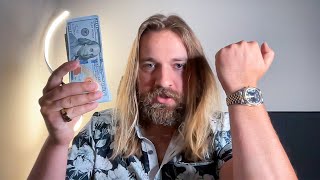
A speaker shares when and how to quit your job to pursue entrepreneurship. He covers financial preparation, building business assets for leverage, and achieving time freedom without sabotaging your current income.
The questions I most commonly get asked is when should I quit my job? And this is for varying reasons why I get asked this all the time. First of all, I help a lot of people build very successful businesses. I help people generate their first income online. I'll even just for the sake of proof, I will show you guys. One of my businesses has generated over a million dollars in the past year. And I've helped a lot of people get to, you know, success a lot. And I've helped a lot of people quit their jobs. And the inspiration I'm making this video is one of my students that I was helping them quit their job actually just sent me a message saying that they made $25,000 last last month and they're making 25 grand a month now. It's kind of funny. He actually ended up buying like a WWE belt. Here you go. I'll actually send this to or show you guys this real quick. Yeah, I just got this message from this one guy. Thank you for showing me this was even possible. And you just sent me a video of him buying a WWE belt for making 25 grand and quitting his job. But the question is, is like when should you quit your job? And it really depends. There's a few different features. But what I will say is first of all, you need to have one of two things is either you need to have savings for six to 12 months that are set aside to make sure that, that you're able to, you know, continue living your life. If it takes you a little bit longer to, to get to where you're making money now, you can obviously decrease your lifestyle expenses a good amount. So then it's not so tax like it's. So it's not so much money that you need to set aside to be able to make this happen. Or what you need to do is just set aside the money or figure out how to make more money. Or then the other thing is that you have another income stream or like your income stream is greater than what you're making at work and it is able to allow you to quit your job. So that's typically how most people do it is they'll, they'll work their full time job and then they'll build a business or they'll build an income stream on the side. And then once the income stream is able to be very sustainable and it's been consistent, then they'll quit their job or then they'll start taking less hours. So they'll go from like eight hours a day to maybe Four hours a day or something like that. So then they can kind of invest half the time into their, into their job or a lot less time into their job and then more time into their business. I'll see that pretty frequently. Or another strategy I'll see people do is where they take their current job. Like it's just, let's say they're making $6,000 a month at a job, they have to go show up into an office. They'll start looking for other opportunities or other jobs that allow them to not have to go to an office or show up in an office and instead is more like kind of contractor work or more kind of like where you're able to work from home or it's a little bit more free with the time that you have. And they're able to build their business or their other income streams while they're working. So that's kind of like the main thing is if you have no time whatsoever and you're not really heading towards a direction of being able to set aside some real income, then you probably want to reconsider, like what you're doing for work. Maybe you need to go work somewhere else, pick up some freelance work. I see that happen a lot, especially with people in like the tech industry or, you know, kind of more where you can become more of a consultant. Those types of industries are pretty well. But if you're, let's say like a nurse, you know, maybe then it's like either taking less hours or being a little bit more intentional with your schedule. The then at that point, some people, they have no choice but to either, you know, maybe you guys pick up like driving for Uber or some sort of gig work, becoming a freelancer online, working on fiverr, you know, something like that, where you're able to replace your income. So then, you know, maybe you're still working eight hours a day, but then it's on your own time and your own schedule, and then you're able to kind of do your own thing. Because that's like the biggest constraint. The biggest bottleneck for most people is their time time. Like the amount of free time or the amount of like time that they have to put into developing more income streams is typically like a lot of what, you know, holds most people back. Like for me, I ended up never getting a job. Like I worked jobs and I realized that I didn't want to work a job. So then I ended up buying. Like, then I ended up just started making money as soon as I possibly could. Um, I started doing Like I did during my sales job, actually I had. Was when I started to figure out how to. Like, that's what I. Actually, what I did was I had a sales job. And what's nice is about a sales job is you're 1099, so you're not really showing up to an office. And I was selling people. I was selling, what you call it, I was selling vacuum cleaners in people's houses. And in between these appointments, what I would do is I would be building my real estate business. And with the real estate business, I was able to make like an extra eight grand or something like that while doing my sales job. Then I went back to college, and while I was at college, then I would, you know, while I was in class, I would be working on some of the deals that I was flipping or after class or on the weekends. Then I would. I would focus on that business. And then it got to the point where during that summer, I saved up, I think, like 10 grand or so. I moved out on my own and I decided to go all in on business because I had some money saved up. That was how I did it. And so that's how I've seen, like, a good amount of other people do. It is where you just kind of start building the business, you kind of start getting the income going, you start setting aside some money. Until then, you can finally make that quit and make that change. Now, if you work in a really toxic environment or, you know, it's just like, it's just not a good environment, then, you know, definitely, you know, whatever you can do to keep just making the money and setting it aside. And then as soon as you start making any money, let's say your current job, you make like eight grand a month. But as soon as you start making like 4,000, $3,000 a month from something else, then you could probably quit a little bit sooner. Especially if you have like two, three months worth of money set aside, um, then that's something that you definitely could start to quit. So the question is, like, why do you want to quit your job? I mean, I know a lot of us, we have all sorts of different reasons, but I mean, I would say for me, you know, because I. I see this world right now of like, all these lazy people or people that are perceived as lazy for not wanting to work your job anymore. And I get that, you know, we definitely live in a weird generation where a lot of people are quitting their jobs. But I think for, for me, at least the way that I look at it is. Let's say that, you know, we got this, like, fake money here. Let's say that, you know, at your job, you can work. Let's say you get paid a hundred dollars an hour. The most that you could make in any sort of given day is, you know, let's say $1,600 an hour, or $1600 it is. So it's 1, 2, 3, 4, 5, 6, 7, 8, 9, 10. All right, we'll just say that's like 16. Let's just say this is like 6. So the most that you can make in a single day is $1600. Now, yes, that's good money. But in a single, like, you know, say you can only work five days a week, then that's only so much a week. Basically, like, in a month, you can get to where you make, let's say, like $30,000 a month. Now, that's cool and all, and that's good money, but you're still capped at, like, how much money you can make. And I came to this realization that no matter, like, how much I work up this corporate ladder, I am kind of limited by the pay structure that I am at. Unless I start getting stock options and I work my way up the ladder and really kiss ass or I'm able to really strategically find my way into the company versus what I realize is that instead of trading, that actually grabbed instead, you know, we're creating something that's leverage and media leverage. As I upload videos, as I upload this video that you're watching right now onto YouTube, you know, this platform right here, then the video is able to stay on the platform for, you know, months, day, like, days, weeks, months, years. And that one time I record the video, it can not only be watched by 10 people, but it can be watched by hundred people, thousands of people. Hundred thousand people are able to, like, watch my videos. And out of that, I'm able to make significantly more. And the more videos that I make and the more channels that I run and the more assets that I build, the more money that I'm able to make, regardless of how many hours I work, regardless of how, like, how I show up that day, regardless of, you know, what my boss, if I don't have to, like, show up to some douchebag boss and sit in traffic or anything, and that's what we're shooting for, that's what we're seeking for, is time. Freedom to where our. Our. Our money is not associated with our time, but instead our money is associated with the assets that we create and the leverage that we build. And that is why we want to quit our job, and that is why we need to figure out how to quit our job. So that's my strategy. That's what I got. I was a little bit scatterbrained inside of this video, but I think the point was abundantly clear. You know, how to quit your job. Start being strategic about it. And if you guys have any questions on any tips or anything like that, I got you. See you all in the next one. Peace.
More from Devon











Powerful dopamine junkies, Geniuses are depressed and Nueroscience of environments