Obsession Based Learning: Level Up in Life w/ Dickie Bush (MI324)

Dickie Bush went from BlackRock trader to co-founder of Ship 30 for 30, a writing program with over 10,000 students. He built his audience through a viral Twitter thread, then learned to sell his expertise for $5,000 ghostwriting gigs. His framework: turn obsessions into skills, systematize your day job to free time, and publish consistently in 30-45 minute blocks.
Chapters
the worst thing you could do is quit immediately because then you're going to pursue other opportunities from a place of scarcity where I have to do this, otherwise it's not going to work. And I just don't think that's going to lead to clear decision-making.
Right.
Rather, it's how can I identify the parts of my job that are required and systematize that in such a way where my level of effort goes down and then I could reapply some of that Unlocked time elsewhere.
I wanted to touch on video games. I know, and I, in my research, I found out that you're like this Call of Duty champion or whatever, you know, professional player, right? And so I know that you were playing baseball, got hurt, obviously a competitive guy, dove into the world of video games. And I really, I've got stepkids who I shared with you before we started talking who could play 18 hours a day if we let them. Right. And I, I have a framework that it's like a total waste of time. So I want to hear your perspective on it. I know you spent hours and hours, obviously got, got so good, you know, you won money professionally. So talk to me a little bit about how you view video games and maybe how I can reframe the time that my stepkids spend on video games.
This is certainly a topic I could talk about for a long time because before Call of Duty— so it's funny you said that. 7th grade, I was pitching and tore my rotator cuff. I was decently athletic in growing up, but never really hit my athletic stride till high school. But during that 7th grade period, I couldn't play any sports. And so I went down the Call of Duty rabbit hole, played professionally. I think I was the best player in Florida, et cetera. But I learned far more from video games actually when I was even younger, when I was playing kind of MMORPG, which are just role-playing games where there's a different world. And the big one was like RuneScape. A lot of people probably played World of Warcraft. My co-founder Cole played World of Warcraft.
Yep.
And those games taught me to this day more than my Ivy League degree about business and operating with a team and everything like that. And I think the reason is I, if my parents did anything right, raising me was they allowed me to follow whatever I was obsessed with at the time. And they banked on the fact that if I followed whatever I was interested in, I could learn more about the world through that lens than I would if they forced me to do anything I didn't want to do.
Right.
So it was different video games growing up, and then it was a little bit of sports. The Tampa Bay Rays was one of them, and then Call of Duty in middle school. And then eventually I transitioned to play football and built my whole life around that in high school and college. But I think that's the overarching framework, is if you can allow someone to be obsessed with a video game, they're probably going to learn more about working with team members or, uh, doing kind of boring, monotonous work, or just enjoying themselves that I don't necessarily think you're going to achieve if you force them to do things they don't want to do. So in your example, if, what are the video games they're playing? Is it anything specific?
Minecraft, I think. Minecraft.
Okay. Um, that is the point to me. I never played Minecraft, but I know it's like world building where there's strategy involved and you're always creating something and you have to like resource allocation and all these different little skills that I say you have to pick something to go and build. And whether that's a video game or whether that's business or whether that's a sport or whether that's a language. this is something I want to talk about long-term of how you can educate children through what I call obsession-based learning, which is you let them pick a topic and whatever it is they're naturally curious and drawn to, you can then educate them about all the other parts of the world based on that. I love that. So it's super interesting topic to me because video games are my thing.
Where did you come across that topic, obsession-based learning?
I named it that. I don't know if I was the first one to ever say it, but to me, that's how I implicitly was raised. It was, what are you interested in? Go do that with full force. And then, like, my example is when I was 6, 7 years old, I was obsessed with the Tampa Bay Rays. Pure obsession. I could name every player. And this was, granted, we were the Devil Rays back then, and we were losing 100 games a year. We were the worst team in the league, but all I could do was think about them.
Uh-huh.
But through that lens, I learned about business because I looked at who was the owner of the Rays and how did they ascend to this level. And then I learned about sports management and I learned about teamwork and all these different things because I had like a vehicle to go down those rabbit holes. And that's my general thought on this is if you try to educate people on math or business or whatever through a lens that they're not interested in, nothing's going to resonate. But if you can pick something and then say, let's now build around this world. I think the long-term learning outcomes are a lot cooler. So this is a very rough draft idea, but something I think a ton about for the future.
I love it. You made a comment in an interview that I was listening to about the whole idea of leveling up, like in a video game and how that can apply to your own life, which I never even thought about. When you said that, I was like, wow, that's like really a great idea. I really want to apply that to my stepkids who You know, are spending a ton of time on video games. Interesting to me that you said you thought the world of video games taught you more than your degree at Princeton.
Correct. Yes, exactly. Because I didn't learn anything tangible there. It was all theoretical learning versus when I was 12 years old and part of a clan of other RuneScape players my age. And we were going and, you know, building skills and leveling up and figuring out trade-offs and learning how to merchant different items. I just learned about economies and how all that worked, which is another topic I want to write about, is how you can learn through video games like that, but definitely more applicable than, you know, some of the quote-unquote business classes I took in college.
Well, you became a trader at BlackRock, right? And so did any of the skills that you learned in video games come into play in your later career after you graduated from Princeton and were working at BlackRock?
Less than I would like.
Uh-huh.
When I was working there, this was definitely a dream job of mine, and I came to that dream job in college because the analytical, logical thinking that is happening on, on Wall Street with any kind of trading I had a math background growing up. I really enjoyed numbers and everything like that. So that was kind of the path I was groomed on. But I learned while I was working there that I actually wasn't building the real-world skills that I wanted to. It was very siloed, very— I didn't feel that I was going to be able to reapply anything I was learning. And if you take a step back, this whole video game approach, this whole picking something approach is it doesn't really matter what you're doing. It's the skills you're building as a result of that pursuit. And so if I was working that job where the skills that I was building through coming to work every day weren't tangible, that I would be able to reapply to something else, that was the first time I felt stagnant in my growth.
Right.
Versus in any other endeavor I've had, I knew that I could reapply that obsession skill, right? Being obsessed with a video game and giving it all your attention, you could then, and which is what I did, apply that same mindset to football. I played it in high school and college. But then I tried to apply that when I was working as a trader, and it just didn't— it didn't click because there wasn't— you know, this is a far deeper rabbit hole, but I don't think most quote-unquote traders really have any kind of edge in the financial markets. So it didn't feel that I was building a tangible skill in any way, and that kind of led to pursuing other opportunities, which I'm sure we'll talk about a little bit.
So that's interesting. So BlackRock was the only job really you had, I believe, aside from what you're doing now, which is, you know, it's totally out on your own. But you started off as an intern. You're a trader and it's your dream job, I presume, right?
Correct. And the only, yeah, so the only job I ever had outside of working as a cook slash kind of busboy in the back of a restaurant for 3 days when I was 15 years old and I got hired, I was like, I got a job. This is going to be awesome. I went to work for 3 days. Learned what it's like to work in the service industry, made $100, which as a 15-year-old is enough to keep you running for a couple months. And I was like, all right, I'm out on this. And then the next job, the next job interview I had was that internship at BlackRock going into my junior year of college. So I worked for that team as an intern going to junior year, senior year, and then for the 3 years that I worked there professionally, same team, one job interview, everything. And yes, the exact path that If you had told me when I was 16 in high school that that was the trajectory I was going to take, I'd say that's an absolute home run. And I think the painful realization to me was waking up 2 years into that job realizing this is not a path I'm going to take for the next 20 years. What does that mean for everything I've done previously?
Yeah, it's a hard realization. I had the same exact experience, exactly like yours, working at an investment bank, thought I had my dream job, Looking around, and I think you had a similar experience, you're looking around at guys that are 30, 40 years old, and it's like, I don't know that I want to be those guys when I'm that age.
It was difficult for me to show up with the level of intensity and effort I like to bring to things when I saw that the endgame for 10 years of that was going to still lead to asking for permission to go to my son's Little League game.
Yeah.
And That was a, like a wake up in the middle of the night type moment for me when I had to start to reconsider where am I going to apply my efforts that I know could compound for 10, 20, 30 years in the future if this isn't the path that I want to take.
Yeah. Yeah. It's a tough realization. So I want to hear, you've got this obsessive learning thing that you applied to video games. You applied it to football. At what point did you apply that to writing?
when I realized I was horrific at writing. So I hated writing in college. I took one freshman English class. It was a pain for me to show up. I hated the idea of writing a specific number of words about a topic I didn't care about. And so I went the next 4 years completely avoiding learning that. And I entered the real world, and at BlackRock, I actually noticed that the majority of the people at the firm who held the most power, meaning everyone looked up to them, they had influence, they were writing these very well-crafted, well-formatted, well-thought-out emails that they'd send to the entire firm. And then I looked at some of the investors I looked up to— Warren Buffett, Howard Marks, Jeff Bezos— not really an investor, but they all built so much of what they were doing around writing these memos. So I said, okay, clearly there's something here. How can I go learn about that topic? And I actually started an internal newsletter at BlackRock where all I was doing was summarizing podcasts like this or podcasts like Invest Like the Best or other financial podcasts and sending it around. And then it kind of clicked with me as more and more people inside the firm started reading it that one, I was unlocking new opportunities that were just flowing to me. Now I could, I had people high up at the firm reading it where I was like, okay, here I am in my second year. Why do they have any care of what I have to say. Well, that's clearly working. Let's double down on this. And then after a few months of doing that, I recognized, why would I cap this at only people at the firm? Why couldn't I give this to the whole internet? I didn't actually end up publishing anything financially related because I was kind of worried about conflict of interest and if I get fired for doing that. So that— I started a personal newsletter. But that was when I recognized There's a lot of upside to this skill. How can I go immerse myself in the world of it? So I started to read copywriting books. I started to follow a bunch of different writers. I read everything there was on the topic, and I just started to write a ton, which gave me the lens to apply what I was learning.
So I want to take a step back and talk about BlackRock. I, you just sent me an email that you found out that the fund that you worked for is shutting down after 27 years, I believe. So the Obsidian Fund was their first hedge fund for BlackRock. I just was kind of curious your thoughts, like, or, you know, I think you just found out about this, so I'm just interested in just what your thoughts are about all that happening.
I saw the headline, I saw the headline come through. I guess it was an older one, but it comes 18 months after I left. And at the time when I was leaving, I considered it the riskiest decision I had ever made. I had what most people would call a dream job. I had an uncertain path. outside of that. And if I'm lucky enough to say right now that the riskier decision by far would have been to stay, which is to have my financial future outside of my control. And I recognized that luckily even earlier, way before I left. And I definitely like, quote unquote, risky was what other people were labeling me leaving as, but I felt very confident in the skills I'd built in the 2 years of doing both things on the side and working full-time. That it was not like a leap, it was more like a step, uh, right onto another path that had kind of been laid out. But, uh, my gut reaction was, man, that worked out. And here we are where luckily I get to talk on a podcast like this now about investing, which is still something I'm very passionate about, and money and finance and everything. But I came here from a completely different lens than, uh, where you might have— where I might have thought I came from 3 or 4 years ago.
I wanted to touch on just how you straddled that, taking the leap from working at BlackRock to going out on your own. And then I also want to follow that up with just how your family reacted, because when you've got a dream job like that, that can be psychologically really hard to do and you don't get a lot of support from your family. So I wanted to hear a little bit about that, just how you straddled it and then the family experience.
Okay, a couple points here. I was fortunate enough to be working from home during this entire endeavor. So I started to write on the internet in January of 2020, pandemic hit, we all went home, and I found myself realizing that a lot of the work I was doing was more than likely because someone was looking over my shoulder, making sure I was quote unquote working.
Right.
But my actual output was not 12-hour days, it was a couple. So here I am working remotely and I'm living with my mom and I have all this time. And so I started to do other things on the side during that free time and still do the whatever was required at my full-time job. And slowly and slowly, I kind of changed that time allocation where I was giving more and more to the side hustle. In terms of leaving, I took an extremely, extremely conservative approach that I think anyone looking to exit a job that no longer has incentivized upside for them, where more effort does not lead to more skills or more income. I left when what I was doing on the side was 2 times as much on a monthly basis as my full-time job. So there was no risk.
In terms of income or in terms of learning or?
In terms of income.
In terms of income.
Now, that's about as conservative as you can get. Right? It was now more of a financial risk for me to stay. I look at it as you need to do both. And rather than— if you realize you're on a path that you don't want to stay on, the, the worst thing you could do is quit immediately, because then you're going to pursue other opportunities from a place of scarcity where I have to do this, otherwise it's not going to work. And I just don't think that's going to lead to clear decision-making. Right. Rather, it's How can I identify the parts of my job that are required and systematize that in such a way where my level of effort goes down, and then I could reapply some of that unlocked time elsewhere? Now, I think it's an important point just to kind of touch on this. If you have a job where you are building skills and you have incentivized upside, or you have a piece where more effort does lead to more skills and more income, you should totally disregard what I'm saying because there you should triple down on giving that your full attention.
Right.
But if instead you realize that this isn't a path you want to take forever, you need something where most W-2 jobs, your skills are not the bottleneck to your growth. It's the management above you. And so you could work for 16 hours and you could get You could become an unbelievable performer and you don't make any more money and you don't learn anymore.
Right.
So that's a difficult spot to be. If you're in that spot, you need a vehicle where your skills are the bottleneck. And that can be any kind of side hustle, any kind of writing, any kind of area where this is my thing. And then it's going to illuminate all of your personal skill bottlenecks that then you can go and solve.
Yeah. So you started off with a blog, right? And you were, Listening to podcasts and basically synthesizing what you were learning, correct?
I picked something that I was already doing. Yeah. So every day on the train, I would listen to a podcast. I was taking notes on it. And I did that all of 2019, but not a single one of those found their way outside of my notes folder. So when I started to write, it was an extra hour of work where this is a framework for evaluating any kind of opportunity to pursue. Worst case, I was going to better understand those ideas. So there was zero downside to me putting out that newsletter. If nobody read it, I understood them better. But if everyone read it, which is not everyone, but what ended up happening, it has unbelievably exponential upside. And so as I was kind of weighing the time allocation to that, it was great. Worst case, I'm smarter. Best case, exactly what happened. I unlock tons of new opportunities that are coming to me. just by sharing things that I'm already doing.
I think I read that you have listened to every Tim Ferriss podcast. Is that
correct? Correct. I, I've actually haven't listened to some of the more recent ones, but there was a period, there was a period where that was what I was obsessed with.
Yeah,
I was just, this guy's gone and interviewed every interesting person for what seems like 5 years, and I can download that into my ears and just walk around and learn it. That was such a cool idea to me that, yeah, I just listened to every single one of them and tried to come up with one or two takeaways after each one.
Yeah. So at what point did you decide to move away from the blog and focus strictly on, or mostly on Twitter? And how many was that? Like, what year was that? And I wanted to hear just about like how many followers you had then and the growth and how that happened.
I love this story because I've, I've told it a bunch and every time it brings a smile to my face because it was around September of 2020. So I started writing my newsletter in newsletter, newsletter/blog in January of 2020. So 9 months. I was under the assumption that all I had to do was write and everyone was going to find me. And by the end, I'd be this big successful author and the rest would take care of itself. Turns out that wasn't true, especially when you publish somewhere where people cannot discover you. So 9 months in, I think I had 200 newsletter subscribers, something like that. So I'd written 37 editions and do the math on that. I averaged about 5 subscribers additional per newsletter. It was very slow. It was very frustrating.
Yeah.
And in September I said, okay, I'm clearly doing something incorrect here. And rather than give up, I said, okay, I'm going to reposition and test something else, which is rather than publish weekly to somewhere that no one knows exists, I'm going to publish daily to a stream of attention, which is at the time Twitter, now X.
Yep.
And what this forced me to do was tighten my feedback loops where the old way I was publishing once a week and barely anyone was reading
it.
Now I was publishing every day and lots more people had the potential to read it. And so over the 30 days that followed, I published a Twitter thread rather than a newsletter on a podcast I listened to that day. So same idea,
yep,
just summarizing what I was learning. And on day 28, I hit publish and it felt like I had started over again. I had zero likes, zero comments, zero retweets. It was like I didn't exist again,
right?
And so at that point, I was ready to completely give up writing on the internet. I was like, okay, this isn't for me. Very humbling. And I was ready to give up. I said, okay, I I tested a different iteration. This clearly didn't work, whatever. But I wasn't going to quit after just 28 days. I was like, okay, I'm going to finish 30. Next day, kind of begrudgingly got up, listened to a couple podcasts, wrote the summary, same thing, hit publish, went to bed, was like, all right, 2 more days and then I'm done with this. I woke up the next day, that thread had 6,000 likes. I dropped my newsletter at the bottom of it and went from 250 subscribers to almost 1,000. overnight. So I said it took me 9 months to make 250 subscribers and then, uh, 9 hours to go to 1,000.
Yeah.
And I recognized, okay, what— how can I zoom out and validate or come up with a framework for what just happened? And it was, you never really know what's going to go viral, so you need to keep publishing,
right?
And second is the people that were reading that and sharing it were all individuals that I looked up to. The thread itself was on Balaji Srinivasan, who you're probably familiar with.
Yeah, I interviewed Eric, uh, Jorgensen, who wrote a book on Naval and Balaji.
Awesome, awesome 2 books. Highly recommend those to everybody. And that's what happened. I wrote the thread about him and he was sharing it and Naval Ravikant was sharing it. And I said, wow, I have access to their attention on this platform. That was mind-boggling to me. So rather than write on my own blog, if I'd have published that same thing to a newsletter, nobody would have seen it or to a blog post, nobody would have seen it. But I put it in in front of aggregated attention. And then that kind of started to spin the entire flywheel where I had momentum, I doubled down on that momentum, I realized what was working, and here we are 2 and a half years later. And I've just kind of been following that playbook, but obviously to different lengths and different topics and things like that.
It's pretty wild, right? I mean, when you think of it, what, what's happened in just 2 and a half years.
Yeah, definitely something that is still catching up identity-wise.
Uh-huh.
And It will continue to take a long time, but I'm just taking it day by day at this point and not trying to extrapolate anything too far into the future, just continuing to write and enjoy what I'm writing about.
Yeah. So what was the thread on specifically that Balaji retweeted and Naval retweeted?
This leads perfectly into where I took it, which was, this was kind of a thought profile breakdown where I listened to like 6 different podcasts that he was on. And for myself, I wanted to say, what is this guy's worldview? And granted, this was, he's taken off quite a bit with his Bitcoin bet and the book and his podcast, but this was 2020. Not very many people knew about him. So it was very novel to write something like that. And it was basically the hook of the thread was the most fascinating thinker I had never heard of, Bollinger. I listened to 20 hours of his podcast. Here are the 9 ideas that really stuck with me. All it was was a distillation of things he said. Yeah. And because that was useful to him, he shared it. And because it was useful to him, other people shared it.
Yep.
And then I kind of took that framework and said, who are all the other thinkers that I'm interested in? And I started to do different thought profiles on them, where eventually that's kind of what I became known for over the next couple months, where I then had people reaching out to me who were asking if I could write a thread for them summarizing their worldview. And then they would pay for it. That led to me ghostwriting, that led to income on the side, which helped me meet Cole. I mean, that's where the whole story goes from there. And we can go down that rabbit hole if you'd like.
I wanted to touch on the thread thing first because we've got a newsletter that we put out called We Study Markets. And at one point I was tasked with writing a thread every day on Twitter to try to generate new subscribers, right? And so I studied your content. Like that was hugely useful to me. Like I had no clue how to write a Twitter thread. You know, I've never done it. And your whole idea of like hooks, and I actually stole that idea of like the most interesting investor you've never heard of. Right. There was a British guy named Sir Chris Hohn who I truly had never heard of, but it had the most, you know, and like you said, you have no idea how something's going to perform once you hit publish. It had the most impressions that of any thread that I did. But I was studying your content, which was great on how to write hooks. I like the whole idea of like the moment in time. I use that a lot. There was just a lot of useful information that I just want to thank you for, for like, I learned a ton and it's like truly an art form, I think, to learn how to write a thread.
How do you get started with stock investing? I've put together a course to teach you everything I wish I knew when I first started investing in stocks. Let's start at the beginning and ask, what is a stock? Let's zoom on in into what it's actually like to buy a stock. A few options are Charles Schwab, TD Ameritrade, Ally, E-Trade. Fortunately, you won't have to necessarily calculate all of these taxes yourself. I'll outline a few main ones to be aware of throughout your lifetime investing journey. As Warren Buffett says, your best investment is yourself. There's nothing that compares to it. By the end, you'll be savvier about stock investing and personal finance than the vast majority of people. Even if you're not a total beginner, I'm confident you'll get a lot out of the principles and strategies I outline, which we'll build on throughout. Link to the course is available in the description below. See you there.
It's really the art of capturing and keeping attention,
right?
And the vehicle that you apply that to could be video, could be this podcast, it could be a Twitter thread, it could be a book, but it's something that fascinated me. It's just the world of copywriting. And Twitter is just copywriting and in a social media feed, the person who writes the most concisely, delivering the most value in the most readable way while solving people's problems are going to see success. So the reason that that thread worked for you was a proven hook where you're kind of implying, here's, I did a bunch of work researching someone that you you don't know about, and then I distilled all that work.
Yeah,
for you right here. So it's like little cost, big outcome based on all the work I did. And there are tons of templates that you can follow that once you see something that works and you're writing consistently, you just kind of can reapply that to your niche just as you did.
That's what I did. It was like 5 or 6 different templates, I think, that you have on how to write a hook, and it was great, super useful, uh, information for me. So, um, But I wanted to hear more about the writing for you and like when you first started making money. I think you said that you made $10,000 as a ghostwriter. That was your first, you know, income that you made as a writer. Was that always the thought in the back of your mind that eventually you were going to monetize this somehow?
I accidentally monetized it. So this is where I was kind of leading to. After I was writing those threads, I had someone reach out and say, hey, could you write one of these for me? And this was someone I really looked up to, that I was going to study anyway.
That's pretty cool.
Which is important. Exactly. So I did a bunch of free work where I basically did 30 of these for free in public for other people. And then someone started to ask, could I pay you to do it? Now, they asked, how much do you charge for this? And here I am, I'm terrified to charge money for anything on the internet. I'm like, uh-oh, what if he says no? So I didn't quote a price. I said, and this was smart in hindsight, I said, I don't know what to charge. How about I write it and do it for free and you pay me however much time it saves you or however valuable it is? Agreed? Great. So I went down just his rabbit hole. Every podcast, every newsletter he's written, every blog post, every TED Talk, every keynote, everything.
Can
you say who it is? Yeah. Uh, well, yes, because— no, I can't. It was Craig Clemens. Craig Clemens is a legendary copywriter.
Oh yeah. Okay.
And So I was doing it for him, and it's so fun to tell this story because of all the ways it connects from here.
Right.
So he eventually ended up, uh, I published it for him. I said, hey, you gotta write this book. This was awesome. And we started to work together where by going down his rabbit hole, I learned about the world of copywriting. And then I summarized it for him. And at the end he goes, okay, great. Uh, I'm gonna connect you with my assistant. This is amazing. Thank you so much. I'd like to pay you, blah, blah, blah. I'm like, cool. Heck yeah. I'd never collected payments before. I'd never, I didn't even know this was ghostwriting. I was like, 'cause it's really not like he wasn't publishing this stuff. He just had it all there. And I was like the synthesizer for him.
Yeah.
But it's kind of like ghostwriting. And that's really what ghostwriting is at the end of the day is you're synthesizing someone's worldview and then you end up publishing it. So he connects me with his assistant and I send his assistant my Venmo. because that's all I had at the time.
Yeah.
And she sends me a message back and goes, hey, the amount we'd like to pay you is higher than the Venmo daily limit. Do you have a PayPal or something like that? And I'm like, what's— I'm here, I'm Googling what is Venmo's daily limit, and it's $1,000. I'm like, yes, $1,000, let's go! And so I make a PayPal, I send it to her, and then $5,000 hits my account within like 10 minutes.
And
that just completely broke my brain because it was the first time that I'd made any kind of income from this whole 9-month journey.
Yeah.
And I recognized that— so there's a couple frameworks you can extract from that, but my message back was, hey, did you make a typo? Thinking they meant to pay me $500. And their response was, yeah, is $5,000 enough? Thinking that they might have underpaid me. And I was like, yeah, yeah, yeah, it's plenty. Like, thank you so much, talk, talk later, right? And that was my realization, was that My skillset applied to my expertise was not going to generate much income at the time. But to a lot of other people, I could save them time and generate more income where the $5,000 that they were paying me was not very much money to them at all. And so that was where the arbitrage was, was I was then going and providing that same service to other people who $5,000 relative to the amount of time that would save them is a great trade.
Yeah.
And so that's for anyone starting any kind of beginner service. It's figure out what you can do that if you were going to try to monetize yourself might not lead to income, but helping someone else with a problem who values their time much more, then you get to unlock that spread. So that was where I had the first taste of kind of internet freedom was, wow, something that I completely started on my own, did all the work for, it took 9 months to get here, and this is the payoff. Great. How do I double, triple, quadruple down on this idea? Because there's clearly something here.
And he introduced you to your current partner, right?
Correct. So then there's a cold email that came about 2 weeks later that the title is, or the subject line is, not sure why, but I think you 2 should know each other. And then the email goes, subject line explains itself. I'll let you 2 take it from here. And Nicholas Cole, my co-founder, his real name's Cole. He had written a book called The Art and Business of Online Writing. So The Art and Business of Online Writing, I had read it. It was very influential to me. And so I'm like, of course I want to meet this guy.
Yeah.
And we ended up partnering up on Ship 30 for 30, which is our cohort-based writing course, kind of helps beginners take that first 30-day journey if they want to start writing online, the same one that I did and the same one that Cole did, but on Quora. In 2015.
Okay.
So his whole story was he started writing a daily answer on Quora. His first couple went viral, then he monetized that into an agency and has been writing ever since. So a lot of interesting pieces where when I zoom out, it was writing on the internet generated more opportunities than I could have ever thought possible.
Mm-hmm.
And so for the last 2 and a half years, Cole and I have been trying to help other people unlock that same level of opportunity and as many different vehicles and platforms as possible because it's changed our life and we know that it only takes 30 days of publishing. And I was proof of that when I wrote my 30 threads in 30 days. So that's kind of the genesis story and it's fun to recap it.
Yeah, no, thanks for sharing that. It also changed my co-host, Kyle Grieve is his name. He took Ship 30 for 30.
Oh, really?
And was posting, you know, on Twitter. really posting great content on value investing. And as a result, he was hired by TIP as a podcast host, which I don't, I don't know if it would've happened without Chip 30 for 30. He speaks highly of it. So yeah.
I really appreciate that. And it, it, it's a testament, right? When you share things,
right,
you give a jumping off point for people to reach out to you. It sounds so simple, but if you have 30 pieces of content out there on one topic, And someone is interested in that topic, they're going to read one, then read all 30, then reach out to you about it.
Yeah.
And the internet guarantees that if you write about something, it's the job of the social algorithms now to show that to as many people as possible that are interested in that topic. So it's kind of democratized access to attention where write about something people are interested in, we'll take care of the rest.
Yeah, it's incredible. So I wanted to step back and talk more about Ship 30 for 30. At what stage of the game did that idea develop and how did it progress?
So this was November of 2020. I had gone on that individual 30-day challenge. My life was changed. I landed the ghostwriting client, I was making income, and now I said, great, I could do my full-time job, I can continue the ghostwriting because that's generating enough income where this is great. If I want to do 1 or 2 clients and make an extra $10,000 a month, that was absurd to me. That was matching my BlackRock salary at the time.
Right.
And then I said, okay, this worked for me. Why, why wouldn't it work for other people? And I wanted to continue writing every day, but it was hard to do those 30 days alone. And so I tweeted out to my couple hundred followers at the time, hey, who would be interested in a 30-day accountability writing challenge? And it's fun because my current Twitter that I'm still using has all of this archived on the timeline. So you can trace all the way back to that original tweet.
That's awesome.
In November of 2020. And I've resurfaced it all the time of like, hey, I had a couple hundred followers when I started this thing and I did not have any kind of grand vision to help 10,000 people eventually do it. So there was no grand plan at all. But over Christmas break, November and December, the original Ship 30 cohort, I was terrified to charge money for because yeah, I'd monetized with ghostwriting, but I never monetized with like a cohort or any kind of, um, real product like that. So it was $50 and I gave everyone their money back if they wrote every day for 30 days.
Mm-hmm.
Which was, I'm, I'm like balancing spreadsheets, making sure people are writing every day, and I'm like putting accountability Slack. We had 80 or 90 people in a Slack channel where my whole goal was to validate the idea. So I held one-on-one interviews with every single person who completed all 30 days and a lot of the people who didn't, where I asked what worked well, how could this be better? Why'd you join in the first place? What are you looking to unlock? And then in January of 2021, that was the first live cohort. So that one was $99. It went for sale. I think total gross on that was $35,000 or something like that because it had gained a lot of attention because I started to take the principles I had already learned, write to market the course, and then write emails, get people on an email list, offer it to them. And that first cohort in January was life-changing to me because I went from never making any dollar or any money from it to $5,000 to $10,000 for ghostwriting, to taking that, doubling down on investing in some courses and coaching programs where I was better understanding how this whole world worked. And then launching the product. Product broke every belief I had around money. I still remember the first person that it wasn't a refunding or it wasn't like a refundable $50. Someone Bought a product from me that's completely different than a service. And yeah, that was January of 2021, partnered with Nicholas Cole from there. And now we're currently, this is January 2024 as we're recording this. We've done 20 live cohorts, helped over 10,000 students and all from that original idea that was just, hey, let's get in a Slack channel and keep each other accountable to write every day.
So that first iteration though, you were going to pay them or return their $50 if they wrote for 30 days in a row.
Correct. So I'm like wiring money back out of PayPal. I got suspended by PayPal because I processed them all as refunds for the original charge. But that was the thing. I was like, I just want your feedback. And if you don't pay a little bit of something, you're not going to give it your full attention. So $50 was the minimum that I knew, like, you'll join and I'll promise to give it back to you. And most of them at the end were like, just keep it because this was life-changing.
That's awesome.
And to this day, we just continue to improve the product, improve Raise the price, all that. And it's only through 20 iterations now that we can say this is a home run experience for everybody.
That's incredible. I want to touch a little bit on money blueprints and scarcity and mindset. So you had this idea, I think, that just the scarcity mentality, right? And I believe you've done a lot of work on shifting that. So I wanted to go—
Correct.
Kind of do a little bit of a dive into that, like how you reframed things in your mind, what worked for you, the books, podcasts, whatever that were influential.
So if there's one topic I plan on writing about a ton more in the next couple years, it's this one because it's crucial. And there's so much advice out there about how to make more money, but there's very little advice out there on how to improve your relationship with it. And I see a lot of people who make a lot of money, and never improve their relationship with it and then still end up miserable there. Right. Where this is a skill, spending and reinvesting your money in yourself and your life and your experiences is a skill that takes a lot of internal work to do. Now, I grew up the poorest kid at my school and we were never in any kind of real financial trouble, but I felt it because it's really not your actual circumstance, it's your circumstance relative to everyone else where you judge your financial wellbeing. Anyone who's made more money recognizes that you don't really ever make it. You just find a new group of people to compare yourself to.
Yeah.
Right. So this was all I was doing was I was comparing myself. Wow. Okay. Interesting. Everyone around me has a better, uh, house. They're able to do different trips. I bought my first car in cash while they all got it for their 16th birthday. Like just way different.
Yep.
And the framework I've been working on here is when you start a business, the bottleneck to your business will be your personal relationship with money. And as I looked backward on my journey, you can see that manifest in some of the things we've talked about, right? My original ghostwriting client, I was going to charge $250 to $500 because I thought that was a lot of money.
Yeah.
And then when $5,000 hit and I realized that the extent to which that $5,000 hit my account was he thought about it for about 3 seconds and was like, what's a good number? Yeah, 5 grand. Okay, kick it to him. Boom, on to the next thing,
right?
As someone who to this day still thinks $5,000 is a ton of money—
Sure.
I had to recognize, okay, there's clearly a different level to this. And then as I've been building the business for the last couple years, each time there was something uncomfortable like raising the price to something or selling something for over $1,000, I have felt, because my personal relationship with money wasn't there all the way, that that was what was holding me back. And so every lead in income, every original investment. So I mentioned in November of 2020, I bought a course that was like how to market and write different things on the internet and how to package things up. It was $150. This was the first course I'd ever bought.
Yeah.
And I was so terrified to spend $150 on that, right, that I called up my friend and said, hey, will you split this with me and I'll share the logins with you?
Right.
Right. So And here I am like helping 10,000 people make the same decision in the future. And so this was something I've had to work on. And it's, it all comes back to, are you operating from scarcity or are you operating from abundance?
Right.
And my definition of abundance is having more than you need of anything. And this is, as I think about kind of a general operating system or personal ethos is kind of what I call it. The main thing I'm trying to achieve in every area is abundance where I want more than I need of anything. But there are 2 ways to generate that abundance. You can have more or need less. So a lot of people hear that and they're like, oh, it's— that must be greedy. It's like, no, it's actually figuring out when you don't need any more and you can reduce the need and you still end up with a surplus. So on the money side and on really anything, any kind of resource, you can ask, could I make more of this, or is there a world where I could need less of it? And I've been retraining that on the financial side, but relationship side, health side, everything. It's How can I just generate a more abundant and stop operating from scarcity? And we could talk about some examples of that, but that's the overarching framework.
Well, it reminds me of, um, in The 4-Hour Workweek, Tim Ferriss has got a thing about, I think it's like the experiment is called fear setting.
And
it's just the idea of like, how much do you need to live the life that you want to lead?
Right.
And like you said, you can either make more or reduce your needs, or I guess a combination of both. But are there any, like, maybe Tim Ferriss was an influence. Were there any books though that like changed your psychology? Because it's a psychological issue, I think.
Certainly.
I think there needs to be money therapists.
Definitely. 100%. And that could be a great topic right there. In terms of books that have done it well, I'd say the biggest one by far was something that I did implicitly. but stumbled on, uh, Die with Zero by Bill Perkins.
Yeah.
Now, why did this book click with me? He was a former hedge fund manager, and he described the concept— I read it last year— that has 100% changed my relationship with money. And it's the idea of a memory dividend, where as I was accumulating a little bit more income on a monthly basis, I was very hesitant to spend anything. I, I was like, you, you get it and you save and you reduce everything else. And I think at a certain point you have to recognize that you can cut your expenses by 1 to 2 grand, but that relative effort reapplied to earning more with skills is way easier. And same thing with credit card point hacking and budgeting, like all these things, the amount of effort and time that goes into that, crypto investing, whatever it is, if you reapplied it to learning something, Yep. your long-term earning potential goes up way more. And that's aside the point of memory dividends where a memory dividend is when you invest in something like an experience, it feels like, okay, let's say, and I'll tell the story of going to the Super Bowl. So it's 2020, 2021, and I'm from Tampa, born and raised Buccaneers fan, lifelong, all that. Pandemic season, Tom Brady's our quarterback. We're going to the Super Bowl. It's the first time that a home team will play in the Super Bowl with a chance to win.
Yeah.
It's Tom Brady's potential last game. World, like every single thing lined up. Now to go in, you're looking at somewhere between $5,000 to $10,000 ticket price. There's a couple ways you could look at that $5,000 to $10,000. It's so my ticket, and I'll spoil the story, but I ended up paying to go in the game for $7,000. And that was a large percentage of the money I had saved at the time.
Sure.
But Ship 30 had just started to accelerate. I was trying to train this, uh, kind of bet-on-myself mindset where when you make some kind of investment like this, all you end up doing is raising your level of effort and intensity for the future. And that, that proved. But you could look at that 7 grand and say, I got to go to the Super Bowl. That's it. Great. Instead, the memory dividend concept says you're actually buying an asset that is going to pay you dividends in the future. Every time you think about that memory, every time you look at pictures— right now I'm collecting a memory dividend on that experience because I get to tell that story. Anytime someone mentions Tom Brady, I go, I got to go to his last Super Bowl win.
Yeah.
Anytime someone mentions the Bucs. And so you look at all these different ways where, how could I invest in an experience that pays a big dividend like that in the future? Now I think that has changed the way I look at earning, where I want to make sure that a percentage of the income I earn every single month, I'm allocating to a memory dividend investment portfolio, just like I am stocks, just like I am crypto, just like I am education and any other asset class. Because those are— I'm trying to collect them. Like we were talking about my trip to Germany before we started recording,
right?
Huge memory dividend opportunity. And we got to collect one at the beginning of this. So that's been a huge one for me. And there's a couple other spending areas, but highly, highly recommend that book and just general way of operating for anyone who is looking to improve their relationship with money in any way.
Which is Die With Zero. It's on my Audible and I've started it, but I've not finished it. So after, I'll definitely listen to it after your recommendation. So
it is so good. So, so good. And I think the name is the only thing that kept it from being a smash hit, right? Because I think it implies like give away all your money and it's really just spend it on the way up.
Right.
It's spend it on the way up because you're collecting dividends for the future anyway. So you might as well build that skill along the way.
Yeah. So you'll have a specific percentage for your memory allocation fund or whatever you want to call it.
Exactly. So let's say $1,000 comes in right now. I skim 10% right off the top that goes to a different account. that I don't even look at. And then 35% goes to taxes. The rest goes to cash or stock investing or whatever other allocation I have.
Yeah.
And what that does is it forces me to invest in those experiences where I think the reason, and this was something I realized myself, when I was saving all my money and then putting it in cash, if I wanted to take a trip, I would feel that number decrease. And that was psychological where it was like, I was hesitant to invest in that because then the number goes down.
Uh-huh.
But if you don't track that, uh, money that's sitting in your memory dividend account as like money you have, you're just like taxes. When money comes in, they just skim them out off the top. Then psychologically it works because the number, you get used to just going up your other allocation And then when a trip or something cool presents itself, you have money already earmarked for it that goes, I have to go spend this. And I didn't even think I had it in the first place.
Right.
So that's been the big hack for me is how can I optimize my own psychology around investing in this? And I spent last year kind of honing in that system and feel really good about it.
I love it. It's a great idea. You also had an idea that I liked that I read about, about, it was basically like save $100,000 in cash before you even mess with like Whatever, trading altcoins or trying to hit a home run, whatever, you know, like talk to me a little bit about that and how that idea developed. Because it's a great advice.
Charlie Munger has a great quote, like, you gotta do it though. That's his exact phrase. He's like, you get, and he said that 20-something years ago, so it's a little bit higher.
Yeah.
But I was giving some just money frameworks to someone on my team who's in their early 20s. And the single best one I said was all the effort people think like, oh, I need to just be dollar cost averaging to the S&P 500 forever, and like that'll compound at 8%, and then I'll have $10 million when I'm 50. I'm like, yeah, but in 50 years, $10 million will really be like $25,000 today, so you're still going to feel the same way you do,
right?
Instead, you need to look for these big outcome returns. Rather than putting that towards crypto or something where you have to go pay a bunch of attention to it. I think you should have one spreadsheet with one bank account, and every morning you wake up, you put the date and you put the bank account balance. And until that number is $100,000, you should only make that number go up. So again, psychologically, how do you make sure that only goes up? You save it in cash, because the worst feeling when you're accumulating is to see the volatility and then you freak out about it or have to go check your crypto account every 10 minutes or your stock account every 30 minutes when all of that time, and I'm only saying this because this is exactly what I did incorrectly.
We've all done it, right?
Incorrectly. Where I remember I'm like, I got to be trading options. That's a thing. And I'm like trading options on my phone while I'm at work, like losing money, burning it to the ground. And that's all that happens. And so I'm trying to save people from thinking that's the way to do it when instead, and I mentioned it already, credit card point hacking or overly frugal expenses, all like all that. If you just took that same effort and said, how can I earn more income? You're going to earn more income. It's— it becomes as simple as that. So I talk about, I think there's 5 things you should invest your money in during that accumulation phase. And this is from looking back at where were some of the smarter investments I made. It's convenience, So anytime you can save yourself a little bit of time, as long as— and it's cool to feel this conversation become full circle, because when you have a vehicle that more effort and time and intensity leads to more income, this all makes sense. But if you have that W-2 job where you don't get more skill or more income, it doesn't make sense.
Yeah.
But when you have that vehicle, it's convenience. So save yourself time, optimize your energy levels. So whatever you got to do on the diet front, gym, etc., so you feel good all the time. Memory dividends, so making sure that on the way up you're not just miserable the entire time. And I probably made that mistake the most of any.
Yeah.
Education, so figuring out courses, coaching, anything that is going to build your skill set. And then the last one is normalizing success, where you pay to put yourself in a situation to see other people look at that same expense as normal. And so this was very subtle for me, but the first time I upgraded to like a business class flight,
yeah,
and I looked around at everyone next to me and I remember like freaking out to spend the extra $400 to go first class on like a 4-hour flight to New York City,
right?
And I'm like hovering over the button, quivering, and then I hit it and I sit down and I look at everyone next to me. I'm like, oh, you guys do this every flight, huh?
Yeah.
Like, this is just normal. And then making those investments in yourself, all it does is force you to level up your effort where I want to keep this as normal. So how do I do that? And then you level up and you level up. So this is the whole art of spending money is figuring out how you can allocate it to align your spending with the ability to earn more. And I think it's normalizing success with, through your beliefs, building skills, or just freeing up everything that doesn't have to do with Earning more and building more skill.
I could go in a couple directions with this. One idea that you've just sparked is like Noah Kagan, who I'm sure you're familiar with. He will interview people who are in first class and just talk to them. And he's got some funny, you know, YouTube videos that he's done on first class passengers that he just picks their brain. The other thing that you were talking about normalizing success, I read that you did a mastermind class or group. It was like a big amount of money, $68,000. Yeah. I think the cost was. Talk to me. I want to hear about that, like actually spending that amount of money. I know how I would feel about that and I would, I'd have a tough time doing it, but I want, you obviously did it, obviously had a lot of benefit from it. So talk to me about the experience, the people that were involved and, you know, what it was like for you.
So it's $6,000 to $8,000 for a year of support. It's basically a business coaching program where it teaches you how to build a couple different fulfillment mechanisms, um, that you can monetize your attention with. So rather than a digital product, you can do a group coaching program, which is what we offer now for our premium Ghostwriting Academy, which helps freelancers become ghostwriters or helps anyone who wants to take this as a path.
Mm-hmm.
Now, It's funny to look at that now because again, all the entire journey, every time I have invested in education or normalizing success, within the next 3 months my income has doubled in some
way.
And I can point directly to each one of those. And I've been telling the story throughout of really nervous to buy $150 course.
Yep.
Bought it, generated tens of thousands. Great. Next one, I Same decision, but it was $1,500. I went back and forth. I'm like making a pro-con list, whatever.
Yeah.
Bought it immediately, led to hundreds of thousands in revenue.
Mm-hmm.
Same thing now, just at a different level where once you are kind of playing the game that we've been playing with our different products and whatnot, there's only certain— you can't find the information to get to the next level from a book. You need tactical information. from someone who's done it before with the accountability and implementation to get there. And so this was the only vehicle that we could do that. Now, I still to this day was quivering over the button to invest in that. And then what did I do the very next day? I woke up and said, I'm gonna get my money's worth on this thing.
Mm-hmm.
And so I gave it my full— I mean, I had those programs in my ear for 3 weeks straight, 12 hours a day. Just, I'm going to learn everything here. I'm going to talk to everybody in the group. And all it did was put me around, again, normalizing success. Everyone in there was generating multiple hundreds of thousands of dollars per month in income, way more than we were.
Right.
And so I said, wait, you guys aren't doing anything differently. You just are choosing this as the delivery mechanism. Okay. That normalized it and it made it much easier to continue. And we just renewed on that this year because of the return we saw.
Right.
Now, I made a video talking about my takeaways from that, and one of my main takeaways was people hear that $68,000 number and go, that's a complete waste of money. And for 99.999% of the world, yes, it is. Like, that would be a horrible investment because you'd have no context to apply the information that you've learned.
Sure.
But for the 0.00001% where that is the only source of information, It's a home run, 100-to-1 return. And I assume in the future there will be a similar investment that I'll have to make that will be bigger than that,
right,
to get the next source. And then I will just continue to play that game forever.
I wanted to touch on this. You had an idea about intensity versus consistency in learning something. So can you touch on some of those ideas about how you think about intensity versus consistency?
Consistency. You see a lot on the internet about consistency wins, right? You have to be consistent with whatever you do. If you, you show up every day, that is true for areas that are limited by biology. So health and fitness, diet, things like that. Yes, you need to show up with a certain amount of consistency every single day. Mm-hmm. But I think people are getting incorrectly in their heads that you should apply that to learning a skill. where it's like, oh, 20 minutes a day of learning a language, you'll get really good at that language over 6 months. But you're not limited by biology there, meaning the faster way to learn a language would actually be doing it for 24 hours a day for 2 weeks by living in that country.
Right.
You will learn way more. But the counterexample, running for 14 hours is not going to make you better at a marathon. You need to run for 30 minutes a day for a long period of time. But studying a language for 14 hours, you can then go to sleep and wake up and do it the next day. And so it goes back to the idea of obsession-based learning as well.
Yeah.
Where when you pick a topic and say, I'm going to only think about this, you can learn way more through that initial period of immersion than you will with just a little bit of effort towards that every day.
Yeah.
So anytime I look at building skills, and I had a great example of this in the last year, Where one of my hobbies is to learn to DJ. I want to be able to mix house music and play
it. Yeah, that's cool.
And I tried to take a 1-hour lesson per week. I'm like, oh, great, I'll just be consistent. I'll do it on a weekly basis. And I was doing 1 hour. For the first 45 minutes every week, I'd be pissed off that I couldn't remember what I did last time. And then the last 15 minutes, I'd be so tired from the week that I just gave up on it.
Yeah. And Friday nights, right? You took Friday nights.
Yes. End of the week, I'm like, oh, great. Like, I'll end the week and it was miserable.
Yeah.
And I realized I was trying to apply consistency to something that I'd be way better off with intensity. So I have scheduled for July of this year, I'm going to do a 1-week intensive where I take a week off of work and I just do that for 10 hours a day. And I know that you can then maintain that initial skill you built with 1 hour a week after that initial period of immersion. So I think this is true for boxing and jiu-jitsu is another area I want to do this. I think it's true for language. Anything that is a skill, you should start with immersion and then maintain it with consistency rather than try to apply consistency at the beginning. 'Cause I just don't think it works.
Yeah, that's really great advice. I want to touch on your physical transformation too. Like you were a 280-pound center on the Princeton football team. You're now, I think you're, you're 200 or whatever, but you got down to like 180. You lost close to 100 pounds, I think. So you've obviously hacked your physiology and fitness and nutrition. I just want to hear about your journey and like what, what, you know, there's, this could be a whole, you know, whole episode, right? But I want to hear just like some of the, some of the things that like really have been like the most important things to like your transformation that's worked really well for you.
So it's been 5 years or I guess 6 now, right around this time. So it was 2017. So 6 years. Uh, since I played football, I was 280 pounds, and I remember taking my last snap. And unfortunately for most athletic sports, you end up in a shape that at the end of your season when you retire, you can be pretty well off in the real world at that size,
right?
Offensive line is the one that you cannot, of all sports out there.
Yeah.
So I faced a choice where If I maintained my same nutritional habits to stay at 280, but I stopped playing football, I was going to go to 380.
Which was just a massive amount of eating, right? I mean, I don't know how many calories you were taking in a day.
Exactly. To maintain that, it was 4,000 easily. It was absurd. We were talking before, I basically was getting paid to eat, lift weights, and hit people.
It
was a great life for a couple years. Then I entered the real world and go, oh, I can't just do this forever because I'm going to end up in horrible shape. So I spent age 22, 23, 24 learning how to rewrite my health operating system because for the previous 8 years, there was no negative reinforcement from eating more. It was, I ate more, I got stronger, I got better at football, reinforced, do that more. Yeah. So I had to go untrain that entire pattern, which means I went down every rabbit hole, every diet, Keto, low carb, high carb, carnivore, paleo, everything. I was just like, let's just figure out what works. And I can only say with the benefit of hindsight that almost all of that is a marketing ploy and you need to move more and eat less. And so if I could trace anything, it'd be take 15,000, 10,000 to 15,000 steps a day and eat a little bit less than you are now and do that for 3 years and you're going to end up in great shape. But I maintain lifting. I went down the distance running rabbit hole. It's where I'd say outside of business, I've spent the most time and effort and thinking, and I occasionally talk about it, but it's the last thing I ever want to get into is dictating to people or giving health and fitness advice because I think it's so context dependent.
Yeah.
And I already kind of shared my main advice where most people talking about this full-time, have to overcomplicate it to the point of getting people to continue paying attention, which is why you see a new diet or a new workout plan or new everything pop up.
Yeah.
But the fundamentals don't change. And so I was like, oh, so I'm just going to be like making things up along the way to keep people interested. It's like, I don't have any interest in that. I'd rather just figure out what works for me and then say, hey, this is what works for me. Take some if you want it. And then just complete, you know, tell my story on that front.
So you're getting at least 15,000 steps a day. You don't own a car, correct? So you're doing a lot of walking.
Correct. I— my apartment's right there. This is our studio, which is about a 2-minute walk. I have a 15-minute walk to the gym. I walk to 20 minutes to a coffee shop. 15,000 kind of takes care of itself when you don't have a car. And that has been the foundation of my creative habit far more than my health and fitness habit, where if I'm not walking a ton, I'm not thinking.
Yeah.
And so when I can put my head kind of down, not on my phone, just ponder on an idea for a 20-minute walk, every time I emerge with clarity. So that's kind of my morning writing routine is get a couple ideas out, then walk to a coffee shop and think about them as I go. And then I get there and I know exactly what I want to say. So the walking is turned into a byproduct of I need to do this to remain creative. And it just happens that I pick something that helps keep me in good shape too.
Yeah, double benefit. So when you're walking, are you listening to podcasts or are you just kind of allowing your mind to, or is it a little bit of both?
It's a little bit of both. Sometimes if I want to generate ideas, I'll throw something in because that's just going to spark creativity. But if I want to think about something, I put everything away and I even try to go to the coffee shop with just a physical journal. So I get there and it's like, oh, you can't listen to music, you can't check Slack, you can't do anything. It's like you got one One outlet here, get these ideas out of your head. And I mix it up, but there's no, I don't have like a set walking protocol or anything like that. It's whatever I'm feeling at the time.
Yeah. I want to touch on writing before we wrap up. For people that don't write or are scared to write or afraid to like put stuff out there, you had an idea that I thought was really great about this like 2-year test of how to generate ideas. So can you share some of those ideas of, because I thought it was super useful for like, for people that Like, what do I write about? Like,
what keeps people from writing is thinking they don't have anything worth saying,
right?
And the reason they think they don't have anything worth saying is because all the ideas that are sitting in their head are now completely obvious to them because they live it every single day. But if you do what we call the 2-year test, which is just look back 2 years and make a list of all the hobbies you've built, life transitions you've made, jobs you've experienced. So just on this podcast, we talked about My health and fitness journey, video games, business journey, writing, all these things that if I didn't have proof that people are interested in, I might think like, no one wants to hear about that. But it's not until you recognize that all these ideas that are obvious to you now would've been incredibly valuable to your former self 2 years ago.
Right.
And that is who you want to write to. So let's say in your case, how long have you done the podcast for? How many episodes?
This is a couple hundred, correct? It's a little over a year. I started like December of '22.
Right. So you could now write about all your lessons of starting a podcast where someone might go, why is he qualified to talk about a pod— or you might think this, I'm not qualified to talk about a podcast. I've only done it for a year and a half.
Yeah. Right.
But that's if you try to take the frame of, I am the podcast expert. Here's what you should do. Instead, if you just write, over the last 2 years, I've recorded 100 podcast episodes. Here's everything I wish I knew when I started. Here's the gear checklist. Here's how to interview guests. Here's how I found guests. Here were the 3 best podcasts that I heard. Here's who I learned from. You then have context to just talk about what you're doing.
Yep.
And to simplify it, if someone came up to you at a coffee shop and said, hey Patrick, you know, could you tell me a little bit about what you've learned over the last 2 years with your podcast? You'd be like, oh yeah, I've done this and I've done this and I've done this. And we just assume on the internet that there's millions of people out there, so it doesn't, doesn't work. But we just say, how would you explain what you've done to someone at a coffee shop?
Yeah.
Now go write about that for the next month and I guarantee you'll end up in a different place than the one you're in now.
Yeah. If I post publicly. Exactly.
Right. That's, that's the thing. But here's the beautiful part is in the beginning, more than likely, most people aren't looking at you. Where everyone wants all these readers in the beginning, and then, but they're also scared to publish. So at the same time, it's like, oh, if I publish, everyone's going to read it. But the beautiful thing is most people aren't reading it. So you're kind of like in an empty gym, just putting up shots.
Yeah.
And that takes all the pressure off. It's just get 50 pieces out there and then we can have the conversation. And it could be as easy as writing 50 tweets where you're going to learn so much. And the downside is literally zero. So there's, again, why wouldn't you take something like that on? Worst case, the imaginary opinions of people that you don't even like that much are holding you back.
Yeah.
So if you can just get over that fact that like the person in high school is going to laugh at you when you hit publish, it's not going to happen. They're way too busy thinking about themselves. And again, that eliminates all the pressure. So it all melts away when you hit publish for that first time and you expect this big wave of everything. and you just get the internet's crickets of indifference. And then you're like, oh, that wasn't so bad. No one's actually reading it. Cool. I'm just going to keep doing this until I get better. And then once I'm better, more people will read it.
Right. Right. I took years ago, do you know Michael Ellsberg? Do you know that name?
I'm not familiar.
But he was a dude that like, he did a Facebook writing group and I did it. It was probably 2013 or '14. And it was just like same thing, just publicly write and post on Facebook. And it was, it was great, but we're going to edit that out. What I want to talk about now is just habits of writers that you admire. Like if, if I want to do this and I want to start sharing my lessons of the last 2 years, just what are some general lessons, habits that I can be doing that can create a writing habit aside from the obvious of just like, write, dummy.
It's eliminate all the decisions that are keeping you from writing in the first place. And so this is what we do during the first week of Ship 30. 95% of the things keeping people from writing have nothing to do with writing. It's what am I going to say? Like, if you knew what you would say, you could easily sit down and type. When am I going to write? I'm busy. Cool. Figure out the 30 to 45 minute block of your day that you could be unreachable and you're most productive. So for a lot of people, that's early in the morning.
Right.
Figure out where you're going to publish. Just make the decision, put it on X or put it on LinkedIn, pick a platform. And then once those trivial decisions are out of the way, you just generate ideas and hit publish. Again, I make it sound pretty simple, but at the end of the day, that is what it is. It's pick a, you have to pick something to start with. And then once you pick something and publish 10 times, you'll recognize, you know, I actually don't like writing on this topic, but I liked this one and now I can improve it. Yeah. But most people delay hitting publish on that first thing for so long, where it's like, once work slows down, or once my job is easier, or once I move, or once my kid graduates high school, like, then I'll do it. But those once's never go away. You're just going to find a new one in the future. So we say, look at your calendar or your team or something where someone has asked you a question in the last day, write something and post it on Twitter, your answer to that. And then poof, you're a published writer.
Right.
And then from there, you're just iterating on that little process. So you could get into like the longer-term tactical stuff, but I think most people in this world solve problems they don't have where they go, but okay, so let's assume that I write for the next 3 months and then I have to do this. Like, what should I do then? So, well, let's go write for 3 months and then we'll solve that problem when we get there.
Yeah.
So I think the easiest thing is just hit publish before you feel ready. And then iterate day by day and you'll wake up in 3 months saying, I can't believe I waited 3 years to start that.
Yeah. And I guess that's the beauty of doing a Ship 30 for 30 is you've got a cohort of people that you're working with, holding each other accountable. I think something, a program like that helps immensely. Obviously,
that's our entire goal is to, again, strip away all that complexity. We tell you when to write, where to write, what to write about, what platform to write on. And we give you a bunch of people where the normal behavior is to wake up Write and publish.
Yeah.
With all those things, you kind of feel like the odd person out if you don't actually do the writing.
Right.
And that's kind of the whole point of social accountability, where I think James Clear does a great job describing this, which is if you want to start a new habit, find a group of people where that is the norm.
Yep.
And so that's what we've tried to establish with Ship 30.
Yeah, I love it. Let's put a pin in it right here. This has been a blast. I really appreciate your time. Is there anything that you wanted to touch on Before we wrap up?
No, dude, that was— we hit on every single thing that I enjoyed talking about. So that was a lot of fun.
Okay, cool. For our listeners that want to find out more about you, obviously Twitter, but are there any other ways that you recommend people to get in touch?
So I'm Dickie Bush on Twitter and LinkedIn. If you're interested in starting to write online, we have a free 5-day email course that kind of walks through the fundamentals. It's at startwritingonline.com. You can download a 13,000-word ultimate guide that kind of has everything A to Z. For anyone looking to start publishing on any of these social platforms. And then my personal newsletter is dickiesdigest.com. It's also on Substack where I'm going to start publishing more of these kind of financial ideas and just general lifestyle stuff as well.
So
yeah, I'm all over the internet. You can find me. I spend too much time there. So in general, but I appreciate you having me on, Patrick.
I love it. Yeah, this has been a blast. And thanks again. I've learned a lot from you, so I truly want to say thank you.
What's my cash conversion cycle? How long does it take me to get money from my accounts receivables? How long does it take me to pay my bills? And once you learn those things, let's say you build a nice cash-flowing business. If you want to go pursue a fast-growth, big venture capital swing, feel free to do that, but you're now doing so with kind of better hygiene, better fundamentals than I did when I was younger.
More from Dickie


Dan Koe & Dickie Bush On One-Person Businesses, Creative Workflows, and Lifestyle Design
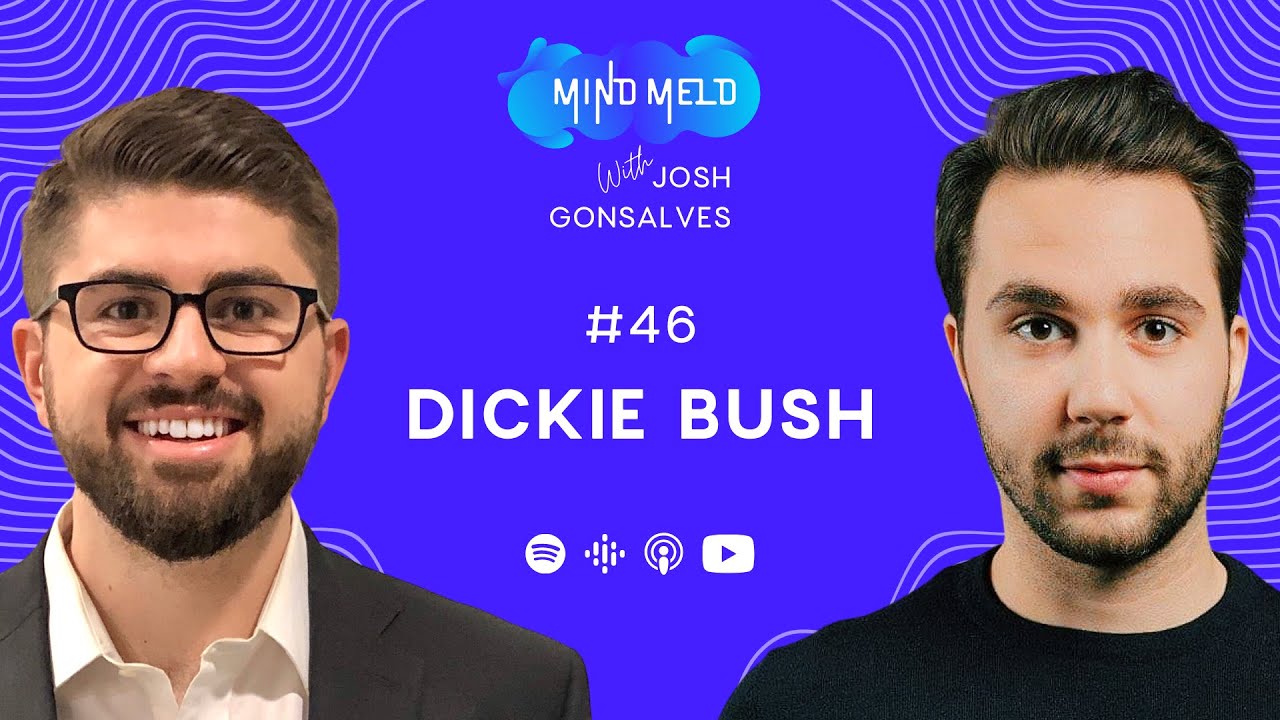
Compounding Your Knowledge and Credibility with Dickie Bush | Mind Meld Podcast #46


Dickie Bush on Princeton Football & Personal Growth | The Danny Miranda Podcast #021