Running an Internet Business with Dickie Bush

In this Gumroad Podcast episode, host Justin Michaelay interviews creator Dickie Bush about how he turned a personal habit of curating podcasts and writing Twitter threads into a thriving internet business, Ship 30 for 30. Dickie recounts his early experiments— a weekly newsletter, a paid podcast‑curation product on Gumroad, and a 30‑day Twitter‑thread challenge— that led to the first cohort‑based writing course. He explains the core mechanics of Ship 30: daily writing practice, accountability via a Slack community, a low‑price entry fee with a money‑back guarantee, and the development of “Atomic Essays” as a repeatable content format. The conversation dives into how he built credibility by either borrowing authority from well‑known experts or delivering ultra‑specific, niche advice, and how that “credibility barbell” fuels audience growth. Dickie shares the operational challenges of scaling a cohort (onboarding, support, process documentation) and the importance of focusing on community over platform infrastructure. He outlines his “2‑year test” learning framework, his disciplined information‑diet using tools like Mailbrew, Instapaper, Readwise, and Roam, and how a high‑quality information pipeline amplifies output. The interview also touches on balancing a full‑time portfolio‑manager job with the side‑hustle, the concept of “full‑stack communication” across writing, audio, video, and visuals, and future product ideas such as a free ultimate guide, a membership for post‑Ship 30 writers, and a course on turning writing into a sellable product. Throughout, Dickie emphasizes intentional consumption, concise communication, and iterative documentation as the backbone of his business growth.
Chapters
I think of my podcast feed as one of my greatest assets, where for some podcast to make its way onto that, it's— I'm, I'm going to listen to it if it shows up there, more than likely. Right. So I have to be very intentional about that. The blogs, the people I follow on Twitter, you're, you're basically letting other people program your mind.
Hello everyone, and welcome to the Gumroad Podcast. I'm your host, Justin Michaelay, a senior writer at Gumroad, where I deconstruct the tactics, strategies, and processes of top creators. Each week on the podcast, I interview creators and digital entrepreneurs who are at the top of their field. On this week's episode, I interviewed Dickie Bush, creator of the massively successful online writing community Ship 30 for 30. This is a companion episode to my season 1, episode 8 conversation with Dickie's business partner, Nicholas Cole. Rather than talk about the mechanics of online writing, Dickie and I explored how to start and build an internet business and how he's packaging together his growing expertise into products he can give away for free and sell online. This was just a terrific conversation. Enjoy. Our guest today is Dickie Bush. Dickie, thank you for being here.
Hey, thanks for having me, Justin. And real quick, I just want to say very rarely does a new podcast jump straight into my listening routine. And I have to say this one did right away. So props to you for what you've put together very quickly with the Gumroad Pod. I've enjoyed quite a few episodes so far.
Thank you. It's really a testament to the whole team. I have a great set of colleagues led by Sahil at Gumroad. I work with Kyle Prinsloo, who's the head of marketing, and Alex Garcia, who is a force of nature like you on Twitter and a terrific writer and a terrific thread writer in particular. You have a knack for writing threads on Twitter. I reviewed them this morning and you have something like at least 10 that have more than 2,000 likes or something like that. So kudos to you, Dickie.
Hey, I appreciate it. Yeah. And that's a stellar lineup of people too. So thanks.
Great. Well, we have a lot to talk about and we could cover everything from writing online to digital leverage, something that you write a lot about. I've noticed that you don't shy away from the idea of stealing from the greats or studying the greats or curating the greats. And one of the things that I have really enjoyed about you is that you go back in time You read some of the best writers and copywriters in particular. And then, you know, one of your threads says, I studied 500 hours how to write and copyright from various of the icons in the industry, say for the past 50 or 100 years. And one of the things that you did to get started online was to curate podcasts. And I believe you sold a product related to that. So maybe tell us about how you did that. And then as a companion idea, I think you push back against the notion that businesses or employers and universities, colleges, and schools are any good at teaching us any of these skills. And in fact, what we should do in today's day and age is learn ourselves, teach ourselves since the information is so abundant.
Yeah. So I guess there's a lot there. What's cool about the podcast idea is it's really how I started doing anything online. So I came into 2020 looking to share some more of the ideas that I was listening to. I found myself every single week studying and reading and listening to all these things, but feel like I wasn't actually making progress on anything. Wasn't that, you know, I take notes and they'd end up in the back of a Notion folder for months and there was really no action. So I started a weekly newsletter. where all I did was kind of summarize whatever I read, listened to, et cetera, for the week. And I did that for about 7, 8 months. It was kind of just passive. It was fun. I committed to doing it for a full year and I got to around, I guess it was July, August of 2020 and said, well, what can I do with everything I've started to listen to and put together? And was just exploring all the different ways people were doing things online and So I started writing Twitter threads summarizing the podcasts that I was listening to. It was just a nice forcing function that made me better understand what I was listening to each week. I'd have takeaways, and then there was the free upside of whoever was on the podcast would share it or thank me or whatever. And that led to, I put about 40 of them out there and I did it every day for 30 days. And that was really the genesis of Ship 30 that I'm sure we'll talk about. But Yeah, my first really dollar on the internet was selling podcast curation on Gumroad, which was, here's the 50 that I've really, really enjoyed. Here's the 5 biggest takeaways from them. This will save you countless hours. So that was definitely the beginning of the journey, which really has been a journey to say the least over the last year and change.
Yeah. One of the things that you embody is the idea of simply documenting the things that you're learning. So for example, Your most successful thread ever was, it started something like, Twitter's the most powerful platform in the world if you know how to use it correctly. And by the way, that particular phraseology has been stolen from you many times over.
Quite a few. Yeah, it's about every tool out there now has a thread on it, which is pretty funny, but they're all super helpful. So credit to those guys.
Yeah, exactly. And that thread was just so well done because you simply Stated in plain English the 10 or maybe a half dozen, or rather 18 or so of the things that you'd learned and applied, how to use Twitter itself. And you have a ready audience if you're gonna teach people on Twitter how to use Twitter better.
Oh yeah, that, that was again, a lot of, I'd say 95% of the threads I write are me trying to share something that has become obvious that I've internalized or learned over the last year. So I mean, I spend way too much time on Twitter, so knowing the advanced features was pretty easy, but that stemmed from me writing one time just a single tweet that was like, here's how to use advanced search. And people were like, oh my goodness, that's the craziest thing I've ever seen. So I said, clearly there's a market here for this. And so threw it all together.
Yeah. Well, I want to frame our conversation today This should be a companion piece to your business partner and co-confidant, if you will, on Ship 30 and Write the Ship, Nicholas Cole, who goes by Cole. We've interviewed him on this podcast. We talked a lot about writing as a craft. In terms of architecting this conversation, you're clearly talented, although you did study math and computer science at our fellow alma mater. And not English per se or writing. But you both can, you're sort of a double threat. You both can write and you've scaled and built Ship 30 into a juggernaut and a functional business that has cohorts monthly with a very strong revenue stream, a strong community built around it. So I thought we would focus on Once you catch lightning in a bottle, as you did, and this was not something that came out of nowhere, it was an object of your own creation. But once you sort of capture that, how do you then build an internet business around it? So for context, for everyone who might be listening and not familiar with your story, you did reference the origins of Ship 30. So please connect what you said before to the actual project And business that you're building?
Sure. So for anyone unfamiliar, Ship 30 for 30 is a cohort-based course teaching you the fundamentals of digital writing. But instead of kind of some other courses out there, instead of learning passively, you put your learnings into practice by writing every day for 30 days. And that really started back— I actually just got the email from Namecheap that said the domain It's set to expire in 30 days. So that actually, that hit my inbox yesterday. So it's been 11 months since the initial idea, or really, you know, the beginning of an idea is always when you buy the domain. So that was right at the beginning. And I had written 30 Twitter threads in 30 days on 30 podcasts that I had listened to, and that accelerated my following. I was just waking up excited every day to write and think and explore. I was attracting a bunch of people that were interested in the same things as me, and I got to experience just this personal acceleration that came with writing every day. And on the back of that, I'd built a small following on Twitter, and so I threw it out there. I think it was the end of October. I just said, hey, would anyone like to join a group that holds you accountable to write and publish every day for 30 days? That's it. And, you know, I sent it as a one-off, kind of came to me on a walk, and I threw it out there, and the response was overwhelming. I mean, there were so many people. There was clearly a problem here of, I want to write, I know I should write, I'm kind of dancing around the idea of becoming a writer, but there's no accountability. So in true internet fashion, I moved as quickly as possible, spun up a Notion page, a Typeform, and I had so many emails after the first day that I said, okay, well, this can't be free. So the very first one was $50 and you got your money back if you finished all 30 days. So about a week later, we had 60 or 70 people on a Slack channel and we were off and running. And really the last 10, 11 months has been iterating on that idea of there's a lot of people out there who want to start writing and don't know how to get started. And Ship 30 is positioned as the way to start writing online.
Yeah. And you share at this point, you have a corpus of frameworks and you're building content behind the scenes around it, codifying all the things that you're learning. You do share, I believe, a free digital handbook at this point. None of that existed prior to you going live. However, you did quickly develop a template, a framework, through which to publish via the Atomic Essays. Was that something that was an outgrowth of your first cohort, your first monthly cohort? And did you coin that term? And was it based on Atomic Habits, for example?
So that came from— there was kind of a popular format around that time of a screenshot essay where people were writing it. It it in one screenshot. It was a novel way of putting something on Twitter. And I kind of backed it out and said, it's really atomic in the sense that it's a building block for a lot of other things. And so people were expressing these short essays with just a single idea. You don't have room on Twitter to publish, even if you publish it as an image, anything very long. I think 200, 250 words is kind of the limit we put it at for for Ship 30 members. And so Atomic Habits had an influence on me. There's probably something in there, but it was more that it was a building block where we say that your 30 days of content that you put together during Ship 30 serves as a foundation for months or years of future writing. And so in that sense, it's atomic because you're going to remix and rematch for a long time.
And I imagine you advise Folks, and many of the people who join Ship 30, I believe, already have some expertise. They potentially have not shared a lot online quite yet. Something is holding them back potentially, or they're quite experienced and they need to sort of reinvigorate the habit of hitting the publish button and so forth. And the point I'm trying to get to is Your two-pronged approach, the thing that you have emphasized online in recent days about establishing some credibility. And you can do that either through curating experts like you did initially, or saying something, what you say, ultra-specific. So why is it that those two things are helpful to establish that credibility online and potentially build your following?
Yeah, this was So I posted this thread, I guess it was yesterday, and it was clarifying almost my playbook and journey over the last year of how I went and have become a somewhat credible source in the writing space. And that really started as, okay, I knew I wanted to learn something. It was to better communicate, whether that was through copywriting or just general writing principles. And this idea that in the beginning, the big mistake a lot of beginner writers make is they say, I want to write about productivity tips. And so they start writing blog posts on their own blog that no one's going to read, no one's going to navigate to. And they give what I call commodity advice. It's, here's how the Pomodoro technique works. Here's how the Eisenhower Matrix works. And all those things are great, But a reader comes across their profile and asks a single question: Why should I care what you have to say? And if you don't have any credibility, whether it's external, like a large number of followers, or a large amount of posts that show you've kind of put in the work to get here, people are not going to pay attention. And you can either think that's unfair or accept that. And so instead, Instead, you need to build credibility. And there's only really 2 ways to build credibility in the beginning. It's borrowing it from a bunch of experts or saying something so specific that you're the only person that could be credible on that topic. So what do I mean? In the productivity space, and I'll give you some examples from this thread, maybe we'll link to it in the show notes, right? Instead of saying, here's what the Eisenhower Matrix is. You say, here's how 10 billionaires use the Eisenhower Matrix. And so if someone comes across that and they have no clue who you are, they can then look at it and say, I don't know who this writer is, but I know who Elon Musk is. I respect him. I should probably read this because he's doing something right. And so that is borrowed credibility. Now, if you— and you do a tremendous job of this as well, Justin, of curating and Where your point of differentiation becomes, I'm curating experts and I do it in such a potent way and cut out all the fluff that people come to me as a trusted curation source. And so you build credibility points that way that compounds over time. So that's one side of the barbell. The other side is the specificity barbell where you are going to position yourself as saying something so specific that You're not competing with anyone. And Naval says that you escape competition through authenticity, right? And so the example I use in this thread is instead of saying what the Eisenhower Matrix is, you say how to use the Eisenhower Matrix for middle market SaaS portfolio managers. And hint, hint here, you are a middle market SaaS, so you have credibility there. And then you say something so specific that 99.999% of people come across it and say, That's not for me. And that's exactly what should happen. But for the very, very specific few who say, wow, I'm the middle market SaaS PM, I should probably read this and learn from it. You're going to build extreme credibility with that group. And that compounds over time. You can branch out from other topics they'd be interested in. You have a feedback loop of people actually reading. So you kind of strike this balance where you're attracting a general audience interested in productivity and a niche audience interested in productivity through a specific lens, and that you kind of have this spectrum, and that's where you get the ball rolling.
Yeah. Let me take what you just said a step further, and I want to use what you just said as a Trojan horse into the castle of Ship 30. You're the captain of the ship, or rather, let's storm the Ship 30, a pirate ship, And less than a year ago you said, hey, would anybody be interested in joining me in writing daily online and so forth? And you just spoke with great confidence and authority as if you're the coach of or the captain of the ship. So from that time 11 months ago when you launched to today, you've learned a lot. You've coached a lot of people along, but you didn't start doing that. You've adopted the role of the Ship 30 So how have you scaled yourself with the business? And sort of when you first set out to have one cohort, how did that develop into a sort of a more systematic one-person independent internet business?
Okay. So a couple things there. The first is when you talk about something and you immerse yourself in something for 11 months, You are going to develop a little bit of a confidence. Now, I would not have just been able to give that rant on how to build credibility as a beginner when I was a beginner. So I talk a lot about this concept I call the 2-year test, where a lot of what you write online should be either something you want to better understand in 2 years, So I want to learn about Web3. I think it's going to be huge in 2 years. I'm going to start studying and writing it so I can think about it better. That's what I did initially with writing. I wanted to get better at it, so I'm going to ironically write about it. Then you have another thing where instead of what you want to learn in 2 years, it's what have I learned over the last 2 years? What have I solved? What problems have I solved? for myself. And the internet guarantees that there are millions of other people behind you on that journey, just 2 years behind you. So to me, it was the last year has been— in the beginning of Ship 30, it was, I know how to get started writing. That was my very specific problem that Ship 30 solved. In the last year, I'd figured out how to get started. And so all I did was share how to get started. And then over time, I've kind of moved myself across this bridge of I've learned more of, you know, I have more experience. So I can't remember the really initial question that you asked there, but it's more learning things that have become obvious to you and sharing them. And for me, I've just been immersed in it now where I can sound a bit more credible given I have done nothing but that for a while.
Yeah. Let me get more concrete and sort of drill down on the question that I originally asked, which is you confronted a series of problems, most likely or ostensibly, in the first several months as you had hundreds of people wanting to get on the ship with you and you couldn't necessarily onboard all of them at the same time. Or scale it infinitely as you would want. You hadn't productized anything. For example, this was a live cohort. It was a temporal program that you're running once a month and your revenue shot from zero to whatever it was, 5 figures at minimum early on per month, and then scaled from there. So concretely, what were the things that were sticking points that you've had to overcome in those initial months? For example, just the administrative bureaucratic burden of onboarding people, communicating with people, setting up the Slack. I think people who are listening to this will face a similar set of problems as they gain traction. So let's give them a roadmap.
Sure. So I'll start with the first one, and this actually goes back to your interview with Cole, where I recognized very quickly the limits of my own expertise. And in January, we had a— January was the first cohort that cost anything and that you didn't get the money back. And I think it was $99 and we had something like 100 people, something like that. And I quickly recognized that these people were paying me to teach them to write. And I had limited— I mean, I'd only been doing it a year and all I really understood was how to build a writing habit. And so Cole was part of that cohort and was the very first Office Hours guest. And it was just a match made in heaven of, he had this amazing— and to this day, I learn from Cole every single day about writing. I mean, every framework that I talk about is somehow derived from something he's implanted into my brain. So very early on, it was, if I'm going to scale this thing at all, I need to have someone next to me who's better at articulating these principles and talking about them and has far more than a 2-year test's worth of experience. He's been writing since 2014 on the internet. So that was number one, was saying, where are the limitations of what I can do? And then secondly, it was building processes around identifying the things that wouldn't scale. So right now, or I guess going back to then, there are some things that you can scale very easily with a course. You can have more people come in and consume the content and join the community, and all that is going to take care of itself, right? There's no limitation on the number of people that can consume an online course or join a Slack channel, whatever that limit is. But the things that don't scale are customer support emails. Or refund requests or anything that is very personal, circumstantial. And so you have to start building processes around that. I will say before, most people get way too caught up in the infrastructure. They think, oh, do I need Circle or Slack or Discord, or where do I host this? And to me, that is all procrastination. And you've kind of convinced yourself that that's the thing you need to be focusing on. If you have a high-quality community, people very excited, and you're delivering high-quality content, you could host it on Facebook groups and it would do just fine. So I'd say spend a little bit less time worrying about your infrastructure and more on your community and the course itself. One of the, you know, I'm just kind of going here, but one of our underlying principles is just enable. So enable anyone in the community to interact with one another, to get the most out of it, to get out of it what they need, whether that's they show up every single day and love it, or they come and take one lesson, that one lesson has a golden nugget, and then they're off and running. So that's one thing we focus on. And then on the logistics side, you're going to have to scale yourself with some kind of support. So I've, I've, we have 2 contractors who are incredible. They have really just created a seamless experience. There's no shortage of ship metaphors and nautical references with Ship 30. They keep the ship sailing for sure and just do a tremendous job where they have created systems that just make things run very smoothly. So I'd say start documenting those processes early because if you run a cohort or anything that is somewhat recurring, You're gonna have to do it again. And so start early there. Don't worry too much about the infrastructure and look to scale yourself with some support.
One of our core principles at Gumroad is to help creators make a living, earn a living, earn a side income doing what they love. And you seem to be really enjoying what you're doing. It seems like you didn't set out intentionally a year ago to teach others how to write online, but you did talk about one of your core principles. enabling others. I would love to hear you reflect on whether or not you've taken the time over the past year to look from a 30,000-foot level and to distill some of those core principles of how you're running your business and how you're building your community.
It's on the agenda because really the last 10 months have been a sprint. We haven't taken more than 3 weeks between each cohort yet. But we're currently week 2 of the October cohort. That one will end in the middle of November, and that will give us until January 1st, where we'll have a big kickoff for 2022. So I hope to spend some time during the holiday season and some of that quiet time putting together really everything we've learned about running a course, logistics, backend, How to create a thriving community, mistakes, lessons, all of that. It's all sitting there. It's been swirling around. I have this one long document where I'm just kind of dumping ideas right now, but I hope to kind of put together some kind of pillar post that says, look, from challenge concept idea to 3,000 students in a year, like here's every mistake I've made because I've made just about every single one there is. Here's some things that have worked. Here's some things I think you could skip entirely. So I do hope to put that together. And this goes back to really the just 2-year test, kind of solving problems as you go. Now I'm going to put together a document that I wish I had back in November of last year, where if I could distill everything I've learned and hand it to my year-ago self, then hopefully everyone else on that same part of their journey can pick it up and find it useful as well.
Yeah, presumably you're going to package that all together in some elegant way and share most of the learnings for free via Threads and, and that sort of thing. What people, I think, pay for a lot of times when they buy Gumroad products is the packaging itself. A lot of this information is readily available, it's just very hard to curate. It's very hard to get in one coherent package. How do you plan to present all of these learnings both on the free side and maybe via a paid product?
Yeah, I haven't really formalized our ideas around it. My thought is that I'm going to just give it away as some kind of ultimate guide blog post and probably capture emails with it. So I know people that are very interested in creating courses, I'm just going to give them a ton of free value and say, here it is, kind of nicely packaged. We'll probably do something We have a follow-up membership to Ship 30 where people who build their writing habit then want to go and do other things and explore writing on Medium or copywriting, ghostwriting, those kind of things. And there's a lot of people who want to build a course. So we might build a cohort-based course around that of people who want to take their writing and package it up into a course specifically. And they'll be both the writing side of that, but then the marketing and the infrastructure and all that. So haven't really formalized it. It's all kind of just an idea sitting out there right now, but I think there'll be something there.
Let me ask a follow-up question. You're not the first guest here. In fact, you're the second guest in a row on the Gumroad Podcast who has a full-time job. You're a portfolio manager. Our guest last week was Ev Chapman. She's a professional marketer. I think it would surprise people to learn about the fact that you do analyze numbers, interact intimately with spreadsheets and so forth during your day job. And yet you've built all of this wonderful infrastructure, the community, and a very successful cohort-based course on evenings and weekends. Would love to hear you talk about how you think about that. Over the past year and then maybe how you conceive of it moving forward.
For me, I've always been someone who thrived with multiple things going on at the same time. So, I like to say I'm kind of a liquid takes the shape of its container, where if I give myself enough, it's Parkinson's Law, I'll get it done somehow. I played football in college and always found that I was a better student in season than out of season. Because when you had practice and lifts and meals and trainings and meetings and all that alongside school, you found the time to do it all. But in the spring, I'd have no practice or whatever it would be, and I'd find myself with too much time. So a little bit of just, I like to keep myself busy and have something going on. But the other part, and the reason I think I've been able to do both very sustainably, is because they're separate ways of thinking. where it doesn't feel like I'm doing additional work. And I advise anyone that is starting some kind of side hustle or weekend project, it has to be something that doesn't feel like additional work for you. And that's the only way to do it sustainably. If I would, if I tried to do something in the markets space, you can't spend 16 hours a day doing that, but you can spend 16 hours a day doing 8 hours on 2 things. I think when it doesn't feel like work doing either of them because I enjoy both of them. So for me, I have no intention to really make any big decisions or anything because I wake up every day and it's like, wow, I get to do 2 incredibly fun things that I enjoy. They're separate ways of thinking. I get to flex both sides of my brain. I get to wear different hats in both of them. So for me, it's find those things that just bring you more energy to do. And I think any side hustle should be complementary and not something that becomes additional work whatsoever.
Yeah. I have a question that we might use to sum up our conversation, but it's a fulsome question. So it's not one of these rhetorical or yes/no questions. I'm genuinely interested in your answer to it. And it strikes at the heart of what you're teaching online, which is writing. I have a thesis that, in today's day and age, it's not merely writing effectively, writing clearly, quickly, and well, as they say online, that's going to accelerate your career solely. But, in fact, it's the idea of communicating well, communicating effectively online. That implies much more than just writing, much more than just prose. The theory is that you should communicate effectively through audio like we're doing now. I.e., extemporaneous conversation, communicate well via video, communicate well through images and visualizations. Those who are able to package all of that together will accelerate their career faster than those who just know how to write well, for example. There are people like you. There are people like David Perell and many others who are teaching effective daily writing habits, note-taking systems, and the like. But then there's people like Jack Butcher who embody the idea of communicating through visuals. I would love to hear you talk about whether or not you'll broaden the offering of Ship 30 to some of these other aspects in the long run, cultivating a daily writing habit or cultivating an effective communication habit through all of these different media types.
Well, Now that I'm thinking about it like that, that's a very cool way of putting it where I do think that writing is a foundation for a lot of these, where if you want to start a podcast or you want to start a YouTube channel, more than likely you're going to have to write scripts. But the visual side is also extremely interesting. I think this full-stack communication platform where it's really writing, storytelling, visualizing, speaking, all of that. I need to either write that down or kind of journal on that one a little bit because that's a very cool idea. I do think the people who are hitting on all these mediums, I like to think that there is a proper creative medium for just about every idea out there. So whether that is a newsletter or tweets or atomic essays or Twitter threads or blog posts or YouTube videos or podcasts, Having that full suite of potential creative outlets, I think, is something that enables your mind to come up with a ton of ideas where you're not limited by, oh, I'm not going to think about that idea because I couldn't write 1,000 words on it, or I'm only writing tweets, so I can't think of anything that requires nuance, or I can't think of something that requires texture of a visual because I can't visualize anything. So I really like that idea. And I think almost the full-stack communicator is going to be able to use all these proper, all these mediums creatively at the same time in some way and just be everywhere at once, right? If you are using all of these, if you can make both a 20,000-word in-depth ultimate guide blog post and a 6-second TikTok, you're unstoppable, right? Both from a marketing perspective, from a personal perspective. So I really like that idea and I need to think about it more.
Yeah, I say that because I have sort of a complementary or corollary thesis that for independent creators like yourself, that the necessity to communicate well in all of those different mediums I think is self-evident. But I think that's also true in your full-time job. I imagine that your ability to communicate internal to your company requires you to drop, you know, on Slack a little Loom video or a clip, an audio clip to your team, that sort of a thing, rather than just, hey, here's a bulletized list of everything I'm thinking about.
Oh, I mean, Once you learn how to write effective headlines for articles or write effective tweets, you'll stop putting an email subject line that says some quick thoughts or some thoughts. It'll be 3 quick thoughts on this opportunity so we can unlock this benefit, right? It's all the same. This is all writing on the internet, writing tweets, writing Slack messages, creating loot. Like, this is all about concise, Communication in a way that doesn't waste people's time. That's all we're getting at here is if it— concise communicating well means you're getting your point across without wasting anyone's time. You're saying as little as needs to be possible. And some people don't like that idea. Some people think, oh, prose and flowery, and maybe that's for you, but that's not for anyone who's looking to accelerate output in some way. Right? So I think that's a great point too, is And I've found this in my own writing, both internally, externally, right? You start to value other people's time, you are going to, whether that's a Slack message or an email or an essay. So I like that idea as well.
I have a final question for you, and it's one that I ask many, if not all, I try to, of the Gumroad Podcast guests, and that is your information diet. And this gets to, you know, Some people struggle with, oh, I have nothing to say, or I don't know which topics I'm interested in that would lend themselves to be attractive to an audience or to readers. So it's sort of a two-pronged chicken and egg question. It's like, how do you consume information? And then how do you use that consumption, which is, I would assume, somewhat meticulous or at least has a degree of choosiness? about it, selectivity, to drive you towards creating content that people want?
I think the amount of time you invest in your information diet will be one of the biggest personal differentiators over the next 2 to 5 years, where there is more high-quality information out there and more infrastructure to have that information served to you passively than ever before. Where this idea I think about a lot is kind of the internet benefit spectrum, where pretty much everything you do falls somewhere on the internet is helping you or it's hurting you. And for a lot of people, their information diet is either extremely poor because of the internet, or extremely high quality because of the internet. And it's those that invest the time in curating their Twitter feeds and finding interesting blogs and using the tools that are out there and saving notes from all these places that are seeing all the benefit. And then it's the people who are beholden and enslaved to the algorithm and only being served what they think should be served to them that end up doom scrolling and arguing and what have you. So it's actually something I'm working on of, I want to codify the way I approach information. I use tools like Mailbrew that serve through Twitter lists and blogs and newsletters and send me daily emails that allow me, and I pick areas of my life that I'm interested in. So that's both just internet creator in general, market stuff, health and wellness where I have these feeds. And I try to just consume intentionally. And my goal is to create and hire internet robots all over the place to just ping me with good information. And that's, I think, one of— it's just the highest leverage investment you can make is if you sit down and it's like bang, bang, bang, here's interesting things. Your output is purely a function of that input. And so for me, that's, I'll take notes. Like I have kind of a basic setup with Instapaper and Readwise will sync notes into my journal in Roam and all that. But I, I think people get caught up in that system, just like they get caught up in course infrastructure systems where really it's just, if you're reading, the, the potent ideas are gonna stick. And part of The human brain and its ability to forget things is a feature, not a bug, where the salient things are going to bubble up. And if you're consuming enough good stuff, you're going to latch onto the very good things. And it's kind of, you don't want to capture every single thing because then you're just overloaded. But yeah, I think that it's a long-winded way of saying you should spend hours of time seriously looking at what am I reading every single day? What am I listening to? I mean, I think of my podcast feed as one of my greatest assets where for some podcast to make its way onto that, I'm going to listen to it if it shows up there more than likely, right? So I have to be very intentional about that. The blogs, the people I follow on Twitter, you're basically letting other people program your mind. And when you realize that, you kind of think a lot differently about who you're following, what you're reading. And all that. So I think it— I can't understate how important I think it is. And I think in the next 6 to 12 months, I'm going to have some kind of product or guide on using all these tools to just deliver that information to you.
I'm going to hold you to that. And it elicits, it evokes the old Navalism of if code scripts machines, media scripts humans.
It does. And once you recognize, like, think of all the thoughts you've had today, they're downstream from something you've consumed earlier, right? Which is wild to think about, but you can either use, like, you can use that to your advantage. That's the coolest part is you can program your mind with high-quality things or you can doom scroll, right? Anything that— there's the spectrum and people think that it's all bad, bad, bad, but I mean, There's clearly, I think, the paradox that right now there's more extremely healthy people than ever before and there's more extremely unhealthy people as ever before, right? So clearly, this amount of abundance means people are either using it to their advantage or using it to their disadvantage. And I think that's just about everything.
Yeah. One of the things that you never shy away from And in fact, some of your best content, or at least content that has gone viral temporally, is not new. For example, you've researched people that have put down in writing and preserved for future generations what they've learned about advertising or copywriting from 50 years ago. So part of it is choosing an information diet that might not necessarily suffer from recency bias. But rather looks broadly across the temporal spectrum.
Yeah, I mean, there's a bunch of them. Nick de Wilde, or de Wilde, I don't know exactly how to pronounce it, but has a tremendous article. Maybe we can link to it called The T-Shaped Information Diet. And it's all about striking a balance on the spectrum of Lindy to it's been around for 1,000 years versus very new, very specific versus very broad. Common popular authors versus niche authors, all those. And so everything you consume should be on some kind of— you just want to hit all those points. And if you do it right, it's truly a multiplier on whatever it is you're doing.
Well, we will link to that. And I greatly appreciate your time in joining us here on the podcast. I would summarize by saying I'm looking forward to what you're going to produce in the next 90 to 120 days related to your learnings from cohort-based courses. I would love to see you put together something related to your information diet. So there's 2 products right there in addition to sailing the ship 30 for 30 forward. Thanks for being here. Really appreciate it.
Hey, Justin, thanks for having me. And I love what you're doing here. I'm looking forward to both every episode you have on the docket as well, because I'm sure this one continues to be One of the best.
Thanks, Dickie. Talk to you soon.
Cool. Take it easy.
More from Dickie



Dan Koe & Dickie Bush On One-Person Businesses, Creative Workflows, and Lifestyle Design
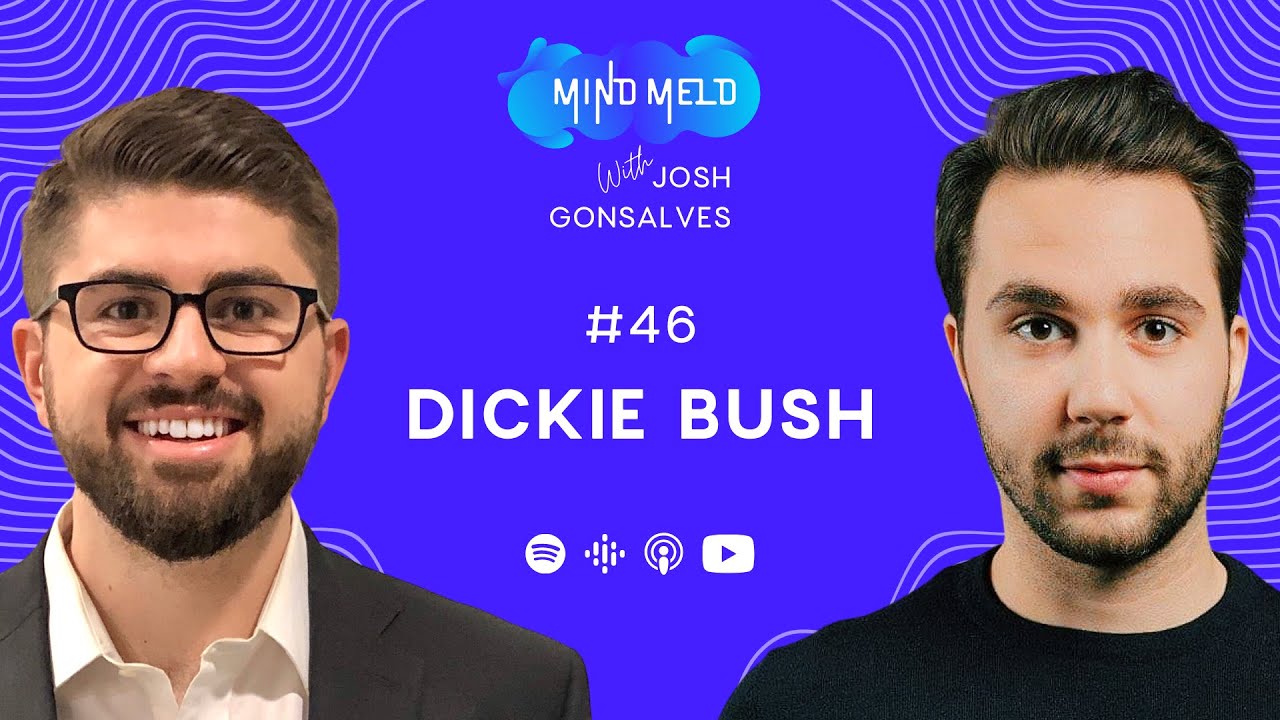
Compounding Your Knowledge and Credibility with Dickie Bush | Mind Meld Podcast #46
Dickie Bush on Princeton Football & Personal Growth | The Danny Miranda Podcast #021