Lecțiile unui Maestru Shaolin: Cum să-ți controlezi viața | BOABE DE CUNOAȘTERE | cu Shi Heng Yi
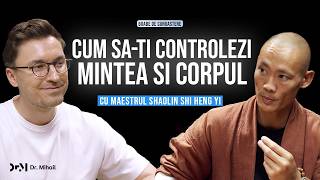
A full-length interview with Shaolin master Shi Heng Yi (host Mihail Pautov) exploring how Shaolin training shapes character, presence and life-balance. Key themes: confronting fear and uncertainty by leaving the comfort zone; discipline and habit formation starting in childhood (Shi Heng Yi began training at age 4); linking body care and internal refinement (physical training, breath work/qigong, meditation) as a path to mental clarity and reduced attachment; practical ways for non-monastics to integrate the teaching (start with regular physical activity, small steps out of comfort, 80/20 chase vs. inner work); monastery programs and daily structure (guest weeks and discipleship up to multi-year training, sample daily schedule with wake/meditation/meals/training/ceremony); advice on diet (primarily vegetarian in the monastery), sleep (recovery quality over hours), wearables (useful but don’t outsource sensitivity), and a balanced, non‑doctrinaire stance toward modern tech and culture.
Chapters
Are you living your life based on fear or not? Fear is restricting you. To discover you need to go into the uncertainty.
How can you approach this pain and this empty space?
Do you have patience? Do you have discipline? Do you have willpower?
We always want more and more. I get what I want and I still want more. That doesn't satisfy me.
Your satisfaction about life, is it based on a condition or not? God is not putting you in this earth incomplete. Take care of the body, refine the body and at the same time you refine the mind. The more you think you are perfect, the less you're going to change. There is no progress. There is no development without restriction. Just feel free without any touch of restriction. I don't think this is the way how a human in this world is learning to grow.
What is the Shaolin approach to such young kids? Studieri practice interaction. Monastic buddhism situate germania. The inner mapping inside. My interest to Lord Constant Pentroaches de Merc Educative Credit Bank Master hello and thank you so much for coming here to this podcast. That's a surprise. How do you. Did you. Did you learn Romanian now? Before coming?
Not before coming, but I spent some years. I have a good connection actually to clu.
Okay.
And in the past years I had some period where I also stayed in the city for a few years and there I just catched up, let's say what was necessary. So I understand a little bit.
Okay. That's so great. That's such good news. I have a lot of questions, but I want to start with the beginning, with your childhood, when you were introduced to the Shaolin practices at the year, at the age of four, how was it for a five, for a four year old to be introduced to the Shaolin practices? How did that change you?
Well, let's put it really straight away like this. I grew up in an Asian family. You know, my parents, they came as refugees from Vietnam to Germany in 1979. And I also have like an older brother. And so growing up in an Asian family is very clear that whatever my father is saying, you just listen to.
Yeah.
So which means that at the age of four, when he decided he's putting me into a Shaolin school. So I had no choice in that sense. I just followed the instructions of my father. He said, go there, do the training. And so I went there, do the training. So I wouldn't really say that in the beginning it was my choice. For me, it was just starting as a hobby, starting just as a practice to use my body, not to sit around too much, using the body, using the energy that as a child, for example, you just have this type of energy, which means to children, there's not much talking necessary. They are not using the energy to process with the mind. This is what adults do with children. They are processing energy by moving. And so for me, growing up with this type of Shaolin practices, meaning kung fu, practicing kung fu, I just felt like it's good for me. On the one side the body gets strong, and on the other side, I just felt that to some extent it's a big contribution to the state of balance that at a later point in time became more and more important. What it means, what is it that needs to actually be balanced out about yourself?
What is the Shaolin approach to such young kids? Isn't it's anyhow constricting you from playing and doing what kids are doing?
No, it's. It really depends on how deep we are going to answer that type of question. So on the one side, of course, there is the freedom that a child is supposed to have, but that definition of freedom to do what you want at any time that you want, just feel free without any type of restriction. I don't think this is the way how a human in this world is learning to grow. So there is, for example, derived from the ancient teachings are saying that there is no progress, there is no development without restriction. And this means, for example, sometimes you need to have somebody telling you what you are supposed to do. Even if you feel like sleeping until like 10, 11 o', clock, well, it's not good to do. It's wake up, do your discipline, structure, and then learn first of all to just do things which are not based on your own sense of comfort. Let's call like this. But this sense of comfort is not helpful when it comes to developing yourself. So and in a way, now the Shaolin practices, especially when it comes to children, it is still a playful way. Because you're using the body, it's fun. At some point, it's still fun. You like to do the things. But at the same time, it's also a healthy way to also start to understand that this lifetime is not just about. Is not just about roses and butterflies. Sometimes you are meeting situations that you just have to face and that you have to go through, meaning you're going to meet conflict at one or another point. You're going to meet the feeling of having competition. And the martial art, the Shaolin practices, for example, I think is a very healthy way to already get used to if you fail at one competition, it doesn't mean that you're a bad person. It just means practice more. So these are all things where now when we talk about it already you see that it's not just the physicality that is so interesting about this tradition, about these practices. It is especially the question, how does all this physicality, all this practicing of using the body, how does it eventually translate into your mindset, translate into what type of character are you? Do you have patience? Do you have discipline? Do you have willpower? This is the question. Because, you know, when we go to school, for example, there are subjects that we are learning. Mathematics, biology, physics, chemistry, all of these things. These are subjects that we are learning. But every human being has something. We have something inside of us. Some people, you would say, they have discipline. Other people, they don't have it. Some people have gratefulness, other people don't have it. Some people have a natural sense of respect. Other people don't have it. So the question is, is it coincidence that you are born with respect or that you are born with discipline? Or is these character traits something that actually need to be and can be developed inside the human being? Because if you're disciplined, it doesn't matter what you do afterwards in your life. If you are disciplined, you're going to have this discipline because it's part of your character. You're going to carry it on for whatever you are doing. Going to school, going to university, having your first job, building up your own company, doesn't matter what it is. So this is that interesting part, which means what all of this Shaolin practices for me, the way how I am sharing it since years, what it is about, it is about figuring out what is the core of you as a human being that you can develop. And then afterwards, what you are doing with this core really doesn't matter. Some people make a professional life in sports. Other people make a profession by being a entrepreneur. Other people, they stay employed. Other people build houses, other people build cars. It doesn't really matter. The thing is that along the way of creating something in this lifetime, there are some helpful human character traits or mindsets that I think they need development. So, and the question is now, okay, how to develop them?
Can you still develop them when you're an adult and you realize you don't have discipline and you don't have the score characteristics you talked about?
So from my observation and also like sensing into myself, the more you're used or getting used to something, the more habits, actually you yourself are starting to Develop. So we humans are beings of habit. So the question is, if 20 years long you lived a type of life where there was not a lot of discipline involved, you can still develop it, of course, in the 21st years and onwards. But before that, we have to somehow balance out these 20 years of your habit of being un undisciplined. So what it means is the older you get, the more habits you already have, the more difficult it will become to change any of them. So this is why starting as early as possible is the easiest way to actually program yourself. Condition yourself in the right direction of what type of habits, what type of thinking patterns you would like to develop in yourself. But the other truth is also it depends on the openness of the mind. Eventually it depends everything on the openness of yourself. So if somebody is 50 years old, but he is still open to life, open to life means you actually realize about yourself that you know nothing about this lifetime. You have 50 years of human life. Yeah, but 50 years is 50 years. Yeah. So it really depends on how open are you staying throughout your journey in this lifetime. If you always take care of staying open, there is no limit in terms of how much and how much more are you able to develop yourself. The more limited, the more restricted, the more closed you are, the more you think you are perfect, the less you're going to change.
They call it my point of view.
Right.
You change the range of the possibilities to a single point of view in your life. You mean we don't need to be that sure that we know the answer and we know what we know and to be like to develop that curiosity that kids have, usually into learning and finding new stuff.
Yes. For example, now when you are mentioning already like that child mindset.
Yeah.
Okay. Now, sometimes when people are starting to study or starting to get involved into any type of ancient practices or ancient teachings, for example, like Buddhism, like Taoism, like Confucianism, just as an example, you know, these ancient philosophies were developed in a different culture. It's not the Western culture where all of these things were developed. So of course it means that the language, the words, the pictures that are being, let's say transmitted, are based on the culture for what it was developed for. So. And why I'm mentioning this is that here in the Western, very often you want proof and you want to have science as the one that is the truth. People believe numbers, people believe the science and all of this. And therefore, one very important thing, if you believe in science, then you maybe just listen, right? Now, what the scientists maybe say about their observations about this universe that we have right now, which means that all the matter, everything that we humans see, see the planets, the stars, the galaxies, what we see is 0.1% of what is there.
Yeah, that's true.
Okay, so what does it mean? It means 99.9% or let's say the majority of existence, you don't see.
Yeah.
So how can you as a human being say you know anything?
At least you can, you know what, what you know. I mean, I have this, I have this kind of questions and conversations with myself because I'm a scientist and it's very hard for me to go beyond the evidence based. I mean, the evidence base is something I can be sure about. The rest for me is like a dark forest. And I'm kind of afraid. I don't know what I can find there. And if what I find I can't interpret in the right way. And it seems dangerous for me as a scientist.
Okay. There is a time when the child is born. He has no words in his mind. He doesn't know anything. When the child looks at the tree. Looks at the tree. Now I said the word already, but when the child looks at that. Yeah, it's there. It's obvious there is something. But when does this something become a tree?
Well, say that when your mind starts to develop this pattern and when these tree fits in the pattern of the.
Tree, from where does he get the word tree? Okay, how does he know this is.
Well, he learns it from his parents.
Or before he get the information put in the mind of the child that this is a tree.
Yeah.
The child still looks at that, whatever it is.
Yeah.
It is only a tree because somebody is telling you it is a tree. Without somebody telling you a name for this, it is still there. It is out of doubt. It is in existence. It is not, let's say, an illusion. It's real. The difference right now is that everything that we start to like, learn in this lifetime from somewhere, we learn to label everything. Labeling. And this is the moment where the openness, the curiosity of whatever happened, whatever it is, it's just there it is. But this labeling of giving everything a name, this is the reason why things along the line get restricted because we start to think in categories. This is good, this is bad. Yeah, yeah. And it is useful, let's say, for communication amongst people. But on the other side, in another state of being, in another perspective of looking at this lifetime, sometimes it's really not necessary to use words because the Words, any words never describe what it is. It never describes what it is. Now, the only reason we call this one right now table, because it is commonly understood and defined as table. If right from the beginning we would have said this is not called table, it's called chair, then today we would call this chair. So it's not a table, it's not a chair. It is just something we label it as. What is it in essence?
Can you describe a situation where this kind of thinking can help you? Or when describing by words some things, we are limiting ourselves in understanding the world.
I try as good as I can to still that everybody who also listen right now can follow a little bit.
Yes.
Okay. So I said, in the moment, we are labeling something. Labeling, meaning you give something a word. So if I say look at the glass, we know where to look, because this one we have named glass. But why do you know where to look? It is because this glass at this very moment is something else than everything it's surrounded of. So by using words, what you are actually doing? What we are doing is we are separating. Every word is defining a form. It is defining a shape. In the moment, something has a form, something has a shape. There is something inside the form, there is something outside the form. You are separating. This existence is not separated. Yeah. Okay, now let me give you an example. For example, we are right now here in Clu. Napoca. I think like one 1pm noontime. If you look out right now, what do we have?
Sunlight.
Okay, actually I made a mistake telling you that's 1pm without the 1pm If I ask you around, what do we have right now?
If we look outside the building we are in.
No, right now. From your sense, do we have day or night?
Ah, well, if I. If I would not know the time, I would not. Could not tell if it's day or night.
Yeah. Okay. Even if we look right now out and you say it's day.
Yeah.
It is only day based on our perspective, because we are right now here in Europe. Yeah, but at exactly this point in time, it's day and night at the same time. On the perspective I'm talking about. It's just that we. It's day and night exist at the same time. This part of the globe we have day. Other part of the world, right now is night. At the same point in time, we have both. There is no chronology between now is day, later is night. Day and night exist, coexist at the same time. Right now we can sit here, we have. We call this life. We all wish that now we have life. We hope this life is going to be 70, 80, 90, maybe 100 years long. And after these 100 years, then death can come.
Yeah.
Death and life is not a chronology. Who gives you the guarantee? Not right now. No matter how healthy you're living, you get a heart attack right now. Where's the guarantee?
Well, I don't have one. It's one of my fears.
Yeah, me, I don't have it either. I don't have the guarantee. I don't know. Every morning if I wake up, death is not coming later. Life and death simultaneously at the same time. So using this type of perspective, success and failure. There is no successful person I know in this world that I would regard as successful who does not at the same time has failed success on this side and can prove to me on the other side all of the failures that eventually led to his success.
True.
So what it means is to live in a world where you think that we are living in a world which is about life, it is about light, it is about moving upwards, it is about successful, it is about beautiful, it is about higher, faster, better. This type of propaganda of making the human belief this life is one directional and that you can choose, I think is a misconception. And one day I feel the very hard reality is going to come. And the reality is that this one and this one, losing, failure, letting go, dying, getting sick, it is a part of every human being's lifetime. But now, just looking at the world, what is it that is propagated? Where is all the energy of the human being going? It only goes in this direction because it feels comfortable. Security, insecurity is nothing, uncertainty is nothing that you feel comfortable with to deal deal with it. Well, what I'm saying is this and that they belong together. There is no way out. And the earlier you start to realize this, the more real your view about this existence, about your life becomes. And, and what it means is you start to appreciate way more what you have right now. Instead of running around, starting to chase some things over and over again to afterwards realize, you come alone, you go alone. Very simple. Yeah. And so these are all these implications that again, you see, we talk a lot about mindset, it's all about mind. This is the essence of the Shaolin practices, not to forget. This is the essence. This is where all of the beautiful forms, the hardening, the fighting aspect of it, the combat aspect of it, where at the end all of it boils down to the point how much have you understood about your Life during this. Yeah. This lifetime that you have available. That is the core.
How can normal people that don't have the time to go to the Shaolin temple and to practice a lot, how can they start to integrate this. This philosophy in their lives? Because the truth is that we always want more and more. Let me not talk about others. I want more. I want more money. I want more knowledge. I want more sports. I want more friends, more holidays, more success. And I feel why I want more, because I feel more. Valuable this way. When I get more and when I get what I want, I still want more. And I know it's not the healthy path. Yeah, I know it's. It's not going anywhere. I get what I want and I still want more. That doesn't satisfy me. What can I do to find this harmony? Because by the other side, I'm afraid that if I will not work more, if I will not have more vlogs and TV shows and stuff like that, I feel that I. I'm afraid that I'm going to lose stuff, I'm going to miss stuff. So I keep going that direction, although I know it's not the healthy one. What. How can I bring back the harmony while still serving my, let's say, my purpose in life?
Okay, there are, like a lot of things right now. So number one that starting, you know, when we started the conversation that I hear is you mentioned the word fear. Yeah, fear and also uncertainty. Yes. These two things are the biggest challenges every human being is going to face. The question is, are you living your life based on fear or not? And this fear, let's. Let's put it like this, is not helpful because it restricts you. It restricts your ability to, let's call it to expand the mind. Fear is restricting you to discover because fear makes you to stay inside, let's say, the comfort zone. But why do we call something the comfort zone? It's because we have spent so many time already inside that zone that we know you know everything about it inside there already. You have seen it. You have experienced all of it. That's why everything has become comfortable to you. So as long as you're comfortable, it means you are not leaving the things that you know. This existence is too big. It's 0.1% of knowing. It's 99% of not knowing. If you want to discover what is the 99.9%, it means you need to leave the space of knowing. You need to leave the space of comfort. You need to go into the uncertainty and this is that fearful part. And people, the more fearful you are, the, the more you're going to stay where you are, the less fearful you are, the more you're going to expend, the more you're going to discover. So now the question is, how can I now learn to face your fear and to, let's say to face it? And there again. I think the Shaolin practices is one of these ways. Like I said in the beginning, it starts with the fact of you have competition sometimes there when you're still young, facing other ones in competition. After all, the Shaolin Kung fu is still a martial art. Meaning you're also using the things together with another partner or do any type of sparring, meaning even if you have gloves on, but you are standing there and are still willing to actually right now try out how good is the things that you have learned and how much pain can you take. So facing pain is also something that goes along the way of practicing the Shaolin martial arts. Now to just give you an example right now, if I'm telling you, okay, let's make together, I don't know, 50 push ups, maybe you can do 50, but 200 you cannot make right now. So the question right now is how can you move up from making 50 push ups up to 200? It means that at the 50s push up even if you're struggling, even if it hurts, even if the muscles are burning, you need to learn to unlock that last power that you have and push through the pain and make at least the 51 push up. This is the way how skills, how abilities start to grow inside of us and in the same way how the body is growing in the same way. Also I think it is in regards to the mind. You don't have to jump right away into the darkness. This is. Not many people can do this, but realizing, okay, this is right now my comfort zone. And tomorrow I'm already trying one thing that is just new to me. I feel, it still feels uncomfortable to me. But okay, let's try just one step out, next day, another step out. Meaning integrate the jump into the uncertainty into your lifetime until it becomes a habit. Yeah, this is the one way that means how to develop that ability to go against the fear. This is one thing. And now the second part is, and I think this is now very useful for, for everyone. If you have, if you have the wrong image about yourself on this earth, if you are viewing yourself like from a wrong perspective, then it just means you will never get into the understanding what type of potential you are actually possessing.
What do you mean? You have a wrong image of yourself. Can you give an example?
Yes. Somebody who has never practiced martial arts. If that person looks into the mirror, he will say, this is me. I have this black hair, I have this eyes, I have these lips, I have this skin color. This is the very first view when you start practicing the martial arts. It goes hand in hand at some point that you see, okay, but inside of that back of skin, there's more. You have a skeletal structure. You have muscles, you have tendons, you have organs. You have a whole system of, I don't know how you call it, lymphatic system. You have, according to ancient tradition, you have an energy system you can go even smaller into. All of our organs are made out of molecules. The molecules of atoms and the atoms of proton, neutron, electron. The point is, you're becoming more and more fine, more and more refined about. There is much more about us. Because in the moment where you realize that back of skin has more on the inside, it also increases right now, your ability. If you say health is important to me, well, then it's not enough to just like use cream on your skin. That is taking care outside. If you know there is more inside, then it means whatever you eat, whatever you do, whatever you're drinking, how does it affect what is inside of you? So all these practices, what does it do? It makes you become more refined about yourself. Your layer of. When you look at yourself, when you sense into yourself, you feel more what you are. And still we're talking right now all about physicality. But at the same time, just like in the psychosomatic relation, your mind is unhealthy directed, so the body can have an effect. So Shaolin tradition, or this approach is exactly the other way around. Take care of the body, refine the body. And at the same time, you refine the mind, the more fine you become about the mind. And why is the mind so important? Because I think, no, it's not. I think, but it matters. If you wake up in the morning, what are you thinking when you wake up in the morning? And if you already wake up with conflict in the mind, wake up with unsatisfaction inside the mind, wake up with a feeling of, lack of, I wake up, I have to do something quickly because I don't have it right now, whatever it is. So running after something, this is where it is already. So the point is, why do we chase? Why do you chase anything? It is because you're in a state of lack. Something's missing. If you would have it, why would you chase it?
Yeah.
And now the question is, where does this lack come from? And now come back to the child. The child, the incarnated soul, the incarnated spirit. When it comes to the earth, whoever made it possible for that child to come, you can call it God, you can call it the nature, you can call it the universe. No matter what, this force, this power does not make mistakes. God is not putting you in this earth incomplete. Why would he do that? What he's putting on the earth is existence. He's granting us existence.
Yeah.
And afterwards it starts that we have concepts, we start thinking, we start having ideas about how this life is supposed to be. If you're not successful, it's not a life. If you don't have many cars, it's not alive. If you don't have many friends, it's not alive. Well, no. This is all human ideas. You came to the earth right from the beginning. You have been complete. This is the alternative. And this is what let's say at the moment I would say is just guiding to rethink. So what is the next way of what can people do? Rethink your life. Look at how is your life looking at the moment? How did you spend the last five years, 10 years? And then also do you maybe see some patterns in your life? I tell you one pattern everybody has. I have. I had it too. We all have it. Because it's normal. There was a time we didn't even have any mobile phone. Then like the first Nokias came out in different type of shapes and forms. And okay, eventually you even got one. We're happy about it. Then the next generation of phones came out and this one was okay, it's old already. You wanted the next one. So then you got the iPhone, then you got the iPad, then you got the MacBook Pro. Then you got your hyphae station. Then you got the big TV screen. Then the first car you had was a Volkswagen. Then afterwards you had a BMW. Meanwhile you can afford like Mercedes. A Porsche is also on top. A Lamborghini is on top, a Bugatti is on top. But there is a pattern behind there. Whenever you get what you want, you will realize that's not it. And so the question is, when do you start to realize the pattern that running after desires is not going to fulfill your desire?
I know that, I feel that. But I still run after desires. I have like desires. And I want to have a Porsche, I want to have a bigger house. I know this won't fulfill me, but I feel this world I live in is like screaming at us. That's that this is the only way. The world right now is so good on comparing us, right? I mean, maybe 20 years ago we didn't have social media. You don't know how many friends have each one. Now you can see gold social media. You see how many followers you have. Like it is. It becomes the competition that I feels is sucking all the energy from us and getting us apart from that, that human being that you become when, when. When you're born and when you're complete. So how to. I mean, I feel like we are in a, in a loop that is sucking this energy from us. How can you get out without losing your purpose in life?
Let's say this is where it comes from. What you need is realization. What you need is wake up. This is where all these terms are coming, coming from and also really important. Followers are not friends. Followers are followers. They follow you. As long as the image that you represent fits to some way of thinking of the ones that follow you. Yeah, I wouldn't give anything about followers. There is a circle of very, very close friends of life. And they don't care if there are ups and downs. These are the ones who stay on their side. So this is like the other truth. So quantity itself determines nothing. It only determines and is a proof maybe that at the moment the way of what you are sharing with the world, many people are resonating with it, which is a good thing. Then at the same time, also to take that misunderstanding away, I grant you the Porsche. I grant you a big house. Yeah, it's all nice and I mean if you can afford it, it's absolutely something. I mean, why not The German technology and possibilities that meanwhile is able to do is like pretty awesome. The only thing is ask yourself your satisfaction about life. Is it based on a condition or not? Because this is what now I would see right now everything that at the moment you want to have. You say you know already. But what I'm saying is always when you say I need this in order to feel complete, I want this in order to feel complete. Then it means your life, your satisfaction about life is based on conditions. As long as I have many followers, I'm happy. As long as I have a family, I'm happy. As long as I have the car and the big house, I'm happy. The fact is you do not have a guarantee, you do not have a security that at any point in time you gonna lose these things. First of all latest. When the body falls apart, you're going to lose them anyway. But even before that, just look out in the world. When we had, for example, the restrictions coming because of the COVID What can you do as an individual if the government decides Finished. No more podcasts, no more going out, no more meeting friends. Stay at home. Yeah, and you had a lifestyle. Every day you go out meeting friends, every day you drive around, every day you are outside. But now, because of whatever, you are forced to stay in that restriction. What is going to happen to your life satisfaction? The more you were con, the more it was based on the condition of life needs to look like this, the more we will suffer.
That's probably one of the reasons why a lot of people develop depression right during the lockdown.
I think it goes both ways. Many develop depression and many started waking up realizing I cannot base my life on circumstances where I don't have influence on. And this is exactly what this life is about. Don't base your life satisfaction on circumstances where you have no influence on. If you have, well then change them in the way that serve you. But there are many things we don't have. And to already right now, like realizing I cannot as a small citizen, I cannot to have no influence on whatever the politicians are going to throw out there. No way. And then it starts that you are realizing your life is in your hands. Your responsibility is make sure that inside you are always full or that you are feeling full. No matter what happens on the outside, nobody can take something away from you. Because the gift that has been given to you is the existence is this lifetime in the first place. We already have been given the greatest gift of everything existence. Now don't let anybody interfere trying to take that away from you. So that means don't outsource the power of having your hands, of having your life in your own hands. Don't outsource this to external circumstances. Don't outsource it to the amount of messages you receive per day. Don't outsource it to the number of followers. Don't outsource it to how big the apartment is, how many cars you have. If you can afford it, do it. Just don't make that emotional and mental attachment. This is the part. It's not about how many cars you have. You can have a whole garage full with all the luxury cars. That's not a problem. The problem is how much are you identified with your possessions. The identification is the problem. To have a garage full and just use them and enjoy them. And when you drive and the weather is nice, then it's really nice. But then you put it back into the garage. You go eat your meal, and while you are eating, the car is gone. You're not thinking about the car anymore. It's gone. It's standing in the garage, finished. Now you just enjoy the meal. Attachment is the problem. Yeah. So, and this is all I would say it is a process. It is of rewiring. How have you lived your life until right now? How much did it serve you the way of thinking until now? And how much also did it limit you? These are all things every individual has to ask for themselves. And this is why. This is why. Also now, for example, whatever conference I go to, I always say, I have nothing to give to the people. I'm not giving you anything right now. I'm just saying something, which is, let's say, my view. And you have to ask yourself, what is it from what you have heard until right now that in a way resonates with you? You observe this pattern in your own life, and ultimately the only person who can do something about it, it's not me. You make the decision. Your life is in your hands. The only thing that I'm doing is, if at all, I'm taking something away. I'm taking away misconceptions and illusions that people might have in this lifetime if they didn't have the possibility to. To hear other perspectives. So, and because the Shaolin tradition or the way how I grow up is a very different way of life, this is maybe why this understanding of, okay, you can use the body to get to the mind, and then once you are at the mind, what is it that you can actually observe about yourself? What type of questions can you ask yourself? This is then where people realize, oh, okay, so there are other people in this world. They have grown up differently and they ask themselves different questions, but we all live the same life. So which way is the right way? The Western approach or the Eastern approach? No, listen to all of them and then individually choose what is working for you and what not.
Yeah. I have so many things to say. First of all, this podcast is called, which means seeds of Knowledge. So you basically give us some seeds of knowledge. They can grow in a fertile soil or they cannot. But, yeah, you share the seeds of knowledge. And thank you for doing so. I love the way that having properties and being competitive does not necessarily negatively impact your fullness. Right. But you need to be sure that this is not like you're not filling your. Your gaps with these properties. You first have to be full inside.
And.
Where can we start? Say that somebody realizes that he is using these external conditions to feel good inside. How can you start? Because I think the more you're in that situation, it becomes more painful to look inside and to see how empty you are. Dominica dos e choctombria and caravanzo some doi super invitates. Professor Investitar Andre mio de la clu. Valerie. How can you approach this pain and this empty space? Where. Where do you have to start?
This is exactly the approach how you learn to face the pain. Use the body. So what is the very first thing anybody in the world is supposed to do? If you look at your life and realize that in the last seven days you are only sitting or lying is not enough. It's unbalanced. No matter what it is, that person is going to be unbalanced for sure. So this is why any type of physical activity doesn't need to be Shaolin Kung Fu. Any type of physicality needs to be inside the way of life of a normal human being.
You mean any sports like.
So sport is already good, ultimately, meaning take care of the body. Because, you know, there is a nice saying. As long as your body is healthy, you have thousands of problems. Yeah. But in the moment your body gets sick, you have one problem.
That's really true. Yeah, that. Yeah, that's true.
Okay, so this is. That's why. I mean, first of all, before, like tackling everything, so how to build up your life and how to whatever do, make sure your body stays healthy. If the body is not healthy, you don't need to worry about anything else. So respect, take care and love your body. Nourish your body. Nourish yourself in such a way that you understand it's something right now very, very precious to have. Okay. This is number one. Okay. Okay. Now, of course there is a difference probably what type of sport you are doing. But I can only talk about, let's say the Shaolin way, the Shaolin practices. And what is so special about them is that they are not based only on, like, external practices. Yeah. In the Shaolin way, sometimes you have just positions. You're just standing but is not moving. But just because the body is not moving doesn't mean you are not training something. Doesn't mean you are not doing something. It's just not visible on the outside. Yeah. That's why we call it. It's internal training. Internal training, meaning for just as an example, feeling how much tension do you carry inside of your body? You know, if somebody like stay like this, you can see I have tension, but then I relax the shoulder. Okay, now looks better. But that's just the outside layer. The question is inside your organs, everything inside. How much tension do you carry there? So this is also a way. What is happening in all of these martial art practices? Meaning you become more fine than even about your body. And the more fine you become about the body, the more access you have to it. And because you become so fine, the mind becomes so fine, it becomes more subtle to the changes that are happening inside our lifetime. And then what do you do with that ability of you sense like the subtle changes? It is like you have a way better possibility right now to really fine tune your life. Yeah. You realize. Oh no, that that frequency doesn't sound right. A little now it's okay. Yeah. So it has something to do with how fine are you to adjust your life. It's like you're a busy man, you have a hobby, you have a profession, you have the podcast. Maybe you have a girlfriend, maybe you have children. The more you have, the more aware you need to become. How do all of these areas actually interfere to your overall feeling? And if one of these things like needs more attention, you need to be able to sense this. If another is like too much, then you need to take a little. So it's always a type of balancing. The more areas in life you have, the more detailed, the more fine you have to become to balance all of this out. You spend too much with podcast and with work and with, I know, with your hobbies. Well, your relationship won't be happy. It's just going to be like this. But you give all energy only into the relationship. Well, you're going to be unhappy because all the other things that are also important to you don't have enough energy. So it's a very fine line sometimes to really figure out how to adjust. And that means to be able to really sense, sometimes really sense the presence of the other person. Which means just because somebody talks to you and smiles in your face doesn't mean the energy is right. Yeah, but exactly already with this word, when I say energy, it's sometimes strange to people. They say, oh, it's esoteric. What do you mean by energy? But you know, it's very simple. People can laugh in your face, but you feel is not real. People can just sit there and you can feel their suffering. People can sit there and pretend to smile, but you can feel they're angry. This is what I in a simple way say beyond what we see obviously there is another area that gives you more and more real actually information than the obvious. What you think you see. Smiling doesn't mean friendly. What energy is behind there. And this also means the refinement of you sensing also sings.
And it comes with a healthy body.
It is the starting point. Healthy body first. Then you integrate the practices more into your daily life. And this refinement, like I said in the Shaolin arts, also like in the Tai Chi chan systems, there you have a lot of this type of what I call refining the body. Yeah, you refine the body automatically. You are refining the mind. And this is where nowadays I think it's such a great help actually, that it just looks like a martial art. It just looks like you do sport, but with the right mindset in the combination of what you are doing and what mindset you have is a very, very powerful tool to combine two things, body and mind in the same practice. In the same practice. Body and mind. Yes. And translated into your inside world together with the outside world. So at the moment, people are chasing, chasing, chasing, which is not wrong. Yeah. But now instead of having a hundred percent of only chasing, do 80% chasing and 20% look inside, adjust what look, if you cannot face yourself 100%, face yourself 20%. When you are comfortable with 20% looking inside, move it up 50%, you do internal work about yourself, about your mindset, about your feelings, about your expectations, about the perspectives, how you're looking into the world. And 50% you invest in building something up on the outside. Now we're already at 50, 50, and from there on your decision, how you continue. Some people go 100% inside and outside, do nothing anymore. But it's also for me, for me personally, also not the way how I am at the moment, working. Now, this is the reason why I also like accepted in a way to come to this podcast, because I just think it's a very, very good way to get this type of knowledge out. So I regard this also as my contribution in a way, with all the practices that I had before to now, I think there is something that can help people just by listening to it. That's why I do it. Yeah. But on the other side, when podcast and all the events are finished, then I'm by myself, all alone. I'm very happy to be alone. I have no problem with that at all. And then go into my internal practices, refine myself and actually working on myself. So working on yourself on the one side and then with everything that you have discovered, give it out. Do something, contribute to this globe. Contribute something in this earth. This is my balance that makes me feel very, very comfortable.
What are you doing when you're alone?
It's mainly training. Training or also really sensing inside. Where are the gaps? So just really sitting there and asking myself what is the reason at the moment I don't enjoy this life. What is missing? Yeah. What's the reason right now for you to be unhappy about this life? Simple question like this, this is something.
That everyone can do, right?
Yeah. Not can do, only probably should do. Because if you don't ask this question, the answers most probably cannot come.
So you just sit and you ask yourself, what? What? Why don't you like what? Why don't you like your life right now?
Yeah.
What is the gap?
What is missing in my life? Yeah. What do you think you still need? Does it really make sense imagining you would have already what you are wishing for? How would it change you right now? No, let's put it simple like this. Outside I have at the moment, maybe I have my Porsche standing. Now just imagine instead of the Porsche outside, this time it's a Bugatti standing both of the Majorca. How does it change you sitting here? Nothing. Nothing? Yeah. Only when you sit inside then there is a difference. But for right now there are many things on the outside, they don't matter. What matters is how do you feel right now? This is what matters. So there is something simple about it. No, the problem many times in nowadays world is that you are not here. You cannot just be alone with yourself either. When you're alone, either you're drifting off into the past about what everything went wrong in the past, or you're drifting off into what you still want to see and have in the future. So this projection either into the future or the memories into the past, both of these things is what makes you suffer. We can sit right now over here and think about what happened last week and then maybe it makes us angry. Or we can sit right now here and we look into next week. Oh no, financial department is going to come. Yeah, and also makes you suffer again. But right now, right now there is no reason to suffer. I don't suffer.
Neuroscience calls that predictions. So basically our brain is a predictions machine. It predicts all the time. Even when you don't think about things, it predicts things like what would happen if it's going to be an earthquake. What is the roots out here, even if you don't think about that. So I think that like this is, and we analyze the past to learn from that. So probably these are good tools, but they are not good when we just do that. Right? And because this brain, this machine is, it is made to analyze the past and to make predictions for the future. It is so hard to stay in the present.
Right?
So how can, how can we stay in the present?
So I think we, we can also say that the mind, or what we refer as the mind is something very, very powerful, is something very intelligent. It is something very, very powerful because it is so powerful. It is also that element about you which can make you suffer a lot or which can make you flourish also a lot. It's the same mind that created the atom bomb, and it is the same mind that created all the technological developments that we have nowadays. So we can create something with the mind or we can destroy something with the mind. We can use the mind to really use it and benefit our well being, but we can also use the mind to destroy our well being. So the question is, how do you use the mind in the proper way? This is like one question. So, and how now to make better use of the mind or better use of the presence? This is the point where now it comes to all different types of practices that are existing in this world. Like focus on the breath, do your internal work, focus on the movement, focus on the sound. Everything that brings you into the presence. This one doesn't happen in the past. Yeah, there's nothing more real, there's nothing more direct, nothing more present than something like this. And so to remind yourself, also again to identify, okay, I'm drifting off right now, come back. Because also when you do breathing methods, when I inhale and let's say I feel this stream of air that goes in. Also in the moment where your mind is locked on the breath. So you follow the line as good as you can. This can only happen in the present. You cannot feel the breath of the past. There is no breath of the past. There is no inhalation of the future. Whatever you are sensing, when you follow the stream of the breath, it's the presence. The breath never happens in the past and it never happens in the future. It's that direct experience. So that means it doesn't matter. Eventually, what is it that you are, let's say, locking your mind on, as long as it is something that happens in the presence. And this is where all these exercises are coming in. When I talk with you right now, I know what I talk. When I'm eating, I feel the sense of the food. When I'm sleeping, I'm really trying to enjoy the sense of body is resting, mind is resting. This is how sleep feels when I'm at a concert, listening to something. These are all type of practices. When I walk out in the street and the sun is shining on my face and the people are sitting there at the coffee and you hear they talking. But I, I walk and I feel. I sense this is the sunshine, this is the people talking, my feet are moving, I'm here, I know what I do, I know what I'm surrounded with. So being just very present, being very aware. Because without this awareness, it's like without this awareness you wouldn't even, or people maybe wouldn't even make a difference whether you sit in a Porsche or if you just like sit in a, in a Corvette. But if you are aware, you feel very, very clearly. A car that drives like this can only be a Porsche.
Yeah.
So awareness is key because without it there is no enjoyment. You don't make use of what you have. Awareness is what is like making it finally real for you. You worked so hard for it, now you have it. Enjoy it. But you can't enjoy it if all the time you think about like last week or if you think all the time about what happens in the future, enjoying what you have is. You arrive at exactly where you are right now with what you have. That's it. There is no wishing for something more of the future. And there's not wishing for something that wouldn't have happened of the past. No, you are in the presence. That's it. And the more you realize this about yourself, the more you integrate this just into your normal being, then it starts to shift, just bring more presence into the present.
How often we have to do that? I mean, are you always present or what percent of time you try to.
Be present at the moment? If I talk about myself, if I observe myself the most of the time, I would say I'm present and I'm realizing when I'm not. So the amount of being absent is what I realize when I'm absent. I realize it when I'm present. It's my normal state for other people, maybe it's the other way around. But this really depends on your personal relation and how much you practice. So eventually the thing is, the truth is you're always present. You just don't know about it. You just over, you're over. There's some layer on top of the presence which somehow makes you think you're not in the present. But we're always in the present. Just the realization that you are is not there because it is overlaid by thoughts. If you take the thoughts away, you will realize, oh, there it is.
That's so nice. Because this is a much easier approach for me at least to understand that present. I mean, I am present right now. I just don't realize. It's not something. That presence is something I have to achieve by big efforts. No, I'm just present. It's so nice. I'm present. I just have to realize that and get, get rid of, of the noise.
So, and this is exactly a very, very nice point where now you see, I call it only like this. Yes, but the one approach that we have at the moment in this world is in order for us to be full, to, to feel full, we need to attain something, we need to do something. You need to have your diploma, you need to have your job, you need to have money, you need to have the first car, you need to have. So that means this approach is about. You need. It's about, it's about doing. Yeah, but the realization that I was just telling you right now that you have yourself is. No, it's not about doing. It's there already. It's there already. It's just covered all the time. So this time it's not about adding something there. It's about this here must go, and that one must also. There it is. Nothing needs to be done. It is something we have to undo. This is the eastern approach.
Yeah. And I love the way you combine them because you don't say you don't have to do anything. I mean, you can still have, you can still do, but you have to realize that you already have what you need.
Right. It's the balance. It's the balance. So just right now, I think it's really helpful. Yeah. You know, you don't have to throw away everything that you have learned until right now in that sense. It's just that there are more perspectives that when you have access to both of these perspectives, just find out for yourself, sometimes this makes more sense. Sometimes this makes more sense. Well, important part is, as long as you have it, you can choose when to use it. But if you don't even have it, you can't use it. So what does it mean? Whatever there is to learn in this world, it's never wrong to learn it. You never know if you will need it one day. And then it's better to have than to need it is one way out of many that are existing. I can only, or I did talk only about this. My Whole life. Because I walk this way, it doesn't mean it's the only way. It's just because I walked it for so long. It is my understanding of, okay, how do this, these practices interfere or are connected with, with building up a life that you think is worth living. That's it. What is the Shaolin practices doing for me? Help me build up a life, a quality life. That's it. If you want to call like this, this is one of the main emphasis that I was putting in, always sharing these things out. But there are many ways. Yeah, so but ultimately it's the mind and yeah, it's just, you know, but in the field of martial arts, it's just in a way also like pretty attractive in terms of you make your body strong. You have, let's say, movements that on the one side also sometimes are quite aesthetic. And it's so nice and whole for me. So you. There's everything involved. There is diet involved, there is like structure involved. Like when would it be good to wake up, when is it good to go to sleep and all of these things. So it's a whole nice, let's say culture, tradition. This is what I find so nice about it that the search is over. You don't need to search for like. So like here I take this yoga practice and then from here I take the breathing exercises from here and from here I take like the dancing moves. And then you have like a mix up. Yeah, yeah, a mix up menu. But mix up menu maybe gives you the feeling of you have some freedom.
Yeah, yeah.
But structure gives you direction.
And you find destruction in a Shaolin school or temple, right?
Yes. Also depending on who's teaching it to you. But it's supposed to be like this. Yes.
Tell me about your temple. Can anyone attend that? Do you need. Is there an exam? How do you. If I want to come to your temple, what should I do?
So very simple. I started with this idea in 2011, 2010 as you mentioned. And already from the beginning it has always been my wish. And also the way of how I share the things to tell the people. Listen, you do not need to live inside the monastery to develop everything that I think is worth to be developed. You don't need to stay inside the monastery. But what is the special thing about the monastery? It means if you come, for example, to visit from Monday till Saturday for one week, everybody can come. Or sometimes we also have weekend programs. During this time you don't need to worry about where you sleep, what you eat and what you drink. Everything of this is taken care of. Your job in this week is only sleep, eat and train. After you train, you can rest. When you rest enough, you train again. So the main focus about why a monastery, it is in order to not waste your lifetime. Yeah. If you come, food is taken care of, everything is taken care of. Your focus is dive into the teaching. Completely dive into the teaching for, let's say in that week, one week long. And now just imagine somebody who spends their one year, two years, three years, four years, ten years. Ten years of every day looking inside yourself, sensing inside, feeling inside, refining yourself. Of course, somebody like this, when he then goes out, has a complete other sensation and perception of this life than a normal person. It is because of the time investment that has went in to. Yeah. To dive into these teachings. So this is the reason for me why monasteries make sense, that you have a place that is going to take care of you and you can just focus on all of these series, how to put them into practice. Okay. So and for all the world. Yes. There is the possibility that they can come for one week and just visit the temple and dive into for one week. All a weekend throughout the whole year. So we normally have a yearly program where you can just. It's a PDF file with all the dates when you can come. Yes. This is the way how we are set up in the monastery. And what you also find there, for example, is very strict and structured schedule. Okay. So there are fixed eating times, 8 o', clock, breakfast, 1pm is lunch, 6pm is dinner.
There's good times.
Yeah.
For the health.
Yeah, these are good times for the health. But in the beginning, together with that amount of training, what you also have, sometimes it's also difficult. Yeah. Meaning you eat at 8 o', clock, then you have training from 9 until 11. So when you finish the training, you're hungry already, but you need to wait until 1 o', clock, you cannot eat in between. So what it means. Yeah. Is yeah, but why can I not just go to the kitchen and eat when I'm hungry? Because this is your mind telling you. But there's something about you which is, let's say, stronger than the mind. The mind can be your friend and the mind can be your enemy. And if I'm telling you there are three times per day eating, that's it. In the first weeks, let's say when you would stay still, you're thinking about eating, you're hungry, all of this. But at some point you will have accepted it that. Okay, 8 o', clock, 1 o' clock, 6 o', clock, you're okay. And what does it mean now the real freedom has come. Now you're free. Because even if you're hungry and you say, next food is at 6 o' clock is no problem. I can wait. It's good. And that's true. Something else. Yeah, and you're free. Not free is. It's two o'. Clock. I'm already hungry four more hours. I need to eat something. I cannot wait until 6 o' clock anymore. This is not free. See, so this idea of what does freedom mean to you? Does it mean you can go to the kitchen anytime you want? No, that means you are slave to the mind. Free is no matter what the mind tell you. You can wait. I can wait. So, and this is where now you see that sometimes it's necessary to have this obvious structure and discipline on the one side. But why? Because it's. It's a helpful way to bring out that type of freedom that we say from our tradition. This is the freedom. It's also not the freedom in terms of. Yeah, yeah, Especially. Yeah, you walk through clues. Yeah. Many beautiful women, but at home you have like your own woman sitting already. Now you could say, well, it's a free world. We're all free. So my wife is at home, but actually I can still flirt around. This is a way of where you say, well, this is freedom. Yeah, but where does this type of freedom lead to? It's leading to suffering. Yeah, you're causing suffering by behaving this type of free. No, if you have one wife, you stay with that one wife. That's it.
And you're free from suffering. Right.
And you stay free from suffering. But if you're. But if somebody is tempted too much, if somebody cannot handle his temptation.
Yeah, he's not free.
No, he's enslaved by temptation. And at some point, this type of behavior is not just going to bring suffering to you, it also brings suffering to everyone that you are involving in. So this is where I say, what type of freedom are you talking about? And the freedom that eventually is going to get onto the costs or is causing suffering to you and other ones. This is not the freedom we want. It's the type of freedom that makes us be able to live together in a community way better. This is the way of freedom where I can let you live the life how you like to live it. And you let me live my life how I like to live it. I don't need to tell you your way is wrong. You should live like I do. No, this is not free. This is limited. This is thinking. You have the answers to the questions of the universe. Well, you don't. Just as like I don't have them. The only thing I'm sharing right now is my observation. I don't say it's right for anyone. I just say, until now, everything we talked about, it worked for me. If something is useful from what we have talked about and somebody tries it out and then realize, cool also works for me, I'm really happy about it. But if somebody says, well, this is not my way of living, I don't share this opinion. It's not a problem.
Yeah, well, at least I would really love right now to visit your Shaolin temple sometime. But so is it. You have programs that are available to everyone, right? Is there any test you make or you just subscribe and you go there?
Yeah, you subscribe, you go there. And then starting from day one, we're going to have a look at you physically and also like mentally where we, where we sense that you are standing. And based on that week, then you will get answers.
Okay. And you can stay for a week or more?
Well, normally the guests or the majority of people that are visiting us, it's a one week stay. Yeah, sometimes now during summertime or when there's Easter, it's possible to have like two weeks next to each other. Two weeks. Consecutive.
Yeah.
But then there is also a possibility, and this is what we call in our place, discipleship. That means you start on the 1st of January and stay the whole year, more or less, without leaving the monastery. One year you stay there.
Do you have your phone there you can communicate with other people?
Not at all times. Yeah, there are spaces when of course you can communicate, but the majority is really for one year. You are dedicating your lifetime that this is now the center of your activity. It is your center of being. So one year long, dive into all of this.
How do these people that go through this one year program, how their life changes? They go back to community?
Well, the one year is only the preparation year. Mostly they stay one year. Then after one year, you can actually already decide, is this a way of life for you? Yes or no? If you say yes, actually it's really nice. You extend a second year, two years of discipleship. If you have stayed already two years now afterwards you have the chance to extend another three years. So we have five years already. After these five years, actually, it's possible that you are starting to enter into, let's say the. The inner circle. The inner circle of our community, which means you're learning also things related to the martial arts and you just dive deeper because five years staying inside this mindset, in, inside this world, you get some deaths that you don't normally get when you just like from time to time get into these teachings. Yeah. And this is our way, this discipleship. And then afterwards, another three years of training people, this is our way right now how to make sure that all of these teachings doesn't get lost.
Yeah, that's so nice. And for, for the one week, I'm just curious, for the one week program, what you told me. Yeah, you eat 8, 11, no, 8, 1 and 6. Right. And what other things are people doing at what time you go to sleep?
Normally the day ends around, let's say 9:30. The day ends with the last final ceremony and it is possible at 10 o' clock to lay in the bed actually. Okay, so yeah, and besides that, besides the lunchtimes, there is quite intensive, like six hours of training which are then still spread throughout the day. Which can mean sometimes it's two hours in the morning, two hours afternoon, two hours evening, sometimes depending on our teacher, three hours session in the morning, three hours afternoon, finished. But so it's quite a lot of time, like I said, to try out all of this, what we refer as the Shaolin methods, the Shaolin arts, the Shaolin practices, this physicality merged together with the internal practices to get to the mind. Meditation practices, sitting meditation, walking meditation, all of these things included. Yeah.
Can you just describe your day like in the temple, what, what are you doing, what time you wake up, what, how you start your day, what you're thinking about.
Well, so the structure is normally 6 o' clock is wake up time, 7 o' clock is the sitting meditation, 8 o' clock is breakfast, 9 o', clock, like I said, 9 until 12 or sometimes 9 until 11 is like the first training session at 12. 12 noon is working time for one hour.
So walking, you walk.
Working, working. So working. So if there's something to do inside the monastery, cleaning the windows, cleaning the toilets, helping outside in the garden, sometimes we also then integrate the guests to help us with that. 1 o', clock lunch, after lunch, short break, 3 o' clock until 6 o' clock or 3 until 5 training time again, 6pm dinner. Then if it was only two hour session, 7 until 9, another training session or sometimes classes, philosophical classes, open talks, question and answers, 11 o', clock, 9 o', clock, evening ceremony and that's it, Monday till Friday.
That's a pretty Strict structure.
That's a pretty straight structure, which is happening every day in the monastery, but depending on, of course, how the schedule also of the individual there is. So meanwhile, look, right now, like I'm traveling here to Cluj, so this is not my schedule right now, obviously.
Tell me about the sleep. Is there any anything special you're doing? And are you just laying in the bed and in. In the bed and fall asleep?
So one thing I realized for myself is, is not the amount of time how much I spent lying horizontally, which matters. It's not the fact of lying, which matters, is the question of how much do you recover during that state. And that means recovery can only happen if there is no usage, let's say, of energy. It's like when we have our phones or you have the iPad, even if you plug it into electricity, but you still have a lot of programs running there still can mean that three hours later, nothing has changed in the amount of battery capacity. Yeah, okay, so that means being plugged in, but then at the same time having as inactive as possible, then it starts recovering. Yeah, so a similar like this, I think it refers to us humans as well. So that means what is it in the evening that is sucking energy most probably. Well, probably it's not moving, because this is what the body is supposed not to do. So staying still is the mind. Is the mind activity very much, which is sucking a lot of energy. Meaning, like you go to bed, you wake up in the morning, but still feel like very tired and not recovered. Well, it might be the reason that your brain, your mind is still too active in the evening. And this is again where it comes from to discover, okay, stop thinking too much of the past, stop dreaming too much about the future. Practice yourself, remain in the presence. So, and this also then translates afterwards into your quality of sleep. Because when you sleep, you sleep. When you eat, you eat, when you talk, you talk. When you work, you work. But nowadays people work and they think about eating, people eat and they think about sleeping, people sleep and they think about working. So there's something not aligned. See, so there is some. There is no synchronicity. You are here, but actually something else is there. And this is not how it's supposed to be. Being present means you sleep, you sleep, you talk, you talk, you eat, you eat, you walk, you walk, you drive, you drive, you listen, you listen. This is ultimately where all of this journey goes. And then the amount of sleep is not so important, but the recovery rate is very, very different.
How much sleep do you need? As Hours when you're, as you said, you sleep, you sleep when you rest properly.
Well, I'm happy if I have seven hours. When I have seven hours, I'm happier. Six hours is quite limit. So then six is really limit. I can maintain even five or six hours, but after like a few days, I feel it's not good to continue like this because then you're starting to really burn some energy which you cannot recover anymore. And this is also very interesting now when it comes to that word energy on the one side, and also how it is related to diet, breathing and lifestyle. So the quickest way of to, let's say, change something about the way, how you feel during the day, or about your energy state are these three things. Diet, breath, work and lifestyle. If you have good nutritious food, if your breathing apparatus is working properly, and if your lifestyle, let's say waking up at a certain time, going to bed early enough, having enough sleep, if you maintain all of these three things, chances are very, very good that your energy level is proper. Yeah. If the diet is not good, if your breath is not good, if your lifestyle is not good, still you are alive somehow. But the energy that is now being sucked out from you in order to make you still functioning, it is coming from something that we, let's say in the ancient tradition call it comes from your essence. The essence that in traditional Chinese medicine we regard as being stored in the kidneys. Yeah. So the kidney, which means ultimately to make it short, no good lifestyle, no good food, no good breath, life short, you die early.
Yeah, that's very simple.
Yeah, yeah. So that's it.
Yeah. Can you maybe. Can we go through them in short terms about you said diet, breathing and lifestyle? What, what diet do you practice and what do you recommend to people?
So I think it is a very individual choice. Yeah. Yes. Inside our monastery, we mainly eat or primarily it's vegetarian, not vegan. It's vegetarian.
So you eat eggs, for example.
Eggs. We eat milk products, we also have. Cheese is also not a problem for us. Yes, but a lot of vegetables, a lot of fruits. And let's put it like this in generally speaking, not so much dead products, not just like animal debt, but like bread. Bread is also, in a way, is debt. Yeah, you know, so. Or yeah. This is ultimately like, if you want to look for your. For the diet, how to, like adjust it, maybe beans, vegetables. There you see, it's still like, it's a plant, it's still alive. It still carries the energy of growth inside of it. This is a Little bit this idea. Yeah. But at the end, I really think it's a personal choice everybody has to make. That's why I normally never give any recommendation except for the one I just told you right now to really try, try things out. Anything that is in a way also artificially produced. Like sugar put into form.
You eat those?
Sometimes, but only if my mother gives it to me. But besides that, I normally like, don't eat sugar. Also chocolate. I am not a big chocolate friend. Okay. Yeah.
So what about the bread? How should we practice bread for health?
Okay. I think there is breath work, also known as qigong or a part of the so called qigong practice. Yeah, Qigong meaning energy work. Or sometimes also simply breath work. Because that word, qi energy, the breath is a form of energy. You stop the breath, life's finished. So therefore qigong also is involving different type of breathworks. Nowadays people already know very famous, very helpful. From Wim Hof. Yes. So he's for example, one pioneer in this type of area for sure. But also deriving many of the methods from Tibetian Buddhism where you have this type of tummo breathing, the so called fire breathing. But it's just one area. It just means there is so much that you can do with your breath. Your breath is not just about inhalation, exhalation. The question is how long can you inhale? How long can you exhale? You can inhale short, you can exhale short, you can inhale short, exhale fast, you can inhale fast, exhale short. So that means there are many things that you can first of all adjust with the breathing. And then it's also about capacity. So I can just inhale normally like. Or you really start to. To fill up the body. I'm not sure if it's going to be hearable later, but then it's like. Now it's full and then you exhale. Yeah. So that means also like the capacity that was so long, the volume of breath is another area that goes into the field of breath work. So just learning different ways. How can you use the breath to make it useful for you? And this is something also where you. Where we see in the field of martial arts, there is no way to make proper martial arts if you cannot adjust your breath. Yeah. Because it means, for example, in the moment where in the martial arts we have any type of forceful movement, if you want to have a forceful movement, you have to use the breath to support it. It's like when I inhale, fill myself up. So I cannot make. Something is not correct. There is the movement and the breath. It's the breath, the way of how you move it is one expression of how are you using the energy of the body. And this is where it also makes a lot of sense. Not just in the field of martial arts, but on a daily basis. Now that is breath and lifestyle. Of course it's just what we mentioned before in terms of charging or discharging. If the energy input is not able to recover your energy output, well then it only means that at some point people run into what is called burnout. So therefore what is it about the lifestyle? Don't waste more energy than you have.
What do you think about this kind of wearable devices? Because like I found about this energy my body has and how to, how to waste it or how to use it. Like using a watch like this. It's a watch that he, he kind of tells me what, what you, you told us. Right now I think it's better to have your own sensors, but it has a sensor that knows he feels how your body beats and based on that he can tell you how much you recover during the night. So I can have eight hours of sleep and have battery full of 40%. It's like your body energy battery. Or I can have a really restful sleep. When I meditate before the sleep, I sleep in a cold environment and I sleep for eight hours and I wake up and I have my energy at 80%, 90%. And also if I'm very stressed that day, I can waste my energy as you said, BY let's say 5, 6pm and then I'm on 0. And I feel that, that I use the energy that is not mine anymore. I use that core energy that should not be used. So how, how do you think, what do you think about these devices that we are wearing? By one hand they are helping us. Is there a risk to lose your own senses?
I think the risk is there, yeah. Of course the risk is there in the moment where you outsource your own sensitivity to something. Where I say, well, if you train enough, you also have that sense for yourself. But of course it also means you need to be able to have this time to invest first of all to have this sensitivity. Therefore I also think that all these tools are very useful. Yeah. On the one side to give you information that elsewise at the moment you wouldn't get at all. Yeah. But to also understand that tool is going to give you information. But now the question is what are you going to do with that information? Just possessing information changes Nothing. It's always about somebody gives you information, you receive information. And how do you translate this now into any type of action that changes something. So meaning wearing any tool every day getting information. But for you or in general, you just use it as okay, nice. 90 and 60 and 100. Good. And tomorrow you look at the numbers again and for you it's just like collecting numbers, but nothing you do about it then it doesn't make sense.
Yeah, and it's so strange that studies actually show that people that are wearing this kind of devices are not actually taking any action after that. I mean when they develop these devices they said, hey, if you can what. See how many steps you took into the day, that will motivate you to take action. And it helps me. But it seems in, in the studies that it doesn't help a lot of the people like the medium, they, they don't take any action.
Balance is the key. Just like in anything else that I guess we were talking about.
I can tell you how it helps me. Like I understood that I have to go to bed at 9pm that helps me a lot to sleep better. And I understood that I have to leave any party about two hours before I go to bed. So that makes it 7pm so therefore I go to no parties since I wear these devices. Tell me your, your, like this is my last questions. What's your, what's your feeling about the future? About the, about the direction which we, we, we are going with with the world, with all this tech, with AI, with social media that's isolating us. What's the direction we're going to? Is it optimistic? Is it pessimistic?
I think in, in all life cycles of every culture that ever lived on this planet. Now I have to mention probably people will misunderstand, but doesn't matter. I think this nature, this planet, everything about it can never be out of balance. The universe is never out of balance because the universe is simply not separated. Yeah, this is like the one statement. So even nowadays, if you have, or if we sense, oh, something is shifting, something is bad, there's too much technological development. Something is too, is too much being outsourced, that is the one thing. But because things are being obviously so much outsourced, there's so fast technological advancement away from, away from being human. This is why the force of other ones, in order to even more now push to the front again the realization of what you really are. This is also growing at the same time. So it is because of the technological advancement moving away from being A human. This is the reason why it's also connected to the fact of so many people right now having all these wake up calls, so many people getting interested into this type of topics. What can I do to not outsource my life to all this technology? So this comes up because of the technology. The faster it grows on the one side, the more and deeper the understanding also becomes to the inside. And the question simply is, on which side are you standing? Or maybe you don't even need a side to stand on because it's all connected. So it's neither optimistic, normal, nor is it pessimistic in my view. It is really just like it is a different experience that's going to come no matter in which way. It's a new experience that is just going to expand, expand the realization how much is possible in this world. You can go to the Mars on the one side and on the other side you can go into the deepest, deepest layers of what you find inside there, inside yourself. Both of these methods are existing nowadays.
Yeah. This is such a calming answer and perspective. Yeah, thank you for that. What would be your message to our audience on how to build a better, more harmonious life that is in tune with who they are?
I think it's really helpful to exactly ask this question. Is it possible that the way how I am looking right now into this lifetime, the challenges that I am facing at this point in time, could it be first of all that I created them myself? This is one question and second one is, is it also maybe showing up like this right now, everything because I was not skillful enough and haven't discovered yet what is my potential. Figuring out what is your potential. And second one is, see who is the one who created all of this? Who is the creator of all the suffering that you are having in your lifetime? I can give you the answer already right now as long as you point out what's there is wrong. I think this is a good starting point. Take your life in your own hands and from there it begins.
That's great. Thank you. Thank you so much for sharing all of these experiences. I really want to visit and maybe say a week in Shaolin monastery. I can't wait for this to happen.
You have to contact details anytime. Feel free to just contact us. No problem.
I'm going with your permission. I'm going to leave a link if you can share and a copy of this podcast. So yeah, thank you again so much for taking your time and to giving us the seeds of knowledge. And I hope all of this infos will help a lot of people to go more inside to find the presence and to ask these questions as a starting point. Thanks again for the Inner Mapping Insight event which we attend right now for making this happen. And yeah, thank you again. Thank you so much Master for all of this knowledge.
Thank you very much. You're welcome.
Goodbye.
More from Mihail


Tu știi câtă sare consumi zilnic? Te uiți vreodată la cantitatea de sare de pe eticheta alimentelor?


Cât de atent ești la schimbările care apar, la cum percepi mirosul sau sunetele? 👨🏼⚕️☝🏻

Tu cât timp petreci zilnic pe rețelele de socializare? Ai încercat să îți setezi limite?

