New Year New Restaurant Planning Workshop
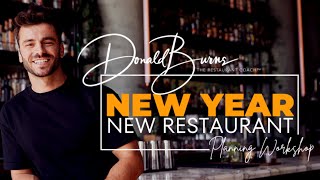
Donald Burns walks through his 3P framework (People, Product, Process) for restaurant planning. You get a one-page worksheet to calculate revenue from seat count and table turns, a SWOT playbook, and a daily planner for 2023 goals. The focus: culture, prime cost control, and raising your check average.
Questions this video answers
YouTube video uploaded January 6, 2023.
People, Product, Process (in that order).
Breakfast+Lunch or Lunch+Dinner: 3.5; Breakfast+Lunch+Dinner: 4.5 (speaker's sample coefficients).
Days open per year × number of seats × meal-service turn factor × guest-check average = theoretical potential revenue (speaker uses 52 weeks × days-per-week to get days-per-year).
Prime cost ≥65% = losing money; 60–65% = 'good' (0–6% profit); 55–60% = 'great' (7–15% profit); <55% = 'outstanding' (≈18%+ profit).
Chapters
Good morning. Happy Friday. Welcome to the New Year New Restaurant Planning Workshop. We got a lot of stuff to cover today, so please buckle up, buckle in. You're gonna need a lot of stuff today. I'm gonna start off with a worksheet you're gonna need and I'm gonna put it in the chat real quick. It is a Dropbox folder. It is the one page the New Year one, one New Year New Restaurant one page worksheet. You will need this because I will show you a copy of it also too. If you would like a copy of what I'm going to talk about today, just let me know. I can make sure you get some copies of this stuff. All right, let's get going. All of my coaching always follows what's known as the 3P framework. The 3P framework is everything. We always follow the 3P framework. I was introduced to the 3P framework back in the 90s when I had my first restaurant. Like a lot of people, I opened my first restaurant thinking that since I had experience and I was a chef for so many years, that opening and running a restaurant would be easy. Running the restaurant was easy, but building a brand and building a business was not easy. So I was very fortunate to hire a business coach. And my business coach actually introduced me to this process called the 3P framework. And it's always people, product process. Everything that we do, everything I coach is always on the 3P framework. It's always people product process. It's always in that order. The things we're going to talk about today, I'm going to be skipping around a little bit all over the 3P framework. But I want you to have this as a reference because it's a really great reference and it's something that I love to share with people. All my, all my coaching members, I tell them, you want to have a copy of this thing and you want to print it out and put it to where you can see it. Most of them have hard copies of it in the chat. I just put the two links for you. One is for the New year new restaurant one page worksheet. The other one is for a PDF copy of what you see right here as the 3P framework. This thing is solid gold. And once you understand it at a deep level, you can truly unlock restaurant success at a, at a capacity that you never thought was possible. It is the. Is how those big, huge, mega restaurant groups scale is because they follow the 3P framework. So today we're going to be going through quite a few little things we're going to be going through the first part as we're going to be going through this new year. New restaurant planning worksheet. Again, in the chat, I just put a Dropbox copy. You should have got a copy in an email sent to you as well, giving you access to download this thing right away. If you don't have a copy of it, it's okay. Don't worry. Don't freak out. We're just going to break it down into blocks. Just make sure you have a piece of paper and a pen so you can write stuff down. If we've never met before, my name is Donald Burns. I am the restaurant coach. I grew up in the restaurant business. My father was his chef. Like a lot of people, I started working in the restaurant at 15, washing dishes. Worked my way up the brigade when I was 18. My father told me it was in my blood. I said I wanted transfusion. I didn't want to do this. So I did what a lot of people do when they have a dominant male figure. I went off and joined the military and I went into the Air Force. I was very fortunate to get selected onto a special operations kind of team called Pararescue. After my four years in the Air Force, I went out, got out, went to college, started working in restaurants again. Found I really loved working in restaurants. Started working the right chefs, right places. Worked in Santa Fe for quite a few years, Taos, New Mexico, for quite a few years, and then opened my first restaurant at age 30. My second restaurant, age 33, sold both of those. Then got recruited by Wolfgang Puck. Worked for Wolfgang Puck for five years, went around opening restaurants for him. And then I decided that, you know what? I think I can help a lot more people by doing consulting work. And so 2005, started doing consulting. 2008, the economy crashed. I had to rebrand. So I hired a business coach again in 2008 to help me rebrand and refigure my business model, because the consulting model wasn't working anymore. And we started. He took me through this coaching process, and at the time, in 2008, I googled restaurant coach. No one was restaurant coaching. And I thought, this is a great idea. So 2009, I became the restaurant coach. And I've been doing restaurant coaching since 2009. I've been very, very blessed to have coached over 2400 restaurants right now. And if you don't know, you probably know I have a couple books out in the market. They're all Amazon bestsellers, which I'm very, very Fortunate for that, my first book, your restaurant sucks. My second book, your restaurant still sucks, and my third book just came out in August of 2022. It is called your Restaurant Culture Sucks. They're all available on Amazon paperbacks. You can get Kindle if you like the Kindle version. And also they also make them in hardcover, too. And the hardcover editions are really, really nice. I didn't really. I was kind of hesitant about when Amazon was going to put these books out as hardcovers. I decided to go for it, ordered some, you know, I put them out there, got them published, ordered a couple, and I was really, really happy by the way they turned out. It's been amazing, amazing, amazing. And I cannot say thank you enough for all the success of how all the books have been doing. They're also available in audio, too, on Audible. If you don't like to to read, you like to listen, though. All three books are available on Audible and on itunes, too. So let's go over the rules for today real quick. House Rules. Number one, have fun. Number two, take notes. Research has shown if you write stuff down your own handwriting, you're 70% more likely to remember the information 30 days from now. And that is my goal, is not just to educate you and give you some tools, but to actually give you a process where you can use these tools and you can apply them for the future. So retention is the key here. And you will hear me repeat stuff a lot. I tend to be a broken record because repetition is the mother of learning. So I tend to say things over and over again. And you will probably get to the point where, oh my God, is he going to say that, that line again? Yes, I'm going to say it over and over and over again because I want you to take this information, I want you to apply it. Everything I'm going to talk about today is just potential. It's like a hammer on the table. A hammer on the table is just really potential. It's not a tool. It's not really a tool until you pick it up. And then when you pick it up and apply it depends on what kind of value you have. I can pick up the hammer, I can put nails in the wall, hang up pictures of my loved ones, or I can take that hammer, hit someone in the head, and go to jail for a very long time. Same tool, different application, different results. How you pick up these tools and how you apply them is going to be the difference between success and mediocrity. And we definitely are anti mediocrity in this community, the whole TRC nation is totally, we always say mediocrity sucks and we are totally against it. And every once in a while, if you've never been to one of my workshops, please cover your ears. I will every once in a while say hashtag wtsd. And what does WTSD stand for? It stands for write this shit down. These are the gold nuggets. These are the things I want you to walk away with today, the things I want you to remember. I'm going to be switching screens a lot today too. So if you got kind of a vertigo thing, hold on to your hat because we're going to be walking into some really crazy stuff today. But you're going to find you're going to get a lot of value out of this. So three modules, it's a three hour workshop. I'm going to break down each module into an hour. So what we're going to do is we're going to talk about the New year, new restaurant, one page worksheet. I'm going to take you through that worksheet first. Then round two, we're gonna go into SWOT analysis for restaurants. I think doing a SWOT analysis, the first of the year is probably the most important thing you can do as a business owner to really understand what are your strengths, your weaknesses, opportunities and threats out there. Understand where you're good, where you're mediocre at and try to fix those things and then what you suck at and how can we can kind of minimalize the damage on those things. And then finally I'm really excited about giving you a tool is going to help you really lock in. This year I'm going to give you a step by step weekly planner that you can either use as a digital download and you can use it. I use it on my iPad. I use a notes feature. It's a. There's an app on my iPad called Notable. And so when I downloaded this thing, it's. It's as. It's a PDF basically. And I take this PDF and I download it to Notable so I can use it on my iPad. If you're more of a paper planner, it's a really cool thing. I recommend getting a three ring binder, printing this thing out, punching holes into it and making a book. That's going to be your Weekly Planner for 2023. You will take this thing with you everywhere. If you're one of my coaching clients, you are expected to have this weekly planner every week. When you come to your coaching calls, all Right, so let's kick it off with the first part. Module one, we're going to talk about the New year New restaurant worksheet. So again I put in the chat the download, the first link you saw in the chat, the first Dropbox one, it says worksheet, that is this. Three, this is a one page worksheet. Now if you don't have time to download it, you don't have time to print it out, don't worry, we can still make this thing happen. How we're going to make this happen is what we're going to do is we're going to break it down box by box. So again, just make sure you have a piece of paper and a pen is all you really need. Long as you have a piece of paper and a pen, you're going to be able to follow me on this stuff. Okay, so it's basically it's 1, 2, 3, 4, 5, 6, 7 and then we're going to kind of put our plan together at the very end. So like seven boxes. First thing we're going to do is we got to gather some information because we got to have just like if I was getting in a car and coming to your restaurant, I would use the gps. The GPS needs two coordinates. It needs to know where I am now, it needs to know where I want to go and then it plots the path to get me there. That's exactly what coaching is. Coaching is figuring out where are you now and being realistic, figuring out where you want to go, being, you know, a little unrealistic, but not, you know, I don't want you to like make it so easy that it's a low hanging fruit. We want to push the boundaries a little bit. I mean goals have to be, I call them, I call them bags. Big audacious goals is what I love. We want to make our goals very big and audacious. So in this new year new Restaurant One sheet planner. We're going to start in the upper left hand corner. We're going to get some diagnostics. So we're going to kind of dial in this thing. If you don't have a piece of, if you don't have the worksheet, here's what you're going to do. Question one is I'm going to ask you, basically I'm going to ask you are you open for breakfast, lunch or dinner or all, you know, which, which serve meal services are you in? So if you want to in the chat, make this a little interactive because I got to give you some Numbers to go with it. Are you breakfast, lunch and dinner? Are you just breakfast and lunch? Just type in the chat like, you know, bl for breakfast, lunch, ld, lunch, dinner. If you do bld, if you do breakfast, lunch, dinner, just like Jonathan did, then you write bld because I got to give you some stats, some numbers that type in there. So breakfast, lunch, dinner. Okay, breakfast, lunch, dinner. If you're open for breakfast, lunch, dinner. I'm going to flip my screen here and we're going to go to. This is a really fun interactive thing. Can everyone see this? Okay, it's called Miro. It's a whiteboard app. I love using this app. It's called Miro. Can everybody see this? Okay, give me a thumbs up or. Yes, you can see this because I got some numbers already drawn on here. So here's what we're going to do. Up in the upper left hand corner right here, we're going to be doing our diagnostics. So the first plate is like breakfast, lunch, dinner. My sample restaurant. Basically I'm going to say they're doing lunch and dinner. Here's the, this number here on the side, the 3.5. Here's how you get that number. If you do breakfast, lunch, dinner, or lunch and dinner. Okay, if you do breakfast, lunch, dinner, you're going to give yourself, you're going to give yourself 4.5 as your coefficient as your factor in there, this number right here. So if you do breakfast, lunch, dinner, let me highlight this. You're going to give yourself a 4.5. If you just do lunch and dinner, you're going to give yourself a 3.5. And if you do breakfast and lunch, you're going to give yourself a 3.5 also. Does that make sense? Everyone got that down. So your coefficient here is, and this is basically what we kind of estimate for table turn restaurants that usually do breakfast, lunch, dinner. Normally the Standard okay. Is 1 turn for breakfast, 1.5 for lunch and 2 for dinner. So that way you can understand now, if you just do breakfast and lunch, you usually do a better turn at breakfast. So it's usually 2 times for breakfast and 1.5 for lunch. All right, so if you do breakfast, lunch, dinner, you're going to type, you're going to put, right, you're input 4.5. If you do just lunch and dinner, you're going to put 3.5 like I did here. And if you do breakfast and lunch, you're going to use the same number, 3.5. The next one is our calendar. How many days a Week. Are you open for. Are you open for 5 days, 6 days, 7 days, 4 days, 3 days? Type in how many days per week you're open. That's our next block. Okay, four days a week. All right, perfect. Right. I don't know why this thing's having this. The next block you're going to have here is what you're going to put in is the seats that you have in your restaurant. How many seats does your restaurant have? Do not count patio seats. This is very important. Do not count patio seats. Why? Because patio. Patio seating. Unless you have an enclosed patio where you can see people consistently. Like, I have a client in my group, Nico, has California Grill out in LA area. Now, he has an enclosed patio, so he can count his patio seating because the bad weather doesn't affect him. You know, rain or shine, winter, fall, summer, he can always sit on the patio. So if you have enclosed patio, you can count that seats. If you don't, don't count it. But you do want to count bar seats. If you have seats at the bar, you do want to count those. So how many seats do you have in your restaurant? That would be the next number we need. All right. And then we'll start putting all this stuff together as far as the equations, and you'll see what I mean by this. Okay, The next number is what you're going to put. This little thing right here is this. I know it's a bad picture. It's a picture of a guest check. What is your guest check average? What is your current guest check average? This is now the numbers I'm using here. This is from a real client. So you'll see how we kind of work these numbers backwards. So they have 75 seats. They were doing lunch and dinner. They're open five days a week. They had 75 seats, and they have a $30 guest check average after that, what you're going to put is your average monthly revenue. Now, I know it's going to fluctuate up and down. What you want to do is kind of estimate what is your average monthly revenue. If you had to, like, do an average for the year, what would be your monthly revenue? Now this client does 80,000 a year. So how do we get some of these numbers here? All right, here's how you do it. So 3.5 is our coefficient. They're open five days a week. So I basically take five days a week. Right? And I take those numbers together. So five days a week times 3.5. Right? Five times 3.5. And then I'm actually going to throw in. So I'm using three numbers here. I'm going to use the 3.5, the 5 days and 75 seats. So I take 75 seats times 5 times 3.5. Okay. Oh, wait. Oh, no, I was wrong. Sorry. I apologize. I was getting my numbers confused. So I take five days a week, right? Five days a week times 52 weeks in the year, times 3.5. Okay. Five days a week times 52 weeks In a year. We're not going to put. We're not going to do the 5.5. 3.5, yes. Sorry. Five days a week times 52 weeks a year gives me 260 days total. All right, sorry, it's early. I haven't had enough coffee yet. Five days a week times 52 weeks gives me 260 days per year. So don't even think about the 3.5 yet. So we got that down so far. You should have five days a week. It's 260 days a year. Right now we're gonna basically start putting these numbers together. So I got 260 seats available, all right? Because you always remember, every seat in a restaurant is basically. So I got 260 days open a year that we're open. Every seat in a restaurant is opportunity. So If I'm open 260 days a year and I've got 75 seats, okay? And then if I'm turning those seats 3.5 times, that's what gives me the 68 2. So you basically take 260 seats or whatever days you're open a year, you take that by the number of seats and then you times it by. Let me type it up here so it's a easier for you to follow. So you take. Number of days. If I spell number right, number of days open per year times. Number of seats. Times your meal service. Factor, okay? And that's that number you have on the top line. All right? So number of days open per year. So I take my number of days open per year 260 times 75 seats times the 3.5. That gives me 6,000, 6,800. And that's basically how many seats seats I have available through a whole year. Does this make sense so far? I know it's a little crazy and I got you a little side sideways with some of the numbers, but it should tell you the number of seats or opportunities I have to feed people throughout a year. I have 6,800. And remember, because every seat in your restaurant is money right now. How do we get to that? So after I get that, I take 68,000. 68. 68,000 seats. Right? 68,000 seats times a $30 guest check average equals. That's $2 million. This is if they maximize utilization. Let me tell you right now that that's a hundred percent utilization. You will never, ever have 100% utilization. Why? Because you're never going to have every seat in your restaurant filled all the time. I mean, you got four tops, you got six tops, you got deuces. Not every time you have somebody come in, you always sit for people at a four top. Sometimes you said a three top there, sometimes you said a two top. At a six top, if you don't have any other thing, you might set five people there or four people there. Sometimes you got single diners come in. That's a one top. So you're never going to hit 100% utilization. Okay. Never going to hit that. Now right now they're currently doing 80,000amonth. You just times that by 12. That tells you he's making basically $960,000 a year. Cool. So that's kind of cool. So what is our potential? So if his potential is $2 million, that's at 100% utilization. Now you can't hit 100%. So I always say you should aim for 60% utilization. So I take his $2 million potential times 0.60. That tells me he should be able to hit 1.2 million easy. That just by just maximizing. That's not doing anything different. Just maximizing, maximizing his utilization, getting, you know, the right number of people in the door, maximizing his utilization. You should be able to hit. If his potential at 100% was 1, was 2 million, he actually, his, his 60 utilization should be 1.2, 1.2 million. Does this make sense so far? Yes or no? Okay, it's, oh, you want to know what your potential is? Because when you see your potential, it's going to unlock the door on some mindset with you. And he's currently doing 960, so he's not too far off. I mean, he's only like a couple hundred thousand off from hitting his hitting his numbers. Now here's where we start getting fun. The next block here is where we start getting into the other fun stuff. So after we got this, our basic down like this, now we're going to focus on this next kind of our target areas, our target marks for the next, for this year. All right, so let's go back to our. My Miro and let's dial in some of this stuff. So his current monthly sales is $80,000. His current profit percent, and you want to put in whatever your current profit percent is, is 12%. His goal for the year is 18%. Now you might think, wow, 12 to 18% is a lot. Correct. Or some of you might think that's pretty easy. I will tell you right now, from working with thousands of restaurants, this is how I know I can move your needle. I can move your needle on your profitability 2% a month. Okay. Sometimes more. Depends how aggressive we get. But I know with the, the number, the average number that restaurants I work with, I can move the needle 2%. So we've got 12 months in the year, right? 12 months in a year. So if we moved, you know, 2% a month, that's a lot. But I'll tell you something else. I know I can move the needle 2%. If you're at 2% to 12 to 12%, I can move the needle 2% a month. After we get after 12%, actually, when it gets around 14, actually that's when it starts getting sticky. When we get to 14%, then I don't know why, but it slows down to 1% growth a month. It's like, I usually use the analogy of it's kind of like when you're losing weight and you go on a New Year's diet and you want to lose 20 pounds. The first 15 pounds comes off pretty easy. Say at last 5 pounds that suck. Well, profitability is the same way. Getting you to 14% is actually pretty easy. 14 to 15%, it's getting you past that. It starts slowing down to like 1%, sometimes 0.5amonth. Because now we're really digging into some really re detailed financials. We're digging into some detailed P Ls, we're digging some detailed expenses. Most of the stuff we're going to talk about today is low hanging fruit. You can fix your food cost, you can fix some of this stuff right away and you can increase your profits. And I'm going to tell you, you can increase profits 5 to 10% in 30 days if you really put the pedal to the metal. If it was like do or die and you had to really like, I had to get my profitability up to like 10 to 12% in 30 days. And you're at like 2 to 4, 5, 6%. You can easily do it in 30 days, but after you get to 14, it starts slowing down. So when he says to me, like my profitability is 12, and he says he wants to hit 18. I know it's a dual number because I know he can get you there. He's gonna hit 2%, pretty steady, you know, for a couple months. So we're going to go from 12 to 14 and then the 16, and then we're going to hit. Once we hit 16, it's going to slow down. Maybe in 14, it's going to slow down. So we go to 15% and 16 and 17, then 18. But I know this, that can be done because I've done it thousands of times. Right. It's just a process. Right. His current guest check average is 30$30 per person. Looking at his ratio and stuff like that, and the biggest thing I put down here is your current menu mix. Your current menu mix is the ratio of food to beverage. The average restaurant does like an 8020 mix. His food ratio is higher than his beverage ratio. He's a 9010. So that again shows me where an opportunity is to increase his profitability by increasing his beverages. Because beverages tend to be a little bit better cost than your food does, especially if you have an alcohol or you have draft beer. I can really move the needle really fast on you by adjusting this. I have some taverns, you know, basically bars that have food and they'll have like a 6040 mix, 60% food, 40% beverage, and they'll hit 28 to 32% profitability. And then I've also done some consulting for like nightclubs and nightclubs, because they basically don't have barely any food. I mean, they'll hit a 50, 60% profitability. Okay. It all depends on your food and beverage mix too. But average restaurant does an 8020 mix. He's at a 9010. So I know if we just kind of adjust that and get them to that 8020 mix, or even a 7525 mix, which would be even better. Buying him to a 75, 25 mix. It's going to really help me get that profitability up to 18%, maybe even higher. So this is where we look at. Okay, so let's do some math. So let's look at his guest check average. So his guest check average, his. His projection for 2023 is he wants to do $40 per in guest check average. Now looking back at his number of seats. So I take his 68,000 two, 50 seats times $40 a person now. Now that puts him up at 2.7. That's 100% utilization. Now is he going to hit 100% utilization. No. So I times it by 60 now, now he should be able to hit 1.6. And that's actually, and I tell her, I always say it's one of the advantages I have of working with lots of restaurants. I see stats all the time, I see numbers, I see P. L's all the time. So a 75 seat restaurant in a nice market like this, doing a $40 guest check average or higher, can easily do like 1.5 to 2 million. So this actually does make sense. So now, you know, when we're looking at his stuff, his goal is basically, you know, he says, I want to hit 180,000. He's doing 80,000amonth. Now I'm saying I can get, you know, I think we should shoot for like 1 6, right? So at 16 divided by 12. Now we're going to push his monthly goal from 80,000. I'm going to put him up there to doing like 133, 133,000amonth. Now here's the thing. When you go from 80, when you look at these numbers of you're sitting down, like you're going like, I'm doing 80,000amonth now. And then Donald says, I gotta do 133,000. It will make you kind of like, oh, shit, okay. Oh my God, how am I going to get there? Well, it's right there. The goal is right inside this. Okay? It's everything you need to do. I'm telling you, it is hidden in here. It's hidden in your guest check average. Guest check average is gold. Seats are gold. Okay? How I maximize my utilization is gold. This is gold. Okay? How I do this, guess check average and my current menu mix. This is how we move the needle on this stuff. And then it's so easy for me to put together a plan for them. Once we understand these things, it's so easy to help people understand what they need to do. You understand your guest check average, Guest check average is one of those KPIs I love because it's called a multiplicative KPI. It impacts so many different things and it's easy, easy to manipulate. It's easy to train the team. Number one, I would tell you right now, look at your dessert sales. Your dessert sales will tell me a lot about what your restaurant's capability is. Most restaurants run, if I had to be honest, they usually run 11 to 2% dessert sales. Okay? Your goal should be at least 6% on dessert sales or higher. 6% plus on dessert sales. That's low hanging fruit too. If you could get your dessert sales up to 6%, if you could adjust your menu mix to a more like 75, 25 or a 70, 30 or even 80, 20, if it was this, you know, it was high, like 90 10, it would increase your profitability and you could easily hit this 18 target. Does that make sense to everybody? Type in yes or yes. All right, now we got the basics of where you are and where you want to go. I always say coaching is basically, where are you now? Where do you want to be? And then we make a plan to get there. So now we got some basic stats. We kind of know what our potential is. We know we can hit this number if we really hit it. If we work it hard and we work it right, we can easily hit this number. But it comes down to looking at increasing our gas check average, increasing dessert sales, working on our menu mix, and then slowly working on our profitability. Profitability comes when you start doing the other things right. I'll tell you right now, it's profitability. A lot of people say, I just need more profits and I need more profits. Well, the profits come when you do the right things in the right order. That goes back to that 3P framework. When you do the right things in the right order, you will find that you will get massive success pretty fast. It's all like clockwork. It all comes together. All right, next on our list, let's talk about. Talk about success. And let's talk about what I call as the restaurant success pyramid. The restaurant success pyramid is a business model I discovered years ago working with restaurants. And one of the questions I'm a big believer in asking myself questions. And one of the driving questions I was like, you know, how come some restaurants are like, kicking ass, taking names? Some, you know, some restaurants seem to be like, I mean, they're having a really hard time. Well, and I also find that there's any market in the world, doesn't matter where I go. South America, Mexico, Canada, Australia, Europe, North Africa, any place I've been. Every market is divided into four sections. And it's just like this. At the bottom of this pyramid, 20% of all restaurants in your market right now are what I call struggling. They're bad restaurants. They're losing money. On a good month, they're breaking even. These people are just like bleeding out money. They are just. They're like hating life. These are the people who say, restaurant business is tough. It sucks. There's no good people out there. Everything is a Struggle. Now, when we look at this success pyramid, there's two sides to the pyramid. There's the right side is what they focus on and what they need to focus on. And then the left side is the culture. I will tell you right now that there is a direct correlation between profitability and culture. That's why my third book, your Restaurant Culture Sucks, is all about culture, because culture is the driver of success and profitability. So the bottom Restaurants are 20% are bad. They're struggling. Next level up is where 60% of your market is, right? And if you looked at a bell curve, what is C? Players. See, players are. They are the middle of the curve. That's where these people are. So in the middle of the curve is the good restaurants. And 60% of any restaurant in your market is good. They are surviving. What do I mean by surviving is that they're usually making the national average. National average is 0 to 6% profit. With inflation and things going on right now and food costs and labor costs rising. I know just this new year, a lot of states implemented, you know, higher minimum wages and things like that. That national average is going to drop from 6% to 4%. I will guarantee that the national average of restaurant profitability is going to drop 2%. If people aren't prepared, I want you to be prepared. So that's going to drop down just because of food costs rising, inflation, and then just labor kind of models getting out of a whack. That national average going to drop at least 2% easily. Okay, good restaurants are surviving. And surviving to me is like you're on the P and L. You're on the cash flow roller coaster. You have a good month, then you have a really bad month. You have a good month, and you have a couple really bad months, and you have a good month, and then really bad. You're up and down, up and down. The problem with this kind of cash flow and these sales like volatility, up and down, up and down. It's very emotionally draining. Probably majority of people I work with are in this category. They're just. They're on this roller coaster. And it just seems like it's highs and lows, highs and lows. It's a great month, man. You're thinking about franchising. It's a bad month. Sell it all. Get the hell out of here. I want to burn it down, right? You only just want to get out. This is where most restaurants kind of exist and it's a horrible existence because again, it's very dramatic. It's very draining because it's up and down, up and down. It doesn't seem like, you know, you have like a couple months where it just seems like there's lights in the tunnel, and then all of a sudden you just get smacked upside the head with a couple bad things happen. You have a bunch of people quit, sales drop off. And I'll tell you why, and I'll kind of show you through our little pyramid thing where why you're up and down and stuff like that. The next level up is what I call great restaurants. 15% of any restaurants in your market are great. They are thriving. They're doing usually 7 to 15% profit. Now, the downside. Here's the. Here's kind of the warning, warning, warning. Great restaurants tend to coast on their laurels. They think they've made it. They think 7, you know, 15% profit. They're doing great. I'm super successful now. I can stop working in my restaurant. I can take those vacations I want, and they take their foot off the gas a hundred percent, and they just really coast because they think they made it. The worst thing you can do at the great level is coast, because what happens is you get the backslide. When you get the backslide, you slide right back down to the good level again. It's horrible. I've seen it happen so many times. So many restaurants, they get a little bit of success. They think they've made it, but if it just would have pushed a little bit harder to make it to that top level. But they get a little complacent. And then when you get complacent, you drop automatically. Anytime you get complacent, you're going to drop a level. That's where the danger zone is. The great is. I mean, it's a great level, but it's also a dangerous level because you do get complacent. And then the very top is what I call outstanding restaurants. My goal is to get all my clients to the outstanding level. 18% profits or higher. And I'm happy to say that the average member of my coaching programs right now averages. Right now we're going running like a 19.6% profitability between all the different clients I have. 19.6 is the average restaurant profitability in my groups right now, which is. I'm pretty happy with that. That's the highest it's been, especially with all the economic stuff. It's been awesome. Okay, now look at the right side of the pyramid. This is where they go wrong. It's what they focus on and what they need to focus on so bad Restaurants focus on their menu. They just focus on their product. They think that if I just put out a different product or they put out more product. This is where they go crazy. This is where we get that brand confusion. They start putting everything on the menu because they, they just like, they're in panic mode. What happens when you're in panic mode? You're desperate. When you're desperate, you try all kinds of crazy. That's not good. You just start throwing all kinds of stuff. And unfortunately, all your friends come out of the woodwork to tell you what you should do. You know what you need? I know you're a burger place, but you know, you need, you need pizza. Everybody loves pizza. All right, so you put some pizza on there. You know, you need, man, you need. You know, euros are really. I saw an article said, euros are really trendy. You should put some euros on the menu. Okay, that sounds good. You know what, you know, I mean, people love bowls, man. Like Asian bowls, man. People love Asian bowls. And now you start adding. You add so much shit on your menu that it is a hodgepodge and you have what's known as brand confusion. When you are confused, guess what? Your guests are, they're confused too. What you really want to focus on, you want to focus on really carving out your niche, being good at one thing. And I use the example of in n out, they are good at one thing. They don't have chicken sandwiches on their menu for a reason. They are good at one thing and they do it super well. And they're a billion dollar brand, right? Chick Fil? A, you don't say a hamburger on Chick Fil? A. Chick Fil? A does chicken. That's what they are. Focus on a niche. Be the very best you can be at that niche and you will dominate your market. I guarantee it. All right, next level up, good restaurants, they focus. They start focusing on systems. They think they need some checklist. This is where they get drawn into all these online marketers and these restaurant gurus that say, hey, download my templates, my new training templates, and I will help you change your culture. Oh, my new five step checklist for opening and closing your restaurant. That will save you. No, you don't need systems, okay? What you need at this level is you need training. You need a better training. You need to have your team more accountable because you have some systems. But the team hasn't really bought into the culture yet. So the systems aren't really working. The Next level up, great restaurants, they focus on strategy. What they really need to focus on is personal development. They need to focus on making themselves better leaders and they need to be focused on making their team better people. And then the top level, they focus on people. But what they really need to focus on is better communication because all business problems are people problems. All people problems are communication problems. Now, on the left side of the pyramid, you will see the corresponding cultures that go with each level. Bad restaurants have a toxic culture. Best way to describe a toxic culture is the team runs the restaurant, but they run it their way, not your way. Their way is where I and I can always tell a toxic culture. This is where the team tells people, no, I'm not doing that. No, no. I mean, no, I'm not, I'm not doing that. I'm not working that day. I'm not doing this, I'm not doing that. They talk back. They don't do certain things. Yeah, that's a toxic culture. Next level up, it's called a trading culture. Remember, 60% of all restaurants are in the good level. That means most restaurants have what's known as a training culture. Training cultures are the ones that you see all the time. It's where you train people in the front end. Someone gets hired and they do the typical three or four, five day shadow program. And please don't say, well, I do a seven day shadow program. You're still doing a shadow program. I don't care if it's 5, 7, 14 days. It's still a classic training culture. You're only training people in the front end. There's no development, no personal kind of improvement plans. There's no room for growth or opportunities. So people only get to a certain level and then they kind of stagnate. The next level up is where we want to aim for. You want to go from a training culture, you want to start developing what's known as a learning culture. A learning culture where we want the team to be hungry for learning, growing, developing, becoming better. We want to kind of create this atmosphere. Like, hey, I got this new blog. I heard this, I heard this new podcast. Oh, this is a really cool audiobook. Hey, I grabbed this book for you. I got you a copy. It's a really great book, changed my life. It's called who Moved My Cheese? And I wanted you to share it with you. You're sharing information, you're sharing stuff. Hey, I saw this really cool class on LinkedIn, learning about communication. I wanted, you know, one of your managers. I want you to take it. Hey, you know, Donald has this really cool leadership blueprint course. I signed you up for it. 16 weeks is going to help you become a better leader. Hey, I signed you up for this. I signed you up for that. Hey, I got you signed up on tipsy. There's tons of things you. Do you want to create this. This kind of hunger to learn, grow and develop and become better. Hashtag, write this shit down. Restaurants become better when the people in them become better people. That does not mean about work. They need to become better people, more accountable, more committed to improving themselves. When you get that, then you finally can elevate to that top level. And that's where outstanding restaurants are to have what's known as a leadership culture. Leadership culture. The culture. Best way for me to define it is that the team runs the restaurant your way. This is where, if you've ever heard that kind of expression and you've heard every consultant in the world say, you need to work more on your business, less in your business, that's great. They don't tell you how to do it. I'll tell you right now, it's all about culture. If you can elevate your culture from training to learning to leadership, when you get to a leadership culture, you work on your business, not in your business. Because your team runs the restaurant your way, you don't have to be on top of them anymore. It is an amazing, huge breakthrough. When you get to that top level and you can have this leadership level, this leadership culture, it will change your life. I've seen it happen so many times. And when it happens to people, I mean, they love it. They actually. I mean, they call me, like, almost. Actually, I had one person call me crying because they were just so ecstatic. They hadn't been able to take vacation in years. They finally, you know, got to this level where it had a leadership culture and they could take vacations. They spend more time with their grandkids now. It's an amazing, amazing thing. All right, so right now, type in the chat. There's no judgment here. This is a no judgment zone, by the way. I'm like Planet Fitness, a no judgment, judgment free zone. Type in the chat, where are you right now? Because remember, the goal about coaching is you got to be honest. Where are you now? Where do you want to be in the next 30 days to 90 days? If you're at a bad level, that's cool. Just admit it. Hey, you know, you can either say what level you are, you can say what culture you have either way, you could be a training culture. Toxic. All right, see, that's honesty right there. I will tell you right now, the hardest thing I do is fix toxic cultures. Because toxic cultures, here's the thing about toxic culture. You might not realize they don't want to lose control. They like having a toxic culture. They like being in charge. They don't want to give up control. So it's a hard one to do. You got to do a lot of soul searching. You gotta have a lot of fortitude and grit and determination that I'm not going to take this anymore. I'm not going to tolerate this. And then we can make a plan to move forward. But it's a, it's a hard one to overcome. But you can be done. I've done it. It's very hard. A lot of people are saying learning cultures. A lot of people have. Between training and learning. Yes, yes. I would say if you're between training and learning or at training, you really want to push hard on the learning level. You got to get this team inundated when they're at that learning level. What they have is this kind of. They have this mindset of. It's almost like kaizen. Kaizen's a Japanese term for constant, never ending improvement. You want them to develop this kind of 1% mindset a day that we just want to be 1% better today than we were yesterday. I always make this joke that, you know, I know we're doing a new year, new restaurant kind of goal setting workshop, but I would tell you the number one thing you should work on this year. Work on just being 1% better today than you were yesterday. If you are 1% better every day, think about where you're going to be a year from now. It's 360. I mean, we're already at day six. So like 359 days left in the year, you would be a totally different person. Your restaurant would be totally different. If you just committed yourself and your team got all committed to just being 1% better. This is where we talk about the compound effect. So if you commit to being 1% better every day and you've got 20 people on your team and they all commit to being 20% better each day, how much better does your restaurant become every day? You got 20 people on your team, right? You got 20 people on your team and they all commit to being 1% better each day, that's compound effect. You want to talk about changing restaurants fast. When I get the culture right and I get people in this learning culture level, when everyone's committed to learning, growing, developing, becoming better, it changes restaurants. It's evolutionary. Okay? It is evolutionary. It will change you overnight. All right, thank you for being honest. I appreciate everyone, you know, being honest about where your restaurant is. Now. I know it's sometimes it's hard to, you know, get on a zoom call with a bunch of strangers and kind of spill your, spill your guts out there, but that's what we're going to do. So. All right, let's go to the next one now. We're going to do a little self. Kind of a, you know, kind of a. I hate to say we're going to kind of. Our goal now is to give ourselves a little bit of, let's see, understand where we are. The goal here is to understand where we are with our key systems. Right? So here's what you're gonna do. If you have the worksheet, you can use the worksheet. If you don't have the worksheet downloaded yet, that's cool, too. I will put a link back in. I know we had some people jump in the call late. If you'd like to download the one page worksheet that you saw before, I will put the link in here again in the chat. It's a Dropbox folder. It should say worksheet and you'll get that one page worksheet. So all you're going to do is basically it's 1, 2, 3, 4, 5, 6, 7, 8. You're right. Eight things. You're right. Culture, hiring, menu, marketing, strategic planning, training systems, and team. Right. Next, what we're going to do. So you got eight things written down. You should have culture, hiring, menu, marketing, strategic planning, or strategic plan, training systems. Team culture is number one on a scale from one to 10. Right. One is, man, we stuck. I mean, it's Donald. It's so bad that I'm scared to come out of the office because I free. I'm afraid they're going to kill me. That's bad. That's a one. If your culture feels at a ten, a ten culture is again, it's a culture of accountability. It's a culture where I don't have, you know, the team just basically runs the place. I don't have to step in and do anything. The team runs a show. I don't have to step in and do anything. That's a 10. That's where I'm at a leadership level. If I'm at a learning level, I'm probably around a 7 or an 8. Now if you have the diagram, you can color in. So this whole thing was meant to be kind of shaded in. So you can go from like the inside. Each ring is a number. So like this inner circle here, closest to a bullseye is 1, then 2, then 3, then 4, then 5, then 6 and 7, then 8 and 9, then 10. You got it. This is what we call kind of a mini culture wheel. I call it a mini restaurant operations wheel. Okay, where are with our systems? Culture actually is a system. It's a living, breathing system. I will tell you now that culture is a living thing. You have a culture either by design or by default. And you do not want a restaurant culture by default, trust me. Because that will never, ever get you where you want to go. Because they do not care about your profitability. They do not care about where they're at. They usually, they're kind of tuned into radio station wiifm. What's in it for me? And that sucks, right? So just type in the chat real quick. On a scale from 1 to 10, where's your culture at? 1 to 10, 1. Totally suck. If I'm at a training level, I'm probably a 3, 3 or 4, maybe a 5. Learning level, I'm probably a 6 or 7. I'm at a leadership level, I'm an 8, 9 or 10. Type in the chat real quick where you are for your culture. All right, got some fours, got some sixes, sevens. Good, good, good. Honesty. I love it, I love it, love it, love it. All right, hiring, hiring is the next one. Hiring. Talking about hiring. Talk about all your hiring systems. Do you, are you actively recruiting every week? Not putting up job ads, but actively recruiting? Are you interviewing using behavioral based questions? Are you onboarding like a rock star? Do you have some, do you have like updated job descriptions in the first person? By the way, do you have training manuals? Do you have onboarding materials? Do you have like a welcome packet for somebody? I really love it when people go crazy on onboarding and they have like, almost like a welcome box. And I've seen some really great ones. And you might want to think about this, having a welcome box when people join your team and make it over top. I've seen people now, it depends on what you know. Depends on the restaurant. I've seen people give, you know, T shirts, hats, coffee mugs, wristbands, stickers, have a card from the teams, from the, from the, everyone in the team signed and said, hey, welcome to the team. We're glad you're here. You want to make onboarding like a huge deal. This is where most people drop the ball on the hiring stuff is that they do the hiring part, but then they dropped the ball in the onboarding. You get people all excited about this new job and then, you know, they walk in at 8am on a Monday, starting a new job, and you didn't, the person didn't communicate to the opening manager. There was a new person. I've seen this happen so many times. Guys all excited, man, first day, first job in his life. He's, you know, I'm so excited. Monday morning, shows up at 8am at the restaurant. He's all gung ho, ready to go, let's go. This is awesome. I can't wait. Walks in the back door. Hey, I'm Donald, opening manager who didn't know anything about it. His name's Fred. Fred goes, what? Who are you? I'm Donald. I'm starting today. You are? No one told me, man. Hey, man, just go in, you know, just go sit down out in the dining room and I'll make a call. So then Fred gets on the call and he calls Ed. Ed's like, oh, yeah, yeah, man. I hired his new guys. Oh, he's starting in the kitchen with you? Oh, man. Well, you didn't tell me, dude. Oh, I know, man. Sorry, man. But could you give himself. I'll be in like an hour and I can, I can get some stuff going for him and I can help him out. All right, all right. So then, you know, Fred goes out. Hey, you know, I just talked to Ed. He's not gonna be in for another hour. Why don't you just fill up some paperwork? And now I'm sitting there filling out this paperwork thinking, and this, this. I don't know if this was a good idea. This might not be the place for me. And they don't seem very excited. I was pretty excited about this job and I didn't seem like they're very excited for me to be here. That's how we lose people quickly. So hiring, where are you from? A scale from 1 to 10, do you hire? Do you onboard like a rock star? Do you have a training system too? Well, we'll get to training down the road. Okay. What you're hiring at, I always think most people can work on their hiring a little bit better. You could ask better behavioral based questions. You could onboard a lot better. You can make it a bigger deal. Okay. You can always do some work on hiring. All right, Menu is the next part. Menu on a scale from 1 to 10. Here's the key question. Do you have everything on your menu costed out down to the penny? Has your menu been updated in the last 30 to 60 days or 90 days? 90 days max. Has your menu been updated in the last 90 days? Do you have everything on your menu cost it out down to the penny. Do you use menu engineering worksheets to maximize your potential and profitability? I know you have a menu because every restaurant has a menu. But here's the question. Where is your menu as far as operationally wise? Right. Has to be costed out. Has to be updated 90 days. That's every quarter, by the way. Cost it out. Updated every 90 days. Has to use menu psychology. And you have to use a menu engineering worksheet. Give me your scores now. Not based on I got a menu, but do I have all four of those things covered? Is my menu costed out, updated? Have I rotated or, you know, looked? Do I look at it every 90 days? Use a menu engineering worksheet? And also, do I use menu psychology? Menu psychology. I'm crazy. I'm shocked. Menu psychology. I can usually get people an increase in sales 20% just by doing some menu. I call it ninja menu. Ninja menu mind tricks. Just by doing a few ninja menu menu mind tricks, I can do a. You know, it's kind of like that Jedi stuff. Jedi menu mind tricks. These are the items you're looking for. Little way of the force. Awesome. All right, marketing, here's where we get fun. Liz will back me up on this. Every restaurant posts. Very few restaurants market. You want to talk about the difference between posting and marketing? 80% of restaurants, the bad restaurants and the good restaurants post the top two, the great restaurants and the outstanding restaurants, market. So 80% of restaurants post 20% market. So when I say marketing, number one, do you have a consistent pattern of posting? Do you post every day? At least twice a day. You're not posting twice a day. You are not actually marketing. You're just kind of making noise. And there's plenty of noise on this. On social media, if you're not utilizing video, you're not marketing effectively. If you're not using paid advertising to get your name out in front of people in your market, you are not effectively marketing. If you're not using geo fencing to target where your ideal avatar lives at or where they visit, you are not effectively marketing. So on a scale from 1 to 10, where you're marketing at 1 is, you know, 1 to 4 is. I'm basically, I'm just Posting on social media. I'm doing a couple videos a week, right? That's a 1 to 4, a 5, 5, 5 to 6 is that I'm probably doing. I'm posting every day and I'm posting twice a day. I'm doing reels once a day. And TikTok, I got a YouTube channel, Tom. I'm doing YouTube shorts. That's a 5 to 7 and then an 8 to 10 is I actually have multiple campaigns running all the time on social, on, on the, on the Internet. I have Facebook ads, I have an awareness campaign. I have retargeting campaigns that run on Facebook and Instagram. I'm using YouTube ads, I'm using Google Ads, I'm using TikTok ads. That will get you in the 8 to 10 mark. Write down where you are on your marketing. Don't be afraid. Everyone's usually pretty low when they really realize what marketing is about. A lot of people just think it's posting. It's not posting. Marketing is marketing. Marketing is where I have a clearly defined target and I'm actually reaching out and getting what I want out of that target. That's marketing. Where I have a clearly defined outcome. I'm putting money behind it to get an roi. That is marketing. Most people make noise. Okay, next level strategic planning. Now strategic planning is do you have a five year, three year, one year, quarterly, monthly and weekly plan? If you do not have a five year, three year, one year, quarterly, monthly and weekly plan, you do not have strategic planning. Most people have usually now if you have all of those, that's a, that's a 10 for sure. If you have just a yearly plan and maybe a monthly plan and you're probably around a 5. If you don't have any plans at all, you're definitely a one. If your plan is open the door and hope for some sales, that's definitely a one. So where are you with strategic planning? Hopefully you're going to get a lot of strategic planning done after today. So you should have at least a yearly plan. A minimum. You should have a yearly, quarterly and monthly plan and a weekly plan. That should be like the minimum. Bare minimum. Minimum. If you want an 8, 9 or 10, you got to have a 5 year plan, 3 year plan, 1 year plan, quarterly plan, monthly plan, a weekly plan. Bonus points if you have a daily plan, which I will give you a daily plan today. All right. Training. Ah, training. Now we're not talking about the standard, you know, training format which is the, you know, the classic, the classic shadow training. You're gonna gauge yourself from 1 to 10, and you get a 10 if you follow what's known as the 70, 2010 max methodology for training. I've learned over the years about how to train more effectively. And one of the things I've studied a lot is what's called adult learning theory. And when you study adult learning theory, you understand that people learn certain ways and that's why certain people can learn things faster than others. And if you replicate this learning theory, it's really, really great. So the 702010 methodology goes like this. 70% of your training should be still hands on. That's what is employed. Or what's known as kinesthetic learning. Okay. Kinesthetic learning is where I'm actually, I'm touching, feeling, you know, making mistakes, actually having the product, holding the tray, serving the drinks. 70% of your training should be hands on. 20% of your training should be active mentoring or coaching. Either way. You can say it either way. Active mentoring or coaching. That's when at the end of the day, you're actively sitting down with someone and reviewing the day, reviewing what went well, what they need to work on, where they got stuck on. You're actively giving active feedback. This activates what's known as visual and audio learning styles. Video, visual, audio, and also a little bit of what's known as kinis as a tactile. So audio, auditory, visual and tactile learning. And what do I mean by tactile is that everyone who trains with you should have some kind of training journal or notebook with them and they should be taking notes. That's called tactile. Tactile people love to take notes, if you notice. I love to take notes. I take notes while I'm talking. I take notes while I'm working with clients. I'm always listening, always writing stuff down because I'm a tactile learner. That's my learning style. If you notice at the very beginning of this workshop, I said, make sure you have a piece of paper and a pen. Write stuff down. Because research has shown if you write stuff down in your own handwriting, you're 70% more likely to remember it 30 days from now. That's called tactile learning is more embedded into your neural network. 70% hands on. That's usually just kinesthetic. Okay, A little bit of auditory, little bit of visual, but mostly kinesthetic. 20% is active. Right. Mentoring or coaching. Where you sit down at the end of day, you talk about stuff, you have them take notes. That involves three learning styles, auditory, visual and tactile. And then 10% should be an online training portal. You should have an online training portal with all of your training videos. This is where most people today mess up. They usually have the 70% down to a science. It's usually the shadow method. This is why training fails in most restaurants, because they don't have a solid training system. The 70, 20, 10. When you add up the numbers, what does 70, 20 and 10 add up to? 100, right? 100%. So the 10% part is having an online training portal. I always recommend Google Classroom. Google Classroom is a free tool that you can set up a classroom for your restaurant. You can call it the, you know, the Kikyo Cafe University. And then you have this online training portal where they can go in and watch onboarding stuff. They can watch how to put the uniform on properly. You show them how to clean a flat grill, how to clean the slicer. You can show them all your recipes. You can have it very, very detailed out. All my clients have to do this because I find this is the final 10% that takes that training and embeds it in their head. People learn by repetition. They also need their own time and space to learn. If I have an online training portal and I give them access to it, I can easily say at the end of the shift, hey, today was your first day, really, really great. Let's go over some stuff. That's the 20%. Talk about what happened, what went good, what went bad, what did that, you know, not go well. And after they get done with that, say, hey, tonight your homework is, I want you to watch video, you know, a, B and C at least three times each. That's how you get that repetition. That's how you get those people get that training stuck in their head where it's actually moving the them forward into learning and growing and developing. So if your training system is just the 70%, you give yourself a 1 to 4. If you're using the 20% where you're actually sitting down, actively mentoring, you can go up to, you can give yourself a 5 to 7. And if you're using, if you have an online training portal with online videos and all your training is already done, so that's anywhere from an 8 to a 10. If you just started doing videos, you're an 8. If you have all your training videos done and it's a solid program, give yourself a 10, right? Where are you with training? Type it in the chat. Type it in the chat. Where are you with training? Are we already Starting to see some areas here. You got all your training videos done, then you're a 10. All right. Systems. Systems is the next next thing. Systems. When we're talking about systems on a scale from 1 to 10, a 1 would be like, I got the, you know, 1 to 1 to 3 is I've got the bare minimum, like checklist, written checklist, and the team follows the systems maybe, you know, 60% of the time or less. Right. So a three. A one to three is like, I got minimum, you know, viable checklist. I got a couple checklists on clipboards in the wall. They sometimes get used if they remember. They tend to get forgotten more often than that. A four to a seven is basically, I've got more online systems involved. I got more of an online program. I use something like maybe Jolt where I get notifications, my team gets reminders. Okay. And then 8 to 10 is I definitely. I've got solid online systems and I've also got solid financial systems too. Or I have like a KPI dashboard where I'm looking at my KPIs on a daily basis. I'm looking at my financials, I'm looking at my numbers. I have a budget. I have a P and L that I review weekly. This is where most restaurants go sideways. They do not have a P and L that they review weekly. They have a P L that they review probably once, once a month. Right? And then the final one is your team. Where's your team at? Where is your team at? You got mostly C players. If you got mostly. If you got D players and C players, you're a one to three if you got mostly D players and C players if you got C. A few B players, you're a 4 to 7 if you got mostly B and A players, you're an 8 to 10. What's my definition of a C player? My definition of a C player is this. Someone whose performance is like a roller coaster. Remember we talked about that good level and it seems like they're a roller coaster. It's like a roller coaster for your P. L. It's up and down, up and down. Well, a C player is basically a roller coaster. The C player is that person. And we've all experienced this, so you can probably relate breakfast quite easily. The C player is that person who one week. I mean, they're like, they're amazing. They're on top their game, they're on time. They're on top of everything. They just seem like they just can't do it wrong. They're like, really great. Then next week, they just. I don't know what happens. Like, it's a different person showed up, and they're really, really like, bad performance, bad attitude, coming in late, talking, you know, talking back, causing drama, gossip with the team. They're always like that. And you're just at that point when you're about to fall, fire them. You just. You took it so long, and you're just at that. They're at that bottom of the barrel, and you just think, that's it. I just can't take it no more. And then somehow they pull a rabbit out of their hat and they're back on top, and you just think, oh, my God, they turned around. They came out of it. They're doing great. It's amazing. I will tell you right now, that only lasts for a little while, and then they go right back down again. That's a classic C player, is they don't have a steady elevation of the progress or growth pattern. They always are this up and down, up and down, up and down. A lot of it has to do with emotional problems they have. Okay? And here's the thing. You got to understand. You can't fix people. You can train people, you can coach people, but you can't fix people. I always tell people, like, you know, I'll get owners that say, I need you to come in and fix Bob. I don't fix people. I fix thinking. I fix mindset. I fix culture. But I don't fix Bob, because, number one, Bob probably broken because you broke him. So, you know, Bob probably broke because you broke a man. I didn't break him. You broke him. Now you want me to fix what you broke. We are so good. And you've probably heard this. My father was classic. I, you know, I did my traditional apprenticeship with my father. My father was classic at break them down and build them up. You ever take anything apart and put it back together and you had, like, a little screw or a washer, and then you're thinking, like, huh, where does this go? Must not be that important. So then you throw it away and just keep going on with your life. Well, it's the same thing with people. We break them down. We don't know how to put them back together. We're really great at breaking people down. We suck at putting people back together. So then we break them down. Now I got Bob sitting in the corner talking to himself, and I broke him, and I don't know how to fix put them back together. So then they call me, trying to Think that I'm basically some kind of like, Frankenstein. I can build, put Bob back together. Don't break down people and build them up. You can't do. It doesn't work right. Especially I get really. It's really sad to see Bob sitting in the corner talking to himself and drooling. It's really bad. You do not want to see that. It's not good. All right, let's move on to the worksheet. Let's move into the marketing area. Marketing area is another huge thing. I'm a big, huge believer in mind maps. I have a whole series of mind maps. All my clients, they probably get tired. I got. I see a couple of my clients on the call today. They probably. They probably. Oh, another mind map from Donald. Yeah, Donald loves mind maps. Why? Because Don's a visual thinker. And when I think it's about stuff, I want to organize it. So we're going to talk about. Let me go back a slide so you know where I'm at. So what we're going to talk about right now is marketing. And typically I'm going to talk about. Remember I talked about a lot of the marketing stuff we talked about. You know, we asked you from 1 to 10 where your marketing was. I'm going to give you some of the biggest reasons there's marketing problems or marketing mistakes, because if you know some of the things to look out for, you can correct them pretty easy. So this mind map I created, and I'm going to flip my screen and go to my mind map software, because that's what I like to do. We're going to go to this thing, it's biggest marketing issues. And I'll dial it in a little bit for you. Okay. Biggest marketing issues. Number one is reasons sales fall could be economic conditions. We've all seen that. Unfortunately, your restaurant's not immune to the economy. What goes up comes down. What comes down, goes up. It's all like that. All right, so that is number one. Number two, you could have a poor guest journey. What do I mean by a guest journey? The guest experience model is a really, really classic thing. And I teach a whole course on this called the Guest Experience Straight line. So there's basically there's 1, 2, 3, 4, 5, 6, 7, 8, 9, 10, 10 touch points in the guest experience. Now, this might change depending if you have takeout delivery, if you have counter service, if you have online ordering, there's a lot. There could be as many as 12 touch points. But it's important every once in a While to do a kind of an audit, a guest experience audit every quarter. I like to do it every quarter. Or I'm actually looking at the guest journey and I'm breaking it down. Understanding each level of the guest experience, understanding where can we improve? Where are we at? Remember, just like coaching is anything, where are we now? Where do we want to be? How do we close the gap? That's coaching in a nutshell. Anybody, anybody out there wants to know, what's the secret of coaching? Find out where they are, find out where they want to be. Help them close the gap. That's how you be a better coach. Just, that's all it is. Just like don't tell them, just figure out where they are, where they want to be, give them the tools and the resources and accountability to close the gap. That's coaching. So the guest experience could be. You could have a poor guest experience and usually it tends to be poor marketing. What are some of the biggest marketing mistakes we talk about? So if you've been to any of my classes and stuff like that, it could be the quality of your post. Quality of posts. There are 13 emotions to marketing. Most restaurants use two or three. Liz is on the call right now. Liz runs a company. I have another company I have called Restaurant Social Plus. Restaurant Social plus is a restaurant social media marketing company. It's basically I got really frustrated with a lot of these marketing experts coming out and giving people really bad advice about how to market their restaurant. So I teamed up, I opened this company up, and I have Liz running it. And we basically teach people how to market the right way and how to market effectively, how to actually really market, not just post a bunch of crap, but how to actually market. And one of the biggest things we talk about is the 13 emotions of marketing. There's 13 emotions. Most restaurants only hit two or three at the most. Now, I will tell you right now, if you look at your social media feed, you are probably overplaying the hunger beverage card. The thirst. The hunger thirst card. Overplaying it way too much. Because what do you think is every other restaurant in your market's doing? They're playing the hunger thirst card too. And when you just do the same thing as everyone else, you do not stand out. You basically blend in. And that is not marketing. That's just posting. Right. There's community, team education, nostalgia, funny trivia values, guest charity, convenience, testimonials, happiness. I always say, do a social media audit. Scroll through your social media, write down each of these emotions that which one your post is triggering right? You want to do it for 100 posts on each of your platforms. Each post should trigger one main emotion. Yes, I should write that from two to do do this for another thing happens again. Well, too few emotions, too many static boring posts. If you don't know video is the new game is the only game in town really. If you don't have video or if your video. If your static posts don't have movement or stickers on there or gifs on there, you are just posting to the masses. No storytelling. One of my good friends is Sean Walshev who runs runs Cali Barbecue Media. He basically built a barbecue company around a media company. So he started off with a media company, started getting popular. Now he has all these little like pop up barbecue places all over the place. And he did it by being really, really good at social at storytelling on social media. He is a social media storyteller. Sean Walshef I highly recommend if you haven't followed him, follow Cali. It's Cali Barbecue Media. Really, really great. Again, no videos. If you don't have videos, you're not even in the game. And here's the thing, a lot of people say, well, Donald, I don't like to be on video. You don't have to be on. Who said you had to be on video? You don't have to be on video. Everyone thinks it's not about you sometimes. You don't have to be on video. You could easily do videos and do a voiceover where you're just basically taking videos and talking over it. Well, I don't like my voice. Then hire a voiceover artist. If you ever listen to my podcast, the Restaurant Coach podcast, in the very beginning of my podcast, there's usually a really lovely lady who usually says something and she offers some kind of offer or bonus or special or gives you come some kind of insight. Her name is, her name is Alice and Alice is a voiceover artist. Alice does all my voiceovers and she's very, very, very, very reasonably priced and I found her on Fiverr. She's a great person. So if like there's really no excuses why you can't do video. I don't want to be on video. You don't have to be. I don't like my voice. You don't have to use your voice. I don't know how to write scripts. Have you heard of AI? AI is a great way to write scripts. Tons of stuff out there. Not knowing your ideal guest is another huge mistake most people make. Listen, listen. Will back Me up on this. Not knowing your ideal guest is usually what causes your marketing not to hit. You think your guest is this, this, and this, but your guest is really something different. And so you don't have a connection between you, your brand, and your ideal guest. So you're just posting a bunch of stuff, and it's not really connecting. I made this mistake very early on when I started launching the restaurant Coach brand. Remember, you saw that pyramid. You know, the bad, the good, the great, and outstanding. Well, I know the people I can help the most are either in the good or the great level. Outstanding restaurants, they're doing great already. A few of them contact me. Usually they're big restaurant groups that contact me, but most people that contact me are in the good or bad, the great level, and they want to be better people. In the bad level, they're usually too desperate to contact me or they're too ashamed or too afraid to reach out. So a lot of those people don't reach me. I, you know, I get a few of them. But my ideal guest avatar is the people that are in that middle struggling. And when I realized that, because at first I was marketing all to the bottom, the bottom of the pyramid, and it wasn't really getting a lot of people into my coaching stuff because they just weren't ready. There's where they were just too scared. When you're scared, it's hard to make decisions. When you're. You're just worried about survival. And that's the, that's the problem with that bottom one is they're just. They're just. Basically there's. They're desperate. They're just. They don't know where the next meal is coming. They don't know if they're gonna make payroll. Right? No CTA Call to action. You gotta have a cta. Every post you have should have some kind of call to action. Make reservations tonight. Order online. See you soon. Be here now. Join us for happy hour. See you. See you. You got to have a straw call to action. And hashtags, too. Hashtags are the filing system of the Internet. If you don't use hashtags, they don't know where. The Internet doesn't know where to file you at. Should always have at least have your. Your restaurant hashtag your city's name hashtag, and usually what kind of cuisine you do. Hashtag minimum. Right? Another thing, another marketing issue is called frequency not being consistent. Hashtag, write this down. Best known beats best. Hashtag, Best known beats best. Everyone knows who McDonald's is, I would probably agree, I think we all could agree that McDonald's does not have the very best hamburger on the market, but they are a billion dollar brand because Best known beats best they spend. I think their marketing budget is $1.4 billion. That's a lot of money to keep those golden arches in front of your face. And here's the thing you have to understand too, marketing is not about spending a lot of money. When we're talking about awareness campaigns, I'm gonna get to that next. Awareness campaigns don't have to be expensive. Okay? And I actually wrote down this is my kind of my social media strategy plan for 2022. It's going to change just because everything changes. So my. I'll give an updated one for 2023. But the biggest thing too, another big market mistake. I talk about this earlier. No paid advertising. You should have two types of campaigns running at all times. You should have an awareness campaign which is a high level video of who you are and what you do. And just very generic. Like, you know, it's like you just make, you know, people talking and talking about your culture. You talk about your team, talk about your restaurant. It's very, very high level. Just an awareness campaign. No, really direct call to action. Just say, just letting people know, this is who we are. We're Juliana Steakhouse. And, you know, we're all about this and this. We have dry aging. We love our team and we love our culture and we have all these core values. And you're giving me this high level stuff. Chef Eddie's on the call right now. I see him. He has a really great awareness video that he made for his brand and it's a beautiful one. If you want to see the most amazing awareness video out there, go to Fox Restaurant Concepts. I will put the chat, the link in the chat for you. Go to Fox Restaurant Concepts. And they have probably the most amazing. I always say this is like the gold standard for awareness videos on their about us page. This is a beautifully written out number one about their core values, their mission. This is a great why statement, which if you've never been through my know why workshop, it's an amazing workshop to get your coach, your, your mission, your core values and your vision out of your head on paper. And then they have this beautiful, beautiful awareness video they did. And it's basically, it's a voiceover. It's a bunch of B roll. I'll play a little bit of it. It's a bunch of B roll and it has someone talking over it. It's a beautiful, beautiful video together. Invites us to share stories, inspires us to dream up new ideas. We love that food, gives us purpose, lets us start plants old and new. It makes us all part of the same family. Some people might say it's just food, that maybe we care too much. That's okay. To do great things, you have to love what you do. And we love what we do. We are Fox guest art concepts and we are a creative culinary community. That is probably the most powerful, you know, awareness video I've seen. So what do you do? So you have that awareness campaign. You should have that thing running 24, seven every day. You should have that awareness campaign. Now a lot of people think, oh my God, Donald, that's going to be expensive. You don't have to put a lot of money. You should just target your local market. Something within like three to five miles of your restaurant and you spend five bucks a day running that thing consistently and steady in your market across all social media channels. You want to talk about being well known, that would do it. Then once people watch that awareness video, if they watch three seconds of it, then they get retargeting campaigns, retargeting campaigns to where I'm actually, now I'm actually asking them to do something. Hey, you know, we're Fox restaurants. Join us at Blanco this Friday night for our tacos and tequilas, you know, symposium. Hey, we're, you know, Juliet Steakhouse every Thursday. We've got a, we got a great feature on our full bottles of wine and we got specials coming from our dry, dry aged steak, steak chambers or, or coolers. We have. Okay, you got to be able to market that stuff. Awareness campaigns tell people exactly what you want them to do. But I mean, awareness campaigns tell them high level retargeting tells them I want you to come down. I'm asking them to be very, very specific. Okay. And then Liz made a comment about that Fox video. Did you notice all the people more than the food? Yes, the food was there. It was all about people. Especially at the end when we said we are Fox restaurant concepts and they showed screenshot or people of their team smiling, laughing, having fun. That's a very, very powerful video. Go in and watch that a couple times and you want to just. The biggest thing I do neuro linguistic programming, nlp. And one of the concepts in NLP is called modeling. You find someone getting the results you want, you just kind of model it Box restaurant concepts video. Make an awareness campaign like that. Just do some B roll Again, it's easy to shoot B roll. You can get a gimbal on Amazon for your iPhone for, like 150 bucks. From DJI, you can get a nice gimbal. You can walk through your restaurant. You can shoot some video easily. And then you can get a voiceover artist on fiverr for like 40 bucks. And for less than 70 bucks. I mean, cost of a gimbal. Voiceover. For 200 bucks, you have an ome. An amazing awareness video that will let people know who you are. Okay, all right, that's my rant. Marketing. Don't get me started. Liz. Like, Liz. I don't know. I was going down the rabbit hole. I know, I know, I know, I know, I know. I'm okay. All right, let's talk about my next favorite thing. Prime cost. Prime cost is another huge thing. So why do restaurants fail? There are a couple reasons why restaurants fail. Number one, uncontrolled food, beverage, and labor cost, which is your prime cost. Underperformance, not growing the top line under capitalization, not managing the bottom line and cash flow, Poor location. You're in a. And then this is something sometimes you cannot control. You're basically in. Oh, Tress said a gimbal. It's called a gimbal. DJ DJI has one because, uh, I'll pull it up on the error screen. It's a DJI. I think it's the Osmo. Osmo 6. Osmo Mobile 6 is the one I got. If you're looking for a gimbal, basically, this is what a gimbal is. Gimbal let you attach your phone to it. You know how, like, those guys do those really fancy videos and everything seems stabilized. That's what a gimbal does. It allows you to, like, shoot video, and it makes it kind of steady, so. And you can do the slow motion thing on your say, and then they're just, like, shooting it. Remember, like that Fox restaurant concepts. They're walking through their dining room and it's. That's just. It's doing this thing right here. This is all on an iPhone. IPhone. Camera is so amazing. You don't need a fancy photographer. You just need to be a little creative, practice a little bit. You didn't get right the first time. Of course not. That's what you need right there. Okay. Go back to this poor location, deteriorizing neighborhood. Sometimes you got a good deal on rent and you didn't know, but that that location was on the way to kind of falling apart. It's not really your fault. It's called a deteriorating neighborhood. Sometimes those things happen. Another thing that could have happened is an ill conceived concept. It's the wrong concept for the market. I know someone contacted me once and this is when I used to do a lot of consulting. Someone wanted to do Greek sushi. And my first question was why? And they said, nobody does Greek sushi. And I said there might be a reason why no one does Greek sushi because no one wants Greek sushi. But there's a market for it. Not necessarily. Okay. Just because no one does it doesn't mean that there's a definitely a market for it. You want to stick to something that's known. So let's focus in on the prime cost part because that's what this part of the workshops that worksheets about prime cost. Prime cost, prime cost, prime costs. Why prime cost matters. Control of your food, beverage, labor cost represents over 50% of your restaurant's total cost and nearly 90% of the cost that operators have any real control over. Influence in the short term. There's so many things on your balance sheet, on your P and L that you don't really have control over, like utilities you don't have a lot of control over. Rent is kind of stuck in stone. Taxes, got to pay the taxes. You got to pay the credit card fees. There's a lot of things on your P L that you don't have a lot of influence on. Prime cost is the biggest one and the most important one that you want to focus on. In other words, prime cost makes or breaks a restaurant. I cannot under emphasize that or not enough. So what is prime cost? Prime cost is your total food, beverage and payroll cost for a certain period of time, say a month or a week. You should be calculating your prime cost on a weekly basis. Please. I know it says monthly. I got week highlighted because all my clients have to do it every week. Why? Because what gets managed, what gets measured can get improved. If I know my numbers on a weekly basis, I can improve them. I see Geralyn's on the call. She's one of my members and she has noticed that when she started tracking her prime cost on a weekly basis, an amazing thing happened. Her prime cost really improved. She just said in the chat 100%. It's the truth. When you measure it and manage it, you can improve it. That's probably the number one takeaway about prime cost. You got to know those numbers. It was a simple formula for prime cost. It's food cost, beverage cost plus salaries and wages, plus payrolls and taxes equals prime cost. Here is where you want to start looking at prime costs. And this is where again, the rubber meets the road. There's certain kind of things that tell me how your restaurant's doing. If your prime cost is 65% or higher, you're losing money. You're bleeding out. The higher your prime cost is above 65, the faster you're bleeding out 60 to 65%, you're going to be in that good category. You're going to be doing a 1 to 6% profit. Okay, so if you're losing money, you're bad. If you're at 60 to 65%, you're good. If you're at 55 to 60%, you're doing 7 to 15% profit. That's great, right? We talk about our great restaurants, and then below 55, you're in the promised land and you hit the outstanding level. Okay, anybody know what their prime cost is right now? Type in the chat if you know what your prime cost is, because there is a direct correlation between your prime cost and your culture. I always said culture is the, is the driver. Yes, it is. If your prime cost is 65% or higher, you've got a toxic culture. If your prime cost is between 60 and 65, you've got a training culture. If it's a 55 to 60, you've got a learning culture. And if you're above, below 55, you have a leadership culture. 58%. Awesome. The biggest mistake most restaurants make is they try to isolate their food costs and labor costs without looking at the overall composition. What do I mean by that? Google is dangerous. Okay, everyone, Everyone like Google's, like, what? What should my prime cost be? Well, remember, when Google gives you an answer, it gives you the average restaurant. Do you want to be average? Don't look at Google. You want to go with Google stats and Google targets and Google, you know, Google average everything, then look at Google. But if you want to do better than average, don't rely on Google because it's not going to give you an effective thing. Like looking at this thing right here, you might say, like, their food cost is 45%. Right? You might think they have a food cost issue because their food cost is 45%. Not really. It's not really the issue they have. They have a 62% prime cost. So how do you improve prime cost? Well, luckily for you, I have a mind map for that. I have a mind map for everything. I love my mind maps. Don't give me all right, there's always a fix for everything. Now I'm not going to go down the rabbit hole on a lot of this stuff, but I'm just going to kind of, kind of go over it a little bit for you real quick. A lot of the stuff I go in a lot of my training. So prime cost fixed. A lot of times, you know, it's. We talked about this earlier. It could be your menu mix. Remember we asked you on the original thing, what was your menu mix was? What was your ratio of food and beverage stuff? So outstanding restaurants usually do like a 60, 40 and they usually run 18%. Great restaurants have like a 70, 30. Average restaurants do 80 20. Taverns sometimes run like a 20 80. Nightclubs run a 100% because they don't sell any food and they run super high profit margins. If you want to change your menu mix up. One of the things I look at a lot of times I'll look at, you know, if I'm selling bottle drinks, if I have a fountain, I want to push the fountains, the iced tea and the lemonades because I usually make a little bit more money on those. Another thing, if I have hot beverages, I want to do alcoholic hot beverages, coffee with anything, you know, spiked hot chocolate, Any of those things will help you out. And if I'm doing beverages, I got a full bar. I want to push the draft beer and the liquor over the bottle beer and the wine. And this is where a lot of times, like, you know, I have some restaurants that are like high end steakhouses and they sell a lot of wine. And that's why their beverage, that's why their costs get up there. Because there's so a lot of wine, right? Food costs could be a lot of problems with your food costs. It could be your food cost too high. 40 thieves of food costs. Not having recipe cards, not costing out your program. And I have a food costing program measure against the benchmarks. There should be certain benchmarks that you should be looking at for alcohol, beverage costs, non alcoholic paper goods, all that stuff. Sales. Another reason why your cost. There's only four ways to increase sales. One, drive new guests to your restaurant. Get current guests to come back more often. That's loyalty programs. Get current guests to spend more. That's upselling special menus, secret menus. And the last way to increase sales is you could raise prices. Labor cost, of course, labor costs too high. Not using, not using projections, the kitchen labor. Sometimes the prep's too complex, too big, too many steps per thing. Not, you know, the team's not being effective. You know, be shocked how many times the team's not being effective. No cost of schedule, not managing overtime, not cross training, not measuring against benchmarks. Again. So there's always a, there's always a fix. I always say for every problem, there is a solution. Sometimes it's not a lack of resource, it's a lack of resourcefulness. So that's the prime cost kind of fix in a nutshell. So if you know where your prime cost is, the thing you want to do is you want to work to improve it. And then last but not least, in our new year, new thing, what happened with COVID was an eye opener that when you only have one revenue stream and the government shuts you down and says you can't have people in your restaurant and your dining room's closed, it killed a lot of people. Having alternative revenue streams is the biggest game changer for everybody. And you really want to look at what are some alternative revenue streams that I could look at for this year? And our goal is going to be to come up with at least four alternative revenue streams. And of course, what do you think? I have to help you with revenue streams. I have a mind map. You guys are probably getting that. Donald, Donald, really, man, he really loves mind maps. He's like crazy about mind maps. All right, let's talk about some of these things real quick. So this is the mind map I have for alternative revenue streams. As you notice, there's quite a few different alternative revenue streams that you could actually get going for your restaurant. You only need to really think of four that you should focus on for 20, 23. Okay. So I'm going to go down the list pretty fast and then you can kind of like, we can talk about these things later. Like in house, private events, chef tables, banquet rooms, take out more laboratory, doing takeout, sometimes delivery. If you're doing third party delivery, you want to convert third party to first party. How do you do that? You want to convert third party to first party by using certain marketing things to get people to trans to go from third party to first party. Now, some people like third party and they'll always use it. Some people you can't. You can use their service companies in major markets like Relay, DoorDash, Drive and Uber will actually pick up food at your restaurant. You don't need to use their third party apps to order from them. They could order on your, on your online thing and you could use a service company to deliver for you. Or you could do your own in house delivery, online shops Are another huge revenue area. A lot of my clients have found a lot of success with this. They set up butcher shops, they sell fresh seafood. They have a spice store. Especially if you're kind of a unique specialty place. Like you're a Mexican restaurant and you get like imported chilies from Mexico and you got like cascadels, ancho chilies, pasilla, you know, peppers and stuff like that. Things that people like might want. And you get them from a really good source. You get huela coche, something like that from the Yucatan. You want to be able to. You can sell that stuff at spice stores. Especially like, you know, I know Chef Eddie has like a dry age, you know, dry age lockers now. You know, he could actually sell some of that stuff and make a. Make a nice little online butcher shop available. Neighborhood grocery stores allow these popped up during COVID pop up events are another huge things you can do. Local partnerships, you do pop ups with local chefs, you do pop up with food trucks, you do an in house event. Ghost kitchens are another huge area that you see popping up a lot. Satellite kitchens, commissaries. Okay, digital brands, that's like. And digital brands are broken down into two categories. There's ghost kitchens and virtual food concepts. Okay, Anybody know the difference? A ghost kitchen is actually like a satellite kitchen. It's actually a location where a virtual brand is something that you run off of someone else's restaurant. Like Mr. Beast Burger. I know like Dwyane Wade has his own thing. George Lopez has tacos. Guy Fieri. There's a bunch of like celebrity chef brands. Sometimes side. You could do a side brand based on a portion of your menu. Maybe like you're really well known for pizzas, but you got a really killer burger. You could do a burger concept off it. Maybe you got a really killer taco. You could do that. Maybe you got some bakery stuff you could sell off. Maybe, you know, these are probably the most popular items on. On virtual brands is burgers, tacos, grilled cheese, Mac and cheese. Those are like the most popular one. Especially if you got some vegan stuff too. You could have a restaurant have a couple vegan items and run a virtual brand just on vegan stuff. There's also virtual brands like next bite and virtual dining concepts. Wow bao. This is all wow bao takes up. It's only like I think five feet in your kitchen and they'll set up a complete virtual brand for you in your kitchen with all the stuff you need to sell their, their bao buns from your restaurant and make some alternative revenue. All right, let's see. Membership programs are great. Everyone should have a loyalty program. If you don't. Wine clubs, beer clubs, steak knife clubs. If you got a steakhouse place, you should have a steak knife club where you basically have a cabinet and they get a really nice steak knife with their name etched on there and you have their knife stashed in the thing. It's a really cool thing. It's amazing. It's like a beer club. But the steak knife club is really cool too. Wine clubs are great. Any kind of birth, personal clubs, birthday, anniversary clubs. Everyone should have a loyalty program. You should have some kind of personal club. Either birthday or anniversary subscription programs took off really big, especially we have a lot of wine stuff. I got a couple clients who do a wine subscription program. They get really great deals. They're an Italian restaurant. They get really, really great deals on imported Italian wine and they pass that deals on to a lot of their people in their subscription program and they sell that. And they also do a box club. You could do a barrel cocktail club, drive in, movie night theater. If you got some space, you could easily set up a drive in movie theater. If you got a big wall or a, you know, something you could, or a barn or something, you could do it like that. Fundraisers are a great way. Meal enhancements, menu enhancements. You could always push, push your puzzles, puzzles. When we do menu stratification, there's stars, dogs, workhorses and puzzles. Puzzles are where I push those things. You can do fixed price or pre fee or locals. Menu ltos are always a great thing. Happy hours. But here's my thing about happy hours. I'll give you my little rant list as coffee clubs. Yeah, coffee clubs are great too. Happy hour. I'm a big proponent. Do not take items off your regular menu and discount them for happy hour. If you're going to do a happy hour menu, do five items or seven items that are unique and special just for happy hour. You want to drive traffic to happy hour, not discount your regular items for happy hour. That's a cheap, easy way and it's a lazy way because all you're doing is basically devaluing your menu and telling people when you do that calamari at normally $14 and say happy hour, it's half price now you just told people that my Calamar is only worth seven bucks. Do not discount your regular menu ever. Okay? Please, please, please. Smaller versions of existing restaurants. I know a lot of people. I have a lot of clients that have great restaurants that have Been asked to do food halls, food trucks. Add in here to airports are another huge revenue area. I've got a couple clients have just been asked to open, open up small versions of their restaurants and airports. Great, great opportunities for extra revenue. Catering, of course, off premise. That was all on premise stuff, by the way. Okay. Off premise stuff. You have availability, you could easily do catering. I used to do in flight meals for private planes. I was close to a private, a small airport. And I used to do like bento boxes for, for VIPs that were flying out of the small airport. I also used to do factory box launches too. That was a great way to get some money going. I started these things. Well, I started the private in flight meals before 9 11. And then when 911 hit, I had my restaurant and of course everything shut down, but the factories were still going. And so I made some deals with some factories to do box lunches at three different factories in town for like 500 people a day during the week. And it got me through because it gave me some really great cash flow. And it's a real simple box lunch that they. And it was just their way of doing. I sold it to them as like doing a kind of a employee appreciation kind of thing. And they loved it. All right. Private chef services, of course, whole meal replacement kits. I have someone, Nico, who owns California Grill, he does mail order meal kits and he's made bank on this. It depends on how far you want to take it. Cocktail kits were big theme boxes, picnic baskets, partnerships, festivals, always do cooking classes, online, in house subscriptions, tasting dinners, of course. And then we get into merchandise. Merchandise. You got food, of course, spices, dressing, sauces. Gift cards. Always sell gift cards. Should always be selling gift cards all year round. I have a client in Louisiana between Black Friday and Cyber Monday. They sell, this is no bs. They sell a million dollars in gift cards between Black Friday and Cyber Monday. And they have only two locations. They sell a shitload of gift cards and they do this deal. They buy a thousand, they give them 200, they sell a shitload of apparel, hats, stuff like that. Clothing. I've got clothing too available. It's on Zazzle jackets, all that stuff. Stickers, cookbooks, if you want to do a cookbook. Postcards are always great household items. You got like placemats. Like if you have really cool placemats for your dining room, if you got some really cool towels, mugs, cups, kitchen equipment. A lot of people always ask me, where do I get my chef knives? You can easily sell some chef knives. And then, of course, you always do services, consulting or rent out part of your kitchen. You want to pick four alternative revenue streams. Four alternative revenue streams. Please, please, please. Four alternative revenue streams for this year. All right, part two. Analysis. What analysis? What exactly is a SWOT analysis? Anybody heard of SWOT analysis before? Yes. A SWOT analysis is. The goal is to understand what we're good at, what we're kind of bad at, and what we suck at. And that's the best thing to. I always say a SWOT basically stands for strengths, weaknesses, opportunities, and threats. So it's a way for us to look at where we're at with certain areas of our restaurant and understand what we're doing. So let me pull up this SWOT analysis real quick for you. And I will put this in your me. Download it real quick. I will download it, and then I'll send you a copy of it. How's that? And this thing, you will love. You will love this thing. How's everybody doing so far? Any questions? Lots of information. I try to, like, over deliver. If you know me. I try and give you more stuff than you. I like. I like your head to spin a little bit like, oh, my God, I don't know what to do. That's good. I love that. All right, let me open up this SWOT analysis swap map. All right, the swap map, The biggest thing when you're working with SWAT stuff with the SWOT thing is this. And let me flip the screen here. So when we're talking about swat, SWAT basically takes in the strengths, weaknesses, opportunities, and threats. There's seven key areas we look at, and you can write these down. I will give you the link for the booklet in here so you can actually take advantage of this and use it. But seven things, and the number one thing I want us to remember is that anytime we're doing any kind of strategic planning, you've got some things you've been dragging around. All right, this is where we have this honest, honest heart to heart talk. Okay? You got basically what we call is baggage. Everybody has baggage. Don't worry. But what I'm really talking about is emotional baggage. Everyone has emotional baggage, even me. The question is, how many bags are you dragging around with you? I want you to invoke the same rules as the airline. You can have one medium bag that fits in the overhead compartment, and then you can have one personal bag that fits underneath the seat in front of you. The thing you do not want is if you got that 12 piece matching designer set of luggage that Requires you and three other people to move. It's time to lighten up your bags. Remember, Einstein said it best is the definition of insanity is doing the same thing over and over again expecting different results. I want you to look real quick. We're going to kind of go down a little sidetrack here. I want you to look at some of those emotions that are no longer serving you. That's where I have this little. This is the little coach talk. Look at some of those emotions that are no longer serving you, like anger, resentment, jealousy, ego, selfishness, hate, entitlement, doubt, depression, worthlessness, defeat, arrogance and insecurity, Judgmentalness or being judgmental, negativity, being vindictive, reactionary, unforgiving, irresponsible. Those are just a few of those negative emotions you're carrying around. And here's the thing, negative emotions take up the most space in your luggage. Now, there are also those powerful emotions that they don't take up a lot of space. There are a lot of space, but they're super, super powerful feelings like faith, joy, gratitude, appreciation, sincerity, love, adaptability, authenticity, passion, driven focus, bravery, courage, relentlessness, responsible confidence, and compassion. These are the emotions I want you to invite into your life on a daily basis. And here's the secret. You have access to both. You choose in the moment to take an emotion from your emotional luggage and to take it in and let it grow. If you choose to allow doubt inside your head, it tends to make it home. It tends to make itself home inside your mindset. And then what happens is those negative emotions start setting up shop and they live up there rent free. It's the first of the year. It's time to start writing some eviction notices. The battles that you fight and main, the main battle you fight for happiness and for success are not external like people think. Now, you can blame external forces, but the real battle is always fought in your mind. That's like when you look at my 3P framework and you look at that model we had. The 3P framework always starts off with mindset. And then we go into culture. I will tell you right now, 90% of restaurant problems maybe. Well, yeah, around 90%, probably of restaurant problems are mindset, your mindset. You need to do better, need to be better, to do better. If you want to do better, you want to be better. You got to make sure you're. You're doing this stuff right? So on this strength analysis, this business swot analysis, what you're going to do is you're going to look at seven different Areas. And you can write these down. You're right down. Culture, menu marketing systems, profitability and growth. These are the areas that you're going to do the strategic planning with. Right? You're going to have. You're going to get this worksheet. It's a business SWOT analysis. You're going to print out seven copies and you're going to do it for each one. I'm going to ask you some questions and if you want to start doing some legwork on it, let's do a little bit of it right now. So, like, here's some key questions for each area, like culture. When I'm thinking about culture, what makes you proud to work at your restaurant? How does your restaurant support your professional development and growth? How does your restaurant support the professional development and growth of your team? When you're thinking about your culture, is risk taking encouraged? What happens. What happens when. When, When. When people fail? Okay, what happens when people fail? Let me give you. What happens when people fail in your restaurant. In the chat right now, I just dropped the link for the, for the drop for the SWAT PDF, by the way, what role does your company play in hiring and performance levels? Okay. What's one thing you would change about your restaurant if you could? That's a really good one. In fact, in the chat right now, type in your answer. What's one thing you would change about your restaurant if you could? Be honest? Member, I'm not here to judge you. I'm here to coach you. What's one thing you would change about your restaurant if you could? Let's be honest here. A moment of honesty for everyone. What's one thing you would change about your restaurant if you could? I'm very interested in seeing what your answers are. What is one thing you would change about your restaurant if you could? Type in the chat real quick. This is really important, so please do. This. Was one thing you would change about your restaurant if you could. This is a huge one. I want to ask you a question that you might not have thought about, but it might have hit you in the head when you were doing this. When you were thinking about this, did anybody. When I said, what's one thing about your restaurant you would change if you could? Did anyone think of a person on your team? Did anyone think of a person on their team? Sometimes when I do this exercise, people say, yeah, I did think of one person. And that's usually the person, that's usually the thorn in their side. So my other part of that question would be if there's one thing you can change about your restaurant. If you could, why haven't you changed it? Or what would it take to change that? Or what would it take to make that happen? Right. As far as the menu, what's your signature entree? If you had one dish that you had to present before St. Peter, what would be the one thing that you would present? What would be your signature dish about your menu? What's one thing that you know without a shadow of doubt, it's just a home run on your menu? Another thing I like to ask when I'm looking at my swot is like, how does the kitchen handle the business rush? Does your restaurant review your PMIX or your product mix report every month? Are recipes and costing updated on a schedule? And then goes back to that last question. What's one thing you would change about your menu if you could? What's one thing you would change about your menu if you could? For staffing or pork sandwiches, number one. That's awesome. I don't know about you. Now I want a pork sandwich. Thanks, Melanie. Now I want a pork sandwich. Great, Great. Do you FedEx? I want a pork sandwich. Great. All right, let's talk about staffing. I don't think I have staffing on there. Let's talk about marketing. Marketing. What platform has the most social engagement for your restaurant? What's your most favorite? What's your. What's your most popular channel? Is it Instagram? Is it TikTok? Facebook? Twitter? LinkedIn? Does your restaurant have a marketing calendar and budget? That's a huge one. What type of post do your guests engage with the most? You'll find there's certain posts that people like the most. Some people get really, really great reviews with memes and funny stuff like that. Some people love it when they showcase people in the team. Some people find that there's. There's certain posts that you have that do really, really well and there's a theme to them. You want to replicate that. What role does video play in your marketing? Should be huge. And then what's one thing you would change about your current restaurant marketing? What's one thing you would change? Melanie says meet the. Meet the team is a great one. Yeah. People love. People love videos about people. People are interesting. All right. As far as systems, what type of systems do you use every day for accountability? Here's another great question. Are you using the full capabilities of your POS system? If you're honest, probably going to say no. How do you communicate with your team? This is a huge One. I'm just the one. I'm interested in hearing you answer. How do you communicate with the team? How do you communicate with team? Text messages, emails, memos, notes. This is a good example right here. Write down these three numbers real quick. Hashtag, write this shit down. 7, 3855. 7% of how we communicate is the word we use. 38% is the tone in my voice, and 55% is non verbal. This is how people communicate. 738 and 55. When you put them all together, of course it is the best way to communicate. The problem is that most people communicate either by text message or email to their team or they use like the messaging app on like seven shifts or something like that, and they send out messages to the team. When you're using text messages or emails or a messaging system, you are only 7% effective communicating. Do you see why we get in problems? Remember, all business problems are people problems. All people problems are communication problems. Most of those communication problems could be easily fixed if you would just step up and communicate a little bit better. Okay, What's one thing you would change about your restaurant systems if you could? I said hate texting. Too much room for misinterpretation. Yes. That's why it's 7% of effective communication. Just by text. Me? No, not text. Make sure it's. If you can. You want to try to do most your conversations face to face. Only time I use text is just like for confirmation about something. What time will you be in? 9:15. Perfect. Thank you. All right. Yeah. How many tables do we have? Five tables. Perfect. Profitability. When we talk about profitability, what are your yearly, quarterly, monthly, weekly and daily sales goals? It's called having a budget. Guy should have a budget. Do you educate and share your numbers with your team? That's a good one. I love transparency. Do you educate and share your numbers with the team? Yes or no? Here's a good question for you. What item, what line item seems higher than normal on your P and L? I love sharing my numbers with my team. You know why? Because your team thinks you're rich. Your team thinks that you're a restaurant owner, you're rich. They don't know you're not rich yet. Okay? They think you're rich because you own a restaurant. They see all the people coming in. They think you're rich. You want to share your numbers. You want to show them that, hey, you know, average restaurant only makes 5, 6% profitability. That's like a nickel for every dollar comes in that's not a lot of money. People, Here's a good question for you. What's one thing you, you could control or you would control better on expenses? What's one thing on your lot, on your P and L that you wish that you want to control a little bit better for 2023? Prime cost. Perfect. I love prime cost. Prime cost is easy fix labor. Labor is an easy fix. You guys haven't given me anything really challenging yet. Prime cost, easy fix labor, easy fix marketing. I would tell you right now, most people don't spend enough on marketing. Most people, when I look at their, their P and L, they're spending like maybe 1 to 2% on their marketing. You need to spend around 4% on your marketing consistently. And you never turn off the marketing machine when things get tight. You never cut back on marketing. It's like the last thing you do. That'd be like cutting off oxygen. Do not cut off your marketing when things get tight. The first thing I see, like inexperienced restaurant owners do, is they cut down their marketing. Do not cut down your marketing. It's the worst thing you can do. Worst thing you can do. And we talk about growth for your swap plan. You know, what's your biggest opportunity for growth this year? I showed you some really great alternative revenue streams. What do you think is a big opportunity for you? You're going to get into ghost kitchen satellite kitchens. You can get into some merchandise. You're going to set up an online store. What is your biggest opportunity for growth this year? Get into some catering. What is going to be your biggest opportunity for growth this year? And then right now, Eddie said butcher shop online. That's what I want to hear. Off outside catering. Perfect. Catering is one. Catering one in group events. Perfect. Perfect. All right, here's another good one. What markets do you dominate already? Do you dominate the, you know, the steak market. Do you dominate the Friday night dinner crowd? What dominate? What markets do you dominate? What time segments do you dominate? Do you dominate breakfast? Do you dominate lunch? Are you the go to place for lunch? Are you the business lunch emporium? Are you the Friday Saturday dinner? Be careful about what you dominate because it can pigeonhole you, Tom, and keep you held captive. You want to be careful about this. It's good to know what you kind of dominate already. But then you want to make a plan this year to dominate other markets to other other segments of your day. So Friday night is big. Breakfast and brunch is good too. Yep, yep. So you got to, you want to start thinking how can I dominate some other things? And the best way to dominate stuff is just put more marketing behind it. That's all you got to do. Sunday lunch. Yep, yep. So, and if you only dominate one market, you want to dominate at least four markets. Okay, so we're talking about dominating market or segments. I want you to think about four. Four segments that you can dominate this year. If you've got one or two, that's good. You need two more. Okay, awesome. That SWAT thing is great. You want to take your time. I like to do this, the SWOT analysis with my team. So when you're doing this SWOT analysis, like, again, go through these seven key areas. Print out the workbook, Take that worksheet, the business SWOT worksheet. Print out like seven copies or even more. And a lot of times I'll sit around with my team, especially my leadership team, and we'll kind of round robin it just kind of talk about maybe do a brainstorming exercise. My. I love having, like, big pieces of paper on the table. So when every time I used to meet with my team, I used to have like, butcher. I usually get like butcher block table paper. And I would put it on the. On the table with my team. And I'd give everyone like a different colored marker. We'd have different color sharpies. And then we would just, like, we'd have a topic and I would almost do like a mind map on the table. I would like, start with the topic about segments to dominate. And then I would branch out and say, all right, we dominate lunch, business lunch, and we dominate Friday dinner. Then I say, what other markets can we dominate? And I would let them go and let them kind of like start thinking, oh, we, you know, Sunday brunch. We haven't really done a brunch. Oh, you know, we could do like private events on the weekdays for pharmaceutical groups. And we start brainstorming these ideas, and then we take the best ones and we start really pushing it. And then we put our marketing money behind it and we start making sure we dominate that. Now here's the thing about marketing. Un kind of captured segments. If you don't own a segment and you're going to put marketing behind it, it's going to take you 90 days. That's the biggest mistake restaurants make. They'll put a little bit of money behind it. It doesn't take off. Oh, shit. That didn't work. No, it. You didn't give it time to work. It takes at least 90 days of consistent marketing to even get Recognized for being in that segment. So if you're not doing a Sunday brunch and you decide you want to launch Sunday brunch, I see this happen all the time with restaurants. They want to launch a Sunday brunch. They market it for like two weeks. We're doing Sunday brunch. Sunday brunch starts. They don't have anybody come in for Sunday brunch. Oh, shit, that sucks. And then you kill it. It's stupid. You didn't. You didn't put enough energy behind the marketing. Marketing takes time. It's about being top of mind. Marketing for a week or two weeks or even three weeks is not top of mind. You got to push it hard for 90 days to start seeing results. Push it hard for 90 days, please. All right, let's wrap it up with your digital. Your weekly Digital Planner for 2023. I'm so excited about this. Let me get you a copy of this. This thing. I'm so excited about this. It is probably the coolest thing. I got this from one of my. I'm like everybody else. I want to grow, learn, and develop. So I belong to some mastermind groups. Most of the mastermind groups I belong to are about with marketing companies, about online marketing, how to help me market better. So I'm a little bit more effective as. Because my marketing is a little different than a restaurant marketing because I have to do funnels and sales, sales ads and videos and all this stuff. So anyway, you're going to see in here right now this beautiful, beautiful, beautiful thing called the weekly planner 2023. Let me pull up my copy of it. This thing is going to be a game changer for you, okay? Our goal is to keep your goals in progress in one document for 2023. The biggest thing I can tell you right now is that most people, they have plans and stuff like that. They have random pieces of paper. They have random stuff. You want to have one stop shop to have all your stuff for the year, all your. Basically all your shit. It's gonna be one spot for the year. Now how are we going to utilize this thing? How we're going to utilize this thing is we are going to break it down. And I'm telling you, this thing. When I got this thing from my mastermind group, I was like, I'm definitely sharing that with my group because this thing is like, this thing is epic. So epic. Let me find my worksheet. All right. So it's broken down into quite a few categories. And when you go through this, it's actually it's 133 pages. So if you're going to print it out, it's going to be big. It's going to be a big thing. I would recommend just black and white. You don't need anything. There's no color in here. I kept it like that so it wouldn't like drive you crazy as far as like printing out. You just got to print this thing out in black and white. Now it's broken down into certain segments and it's a beautiful, beautiful planner. We'll kind of scroll through it and I'll break it down for you. So we always start off with our yearly overview. You're going to write down your top goals, right? So when we're doing this thing, let me flip my screen to go. Let's go back to Miro real quick because I love the Miro, right? So when you're doing this thing, you're going to do a yearly overview. You're going to write down your top goals first, right? And then I want you to write down some stuff on your bucket list, right? You work so hard. I want you to start thinking about some rewards for yourself. So this is where we start kind of merging this kind of work life balance. Which work life balance is a bunch of bullshit. It's work life integration really. I want you to start enjoying life and to enjoy life. I want you to basically to be able to be able to look at stuff and say like, you know, that is great. I want to work towards that. I love doing mind maps and I also love vision boards. Anybody ever do a vision board before? I love doing vision boards. Vision boards to me are so powerful because I like having. I'm a visual organizer and a visual thinker. Probably why I love mind maps so much because it gets the stuff out of my head and lets me organize it better. But I also love having visual things. So anything on my bucket list? Here's why I would recommend if you put something on like vacation in Ibiza, like I want to take the family on a five day vacation and two Ibiza. When you're doing this stuff, be very specific. We're going to follow the smart kind of goal format. Remember what smart goals. It has to be specific, it has to be measurable and it has to be a achievable. It has to be kind of what the r. Somebody has to be responsible and then it has to be time bound. Okay? So I want to say I want to do a five day vacation to Ibiza with my inner circle members. This year that's on my bucket list. I have a, one of my, my probably top tier coaching programs called my inner circle and inner circle group. We try to meet. We go, we get together a couple times a year and we go out of the country and we go someplace for like five days where we get together, we do some high level coaching, but most of it's kind of a. Just kind of relax and kind of kick back and we go to some really cool places. All right, so the inner circle list, Inner circle group that's like in my list is on. My thing is I want to take the inner circle group to Ibiza for a five day retreat. Five day retreat in Ibiza with my inner circle group. And then I'll say I want to do it by. And I'll usually put a date down like August, you know, 2023. And then I'll, I'll take a picture. So I'll write it down here, I'm gonna scribble it. But then I'll also, I'll basically make a vision board on a separate piece of paper and I'll make a picture of it and I'll put a picture with it in my. And I just kind of stick it on. I might even just stick it on here or something like that. But this yearly overview is awesome. Now, just like in a business thing, we're going to break down our life in quarters. Okay. Just like any goal. So I'm gonna write down my top goals for the year and then I'm gonna break down my goals down for this stuff. Now you can actually, you can be more business focused with this guide. You can be a little bit of both. You can be a little more personal. Whatever works for you. There's no wrong way to do this. All right? So you always do the overview first. After you do the overview, then we're gonna do the. Then after you do the overview. So you do the top goals, you do your bucket list and put up some pretty cool things. Like, I want to do this stuff. All right? Okay. Then you want to put your Q1 goals, right? And you use the big ones. Now this could be like, I'm also looking for overview for like, if I'm doing business stuff, it could be launching this. I'm launching a new program. Like, maybe I'm launching, like, remember we talked about some of the stuff you want to do as far as revenue, like alternative revenue streams. Maybe by March you say, I want to launch a virtual kitchen. By May, I'm going to do in house. In house. Catering available for me. So you want to put this stuff here. Now, when you put it on here at first, you're going to have lots of white space on here. Because just like everything in life, it doesn't all happen at once. So you might have something here. You might have something here. You might have something here at first. But remember, this is a constant guide that you're going to keep with you. You might have two things here, okay? You might have a couple things here. You might have, you know, maybe one thing here. So you might have, like a little random. That's great. You want to have random stuff. After you do that now, you're going to go. You're going to break this down into, like, so I. I have the things I want. What does everything have? That something I want. Everything I want requires an action. Now, your yearly to do list could be a stuff that is, like, mandatory or it's like, stuff like, you know, if I want to. Let's take for example, I want to do a virtual kitchen. So I put on my list by March. I want to do a virtual kitchen. So that's. That's my. Let's change that to green. And that's our virtual kitchen. So when I say my virtual kitchen, now I know I gotta go in here and now I gotta write down, you know, I need. I need a domain name, right? I need to research domains, okay. And I can start breaking this stuff down now. I know if I'm launching it in March, right? So I know I gotta have some stuff done before. Like, I gotta have this finalized by this. This. Finalized by this, this. Finalized by this, this. Finalized by this, this. Finalize this, and then I got launch date. Okay. I also could put in stuff like, I know I have to do, like, I do maybe quarterly reviews. Like, oh, my God, we gotta do quarterly reviews. Okay. Oh, I gotta do quarterly reviews in February. Or maybe you do them in March. Doesn't matter when you do them. Oh, I gotta do it every three months. So, you know, 1, 2, 3, I gotta do quarterly reviews here. Gotta do quarterly reviews. 1, 2, 3, you know, quarterly reviews, right? Make sure you're filling this thing out the best you can. Right now you're gonna kind of go into your goals a little bit more now. You're gonna go into your personal goals, and you're gonna have 10 of them. And the beautiful thing about this workbook is that for every 10 goals you have, it's gonna give you a yearly goal kind of worksheet that goes with it. So when you write down your big goal. Like, maybe my goal is I want to have. I want to have a thousand members in my restaurant, coach University. Maybe that's one of my goals. All right, so I have my restaurant coach University. So maybe my goals is RCU, you know, RCU 1000. So I want to have a thousand people in the RCU restaurant Coach University by end of this year. Okay? So then I basically take that goal, and I basically start writing out what's the things I need to do? So I got. All right, you know, what's my goal? RCU 1000. And I start writing this stuff out, right? And then I say, again, what's my motivator? So I write down, like, what's my motivation? So, like, you know, what's my motivation for the goal? And really get deep into this, because why drives everything? This is important. Your motivator is everything. Because your why drives everything. You gotta make sure that you understand that your motivator for the goal is huge. And then also set a reward for your goal. Okay? Then what I start doing is I start putting my action steps in here. When I start putting my action steps in again, I'm putting in, like, my steps. I'm writing down all the steps. I'm going to need to do this goal. What I need to do this. I'm going to need to do some promos. I'm going to need to do some new followers funnels. I'm gonna need to do some tight, you know, some copy. I need to shoot some videos. I need to basically put it out. I need to start putting ads behind it. I need to start tracking the ads. I need to make adjustments, right? So I start making these steps out. Now. My milestones go down here. Like, I'm gonna break it down. So my end goal, remember, your end goal is down here. So I write, you know, I want to get to a thousand. So what's my goals? Right? This is usually, if you notice, this is, like, broke down almost like in, like, you know, January, February, March, April, May, June, July, August. It's usually. It's like half the year. So maybe I'm breaking it down, like, every three months. So, like, I might put by March, right? So I put, like, dates on here. This might be June. All right. Please excuse my writing. I put my date there. I put a date there. I put a date there. I put a date there. I put a date there. Put date there. This is December 31st right here. That's the end. And I want to be by a thousand, so I know I got to be 300 here. And then I just basically start setting parameters, like, what's my milestones? 400, you know, 500. And then I know it starts getting slower. 600 and 700. 800. Oh, hit the wrong button. I hate when you hit the wrong button. Everybody get this so far? Yeah, it's pretty simple. All right. And then after I have my yearly goals, of course, the beautiful thing about this calendar is that now it breaks down into monthly. So what I like to do for my monthly goals is I like to go in and plan out all my stuff. So I'll go in and I'll block off. Like, I might block off dates. So let's see. Like, you know, today I'm doing this workshop here. I know Sundays. I do a certain thing on Sundays, every Sunday. So I might just fill out my calendar on Sundays. I always do some training. I know I got that workshop. And then I could use different colors, too, which is really cool. I know, like, on Mondays, Mondays, I always do, you know, mastermind call. I always do an accelerator call, Restaurant social Plus, I do mastermind Q and A call. And then I got a new program starting on Friday the 13th, which is really cool. So I might just, like, you know, put all those. Those mandatory, like, big, big things I got going or things I want to do. All right. And then after I get that done, this is where this workshop, this workbook is so cool. Now I start breaking it down. So I look at my month, I break down. What's my monthly goal? The beautiful thing about this, this works with the same way I coach my coach, all my members, is we always focus on three things. We call it the big three. So my monthly goal for the month, I have three things I'm focused on. What are my three goals? I will tell you right now. If you can get three things done each month and get them done, you will be so far ahead by the end of the year. The problem with most people is that we set all these crazy goals, and then we never get close to any of them. It's better to have small targets and hit them than have these huge lists of, like, 12, 15 things you want to get done this month, and you don't get anything done. Then you get pissed at yourself for not accomplishing stuff, and then you start beating yourself mentally, calling yourself an idiot, a loser, lazy. You're not. You just don't know how to structure your goals properly. This booklet here is going to help you really structure your goals. So monthly goals, again, I hit my what's my focus for this month. Maybe my focus for this month. I like to have like one main focus. Like I have one program I focus on each month. That's for me. Like maybe for you. It's like this month I'm really going to focus in on labor. I'm really going to make labor my priority this month. All right. Whatever that thing is. Remember I asked you what was the one thing you could change? That's the thing you want to focus in on. And then you're going to say, what are my goals? How am I going to hit this target? How am I going to hit this focus? How am I going to hit these things? What are my targets? So you have the goals and then you have the action steps. Because every goal requires action. And then if you notice, it'll say deadlines too. I love it because it puts deadlines. Use the deadlines. A goal without a deadline is useless. Hashtag, write that down. A goal without a deadline is useless. You gotta have a goal in this sucker. You gotta have a deadline goal and a deadline. Goal, action, deadline. That's the, that's the three way. It's a goal, action, deadline. Everyone got that. Goal, action, deadline. Write that down in the chat so I know you understood me. Goal, action, deadline. Goal, action, deadline. And then I'm going to review. Okay. And then after that it's beautiful. But I love this thing because so I have my big goals for the month and then it breaks it down every week. So you have your monthly goals, you break them down into weekly goals. Remember, all I'm doing is taking that, that, that target and I'm cutting it down. It's like the old joke. What's the old joke? Could you eat a whole cow? Yeah. One steak at a time. That's what we're doing. We're taking your goal, we're cutting it down into a subprimal. And then each week we're cutting it into steaks. And that's how you do it. And if you can just do one, one to three things a day that move you closer to that target, trust me, your life is going to be and your restaurant will be totally changed. But you got to use this book. You got to pull it out, you got to print out a copy or get it on a day planner or on your iPad. Like I said, I use Notability, the app on my phone. It's a PDF. If you're a written person, you love the written stuff. Print it out, get a three ring binder, put the COVID on there and Then just make this thing like you're. It's like tethered to you for the rest of the year. Your priorities this week, your to do list. When you put in your weekly priorities, please do me a favor. Put something in there for self care. I would say the biggest thing I see with restaurant owners is we just don't take care of ourselves. We give and give and give and give and give and give and give to others. But who gives to us? You gotta take time to give to yourself. Self care is not selfish. It is smart. Remember, restaurants become better when the people in them become better people. That becomes you becoming a better leader and a better person by taking charge of your own mental and physical health and manage yourself. This business will beat you up mentally and physically. Trust me, it will beat you up, reinforce your mindset. Probably the biggest thing I coach on with all my coaching programs that we really coach on mindset a lot. Because the biggest thing I find is that restaurant owners are just beat up so bad mentally and physically exhausted. And I'll tell you right now, when you're mentally and physically exhausted, you make bad decisions. Shake it from someone who's been there and done that. Really bad decisions. When my restaurant wasn't running well, abused myself, all right, Beat myself up verbally negative self talk, drank more than I probably should, did shit I shouldn't have done, right? And then at the end of the month, you're always going to review. Hey, and we always do this all the time. Your accomplishments first last month, lessons learned, improvement for next month. Remember, it's a lesson. It's not a mistake. What did you learn? Hey, you know what? I should let go of C players a lot faster. Yes, that's a great lesson learned. What am I going to do? I'm not going to tolerate poor performance. I'm going to be slow to hire, quick to fire. Forward to next month. What am I going to do? I'm start looking already ahead. What next month. I'm like, hey, you know what man? I got momentum going on this. I want to keep this going. I'll move this forward to next month. Improvements for next month. Forward to next month. My goals for next month, actions. I love this one. Stop doing, keep doing, start doing. We call this a habit tracker. I have a 5:15 report all my members have to do every week and their habit tracker, they're 5:15. Which I will tell you if you're listening to me now, if you're in my members group, if you want to just show me your review for The. Well, actually, no, because it's. It's a monthly review. It's not a 515. Yeah, never mind. You still gotta do your 515. Sorry. Sorry, Jerilyn. Sorry, Liz. Still gotta do your five 15s. Sorry. But this is a good monthly review. All right? Actions to start doing, stop doing, keep doing. Habits, actions. You can always replace actions with habit. And then things that are important. My overall rating for this month, you always want to give it a rating. Remember, the job is to do better. If you had a bad month, that's cool. You're going to have some bad months. Every month is not going to be a 9 or a 10. You will have some one and twos. You know why? That's life. That is life, my friends. It will come up and kick you in the face like a ninja jump front kick. That's what life's job is. Life's job is not to be easy on you. Life's job is to make you stronger and better and more able to deal with this stuff. Okay, if you just know, and these are actual real stats I found. If you just track each month, if you know where you are each month, improve. You improve performance 27% just by tracking your stuff on a monthly basis. You track your performance on a weekly basis. You improve your performance 52% if you track your goals daily. If you track your goals daily, you Increase your performance 86%. Hashtag game changer. Write your goals down daily. Track them daily. That's why it's called a daily planner. It's not called a weekly planner, it's a daily planner. All right? Take this thing, keep it to heart and keep it with you. You wanted this thing, like tethered with you for the rest of the year. I have mine on. I'm a digital kind of guy, so I have mine on my iPad. And I tell you, and I got some really cool, big, audacious goals for this year. And I'm excited to make them happen. I'm so excited to make them happen. It's gonna happen, and I know it's gonna happen because I gotta a plan. And I got a system to keep me accountable and keep me on track. It's the best thing you can do. All right, so what's next? What's next? What's next? If you're ready to Crush it in 20, 20, 23, 100%, then here's the deal I have for you. Coaching is the way. You're already in my coaching program. You don't have to listen to the rest of this. If you're not in my coaching program, here comes what I'm going to offer you. Today. I put together a new program that's going to give you the tools and the support you need. This is a super badass ninja program that I pulled out. I ran a couple restaurants last fall on it in a kind of a beta program just to see if it was going to actually work. And it really worked really well. It is called the 30 day rapid growth program. It's a 30 day program. Not three months, not six months, not a year. It is a 30 day rapid growth program. Now, if you're already in my coaching program, like my accelerator program or the mastermind program, you will get access to this already. Okay, you will get access to this already. So if you're already in my coaching program, this is part of your membership as the accelerator members. Inner circle members. Inner circle members get access to everything I have. But this will give you. So if you're already a mastermind member or an accelerator member, don't worry. You already have access to it. You just. If you want to participate, if you don't want to, that's also up to you as well. You don't have to participate. I don't make anybody, but I'm going to offer it for you. All right, here's what includes eight specialized workshops. So there's going to be eight specialized workshops that we're going to focus on. We're going to do two per week and we're gonna have a call. We have a rapid growth call every week on Friday. It'll be a Friday at 9am I think maybe it's 10, 10am Mountain Time, 9am Pacific Time every Friday. We're gonna have a rapid growth call every Friday. We also. You're gonna get access to my mastermind group. My mastermind group is a. Is a group of restaurant owners. It's only for restaurant owners. By the way, if you're not a restaurant owner and you can't really jump on this program, this is for restaurant owners only. Is for restaurant owners doing 750,000 more or more in sales a year that want to grow really rapidly in the next 30 days, you get access to two mastermind calls a week. We have a mastermind call every Monday at 1pm Pacific Standard Time. We also have a mastermind call every Thursday at 1pm Pacific Standard Time. Monday is educational. Thursday is pure Q and A. And then you have a Friday call at 9:00am Pacific Standard Time. For our rapid growth plan group. You're Also you get 24,7 access to my RCU, my restaurant coach University, which is my online learning Library which has 27 courses in there you have access to. It's more of a learn as you go kind of program. The RCU is Restaurant Coach University. Plus you also get access to the Mastermind toolkit. The Mastermind toolkit has even more workshops. Some of the stuff you'll use in the rapid growth program, you're going to use it. Part of the rapid growth program is stuff in the Mastermind group. So that's why you're going to have access to the toolkit so you can use some of the modules and stuff like that. It's kind of a rapid growth means that you got to dedicate at least two hours a week to this program, right? If you don't have two hours a week, it's not the program for you. So here's what it looks like. Just so you know, I always like to do mind maps. I always like to do process maps. So week one we're going to talk about culture and standards. Week two we're going to dig into hiring and food costing. Week three, I'm going to show you how to maximize your menu. How to use menu engineering, how to max how to maximize psychology. I'm going to talk about Marketing accelerator. I'm going to give you a down and dirty marketing course. Plus you got some other marketing modules in there that's going to help you get to speed on that. And then week four we're going to talk about Restaurant Map. My show you how to set up a monthly planning map that you're used for you and your team. And then I'm going to show you how to accelerate your profits. Restaurant Coach University again has all bunch of tools. 27 different courses. I mean it's crazy. I think there's actually I think 32 total in all of it. And you also get access to like outstanding Mindset audiobook. You get access to restaurant. Your restaurant sucks audiobook, Access to Restaurant Track. Restaurant Track is my download library. It has over 400 downloads available. You also get access to the 3P the 3 Frames to Thrive series which is a great workshop to start you off with. And then the Mastermind Group again you get access to all the Mastermind tools. Plus we have a. We're going to have a private group chat channel just for the rapid growth plan. The Rapid growth plan plan is going to have its own group chat. It's available. We use an app called Group Me. You can reach out to anyone in the group 247 there will be someone probably awake, unfortunately. And the group chat that you can reach out to, we use group me. You can get on there and listen and ask people questions. You can always reach out to me anytime you like. And that is like the fastest way to grow this sucker is. The group program is really, really cool because that's why I love mastermind groups. It's not only just you, but it's also, you get the opportunity to, you know, bring people in and you get also the elements of their experiences because we got people from all around the world. Mastermind group, there's people from all around the world and it's a really, really great program. I think it's, you know, and Liz has been in the mastermind group for a long time. You know, I know there's a couple people on the calls that have been in the group for a while. The power of the group chat is great. I mean, amazing. You can reach out, ask people questions, get answers right away, get great info. Everyone in my groups is dedicated to helping each other out. I can tell you that for sure, right? This is, it's a game changer for sure. So three elements you need for results. You need a proven strategy, you need a support system and you need 100 commitment. All right? The support system is the group. The group is there to help you 247 anytime you need it. You have to supply the commitment because I can't do that for you. But I will give you the strategy. I have a proven strategy that does work. This rep or growth plan has worked. I've run it through a beta program. It does really work and today you can grab it. It's normally going to go for 497. Since you sat through a three hour workshop with me. You can grab it today for 297. Okay, 297. You can grab everything you saw in the rapid growth program. You're going to get the eight specialized workshops. You're going to be. You get a 30 day access to the mastermind group, you're gonna have the rapid growth call every Friday. Access to rcu for 30 days, access to the mastermind toolkit for 30 days, over 300 hours of content and rcu, over 400 downloads and rcu and spreadsheets, templates, you name it. It's all in there. Okay? It's a great, great offer. There's anything I can do or any questions you have, please, you can reach out to me at donaldtherestaurantcoach.com you'll get a follow up email that will take you to a landing page that will show you how to sign up for this. If you want to take advantage of this, Tom, the price will jump up next week to 497. All right. And we do start next Friday, by the way. So the first rapid growth plan call is next Friday. On Friday the 13th, believe it or not, Friday the 13th at 9am Pacific Standard Time. We will do the first call. We go through module week one. We can go through two modules and talk about culture and we're going to talk about so we're going to talk about the culture and we're going to talk about standards and I'm going to show you how to set your culture up, how to dig out some of those core values you need. How, what really makes culture, how can we change culture? Because some people talked about on their thing they have a training culture. Some people said they had a toxic culture. Toxic culture. People got to do a little extra work. Just so you know, it's not going to be easy. The training people, you're gonna have a little bit easier. If you're already at that learning level, you have it. The easiest to get to that next level is gonna be the easiest for you. But I want to say thank you so much for being here today. Thanks for showing up. Thanks for sticking with me for three hours. My God, I can't believe I, I talked that long. But I did. So if you have any questions again reach out to me@Donaldtherestaurantcoach.com I'll be more than happy to answer any questions you have. All right. If you have any, if you're interested in doing any of marketing stuff, Liz, you can always just go to restaurantsocial plus.com and Liz can help you and she'll basically you can book an appointment with Liz and I and she will hook you up. If you want help with your marketing, just go to restaurantsocialplus.com all right. Thanks everyone for showing up today. I really appreciate you. Happy New Year. By the way. I hope you have a fantastic 2003. Use the tools I gave you from the links in the, in the chat that I'm telling you that monthly. That, that game, that Daily Planner is a game changer. I am so looking forward to that because that is going to be a game changer. Weekly one is so awesome. Weekly Planner is going to be huge. I can help you at all. Please reach out to me. Download the restaurant coach.com Everyone have a fantastic day. I appreciate you so much, and thank you.
More from Donald




If your restaurant only works because you work 80 hours a week, it doesn't work.






