The 5 F's of Restaurant Success with Robert St.John
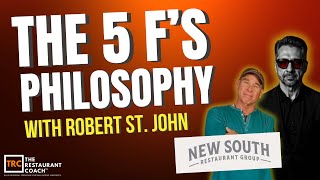
Interview (podcast) between Donald Burns and Robert St. John (founder & CEO, New South Restaurant Group). Robert recounts a 44-year restaurant career (38 years as an owner), early struggles (addiction; sober since May 25, 1983), and the growth of his group (currently five restaurants and two bars; plan to open seven more in five years). He discusses leadership (radical candor), the "Five F's" life framework (Faith, Family, Friends, Food, Fun), the TRC Method (people → product → process) implementation that improved culture and profitability after COVID, and operational priorities (watching food & labor costs, inventory, using Restaurant Systems Pro). He names portfolio highlights (Crescent City Grill — Creole casual, Purple Pear Cafe, Tibella — Italian, Ed's Burger Joints, the Midtowner, Loblolly Bakery — named a Top 20 US bakery by the New York Times). He reports ~450 employees across the group and ~ $7M annual sales at the flagship. The tone is candid, reflective, and practical; content mixes personal narrative, leadership lessons, and concrete operational tactics.
Questions this video answers
44 years (38 years as an owner).
May 25, 1983.
Five restaurants and two bars.
About 450 team members.
Approximately $7 million per year.
Chapters
And welcome to the Restaurant Coach podcast. It is the cure for the common restaurant. I am so honored to be joined Today with Robert St. John, the founder and CEO of the New South Restaurant Group. And a full disclosure too. Robert also generously wrote the forward to my very new book. My newest book just came out, Ingredients Creating Total restaurant success in 90 days. Robert, I am so honored to have you on the call today.
Donald, all you, whatever you ask of me, I'm gonna do. Hey, well, tell people I'm honored.
Hey, well tell people a little bit about your, I mean, you've had a wild ride in the restaurant game. So why don't you tell people a little bit about your story about how you got in this crazy business.
Well, I've been in the business for 44 years. I'm in my 38th year as an owner. I was born and raised in Hattiesburg, Mississippi, on a house about four blocks that way.
Nice.
Currently live about eight blocks that way from where I was sitting. We have five restaurants, two bars, and we're opening seven restaurants in the next five years. I grew up here in this. We're in South Mississippi, about an hour due north of the Gulf and about an hour and a half northeast of New Orleans.
Yep.
My dad died when I was 6. My mom raised my brother me up on a art teacher's salary as a public school art teacher. And so that meant I had to work.
Yeah.
And I started working really like mowing yards at 12 and at 15 had a full time job as a disc jockey in radio, which I loved. I'm a huge music fan. And I went off to college at 17 and didn't really know what I wanted to do or what I wanted to study. And I knew I loved radio. Was pretty much all I knew this was would have been 1979 and I'd been in radio for three years at that time. So I just majored in communications, but I really mainly majored in partying. I was pretty good at that. I had a good skill set. And after about two years, Mississippi State University decided they no longer needed my services up there. And so I flunked out of college. I moved back home, kind of tail tucked between my legs, was kind of embarrassed, needed a job. And there were two ladies really half a block from where I'm talking to you now, two ladies opening up a delicatessen who knew nothing about the restaurant business, which is evident because they hired me as the manager of the deli. And it's one of those things that I'm going to Tell you it, you know, looking back 44 years ago, it feels like it was the first shift of the first day I just fell in. But it was probably true, truthfully, sometime in the first week where I just fell in love with. It's like not, this is what I want to do. Like this is what I'm supposed to do. Restaurant thing. I love it. I loved, you know, the, the peaks and valleys and seeing the people and the stress and the difference. And so I started managing the deli during the day and I started waiting tables at night and I just couldn't get enough of it. I was unfortunately in the middle of a major alcohol and drug addiction at the time and ended up in treatment in rehab, which is one of the better things that happened to me. There are. Well, I'll cover that in a minute. So ended up in rehab, clean my life up. I've been cleaning sober since May 25, 1983. Went back to school, got a degree in hospitality management. Was, you know, working 40 hours a week, putting my, you know, taking 18, 21 hours summer school, the whole thing. But I was so consumed and eat up and in love with the restaurant business. Any spare moment on the university campus, I went to the library and just, just lived in all the restaurant. Trademark Nation's restaurant news, restaurant business, all that. I was in the periodical section anytime between class, whenever I waited tables at night and a lot of lunch shifts. And then I'd stay up till 2 and 3 in the morning designing restaurants, designing menus. Oh, wow. I mean, I've got reams and reams. I still do it. I mean, I'm just in love with it. So I opened the first restaurant, which was a fine dining restaurant, Purple Pear Cafe, December of 1987. I was a waiter and hired a bunch of my buddies who waited tables and brought a chef in. I had original business partner. We brought a chef in from the Florida panhandle who was a legend. He was a legend for two reasons. Number one, he was a great chef and everybody loved his food. Number two, he was a binge drinking alcoholic, really bad. And so, you know, he would start drinking on Wednesday and they'd find him, you know, 90 miles away on Sunday. But we brought him in and like, whatever you do, you can try. I opened that first restaurant, I had $25,000. I had no money, had a negative net worth. Had been trying to put myself through school. Sold a little piece of land my grandfather left me for $25,000. That was my steak and opening the restaurant. We told this Chef, whatever you do, you can't drink. Do not drink. He didn't. He trained all the kitchen staff and developed the menu. I brought in and my partner and I brought in the front of the house staff. Opening night. We went for a soft opening. December 27, 1987.
Wow.
And I, I learned my first business lesson in the restaurant business, which is lock the beer cooler because this guy. About 8 o' clock I noticed some hitches in our service. Went to the back and this guy was passed out. He had drank a case of beer out of the walk in a bottle of Dr. Tishner's from across the street. Oh, my God. So we fired our chef opening night on night number two. You know who's back there?
You. Yeah.
And my, my mom had begged me, do not open a restaurant. You're going to ruin the family name. You're gonna blah, blah. I said, mom, I've already ruined the family name. We can only go up from here at the bottom. The extent of my cooking experience at that point in time was that I had asked for and received an easy bake oven from for Christmas when I was six years old. That was it. I cooked with 100 wide light bulb. So it forced me to get back into the kitchen. Yeah, we were closed on Sundays back in those days. And my wife, she was my girlfriend then. Jill.
Yeah.
She and I would drive down to New Orleans and I would eat around New Orleans at different restaurants, which I'd done all my life. But this time I'm doing it with restaurant eyes. So you're looking at things differently. I would come back and I try to replicate those dishes. Eventually my dishes took over for the other guys. I did 90 hours a week for the first four years. Lived in a one room apartment above a garage till I was 30. Loved every minute of it. I still love every minute of it. And what I was going to say a minute ago. Things that look like the absolute worst thing that could happen in your life. So other than my dad died when I was so young, which I couldn't do anything about, obviously, but, you know, flunking out of college at that time was the worst thing that could happen. But had I not flunked out of college, I never would have gotten into the restroom business. Getting that DUI. May 25, 1983. Had I never gotten that DUI. And I kept going like I was going because I was, I was bad, man. I had accepted the fact that I wasn't going to live to be 30, I probably wouldn't have made 25. I was 21 at the time, so getting that look, you know, obviously I ended up in drunk tank one night.
Yeah.
Again, one of the best things that ever happened. It looked like the worst at the time. Best thing now because it got me clean and sober. Firing our chef opening night again seemed like, oh, man, what are we going to do? I'm, you know, I'm doing. And it forced me to get back into the kitchen and learn the business from that. I was just a waiter for six or seven years before that. So, you know, it's one of those things that, you know, Covid look like, you know, this existential, Existential crisis to us. And, you know, I had conversations with my kids and my wife. You know, I don't know when we have to sell the house. You know, these restaurants may close, move into a bar. We're going to do whatever we can, whatever we need to do to keep these things open, keep the people working. And that thing, as bad as it was, you know, made us tighten up, made us work more efficiently, effectively, and actually ultimately led us to you, and we got better. So.
Yeah.
The worst things in life aren't always the worst things in life taken in the whole picture.
That's true. That's so true. Sometimes. Sometimes the things that we think are setbacks are setups for a great comeback.
So that's a long answer to your very short question.
That was a great. That was a great answer that gets.
Everybody to this point. So we have five restaurants, two bars. I'll go over those real quick. And we have Crescent City Grill, which is kind of our flagship. That fine dining restaurant was a Covid casualty. It was open 33 years. Purple Pear Cafe was a great restaurant. So Crest City Grill is a creole themed casual restaurant. We have a Italian restaurant called Tibella. We have a burger joint, which is one of our growth vehicles, called Ed's Burger Joints. Awesome. We have a breakfast lunch concept called the Midtowner that we're in the process of doing a second one of those. We have a bakery. The newest thing I've opened is about a year and a half ago, maybe two years at this point. It's called Loblolly Bakery. New York Times named this one of the top 20 bakeries in the country. And then so we have a lot. And we have two bars, mahogany bar, maple bar, that do substantial business. So that's. That's what we have going now. Awesome.
Yeah, Loblolly. I mean, I was. I mean, I came out and did some work with your leadership team. We Did a leadership conference, and we're just in the beginning of king cake season. I'll tell you right now, man, when king cake season runs around, you gotta. You gotta get ready. You gotta go to Loblolly. We're gonna try to get. Get to the point where you can ship those things.
Yeah. This year we hope to ship. We couldn't ship this past Mardi Gras season, but next year coming up in.
26, that'll be awesome because that's, like, the most amazing king cake I've ever had. It was the flavor profile, just that light has a really, really light texture to it, which is unusual. Yeah, it's amazing. Awesome. So leadership, you know, leadership is really, really crucial in. In restaurants. And so like that. What do you think is the number one trait that leaders need today with.
And I can just speak to myself, you know, I'm not sure I'm equipped to give advice on other people, but what has worked for me, and it's something I've really just gotten in touch with in the past year or two. And. And you are partially responsible for this. And then Gary Vaynerchuk, who, you know, I'm a big fan of him as well, both of you guys. And. And I would say candor.
Oh, yeah.
I've never been very canderous with people, and, you know, I didn't want to hurt people's feelings. I didn't. You know, I didn't, you know, and it's different than being honest. I feel like I've always been fairly honest person. But there's a clarity in. In being candorous and using, you know, there. There's radical candor that we know about. And, but, you know, it's. It's a situation to. Where I would be with my leadership team. How's, you know, old Joe doing over there? He's not doing great. You know, it's. They'd say he's always late. You know, he's doing this, he's doing that, and we're all. Everybody's complaining about Joe. And then I'll say, Joe. And the rest. Hey, Joe, man, good to go. You know, how's it going, man? Keep up the good work. That kind of. Which is terrible. It's terrible leadership. And there's nothing canderous about that. And, you know, and what I've learned, because, you know, you, You. You say rightfully, all problems are people problems.
Yes.
And that's right. And. And most of those people problems, I've learned, are communication problems.
Exactly.
And, and lack really, of Communication.
Yep.
And what I've learned is that life is much easier. It may be a little harder in the moment and a little more uncomfortable in the moment. Some people. My wife has no problem speaking very frankly to people in a respectful way. She can do that. She get. And it's something just, just in me that I'm not comfortable with that. But what I've learned is that I will if I can get comfortable in the uncomfortable and be upfront and honest and candorous in a respectful way with people. Life is better. My state of mind is better, the business is better. You know, it's just a better thing all the way around. So, so leadership in restaurants, to me, it comes in. And you also, it was in your last book, talk about just honesty and brutal honesty. And you and I talked recently, actually, and I said there's freedom in being that kind of honest when you can take the shields down and just be raw and, you know, put your ego aside, keep your ego in check and just be honest with things and lead from that standpoint. It's a very freeing thing.
Very freeing. No, it's like it takes away a love that, I mean there's, there's a heaviness to holding up wearing a mask. And I talk about wearing a mask a lot. And when you take the mask down and just authentic and just being real and you know, and you and I both know you can be, you can be very respectful, but you also be very, very open with people too.
Yeah. And people want to follow somebody who's real and who's honest and you know, it knows where they're going and communicates that. And especially Gen Z, they can just see through stuff. You know, it's. And so I've just learned that we have about 450 total employees, team members working with us now. So, you know, I just try to be real and be me and be honest and candorous and so far that's working well.
You know, I'm a big believer in self care. What. And I know you do self care too. What are some things that you do to take care of yourself?
Well, you know, I told you earlier, I'm clean and sober for 42 years now and. Or is it 43? No, it's 42. Yeah. And. And so I do a 12 step program that I go to meetings for that probably four or five times a week still four decades later. And it's a very spiritual component to 12 step programs. And so, you know, I'm very plugged in there. I'm Very plugged into helping other people, which in turn, really helps me. You know, I put my phone number out there for people about once or twice a year. I go through my whole story and my struggles with alcohol and drugs, and I was into some hardcore stuff and put my number out there. I got two calls earlier today.
Yeah.
Sometimes talking people off the ledge and things like that. So I try to help other people. I go to the gym three days a week. I love working out. And, you know, I meditate sporadically. I pray fairly often. And, you know, I prioritize. I've learned in my life. It took me really, about. My daughter was born when I was 36.
Oh, wow.
And my son was born when I was 40. And I probably looked for fun in a lot of the wrong places for a long time. And around the time my daughter was born, she's 28 tomorrow, I started prioritizing life, and I. It's something I call the five Fs. And it's in order. Faith, family, friends, food and fun.
There you go.
And so faith is whatever your faith faith is. And, you know, I'm a Christian, I'm a Methodist, but whatever that is, as long as that's the primary part of your life, and that comes first, and then obviously, family is second. And, you know, there's a strange thing that happened when Jill was pregnant with our first child, our daughter, and she was noticeably pregnant, probably seven months. And we'd be out about town at a party or something, and people would come up to us and they would kind of grab one of us by the arm and look us in the eye, and they would say, it goes so fast. And it was. They had a look in their eye when they tell us this. And then I would hear it over and over and over. And finally we sat on the edge of the bed. I was like, you know, we need to pay attention to this. Right. Because I don't want it to go too fast.
Yeah, yeah.
And. And so at that point in time, I was like, you know, this is. This is the most. I've got a lot of job titles. I do a lot of other stuff besides restaurants, but most important job title I ever had or will ever had is being a father. So, you know, we prioritize that and still do. So, Faith, family, friends. My grandfather used to tell me he was like the. The primary male influence in my life. My maternal grandfather was a great man. He used to say, a rich man has his first dollar, a wealthy man has his first friend.
Oh.
And he also used to Say you can judge a man's wealth not by the size of his pocketbook, but by the depth and breadth of his friendships.
That's true.
So, you know, I stay, I have, I, I consider myself a very rich man. Not because I have a lot of money in the bank, which I don't, but I have a ton of great, real friends. So Faith, family, friends, food. And, and, and that's in there. That's one of the Fs. Not because I'm in the restaurant business and not because I'm in the food business and I love food and the whole thing, but really it's the thing that connects us. It is, it's the thing. If you think about it, people, you know, I challenge people a lot. You know, Tim, think about the best times in your life and your fondest memories. And I'll bet somehow somewhere food was. You're sitting around a table, you're celebrating a birthday, you're celebrating a graduation, you're going out with friends, you're doing that. You. It's the thing that brings us together. It's the things that connects us, you know, and I, I can remember back, I'm a 63 year old man sitting here talking to you about lunches at my grandmother's house. That made such an impression on me when I was a kid. And so Faith, family, friends, food and then fun. The, the thing that it took me a long time to learn is that I was looking for fun in a lot of the wrong places. What I didn't realize is, is that when you have four of those other Fs going on, the fun just happens.
Happens. Yeah.
Yeah. Think about that lunch at my grandmother's house that we're selling. Always after church. So there's Faith, family were all around the table, friends were always invited. Food. You damn right. There was a lot of food and it was great food. And so the fun is just creative memories. So. Yeah, there you go.
So one of the things I love about like your Instagram, a lot of your posts, like when you're sitting there talking about food from the restaurants, you, you actually, you kind of reconnected back to your childhood memories. Like at my grandma's, at this. And I remember doing this and stuff like that because that's so powerful. Like my earliest childhood memories are always around my grandmother.
Yeah.
And my dad, you know, being a chef and cooking food. Always, always. Like you said, when you really explore some of your best memories when you're a kid, most of it's usually around food and family or Friends or both.
I'm ready to be a grandfather. My daughter got married in March. I'm ready to be a grandfather. So I can create those memories in those grandkids. They'll be on a podcast or whatever's going on 50 years from now and. And talk about. Yeah, yeah. My granddad, man, he brought us together and fed us well.
You know, the. The basic principles of my. My coaching program is called the TRC Method, and the TRC Method is based on what we call people product process. How do you think that kind of. That framework that I teach, the TRC Method, is different from. From a lot of, like, other kind of restaurant, you know, programs and stuff like that.
I think it's so important and that you order it in that way and that. So just for the listener to this podcast, you know, I. Donald and I, I have a personal coaching call every week. And then. And then Donald coaches with my leadership team, and when we brought him into the restaurant to do a leadership weekend and all this stuff, what I love about it is you always start every session with the. You meet with my C suite, which is my coo, my chief information guy, my chief culinary guy. So the four of us, and you meet with the leadership team, which are all the managers and system managers from the restaurant. But you always start with people, product process, always go through that every time. And you drill it in, because that's so important. And, you know, I've been in business as an. As an owner for 30. We're in our 38th year. But after Covid, you know, we took a dive, man. Our culture took a dive. We were. We lost a lot of people. We're in a university town. There are two colleges in this town. And we were used to, for over three decades, hiring only A plus candidates. We could pick and choose A plus. That's it. A plus candidates. But after Covid, you know, we were. We were hiring warm bodies. Yeah. It takes a whole different management skill set to manage warm bodies than it did A plus candidates. And we weren't good at it at all. And we took a dip in every aspect of our business, and culture was gone, basically.
Yeah.
And. And I was probably before I made my first call to you, which I actually did the book on tape, your restaurant sucks.
Your first.
And then I went to Amazon and bought, like 10 copies and started passing them out to all the managers, because at the time, our restaurant sucked. It did. Like I say, in the. Forward to your new book.
Yeah, yeah.
The first line in the. In the piece, I think is Very.
First line says my restaurant sucked.
Yeah.
And it did.
But you know what? Today I think we've worked together for a little over two years. None of our restaurants suck. Today. We're great. And it's because we. We started with those warm bodies, the people. We started getting the people right. And then we started, you know, we just did the product next and we did the food. And I don't. I didn't. As much as I know about restaurants, long as I've been in it, I probably had that backwards and wasn't every restaurant does. And so, I mean, bottom line, if you're asking me about, you know, the TRC method that you use, it's. It's 100%. You got to do it in that order.
Yep.
Because until you get the people and like you say, you know, all problems or people problems, you got to straighten that out before you can get into the product.
Yeah. That's the way it was explained to me too, is like. Like my first business coach, the guy who sat me down and told me this 3P framework, this people probably processing, he says, you have it all three. You just have the. You have, like. You hear me use the analogy. It's like a combination lock. Yeah. And if you have the lock and I give you the combination, you gotta make sure the combination's in the right order or else the lock won't open. That's where most restaurants are. Most people start with product because every restaurant has a menu. And then they get a couple process in place. Oh, I need some checklists. We need probably a P and l probably need this and that. Oh, and then they go back to people part. Oh, I need to hire people. I need to train some people. People, product, process, it always works in that order. It's like the comp. If you have the combination lock in the right order, it always works. And you hear, like, you hear me say it. In fact, the first chapter in a new book is like, it's the frame that changed the game. Because when I learned this people product process framework and I started implementing it in that order, it changed everything for me. When you started implementing this TRC method, what were some of the immediate changes you started noticing right away?
Well, you know, we started living by our core values and our mission statement, which. Which again, you know, you pre. I had core values. Always had. My problem was I wasn't. I wasn't preaching them to the team. I mean, so they do no good if I'm just keeping them internally at all. And so we started going heavy into that. I put them everywhere. You know, we do, we do the cards, you know, we've got the mission statement and the core values on a card. It looks really cool and slick and all the managers have them.
Yep, yep.
They're getting better at using them when, when they have to discipline. But they're, they're posted everywhere, they're posted in public places. Our core values, which are hospitality, quality, consistency, cleanliness and community.
Yep.
And, and we, we always hit on some of those. Some of the time. But we weren't ever hitting on all five. All of the time. And so we started doing that and then we had a purpose statement that had changed. Originally it was customers, co workers, I think I call it customers, co workers and community. And that's all it said, was just three words.
Yeah.
But now our purpose is really we exist to support our team, to delight our guests and to serve our community. And we started using different language as far as our guests instead of customers.
Yep.
And instead of co workers, which I use because it was a C word back then. And customers, you know, it's guests now. Our mission statement, you know, we had a clear mission statement that we didn't really develop until we started working with you. And our mission statement is we give exceptional, exceptional experiences through fanatical wall to wall hospitality. And when I say, obviously, you know what fanatical is, but wall to wall hospitality, what we preach and what that means in our restaurants is from the back door to the, the front door.
Yep.
So. And everything in between.
Yep.
And, and we try to create experiences, not just a restaurant visit. And so you helped us. Thank you. Put those things together. But then to start preaching them to the team and you can, I mean, you can just, if you, if we graft it, you can just see how culture just started getting better.
Yeah.
Better and better. And we still have a ways to go, but man, we're, we're, we're hitting 90 these days.
Yeah. And you had last year. I think it was your best year.
Oh, oh. By far. Our 37th year. We had a record year in sales. We had a record year in profit. And our culture is better than it's ever been. We have a strong leadership team. This is going to start sounding like a commercial view and it's really, really not. It's just if I were talking to somebody else. Yeah, same thing, same thing. So I don't want anybody to think you've got me on here to talk about, you know, all your, this is just, this is how it happened. And I'm I'm like, a veteran of this stuff. I've been, you know, over four decades in this business, and, you know, things. Things are really good nowadays.
So, you know, the thing I admire about you is, like, you're definitely like, there's a lot of owners out there that just definitely don't think that, you know, I can't learn anything new. I'm just kind of like, I've been doing this for a long time. There's one of the things I always loved about you is that you've always had this openness about just being able to, like, all right, tell me. Let's talk about it. Explain why and, like, you know, open the doors and. And like, you were just a. You were just a knowledge. You just love to learn and read and grow. And that's the number one thing I think that makes a great leader, is that this is the ability to be a lifelong student.
Yeah. And that's just ego, in my opinion. And I'm, you know, no man's without ego. And I have. I've suffered from, you know, ego in the past and thinking, man, I know it all, and I got this down, and I'm. I'm the guy. But, you know, I guess, you know, if you get beat up long enough in this business, you take some knocks and you start knowing, you know what? I'm still learning. And. And I don't preach to my team anymore, man. I just ask questions a lot, you know, what should we do here? What do you think about this? What do you. And I'll, you know, and sometimes they're right. Sometimes I don't agree, but I'm gonna let them know, you know, I think. I like that. I think that's a great point. But what if. What if we. Let's try it this way or, you know, something like that. So I don't know it all. And I'm, you know, I'm never going to retire. I'm 63 years old. My plan. I think I'm gonna live to 100. Good. I'm serious. I'm gonna do it. I'm gonna live to 100. I'll try to take good care of myself. And my. My goal is to. The night after I've opened my 50th restaurant, I just want to go to bed and not wake up at 100 years old.
That's my. As a good goal. I like that goal. Go out. That's the way. That's the best way to go. Yeah. So you travel a lot. You've been around the World. What's the best meal you've ever had?
French Laundry, 2006. Maybe it was 2008. Somewhere in there, I had. I write a part of. I'm a writer also, and I write a weekly column, and it's still in some newspapers. It used to be a lot of newspapers from newspapers where they've been writing for 25 years. A thousand plus words a week. I've never missed a week. Over 1.3 million words in print. I had eaten it, per se. Thomas Keller's New York restaurant.
Yeah, yeah.
It was fairly open. I could check the date. So right around the time he opened that I had a meal and wrote about it. And at the time, it was the best meal I'd ever had in my life. It was amazing. You know, the butter came from some small. The butter just for the bread came from some small dairy in France. He flew it in. There was a seafood component that one of the courses that they had flown in from the Pacific. You know, it just. It was awesome. And so I wrote about that. It was an awesome meal. And about that was in June, and in late July, I had a reservation and went in with three friends out at the French Laundry in Yonville. And we walked in, and I was with this guy named Jim Kimsey, who's passed away now, but he's the founder of America Online. He's a billionaire with a. Yeah, yeah. And we're in there and two other mutual friends of ours. And right off the start, Kimzie starts going, man, they know you here. They know. I said, dude, trust me. Little Robert St. John from Hattiesburg, Mississippi, they do not know me in here. No, I can tell by the way they're treating you. And. And Tony Bennett was in there with some big. Tony Bennett walks by, says, hey to Kimzy, and I said, see if they. If. If these people know anybody, they know you, dude. They don't know me. And every course, we had 36 courses.
Oh, my God.
That's one meat. And it wasn't 36 rounds. It was 18 rounds. So from the moose boosh to the final dessert, and, yeah, you know, a little lagniapp they gave us. It was 18. So there were four of us. If, you know, on the foie gras course, like Kimzi and I were sitting across, we'd have one foie gras, and then the other two guys would have a different foie gras. So we're all tasting. We tried 36 different. It was. The meal was so long, we needed a halftime Break. We went outside and just, you know, had to walk around as someone who's clean and sober, don't drink. They were doing non alcoholic pairings with me. I think it's the first time they had ever done that. They asked my promotion mission if they could do that. Said, yeah, I've been back several times since and they still do it. And the whole time he said, oh, you know, I said, dude, this is Thomas Keller. He has no clue who I am. In the very, after the very last course was served, guy named Larry Nadeau, who was the maitre d there at the time, said, Mr. St. John Keller would like to see you in the, in the kidnapping. And Kim's. He's going, see, I told you. I told you. And we walk back there and Keller goes, you know, thank you for the piece you wrote on Per Se. You know, so he read it and it was. So that meal really stands out.
Yeah.
As a restaurant meal. But I could pick any meal I had at my grandmother's.
Yeah.
So she was a great cook. She, her specialty was leg of lamb. She made great leg of lamb. And then there's several meals. Probably in 2011, I took my wife Jill, and at the time, my 10 year old son and 14 year old daughter, we flew to Sweden, bought a Volvo and spent the next six months traveling around to 17 countries and 72 cities on two continents. And my son and I would have, the girls would sleep late. He and I would get up at breakfast every morning. I'm a breakfast guy, always have been. He's a breakfast guy. And we, we had breakfast in some amazing places and you know, it's, it'd be hard to pick, but that, that one French Laundry meal was the first time I ever went there. And it was, they blew us away.
Yeah. You know Rick Tramano. Yeah, yeah. The best meal I ever had in my life. He is have a restaurant in Chicago called True.
Yeah.
That was like the best meal I've ever had in my life. I mean just everything just synchronized, everything meticulous. Just not, not one detail was overlooked. Everything was.
He partnered with a Cajun chef from Louisiana named John Foles.
Yeah, yeah.
And they opened up a restaurant called Revolution Restaurant Revolution in New Orleans. And then in Jackson, Mississippi, did one called Seafood Revolution.
Oh, I didn't know I had seafood.
Ended up closing. Yeah, yeah. I never met him. I know who he is. I met John Foles. But.
What do you think is like the biggest problem you see with restaurants when it comes to profitability?
Not, not paying attention to the Two main cost of goods and labor.
Yeah. Yeah.
I mean, you've got everything, you know, you can worry about, you know, somebody making sure they turn the lights off and you can worry about, you know, turning the thing for your water bill and keeping. And those are all need to be done because there are a thousand ways to. Details that need to be taken care of in the restaurant business. And there are a thousand ways. It's, it's the only business where there are more ways to lose money than there is to make money.
That's the truth.
If you aren't watching your cost of goods and your labor and keeping those and keeping your prime cost in line. And we're in the mid-50s in most of our concepts.
Yeah.
And, and you've just, there's, there's no way you're going to make money. I just, at least I haven't figured it out how to do that. And so first and foremost, it's all cost of goods and, and labor. But the problem with our industry, you know, bankers hate restaurants.
That hate.
And part of the problem is, is that, you know, everybody thinks, you know, I can, I can do. Hell if St. John can do this dumbass, I can do it. You know, it's. No, there's, you know, obviously it's, it's got to be easy if he's, he's doing it. And so what you get is every Tom, Dick and Harry that cooks a good steak in his backyard.
Exactly.
Hey, hey, Tom, man, that's the best steak ever. You ought to open up a restaurant. So Tom starts thinking, yeah, you know, that is a good. I could do that.
Yeah.
And so he thinks, you know, he's thinking he's going to be basking in the glory of his customers at table five in the corner booth on a Friday night. And what he learns pretty quickly is that the dishwasher didn't show up and he's taking out greasy mats at 1 in the morning. And it's nothing like what it looks like on the Food Network. And knowing how to cook a good steak is about 5% of what you need to know in cooking a good restaurant. And there just aren't many industries. It's like somebody who's good with numbers doesn't just go, I'm going to be an accountant, or, you know, but the restaurant business is kind of rife with that. And they get in with the. Not the proper skill set.
Yep.
And not the proper priorities. And, and so, you know, you gotta watch your food and labor. Food, fear by food. Beer, wine, Liquor and labor. That's what we preach.
And yeah, let's give a shout out. Like you and I are both friends with Fred and Gino, Restaurant Systems Pro. And those guys are. I mean, I'm a huge believer in getting software. I mean, the days of manually tracking shit on a fucking piece of paper and a notepad, that's like past. You gotta have a good software system.
If you ask me. And I'm glad you brought them up because we got with them before that. That really is partially what also led me to you. Because we needed to get our financial house in order because it was crumbling.
Yeah, yeah.
I mean, we were, we, we had grown from a mom and pop restaurant to. We had several others and we had about seven at the time. Covid took. Took a couple of them out. But. But we weren't being responsible restaurateurs. I mean, we weren't doing weekly inventory. We had gone from this mom and pop when it started. And it was me and my original partner who I bought out after a couple of years and. And you know, 40, 50 team members. And we, you know, we were all the same age. We're all running. It was all good. And you had all the great stuff and how it is when you're opening a place early on like that. But we had grown into, you know, four or five hundred people at the time, and we're still running it like this. Mom and pop. We weren't doing inventory. We weren't measuring our prime cost, all that stuff. And so Fred and Restaurant Systems Pro and it was not easy. I'm going to tell you, man. It was trying to get the management team at the time, we pretty much flipped it, but except for maybe just a couple and Jared is the CEO. But trying to get them, you know, to do. I mean, this is a huge. We have 4,000 bottles of wine in our wine inventory and we have a huge menu in this one building. And a lot of. We had at the time like 180 tequilas and probably 200 bourbons rise and whiskeys. And so trying to get them to do inventory, it was. But, but once we did and once we started practicing good financial, responsible business practices through their system, things started looking up. And then when we got with you and we started working on culture and.
The people called frame stacking.
Yeah. So I'm, I'm wide open and that. And, and I talk to you about this a lot too. I'm a huge fan of Alex Hormozi as well.
Yeah.
And have been out to Vegas and done a seminar or whatever and do a lot of his stuff. And. And he's. He's given a lot of good, good examples of. Of what I need to do. And, you know, so he. He preaches that you need to go. You can go out and buy experience and you can buy other people's wisdom, and you can, you know, which is what I. I do with you. And, and you've got such a broad experience with, you know, that, what is it, a thousand, two thousand restaurants you've worked with? And so we feel like we're the beneficiary of all of that. And so it's an easy decision for me to pay for that. It's an easy decision for me to pay to go to Alex Hormozy and to pay for restaurant systems Pro to help us get. And we've got a couple of other things that we're working with. So I'm a big believer. And that's also. You got to put your ego aside. You don't know everything. I don't know everything. I've been doing it a long time. But the more I learn from other people and open up to, you know, learning from other people, then the better we get. We just keep getting better.
I still. I still have coaches. I still have five coaches. I'm a huge believer in learning. I've always been. And you hear me talk about all the time the 1% mindset. You want to just be 1% better today than you were yesterday.
It's money spent money. Well spent money.
Always. Yeah. Every coach I've ever invested in has always, always returned me at least 100x. Every time. Yeah, every time. Labor crisis. You hear a lot of restaurants talk about the labor crisis. Do you really think there's labor crisis or what do you think really is a problem?
I'll tell you what. Our experience, you know, like I said earlier, we went from, you know, being being able to pick and choose a plus to just hiring warm bodies after Covid. But, you know, we probably used that excuse longer than it was actual reality. Well, we just can't find. Can't find. What we needed to start doing was making our culture better. And years ago in the 90s, you know, we made a decision. We want to be the. We want to be the restaurant to work at and this market, what do we need to do? It's not always money, you know, what do we need to do to be the place? So when somebody moves to town, they want to wait tables, they want to cook in the kitchen. What is going to make them come to here. And so we reverse engineered that and started doing things. This is what we want to do. And we, you know, it's, it's all about creating that good team and that good culture. We started interviewing only interviewing help on Tuesday mornings from 8 to 9:30. What was happening is, you know, at the time we needed people. And so they, somebody come in three in the afternoon. A manager's trying to work on a project. Well, we need people. So the manager, you know, goes and interviewed. Then, then they're not doing what they're supposed to do and maybe we're not going to hire that person anyway. So we had a card at the hostess stand. When somebody would come in, it was, you know, we'd hand them this card. Thank you for your interest in being on a part of our team. We conduct interviews. We'd love for you to meet our leadership team. We will have a person there to interview you from 8 to 9:30 on Tuesday. So that solved a couple of things. It made sure we always had a manager there to interview. It made sure people who may have a problem in the restaurant business, a lot of people have a problem getting up early. You know, it's kind of a party culture in our, in restaurants. So if you can't be there by 9:30 to interview for the job, you're likely not going to show up for that 10 o' clock shift when you get the job. And, and it managed our manager's time, so it all worked out. So after Covid, you know, everything took a dip. But what we learned is I call them skunks. You've got a different term for, but I call them skunks. And every skunk that's in your, in your restaurant, you got to just get them out. They, they come in and they just spread the funk everywhere. And it brings everybody.
I call them negative energy vampires.
I learned that that was an early lesson. I learned. We had this guy, he was talented, man. He could literally, I'm not exaggerating, he could work two, two on the line. He could grill and saute at the same time. So coordinated. He was just a restaurant dog. He was great, but he had a lot of problems. There were a lot of issues that we had to deal with. But me as a young and inexperienced weak leader, I was like, man, we can't fire that dude.
He's a workhorse.
Manage around the problems. He's too good. And I was off at, I had a restaurant, big nightclub at the time in Jackson, Mississippi, and I was off working in that. And I got a call. Hey, we had to fire so. And so. And I was like, oh, man. And. And man attitudes. And everything just got better.
Yeah.
When we got him out of there. And I learned that lesson early on. And so we. We hire fast. Fire faster. Promote fastest.
Yeah, promote fastest. Right, Exactly.
That's the way we do these days.
Yeah. I always make the joke, like, when people are afraid.
I don't think there's a labor problem. If you create the right. Right culture, the right atmosphere, then, you know, we. We hadn't had a problem, but. But lately.
Yeah. You hear me say your vibe attracts your tribe.
Yeah.
I have restaurant owners all the time. Like, oh, there's just no good people out there. Is it really? There's no good people or it's. Maybe they don't want to work with you. That's the question you gotta ask yourself. Yeah. I'll tell you, man. Yeah. It's like you get rid of those negative energy vampires, and then it's. It's like there's like a cloud that lifts off the restaurant and just people can just breathe again. It's like, I make the joke. It's like, you know when you're dating and you're dating somebody and then you break up with them, and then all your friends say, I never liked her in the first place. You're like, when did you tell me?
Did you tell me that?
It's like, you should have told me that when I was dating her.
Yeah. And you know what happens sometimes is you get back together with them. Then you know the. The friends you have who didn't like the girl, man.
Yeah, yeah, yeah.
And I've been on the other end of that. I've told people, dude, man, she's a, you know, this and that.
Horrible. Yeah.
Getting back together.
Then you're like, oh, man. It's like, oh, no. Yeah, yeah, definitely. So if you came with a warning label, what would your warning label say?
If I came with a warning label, it would. It would say, caution. He doesn't slow down.
Is it. You don't. You are all gas, no brakes.
I do. You know, I'm. I'm here in South. I don't hunt. I don't fish, I don't play golf.
No, you're like me.
I do restaurants.
I breathe.
I breathe restaurants and family, and that's it. And I'm still, you know, like I told you when I was in my early 20s, I'd stay up till 2 and 3 in the morning, design it. Well, back then, I was Riding on a yellow legal pad. I still. I go. I go home, you know, I spend time with the family, But I'm also. I'm working on restaurants and future concepts. And it's just. I am eat up with. And I love it. I'm still high energy. I get tired every once in a while. I'm gonna tell I'm 63. In about 10 years ago, I can remember getting in bed. I'm very add. Very hyperactive. And I remember getting in bed with my wife and. And I went, I think I'm tired. I think this is what tired. I was in my mid-50s. This is. I'm really. This. Not exaggeration for effect. I was in my mid-50s before I ever really thought what tired feels like. And these days, I get in the bed, I'm like, oh, this feels really good. But I'm also on my laptop.
We should compare notes one day. Because you, like. You, like, in your youth, you were designing restaurants. Like, my youth, I was a chef. And, you know, I wanted to be like. I wanted to be like, you know, a James Beard chef. I have notebooks, thick notebooks of all these, like, menus I created in my 20s. I mean, like, yeah, notebooks and notebooks of menu ideas and just like. And I would sketch out items. Like, I would draw out items on the plate and how I played it and the garnishes and stuff like that. I still have a lot of these drawings today. It's crazy.
I've got all my old yellow legal pads. I. I have. I bet I've come up with 60, probably total concepts, menus, look, kitchen design, layout, all that stuff. And several of them, even though I never expressed them to anybody else, have come and become national things. And then that kept me going for a while. I would. You know, Jill. Jill knew because I was like, what? She's. What are you working on? I'm working on this concept that blends and to be this. And like, four years later, someone open up. She'd go, that's like that thing. I said, yeah. So, you know, it makes you feel like, well, at least maybe I'm on the right track.
On the right track. You are.
With my imagination incorporated creativity.
And the one thing and you and I talked about this a couple weeks ago is like. The team was like, you know, Robert comes with all these ideas, and it's just. It's just. It just comes as crazy. You got to tell him to stop. I'm like, no, his job is to keep the ideas coming. Your job is to Feel out which ideas are, are viable and which ones have good roi. That's where you guys put your focus at. But Robert's not going. And I said I don't want him to slow down. I want them to keep coming with the ideas. That's his, that's his goal. That's his job as the, as the visionary of the brand, is to come up with new ideas.
I couldn't make it stop if I wanted to.
I don't. Can't. And you shouldn't. That would be against who you are.
Yeah. Yeah, I like hearing that.
Yeah. What's one thing you think restaurants can do right now to make more in 2025?
Make more money?
Yeah, more, More money.
We could, we could, we're about to start working on sales. We, we used to be better at that in, in most restaurants. And, and we're, we're about to rework our training.
Yep.
And, and go hard into sales. We're, you know, we, we do. At the flagship here, we do about 7 million a year.
Yeah.
But I think if we really worked with the team, we can, we can bump that up probably 15 with people that are already coming in.
So I think you can too. Yeah.
Without any, you know, marketing. And we spend zero. Other than what I pay Drew.
Video guy.
Video guy. That's it. I mean that's the only marketing expense we have. And, and so, you know, these people that are already coming in, that's 100% of our target market. And so if we can maximize that, that's, that's my goal for this year.
Very cool. How do you deal with stress?
I really, I don't, I don't think I have a lot of. It's not that I live, I have stress, but I try just live in the solution. I don't ever, I don't ever feel sorry for myself or go, this is stressful. I just go, okay, this is a problem. You know, I don't. What, what good does it do? I've worried more about stuff that never came to fruition.
Yeah.
Than the actual problems in my life. And I think I, it's a lot of 12 step program in recovery. You know, I learned that in my 20s that you just got to live in the solution. You're sitting there. I have zero tolerance for whiners.
Oh yeah.
Miners are dead to me. You know, it's just. You got, you got to live in the solution.
Yeah.
And so I really don't. I have stress, but it's not like stress that takes me down. It's Dress that just puts me in. And I've surrounded myself with, with such a good team now that if I can keep these guys together, you know, we're gonna, we're gonna really grow. And I love collaboration. I do. I've written 15 books and several of them were with a watercolor artist who we collaborated on books together, but kind of coffee table cookbooks with his paintings and my recipes and stories and so I just love working with other people. And I think that helps with stress too, because you can problem solve as a group. I just look at it as challenges. I mean, not really a stress.
Well, you know me, I'm a big believer in the power of words. And one of the things I learned years and years ago is I don't even use the word. There's certain words I don't even use. Like someone that says, are you angry? I said, I don't get angry. I get frustrated. Yeah, I don't get angry. Another thing I've learned too is I don't say I'm never stressed. I feel a little pressure. But then my automatic thing I say, as soon as I say I feel pressured, I say to myself is that pressure is a privilege.
Yeah, yeah, true. I try to keep an attitude of gratitude.
Oh yeah, that's it.
People who are grateful can't feel sorry for themselves or, or, you know, bitch and moan about this and that. You've got to just, you know, I'm, I'm a guy nowadays. In my age, this, this, I started doing this about five years ago and for a long time before it, I would think, you know, so and so made a big impact on me when I was a kid or this and that. And then I would just think I'd make a mental note, man, I should tell him that sometime, but I really wouldn't do. These days I will call somebody up. I did it the other day, man. I just want you to know that the way you parented your kids was a huge influence on how I parented my kids. And I think my kids have turned out better today because of the example you didn't even know you were set. And I'll start a conversation with, like, this is going to sound weird, but I've gotten to an age where when I think of something, I need to tell you. So I'm going to just tell you this thing. I'm glad you and I just. And that, you know, when you, when you're doing those kind of things, you just. Life is, is more positive. So I think gratitude helps and perspective helps.
And I've always believed that when you're. When you're. When you're grateful, you're rich. You're rich in the things that matter. It's like you said earlier about faith, family and friends.
Yeah.
You're rich in those things. You're rich. I mean, it's not the dollars in a bank account. That's what really makes someone, like, just a person appreciate life. Yeah. So when you were a kid, what was the first. What did you want to be when you grew up? It wasn't a restaurateur.
No. Well, the first thing I wanted to be, I wanted to be Darren Stevens. You know who that is?
No.
Darren Stevens was married to Samantha, the witch on Bewitched.
Oh, yeah, yeah, yeah. You want to be married?
He was in advertising.
Oh, yeah, yeah.
Named Larry Tate. And they would pitch ideas to clients, and I was totally fascinated with that. And so that's the very first thing I ever wanted to be other than, you know, I would have liked to have been in the Beatles, but I wanted to be an astronaut for a little while after 69 and we landed on the moon. And then I drank Tang and I was like, those guys have to drink this Tang mess. I don't want to. To be an astronaut anymore. And then I. I think I went through a period where I wanted to be like, a writer for Rolling Stone. Cameron Crowe.
Oh, yeah, yeah.
Who started writing for Rolling Stone when he was 15 and toured with Led Zeppelin. You know, at 15, I was like, that's the job. I subscribed to Rolling Stone from time. I was probably 10 or 12. I wanted to be that for a while, and I thought a concert promoter would be cool. And then I was maybe 19 when I started working at wrestling. Boom. That was it.
Yeah. Yeah.
After that.
Ever tell you what I wanted to be?
No. I'm interested.
Remember. Remember Marlon Perkins from Mutual's Wild Kingdom?
Yeah, yeah.
I wanted to be Marlon Perkins. I wanted to be the guy like animals. I want to be a zoologist. The craziest thing in the world. I want to be a zoologist. I wanted to run. I wanted to run zoos.
Who was his. Was it Jim?
Jim, yeah. Jim.
Jim was always the guy doing the dangerous stuff.
Mar was wrestling alligators in the boat. Alligator. He's wrestling. Yeah.
Doing all the dangerous.
Didn't want to be Jim. Want to be Merlin. Marlon Perkins. Like, talking. Today we're going to talk about the zebra. Yeah, yeah. That's what I wanted to be when I was. Yeah. So name. Name. And I Know you love audiobooks. I know you love podcasts, name of Aud Audiobook or a podcast that you would highly recommend.
The ones I listen to, I'll give you maybe my top five. And I, I am all in them. My wife and I will, will binge stream a show, but other than that, I'm listening to podcasts.
Yeah, you're like me because I'm gonna.
Tell you here's if there were two things. If, when I was 30, if I had access to AI and podcasts, I'd be talking to you from my private island right now. But there's a podcast called All In. I never miss All In. And it covers, it's. It's four guys. They're billionaires. Some of them are out of tech. They have major players on. I think they, they call it the number one podcast in the world. I guess it is. But they cover politics, they call in health. All In.
All In.
I never miss it. And, and they do. Once a week they'll have some interviews as ancillary things. So I listen to All In. I listen to present company excluded. I listened to Dan Martell.
I love Dan Martell.
Always listen to him. I like Gary Vaynerchuk.
Yep.
Yeah, those, those guys. I never miss any of them. I do. Megyn Kelly's like, Megyn Kelly does this like morning update thing. It's about 16 minutes. And so in the morning, about 6am After I'm out of the gym and I'm in the shower and doing all the stuff, I'll play that. And that runs that. That sets up some news at least of what's going on in the world. And, and I'll play that. But otherwise, you know, there's some, you know, there's some. I like that. Let me just pull up my list.
What's a quote you live by?
Oh. Oh, man. There are a lot of quotes. Shoot. That. You stump me now because I'm gonna go with it's. It's a pretty, pretty all used quote by Maya Angelou, who was talking. It's used in hospitality a lot. I've heard Danny Meyer use it, heard Will Guiderra use it. And it's. She was actually talking about something else. Not hospitality, but it works for hospitality. And it's. People will not remember what you said. People won't remember what you did, but they will remember how you made them feel.
True.
And I use that with my team a lot when we're talking about customer experience. It's about how you make them feel. And that is what hospitality is hospitality is not being nice and kind and doing all the things and taking an order. It's how you make people feel. And another thing I tell my folks is a lot of times, you know, it's when there's a problem, and if we handle those problems in the proper way, a lot of times you win guests over more so with a problem situation than if you would have just knocked the meal out of the park from the start.
Yeah.
So very true. Yeah.
My favorite quote. And I built my entire. The whole TRC brand is built around this one quote from Zig Ziglar. And the quote is, you can have everything in life you want if you just help enough other people get what they want.
True. You know where Zig Ziglar's from?
He's from Hattiesburg, isn't he?
Oh, he's from Yazoo, Mississippi.
Yazoo, Mississippi. Yeah. Yeah, that's right. Yazoo, Mississippi. Yeah.
Mississippi.
Yeah. I knew he's a Mississippi boy. Yeah. Yeah. All right. Awesome. Robert, I want to say thank you so much for stopping by today. Thank you so much, and thank you again. Ingredients is now available on Amazon, paperback, Kindle, hardcover, forward by the legendary Robert St. John. If you're in Mississippi, please, New South Restaurant Group. You can go follow them on Instagram. You can follow Robert. What. What's. What's your Instagram?
I think I'm Robert St. John with underscore. Robert Underscore. St. Underscore.
Yeah, yeah.
I mean, you Google me, You can Google me, and all my stuff comes up robertsaintjohn.com and you can get to all of it, the rest.
Yeah, you got great books out there, too. Yeah, I got. I'm trying to catch up to you. I've got seven books. I got. I got a ways to go to catch up.
You'll get there.
I'll get there. Getting there. Well, thank you so much, man. I appreciate you stopping by today again. If anybody needs anything, please, you can always reach out to me. You can reach out to Robert, especially if you're suffering with any kind of addiction or drinking or depression stuff, please, both of us are available. I've dealt with depression my whole life, and I'm more than happy to talk about any of my kind of struggles with it. If you are feeling any kind of depression, any kind of weird stuff that you just like having some bad, negative thoughts, please reach out to one of us. We've been more than happy to help you out always.
Always.
Thanks, Robert.
All right, buddy.
More from Donald




If your restaurant only works because you work 80 hours a week, it doesn't work.






