The New C-19 Economy with Chef Craig Shelton
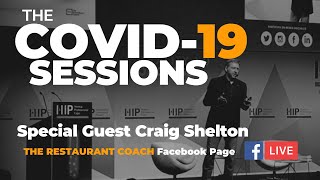
A March 2020 live YouTube interview (Donald Burns hosting Craig Shelton) about how COVID-19 is exposing weaknesses in the restaurant industry and opportunities for reset. Shelton discusses personal health precautions and nutrition (supplements, inflammation, seed oils, ketogenic diet), advocates integrative thinking for leaders, and offers detailed operational and financial advice for restaurants (EBITDAR/KPIs, pricing strategies, hybrid business models, employment-tax and healthcare policy critiques). He also promotes regenerative agriculture and a renewed industry mission to 'restore' health.
Chapters
Hey everyone, Donald Burns here, the restaurant coach. We are live coming to you this week. You know, the coronavirus is a huge pandemic and it has definitely turned the restaurant industry upside down. So I wanted to bring on a bunch of people during the week to help us kind of get some perceptions and perspective about how we can kind of cope and deal with this. And today I'm joined by my good friend Craig Shelton. James Beard award winning chef, kind of started that whole sustainability farm to table movement a long time ago. He was a member of our team usa. We just got back. Is it crazy? A month ago we were in Madrid speaking, having a great time and now we're on total lockdown.
It was really sad to see that that great convention center has been converted.
To, oh, I know, to a hospital.
Over overages and all those beds.
Yeah, we saw those, I saw those pictures and it was just, it was like night and day, you know, it can't believe how fast the world has changed.
O', Donnell, thank you for having me on. And you know, first thing I'd like to do is to salute the healthcare workers of the world who are the truth in all of this. Maya, my life partner is, is a surgeon and so I have a first hand window into, into what's going on through there through her. This. You know, if you've ever been through a major, major disaster that has taken your job away from you or took, taken your business away from you, there is, especially in America, a tendency to internalize the blame and to take the blame upon ourselves. Like, it was all my fault. And I think that there's no time quite so like the present for avoiding that intellectual fallacy.
Exactly.
Yes, we are all responsible in part for where we are in life. But none of us are completely responsible for where we are in life. There are contributing factors that are beyond our control. I'm not powerful enough to have caused Coronavirus 19. Neither are any of you. This beyond your control. Please keep that in mind so you can help take care of yourself. And that's really where I wanted to start. With no time like now. Are critical thinking skills as deeply important? The ability to look at things all the way to their first assumptions. Challenge those assumptions. This is what's going to determine those who come out of this stronger and those who don't come out of this without devastation. I also want to talk a little bit or mention integrative thinking. Integrative thinking is like. There's a book called the Opposable Mind.
Oh, awesome. We'll put up a Link for that too, for people who want to get it.
So this is Roger Martin, and he talked about how some of the greatest CEOs, brilliant leaders, are skilled at integrative thinking. The ability to hold two opposing ideas in their mind at once.
Yes.
And then reach a synthesis that contains elements of both, but actually improves on each. A great. A sum far greater than the parts. And we are such a divided nation right now. We need to switch from adversarial thinking to integrative thinking. And the opposable mind is exactly what's called for at this moment in time. Definitely. Before we talk about protecting our businesses, protecting our employees, we have to talk about protecting ourselves. What can we do in the short term? You know, personally, I'm, I've been, I'm a high risk patient. I'm a high risk person because five years ago I nearly died from double pneumonia and black mold infection in my lungs. They brought me to the hospital and I was, my, you know, oxygen uptake was so compromised, they thought I might have died if it had waited a few hours longer. So I've been taking things like, and I don't know if this is a placebo effect, but I've been taking things like elderberry syrup, NAC, that's, that's N acetylcysteine, I take 600 milligrams of that twice a day. Beta glucan, I take 250 milligrams a day. Vitamin D3, I'm taking almost 2,000 units a day. Taking a little bit of selenium and a decent amount of vitamin C. You know, my daughter's also a naturopathic physician. She's in her last year of medical school. She's advocated a number of things like that. But what we do know, I believe conclusively about this disease is that it seems to really favor people who are in inflammation or more precisely, in insulin resistance expressed in all of the various branches of the trunk. Coronary heart disease is, of course, one of the branches of insulin resistance. And the morbidity correlate there. It seems to correlate at a 10% mortality rate for disease, 8% mortality rate in diabetes. This was something published on Fox News, by the way. Okay. And, or obesity also, of course, smoking. So if you're doing any of these things, smoking, if you're on a high carb diet, I would suggest first and foremost that you stop consuming any and all what are called vegetable oils, which are in point of fact, actually industrial seed oils. I believe that there's a relationship in the mitochondrial barrier or the wall of the mitochondria, which are the energy creating systems within cells. And when you start consuming a lot of vegetable oils which are mono or polyunsaturated, it prevents the reverse electron transport mechanism from happening, which is what causes the localized at the cell level, insulin resistance, which in turn triggers the satiety response that you feel you've had enough. So when you eat saturated animal fat like grass fed butter, or the three fruit oils which are extraordinarily healthy for you, which extra virgin olive oil, extra virgin coconut oil and avocado oil, along with the saturated animal fats, it seems to be what the natural system of regulation in our body that triggers satiety and keeps us out of inflammation. Okay, So I would first of all recommend no more vegetable oil get out of inflammation if that requires a ketogenic diet for a while, a short while. But generally speaking, just switching from vegetable oils to any of those saturated fats that I mentioned earlier will be a step in the right direction. I think that with this moment in time, the restaurant community, it would be appropriate to really start to think deeply about the connection between diet and the diseases of civilization. Oh, definitely, because I was thinking about this, Donald, you know, restaurants violate the idea of marketing, which is to create promises that are explicit and valuable and unique in the sense that restaurants rarely make any explicit promises in their, you know, like on your front door, right. Your tagline, your marketing. So therefore we fall back upon the implicit promise of restaurants which is come from the French term restore, which means to restore. But to restore what? First and foremost to restore nutritional health of the body. Correct. And think about cooking school pedagogy. The singular great vacuum of non existence is the training in human nutrition. What cooking school do we know of, Donald, where that is is emphasized, trained, modern, up to date, holistic, you know, and, and the scientific literature backing it. Right.
Yeah.
Consider, I mean I, I could send you right now more than 75 peer reviewed papers that discuss the how, for example, a ketogenic, you know, a well regulated ketogenic diet can show greater helpfulness for almost all types of mental health issues. Epilepsy, ptsd, even blunt trauma to the brain. And much of that I think the correlation might be made with of course, the omega 3 fatty acids we find in wild and only wild or 100% grass fed animals and those three fruit oils. The substitution of vegetable oils I think has had a number of unintended consequences, especially in the mental health arena. Again, correlation does not prove causality. But the correlation is extraordinary.
Yes.
And I think it's time for restaurants to really consider whether we have been living up to that promise of restoring health or actually doing exactly the opposite in most cases.
Yes, yes, yes.
So what this Coronavirus 19 is also doing is it's starting to expose many of the intellectual fallacies in a great number of our institutions. Any, any restaurant operator ought to be taking this time to obviously bone up on standard managerial practices. Understanding what KPIs are, you know, key performance indicator range, of course. Right. Understanding food cost, understanding what the basics of finance are. What does it mean when we say the time value of money? What does it mean when we say the pricing of risk? What does net present value mean? How does that help guide our investment decisions? I think that Another thing that COVID 19 is doing is it's demonstrating all too sadly the weakness of our standard restaurant business model. Oh, that we have zero resilience.
Yeah, we. I had somebody the other day message me and said, you know, I thought the restaurants were recession proof.
When part of what I talked about in Madrid was looking at hard data.
Oh yeah.
Most people think with their eyes, right? They travel past a restaurant on Saturday night because that's the only night they go out maybe, and they see a restaurant full and immediately conclude that restaurant's raking in obscene amounts of profit. In point of fact, I brought up Baker Tilly's data. Baker Tilly is one of the most revered accounting firms and analytics firms for the hospitality industry. And I'm talking about independent restaurants, not chain restaurants, not publicly traded restaurants, I mean, but independent ones. And they were, they were showing key performance indicators such as the average ebitdar, which is basically EBITDA is basically a kind of cash flow measurement or kind of profitability measurement. But there the R at the end means we're also adding back rent. And that number was 10.6% of sales. And since most landlords today are demanding 10% of sales as rent, that would leave only 6/10 of 1% as profit and cash flow.
Wow.
One of the things we have to begin to understand as restaurateurs is whether we are creating capital or destroying capital. And a long time benchmark of that was this ratio. It was this expression. If you subtract the weighted average cost of capital, what it costs you, the combination of equity capital and debt in financing, in financing your restaurant or your restaurant company, if that weighted average cost of capital is, is not 200 basis points less than your internal rate of return on capital here, then you're, you're essentially assumed to be destroying capital. And what we found in that Baker Tilly thing is that even if your rent was as low as 5%, if your EBITDAR is 10.6%, you're destroying capital. Even if your rent was almost zero, you'd be destroying capital. And it led me to make this harsh statement. Maybe we ought to relabel the restaurant industry as a capital destruction industry. Why aren't we more concerned? Why aren't we more financially informed? It's time to do it now. Yes, in fact, and it's also, you know, I, I, I'd say that this COVID 19 has exposed the weaknesses or the intellectual fallacies embedded in our business models, in our pricing models. It's also exposing the intellectual fallacy of financialized capitalism or what's often con called neoliberalism. I don't want to go into great detail on that today because the time allotted wouldn't, wouldn't really do its justice. But we are seeing that as a nation we're not resilient. We need drugs manufactured, that's all outsourced, been outsourced for the last 35, 40 years. We really wonder if this is, you know, if our own food system has been too compromised by over specialization that this disease helps us to realize that we ought to, if we have to close our borders because of an epidemic, our food system is adequate and self sustainable. Instead of 99% of our cropland being squandered growing corn and soy and all the things that cause human health decline. Maybe we ought to be right. I don't think we could have a worse agricultural plan if we, if it had been designed by Stalin himself. So we need to think all the way down to the level of economics. Why is it that even before coronavirus things were so bad for so many restaurants?
Yes.
Part of that is of course because of the financialization of capitalism. What I like to do, I'm working on a book is that there are an infinite number of, of varieties of capitalism. We simply have been led by very, very powerful and rich interests towards a. We've changed, we've taken a radical change to capitalism over the last 40 years. The capitalism of 40 years ago, from 1945 to 1975, it was very different in nature than the capitalism we currently have. They were both capitalisms. This is not a, this is not a choice between communism and capital. More social, all of that is a red herring. It's a question between a capitalism which is more sustainable, not less sustainable, more that strides towards stability instead of what we have, which drives towards instability. And much of this has to do with our banking regulatory schema, But I'm not going to go into that deeply today. So what we can say that we've noticed for the last 35, 40 years is that rents have been rising 10 times, maybe in some places 100 times faster than we're able to raise our own prices.
Exactly.
And this has consequences at every level. As restaurateurs, we are often the most vocal opponents of minimum wage rises. We need to think about that again. But even if we raise the minimum wage, it doesn't take, it doesn't adequately treat this problem of housing, of, especially for people who have to rent, especially young people who want to buy. What I can tell you is having done the regression analysis, it takes a family today four times the number of man hours at work to pay for the same size house on the same size lot in the same location as generation ago, let's say in 1960. And that's just the average. Maybe in the Rust belt and depressed areas, it's only twice what it was in 1960, but in some places, some urban areas, it might be 10 times what it was.
Right.
And so our biggest problem for our, for most of our population is that there are two economies and one is an extraction economy, which is almost preventing people from getting ahead. And it's all unnecessary. There's no need for it. It also drains brain flight. You know, when I teach a course at Princeton University, you know, and, or when I travel and visit my, my alma mater, Yale, you know, it's. I remember when I was there in the 70s, late 70s, early 80s, there was a wide, wide variety of distribution of what majors people were following in their career paths. And it seems that as each decade goes by, more and more people feel they have to go into finance or they'll never be able to have a net present value for their education cost. That's positive and that's truly tragic. But let's talk about what, what the restaurant industry can do for itself.
Yes.
I want to talk first of all about a structural issue, the employment taxes. You know, 12 years ago, there was a national dialogue, a national debate on health care. And the first question that was asked was a very humane and intelligent question, is, you know, how is it that the most wealthy nation the world has ever known has 25, 35, 45 million working people and their family dependents without insurance? And somebody else made mention of the fact that, you know, all the other advanced nations of the world have some form of health care, universal healthcare. But after that it seems like the brains just stopped working because nobody followed through and said well how do they do it? How do they pay for it in those other nations? Because if they had, it would have upset that tiny few number of oligarchs who've managed to rig the system so that all taxes are levied mostly upon those least able to pay them. What do I mean by this? In every other nation they basically tax the top line sales with a, with a, what they often call a VAT tax, value added tax. This distributes the cost of the social safety net fairly across all industries equally. Okay, Is that how we do it? Not in the least. We don't pay for our social safety net by taxing the top line of businesses, not even by taxing the bottom line. Income tax does not collected for those social safety net expenditures. Instead we tax employers on a headcount basis, which would only make sense if it was a private benefit to that company in sort of local parentis in the place of parents, the industry. These were their own dependents. Okay. And no employer is the parent of his employees. When you do the mathematical regression on this, what you notice is that because the how did that policy come about, the Obamacare? You can imagine several economists sitting around who have a tendency to work with averages and means and say what is the, what is the median productivity in American industries? And again, most people don't even know what productivity means. We think it's a virtue. Are you productive? Well, when economics and in tax policy productivity doesn't mean what you think it means. It simply means the labor productivity is simply the annual sales of a company divided by the total number of workers full time or their part time equivalents.
Right?
So if you had a company that did 10 million a year in sales with 10 employees, the productivity would be $1 million. That doesn't tell you whether that company's profitable. It doesn't tell you whether it's the sales are going up or down. You could have a company where the productivity was increasing and the sales were decreasing and the profits had gone from positive to negative. So please, let's stop fetishizing this word productivity. But it's important in order to understand what the obstacle to solving our medical crisis is. Because if you have epidemics and you will, we have to have some kind of universal health care, even if it's just basic. Because if people don't have health care, they won't go get tested or they won't go get treatment and you won't lick this thing. Once you understand just how obscene the tax mechanism is on employment, on employers, especially, the average productivity in America when that bill was being created was about $425,000.
Wow.
Per employee. Okay. And the average profit, they were estimating 8, 9%. So that's about $40,000 of cash flow we have to work with. The average policy is probably, you know, $10,000 the employee can contribute in maybe two or three thousand the employer's left with. Okay. And you know what? A little bit of adjustment here there. And in theory, there should be no problem. Okay. But of course, all those companies that had productivity that high or higher were already providing health care. The. The problem lies with those companies who have low productivity, or another way of putting it, is high labor intensity. Do you know what industry has the lowest productivity of all? Solo. That. The second lowest is three times as much. And the second lowest is hotels at 120,000 at that time.
Second lowest is hotels. Right.
The lowest is restaurants, averaging about 42,000 back then. I'm not including tip income because tip income is not ever considered part of the restaurant's property.
Wow.
Then I. I discovered this statistic back then. At that moment in time, the average restaurant employee in America, including management, only produced $800 of profit for the restaurant in the entire year.
Wow.
So how are you going to pay for a $12,000 health insurance policy with only $800 to work with? Can't. I'm going to express it a little differently here. The highest productivity industry of all is Big Tobacco. At the time, the bill was written with a productivity level of 3 million. $3 million per employee. Basically, they only have one guy working in the factory to oil the machine. It's a joke. It's like that joke we talked about in Madrid. The factor of the future is going to have only one man and a dog, and then the dog is there to keep the man from touching the machine. True. All too true. But the reality is, therefore, they also had a pretty high wage scale. When you account for that, the fact that the restaurant industry only has $40,000 of productivity. What it turns out to mean is that restaurants are paying 100 times the tax rate in employer taxes on the basis of sales.
Okay.
Now what can we do about that? Well, we could. You know, my favorite adage is, it's George Costanza opposite day, every day in every. I have found that to work in almost every situation.
You know, you're the third person this week in the last two days has mentioned George Kissinger. You Know, I don't know what it is.
Yeah, well, you know, Seinfeld's comedy just was sheer genius. Absolute. And I want to talk about this employment tax shift. Okay. I want to, I want to do a personal inventory and I, I invite anybody else to do it. We always talk about team and we demand team from our, from our employees. We are the first industry to savagely suppress and attack any attempt to raise the minimum wage. What if we were to stop treating our employees like they are the adversary? What an amazing voting bloc we could be.
Oh, it would be huge in the world, right?
Yep. 10% of the workforce. But if we demonstrated that we were the ones most behind, most in support of a raise of minimum wage. Okay, it, it's hard to do it voluntarily, one company at a time. It's not impossible.
Right.
And what I'm saying is reverse engineer your business model to allow for living wages and beyond. Okay? And we're going to go through some of that today. Some of the techniques that I've used in the past that have opened massive increase in profitability and almost all, you know, there's a book that I, I talk about often. Red, Red Ocean, Blue Ocean, you know, Blue ocean strategy. And they talk about the fact that if you want to, to succeed, stop competing. Because all of the great discoveries are going to be found. To some degree. By doing the opposite. Exactly. Not just blindly doing the opposite, but by questioning the thinking process that got our industry to where it is today. And I, I, I, I, I assure you that when you do that, you begin to see almost everything suffers from false first assumptions.
Exactly. Huh.
Let's talk about food and win. For 100 years we've been told, well, the pairing is about similarity. If we smell vanilla in the wine, let's get a food that has vanilla on the nose. Okay? Which brings up the second gross area omission in cooking school curriculum. The second kind of promise, if you will, implied in Restore restoration is the emotional restoration. The pleasures of the table. And those pleasures of the table are mediated by the sense organs. Sight, sound, taste, smell. And this is the one thing that we absolutely don't teach. And if we did teach it, we would realize the inanity of a recipe suggesting season to taste. That's a simple demonstration. We don't understand the physiology of the human sense organs. Right. Consider that in if this were true, that it is the similarity in elements of aromatics in the wine and the food that causes good marriages to happen, then the theory that they use in India of creating cuisine is no Two things on the plate can be alike.
Exactly so.
And yet those dishes are great too. So. And their theory is also false. Because if no things on the plate can be alike and the dish turn out good, then no Western cuisine could be good. Right. And if our theory was correct, no Eastern cuisine of from India could be correct. Okay. So these things cancel each other out and show that neither the east nor the west is thinking about this correctly. How could we. So this is to me the perfect time to think about the following. One of the harshest aspects of being a restaurateur is the fact that we're always on the wrong side. Ethically, yes. With entitlements. Because it hurts us a hundred times more than it hurts Big Tobacco, which is the greatest culprit. Right. Isn't it intriguing that our incentives are perversely organized almost always. Right. We, our nation rewards the people that cause death by, by detaxing them and, and, and restaurant industry, which does so much good for society. Mainstreams, marginal people.
Yep.
Right. Gives them a start in life. How many of my, my employees at the Rye Line and came in, in semi failure mode or outright failure mode, flunking in school, this and that, and you know, and they came there to learn life skills. And I always said to them, listen, I, I don't care that you want to be in the restaurant business for the rest of your life. In fact, I urge you not to be unless it's truly your passion. That's not what's important here, learning the technical skills of a restaurant. What's important here is learning the life skills so you can achieve whatever your dreams are. And I will help you any way I can. And so many of them went on to be doctors and lawyers and business owners and importers and distributors and so proud to see that. And yes, some of them even did stay in the restaurant industry. And I've done pretty well. So imagine if we were to change the way we tax employers so that it was fair, so that the burden was, was spread evenly on all businesses. Might be something like a VAT tax. I leave that to other experts. But in that case, see, because the way it is, when somebody says we need a new entitlement like health care, well, it's going to affect us a hundred times more. A hundred times the consequence of big tobacco, roughly 25 times more than the average business in America. So instead of addressing the root cause, which is the, is the, the screwed up way we tax employers, instead we attack minimum wage. Now you're going to talk all the Talk you want to your employees about how much you love them. But if you're out there every day as the biggest advocate against the minimum wage, who the fuck are you kidding?
Exactly. No, we're hypocrites.
You know, I think we need to look at that a little more carefully and say, okay, the business model itself. And I showed this in Madrid and I advise people, if they want to see the 45 minute presentation on this, about, okay, it's roughly 40 hours of material trying to compress it in the 45 minutes. And so it's not going to be a do it yourself manual, but it start to stimulate the ideas.
And the links on the link will be in the notes too, by the way.
Thank you, Don. So imagine if instead we worked with our employees that we manifestly said, we need affordable housing. Somehow we need to solve this runaway exploitation, what I call systemic regressive wealth redistribution. So many of my friends say we hate wealth redistribution. And I say, then why are you supporting the system we have? Because it is redistributing trillions of dollars from the poor to the rich and from the young to the old, primarily through the mechanism of artificial asset price inflation. Steve Keane has pointed out that the correlation between margin debt and the Dow Jones industrial price is 0.945, meaning almost perfect. You know, even the sun revolving around, I mean the earth revolving around the sun doesn't have quite that much correlation. Not without it, you know, pretty advanced mathematics. So recreating the underlying reality. Let's talk about a few of these things that we can do. We have time now, all the way to first principle thinking. One of the first things I advise all of my clients who are not in the international cities in the best locations of those cities. If you're not, you know, in the a locations in Manhattan, you might be Upper west side. That's not aaa. You won't get the four complete seatings a night as a three star Michelin restaurant that you will in a prime location in Manhattan. And that alone could be your death.
Exactly.
Forget it. If you're, you know, in one of the boroughs. Oh yeah, God forbid. You were like I was at the Ryland Inn, okay? Out in the country, lucky to get an average of one seating a night. 10 people on a Monday, couldn't give a table away. I could pay people to come and eat there, they wouldn't come. But on Saturday, I turn away 5, 000 every Saturday. Yeah, we did. 750 people a night on Saturdays.
Wow, that's crazy.
Against all odds Right, Yeah. And I've been constantly helping people to understand that standalone restaurant business model is absolutely invalid for the suburbs, let alone the country countryside. Okay? We need a hybrid business model. We need another business that is really suitable for that location. We need, let's say, for example, a large capital investment in a hotel and a small footprint restaurant. Or we need a large capital footprint banquet facility with a small footprint restaurant. That's one of the new ways of enlightened thinking. When you think about this restaurant, let's talk about the fact that we know that you have a manufacturing plant in the back, right? The kitchen manufactures the food in the front. You have a store, if you will. If I said to you, let's take those two things apart. One, I want you to imagine a factory that makes these reading glasses. And I give you a choice of two locations. One could be in, I don't know, Patterson, New Jersey, right near the highway. Okay, so lower income area. The rents are extremely low. Or you could have that factory on Madison Avenue paying $1,000 a square foot, Don, which would make more sense. Patterson, New Jersey, of course. On the other hand, imagine a very elite jewelry store that sells super highly expensive wristwatches and diamonds like Harry Winston. What's the better location? Park, Madison Avenue or Patterson? Of course it's Madison Avenue. This is the problem inherent in restaurants. The back of the house should be in Patterson, but the front of the house should be in Madison Avenue. So no matter where you're located, you're misusing real estate 50% or that proportion, it's things to start to get around. You know, ghost restaurants were already an important burgeoning factor, a way of not solving the root problem, which is artificial asset price inflation due to British banking regulations and a tax code that's income based rather than wealth based. Those two things drive it, they maximize it. So what can we do? We can start to make hybrid models. Okay. The problem with restaurants is they're not really scalable. So you want to double the size of your business, you need a second store. You're just doubling your problem too.
Exactly.
We need to think about ways of having hybrid businesses that perhaps employ the digisphere. Maybe it's content creation, maybe it's education. Whatever the case is, that's infinitely extensible. I mean, the Rolling Stones are worth a lot of money because vinyl was invented and then, you know, digital recordings, they are infinitely reproducible, what they create. But if those technologies had never been handed, you know, and created, they'd be still singing for their supper like starving artists did for thousands of years. The second thing we talked about was the erect was enlightened. Pricing models talked about the fact that universally in all restaurants all items are mispriced on an intellectual valid sense. Because we conflate food sales and beverage sales as one and the same. We ignore the fact that we manufacture food, we merely retail beverage and treating them the same creates nothing but problems. It's the single most important reason why restaurants destroy capital. And that's the easiest thing in the world to change. I'm not saying it isn't. Without an art form. Just like Don, you could throw the food cost formula on screen right now. Anyone could read it and allegedly learn it in three minutes. But to be able to produce great food cost results takes 10 or 20 years of intense study and work and daily stick to itness. So the rational pricing model recognizes that 100% of labor and 100% of overhead should be attributed to the food and none of it to the beverage pricing. What that allows you to do, I mean and I showed it in the model. You can see it on YouTube. You can take a restaurant from 1% profit to 30% profit just with a little third grade math. Next thing we talk about is reversing the perverse incentive structures. Just like our nation has so many perverse incentives, meaning it rewards criminality or rewards antisocial behavior and punishes social behavior. Let me explain that a little bit in ways that everyone can understand. Let's think of the three or four ways that a human being in America could be earning 3 or $400,000 a year right now. Let's start with the traditional idea of education. Person in high school doesn't screw around that much. You know, studies hard, gets straight A's, gets into a top college.
Right.
Doesn't screw around, works wicked hard, takes on hundreds of thousands of dollars debt potentially doesn't party, gets straight A's. Good. No, gotta go now to advanced school, goes to medical school. Another several hundred thousand dollars of tuition debt, works his ass off. Then maybe four, five, six years of residency and specialism. Finally when he's in his 30s, starts to order to to earn big money. 300000 a year maybe. What does our society say about that? Let's tax the out of you.
Exactly.
Make sure we don't reward that that type of pro social behavior. What about this guy's an entrepreneur? It starts off he's eating ramen noodles for the first 20 years of his life. He's learning businesses from the bottom up. He's sacrificing every day. I slept on the floor of restaurants for years to save up my little wages I made as a line cook so I could go to France and study under six of the great three star Michelin restaurants. Okay, that's the kind of sacrifice you make as an entrepreneur perhaps. I worked 120 hours a week minimum every week of my life until I got sick five years ago. Some weeks I worked 140 hours. I sometimes went without sleep for seven or eight days in a row. And most of my adult life I lived on one to two hours of sleep a night. We do something like that. And then let's say all of a sudden you're an overnight success in your 40s. Now suddenly you're making 300,000, you're providing hundred jobs to other families, you're taking on all this risk. And what does our society say? Let's tax the fuck out of that guy too. Let's make sure we punish positive productive behavior. But on the other hand, perhaps you were born into some money. You buy a big, big house, a big piece of real estate, you sit on it as your residence for two years, you sell it for $600,000 more than you paid for it, that you can keep 100% of reward. The fact that you're doing something essentially antisocial, which is taking exogenous money from a bank, which just drives up the price artificially. What if we were to do the opposite in our own industry as well? What if we were to stop having. Once you understand this perversity of our pricing formulas, you begin to see that almost everything we do in restaurants punishes good customers and rewards, if you will, bad customers. Bad is not that any customer walking through the door is bad, but your pricing model that is just taking cost of goods and nothing else and multiplying it times some coefficient turns most of your customers into bad customers. You lose money on and you're not even aware of it. You don't even see the problem, let alone, you know, it's not that you're not ask, answering, have the right answers, not even asking the right questions. Once you see that as we, as we pointed out in Madrid, and you'll see it in the YouTube video, we lose 75 on the food sales we. And that's the reason we have to gouge the customers on alcohol. What restaurant could survive without with if their, if their alcohol cost of goods was higher than 25%? They can't. They can't because. And why, why do you have to gouge so much. What is the answer to that question? Every time I ask that, I get a dumb look.
Okay, the deer in the headlight.
A deer in the headlight. The only reason you have to mark it up times four is because you're losing so much money in your food. And why you're losing so much money on food because you're not including the fixed cost. You're only. You're only thinking about the variable cost.
Right. Just a food itself.
So you fix that, and all of a sudden you realize that you have room in your business model to take good care of your people. Just that one little thing on that YouTube video. I'm giving you more than nine strategies that could take your profit from 1% to 20 or 30%, increase your internal rate of return on capital extraordinarily. And if you do that, if you're suddenly 500 basis points. Basis points means for every 1%, that's 100 basis points. So if you're 500 basis points or a full 5% higher than your weighted average cost of capital, you will have money coming at you from every direction. Every equity firm will try to give you money. That's your goal. Demonstrate that you can produce a return on invested Capital at least 200 basis points, but 500 basis points greater than your weighted average cost of capital, and all your problems are going to disappear.
Yeah.
So we showed how a customer comes in. Six people spend a hundred dollars each on food, right? But we're actually losing $450 on that table. Whereas a guy sitting in a bar having two expensive glasses of cognac or single malt Scotch maybe spends $80 and we're really making, or, you know, or $100, whatever, making 75% profit on that. What bar, what restaurant do you go into in America where you know that if you ordered a Macallan 18, they're giving you a free appetizer? Have you ever seen that, Don? That's the person who should be rewarded with fucked up pricing formula. But we reward the person we're losing the money on and we punish the guy we're making money on.
Right? Right. You got the table of six and you comp desserts for them.
Thank you. And they. And they are voting their feet. I remember somebody, one of the. One of the great wine distributors in New Jersey told me, this is back in 1980, we love you. I said, what do you mean you love us? You're one of the top restaurants in the state. I was working in a place in Jada, New Jersey. And they said, you know, we got into this because we love the great wines. We love the first gross, you know, the ground Cruise. And. And 97% of the fine wine we import to New Jersey is sold through fine restaurants like yours. Because the liquor stores don't really have the say. They were saying the. The interest or the skill sets to sell it. I said, wow, I didn't know that. But, you know, then came along several things. One came along, first of all, this changing in bank regulations which allowed this extraordinary artificial asset price inflation, this exponential increase in the price of land that started to happen to restaurants. Second thing that started to happen was the transparency in pricing, in wine pricing. We started to have point scores. So now even people who didn't know much about wine could sell it. Here's the point. Here's what it costs. It's now commodified. Rather than democratizing wine, it actually sort of made it more the venue of plutocrats. That's an unintended consequence. Yes. But all of a sudden, people are saying to themselves, holy, you know, I can get this in a liquor store for a hundred dollars. Why are you charging me 400 or 350? And they vote with their pocketbooks so that today I remember that same wine distributor telling me about in the year 2000, that as of that moment in time, 97% of the fine wine was no longer sold in restaurants but in liquor stores, and only 3% of the fine wine was sold in restaurants and restaurateurs. Rather than thinking about this and going, holy shit, what's wrong with my diet pricing model, let me fix my pricing model. Instead, say, let's lose the billions of dollars of the good part of our business and we'll just work harder.
Yeah, totally.
The refusal to do math has its consequences. Now we get to the idea of service. What I'm advocating is people think a brand new way about service. Yes, it's wonderful when people have a great experience. I couldn't agree more with Kelly when he talked about that, that magnificent quote from the August Escoffier, the greatest chef of the last century of, you know, the 18th, early 19th century, early 20th century. And you remember it, Don, he said, you know, what is it that accounts for a great restaurant success? And he said, look at me, smile at me, talk to me and thank me. Beautiful, beautiful wisdom in that. But there's more to it also, if you want to take it to the next level. It's the idea of this. If you start to put yourself in the shoes of your Customer and realize. And this was told to me by a famous CEO at the time, one of the greatest companies in the world was near me. It was a pharmaceutical. And this was, I think it was 1992. I just installed Microsoft Office. And then I heard about this program called Access, which is a database program. I'm all thrilled and I overested my talents by about a million fold as I usually do. And I said I can, I'm going to write my own program and we're going to be able to keep track of customer migrations if their, their itch cycle increases, you know, defection rates and all this type of things would be amazing. Well, I gave up after like you know, two and a half weeks and I, although I'd gotten almost nowhere, but eventually we got, we said all we're going to do is track sales of our most important customers. And wouldn't you know it, a few months later they come to me and say boss, you know somebody, something dramatic change has happened with this, you know, our number one company, their sales are tripled and it's staying there. It was like just like a, a quantum leap. I said wow, they must have something important going on over there. And wouldn't you know it, that Saturday there's the CEO, chairman of that company sitting in my cigar room and I went over, congratulated me. I said Mr. X, I just want to say wow, congratulations. He says what are you talking about Craig? And I said well we've installed this software and we're tracking and we noticed. He said Craig, sit down. So you think you are the only guy who counts and measures shit? We measure too. We just conducted a three year survey of our business entertainment. I don't look at it as a line item expense. To me it's an investment and I want to see my return on investment. I said oh my God, I've never heard of anything like that. Yeah, well we just did the three year and what we found out, Craig, and we don't know how the hell you do it, but when we entertain at the Ryland Inn, we close our deals more often.
Wow.
We close our deals quickly and most importantly, we close our deals far more profitably. I don't know how the hell you're doing it, but you were able to put our guests into the right frame of mind to give us a fair hearing in good faith. I said, holy. Could I get a commission? No, but I'll give you a testimonial letter and that may be even more valuable to you. And so we took that Testimonial letter and send it out to 250 of the top businesses in New Jersey. And we watched our corporate business grow by 300% in less than 300%.
That's amazing.
Just an example. So the service function could be more. In fact, I'm going to argue it must be more. I've said if, you know, there is a deal going down on every table whether you recognize it or not, and if you screw up that deal, no amount of entertainment is going to be appreciated. Here's a guy who, maybe his wife falsely accused him of some impropriety. All for several weeks he's been begging on his knees to be listened to. Listen, It's Gladys. She's 96 years old. She's the secretary for John Smith. You know, I don't believe you. Finally on, you know, and where do people, where do people conduct the business of life most often? In restaurants.
Yeah, exactly.
Most perfect platform to conduct the business of life. Where do you take a date? Where do you do a business deal? Okay. Where do you save your marriage? Where do you end your marriage? Whatever. Restaurants are the traditional place to do these things for a reason. Restaurants are imitations of stately homes in that function. They're called stately homes because they existed long before that network of municipal and state buildings. And that's where the business of state was conducted. Treaties were signed, trade agreements were negotiated, supply chains were figured out, war plans and preparations. And that, that, that tiered system, that hierarchical system of the brigade in, downstairs in the kitchen and on the service floor, eventually through trial and error, became the most perfect platform upon which to conduct the business of state power. Restaurants that then followed in the wake of World War I and great cities became the most perfect platforms for businessmen to conduct the business of business. And then from there, every form of restaurant sort of bifurcated from various socioeconomic levels or occasions. And so there's a primary and forgotten purpose to restaurants, which is to be a wingman, not to be a C block. So you can imagine, right, if, if a person's trying to save his marriage destroyed, lose two thirds of his net worth and the lawyer's going to take a third and et cetera, et cetera. And it's all because of a misunderstanding and he's finally got her to this dinner table in your restaurant and at that precise moment when she's indicating she's ready to listen. In fairness, in comes bumbling the waiter with the specials, invariably with laser like precision or always there to destroy the moment the water pitcher did we just cross across the Gobi Desert that we need our water topped off 75 times in a meal.
Yeah, exactly Right.
Seems like we rest for tours, have often gone out of our way to unteach our staff what their mothers taught them, which was, don't you dare go and interrupt two adults in conversation unless it's an emergency. Even then, with a. With. Excuse me, may I interrupt you? And I can't tell you a thousand restaurant meals I've had. I can count on one hand the number of times I wasn't rudely interrupted at the worst possible moment. So we can consider rethinking service and how we structure it to be the wingman rather than the C block. Tech technicians with titles.
I put that quote up there. I put that quote up on the screen. I think that's going to be the wingman to your guest deal at the table, not the sea blocker.
You know, we think about this, a young person, straight A student, high school graduates, valedictorian. How many Fortune 100, how many Fortune 1000 companies? Give him a call the next day and say, we've heard about you, you're a straight A student. We want you to take over the company and be our CEO. Of course. So he goes to Harvard or Yale or Princeton and he studies economics and business and he graduates 4.0. Valedictorian of Harvard or Yale or Princeton. And how many Fortune 1000 companies are calling up that day? We've heard about you. Oh my God. Straight A student, valedictorian of an Ivy League. We want you to take take over our company, CEO. Zero. So then he goes to business school, he goes to Wharton or he goes to Harvard's straight A top graduate guy. He graduates there. How many Fortune 1000s. Call him now and say you're ready to take over the company again. 0. He's going to need to mentor. He's going to need to have mentors. You're going to have real world experience for another 10, 20, 30 years. He's ready now. That's what it takes to run a company. And so here's another great fallacy that we think because we're a restaurant, none of those skills are required. None of those things you learn in 12 years of advanced schooling. The amount of reading, the amount of self education, the amount of mentors or menteeship that is required to become a true manager. I know, Donald, you don't like that term. And I'm using it in the sense of, you know, manager, like MBA skills there. How many people in our Industry are reasonably well educated in the principles of finance could put together spreadsheets, could pick them apart, could run let's say discounted cash flow analysis. Know what that even is? Understand how companies are valuated. Did you know that for example in the restaurant industry a good rule of thumb is if your sales and profits for the last three years have been going up a quick thumb rule of thumb for valuation might be six times your ebitda. If it's been flat for the last three years, five times and if it's been declining maybe only four times. And that trajectory alone can could change the valuation of your company by more than 50%.
Yes.
How many times have I had people with management titles say to me Craig what do you mean this investment is upside down? We have a positive cash flow. Not understanding return on invested capital.
Think you do okay right?
So we highly, highly recommend is a mini MBA program you can self paced. I put on my website 16 books that'll blow your mind.
Oh yeah, they're awesome. I actually last time you and I talked I actually got them. I've read through most of them already.
Too so wow, that's incredible. Like the E myth if there's one place to start I'd start there. Because people's understanding of what business is. Unless you've read that book, chances are you have no idea what business really is. Three equal wings. Finance, operations and marketing. They're equally important. In fact marketing is the most important of the three. And marketing has three subdivisions. Finance has three subdivisions, Operations has three subdivisions. Not understanding this that even though you may not be aware that a customer service function is actually an analytics function it's the correlate management information systems but it deals with that which is not objective but what is subjective. There's two types of truths. There's the objective truth that the bathroom was cleaned 20 minutes ago but the subjective truth might be the bathroom doesn't look clean because I didn't see anybody clean it.
There you go, perception.
How many times have I asked this to my clients? Do you know what scientifically proven now the number one reason that a customer will not come back to your restaurant. You know what it is Donald?
What is it?
Dirty bathrooms. The perception of dirty bathrooms. I believe that I told that to dozens and dozens and dozens of clients. And if it's the single most important thing you can do to lose clients, you would think that that would be the next thing they do the next day I am going to have a bathroom attendant who makes sure and goes in and cleans that bathroom before any use. Each and every time. It's so important. It's the most important thing to lose customers. I have rarely seen a single customer client take action on this. Wow. Number one reason people come back to a restaurant, Name recognition. Cheers. You want to go where everyone knows your name. Right. But it can't be faux. It has to be sincere.
Has to be sincere.
How many restaurants are using technology or even monitoring this crucial thing? So studying finance, studying business, studying management, studying leadership, studying human capital and how to manage it. The single most important book you could ever read is Human Sigma.
I love that book. That was, that book was a game changer for my mindset.
Telling you precisely.
Yep. Once you begin to understand on the notes here for all these books that Craig's talking about, so don't feel like you got to rush off and Google it on Amazon. I'll put up links for everybody.
So thanks. Once you understand that Human Sigma is the name of the game that almost all managers in almost all industries are destroying. The companies they work for.
Oh, God, yes.
Why? Because they're following. They're doing exactly what they were taught to do in school, in business school and in the corporate education, which is they're following the rules or poor modeling, in which they're. We were told to use cost basis accounting management techniques. Okay. One of the things I show in that, in that YouTube video is that managing a payroll with cost basis accounting management is one of the most destructive things you can possibly do to your business. Right. Especially if you're not in a prime. In a prime, a triple plus location like, you know, La Bernardin in Manhattan right there, they're gonna, you know. But if you're in anything less than that, you're not getting those four complete seatings the way you should be. And God forbid, if you're in the suburbs or you're in the countryside, you're lucky if you're getting one complete seating. And because you staff so stingily, the kitchen gets in the shits, the front gets in the shits, everything slows down. And what could have been a maintained 45 minute throughput becomes an hour and a half throughput and you've squandered your second seating. You could have had an extra $10,000 of profit daily, but save $200 of payroll, the whole thing comes crashing down. Crashing down?
Yeah.
An absolute false economy. Getting back to this whole idea of understanding that even if you don't know, there is an analytic function called customer service which measures subjective responses of clients. It's not important that you know the bathroom was clean. You have, you've sent Johnny in there to clean the bathroom 10 times tonight. That's almost irrelevant. It is actually only in accounts is do customers see it happen? Do customers, does every customer feel that bathroom was impeccable and clean and sanitary? Because women may be assuming they're taking their life in their hands to use a public toilet. Think about that. Men, right? Okay. The single thing that I would change in almost every restaurant is to have a bathroom attendant who cleans things, sanitizes things. Before each use.
Yep.
Before each use. Okay. That would be the kind of, you know, we're going to be thinking about what COVID 19 does. Value of antisepsis. I'm considering with my, you know, my, my new venture in a wedding facility the idea of offering as a service some type of antisepsis. What if all of my staff was tested with the five minute test before the wedding starts on, on site and those, and there's, you know, verification. Every one of my members is sent safe and then you could even offer to them. How about your own guest? How would you like the peace of mind that everyone is tested voluntarily or you know, but they know that before they arrive. That's part of the agreement. So everyone could enjoy themselves. Everyone gets the five minute test. Then you can have, you can party like it's 1999.
Literally.
We go back to this. Just because you don't know that that business function, functional need exists doesn't mean it doesn't exist. Okay? These things, property management, advertising, research, administrator, all those needs exist in your business whether you realize they exist or they don't. And this brings me to one of the grossest fallacies of all, which is the GM general manager based org chart.
Oh God.
Oh God. That's one of the, one of the. It's, it's shocking to me that any restaurant would ever make money if it has a gm. Okay, it's not a GM or bad people, they're great people. But it's a, it's failure by design because in the GM model the GM is responsible for the performance of the financial division. He's responsible for the performance of the operations division and he's also held responsible for the performance of the marketing division. And this is a conflict of interest. Just like we won't allow an attorney to represent both the husband and wife in a divorce because he cannot do a good job.
Right?
He's self compromised. We take it one step further and we have somebody try to serve three opposed masters and all you can do is internalize that cognitive dissonance and underperform. It's the only way you can survive intellectually, emotionally, is to suppress it all. You're never answering as an advocate for marketing. We should, we should double the advertising budget. We should, we should promise twice the speed of anyone. You don't do that because you also know you're responsible for representing operations, which is going to need more money, more equipment, more staff. And you're also knowing you shouldn't even talk about either of these things because as a finance guy, you want to save all the money for a rainy day.
Yeah.
And so everything that comes out of your mouth is modulated pablum. Get rid of the gm. Don't get rid of the person, get rid of the position. If you have only three employees, let one be the coo, one the CFO, and one the cmo. That is their primary allegiance is to one and only one division in business.
Yes, exactly.
Next, the. I'd like to just reflect upon most. What the, what the E myth says is that most people create a restaurant. Most people create any business, any startup for the wrong reason. They start from the people plan. I want to be the boss. I no longer want to be the employee. I want to be the boss. That's putting the, that's putting the people plan first now because I know how to make pizzas, I'm going to open a pizzeria. So the people plan dictates the product plan, the product plan dictates the finance plan. And at that point you have no ability, basically no, no policy space for a marketing plan. You just jump in it whole head. So that shit thing has to completely change. All right? The way an entrepreneur thinks is exactly the opposite. He starts with the marketing plan by research. What is it out there right now that people really need? And you know what? One of the things they really need is stuff. Safety from this virus. How can you do that? So you start with the need. You say to yourself, gee, I don't know. Seems like the American food system is designed to poison people. It's designed to, to. It's. It's basically a death delivery device. It's ultra high carb, wrong lipid profile, toxic with all of the pesticides, nitrogen runoff. Yeah, it, it is an absolute debacle of the first order. It's a prime contributor to anthropogenic climate change. And all because of this pernicious idiocy called agriculture. The way it's been practiced for thousands of years. The idea that we could separate Plants from animals to some temporary advantage. But almost every single civilization has destroyed itself by destroying its ecosystem. So regenerative agriculture, right? A recombining of plants and animals and integrated systems that captures carbon and stacks the product. Ultra high nutrient density. That's the reason I left New York City 30 something years ago to start the Rylan Inn. Not simply good enough to merely be organic, but to be like France. Ultra high nutrient density. An entirely opposite set of decision trees do exactly the opposite and create as a consequence of that the most delicious food.
Right.
Because nutrient density happens to correspond with flavor. The French didn't get there necessarily because they were the best scientists. They got there because they were the best hedonists. And they also had the fortune of some of the best soil and climate on earth. Imagine that for the last 30 something years the official position of USDA and many doctors essentially was this. If it tastes good, it's bad for you.
Exactly bad.
It's good for you. Can you think of anything more anti Darwinian than that? Like we would have developed these feedback in order to kill ourselves rather than preserve the species. Right? So fortunately the world is shaking itself free of this lunacy that we've been subjected to. We need to create an agriculture system that promotes human health, that reduces inflammation, that captures carbon, that creates nutrient, high nutrient density, that creates the correct lipid profile. No longer has all this nitrogen runoff.
Right.
We need to have restaurants that are socially aware of the health consequences of industrial agriculture, of a grain based diet of vegetables or actually industrial seed oils. All of this toxicity that unfortunately most restaurants are peddling not health, but death. Right, Good time to think about that and finally to think about a shift from purely rivalrous activities to anti rivalrous activities. And you create, as you do Donald, this incredible generous sharing of incredible information that can transform businesses, that can transform lives. That's something that's infinitely repeatable, infinitely scalable. What Bo, Brian and all the great other members of the team usa, they love giving this information for the asking for free. And you know, and that's where all the, all the magic starts happening when you reorient yourself towards giving rather than taking.
Exactly.
No, it's good. Lies on the other side of that.
It does, yeah. That's why I, I did that, you know, Coronavirus action plan Free webinar for people links in the notes. You know, and that's why we're doing these live broadcasts. You know, I have a bunch of talented friends like Craig and Bo and Kelly Jones and Andrew Freeman that agreed to donate some of their time to come on and help people. It all starts with that.
Donald, can I tell you one last thing?
Sure. Please.
I want to talk about something that came to me the other day. And I'm going to do it my. At my new project. Okay. So just by sheer dumb luck, we were still in the pre opening phase when the coronavirus hit. And I started thinking about the tens of thousands of brides whose dreams are being destroyed. Right. Having to postpone their wedding. April, May, June, most likely. And for the poor, I mean, the tragedy of this to great caterers or great wedding facilities. I'm thinking like the rainbow.
All right. Right.
I've been starting to talk with some of these and saying what if I could magically restore your lost revenue, the revenue you lost in the past without crowding out future sales. Because even if you can rebook those people in the future, you're not. Then they're crowding out new clients you might have got. And I said I. I want you to consider having my property be your annex. We're just going to simply shift the location. I have nothing but openings. I have a lot of openings over the next 12 months.
Right.
We could save the day. It's still going to be your booking, still keep 100% of that sale. But we're going to get a venue fee and we are going to get a handling fee for the local labor that we need so that, you know. And the alcohol has to be purchased through us because that's just the law and a handling. A small handling fee on that. And let me tell you something. This is just simply an example of thinking outside the box. And people are so These companies are reacting to this like it's a godsend. I don't know. I'm thinking about some of my dear friends. How can I help you?
Right.
Stay alive. How can I help you recover some of this loss or maybe even all of it? You think about other people's pain and suffering and you're. You design your business around solving their problems. Generally you have a. You'll have a good business and it'll grow fast.
It's like we always talk about, you know, that where the origin of the word restaurant came from, it was a man's quest to restore someone's soul. To take weary travelers that were tired and come in and give them some food that would restore them.
Yeah. So you're going to some hard times. Yeah.
We can get back to that kind of premise. I think this is not that. You know, the coronavirus is a nasty thing. And it is causing havoc. And yes, people are dying, but it also, I think, is a good time for us to have a reset in our industry that's lost our way, intellectual reset, lost our focus, lost our purpose, lost our. What our real mission is.
Yep. Restaurants could be the primary giver of healing through diet of the human being, of the species and of the planet.
Yes.
If we all got behind regenerative agriculture.
Exactly.
It's all free. It's a magnificent generative system that only gives and it all takes sunlight and converts it into goodness. But we got to do things exactly the opposite. It couldn't be doing them worse. So there's an area of opportunity and if restaurants all got behind it, what a change we could make for the better, for everyone.
Exactly.
Thanks, Don.
Thank you. I appreciate you so much, Craig, for coming on today. Thanks for sharing all your information. There are links all over the place if you want to check out Craig's session he did at Hospitality Innovation Planet. We got a link in the notes for the YouTube channel for that. For the YouTube website for that. There's also a link in there if you want to connect with Craig. I'll put up again if you want to connect with him on his website, please. All my friends that are amazing, not only amazing, amazing culinary and hospitality and restaurant consultants and their friends, but they're. You know what? They're amazing. They're amazing people that really are dedicated to making sure that our industry not only survives this pandemic, but we also thrive. So I am, I am very grateful and thankful and grateful for friends like you, Craig, that come on and donate some time. This is an amazing thing for people to have a chance to change their thought process is really what it does.
I feel humbled by the group. They're extraordinary people. And Donald, I can't thank you enough for introducing me to them. Thank you. Anything I can do to be of help, just let me know.
Awesome. Awesome. Well, if anybody doesn't have any questions, we're going to sign off and I'm going to say thanks a lot and then tune in tomorrow. Tomorrow. My, my guest is another good friend of ours, Kelly Jones from Kelly Jones Hospitality in Las Vegas. Kelly's an awesome guy here. I love him. High energy. Going to be another great show. So thank you again for tuning in. Replay OV up. Enjoy. Everyone out there, please be safe, be smart and stay healthy.
Thanks. Bye. Bye.
More from Donald




If your restaurant only works because you work 80 hours a week, it doesn't work.






