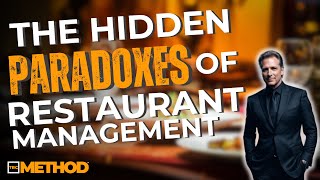
Donald Burns, a restaurant coach, identifies three paradoxes holding restaurants back: hire for personality over skills, train with clear standards and accountability, and lead with both strength and vulnerability. He argues restaurants need business skills as much as culinary talent.
Chapters
Have you ever noticed that most successful restaurants seem to break the rules? That they defy the very logic we were taught? Now, it's not a coincidence. Today we're going to dive deep into the heart of the industry to uncover the three restaurant paradoxes. Now, you might believe that you know how things work exactly in this business, but I'm telling you, by the end of this video, you're going to realize that everything that you thought was up might just be upside down. So stick around and let's really unravel the mystery. Hey. Donald Burns, the restaurant coach, author of the youe Restaurant Sucks trilogy and creator of the Restaurant Coach Method. Now, there are many paradoxes in restaurants and I've discussed a lot of them in my latest book, your Restaurant Culture Sucks. Now, such is the need for that. We need outstanding service and we need also outstanding food. Another paradox is the need for culinary talent and the need for business skills. Now, it's easy to hire someone with a great resume. It's easy to hire someone who can learn the menu. It's easy to hire someone with some experience. However, that experience can really be a double edged sword. Experience is a great teacher. No doubt about that. The problem is that many people learn the wrong lessons. They learn bad habits, and here's the thing, they don't know how to upgrade, undo those habits and learn it the right way. And when it comes to the culinary side of the house, experience is a requirement. I mean, you want to make sure your chef has been trained by someone who knows what the hell they're doing and hasn't been learning how to cook from watching tons of episodes of Top Chef. But having a chef that knows the business side, that's a little bit different. Experience truly is a double edged sword when it comes to cooking skills. Because the problem is that many people who work in the industry, many of these chefs, they don't know the business side. I mean, they're great at cooking. I mean, amazing at cooking. And then there's tons of servers that are great at selling. But they don't understand the concepts of overhead, profit, cash flow. And if you're a chef, you must understand the business side. If you're a restaurant owner now, you probably know the hospitality side. But again, you need to know the number side. You need to know the business side. This is where the paradox comes in. The restaurant industry is filled with people who have outstanding skills and outstanding talent. I mean, there are amazing, amazing chefs and great restaurant operators out there. The problem is that too many outstanding people get stuck in their own comfort zone. They don't take the time to really learn the other side of their skill sets. It's easy to see. They don't want to venture out of their comfort zone. I mean, who does? That's why it's called your comfort zone. It's comfortable. They're too afraid to step into the unknown. The problem with comfort zones is that they're comfortable. Here's the thing. You don't grow in your comfort zone. You don't become better in your comfort zone. You don't become outstanding in a comfort zone. The paradox is that outstanding people are those that are willing to venture into the unknown. They're not afraid to fail. They're not afraid of what failure does to them. Here's the thing you want to remember. Failure doesn't really do anything to you. How you react to failure, that's important. So let's talk about three paradoxes that are holding restaurants stuck in complacency. Number one, the paradox of hiring. Oh, the paradox of hiring is one that you really need to know, and you want to be able to articulate it clearly to other people. Most restaurant managers and owners, they don't know what they want in a new hire. I mean, they have a general idea of what they don't want in a new hire. I mean, they're looking for something. A little bit of this, a little bit of that. Hashtag, write this shit down. You get what you focus on. If you're looking for the perfect person, you're going to be in search of that person for a very, very long time. If you're looking for someone with the right personality and the right skill set, you might be able to find someone a little bit easier. Here's the thing you want to remember. Personality always trumps skill sets and, and experience. Right now, just think about the person you're in a relationship with. You're either on the side of love or you're on the side of fear. You either focus on what you have or what you don't have. When it comes to hiring, most restaurant owners and managers, they do this thing. They focus on what they don't want. They focus on skill sets, they focus on experience, they focus on the gaps in the resume. The best way to hire is to focus on what you really do want. What you want is someone who has the right personality, around 51%, and then 49% is skill set. And it's not easy to find someone who has both. It's kind of like looking for a needle in a haystack. However, it's far better to look for a needle in a haystack than to look for a haystack among the needles. Number two, the paradox of training. The paradox of training is that you must have standards and you must be able to communicate those standards to your team. Too many restaurant owners and managers have a very hard time establishing standards, communicating them, and holding the team accountable. They just kind of think that their staff should know what to do, and they also think that their staff should know how to do it. You need to wake up and smell the tequila. Everyone is an employee. Everyone starts somewhere. Everyone needs to know what is expected of them and also how to do it with clarity and confidence. If you want to be outstanding, you need to train your team to be outstanding. You need to train your guests to be outstanding. You need to train yourself to be outstanding. Remember, you're the one who controls your own training. You're the one who creates your own standards. You're the one who sets your goals. You're the only person who you can control. And number three, the paradox of leadership. Oh, the paradox of leadership is that you have to be strong and yet vulnerable. Most restaurant owners and managers get this paradox completely confused. They think that the way to be a leader is to be tough and be really stern. Think of, like, Hell's Kitchen. They think that being the leader means being the alpha male or the alpha female in the room. It's a bunch of bullshit. Being outstanding leader means being strong and being vulnerable at the same time. Being strong means you're confident and sure of yourself, not cocky. Being strong means that you know your strengths and you also know your weaknesses. Being strong means that you're willing to put yourself out there and really be vulnerable to your team. And being vulnerable means that you're honest with yourself and others. You know, the funny thing I find about being honest is that we want everyone else to be honest with us. But when was the last time that you really, truly were honest with yourself? Hashtag, write this shit down. The truth will set you free. But first it's going to piss you off. See, being vulnerable means that you're willing to share your emotions. I'm not talking about being a wimp. I'm just talking about being vulnerable and sharing what you're really feeling. Being vulnerable means you're opening up to learning. Being vulnerable means that you're open up to feedback. Being a leader is all about service. It's about giving back. It's about living a life that inspires others to reach their full potential. So Many restaurant owners and managers are stuck in the paradox of leadership. They think that the only way to be a leader is to be tough. To be an asshole. They think the only way to be a leader is to be a jerk. They think that being a jerk is going to get the job done. Let me tell you if they won't. Now, being a jerk will get you a lot of short term results. You know that. However, the long term results are that you lose the best people, you lose the respect of your guest, you lose the respect of your team. Lose that respect and you lose everything. Hey, make sure to hit the like and subscribe button for more tools and tips. And if you are super serious about getting on the fast track to making more profits and not having your restaurant kind of run your life, head on over to therestaurantcoach.com over there. You can grab some of my free resources that can get you on the path to having it all. And if you're really sick and tired of your restaurant controlling you, then book a complimentary one on one strategy session with me. It's just going to be an honest conversation about where your restaurant is now and where do you want to be in 90 days? I'll give you a plan and if I think I can help you get there faster than then, we can talk about coaching at that time. No strings attached. In my next video, I'm going to tell you to forget trying to improve your restaurant.
More from Donald




If your restaurant only works because you work 80 hours a week, it doesn't work.






